Introduction
Cowpea [Vigna unguiculata (L.) Walp.] is a major legume grain crop cultivated in the Sahel and contributes to improved nutrition of millions of people living in this region. Cowpea is well adapted to the Sahelian ecosystems as it is relatively tolerant to drought and can be grown in poor sandy soils (Belko et al., Reference Belko, Cisse, Diop, Zombre, Thiaw, Muranaka and Ehlers2014). As a legume, cowpea contributes to soil nitrogen (N) enrichment through natural biological N fixation with compatible rhizobia (Adjei-Nsiah, Reference Adjei-Nsiah2006; Giller, Reference Giller, Vanlauwe, Diels, Sanginga and Merckx2002), thereby improving soil fertility status in cereal-dominated cropping systems. Rusinamhodzi et al. (Reference Rusinamhodzi, Murwira and Nyamangara2006) reported that cowpea can supply up to 48 kg N ha−1 to the subsequent crop.
In Niger, up to 90% of the area cultivated with legumes is occupied by cowpea usually intercropped with cereals such as millet or sorghum (Bationo et al., Reference Bationo, Traore, Kimetu, Bagayoko, Kihara, Bado, Lompo, Tabo, Koala, Bationo, Waswa, Kihara, Adolwa, Vanlauwe and Saidou2003). Generally, cowpea yields are very low under smallholder cropping systems. The grain yield in farmers’ fields is frequently less than 500 kg ha−1 (Sambo, Reference Sambo2013), while cowpea grain yields ranging from 1500 to 2500 kg ha−1 were obtained in Research Stations (Kamara et al., Reference Kamara, Omoigui, Kamai, Ewansiha, Ajeigbe, Sivasankar, Bergvinson, Gaur, Kumar, Beebe and Tomo2018). Low yields in farmers’ fields have been ascribed to a multitude of factors including inappropriate agronomic practices, drought conditions, inherent low soil fertility, and continual decline in soil fertility due to poor soil management (Voortman, Reference Voortman2010).
Several studies have indicated that the yield of legumes including cowpea could be enhanced with the use of good agronomic practices such as improved varieties, phosphate-based fertilizers, and rhizobia inoculation (Buruchara et al., Reference Buruchara, Chirwa, Sperling, Mukankusi, Rubyogo, Mutonhi and Abang2011; Kolawole, Reference Kolawole2012; Saidou et al., Reference Saidou, Omae and Tobita2010; Thuita et al., Reference Thuita, Pypers, Herrmann, Okalebo, Othieno, Muema and Lesueur2012). However, the use of inputs particularly synthetic fertilizer on cowpea remains generally limited and unattractive because of their high cost (Abdoulaye and Sanders, Reference Abdoulaye and Sanders2005; Chianu et al., Reference Chianu, Nkonya, Mairura, Chianu and Akinnifesi2011). On the other hand, the effectiveness of combined use of synthetic and organic amendments for improving crop yields and maintaining soil fertility has been well documented (Bationo and Waswa, Reference Bationo, Waswa, Bationo, Waswa, Okeyo, Maina and Kihara2011; Ibrahim et al., Reference Ibrahim, Abaidoo, Fatondji and Opoku2015; Yamoah et al., Reference Yamoah, Bationo, Shapiro and Koala2002). The availability of the resources for achieving these positive effects remains a major challenge, especially in the Sahelian countries. The sources of organic amendments such as crop residue and animal manure are not available in adequate quantities (Valbuena et al., Reference Valbuena, Tui, Erenstein, Teufel, Duncan, Abdoulaye, Swain, Mekonnen, Germaine and Gérard2015). There is, therefore, a need of exploring alternative options to address organic amendments constraint for efficient use of resources.
Millet glume (residues left after threshing of millet) is a potential source of organic amendment in Niger, the second world’s largest producer of millet (Obilana, Reference Obilana2003). It contains reasonable amounts of major and minor plant nutrients (Tarfo et al., Reference Tarfo, Chude, Iwuafor and Yaro2001). However, the main challenge associated with the direct use of this organic material is its low nutrient release – particularly nitrogen – due to its high lignin content, which limits nutrient availability for increased crop production (Bachir, Reference Bachir2015). Currently, millet glume is gathered and burned in most of the areas in Niger. The burning of crop residues has contributed to environmental pollution with the increase in air pollutants such as CO2, CO, NH3, and NOx (Bhattacharyya et al., Reference Bhattacharyya, Ghosh, Mishra, Mandal, Rao and Sarkar2019). There is, therefore, a need to improve the fertilizer value of millet glume for enhancing nutrient release and increasing crop yields in the Sahel. Composting is a biological decomposition process of organic materials and considered as a good way of recycling organic materials into a stabilized end product for agriculture use (Bernal et al., Reference Bernal, Alburquerque and Moral2009). Generally, compost application to soils stimulates microbial biomass which acts as a source sink in nutrient cycling and as a driving force in nutrient availability (Barthod et al., Reference Barthod, Rumpel and Dignac2018; Moreno et al., Reference Moreno, Moreno, Lacasta and Meco2012; Wang et al., Reference Wang, Li and Klassen2007).
There is limited information on the potential effects of integrated use of millet glume-derived compost (MGD-compost) and mineral fertilizer for increasing cowpea productivity in the Sahel. The novelty of the present study is addressing this knowledge gap, which has an important implication for diversifying the source of nutrients and enhancing crop productivity in the Sahel while safeguarding the environment. We hypothesized that the combined use of MGD-compost and synthetic fertilizer enhances cowpea yield and increases economic return. The objective of this study was to explore the agronomic and economic responses of combined use of MGD-compost and synthetic fertilizer in cowpea-based cropping system.
Materials and Methods
Description of experimental site
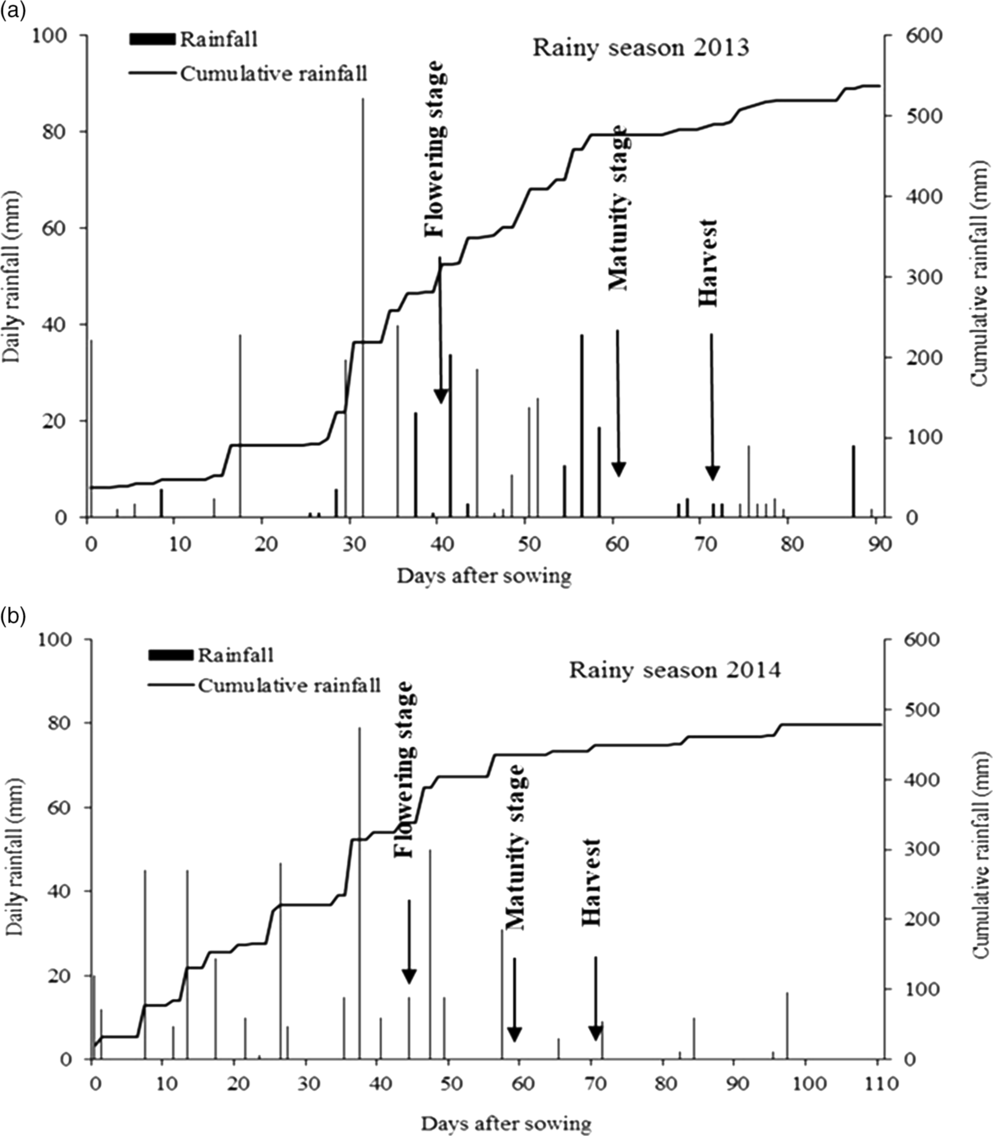
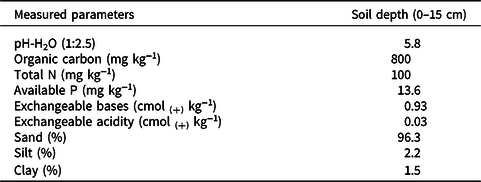
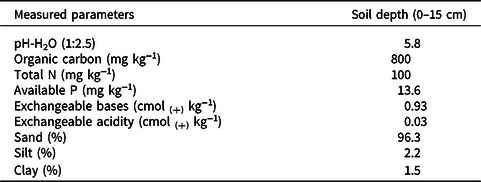
The experiment was carried out in 2013 and 2014 cropping season at N’dounga Research Station of Institut National des Recherches Agronomiques du Niger (INRAN, 13°21′N, 2°14′54″E, 186 m above sea level). The average annual rainfall over the last 14 years at the experimental site is 510 mm (INRAN climate Database). The total rainfall recorded during the experimental periods was 537 and 479 mm in 2013 and 2014, respectively (Figure 1). The soil is classified as Psammentic Paleustalf, following the USDA Soil Taxonomy. This soil is moderately acid (pH-H2O 5.8) and characterized by low organic matter (organic carbon (OC) 0.08%) and low water holding capacity due to its coarse-textured feature (Table 1).
Rainfall distribution during the cropping season 2013 and 2014.

Initial soil chemical and physical properties of the experimental site
Compost preparation
The compost was prepared as a combination (2:1) of millet glume and manure. The compost pile was watered with 0.1 m3 once every 10 days to soften the substrate and thus facilitate degradation by microorganisms. The compost materials were then buried in a pit of 2 m × 2 m × 1 m and covered with polyethylene sheet to minimize moisture losses. The polyethylene was slightly perforated to allow aeration. The temperature was taken daily for the first 14 days and at 3, 4, 5, 6, 7, 8, 9, 10, 11, and 12 weeks after incubation. The ambient temperature was also measured by leaving the thermometer in the air for 5 minutes at each sampling time. Also, the pile was turned after every 10 days (during pile watering) with a shovel to ensure a homogenous mixture of the components of the pile, water, and air. Watering of pile was stopped after 60 days of composting. After 85 days, the compost was then air-dried and stored in bags until its application in the field.
Treatments and experimental design
The experiment was a 3 × 3 factorial arranged in a randomized complete block design replicated four times. The treatments consisted of three levels of synthetic fertilizer: 100, 50, and 0% of the recommended rate synthetic fertilizer (by INRAN) corresponding to 30, 15, and 0 kg N ha−1 and 45, 22.5, and 0 kg P ha−1, respectively. Synthetic fertilizer treatments were combined with three rates of MGD-compost (0, 4000, and 8000 kg ha−1). In plots receiving synthetic fertilizer, superphosphate was applied before planting and urea was broadcasted in two splits (50% of the applied rate for each treatment at 2 weeks after sowing and the remaining at 50% flowering). The compost was applied in the planting holes at sowing. The planting holes consisted of the small planting hills of 15 cm diameter and 15 cm depth dug in the experimental plots. For each planting hole, compost was applied at 0, 150, and 300 g hill−1, corresponding to 0, 4000,and 8000 kg ha−1, respectively.
Crop management and measurements
Seeds of cowpea [Vigna unguiculata (L.) Walp.] variety (IT98K205-8, 65–70 maturity days) were sown at the start of the rainy season on 15th July 2013 and 9th July 2014. Each treatment plot (3 m × 6 m) was separated by a 2 m alley. The planting hill spacing was 0.75 m × 0.50 m, resulting in 26 667 hills ha−1 as recommended by INRAN. Seedlings were thinned to 2 plants hill−1 3 weeks after planting and then three weeding events occurred during each cropping season. Grain harvest was done at physiological maturity from 10th to 25th September 2013 and 1st to 15th September 2014. To determine cowpea grain and dry matter yield, samples of pod and fodder were harvested from the central 2.25 m × 5.5 m of each plot. All the samples were oven-dried at 65 °C for 3 days, and the pods were manually threshed. The cowpea grain and fodder were weighed and expressed as kg ha−1. The harvest indices were calculated as the ratio of grain yield to total biomass yield.
Agronomic efficiency (AE, kg kg−1) is defined as the change in grain yield per unit of nutrient applied (fertilizer and organic amendment) and estimated as follows (Vanlauwe et al. (Reference Vanlauwe, Kihara, Chivenge, Pypers, Coe and Six2011):
 $${\rm{A}}{{\rm{E}}_{{\rm{N}}{\kern 1pt} {\rm{or}}{\kern 1pt} {\rm{P}}}} = {\rm{ }}{{Yf - Ycont} \over {Fn}}$$
where Yf is the grain yield of a fertilized plot, Ycont is the yield of control plot (without any amendment), F n is the amount of nutrient (N or P) applied through synthetic fertilizer, compost in each plot.
Rainwater use efficiency (RaUE) was used as a proxy for water use efficiency and calculated as shown below:
 $${\rm{Rainwater}}{\mkern 1mu} \,{\rm{use}}\,{\mkern 1mu} {\rm{efficiency}} = {\rm{ }}{Y \over R}$$
where Y is grain yield (kg ha−1) and R is the total seasonal rainfall recorded from sowing to harvest (mm).
Economic analysis
Economic profitability of treatments was performed based on gross income, net income, and value/cost ratio. Gross income was calculated based on grain and fodder yields and their actual price at the local market (Jarial et al., Reference Jarial, Blümmel, Soumana, Ravi, Issa, Whitbread and Tabo2016). Total variable cost was estimated from labor and other input costs. Labor cost was estimated from labor for field preparation, sowing, fertilizer and compost application, weeding, harvesting, and threshing. Labor cost for one-time working was estimated at US$ 17.5 person−1 day−1. Input cost was determined from the cost of fertilizers (SSP and urea fertilizer) and seeds. Fertilizer cost was taken as 13 500 FCFA (US$ 23.6) per 50 kg bag irrespective of the type of fertilizer as fixed by the Nigerien government. However, since the compost had yet no direct market prices, only labor cost incurred in compost preparation and transportation was considered. The gross revenue, net income, and the value/cost ratio (VCR) were calculated as described by Khaliq et al. (Reference Khaliq, Abbasi and Hussain2006):
 $${\rm{Gross\, income }}\ \left( {{\rm{US\$ }}} \right) = {\rm{Grain/fodder\, yield }}\ \left( {{\rm{kg}}} \right) \times {\rm{ cost\, of\, a\, kg\, of\, grain/fodder }}\ \left( {{\rm{US\$ }}} \right)$$
 $${\rm{Net\, income }}\ \left( {{\rm{US\$ }}} \right) = {\rm{Gross\, income }}\ \left( {{\rm{US\$ }}} \right) - {\rm{variable\, cost }}\ \left( {{\rm{US\$ }}} \right)$$
 $${\rm{Value/cost\, ratio }}\ \left( {{\rm{VCR}}} \right) = {\rm{Value\, of\, increased\, yield\, obtained/Variable\, cost}}$$
Compost and soil properties determination
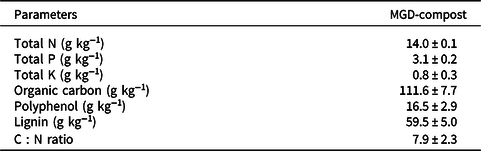
Representative samples of MGD-compost were taken and ground to pass through a 1-mm mesh sieve after which OC, total nitrogen, phosphorus, potassium, magnesium, and calcium were determined as described by Motsara and Roy (Reference Motsara and Roy2008). Polyphenol and lignin contents of the samples were also determined following Anderson and Ingram (Reference Anderson and Ingram1993). The chemical composition of MGD-compost is presented in Table 2.
Chemical characteristics of MGD-compost
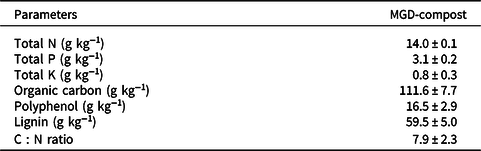
Average (n = 3) ± s.e.
To assess the initial soil physico-chemical properties of the experimental soil, a composite sample consisting of 12 cores was collected at a depth of 0–15 cm in each plot using an auger on May 2013 before the amendment application and sowing. The samples were subjected to chemical and textural analyses after air-drying and sieving through a 2-mm mesh sieve. Each soil sample was analyzed for pH (H2O) using a pH meter (with a 1:2.5 soil:water ratio), OC by Walkley and Black (Reference Walkley and Black1934), and total nitrogen was determined using Kjeldahl method (Houba et al., Reference Houba, Van der Lee and Novozamsky1995). Available phosphorus was determined using the Bray-1 method as described by van Reeuwijk (Reference van Reeuwijk1993). Exchangeable bases (Na+, K+, Ca2+, and Mg2+) were determined by the ammonium acetate (NH4OAc) solution at pH 7, using the extraction method by van Reeuwijk (Reference van Reeuwijk1993). The exchangeable acidity (H+ and Al3+) was determined (van Reeuwijk, Reference van Reeuwijk1993) as well as the particle size distribution using the hydrometer method (Gee and Or, Reference Gee and Or2002).
Statistical analyses
Before the analyses, the graphical analysis of residuals was used to test for normality and constant variance in GenStat. Thereafter, the data were analyzed by analysis of variance with generalized mixed model procedures in Genstat 9th edition (GenStat, 2007). Compost, synthetic fertilizer and cropping season were included in the model as fixed effects and tested for their interactions. Replications were considered a random effect. Least significant difference (LSD) test at error probability <0.05 was used to separate means exhibiting significant differences.
Results
Cowpea yields and harvest index
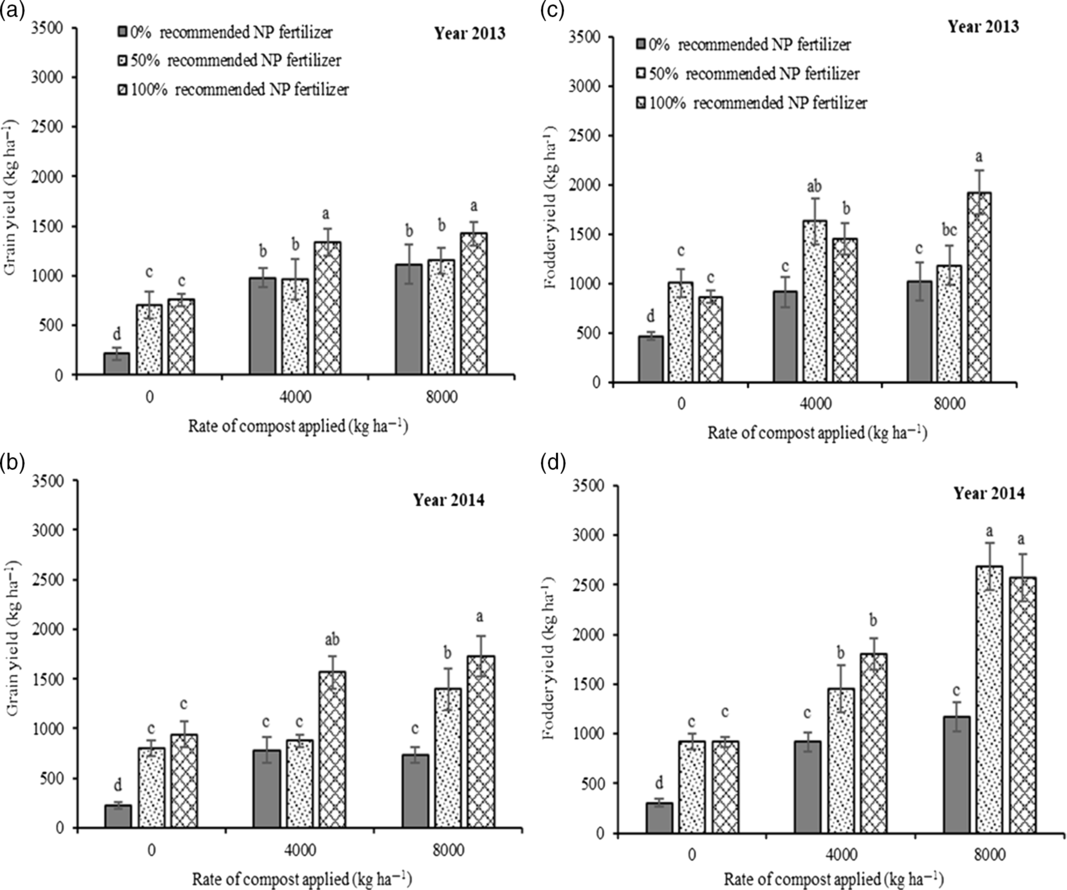
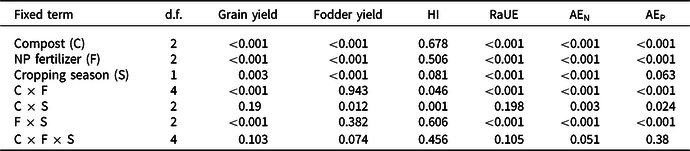
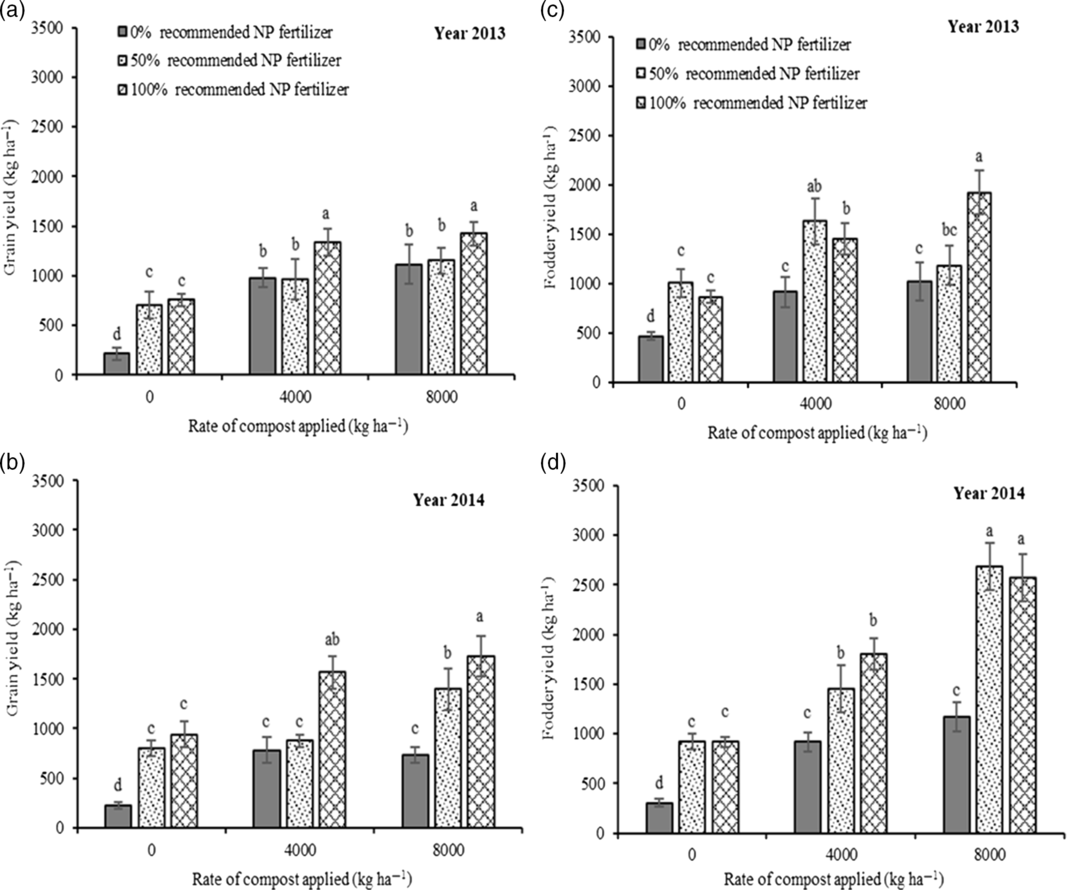
Cowpea grain yield increased markedly with the application of synthetic fertilizer or compost compared to control plots (Figures 2a, b). Combined application of compost and synthetic fertilizer improved significantly (p < 0.001) cowpea grain yields (Table 3). In general, application of 8000 kg ha−1 of compost along with 100% of recommended synthetic fertilizer produced significantly higher cowpea grain yields in both cropping seasons. In 2013, the increases in grain yields were 88% and 77% when 100% of recommended synthetic fertilizer was applied in combination with 8000 or 4000 kg ha−1, respectively, compared to the application of 100% of the recommended rate of synthetic fertilizer (Figure 2a). Similarly, the grain yield recorded for plots that received a combined application of 8000 kg ha−1 of compost and 50% of recommended rate of synthetic fertilizer was 52% higher than that of application of 100% of recommended rate of synthetic fertilizer alone (Figure 2a). In 2014, cowpea grain yields were consistently higher with integrated use of compost and synthetic fertilizer (Figure 2b).
Cowpea grain (a, b) and fodder (c, d) yields in 2013 (a, c) and 2014 (b, d). Each histogram is the mean value ± s.e. Different letters in each histogram indicate significant difference as determined by LSD test.
Probabilities values of observed variables
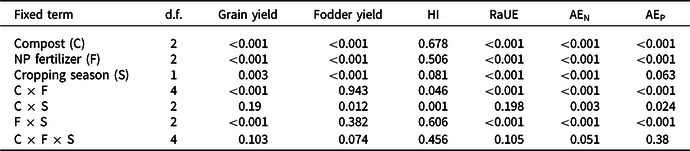
d.f., degree of freedom; HI, harvest index; RaUE, rainwater use efficiency; AEN, agronomic use efficiency of nitrogen; AEP, agronomic use efficiency of phosphorus.
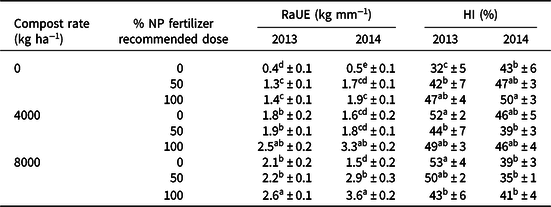
Combined application of compost and synthetic fertilizer application did not reveal any significant increase in cowpea fodder yield (Table 3). Yet, significant interaction (p < 0.001) of compost and cropping season was observed on cowpea fodder yields. Fodder yields were markedly higher in 2014 (Figure 2c) compared to those of the 2013 cropping season (Figure 2d). Significant (p < 0.001) effect of combined application of compost and synthetic fertilizer was observed on cowpea harvest index (Table 3). In both cropping seasons, harvest indexes were generally higher in the plots that received compost or synthetic fertilizer alone (Table 4). In 2013, application of 8000 kg ha−1 of compost had the highest cowpea harvest index followed by the treatment with combined application of 4000 kg ha−1 of compost. In 2014, the highest HI was recorded in plots with the application of 100% of recommended rate of synthetic fertilizer alone (Table 4).
Rainwater use efficiency (RaUE) and harvest index (HI)
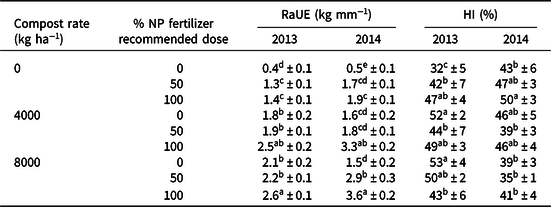
± Standard error. Means followed by the same letter in the column are not significantly different.
Rainwater use efficiency
A significant effect (p < 0.001) of the combined application of compost and mineral fertilizer was found in cowpea RaUE (Table 3). The RaUE increased by 52 and 49% with the combined application of compost at 8000 kg ha−1 along with 50% of the recommended rate of synthetic fertilizer compared to the application of 100% of the recommended rate of synthetic fertilizer alone in 2013 and 2014, respectively (Table 4). In both cropping seasons, the RaUE increased by more than 80% when 8000 kg ha−1 of compost were applied in combination with 100% recommended rate of synthetic fertilizer compared to the synthetic fertilizer applied at 100% alone (Table 4).
Agronomic use efficiency of N and P
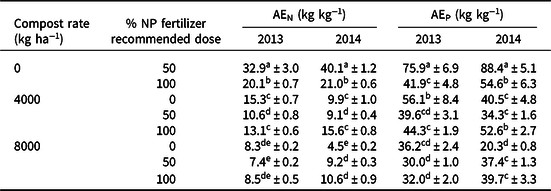
There were significant interaction effects (p < 0.001) of compost and synthetic fertilizer on agronomic efficiency of applied nitrogen (AEN) and phosphorus (AEP) in both 2013 and 2014 cropping seasons (Table 3). In general, the AEN and AEP decreased with increasing rates of the nutrient applied and this was particularly apparent in plots with combined application of compost and synthetic fertilizer (Table 5). The highest values of AE of applied N and P were generally recorded in plots with the application of compost or synthetic fertilizer alone.
Agronomic use efficiency of nitrogen (AEN) and phosphorus (AEP)
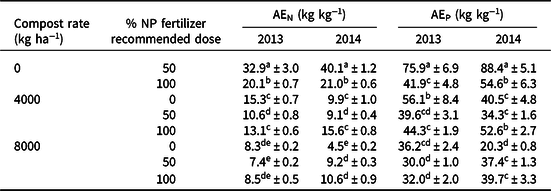
± Standard error. Means followed by the same letter in the column are not significantly different.
Economic performance of the treatments
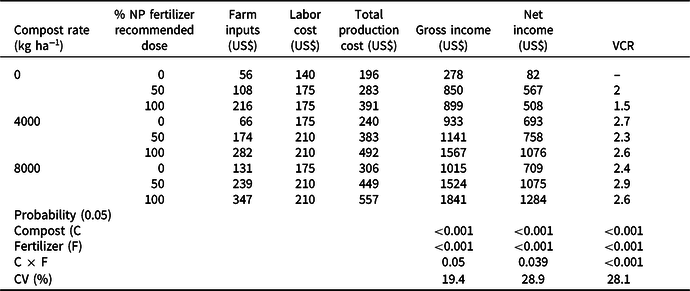
The highest net income (US$ 1284) was obtained from the combined application of 8000 kg ha−1 and with 100% of the recommended rate of synthetic fertilizer treatments (Table 6). Application of compost alone at 4000 kg ha−1 or 8000 kg ha−1 achieved an increase in net income of US$ 185 or 201 when compared with that of the application of synthetic fertilizer alone at 100% of the recommended rate. The value/cost ratios (VCR) were higher than 1 for all the treatments except in the control plots (Table 6). The highest VCR (2.9) was achieved with combined application of compost at 8000 kg ha−1 and with 50% of recommended rate of synthetic fertilizer (Table 6).
Comparative analysis of various treatments for their potential economic viability
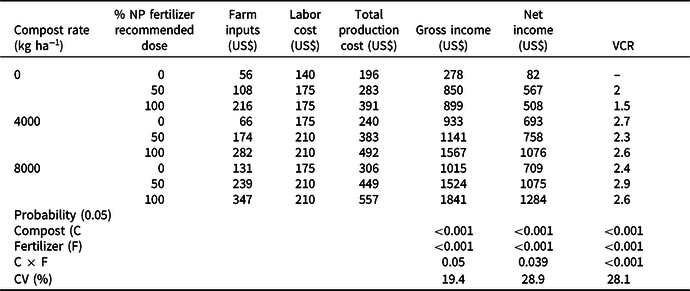
CV, coefficient of variation.
Discussion
Cowpea yields and harvest indexes
Cowpea productivity increased markedly with combined application of compost and synthetic fertilizer. The positive effect of combined application of synthetic fertilizer and organic amendment on crop yields has been extensively reported across sub-Saharan Africa (Abdou et al., Reference Abdou, Koala, Bationo, Bationo, Waswa, Kihara, Adolwa, Vanlauwe and Saidou2012; Akponikpé et al., Reference Akponikpé, Michels and Bielders2008; Dunjana et al., Reference Dunjana, Nyamugafata, Nyamangara and Mango2014; Kiboi et al., Reference Kiboi, Ngetich, Fliessbach, Muriuki and Mugendi2019). The beneficial effect of this combination could not only be attributed to the readily available N, P, and K from the mineral fertilizer sources but also to the supply of additional nutrients such as Ca and Mg by compost (Bayu et al., Reference Bayu, Rethman and Hammes2005; Zingore et al., Reference Zingore, Delve, Nyamangara and Giller2008) which are generally limited in sandy soil (Table 1). Furthermore, the increment in cowpea yields with combined application of compost and synthetic fertilizer could also be ascribed to an improved soil water and nutrient retention particularly in the coarse-textured soil such as the current experimental site, which has low soil organic matter content. Liu et al. (Reference Liu, Li, Zhou, Zhang, Lin, Wang, Siddique and Li2013) showed that application of mineral fertilizer and organic amendment not only accelerated soil fertility improvement but also maintained soil water balance and significantly increased crop yields.
Even though the 2013 cropping season was relatively wet (Figure 1), the highest cowpea grain and fodder yields were obtained in 2014. Poor rainfall distribution during the 2013 cropping season with more than 70% of rains recorded between 27 and 58 days after sowing has led to nutrient leaching, particularly N. Furthermore, earlier study by Minchin et al. (Reference Minchin, Summerfield, Eaglesham and Stewart1978) indicated that intense rainfall led to a reduction in cowpea grain yield. Water excess during the cowpea reproductive stage induced several physiological disturbances, including growth inhibition of leaves and reduction of pod formation, resulting in a significant grain yield reduction. On the other hand, the increase in cowpea yields in 2014 could be attributed to the residual effect of compost applied, which probably supplied more nutrients and improved the soil water-holding capacity. Amlinger et al. (Reference Amlinger, Götz, Dreher, Geszti and Weissteiner2003) showed that nutrient release from compost was modest (<15%) in the first year of application with expected enhancement of nutrient supply in the subsequent years. Importantly, integrated use of 8000 kg ha−1 of compost and 50% of recommended rate of synthetic fertilizer provided higher grain yield than the application of 100% of recommended synthetic fertilizer alone. This finding conforms with previous studies which reported the possibility of reducing 50% the amount of inorganic fertilizer required through integrated use of mineral fertilizer and organic material (Issoufa et al., Reference Issoufa, Ibrahim, Abaidoo and Ewusi-Mensah2018; Palm et al., Reference Palm, Myers and Nandwa1997).
Cowpea harvest index was relatively higher in the plots receiving the application of compost alone (Table 4). Generally, the harvest index is affected by crop management (Smith et al., Reference Smith, Rao and Merchant2018; Yang and Zhang, Reference Yang and Zhang2010), and increases in harvest indices obtained with compost application could be related to the increase in grain yield resulting from better nutrient availability. This would improve the translocation and accumulation of photosynthates from biomass to grains thereby leading to a higher harvest index. This finding is in agreement with the results obtained by Yang and Zhang (Reference Yang and Zhang2010), which showed that soil management options increase growth rate during pod filling and enhance the remobilization of assimilates from the source (biomass) to the sink (grains), increasing the harvest index.
Agronomic nutrient use efficiency and water use efficiency
Agronomic use efficiency of N and P was reduced when increasing nutrient rate application (Table 5). Plants supplied with compost or synthetic fertilizer alone were markedly more efficient in using N and P when compared to ones receiving combined application of compost and synthetic fertilizers. Earlier studies have reported the increase of nutrient agronomic efficiency with reducing nutrient application rates (Argaw et al., Reference Argaw, Mekonnen and Muleta2015; Issoufa et al., Reference Issoufa, Ibrahim, Abaidoo and Ewusi-Mensah2018; Srivastava et al., Reference Srivastava, Panda, Chakraborty and Halder2018). Yet, higher AEN and AEP values recorded from the application of mineral fertilizer alone could not sustain cowpea productivity in the long-term since it would lead to a reduction in soil productive capacity through an exacerbation of soil acidification particularly in acidic-prone soil and a decline in soil organic matter content. On the other hand, combined application of organic amendment and synthetic fertilizer could contribute to the soil organic matter build-up leading to a greater nutrient supply for maintaining crop yield and thereby increasing agronomic efficiency of the applied nutrient. Furthermore, decomposition of organic amendment leads to a release and synthesis of organic compounds. Those compounds combine with aluminum to form solid organic material phase, reducing aluminum solubility and favoring the soil microbiota and plant development (Luo et al., Reference Luo, Li, Friman, Guo, Guo, Shen and Ling2018).
Cowpea RaUE was markedly increased with combined application of compost and synthetic fertilizer (Table 4), which could be attributed to the increase in cowpea yield resulting from improved plant nutrient availability. Several studies have reported an increase in water use efficiency in response to combining application organic resource with synthetic fertilizer in the Sahelian zone resulting in improved crop yield (Akponikpé et al., Reference Akponikpé, Michels and Bielders2008; Ibrahim et al., Reference Ibrahim, Abaidoo, Fatondji and Opoku2015).
Economic performance of the treatments
The economic results indicate that all treatments induced a positive net income, and the VCRs when combining compost and synthetic fertilizer were constantly higher than 2 (Table 6), which is frequently considered a minimum condition for technology to be adopted in uncertain environments (Kihara et al., Reference Kihara, Huising, Nziguheba, Waswa, Njoroge, Kabambe, Iwuafor, Kibunja, Esilaba and Coulibaly2016). However, the application of synthetic fertilizer alone appeared to be less economically viable compared to compost application alone. This indicates that farmers should be encouraged to use synthetic fertilizer combined with organic sources for improving profitability of the cowpea cropping system. The use of 50% of the recommended rate of synthetic fertilizer along with 8000 kg ha−1 of compost appeared to be an optimal choice for obtaining high net income and value/cost ratio. This finding is in agreement with Tovihoudji et al. (Reference Tovihoudji, Akponikpè, Agbossou and Bielders2019), who showed application of 50% of the recommended rate of synthetic fertilizer together with manure significantly increased smallholder profitability. Although an earlier study by Jama et al. (Reference Jama, Swinkels and Buresh1997) indicated that the use of organic materials generally induced high labor costs, the economic results obtained herein indicate that at least the costs for compost preparation and its application were covered by higher yields with the combined use of NP fertilizers and compost. Therefore, given that most smallholder farmers cannot afford the recommended amount of mineral fertilizer to achieve acceptable yields, farmers should be encouraged to use compost in combination with half of the recommended rate of mineral fertilizer. This would make savings on fertilizer investment by smallholder farmers and government subsidy programs.
Conclusion
This study highlights the possibility of improving cowpea productivity using compost of locally available organic input. MGD-compost showed an evident positive effect on improving cowpea yield and RaUE in water scarcity-prone environment. Combined application of MGD-compost and 50% of recommended NP fertilizer is an effective fertilization option for enhancing cowpea production and reduce the investment in mineral fertilizer currently made by smallholder farmers in the Sahelian low-input cowpea cropping system. However, the long-term agronomic effects and changes in soil properties induced by millet glume-based compost application should be further explored.
Acknowledgements
The first author wishes to thank the Alliance for Green Revolution in Africa (AGRA) for funding the study under the Soil Health Programme at Kwame Nkrumah University of Science and Technology, Kumasi, Ghana.
Financial support
The study was funded by Alliance for Green Revolution in Africa (AGRA) under the Soil Health Programme.