Kidney stones represent one of the most prevalent disorders within the urinary system, with their global incidence rate rising annually(Reference Aiumtrakul, Thongprayoon and Suppadungsuk1). Epidemiological studies indicate that approximately 5 % to 15 % of the global population will experience at least one episode of kidney stones during their lifetime, with a significantly higher incidence observed in men compared with women(Reference Crivelli, Maalouf and Paiste2). The formation of kidney stones is intricately linked to metabolic abnormalities, dietary habits, genetic predispositions and environmental factors. The high recurrence rate of kidney stones, which can reach up to 50 % within a decade, not only severely impacts patients’ quality of life but may also result in renal function impairment, urinary tract infections and even end-stage renal disease, thus imposing a substantial burden on public health systems(Reference Wang, Ge and Han3–Reference Uribarri5). In recent years, as lifestyle changes and the prevalence of metabolic diseases such as obesity and diabetes have increased(Reference Ye, Wu and Xiong6,Reference Xiao and Xiao7) , research into the pathological mechanisms underlying kidney stone formation has transitioned from traditional theories of crystal supersaturation to a more multidimensional exploration. Studies have demonstrated that renal tubular epithelial cell injury(Reference Xie, Ye and Li8), activation of the inflammatory microenvironment(Reference Xu, Liu and Zhang9), dysbiosis of intestinal flora(Reference Hanstock, Chew and Lange10) and genetic polymorphisms(Reference Cogal, Arroyo and Shah11) may collectively facilitate stone formation by modulating the nucleation, growth and aggregation of Ca oxalate and Ca phosphate crystals. Furthermore, dietary patterns and elements play a key role in the occurrence and progression of kidney stones(Reference Liu, Feng and Li12), garnering increasing attention from researchers.
Flavonoids are a category of naturally occurring compounds, characterised by a flavone framework accompanied by various functional groups, leading to a vast range of chemical structures(Reference Corradini, Foglia and Giansanti13). Key dietary sources of flavonoids include fruits, such as berries, citrus varieties and apples, and vegetables, such as onions, kale and broccoli(Reference Parmenter, Thompson and Bondonno14). Moreover, tea is a significant source of flavonoids(Reference Ke, Jiang and Lai15). Numerous studies have confirmed that flavonoids possess various biological activities, such as antioxidant, anti-inflammatory and antibacterial properties(Reference Jomova, Alomar and Valko16). Recently, their potential protective role in the formation of kidney stones has garnered increasing attention. In vitro research has demonstrated that flavonoids can mitigate oxidative stress damage by scavenging free radicals and activating the nuclear factor erythroid 2-related factor 2 (Nrf2) antioxidant pathway, thereby inhibiting crystal formation(Reference Hefer, Huskić and Petrovic17). Furthermore, flavonoids have demonstrated inhibitory effects on the formation of Ca oxalate stones in both in vitro and in vivo studies, with mechanisms including diuresis, antioxidation, anti-inflammation and antibacterial properties(Reference Zeng, Xi and Jiang18). Animal studies further suggest that citrus bioflavonoids and lemon peel can modulate the expression of crystal-inhibitory proteins, such as Tamm–Horsfall protein and osteopontin, thereby reducing damage to renal tubular epithelial cells(Reference Sridharan, Mehra and Ganesh19). Some research has also indicated that plant extracts rich in flavonoids may enhance the inhibitory effects on uric acid stone formation synergistically when combined with citric acid and Mg(Reference Maisto, Schiano and Luccheo20). Flavanones, as an important subclass of flavonoids, are represented by compounds such as hesperetin, naringenin and eriodictyol(Reference Barreca, Gattuso and Bellocco21). However, current epidemiological studies on the association between dietary flavanone intake and kidney stone risk remain relatively limited. The interactions among different flavanone subtypes and their independent effects have not been fully elucidated. Consequently, conducting large-sample population studies is of great scientific significance for an in-depth assessment of the correlation between dietary flavanone intake and kidney stone prevalence.
This study evaluated the correlation between flavanone intake and the prevalence of kidney stones among American adults, intending to inform dietary strategies for kidney stone prevention. The analysis utilised flavanone intake data from the United States Department of Agriculture (USDA) and integrated sociodemographic, questionnaire survey data of chronic diseases, and laboratory data from the National Health and Nutrition Examination Survey (NHANES) for the periods of 2007 to 2010, as well as 2017 to 2018.
Materials and methods
Study population
The NHANES is a programme conducted by the Centers for Disease Control and Prevention (CDC) in the USA. This nationwide survey aims to collect comprehensive information on the medical and dietary conditions of the general population. Its research encompasses a wide array of health-related topics and has significantly influenced disease research and public health policies in the USA. The data derived from NHANES informs public health policies and initiatives designed to mitigate the disease burden on the US population. The National Center for Health Statistics (NCHS) Research Ethics Review Board approved conducting human subject research within NHANES, and each participant provided written informed consent. Data from NHANES spanning the years 2007–2010 and 2017–2018 were employed in our analysis. The study included participants who had comprehensive data regarding their flavanone intake and the incidence of kidney stones. Individuals under the age of 18 years, as well as those with incomplete data on flavanone intake, kidney stones, chronic diseases, BMI, poverty:income ratio, smoking and drinking, were excluded. Ultimately, a total of 9790 participants were included in the analysis (Figure 1).
Participants and flow charts. PIR, poverty:income ratio.

Assessment of flavanones and kidney stones
Flavonoid intake was estimated using the USDA Database of Flavonoid Values for Survey Foods and Beverages, an addendum to the Food and Nutrient Database for Dietary Studies (FNDDS). Data from three NHANES cycles were analysed using their respective FNDDS versions: FNDDS 4.1 for 2007–2008(22), FNDDS 5.0 for 2009–2010(23) and FNDDS 2017–2018 for 2017–2018(24). For each cycle, the corresponding Flavonoid Database (Flavonoid Values for USDA Survey Foods and Beverages 2007–2008(Reference Sebastian, Goldman and Martin25), 2007–2010(Reference Sebastian, Wilkinson Enns and Goldman26) and 2017–2018(Reference Sebastian, Martin and Goldman27), respectively) was linked to the dietary recall data to calculate intakes of flavanones and other flavonoid subclasses. These databases provide comprehensive flavonoid content information for all foods and beverages reported in the respective survey periods. Flavanones, a subclass of flavonoids, are represented in the database through three specific compounds: hesperetin, naringenin and eriodictyol. Our study aims to estimate the intake of flavanones across all foods and beverages. The average daily intake of flavonoids, measured in milligrams per 100 g of food and beverages, by participants in NHANES during the periods 2007–2010 and 2017–2018 was estimated using a 2-d dietary recall method. This method involved recording participants’ food intake over 2 d, supplemented by additional data obtained from face-to-face interviews and phone conversations approximately 1 week later.
Kidney stones were defined based on responses to the NHANES Kidney Conditions-Urology questionnaire. Participants were asked, ‘Have you ever had kidney stones?’ (KIQ026). Those who responded ‘yes’ were classified as having a lifetime history of kidney stones. This definition captures prevalent cases (i.e. participants who have ever experienced kidney stones prior to the interview), consistent with previous NHANES-based studies(Reference Zhang, Qiu and Yang28,Reference Qi, Hu and Chen29) .
Assessment of covariates
The inclusion of covariates covers three primary aspects: demographics (age, sex, race/ethnicity, marital status, educational level and poverty:income ratio), lifestyle and dietary factors (smoking status, drinking status, BMI, diet and physical activity status) and chronic diseases (CVD, hypertension and diabetes). Races are divided into five groups: Mexican Americans, Other Hispanics, non-Hispanic Whites, non-Hispanic Blacks, non-Hispanic Asians and other races. Marital status is categorised as married, unmarried, cohabiting or other. Educational levels are divided into below high school, high school graduates, some university/AA degrees and university graduates. The poverty:income ratio is divided into three categories: low (< 1·30), medium (≥ 1·30 and < 3·50) and high (≥ 3·50). Smoking status is classified into three categories: current smokers (defined as individuals who have smoked more than 100 cigarettes in their lifetime and are still smoking), past smokers (defined as those who have smoked more than 100 cigarettes in their lifetime but are not currently smoking) and non-smokers (defined as individuals who have smoked fewer than 100 cigarettes in their lifetime). Alcohol consumption is categorised into non-drinkers (individuals who have consumed alcohol fewer than twelve times in their lifetime) and drinkers (those who have consumed alcohol more than twelve times in their lifetime). The BMI is classified into two categories: normal weight (< 25 kg/m2) and overweight (≥ 25 kg/m2). Dietary intake includes daily energy, Ca, water and salt intake. Physical activity is classified based on self-reported engagement in vigorous exercise. For the purpose of this study, CVD are defined as an affirmative response to any of the following inquiries: ‘Has a doctor or other health expert ever informed you that you have congestive heart failure (CHF), coronary heart disease (CHD), angina pectoris, a heart attack, or a stroke?’ Hypertension is classified as a systolic blood pressure of ≥ 130 mmHg or a diastolic blood pressure of ≥ 80 mmHg, alongside self-reported diagnosis or the use of antihypertensive medications. Diabetes is defined by meeting any of the following criteria: (1) a self-reported diagnosis of diabetes; (2) the use of diabetes medication for treatment; (3) a glycated Hb level exceeding 6·5 %; and (4) a fasting blood glucose level of at least 7 millimoles per litre.
Statistical analysis
According to the recommendations of the NCHS, the entire data analysis process considered the main sampling units, sample weights and strata to ensure reliable national estimates. Specifically, for the combined NHANES 2007–2010 and 2017–2018 cycles, the 2-d dietary sample weights (WTDR2D) were applied in all analyses involving dietary recall data, consistent with established analytical recommendations. The primary sampling unit (SDMVPSU) and stratification (SDMVSTRA) variables were incorporated to adjust for the clustered and stratified sampling design of the survey. Participants’ baseline characteristics were summarised as percentages, and differences between categorical variables were assessed using χ 2 tests. The concentrations and distributions of individual flavanone compounds were evaluated.
Among the three subclasses of flavanones analysed, 57·1 % and 46·5 % of participants reported no intake of eriodictyol and hesperetin, respectively. Consequently, participants with no intake of either eriodictyol or hesperetin were classified into the reference group, while those with non-zero intake were further categorised into three exposure groups. Since less than 20 % of participants reported zero intake of naringenin, they were evenly distributed into four quartiles based on their consumption levels. Given the highly skewed distribution of flavanone intake, the intake values were logarithmically transformed to approximate normality before conducting the restricted cubic spline (RCS) analysis.
A multiple logistic regression analysis was conducted to investigate the relationship between the consumption of flavanones (considered as both continuous and categorical variables) and the prevalence of kidney stones among the American population. The study utilised RCS regression, using the 10th, 50th and 90th percentiles as reference points, to examine the possible link between flavanone consumption and the development of kidney stones. Additionally, subgroup analyses and interaction effects were performed to further investigate the association between flavanone intake and kidney stones in various populations. All analyses were executed using DecisionLinnc1.0 software(30), and P-values less than 0·05 were deemed statistically significant.
Results
Participant characteristics at baseline
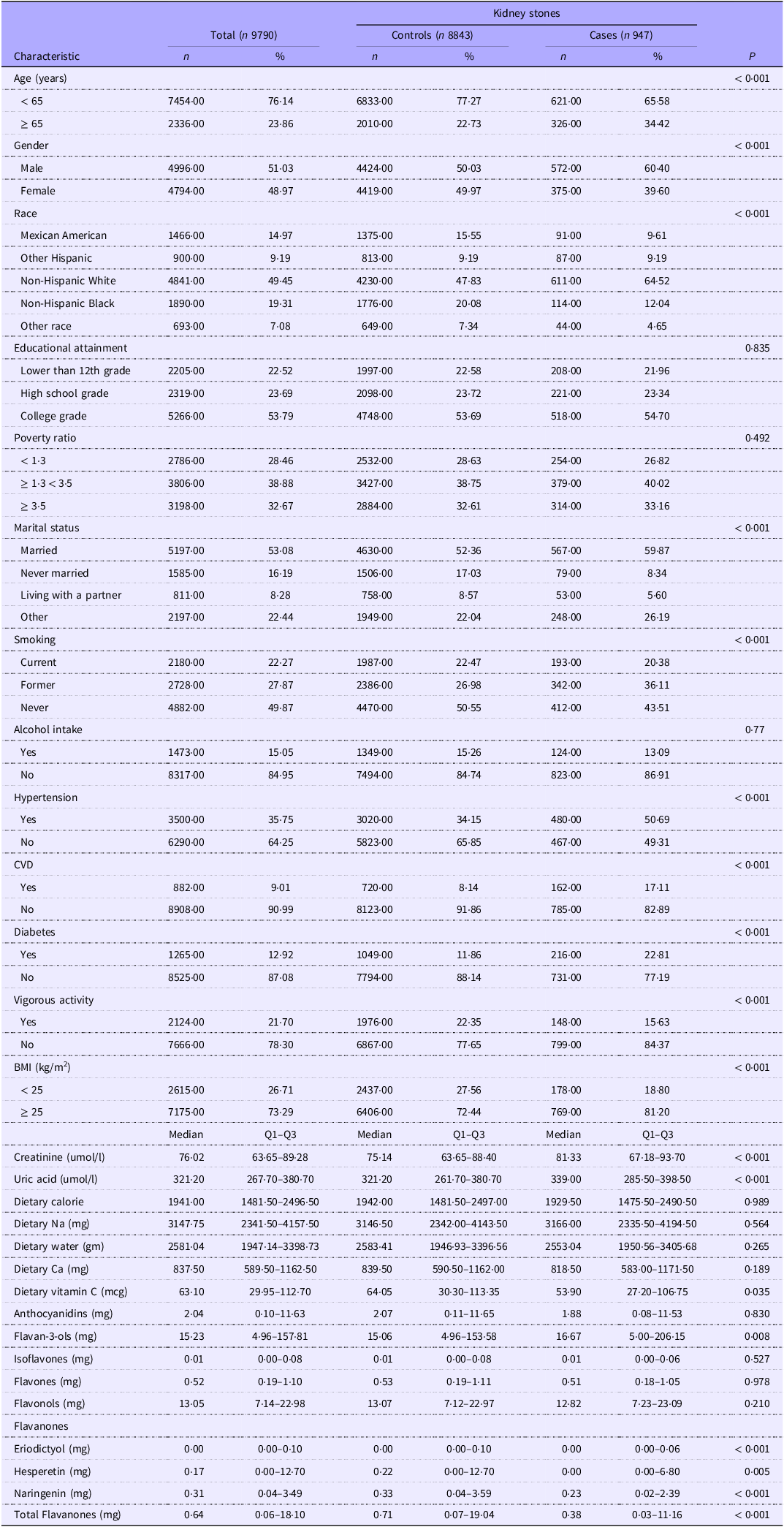
A total of 9760 participants were included in this study, among whom 947 participants had a history of kidney stones, with an incidence rate of 9·76 % (Table 1). Compared with participants without kidney stones, participants with kidney stones are more likely to be elderly people (over 65 years old), male, non-Hispanic White, married, former smokers, people with chronic diseases (hypertension, diabetes and CVD), people who do not engage in vigorous physical exercise, obese people, people with higher serum creatinine and uric acid levels and people with reduced daily intake of flavanones and subtypes. All P-values were less than 0·05.
Baseline characteristics of the participants

Table 1 Long description
A table comparing baseline characteristics of participants with and without kidney stones. The table has 23 rows and 8 columns. Columns are labeled Total, Controls, Cases, and P. Rows include characteristics such as age, gender, race, educational attainment, poverty ratio, marital status, smoking status, alcohol intake, hypertension, CVD, diabetes, vigorous activity, BMI, creatinine, uric acid, dietary calcium, dietary sodium, dietary water, dietary potassium, dietary phytate, dietary anacardic C, flavan-3-ols, isoflavones, flavones, and flavanones. Each row provides data for the total participants, controls, and cases, along with P-values indicating statistical significance.
Data are presented as frequencies (percentages) or median (Q1–Q3).
Sources and distribution of dietary flavanone intake
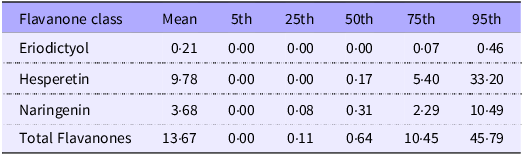
According to the USDA Flavonoid Database, flavanones are most abundant in citrus fruits and their juices, with hesperetin and naringenin comprising the principal flavanone compounds. Online Supplementary Table S1 indicates that orange juice (50–53 %), oranges (30–32 %) and grapefruit (8 %) are the primary sources of flavanone intake. Table 2 summarises the distribution of dietary flavanone intake in the adult population. The mean daily intake of total flavanones, eriodictyol, hesperetin and naringenin was 13·67 mg, 0·21 mg, 9·78 mg and 3·68 mg, respectively. Online Supplementary Table S2 demonstrates the classification of flavanone intake into high- and low-intake groups. The consumption of anthocyanins, isoflavones, flavones and flavonols was significantly greater in the high flavanone intake group than in the low intake group.
Distributions and concentrations of dietary flavanone intakes (mg/d) among adults

Table 2 Long description
A table comparing dietary flavanone intakes among adults. The table has 4 rows and 6 columns. The columns are labeled Flavanone class, Mean, 5th, 25th, 50th, 75th, and 95th. The row labels are Eriodictyol, Hesperetin, Naringenin, and Total Flavanones. Row 1: Eriodictyol, Mean: 0.21, 5th: 0.00, 25th: 0.00, 50th: 0.00, 75th: 0.07, 95th: 0.46. Row 2: Hesperetin, Mean: 9.78, 5th: 0.00, 25th: 0.00, 50th: 0.17, 75th: 5.40, 95th: 33.20. Row 3: Naringenin, Mean: 3.68, 5th: 0.00, 25th: 0.08, 50th: 0.31, 75th: 2.29, 95th: 10.49. Row 4: Total Flavanones, Mean: 13.67, 5th: 0.00, 25th: 0.11, 50th: 0.64, 75th: 10.45, 95th: 45.79.
Association between dietary flavanone intake and kidney stones
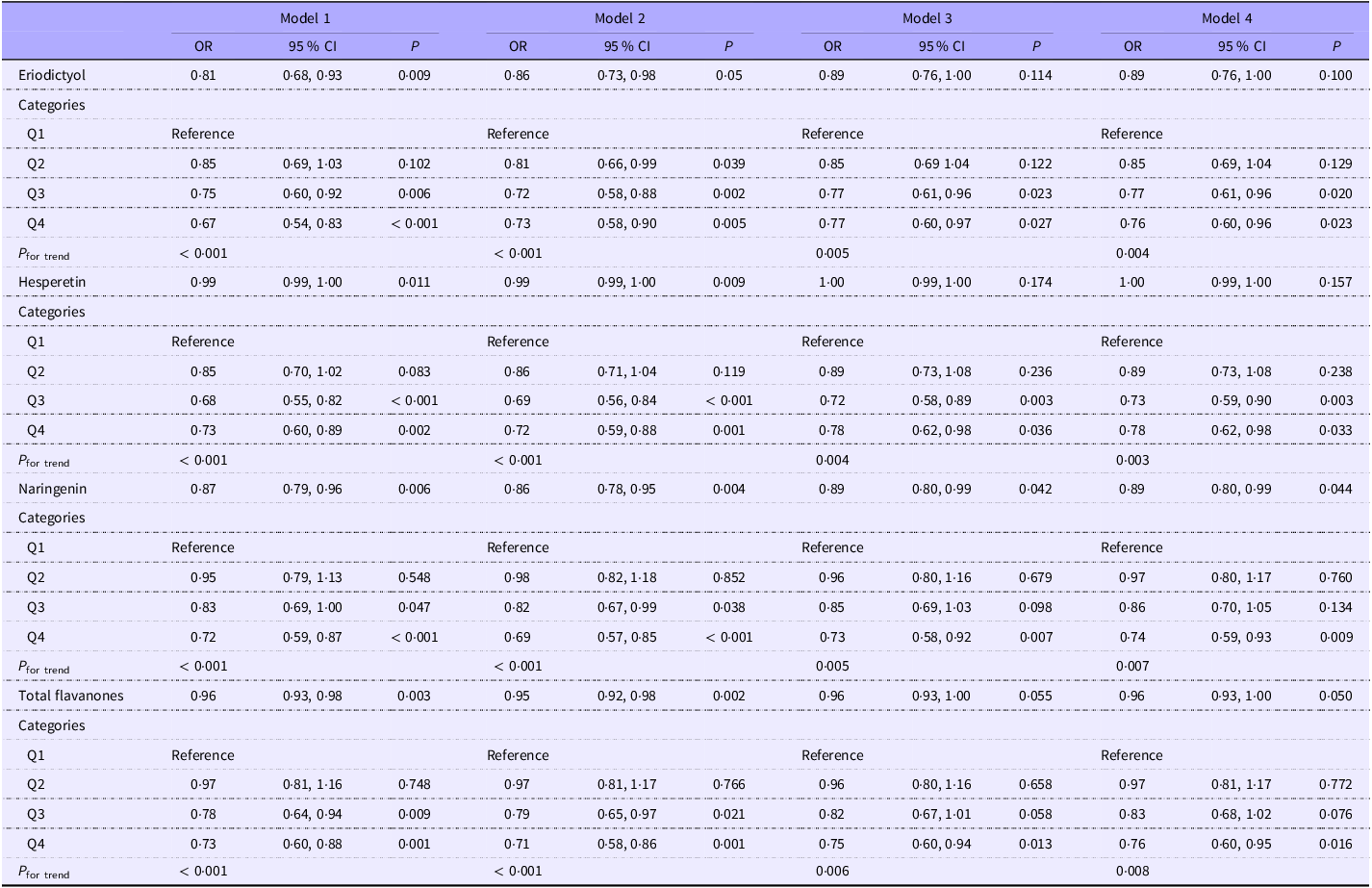
As illustrated in Table 3, the multiple logistic regression analysis demonstrates a significant association between dietary flavanone intake and the prevalence of kidney stones. In the preliminary model, an elevated intake of total flavanones and their components was associated with a reduced prevalence of kidney stones, both in continuous and categorical variables. After adjusting for potential confounders, the continuous intake of flavanones showed a negative association with the prevalence of kidney stones (OR (95 % CI) 0·96 (0·93, 1·00) for total flavanones; 0·89 (0·80, 0·99) for naringenin). In a similar vein, a negative correlation was identified between the categorical variables of total flavanones and naringenin, with OR of 0·76 (95 % CI 0·60, 0·95) and 0·74 (95 % CI 0·59, 0·93), respectively, in the highest group compared with the lowest group (P for trend < 0·05). As illustrated in Figure 2, the RCS regression model exhibited a correlation between the total flavanones, including naringenin, and the prevalence of kidney stones, suggesting a non-linear relationship (P-value for non-linearity > 0·05).
Association of dietary flavanones intake levels with kidney stones

Table 3 Long description
A table with four models comparing the odds ratio (OR) and 95% confidence intervals (CI) for the association of dietary flavanones intake levels with kidney stones. The table includes data for eriocitryol, hesperetin, naringenin, and total flavanones across four models. Each section is divided into categories (Q1 to Q4) with Q1 as the reference. The table provides OR, 95% CI, and P-values for each category and a P-for-trend value. Row 1: Eriodictyol, Model 1, OR 0.81, 95% CI 0.68-0.93, P 0.009. Row 2: Eriodictyol, Model 2, OR 0.86, 95% CI 0.73-0.98, P 0.05. Row 3: Eriodictyol, Model 3, OR 0.89, 95% CI 0.76-1.00, P 0.114. Row 4: Eriodictyol, Model 4, OR 0.89, 95% CI 0.76-1.00, P 0.100. Row 5: Hesperetin, Model 1, OR 0.99, 95% CI 0.99-1.00, P 0.011. Row 6: Hesperetin, Model 2, OR 0.99, 95% CI 0.99-1.00, P 0.009. Row 7: Hesperetin, Model 3, OR 1.00, 95% CI 0.99-1.00, P 0.174. Row 8: Hesperetin, Model 4, OR 1.00, 95% CI 0.99-1.00, P 0.157. Row 9: Naringenin, Model 1, OR 0.87, 95% CI 0.79-0.96, P 0.006. Row 10: Naringenin, Model 2, OR 0.86, 95% CI 0.78-0.95, P 0.004. Row 11: Naringenin, Model 3, OR 0.89, 95% CI 0.80-0.99, P 0.042. Row 12: Naringenin, Model 4, OR 0.89, 95% CI 0.80-0.99, P 0.044. Row 13: Total Flavanones, Model 1, OR 0.96, 95% CI 0.93-0.98, P 0.003. Row 14: Total Flavanones, Model 2, OR 0.95, 95% CI 0.92-0.98, P 0.002. Row 15: Total Flavanones, Model 3, OR 0.96, 95% CI 0.93-1.00, P 0.055. Row 16: Total Flavanones, Model 4, OR 0.96, 95% CI 0.93-1.00, P 0.050.
Model 1: Adjusted for no covariates. Model 2: Adjusted for sex, age, race, education, poverty ratio and marital status. Model 3: Adjust for the variables in model 2 plus BMI, diabetes, hypertension, CVD, alcohol intake, smoking, vigorous activity, creatinine, uric acid and dietary (calorie, Ca, Na, water and vitamin C). Model 4: Adjusted for the variables in model 3 plus anthocyanidins, flavan-3-ols, isoflavones, flavones and flavonols.
The exposure–response associations of dietary flavanone intake and kidney stones by restricted cubic spline (RCS) model in adults. Model was adjusted for gender, age, race, education, poverty ratio, marital status, BMI, diabetes, hypertension, CVD, alcohol intake, smoking, vigorous activity, creatinine, uric acid and dietary (calorie, calcium, sodium, water, vitamin C, anthocyanidins, flavan-3-ols, isoflavones, flavones and flavonols).

Subgroup analyses
Subgroup analyses were performed to examine the association between dietary flavanones and kidney stone risk, stratified by sex, age, BMI, race, education, poverty:income ratio, marital status, hypertension, diabetes, CVD, alcohol consumption, smoking and vigorous exercise. No significant interactions were observed for each subgroup, where dietary flavanones were consistently negatively associated with the risk of kidney stones (see Figure 3). Covariates, including uric acid, creatinine and dietary factors such as energy, Ca, Na, water, vitamin C, anthocyanidins, flavan-3-ols, isoflavones, flavones and flavonols, were included in the subgroup analyses.
Subgroup analysis of the association between dietary total flavanones and kidney stones. The covariates including uric acid, creatinine and dietary factors such as calorie, calcium, sodium, water, vitamin C, anthocyanidins, flavan-3-ols, isoflavones, flavones and flavonols. PIR, poverty:income ratio.

Discussion
We investigated the link between the intake of dietary flavanones and the prevalence of kidney stones among adults within a substantial cohort from the 2007–2010 and 2017–2018 NHANES studies. Initially, we constructed three logistic regression models, progressively adding covariates. Higher intakes of flavanones and their components, particularly naringenin, were associated with a reduced occurrence of kidney stones in adults. It is noteworthy that, although the point estimates for eriodictyol and hesperetin in the fully adjusted model are no longer statistically significant, the trend test (P for trend) remains statistically significant, indicating a marked downward trend in kidney stone risk with increasing intake. Furthermore, the results of our RCS regression analyses indicated that flavanones and naringenin were linearly and negatively associated with the prevalence of kidney stones, and this relationship remained unchanged after adjusting for covariates. Finally, subgroup analyses indicated that within the total population, dietary flavanone intake was consistently negatively associated with an increased prevalence of kidney stones, exhibiting a non-significant interaction.
As an important subclass of flavonoids, flavanones are predominantly present in citrus fruits (including oranges, grapefruits and lemons) and their processed derivatives. In recent years, these compounds have garnered significant scientific interest due to their potential health-protective properties. Studies have shown that these compounds exhibit biological activities, including antioxidant, anti-inflammatory and metabolic regulatory effects, and may contribute to the reduction of chronic disease risk via multiple mechanisms. Currently, epidemiological evidence derived from various study designs provides multidimensional support for the health benefits associated with flavanone intake. In the field of cardiovascular health, a prospective cohort study demonstrated that higher flavanone intake was significantly associated with a decreased risk of CVD among male participants(Reference Cassidy, Bertoia and Chiuve31). Cross-sectional studies further indicated that dietary intake levels of flavanones and anthocyanins were significantly inversely correlated with serum uric acid concentrations and the prevalence of hyperuricemia(Reference Li, Shi and Chen32), suggesting their potential protective role in cardiovascular metabolic health. Regarding metabolic diseases, an epidemiological survey indicated that total flavanone intake was correlated with a decreased risk of metabolic fatty liver disease, with naringenin identified as a major contributing flavanone(Reference Tong, Zeng and Xie33). Flavanone intake has also been demonstrated to be associated with respiratory and neurological health. For example, a cross-sectional study based on NHANES found that higher flavanone intake was associated with a decreased risk of chronic respiratory diseases, and flavanones may exert their protective effects by mitigating systemic inflammatory responses(Reference Wu, Zhu and Guan34). In the field of neuroprotection, a systematic review indicated that naringenin, a citrus flavonoid, possesses potential therapeutic value for neurodegenerative diseases and exhibits notable neuroprotective effects(Reference Evans, Mendonca and Soliman35). A prospective study further substantiated this finding by reporting that flavanone intake was significantly associated with a decreased mortality risk among patients with Parkinson’s disease(Reference Zhang, Molsberry and Yeh36). Similarly, our study revealed that increased dietary flavanone intake was significantly associated with a lower prevalence of kidney stones, with naringenin being the most prominent flavanone subclass. Nevertheless, this study is observational in nature, and its conclusions require validation through randomised controlled trials, while the underlying molecular mechanisms warrant further investigation.
Although epidemiological studies investigating the association between dietary flavanone intake and kidney stone formation remain limited, various experimental data have elucidated the mechanisms by which flavanones may disrupt specific pathophysiological processes of nephrolithiasis, thus providing theoretical support for the inverse association observed in this study. The formation of kidney stones, especially calcium oxalate stones, consists of a cascade of events including crystal nucleation, growth, aggregation and retention within renal tubular epithelial cells, with oxidative stress and inflammation acting as principal promoters of crystal-induced renal injury. Current evidence suggests that flavanones may influence multiple steps within this cascade. First, flavanones may inhibit crystal nucleation and growth via their antioxidant and anti-inflammatory properties. Oxidative stress and inflammation facilitate crystal formation by damaging tubular epithelial cells and exposing crystal-binding sites, thus creating a favourable microenvironment. Li et al. demonstrated that eriodictyol activates the Nrf2 pathway and inhibits nuclear factor of κ-light chain of enhancer-activated B cells (NF-κB) signalling, consequently reducing cisplatin-induced renal tubular epithelial cell injury(Reference Li, Jin and Sun37). Chen et al. further reported that hesperetin activates the Nrf2–Antioxidant Response Element (Nrf2/ARE) pathway and upregulates γ-glutamyl cysteine synthase and glyoxalase-1, thereby delaying the progression of diabetic nephropathy(Reference Chen, Kong and Tang38). By alleviating oxidative damage and maintaining tubular integrity, flavanones may decrease the availability of crystal-binding sites and indirectly suppress crystal nucleation and retention. Second, flavanones may directly regulate crystal formation and aggregation. Prabhu et al. observed that high-dose hesperidin supplementation significantly improved urinary stone biomarkers in animal models, indicating direct anti-crystallisation activity(Reference Prabhu, Sathyamurthy and Ramasamy39). Kale et al. further demonstrated that hesperidin reduces serum and urine parameters associated with crystal deposition and ameliorates kidney damage in Drosophila and mouse models(Reference Kale, Kadam and Shravage40). These findings suggest that flavanones may impede crystal aggregation and growth, although the precise molecular mechanisms require further elucidation. Third, flavanones may inhibit crystal retention by modulating crystal–cell interactions. Chaiyarit et al. (Reference Chaiyarit, Phuangkham and Thongboonkerd41) employed a renal tubular epithelial cell model and found that quercetin inhibits the nucleation and growth of calcium oxalate crystals in a concentration-dependent manner, implying that flavonoid compounds may directly disrupt the crystal formation process. This finding is particularly relevant, as crystal retention – the adherence of formed crystals to injured tubular epithelium – constitutes a critical step in stone formation. Although quercetin is not a flavanone, it is classified within the same flavonoid family. Similarly, Chen et al. (Reference Chen, Wei and Xu42) and Bai et al. (Reference Bai, Wang and Zhu43), respectively, demonstrated in rat and human glomerular mesangial cells that naringenin and stachydrine mitigate high glucose-induced cell damage by modulating the nucleotide-binding oligomerisation domain, leucine-rich repeat and pyrin domain-containing 3 (NLRP3) inflammasome and oxidative stress pathways, thereby maintaining epithelial cell integrity. Fourth, flavanones may modify urinary physicochemical properties that favour stone formation. De Cássia et al. demonstrated that high-dose naringenin supplementation increases urine output and decreases calcium oxalate crystal formation in hypertensive rat models(Reference de Cássia Vilhena da Silva, Dada and Lucietti Dick44). Increased urine volume dilutes urinary constituents that promote stone formation (Ca, oxalate and uric acid) and reduces supersaturation, thus inhibiting crystal nucleation and growth. Furthermore, Liu et al. demonstrated through molecular docking that hesperidin inhibits xanthine oxidase, thereby reducing uric acid production and potentially decreasing the risk of uric acid stones(Reference Liu, Lu and Fang45). In summary, the inverse association between dietary flavanone intake and kidney stone prevalence observed in this study may be attributed to the multifaceted effects of flavanones on various stages of stone formation, including inhibition of crystal nucleation and growth (via antioxidant, anti-inflammatory and diuretic actions), disruption of crystal aggregation and reduction of crystal retention in renal tubules. Future mechanistic studies should aim to further elucidate the direct interactions between specific flavanones (e.g. naringenin and hesperetin) and crystal formation processes, employing in vitro crystallisation assays and crystal–cell adhesion models.
Several strengths of our study are worth pointing out. First, our study included a large sample of 9790 participants from a nationally representative survey. We utilised the extensive dataset of NHANES, which encompasses a broad and diverse demographic, thereby improving the accuracy and dependability of our findings. Second, our study adjusted for many confounding variables and used three statistical analysis methods, multinomial logistic regression, RCS and subgroup analysis, to investigate the relationship between dietary flavanone intake and kidney stones, which improved the stability and generalisability of our findings. However, we are aware that our research may have some limitations. First, since the content of naringenin is significantly higher than that of hesperidin and eriodictyol, our conclusions on the association between flavanone intake and the formation of kidney stones may be biased. Second, diagnosing kidney stones depends on individual interviews, which may introduce bias due to the nature of the interview process. And the NHANES database lacks detailed information regarding the types of kidney stones; hence, we are unable to examine the impact of flavanone consumption on particular categories of kidney stones. Moreover, it is crucial to acknowledge that the assessment of daily flavanone consumption relies on dietary information collected over just 2 d, which could restrict the precision and overall representation of the findings. Furthermore, due to limitations in data or research design, there may be other unmeasured or unincorporated potential influencing factors that have not been considered in the model, such as drug use, the absence of dietary flavonoid cooking and the use of dietary supplements. These factors may have a significant impact on the research results. Lastly, since our research utilised a cross-sectional design, we are unable to make causal inferences. Further prospective longitudinal studies and primary trials are necessary to validate these findings.
Conclusions
Our study shows that US adults with a history of kidney stones consume significantly lower dietary flavanones, particularly naringenin, than those without kidney stones. The results indicate that diets high in flavanones could be advantageous and may inform dietary strategies for kidney stone prevention.
Supplementary material
For supplementary material/s referred to in this article, please visit https://doi.org/10.1017/S0007114526107326
Acknowledgements
The authors would like to express their gratitude to all those who participated in and contributed to the NHANES study.
This study was funded by the self-financed scientific research project of the Administration of Traditional Chinese Medicine in the Guangxi Zhuang Autonomous Region (contract number: GXZYB20230461).
CRediT: H.L.: Data curation, Funding acquisition, Investigation and Writing – original draft; H.C.: Methodology, Software and Visualisation; Y.W.: Conceptualisation, Supervision, Validation and Writing – review and editing.
The authors declare no competing interests.
Given that the NHANES dataset is publicly accessible, anonymised and derived from population data, this research is classified as non-human subject research, thereby exempting it from the approval of the Institutional Review Board at Liuzhou Traditional Chinese Medical Hospital. The Ethics Review Board (ERB) of the National Center for Health Statistics (NCHS) is tasked with the protection of the rights of all human participants.
The data employed in this study are publicly accessible in the NHANES database (https://www.cdc.gov/nchs/nhanes).