Introduction
Ohiocrinus Wachsmuth and Springer, Reference Wachsmuth and Springer1886 is a cincinnaticrinid crinoid characterized by its spirally coiled anal sac and has been reported exclusively from the Upper Ordovician carbonate strata in the mideastern United States of Laurentia (Hall, Reference Hall1872; Ulrich, Reference Ulrich1925; Brower, Reference Brower1992). The Cincinnaticrinidae Warn and Strimple, Reference Warn and Strimple1977 occurs in the Upper Ordovician carbonates of Laurentia except for a single Middle Ordovician record of Isotomocrinus apheles Ausich et al., Reference Ausich, Bolton and Cumming1998 from Newfoundland, Canada. Of the cincinnaticrinid genera, Ohiocrinus is most closely allied with Cincinnaticrinus Warn and Strimple, Reference Warn and Strimple1977 and Isotomocrinus Ulrich, Reference Ulrich1925, as shown in phylogenetic hypotheses of the Paleozoic crinoids including cincinnaticrinids (e.g., Ausich, Reference Ausich1998, figs. 6, 7; Deline et al., Reference Deline, Thompson, Smith, Zamora, Rahman, Sheffield, Ausich, Kammer and Sumrall2020, figs. S1A, B).
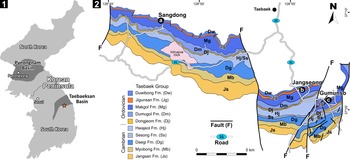
This study reports a new species of Ohiocrinus based on articulated specimens collected from the Middle Ordovician (Darriwilian) Jigunsan Formation in the Taebaeksan Basin of South Korea (Fig. 1) and discusses biostratigraphy and paleobiogeography of the new species and taphonomy of the crinoid assemblage.
(1) Map of the Korean Peninsula with the location of the Paleozoic Taebaeksan and Pyeongnam basins and sampling locality (star). (2) Geologic map of the Taebaek Group (modified from Woo and Chough, Reference Woo and Chough2007, fig. 1) with the location of the Sangdong (a), Jangseong (b), and Gumunso (c) sections, the famous fossil localities of the Jigunsan Formation. The crinoid-bearing siltstone slab reported in this study was collected from the Jangseong section (37°06′05″N, 129°00′46″E).

Geologic setting
The Jigunsan Formation is a Middle Ordovician lithostratigraphic unit of the Taebaek Group of the Joseon Supergroup deposited in the Taebaeksan Basin of South Korea (Fig. 1), which was part of the Sino-Korean (North China) block during the Paleozoic (Choi and Chough, Reference Choi and Chough2005; Chough, Reference Chough2013; Choi, Reference Choi2019). The formation is one of four siliciclastic-dominated units of the Taebaek Group of the Joseon Supergroup, which is a mixed siliciclastic and carbonate succession (Kwon et al., Reference Kwon, Chough, Choi and Lee2006). It is composed primarily of fine-grained clastic sediments (mudstone and shale) with occasional intercalation of carbonate layers and interpreted to have accumulated in a clastic outer shelf and basin environment (Woo and Chough, Reference Woo and Chough2007; Byun et al., Reference Byun, Lee and Kwon2018).
Materials and methods
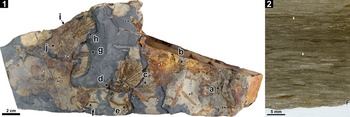
The crinoid specimens are found in a nodule-bearing greenish-gray siltstone slab that was collected from scree at the Jangseong section of the Jigunsan Formation (Fig. 1.2). Ten crinoid specimens are found on the slab (Fig. 2.1), along with sclerites of trilobites such as Dolerobasilicus yokusensis (Kobayashi, Reference Kobayashi1934) and Basiliella kawasakii Kobayashi, Reference Kobayashi1934, typical of the Jigunsan Formation (Lee and Choi, Reference Lee and Choi1992). Because all the specimens are preserved as external molds, latex casts were prepared and photographed using a digital camera after coated with magnesium oxide fume.
(1) Photograph of the slab where Ohiocrinus byeongseoni n. sp. is found; O. byeongseoni (black arrows with a lowercase letter; KIGAM-9J93 is given to the slab and a lowercase letter [a–j] to each crinoid specimen); trilobite sclerites of Dolerobasilicus and Basiliella (white and black arrowheads indicate that the specimen is preserved convex-up and convex-down, respectively, considering that the fossil-occurring surface of the slab is the sole [see text]); cr = cranidium; p = pygidium; f = free cheek; t = thoracic segment. (2) Thin section of the slab showing siltstone lithology and lenticular fabric representing compressed burrows (black arrowhead points to backfilled burrow; white arrowheads point to the upper and lower boundaries of a layer with higher organic content and finer grains); ‘F’ indicates the surface in which the fossils are preserved.

Repository and institutional abbreviation
Specimens examined in this study are deposited in the Korea Institute of Geoscience and Mineral Resources (KIGAM), Daejeon, South Korea. “KIGAM-9J93” refers to the slab and letters “a–j” to the crinoid specimens.
Systematic paleontology
The classifications above the order and below the parvclass used here follow Ausich (Reference Ausich1998) and Wright et al. (Reference Wright, Ausich, Cole, Peter and Rhenberg2017), respectively. Morphologic terminology mostly follows Ubaghs (Reference Ubaghs, Moore and Teichert1978), column terminology follows Webster (Reference Webster1974), and posterior plate homology and terminology follow Ausich et al. (Reference Ausich, Wright, Cole and Sevastopulo2020).
Class Crinoidea Miller, Reference Miller1821
Subclass Pentacrinoidea Jaekel, Reference Jaekel1894
Infraclass Inadunata Wachsmuth and Springer, Reference Wachsmuth and Springer1885
Parvclass Disparida Moore and Laudon, Reference Moore and Laudon1943
Order Homocrinida Ausich, Reference Ausich1998
Family Cincinnaticrinidae Warn and Strimple, Reference Warn and Strimple1977
Genus Ohiocrinus Wachsmuth and Springer, Reference Wachsmuth and Springer1886
Type species
Ohiocrinus laxus (Hall, Reference Hall1872) from the Upper Ordovician (Katian, Maysvillian Stage of Cincinnatian Series of North America regional chronostratigraphy; see Jennette and Pryor, Reference Jennette and Pryor1993) Fairview Formation, Cincinnati, Ohio, USA.
Other species
Ohiocrinus brauni Ulrich, Reference Ulrich1925 from the Upper Ordovician (same as O. laxus) Fairview Formation, Madison, Indiana, USA; Ohiocrinus levorsoni Brower, Reference Brower1992 from the Upper Ordovician (Katian, Chatfieldian Stage of Mohawkian Series of North America regional chronostratigraphy; see Brower, Reference Brower2013) Dunleith Formation of the Galena Group, Harmony, Minnesota, USA.
Diagnosis (emended)
Cincinnaticrinid with spirally coiled anal sac and arms exhibiting alternating heterotomous and/or isotomous branching pattern.
Remarks
Warn and Strimple (Reference Warn and Strimple1977) differentiated Ohiocrinus from Cincinnaticrinus, the nominate genus of the family, by the anal sac condition. Both have an anal sac projected from the C ray superradial; however, it is spirally coiled in Ohiocrinus but straight and narrow in Cincinnaticrinus (Warn and Strimple, Reference Warn and Strimple1977; Brower, Reference Brower2005). Ohiocrinus byeongseoni, the new species from South Korea, is differentiated from the Laurentian Ohiocrinus species with a tightly counterclockwise-coiled sac (Warn and Strimple, Reference Warn and Strimple1977; Brower, Reference Brower1992) by having a loosely clockwise-coiled sac. Warn and Strimple (Reference Warn and Strimple1977, p. 66) characterized the arm branching pattern of Ohiocrinus as “alternating heterotomous.” However, all the Laurentian species have the isotomous branching pattern at the first branch (Warn and Strimple, Reference Warn and Strimple1977, text-figs. 16, 17; Brower, Reference Brower1992, figs. 6.1, 7.1), which is diagnostic of all cincinnaticrinids (Wachsmuth and Springer, Reference Wachsmuth and Springer1886; Warn and Strimple, Reference Warn and Strimple1977). Upward from the second branch, the Laurentian species have a heterotomous branching pattern, whereas O. byeongseoni maintains the isotomous pattern throughout the arms. Therefore, the arm branching pattern of Ohiocrinus in the diagnosis should be modified to accommodate both isotomous and heterotomous conditions. Merocrinus of the Cladida also has a loosely spirally (but counterclockwise) coiled anal sac (e.g., Brower, Reference Brower2010), but it is readily distinguished from O. byeongseoni of the Disparida in having a crown with infrabasal plates.
Ohiocrinus byeongseoni new species
Figures 3–5
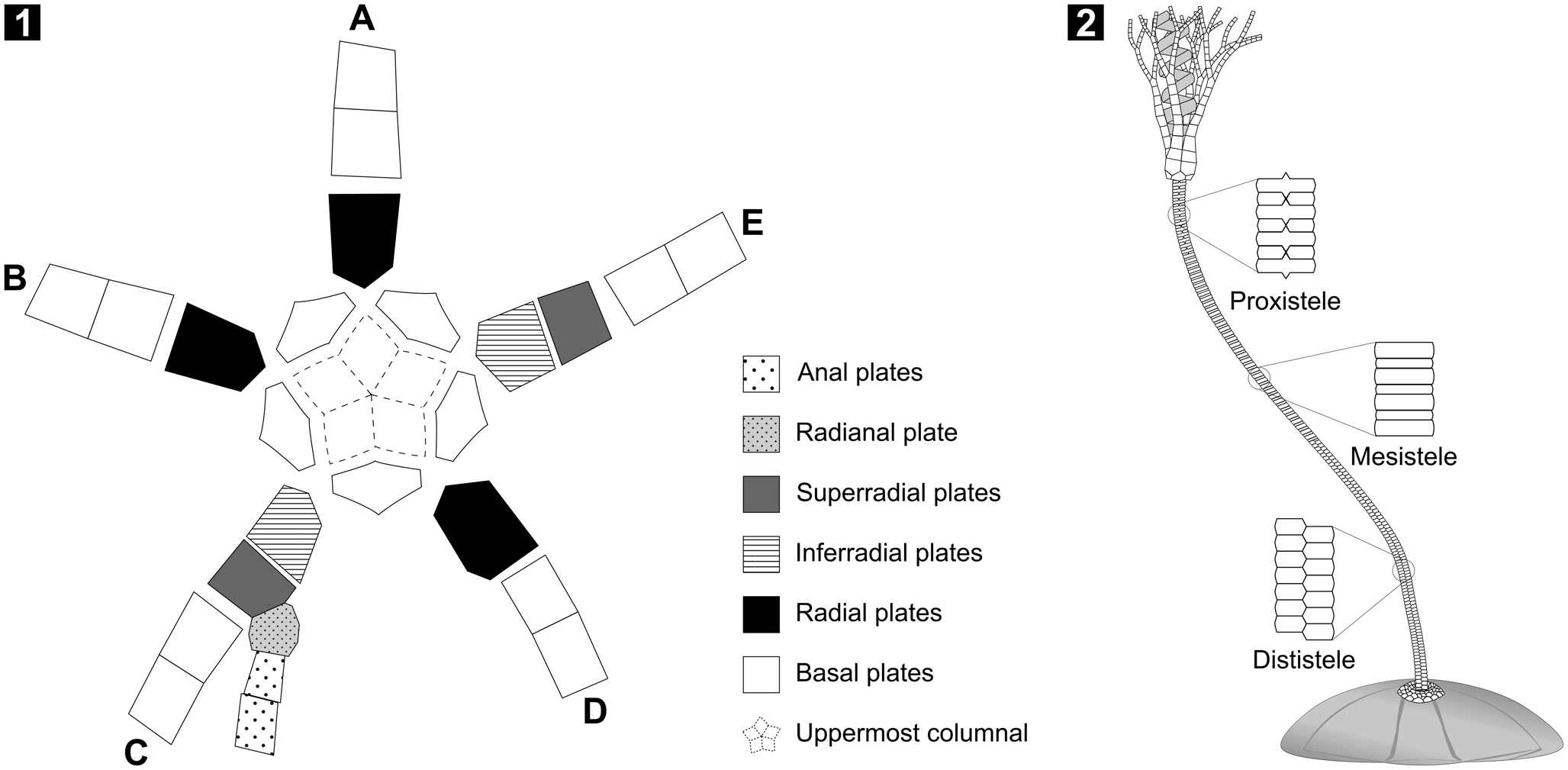
Ohiocrinus byeongseoni n. sp. from the Jigunsan Formation of South Korea. (1) Plate diagram with ray designation (A–E). (2) Reconstruction with holdfast attached to a trilobite pygidium and detailed view of xenomorphic column.

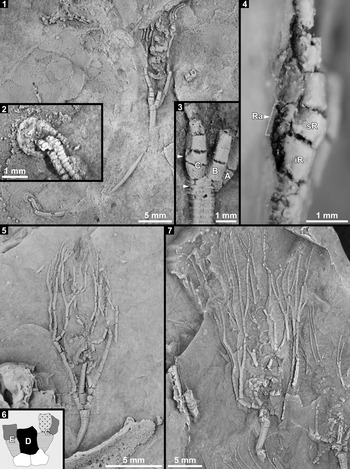
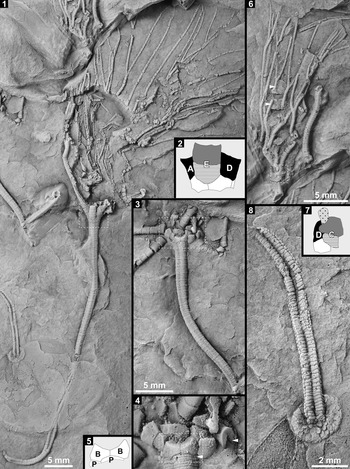
Ohiocrinus byeongseoni n. sp. from the Jigunsan Formation of South Korea; latex cast. (1–4) KIGAM-9J93a, holotype: (1) lateral view; (2) enlarged view of holdfast; (3) enlarged view of crown with ray designation (upper arrowhead indicates position of radianal plate and lower arrowhead pentagonal (in lateral view) pentamere of uppermost columnal); (4) enlarged view of radianal plate (Ra) at C ray (arrowhead with slanted bracket); sR = superradial; iR = inferradial. (5, 6) KIGAM-9J93g, paratype: (5) lateral view; (6) drawing of crown (dotted rectangular area in (5)) with ray designation (C–E); see Fig. 3.1 for fill pattern of each plate. (7) KIGAM-9J93h, paratype, lateral view; part of KIGAM-9J93i (nontype, lower right).

Ohiocrinus byeongseoni n. sp. from the Jigunsan Formation of South Korea; latex cast. (1, 2) KIGAM-9J93d, paratype: (1) lateral view; (2) drawing of crown (dotted rectangular area in (1)) with ray designation (A, E, and D); see Fig. 3.1 for fill pattern of each plate. (3–5) KIGAM-9J93e, paratype: (3) lateral view; (4) enlarged oblique view of dotted rectangular area in (3) showing V-shaped food groove in primibrachial (arrowhead on the right) and pentagonal (in lateral view) pentamere of uppermost columnal (arrowhead in the middle); (5) drawing of basal plates (B) and pentameres of the uppermost columnal (P) in dotted rectangular area in (4). (6, 7) KIGAM-9J93c, paratype: (6) lateral view (arrowheads point to outer surface of anal sac; note the presence of broken columnal on the right); (7) drawing of crown (dotted rectangular area in (6)) with ray designation (C and D); see Fig. 3.1 for fill pattern of each plate. (8) KIGAM-9J93f, paratype, lateral view of dististele with lichenocrinid-type holdfast covered with small plates.

Holotype
Specimen no. KIGAM-9J93a; paratypes (specimen no. KIGAM-9J93b, c, f, g, h); Darriwilian, Jigunsan Formation, South Korea.
Diagnosis
Ohiocrinus with isotomous arm branching with four to 14 primibrachials, loosely clockwise-coiled anal sac composed of cylindrical plates and covered with small polygonal plates, relatively short xenomorphic column, and small lichenocrinid-type holdfast.
Occurrence
Middle Ordovician (Darriwilian) Jigunsan Formation, Taebaeksan Basin, Taebaek, South Korea.
Description
Crown monocyclic and small (1.5–2.6 mm high, 1.5–3.5 mm wide; height-to-width ratio 0.74–1.21 [n = 4]). Five basal plates approximately same size, pentagonal to hexagonal in shape, and wider than tall (height-to-width ratio 0.7–0.86 [n = 4]). Radial circlet composed of three radial (simple) and two inferradial and superradial plates (compound); radial plates at A, B and D rays with height-to-width ratio of 1.1–1.35 (n = 3); inferradial and superradial plates at C and E rays; inferradial plates pentagonal; superradial plates rectangular with height-to-width ratio 0.67–1.62 (n = 4); superradial plate at C ray and radial plate at D ray asymmetrically pentagonal and hexagonal, respectively, and sutured with polygonal radianal plate.
Anal sac loosely clockwise coiled, consists of cylindrical uniserial plates and covered with numerous small pentagonal or hexagonal plates.
Arms uniserial, nonpinnulate, and branch isotomously. Primibrachials consist of four to 14 plates, secundibrachials of six to eight plates, and tertibrachials of five to nine plates; quartibrachials only partially preserved in a paratype (Fig. 4.7); nonaxillary plates rectangular and axillary plates pentagonal. Food grooves V-shaped in primibrachials (Fig. 5.4).
Column xenomorphic, 25–55 mm long with pentalobate columnals. Pentameres of uppermost columnal pentagonal in lateral view with apex forming a triple junction with two adjacent basal plates (Figs. 4.3, 5.4, 5.5). Proxistele consists of alternating pentameric and holomeric columnals with ridges between pentameric columnals; mesistele of alternating different-sized holomeric columnals; dististele of alternating pentameric columnals with zigzag sutures; the tripartite divisions grade into one another.
Holdfast of lichenocrinid-type; small (3.78 and 4.65 mm in diameter; 2.58 times larger than column diameter [n = 2]), rounded, and nearly flat with wide central depression for column attachment; covered with many polygonal (hexa-, hepta-, and octagonal) plates.
Etymology
After Mr. Byeongseon Lee, who collected and donated the specimen.
Materials
KIGAM-9J93a (partially articulated specimen with crown, column, arms, and holdfast), KIGAM-9J93b, c, e, g, h (partially articulated specimens with crown, column, and arms), KIGAM-9J93f (dististele and holdfast).

Remarks
The radial plates are interpreted as consisting of three simple plates (A, B and D rays) and two compound plates (C and E rays) (Fig. 3.1) on the basis of two specimens showing A, B and C rays (Fig. 4.1) and C, D and E rays (Figs. 4.5). The plate arrangement is diagnostic of the Cincinnaticrinidae (Warn and Strimple, Reference Warn and Strimple1977). The pentagonal (in lateral view) structure immediately underneath the basal plates (Figs. 4.3, 5.4, 5.5) is interpreted as representing the pentamere of the uppermost columnal as for Ohiocrinus levorsoni (Brower, Reference Brower1992, figs. 6.1, 7.1). The radianal plate is located between C-ray superradial and D-ray radial (Fig. 4.3, 4.4), similar to Ohiocrinus laxus and Ohiocrinus brauni (Warn and Strimple, Reference Warn and Strimple1977, text-figs. 16, 17).
The anal sac of Ohiocrinus byeongseoni is different from other species in being loosely clockwise coiled (Fig. 4.1, 4.5, 4.7); the Laurentian species have a tightly counterclockwise-coiled anal sac (Warn and Strimple, Reference Warn and Strimple1977; Brower, Reference Brower1992).
Ohiocrinus byeongseoni is further distinguished by its isotomous arm branching pattern and number of primibrachials. The Laurentian species have a heterotomous arm branching pattern above the primibrachials, whereas O. byeongseoni has an isotomous pattern throughout the arms (Fig. 4.7). The number of primibrachials varies in each Laurentian species; three to seven in Ohiocrinus laxus, three to four in Ohiocrinus brauni, and three in Ohiocrinus levorsoni. By comparison, it varies from four to 14 in O. byeongseoni, with a very wide intraspecific or ontogenetic variation.
The xenomorphic column and lichenocrinid-type holdfast of Ohiocrinus byeongseoni (Figs. 3.2, 4.2, 5.8), which is the first record for Ohiocrinus, are similar to those of Cincinnaticrinus varibrachialus (Warn and Strimple, Reference Warn and Strimple1977). The column of C. varibrachialus is divided into four juvenile and two adult parts (Warn and Strimple, Reference Warn and Strimple1977, text-figs. 11, 13), whereas that of O. byeongseoni is divided into three parts, which are considered to correspond to two juvenile and one adult part of C. varibrachialus. The holdfasts of O. byeongseoni and C. varibrachialus (e.g., Brower, Reference Brower2005, fig. 4.4, 4.5) are lichenocrinid-type, but that of the latter is more convex and appears to consist of fewer plates (compare Brower, Reference Brower2005, fig. 4.4 and Fig. 5.8).
Biostratigraphy, paleobiogeography, and taphonomy
Biostratigraphy and paleobiogeography of Ohiocrinus byeongseoni is discussed considering evolution of Ohiocrinus and the Cincinnaticrinidae, which are predominantly from the Upper Ordovician of Laurentia. Taphonomy of the fossil assemblage consisting of crinoids and trilobites is also discussed.
Biostratigraphy
Kobayashi (Reference Kobayashi1934) extensively recorded invertebrate fossils from the Jigunsan Formation. A few groups such as trilobites (Lee and Choi, Reference Lee and Choi1992), graptolites (Kim et al., Reference Kim, Kwon, Kim and Cho2005), and cephalopods (Yun, Reference Yun2011) have been systematically revised; systematic revision of brachiopods is in preparation. Lee and Lee (Reference Lee and Lee1986) and Lee and Lee (Reference Lee and Lee1990) reported conodonts from the formation and conducted a biostratigraphic study. Recently, Cho et al. (Reference Cho, Lee, Lee and Choh2021) comprehensively compiled and revised conodont biostratigraphy of the Taebaek Group.
Choi et al. (Reference Choi, Kim and Sohn2001) defined the Dolerobasilicus (trilobite) Zone for the Jigunsan Formation (see also Choi and Chough, Reference Choi and Chough2005). However, it is not biostratigraphically reliable because the Jigunsan trilobite fauna is strongly endemic and, in particular, Dolerobasilicus is a monospecific genus reported only from South Korea (Harrington and Leanza, Reference Harrington and Leanza1957; Lee and Choi, Reference Lee and Choi1992). Lee and Lee (Reference Lee and Lee1986) established the Eoplacognathus suecicus–Eoplacognathus jigunsanensis (conodont) Zone in the Jigunsan Formation (see also Lee and Lee, Reference Lee and Lee1990; Lee and Seo, Reference Lee and Seo2004). Cho et al. (Reference Cho, Lee, Lee and Choh2021) established the two conodont biozones for the formation, the lower Tangshanodus tangshanensis Zone and the upper Eoplacognathus suecicus Zone. The boundary between the two zones is placed at the horizon where Eoplacognathus suecicus Bergström, Reference Bergström1971 first appears in the middle of the formation. The boundary between the two zones approximately corresponds to the lithologic boundary between the mainly clastic, lower part of the formation and the upper part, which commonly has limestone layers (Cho et al., Reference Cho, Lee, Lee and Choh2021, fig. 2). The conodont biostratigraphic scheme established by Cho et al. (Reference Cho, Lee, Lee and Choh2021) is followed herein.
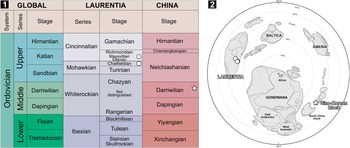
Ohiocrinus byeongseoni is found in the greenish-gray siltstone slab (Fig. 2.1). The lithology corresponds to the siltstone facies that occurs mainly in the upper part of the Jigunsan Formation in association with various carbonate facies (‘Mg’ [greenish-gray siltstone facies], Woo and Chough, Reference Woo and Chough2007; ‘Sd’ [dark greenish-gray siltstone facies], Byun et al., Reference Byun, Lee and Kwon2018). Hence, O. byeongseoni is considered to occur in the Eoplacognathus suecicus Zone defined for the upper part of the formation. The biozone is correlated with the Eoplacognathus suecicus–Histiodella kristinae Zone in North China (Wang et al., Reference Wang, Zhen, Bergström, Zhang and Wu2018). E. suecicus is the cosmopolitan index species occurring in Gondwana and peri-Gondwanan terranes, Baltica, and Laurentia (see Jing et al., Reference Jing, Zhou and Wang2015); the E. suecicus Zone is established in South China, Australasia, Baltoscandia, Argentine precordillera (Albanesi and Ortega, Reference Albanesi and Ortega2016; Bergström and Ferretti, Reference Bergström and Ferretti2017; Wang et al., Reference Wang, Zhen, Bergström, Zhang and Wu2018; Zhang et al., Reference Zhang, Zhan, Zhen, Wang, Yuan, Fang, Ma and Zhang2019; Zhen, Reference Zhen2021), and North Atlantic Realm of Laurentia (Pyle and Barnes, Reference Pyle and Barnes2003). The E. suecicus Zone is middle Darriwilian in age across these regions and correlated with the middle Whiterockian Histiodella holodentata to Phragmodus “pre-flexuosus” zones of the North American Midcontinent Realm of Laurentia (Pyle and Barnes, Reference Pyle and Barnes2003; Bergström and Ferretti, Reference Bergström and Ferretti2017). Because the Fairview Formation where Ohiocrinus laxus and Ohiocrinus brauni occur is assigned to the Maysvillian Stage of the Cincinnatian Series (Jennette and Pryor, Reference Jennette and Pryor1993) and the Galena Group including the Dunleith Formation where Ohiocrinus levorsoni occurs is assigned to the Chatfieldian Stage of Mohawkian Series (Brower, Reference Brower2013) of Laurentian chronostratigraphic scheme (Fig. 6.1), the middle Darriwilian Ohiocrinus byeongseoni is the oldest known species.
(1) Stratigraphic occurrence of Ohiocrinus (Laurentian and Chinese chronostratigraphic schemes are adapted from Bergström et al., Reference Bergström, Xu, Schmitz, Young, Jia-Yu and Saltzman2009, fig. 1, and Zhang et al., Reference Zhang, Zhan, Zhen, Wang, Yuan, Fang, Ma and Zhang2019, fig. 3, respectively). (2) Paleogeographic occurrence of Ohiocrinus on Late Ordovician (Katian) paleocontinent map (modified from Cocks and Torsvik, Reference Cocks and Torsvik2021, fig. 2). Circles and star in (1) and (2) indicate occurrence of Ohiocrinus laxus, Ohiocrinus brauna, and Ohiocrinus levorsoni (circles) and that of Ohiocrinus byeongseoni (star).

The Cincinnaticrinidae to which Ohiocrinus belongs is also an exclusively Late Ordovician disparid family with two Middle Ordovician records, Isotomocrinus apheles from Newfoundland, Canada (Ausich et al., Reference Ausich, Bolton and Cumming1998) and Ohiocrinus byeongseoni. I. apheles occurs in the Table Point Formation, the lowermost unit of the Table Head Group (Klappa et al., Reference Klappa, Opalinski and James1980). Stouge (Reference Stouge1984) defined two conodont biozones in the Table Head Formation (= Table Head Group), the Histiodella tableheadensis and Histiodella kristinae zones, in ascending order, and correlated the former and latter zones with the Eoplacognathus? variabilis and Eoplacognathus suecicus zones, respectively. Because Ausich et al. (Reference Ausich, Bolton and Cumming1998) described I. apheles from the base of the Table Head Group, I. apheles is likely to occur in the H. tableheadensis Zone correlated with the E.? variabilis Zone. Hence, I. apheles would be older than O. byeongseoni, making I. apheles the oldest known cincinnaticrinid species.
Paleobiogeography
The Sino-Korean (North China) block, including the Taebaeksan Basin where Ohiocrinus byeongseoni occurs, is considered to have been located around the paleoequator as one of many peri-Gondwanan terranes during the Ordovician (Fig. 6.2). The occurrence of Ohiocrinus byeongseoni from South Korea drastically expands the paleobiogeographic range of Ohiocrinus, which is otherwise exclusively Laurentian (Warn and Strimple, Reference Warn and Strimple1977), into the Gondwana region; the occurrences are located at the opposite side along the paleoequator. The South Korean occurrence is also the first Gondwanan for the Cincinnaticrinidae, which is also exclusively Laurentian.
The iocrinids, one of the widespread disparids with predominant records from the Upper Ordovician of Laurentia, have been reported from Middle Ordovician strata in the Gondwana region (Lin et al., Reference Lin, Ausich, Balinski, Bergström and Sun2018, table 3). The wide distribution may be attributed to a dispersal during a probably planktonic or free-swimming larval stage (Nakano et al., Reference Nakano, Hibino, Oji, Hara and Amemiya2003) by paleoceanic currents (Servais et al., Reference Servais, Danelian, Harper and Munnecke2014, fig. 1). Likewise, the cincinnaticrinids could be discovered in Darriwilian to Sandbian or perhaps earlier strata located between Laurentia and the Sino-Korean block. It is of interest that recent studies supposed a close paleobiogeographic link or geographic closeness of Laurentia with South and North China. Lin et al. (Reference Lin, Ausich, Balinski, Bergström and Sun2018) performed a cladistic analysis of the iocrinids, and the resultant cladogram shows a sister-group relationship of Muicrinus Lin et al., Reference Lin, Ausich, Balinski, Bergström and Sun2018 from South China and Westheadocrinus Donovan, Reference Donovan1989 from Laurentia. It is of interest that they interpreted the relationship as suggesting a possible, although unsubstantiated, paleobiogeographic connection between the two areas. In addition, a recent paleomagnetic study proposed a radical view about the position of North China, including the Korean Peninsula, during middle Cambrian (Zhao et al., Reference Zhao, Zhang, Zhu, Ding, Li, Yang and Wu2021). They positioned North China between Laurentia and East Gondwana, including Australia, and interpreted that it perhaps acted as a paleobiogeographic link. The South Korean occurrence of Ohiocrinus seems to accord with the speculated paleobiogeographic link of Laurentia with North and South China, contrary to the widely accepted paleogeographic distribution of the areas depicted in Fig. 6.2.
Taphonomy
Two specimens have a holdfast attached to a trilobite free cheek and pygidium, respectively (KIGAM-9J93a and f; Fig. 2.1). The holdfast attachment points the stratigraphic way up (Fig. 3.2) because it was attached on the sclerite surface exposed to seawater. The latex cast of the specimens (Figs. 4.2, 5.8) shows such orientation, which is thus in bedding plane (top surface) view. Accordingly, the slab surface where the fossils are preserved as external molds (Fig. 2.1) is the sole (bottom surface).
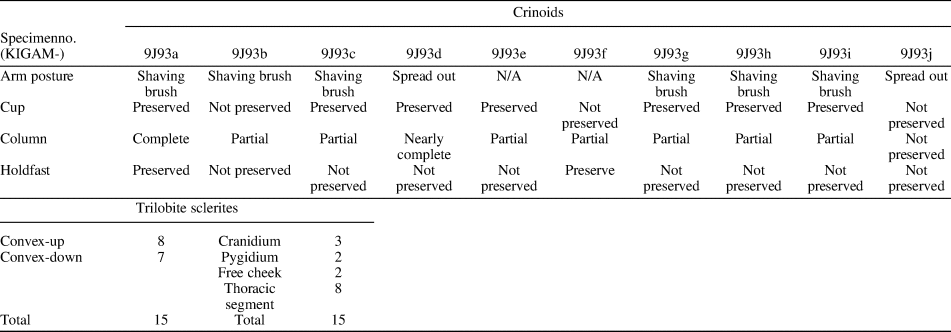
The crinoids occur in the lowermost about 5 mm thick layer; three specimens (KIGAM-9J93a–c) occur in the upper part, two (KIGAM-9J93d and e) appear within the layer, and the remainder are in the lower part (Fig. 2.1). They are mostly articulated with crown and column attached (Table 2), and disarticulation is limited to disrupted or offset arm brachials (e.g., KIGAM-9J93d; Fig. 5.1), disturbed anal sac plates (e.g., KIGAM-9J93h; Fig. 4.7), and broken columnals (e.g., KIGAM-9J93c; Fig. 5.6). The arms of six specimens (KIGAM-9J93a–c, g–i) have a “shaving brush” posture (Baumiller et al., Reference Baumiller, Gahn, Hess, Messing, Ausich and Webster2008), and two (KIGAM-9J93d and j) have the spread-out arms. Some preferred orientations of individuals are noticeable; five specimens (KIGAM-9J93c–g) orient toward the right of Fig. 2.1 and two (KIGAM-9J93h and i) toward the upper right; the remainder are in random orientation, the upper (KIGAM-9J93a), the lower left (KIGAM-9J93b), and the lower right (KIGAM-9J93j).
Taphonomic data of Ohiocrinus byeongeoni n. sp. and trilobites.

The co-occurring trilobite sclerites are preserved parallel to the bedding surface (“concordant,” Kidwell et al., Reference Kidwell, Fürsich and Aigner1986) and completely disarticulated; even partially articulated thoracic segments are not found. Convex-up and concave-up specimens are in nearly equal numbers, and thoracic segments represent about half of the preserved sclerites; others occur in equal numbers (Table 2).
The Jigunsan Formation is well known to amateur fossil collectors and paleontologists for yielding numerous well-preserved, completely articulated invertebrate fossils, such as trilobites and brachiopods; and the occurrence of articulated crinoids and ophiuroids, although rare, has been known as well. The gray siltstone lithology where Ohiocrinus byeongseoni occurs is associated with facies associations ranging from storm-influenced outer to mid ramp to shallow subtidal platform (Woo and Chough, Reference Woo and Chough2007) or from lower slope to shoal of subtidal environment (Byun et al., Reference Byun, Lee and Kwon2018). A thin section of the slab (Fig. 2.2) shows horizontal lenticular fabric filled with organic-rich (darker) or poor (lighter) material representing compressed burrows. It is also observed that layers of different grain sizes and organic contents subtly alternate. No other primary sedimentary features are observed.
The Jigunsan crinoid assemblage is comparable to the “Crawfordsville-type” crinoid occurrences recognized by Ausich et al. (Reference Ausich, Brett, Hess, Hess, Ausich, Brett and Simms1999). The type is known to occur in mudstone to siltstone with the layers above and below the crinoid assemblages being very similar in lithology and preserved on a very thin and discontinuous layer of skeletal debris, which suggests the presence of a minor discontinuity. The discontinuity represents a time interval during which crinoids attached themselves to hard skeletal material and colonized seafloor. The sediment-laden current, probably associated with a storm, smothered and rapidly buried the crinoids.
The holdfast attachment to disarticulated trilobite sclerites indicates that the trilobite assemblage predated the crinoid assemblage. Although the sclerites are in the lowermost layer of the slab and more conclusive information on the underlying bed is not available, the assemblage is considered also associated with the gray siltstone facies.
The ratios of different parts and orientations of sclerites have been used to interpret the taphonomy of trilobite assemblages (Speyer and Brett, Reference Speyer and Brett1986). The ratio of trilobite parts in the Jigunsan assemblage (Table 2) indicates that there was no shape sorting, which is generally caused by current action and results in the relative abundance of a particular part over the others (Hunda et al., Reference Hunda, Hughes and Flessa2006). In general, convex-up orientation results from persistent current action and convex-down orientation from suspension settling (Speyer, Reference Speyer1987). The occurrence of convex-up and concave-up trilobite sclerites in approximately equal numbers in the Jigunsan assemblage can be interpreted to be indicative of deep, intrastratal bioturbation, as suggested by Speyer and Brett (Reference Speyer and Brett1986). However, such bioturbation is expected to result in random (“oblique,” Kidwell et al., Reference Kidwell, Fürsich and Aigner1986) orientation of sclerites rather than the concordant orientation, regardless of their convex-up and convex-down attitudes. The predominance of horizontal to subhorizontal burrows and concordant orientation of trilobite sclerites in the Jigunsan assemblage suggests that burrowing organisms were not able to flip over, tilt, or displace them. It is inferred that the trilobite assemblage before crinoid colonization approximates what is presently preserved in the slab, and disarticulation and convex-up and convex-down attitudes resulted from molting and/or scavenging. The inference is also consistent with the interpretation of the gray siltstone facies as a suspension-settling deposit in a well-oxygenated subtidal environment (Woo and Chough, Reference Woo and Chough2007). Hence, the trilobite assemblage is regarded as parautochthonous (Kidwell et al., Reference Kidwell, Fürsich and Aigner1986) since the trilobites were mainly biologically reworked to some degree within the siltstone facies where they lived.
As noted by Ausich et al. (Reference Ausich, Brett, Hess, Hess, Ausich, Brett and Simms1999) for the Crawfordsville-type occurrence, it is considered that there was a time of nondeposition or perhaps low sediment supply after the trilobite sclerites were disarticulated, even though no sedimentologic evidence is observed. During this brief window of time, post-larval individuals of Ohiocrinus byeongseoni used the trilobite sclerites for their settlement and colonized the seafloor. During the subsequent relatively high-energy condition with sediment-laden current, probably induced by storm, some crinoid individuals were deflected downstream (resulting in the shaving-brush posture of arms), smothered, and finally buried. It is considered that the current, which was most likely a distal gradient or turbiditic down current at the waning stage of a storm below the storm wave base (“Taphofacies IE,” Brett et al., Reference Brett, Moffat and Taylor1997), was not strong enough to align all the individuals into a single preferred orientation. After the burial, soft tissues connecting ossicles were decayed, and later bioturbation and compaction caused the limited disarticulation observed in the slab; the bioturbation, however, completely obliterated primary sedimentary features formed by the current. The monospecific Jigunsan crinoid assemblage is also regarded as parautochthonous (Kidwell et al., Reference Kidwell, Fürsich and Aigner1986) because the crinoids were reworked to some degree but preserved within the environment where they lived.
The Upper Ordovician Laurentian Ohiocrinus species occur in carbonate-dominated shallow-water deposits (Jennette and Pryor, Reference Jennette and Pryor1993; Brower, Reference Brower2013), which are considered favorable for crinoid habitat and preservation (Lefebvre et al., Reference Lefebvre, Sumrall, Shroat-Lewis, Reich, Webster, Hunter, Nardin, Rozhnov, Guensburg, Touzeau, Noailles, Sprinkle, Harper and Servais2013). The Gondwanan occurrence of the cincinnaticrinids and iocrinids includes Ohiocrinus from South Korea in this study, Muicrinus from South China, Iocrinus Hall, Reference Hall1866 from Morocco and Oman, and Caleidocrinus Waagen and Jahn, Reference Waagen, Jahn and Barrande1899 from Czech Republic (see Lin et al., Reference Lin, Ausich, Balinski, Bergström and Sun2018). These are all Middle Ordovician taxa and associated with siliciclastic deposits (Havlíček, Reference Havlíček, Chlupáč, Havlíček, Kříž, Kuka and Štorch1998; Donovan et al., Reference Donovan, Miller, Sansom, Heward and Schreurs2011; Zamora et al., Reference Zamora, Rahman and Ausich2015; Lin et al., Reference Lin, Ausich, Balinski, Bergström and Sun2018), except for the Sandbian occurrence of Caleidocrinus. Of the cincinnaticrinid genera, the Late Ordovician Serendipocrinus Donovan, Reference Donovan1992 from Scotland (part of Laurentia) occurs in a siliciclastic slope deposit (Donovan and Clark, Reference Donovan and Clark2015).
The lithologic contrast, probably representing ecologic contrast, may be reflected in morphologic features. Meyer et al. (Reference Meyer, Miller, Holland and Dattilo2002) analyzed the interrelationship between crinoid columnal morphology and depositional sequence in the Upper Ordovician Kope and Fairview formations. They concluded that decrease of siliciclastic sediment input related to shallowing water depth is correlated with occurrence of larger, more robust crinoids. Ohiocrinus byeongseoni from South Korea is distinguished from other species by its loosely clockwise-coiled anal sac and isotomous arm branching pattern, and Muicrinus dawanensis Lin et al., Reference Lin, Ausich, Balinski, Bergström and Sun2018 from South China is distinguished from other iocrinids by its helically coiled column and smooth anal sac plates (Lin et al., Reference Lin, Ausich, Balinski, Bergström and Sun2018). The function of these morphologic features of the Gondwanan taxa occurring in siliciclastic deposits in relation to water depth and sediment type is yet to be revealed. Nonetheless, the spatiotemporal distribution of the cincinnaticrinids and iocrinids suggests that they might have inhabited a relatively deepwater clastic environment outside Laurentia during the Middle Ordovician before migrating and diversifying into shallow-water carbonate environments in Laurentia during the Late Ordovician.
Acknowledgments
The authors are greatly indebted to B. Lee, who kindly donated the specimen for research. We are grateful to W. Ausich (The Ohio State University) for his comment on taxonomy at the early stage of research and for constructive comments on the manuscript and to an anonymous reviewer for suggestions. This research was supported by the National Research Foundation of Korea to D.-C. Lee (grant no. 2018R1A2B2005578) and J. Woo (grant no. 2019R1A6A1A10073437) and Basic Research Project “Basic Researches in Application and Development of Geological Samples and Geo-technology R&D Policy/Achievement Dissemination (GP2020-008)” of the Korea Institute of Geoscience and Mineral Resources (KIGAM) to S.-B. Lee.