1. Introduction
The pessimistic meta-induction (PMI) targets the realist’s claim that a theory’s (approximate) truth is the best explanation for its success. It attempts to do so by undercutting the alleged connection between truth and success by arguing that highly successful, yet wildly false, theories are typical of the history of science.Footnote 1 There have been a number of prominent realist responses to the PMI, most notably those of Worrall (Reference Worrall1989), Kitcher (Reference Kitcher1993), and Psillos (Reference Psillos1999). All of these responses try to rehabilitate the connection between a theory’s (approximate) truth and its success by attempting to show that there is some kind of continuity between earlier and later theories. One of the most widely discussed proposals has been Psillos’s divide et impera strategy. Psillos argues (Reference Psillos1999, chap. 5), first, that realists ought to make the notion of a theory’s success more stringent so as to include use-novel predictions and, second, that realists face trouble only if it can be shown that those elements of a theory that “really fuel” that theory’s genuine success are rejected and turn out to be completely false. It has recently been suggested (e.g., Lyons Reference Lyons2006), however, that Psillos’s strategy is not as successful as previously thought. Lyons tests Psillos’s move against a number of historical cases and concludes that this “form of realism remains threatened by the historical argument that prompted it” (537). In response to Lyons, recent realists such as Vickers (Reference Vickers2013) have argued that once the selective realist strategy is updated appropriately, more modern realist accounts can, in fact, address Lyons-style historical objections.
In this article, I argue that even recent, sophisticated realist accounts such as that of Vickers fail to be immune to objections from the history of science, just as their predecessors. I make my point by providing an example of such a case—that of the nineteenth-century zymotic theory of disease, predecessor to the germ theory—and by showing that this theory was highly successful in the realist’s sense of ‘genuine success’. I explain what elements of the theory were responsible for its successes, by providing derivations of its predictions and the theoretical posits involved in making these predictions, and then show that the elements responsible for its success that “really fueled” the relevant derivations were discarded in later theories and turned out to be completely false.
I proceed as follows: in section 2, I provide an overview of the zymotic theory of disease; in section 3, I discuss its successes. Section 4 deals with the realist’s updated challenge to proponents of historical arguments, and section 5 is concerned with a derivation of the zymotic predictions and those posits of the zymotic theory that brought them about. In section 6, I show how the updated realist challenge can be met, before concluding, in section 7, that even the most sophisticated recent realist accounts are in trouble, just as their predecessors were.
2. The Zymotic Theory
The zymotic theory was the most sophisticated version of the miasma theory and dominated British disease theory from the 1840s to the 1870s (although it is frequently referenced well into the early 1900s). It sought to explain diseases in terms of complex interactions between miasmas and so-called zymotic materials. Miasma was the result of rotting organic matter produced by decomposition processes. It would be dispensed in the air, which in turn would act, via zymotic ‘principles’, on individual constitutions, causing one of several diseases (cholera, yellow fever, typhus, etc.), depending on a number of more specific factors. Some of these were thought to be extraneous, such as weather, climate, and humidity, and would affect the nature of the miasmas themselves; others were related directly to the potential victims and thought to render them more or less susceptible to disease. Finally, there were a variety of local conditions that could exacerbate the course and severity of the disease, such as overcrowding and bad ventilation.Footnote 2
William Farr (1807–83), statistical superintendent of the General Register Office from 1842 to 1879, coined the term ‘zymotic’ (from the Greek for fermentation) to signal that disease processes were similar to fermentation and, like fermentation, chemical yet at the same time different from the more familiar vinous fermentation. Further, since the link between diseases and decomposition was well known, disease theorists had special interest in the theories of chemistry, since it was those theories that sought to give accounts for processes such as putrefaction, fermentation, and decay more generally. Justus von Liebig’s (1803–73) theories stood out in this respect since Liebig, in addition to explaining processes of decay, had developed a specific zymotic pathology (see Liebig Reference Liebig and Gregory1852). Moreover, Liebig’s theories—which had already been very successful in agriculture—provided explanations of the interaction between living beings and their environment and, therefore, seemed particularly relevant to explaining disease.
According to Liebig and Farr, diseases occur as a result of the body having direct contact with or inhaling zymotic materials. These zymotic materials were organic and continuously undergoing pathological processes of decomposition (see Farr Reference Farr1842, 202). A disease victim’s blood would absorb these materials and “catch” their process of decay; in this way, zymotic diseases (roughly, what we think of as infectious diseases now) had “the property of communicating their action [i.e., decomposition], and effecting analogous transformations in other bodies” (202). These zymotic materials in their state of transformation were the exciting causes of the various zymotic diseases and would transform preexisting material in a victim’s blood in order to reproduce (199). They would then keep communicating this process to more blood, via which it was also transmitted to other body parts, until they ran out of susceptible blood to contaminate. It was in this way that zymotic materials were thought to act just like ferment. It is noteworthy here, first, that disease was the process of zymosis and not the presence of specific zymotic substances and, second, that Liebig (and others) rejected biological disease accounts that viewed zymotic materials as living organisms; the zymotic account was a purely chemical one.
3. Successes of the Zymotic Theory
The zymotic theory was highly successful with respect to a number of phenomena. Specifically, it was successful both in terms of explanation and prediction. Among its successes were explanations of well-known disease phenomena, such as the fact that diseases were known to be seasonal and often tied to particular regions (such as marshy ones) or particular locations (barracks, prisons, etc.). Similarly, it was well known that sickness and mortality rates in poor, urban centers were worse than in their less poor counterparts and that, in turn, those parts were affected worse than rural areas. It could also explain a number of facts tied to epidemics, such as why epidemics began, took the course they did, and then subsided yet often came back several years later. It could account for the fact that epidemic diseases often moved around when there was no known contact with previous victims, why quarantines were ineffective for some diseases (such as cholera), why only some but not all people were affected by a given disease, and, finally, why certain diseases were endemic.
The zymotic theory could explain all of these phenomena through its claims that decomposing material produced miasmas (for more detail, see sec. 6). Diseases peaked when conditions for putrefaction were particularly favorable: this was the reason why certain diseases were particularly bad during periods of high temperature and in certain geographical regions (e.g., the many fevers in Africa), why urban centers were much more affected than rural areas, and why even specific locations in otherwise more or less healthy areas could be struck (sewage, refuse, and general ‘filth’ would sit around in badly ventilated areas). Moreover, since zymotic material interacted with the blood, the zymotic theory could provide an account for individual disease susceptibility and explain why certain diseases were contracted only once (once the relevant material in a victim’s blood had been ‘converted’, the person became immune).
While this degree of explanatory success is quite impressive, realists tend to think that, in addition, genuine success also requires a theory to make use-novel predictions, that is, predictions of phenomena that did not play a role in the theory’s original formulation. Here, the zymotic theory also delivers. It predicted, for example,
i) that the air in areas with higher disease incidence ought to be worse than the air in healthier areas; more specifically, that it should contain more decomposing organic material,
ii) a number of different disease incidence patterns, based on the prevalence of decomposing and putrefying materials (in conjunction with facts about ventilation), including
a) relationships between disease prevalence and season, temperature, rainfall, wind, and so on,
b) a relationship between disease incidence and population density,
c) a relationship between disease incidence and elevation,
iii) facts about the course and duration of various epidemics, and, finally,
iv) facts about the relation between mortality rates and different occupations.
Thus, the zymotic theory had successes on both explanatory and predictive levels. Before showing (in sec. 6) that these successes were, in fact, due to a number of essential working posits that did not get retained in successor theories and that turned out to be completely false, let us be clear about what exactly the new selective realist challenge amounts to.
4. The New Selective Realist Challenge
In response to the PMI, apart from making the notion of success more stringent, selective realists have suggested that we ought to focus only on those parts of past theories that were, in fact, responsible for their genuine success. Prominent approaches include Worrall’s structural realism, Kitcher’s distinction between working and presuppositional posits, and Psillos’s divide et impera strategy. And, while this line of response has also been popular among more recent realists, such as Saatsi (Reference Saatsi2005), Harker (Reference Harker2013), Vickers (Reference Vickers2013), and Peters (Reference Peters2014), they also acknowledge the shortcomings of the traditional responses. In this vein, Vickers, for example, argues that the basic divide et impera strategy needs to be updated since, first, there now are cases of successful theories that did make novel predictions but that, nevertheless, turned out to be completely false (see also Lyons Reference Lyons2006) and, second, “the divide et impera position needs significant refinement, especially concerning the crucial concepts scientific success and responsible for on which so much weight is placed” (Vickers Reference Vickers2013, 190).
Thus, Vickers agrees with his predecessors that a given historical case poses a problem only “if posits that ‘really fuel the derivation’ [of a novel prediction] turn out to be definitely not approximately true” (Reference Vickers2013, 194), but he thinks more light needs to be shed on what it means for a posit to “really fuel a derivation.” To this effect, Vickers proposes a distinction between derivation-external and derivation-internal posits. The former are those that “merely influenced the thinking of scientists” (198), but since they only guide scientists and are not part of the relevant derivation, they are not eligible for realist commitment. The latter are those “posits [that] were actually involved in the derivation of that prediction” (198). However, Vickers argues, derivation-internal posits are not “necessarily the ‘working posits’ since any individual posit might ‘contain within it’ some other posit that is the real working part” (198). In other words, a posit might contain a ‘weaker’ posit that is sufficient for the prediction, such as the posit “the passengers are 50kg too heavy” containing within it the weaker posit “the passengers are too heavy” (198; originally due to Saatsi Reference Saatsi2005, 532).
Thus, contrary to previous realists—especially Psillos, according to whom scientists’ judgments play an important role in determining what fueled a derivation—Vickers thinks that realists ought to commit themselves only to posits that do logical work and, moreover, to their weakest possible versions (i.e., if one weakened the posits any more, one could no longer derive the prediction). Thus, Vickers makes a distinction between actual, historical derivations and (possibly much weaker) logical, epistemic derivations (see also Peters Reference Peters2014, 386). And, while Vickers believes there are now cases showing that there are theories that contain working posits that turned out to be false, he does not think that there are cases showing that there are essential parts of derivation-internal posits that turned out to be false. Coming up with such cases, then, is the new and updated selective realist challenge.
5. Zymotic Predictions
In order to show that the zymotic theory can rise to it, let us look at some of its predictions in more detail, starting with its predictions concerning air quality. Here, the zymotic theory predicts, first, that air quality ought to be proportional to disease incidence, so that the ‘right’ locations should have good and bad air, respectively, and, second, that differences in air quality ought to be related to decomposition and ventilation. A number of mid-nineteenth-century chemists tried to test these predictions; for brevity’s sake, I will restrict my focus to a small subset of the experiments of Robert Angus Smith (1817–84), a contemporary of Farr’s often cited by the latter.Footnote 3
Smith began by collecting indoor condensation liquid from crowded rooms and compared it to fresh rainwater, finding that the indoor liquid, but not the rainwater, had a strong perspiration smell, and “on standing it formed a glutinous mass in which the microscope revealed ‘Confervae,’ ‘greenish globules,’ ‘various species of Volvox’ [a type of algae], and ‘monades many times smaller’” (Eyler Reference Eyler1980, 219–20; Smith Reference Smith1848, 18). While this was not a strong result by itself, Smith believed that it at least showed that the indoor liquid contained organic material on which the Volvox and the monades were feeding (Eyler Reference Eyler1980, 220). Further, upon burning the liquid’s residue, he obtained the smell of ammonia, which was significant, since ammonia was tied to the last stage in decomposition. At the larger scale of towns, these results were thought to be exacerbated, not just because of the various exhalations of living bodies but, in addition, those of animal refuse and fuel combustion (Smith Reference Smith1848).
Smith also tried to measure air quality more directly. He washed air samples by changing the air in a bottle containing distilled water, shaking the bottle after each change of air (with up to 200 changes), and then performed a chemical analysis on the water, determining its amount of organic material. He found these results to confirm those previously obtained from the experiments above (Smith Reference Smith1859, 218–25; see also Eyler Reference Eyler1980, 220).
Most telling, however, were experiments in which Smith tried to show that there was organic material in vapors given off by putrefying meat, blood, and cesspools (because of the strong smell, he only performed a limited number of these). He proceeded to compare these samples to the air in a number of different locations—everything from different areas of Manchester, to “closely packed railway carriage[s]” (Smith Reference Smith1859, 221), to the air in bedrooms before and after someone had slept in them, to the occasion on which a “strong smell of a sewer entered my laboratory” (221), to the fronts and backs of various houses, alleys, and so on. Smith obtained rather a large variation in air quality and, specifically, concluded that by inhaling putrid air from decomposing animal matter (such as decomposing mutton), “we might be inhaling 9000 times more of some organic substance or other than we should be doing by inhaling the purest air” (222). These figures include the vapors given off by the putrefying meat, but without these he concluded that the difference among different areas of town is about 22 times and, within industrial areas, ranges from about 9 to 22 times, while over the Atlantic Ocean and in the Highlands the air was clean (223; see also Eyler Reference Eyler1980, 220–21). Most important, however, as Eyler points out, the ranges Smith found were in proportion “to the range of the crude death rates for the districts of Manchester” (221): in the districts with the highest death rates, the air had the most organic material in it, and the ones with the lowest death rate had the cleanest air. Smith concludes that “these differences … enable us to account for the numbers which represent the deaths of the various districts” (Reference Smith1859, 223).
He also performed an investigation for the mining commission, during which he observed people in airtight lead chambers, recording their pulse, respiration, and so on. He systematically measured the carbonic acid concentration inside the chamber and concluded that carbonic acid was quite harmful, that it “almost always comes in bad company” (Eyler Reference Eyler1979, 222), and then proceeded to use carbonic acid concentrations to test how well or badly ventilated a given place was (since bad ventilation was thought to exacerbate conditions fruitful for producing disease).
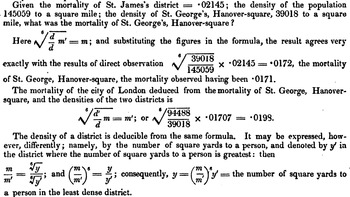
However, Angus Smith’s experiments are not the only ones speaking in favor of the zymotic theory. As we have already seen, the zymotic theory also predicted a number of other relationships, such as those between disease incidence and population density and between disease incidence and distance from sources of decomposition. Both of the latter were confirmed by Farr. First, Farr showed that “the mortality of town districts has a certain relationship to their density” (Reference Farr1842, 207). On the basis of his analyses of the data sets of a number of annual reports of the General Register Office, Farr came up with a law on which he based a number of precise predictions.Footnote 4 When he then proceeded to compare the calculated, expected mortality to that actually observed in the 30 London statistical districts, he found the results agreeing “very exactly with the results of direct observation” (208; because of space constraints, I will not discuss this result in any detail, but, for a quick flavor of the kind of law Farr put forth, see fig. 1).
Farr’s density equation (Reference Farr1842, 208).

Farr’s crowning achievement, however, was his elevation law, relating cholera mortality to soil elevation. This relation followed straightforwardly from those parts of the zymotic theory having to do with the dilution of miasma in the atmosphere. Here, what Farr did was to capture the exact relation between the decline of cholera and increased soil elevation in the form of the following equation:  (e is the elevation above the Thames high-water mark, c the average cholera mortality rate at that elevation, e′ and c′ the elevation and mortality at a higher elevation, and a a constant; Reference Farr1852, lxiii). Farr then calculated the expected series according to the formula, compared it to the actual series recorded in London, and found remarkable agreement (lxiii). Seeking further confirmation, he then proceeded to “submit the principle to another test, by comparing the elevation and the mortality from cholera of each sub-district” and found that this “entirely confirms the announced law” (xv–xvi). Finally, Farr’s predictions were also confirmed by others in different regions. For example, “William Duncan, Medical Officer of Health for Liverpool, wrote that when he grouped the districts of his city by elevation as Farr had done, that cholera mortality in the last epidemic obeyed Farr’s elevation law for Liverpool as well” (Eyler Reference Eyler1979, 228).Footnote 5
6. Meeting the New Realist Challenge
Note that all of the above predictions were use-novel: they could not have played a role in the construction of the zymotic theory since they were not even formulated by then, and, in Farr’s case, the data on which his laws were based did not even exist. As such, the zymotic theory meets all the realists’ criteria for being ‘genuinely successful’.
However, as we have seen, Vickers does not think that this is enough; in addition, he requires that it be shown that the derivation of these predictions involved ineliminable parts of derivation-internal posits that cannot be weakened. In this section, I want to argue that the zymotic theory can meet this challenge, too.
The first question is what the zymotic theory’s relevant posits are. Crucial to the derivations of the above predictions are the following three:
1. Organic matter given off by putrefying material is the exciting cause of diseases.
2. This organic matter is suspended in the air (i.e., there are miasmas).
3. This, in turn, is transmitted through the air.
Clearly, all of the above posits are derivation-internal, not derivation-external: they did not just guide practitioners’ thinking, but they were all crucially involved in making the various predictions. They were essential in the air-quality predictions confirmed by Angus Smith: if any of the above posits are taken away, the entire prediction disappears. While the second and third are directly about air quality, the first is also necessary: without specific reference to (sources of) decomposition, we lose the geographical and other location patterns and, as a result, the entire prediction about air differences. Thus, all of these posits are clearly doing work in the production of the prediction; similarly for Farr’s predictions about density and elevation. Both putrefying material as a source of miasma and air as a medium of its transmission are crucial since taking either one away makes the prediction disappear. Thus, it is clear that the above posits are doing work.
However, as we have seen, according to Vickers this is not enough—it also needs to be the case that they do not entail weaker versions of themselves, on the basis of which the prediction still goes through. Examining our three posits, we see that this, too, is the case. Ironically, the fact that the zymotists knew relatively little about the chemical makeup of the alleged miasmas is to their advantage here since, absent any specific information about the makeup of the allegedly responsible organic matter, these posits are already as weak as they can get: they effectively state that whatever is given off during decomposition is transmitted through the air and involved in causing diseases. Weakening them any more would take away either the decomposing sources or air as a medium, and, as we have already seen, both of these are necessary in order to make the predictions in the first place. Thus, since these posits cannot be weakened, they ought to count as essential parts of derivation-internal posits, according to Vickers. Moreover, they did not get retained in any way, shape, or form in the germ theory: decomposition is not responsible for disease, nor is disease material dispensed in the air, nor is the air a medium for disease transmission. But, if that is right, according to Vickers and by his own admission, we ought to have been realists about miasmas.Footnote 6
So much for miasmas, but what about zymes? Further zymotic posits we might add to the miasmatic ones above are:
1. Diseases are a type of decomposition.
2. Disease processes are analogous to processes of fermentation (which is a type of decomposition).
3. Zymotic material acts like a ferment on preexisting stuff in a victim’s blood.
Now, clearly none of these posits are necessary for the predictions we have seen since it was possible to provide derivations of these predictions without appealing to any of the zymotic posits. Thus, obviously, they are nonessential. However, even if the zymotic posits fail to be essential, note that the miasmatic posits clearly are, and that this is already enough of a problem for selective realists. After all, selective realists face trouble if essential parts of derivation-internal posits turn out to have been completely false, and the miasmatic posits fit that bill. But, of course, it is not a requirement that every (rejected) posit be essential (which is clearly not right). Thus, showing that the miasmatic posits are essential and were rejected suffices to get the realist into trouble.
More interesting, however, is the fact that even though the zymotic posits might not have been essential for making predictions, they play a different and perhaps equally important role in the zymotic theory: that of providing unifying explanations.Footnote 7 More specifically, among other things, the zymotic posits explain why there is a link between decomposition and disease (they are essentially variations of each other), why diseases vary with season and temperature (it was well known that fermentation processes are temperature sensitive), why certain diseases only occurred once (victims’ blood would run out of material to ferment), why certain diseases were childhood diseases (children’s blood was different from adults’), and why epidemics began (existence of sufficiently virulent zymotic material) and ended (lack of new victims with the appropriate blood). Finally, it had been clear for some time that disease material needed to replicate itself somehow, and fermentation processes offered an explanation of how this was possible. The various zymotic posits above can make sense of all of these at once. And, while there are no concrete predictions based directly on these posits, it is clear that the above explanations disappear without zymosis. Thus, while zymotic material might not have been primarily responsible for the theory’s predictive success, it was certainly crucially implicated in the theory’s explanatory success. Without the fermentation aspect of zymosis, the entire disease mechanism would have disappeared, and with it disease pathology. Moreover, without it, the link between diseases and decomposition would have been lost, and, as we have seen, without decomposition, the predictions of the zymotic theory disappear, too.Footnote 8
7. Conclusion
What, then, is the upshot of this case? What is clear is that the zymotic theory made use-novel predictions, such as those about air quality and Farr’s predictions about elevation and density. Miasmatic posits were essential derivation-internal working posits that, further, could not be weakened and so, according to Vickers, deserved realist commitment. Yet, they were rejected, and no miasmatic posits, as we have seen, were carried over to the germ theory. Zymotic posits were not involved in the predictions in these crucial ways but were essential to the theory’s explanatory power since taking away zymosis left a disease theory without a disease mechanism, without a pathology, and without any explanation of many of the well-known disease phenomena that needed accounting for, including the all-important link to decomposition. Thus, even modern, sophisticated selective realist accounts such as that of Vickers cannot meet the historical objection that underlies the PMI. Realism remains in as much trouble as ever, at least on this front.