INTRODUCTION
Small patches are the most obvious result of forest habitat fragmentation which affects the availability of refuges and food resources for many species (Fahrig Reference FAHRIG2003, Vetter et al. Reference VETTER, HANSBAUER, VEGVARI and STORCH2011), reducing long-term population viability (Laurance et al. Reference LAURANCE, LOVEJOY, VASCONCELOS, BRUNA, DIDHAM, STOUFFER, GASCON, BIERREGAARD, LAURANCE and SAMPAIO2002, Vetter et al. Reference VETTER, HANSBAUER, VEGVARI and STORCH2011). The fauna of habitat patches within an anthropogenic landscape matrix are more vulnerable to direct human impacts, such as hunting, risk of mortality from collisions with vehicles and disturbance due to noise and light (Laurance et al. Reference LAURANCE, GOOSEM and LAURANCE2009, van der Ree et al. Reference VAN DER REE, SMITH, GRILO, van der Ree, Smith and Grilo2015).
Many primate populations that occur in forest fragments of only a few hectares are at high risk of local extinction (Harcourt & Doherty Reference HARCOURT and DOHERTY2005, Marsh Reference MARSH, Marsh and Chapman2013). In particular, obligate arboreal species are vulnerable to fragmentation because they usually avoid going down to the ground or crossing clearings (Mandujano et al. Reference MANDUJANO, ESCOBEDO-MORALES and PALACIOS-SILVA2004, Pozo-Montuy & Serio-Silva Reference POZO-MONTUY and SERIO-SILVA2007, Wilson et al. Reference WILSON, MARSH and WINTER2007, van der Ree et al. Reference VAN DER REE, CESARINI, MOORE and TAYLOR2010).
However, in a municipal park in Belo Horizonte, state of Minas Gerais, Brazil, the black-tufted marmoset (Callithrix penicillata) persists in a forest fragment of approximately 18 ha surrounded by urban environment (Duarte & Young Reference DUARTE and YOUNG2010, Duarte et al. Reference DUARTE, VECCI, HIRSCH and YOUNG2011). Two hypotheses have been put forward to explain this occurrence. First, the black-tufted marmoset may have been present in the region before human occupation, but became tolerant of disturbance and persisted when those areas were impacted by anthropic activities. Alternatively, this species has moved to anthropic areas by taking advantage of fewer competitors, lower predation risk and potentially greater access to foods provided by humans than in continuous and undisturbed areas. In this scenario, cross-habitat spillover might occur, which is characterized by the movement of individuals from natural and continuous forests to anthropic areas such as urban zones (Blitzer et al. Reference BLITZER, DORMANN, HOLZSCHUH, KLEIN, RAND and TSCHARNTKE2012, Ricketts et al. Reference RICKETTS, REGETZ, STEFFAN-DEWENTER, CUNNINGHAM, KREMEN, BOGDANSKI, GEMMILL-HERREN, GREENLEAF, KLEIN, MAYFIELD, MORANDIN, OCHIENG and VIANA2008, Thies & Tscharntke Reference THIES and TSCHARNTKE1999). Such movements are usually associated with the spatial characteristics of the resources in fragmented landscapes, which may favour the occurrence of this phenomenon (Collinge Reference COLLINGE2009, Dunning et al. Reference DUNNING, DANIELSON and PULLIAM1992).
To clarify the apparent tolerance of the black-tufted marmoset to anthropogenic and fragmented environments, we evaluated the area preferentially used within forest fragments located at varying distances from roads and urban areas in southern Minas Gerais state, south-eastern Brazil. More specifically, we examined the role of vegetation, human disturbance and habitat spatial configuration in explaining black-tufted marmoset occurrence and distribution within forest fragments. We tested the following hypothesis: the black-tufted marmoset will preferentially occupy forest fragments close to roads and urban areas (ignoring disturbances) compared with habitats far from these anthropogenic areas, thus providing a case of cross-habitat spillover.
METHODS
Study species
The black-tufted marmoset (Callithrix penicillata) is considered a tolerant species to anthropogenic and fragmented environments (Miranda & Faria Reference MIRANDA and FARIA2001, Rylands Reference RYLANDS1996). This species has a wide geographic distribution in eastern Brazil, extending from the states of Maranhão and south-east Piauí to the north of São Paulo, predominantly occupied by savanna (Rylands Reference RYLANDS1996). These monkeys live in groups ranging from three to 15 individuals in natural environments (Miranda & Faria Reference MIRANDA and FARIA2001, Ruiz-Miranda et al. Reference RUIZ-MIRANDA, AFFONSO, MORAIS, VERONA, MARTINS and BECK2006, Vilela & Faria Reference VILELA and FARIA2004), with home-range areas that can vary dramatically as a function of food resource distribution (Vilela Reference VILELA2007, Vilela & Del-Claro Reference VILELA and DEL-CLARO2011).
Study area
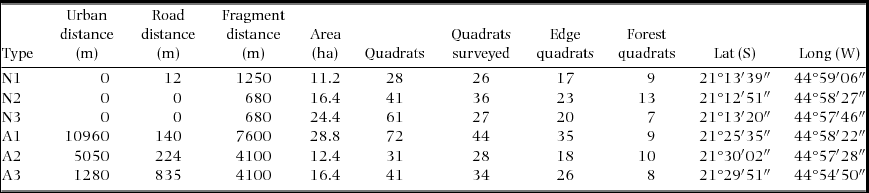
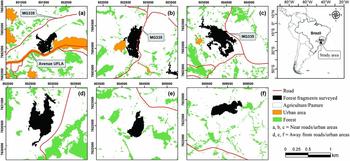
We conducted this study in six forest fragments located in southern Minas Gerais state, south-eastern Brazil (Table 1, Figures 1, 2). The study area was located in a transition region between Atlantic forest and savanna, comprised of forest fragments (closed canopy) and woodlands (open canopy) embedded in an anthropogenic matrix of scrub and open grasslands (Dalanesi et al. Reference DALANESI, OLIVEIRA-FILHO and FONTES2004).
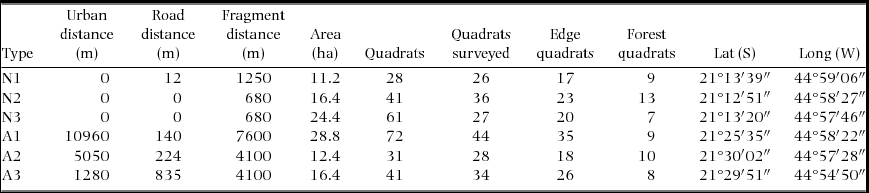
Characteristics of the forest fragments in southern Minas Gerais state, Brazil, used as sample replicates in relation to the occurrence of Callithrix penicillata during the study period from October 2012 to August 2013. Type (N – near roads and urban areas; A – away from roads and urban areas); Urban distance (distance from the nearest urban area); Road distance (distance from the nearest road); Fragment distance (minimum distance to another surveyed forest fragment); Area (area of a fragment); Quadrats (total number of quadrats within a fragment); Quadrats surveyed (number of surveyed quadrats for black-tufted marmoset presence in each fragment); Edge quadrats (number of surveyed edge quadrats); Forest quadrats (number of surveyed forest-interior quadrats); Lat (latitude); Long (longitude).
Study area and location of each forest fragment in southern Minas Gerais state, south-eastern Brazil: N1 (a), N2 (b), N3 (c); A1 (d), A2 (e), A3 (f).

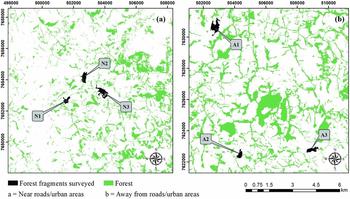
Spatial arrangement of each group of forest fragments sampled in their respective regions in southern Minas Gerais state, Brazil: N1, N2, N3 (a); A1, A2, A3 (b).

After the pre-monitoring of marmoset groups continuously for 5 mo prior to the study period, we selected six sampling fragments post habituation of the groups. The differentiation of groups was accomplished through the individualization of marmosets (identification of unique physical characteristics, such as a cut tail and skin scars), and observing the number of individuals that were present at the same time in each sampled group in each forest fragment. The proportion of males and females, both adults and juveniles, from each group also helped differentiate them.
Three of the selected fragments were in contact with urban areas, with an average distance of 4 m from the nearest road (Table 1, Figure 1). One fragment is near the main thoroughfare into the campus of the Federal University of Lavras, while the others are close to the MG-335 highway, which connects the cities of Lavras and Ijaci (Figure 1). An estimate showed that 13000 university students and staff use the thoroughfare daily to reach the campus by vehicle, while the MG-335 segment between Lavras and Ijaci has an annual average daily traffic of 2225 vehicles. The other three selected fragments were located exclusively in the rural area of Luminárias City (mainly occupied by farms), with an average distance of 400 m from the nearest road (Table 1, Figure 1), which corresponds to a distance greater than the minimum diameter of the black-tufted marmoset's home-range size (0.4 ha according to Zago et al. Reference ZAGO, MIRANDA, SANTOS, PASSOS and SIMÕES-LOPES2014). The minimum distance among near-the-road (N) and away-from-the-road (A) fragments was 21 km (Figure 2).
The individual identification of some marmosets allowed the estimation of at least one distinct group per fragment, with group sizes ranging from seven to 15 distinct individuals recognized throughout the sampling campaigns. Although the same individuals were present in the forest fragments throughout the entire study period, in three of the six groups (N1, N2, N3), we confirmed the birth of two infants during the monitoring months, thus increasing the total number of individuals in these groups.
Surveys of black-tufted marmoset
We used 0.4-ha quadrats (64 × 64 m) as survey units within the forest fragments. A minimum of 50% vegetation cover was required for a quadrat to be considered a survey unit. Quadrats with at least one of their edges bordering an open area (such as landscape matrix or large clearings inside the fragment) were classified as edge quadrats. Quadrats with no borders with open areas were classified as forest quadrats (Table 1).
Over 11 mo, six sampling campaigns were conducted in each fragment between October 2012 and August 2013, totalling 432 h of observation (72 h per fragment): 1 – October–November 2012, 2 – December 2012, 3 – January–February 2013, 4 – March–May 2013, 5 – June–July 2013, and 6 – August 2013. Differences in the number of species presence records in both edge and forest quadrats between the climatic seasons were assayed using the chi-square test.
During a sampling campaign, we conducted two surveys in each fragment consisting of two 6-h periods of active visual search (06h00–12h00 and 12h00–18h00) (adapted from Santos et al. Reference SANTOS, BUENO and CASELLA2013). In each quadrat, we looked for signs of the presence of black-tufted marmoset, which was only confirmed by in situ direct observation. We could not have used a method based on vocalizations alone, as that would not have provided accurate information regarding the exact quadrat from which the individual was vocalizing.
When one individual was detected in a quadrat, the observer recorded the geographic position using a GPS system. The search was resumed only after a 30-min delay from the last detection, which is the time-interval necessary to avoid temporal autocorrelation and for individuals to begin behaving normally (H. Secco, pers. obs.). As our interest only concerns the preference zones of exploitation by marmosets within the fragments, detection cases of the same individual after 30 min of waiting were also considered in the data analysis. An absence in the quadrat was considered when no trace of the species was detected after 30 min of searching.
Attributes of the quadrats in forest fragments
Each quadrat was characterized by three types of variable: vegetation, human disturbance and spatial configuration of fragments. Vegetation was described in terms of mean distance among trees and mean canopy cover. These variables were measured according to an adapted version of the point-quadrat technique (Dorneles & Waechter Reference DORNELES and WAECHTER2004). On the basis of the centre of the quadrat, the observer selected one tree with a minimum girth at breast height (gbh) of 10 cm as a reference landmark and then proceeded along the four cardinal directions (north, south, east and west) until another tree with a minimum gbh of 10 cm was encountered. The observer measured the distance among the trees along the other three cardinal directions, and evaluated the canopy cover among these trees. We estimated the percentage of canopy cover on the basis of the visual evaluation of the trees in the quadrat using a square frame subdivided into 100 equally sized squares. We performed four measurements (north, south, east and west) for the distance among trees (m) and canopy cover (%) in each quadrat, after which we considered the average of these measurements as representative of the variable value.
Human disturbance was defined by the distance of the centroid of each quadrat to the road (m), the distance between the centroid to the fragment edge (m), and the fragment edge type. The fragment edge type corresponded to the matrix type in contact with the nearest edge of the quadrat (road, unpaved road, house, pasture or agricultural field).
Spatial configuration of forest fragments included the spatial autocorrelation index and quadrat category. The Moran autocorrelation descriptor (Zscore) was used to evaluate the spatial bias effect of observations among quadrats. To quantify this variable and minimize the size effect of forest fragments, we developed an index of presence considering sampling effort in each quadrat. This presence index was calculated by dividing the total number of marmoset presence records by the number of surveys in each quadrat. This index ranged from 0 (absence) to 1 (presence in all surveys). The Moran index considers the relationship between the presence index of each quadrat and the distance between them (from the centroid). Zscore values over 1.96 (concentration) or below −1.96 (dispersion) indicate significant spatial autocorrelation in a quadrat (Li et al. 2007). The Moran autocorrelation descriptor for the quadrats in each fragment was calculated using ArcGis 10.1 software. The quadrat category refers to the position of the quadrat within the fragment (edge or forest) together with two fragment types (near or away from roads and urban areas).
Data analysis
We used generalized linear mixed models (GLMM) to examine which variables explain the occurrence of black-tufted marmoset as well as their spatial occurrence within fragments. The response variable was the number of records in each quadrat in all surveys. Thus, we used the Poisson distribution for the response variable (Bolker et al. Reference BOLKER, BROOKS, CLARK, GEANGE, POULSEN, STEVENS and WHITE2008, Zuur et al. Reference ZUUR, IENO, WALKER, SAVELIEV and SMITH2009).
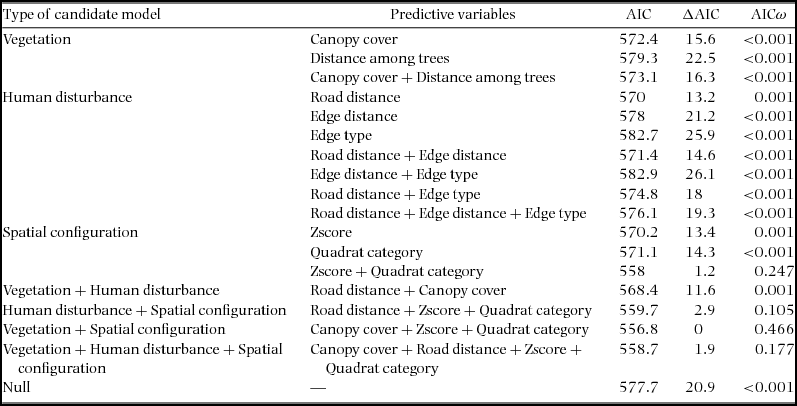
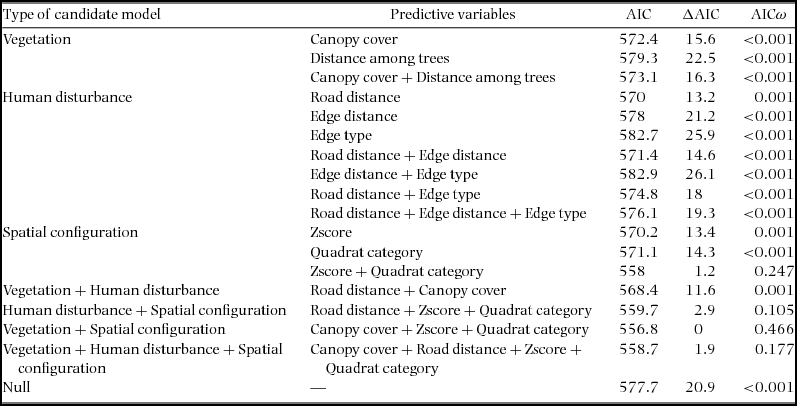
We defined seven candidate models, each considering one hypothesis that could explain the occurrence of black-tufted marmoset in the preferential quadrats of the fragments (Table 2): (1) vegetation (mean distance among trees in a quadrat, and/or average canopy cover in the quadrat) alone explains marmoset occurrence; (2) only human disturbance (distance from quadrat to the road, distance from quadrat to the fragment edge, and/or closest edge type) affects marmoset occurrence; (3) only spatial configuration (spatial autocorrelation of quadrats and/or position of the quadrat and fragment type) influences marmoset occurrence; (4) the combination of vegetation and human disturbance explains marmoset occurrence; (5) the combination of human disturbance and spatial configuration affects marmoset occurrence; (6) both vegetation and spatial configuration influence marmoset occurrence; and (7) the combination of the three types of variable explain marmoset occurrence.
GLMM parameters of the candidate models describing the habitat selection by Callithrix penicillata in quadrats within the forest fragments, in southern Minas Gerais state, Brazil: AIC (Akaike information criterion), ΔAIC (AICi –AICmin), AICω (Akaike weight). Canopy cover (mean canopy cover in sampled quadrat – %); Distance among trees (mean distance among trees in sampled quadrat – m); Road distance (distance of the centroid of the sampled quadrat to the road – m); Edge distance (distance between the centroid of the sampled quadrat to the fragment edge – m); Edge type (matrix type in contact with the nearest edge of the sampled quadrat); Zscore (Moran spatial autocorrelation descriptor of the sampled quadrat); Quadrat category (edge – sampled quadrat located in the fragment edge, or forest – sampled quadrat located in the interior of the fragment; near – near urban areas and roads, or away – away from urban areas and roads).
Due to spatial pseudoreplication, quadrats and fragments were included as random effect variables in the GLMM analysis (Millar & Anderson Reference MILLAR and ANDERSON2004). Controlling for these random effects was important due to our lack of knowledge concerning the history of the sampled areas. Multicollinearity of predictor variables was evaluated using the Variance Inflation Factor (VIF) (Hugueny Reference HUGUENY1989), for which high collinearity occurs when VIF is above 3 (Zuur et al. Reference ZUUR, IENO, WALKER, SAVELIEV and SMITH2009). The Akaike information criterion (AIC) was used to rank the candidate models. For each group of variables, we chose the best model to be evaluated in combination with other variable groups (hypotheses 4 to 7). We considered the models with ΔAIC values ≤ 2 as having the best descriptive ability (Burnham & Anderson Reference BURNHAM and ANDERSON2002). When there was more than one model with a ΔAIC value ≤ 2 we used model averaging to calculate parameter estimates and standard errors. We used the ‘car’ package to assess collinearity between exploratory variables, and the function ‘glmer’ in the ‘lme4’ package of the R environment to perform the GLMM analysis. We employed quantile-quantile plots to evaluate model accuracy.
RESULTS
We recorded a total of 178 presences of black-tufted marmoset considering all surveys. We documented 147 presence records in near-the-road fragments (103 edge/44 forest), and 31 in away-from-the-road fragments (19 edge/12 forest). We observed black-tufted marmoset in 63 out of the 274 quadrats within the six forest fragments. The number of marmoset records throughout the sampling period were independent of season, both in edge and forest quadrats (χ2 = 5.79, P = 0.122).
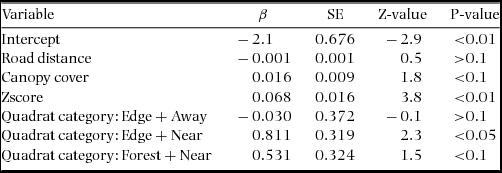
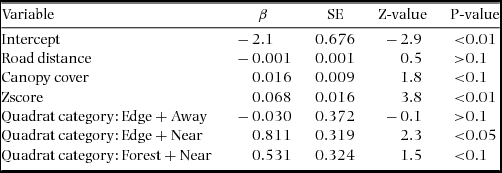
The collinearity between variables did not exceed a VIF value of 2.21. Three models best explained the occurrence of black-tufted marmoset within the fragments (ΔAIC ≤ 2) (Table 2), which included the following variables: Canopy cover, Road distance, Zscore and Quadrat category. The averaged model shows significant positive associations of edge quadrats in near-the-road fragments (β = 0.811; P-value < 0.05) and Zscore (β = 0.068; P-value < 0.01) with the occurrence of the black-tufted marmoset (Table 3).
Parameters of the variables included in the averaged model explaining the habitat selection by Callithrix penicillata in quadrats of near-the-road and away-from-the-road forest fragments, in southern Minas Gerais state, Brazil: β = regression coefficient: SE = standard error, Z-value = Z test, P-value = significance in the Z test.
DISCUSSION
Our results reveal a positive effect of disturbed areas on species occurrence. The black-tufted marmoset was more likely to occur in forest fragments near anthropogenic areas. Moreover, we found a clear preference for forest fragment edges near roads and urban areas. We argue that the black-tufted marmoset can be considered a ‘winner’ species by successfully adapting to habitat modification incurred from human activities such as deforestation and urbanization, increasing its distribution range (see also McKinney & Lockwood Reference MCKINNEY and LOCKWOOD1999, Rylands & Faria Reference RYLANDS, FARIA and Rylands1993).
Interior areas of forest fragments have been regarded as high-quality habitat for primates due to the short distances among trees and high canopy cover (Arroyo-Rodríguez & Mandujano Reference ARROYO-RODRÍGUEZ and MANDUJANO2006, Jennings et al. Reference JENNINGS, BROWN and SHEIL1999), as well as the reduced exposure to predators compared with that in edge environments (Andrén Reference ANDRÉN, Hansson, Fahrig and Merrian1995, Paton Reference PATON1994). However, black-tufted marmoset seem to prefer external quadrats during activity (especially while foraging), which may be related to the ease of accessing food resources at the edges (Hartley & Hunter Reference HARTLEY and HUNTER1998, Pontes & Soares Reference PONTES and SOARES2005), even being vulnerable to predators.
In fact, black-tufted marmoset tend to occur in areas where essential resources for survival are available, namely trees that offer shelter, fruit or exudates (Miranda & Faria Reference MIRANDA and FARIA2001, Passamani Reference PASSAMANI1996, Vilela & Del-Claro Reference VILELA and DEL-CLARO2011). We observed bite marks on the trunks of several gum trees at the edges of all surveyed fragments (Canale et al. Reference CANALE, BRAGA, GONDIM, SANTEE, Ferrari and Rimoli2008, Miranda & Faria Reference MIRANDA and FARIA2001, Vilela Reference VILELA2007, Vilela & Faria Reference VILELA and FARIA2004), including areas with roads and urban disturbances.
Similarly, Lacher et al. (Reference LACHER, GUSTAVO, DA FONSECA, ALVES and MAGALHAES-CASTRO1984) have shown that in situations where marmosets are restricted to small vegetated areas, such as riparian forests, groups can survive by feeding mostly on the exudates of gum trees, which may be considered a parasitic relationship. Considering the importance that gum trees have for the survival of groups inhabiting isolated forest fragments (Digby et al. Reference DIGBY, FERRARI, SALTZMAN, Campbell, Fuentes, MacKinnon, Panger and Bearder2007), marmosets tend to centre their use area around key trees in their diet (Scanlon et al. Reference SCANLON, CHALMERS and DA CRUZ1989, Stevenson & Rylands Reference STEVENSON, RYLANDS, Mittermeier, Rylands, Coimbra Filho and Da Fonseca1988, Vinyard et al. Reference VINYARD, WALL, WILLIAMS, MORK, ARMFIELD, MELO, VALENÇA-MONTENEGRO, VALLE, OLIVEIRA, LUCAS, SCHMITT, TAYLOR, HYLANDER, Ford, Porter and Davis2009). These preferential trees are typical of edge environments, which induce marmosets to exploit these areas more intensely (Passamani & Rylands Reference PASSAMANI and RYLANDS2000).
Establishing territories in the localities with the highest concentration of gum trees (which may represent more than 70% of their energy source in critical periods) allows a group to monopolize key trees which other groups or species may also want to exploit (Thompson et al. Reference THOMPSON, ROBL, DE OLIVEIRA MELO, VALENÇA-MONTENEGRO, VALLE, DE OLIVEIRA and VINYARD2013). This may reduce the cost of larger daily movements towards other food resources that could be dispersed spatially and temporally (e.g. fruit trees). This result highlights the importance of gummivory for the persistence of black-tufted marmoset groups in small forest fragments (less than 28.8 ha), which is even more pronounced in urbanized regions, where marmosets contend with a limited supply of resources and intense anthropogenic disturbances (e.g. contact with roads). Therefore, we have shown that groups with up to 15 individuals survive in these fragments by exploring edge quadrats most of the time.
Furthermore, under severe conditions of geographic isolation, there is evidence that the black-tufted marmoset develops adaptive foraging and movement behaviours (Teixeira et al. Reference TEIXEIRA, HIRSCH, GOULART, PASSOS, TEIXEIRA, JAMES and YOUNG2015). The ecological plasticity may allow this species to move among forest fragments or to reach individual trees that produce fruit at distinct times of the year. We also observed that the black-tufted marmoset adopts regular travel routes towards a specific food resource, and when some individuals explore a resource in a given area other members of the same group spread across surrounding quadrats.
Changes in primate behaviour in response to habitat degradation have been reported in regions undergoing intense fragmentation (Clarke et al. Reference CLARKE, COLLINS and ZUCKER2002), where individuals can explore forest edges more strictly (Pozo-Montuy & Serio-Silva Reference POZO-MONTUY and SERIO-SILVA2007). For example, in a Chinese region bisected by roads, the black snub-nosed monkey Rhinopithecus bieti (Clauzel et al. Reference CLAUZEL, DENG, WU, GIRAUDOUX and LI2015) moved daily among foraging areas scattered in the matrix. The clear preference for disturbed fragments and for forest fragment edges in the vicinity of roads and urban areas may be an indication of cross-habitat spillover. Regions with high landscape complexity provides opportunities for resource complementation for different species (Tscharntke et al. Reference TSCHARNTKE, TYLIANAKIS, RAND, DIDHAM, FAHRIG, BATARY, BENGTSSON, CLOUGH, CRIST, DORMANN, EWERS, FRUND, HOLT, HOLZSCHUH, KLEIN, KLEIJN, KREMEN, LANDIS, LAURANCE, LINDENMAYER, SCHERBER, SODHI, DEWENTER, THIES, VAN DER PUTTEN and WESTPHAL2012). Movements from natural habitat patches to anthropogenic habitats (cross-habitat spillover), in search of complementary resources (mainly food), was also observed in some other terrestrial vertebrates, such as birds and bats (Ethier & Fahrig Reference ETHIER and FAHRIG2011, Tubelis et al. Reference TUBELIS, LINDENMAYER and COWLING2004).
Therefore, as these tolerant species expand their foraging areas beyond natural habitat patches, a large population can be supported in heterogeneous matrixes with presence of secondary forests (Garmendia et al. Reference GARMENDIA, ARROYO-RODRÍGUEZ, ESTRADA, NARANJO and STONER2013, Smith et al. Reference SMITH, FAHRIG and FRANCIS2011). In these regions, tolerant frugivorous species play a key role in the maintenance and dispersal of tree seeds from natural to highly fragmented and anthropogenic environments (Chapman & Russo Reference CHAPMAN and RUSSO2007, Ingle Reference INGLE2003). Without the involvement of these species, seed dispersal dynamics would be restricted to the area in which the trees occur (in isolated forest fragments) (Lozada et al. Reference LOZADA, DE KONING, MARCHÉ, KLEIN and TSCHARNTKE2007).
However, organisms that move across different habitats can be a threat to other species due to an increase in predation and competition rates or the introduction of pathogens and diseases (Batáry & Báldí Reference BATÁRY and BÁLDÍ2004, Rand & Tscharntke Reference RAND and TSCHARNTKE2007, Zhang et al. Reference ZHANG, RICKETTS, KREMEN, CARNEY and SWINTON2007). An example of a threat to another species caused by the expansion of black-tufted marmoset (Callithrix penicillata) and white-tufted marmoset (Callithrix jacchus) is that occurring in the state of Rio de Janeiro (Brazil) where, decades ago, marmosets were originally introduced into a few areas that overlapped with the golden lion tamarin (Leontopithecus rosalia) (Ruiz-Miranda et al. Reference RUIZ-MIRANDA, AFFONSO, MORAIS, VERONA, MARTINS and BECK2006). Since then, the resources of the native species have been restricted by the expansion of marmoset territorial occupation into other areas, as they are better competitors than the golden lion tamarin and also more tolerant of fragmentation and anthropic disturbances (Morais et al. Reference MORAIS, RUIZ-MIRANDA, GRATIVOL, DE ANDRADE, LIMA, MARTINS, BECK, Oliveira, Grativol and Ruiz Miranda2008).
Thus, additional research is still needed to better understand the mechanisms underlying the response of black-tufted marmoset to habitat fragmentation. For example, in forests near rural areas, the presence of hunters (marmosets are often a target) may be common (de la Torre et al. Reference DE LA TORRE, SNOWDON and BEJARANO2000, Peres Reference PERES2000), while in urban forest fragments only a restricted number of species may be able to survive (potential competitors or predators of marmosets) (Møller et al. 2009, Savard et al. Reference SAVARD, CLERGEAU and MENNECHEZ2000). Thus, evaluating historical hunting pressures, predator–prey interactions and intra/interspecific competition is crucial to clarify the observed movement patterns of black-tufted marmoset groups in disturbed landscapes (Alexandrino et al. Reference ALEXANDRINO, LUZ, MAGGIORINI and FERRAZ2012, Galetti et al. Reference GALETTI, BOVENDORP, FADINI, GUSSONI, RODRIGUES, ALVAREZ, GUIMARÃES and ALVES2009, Johnson et al. Reference JOHNSON, KAMILARIS, CARTER, CALOGERO, GOLD and CHROUSOS1996, Lyra-Neves et al. Reference LYRA-NEVES, OLIVEIRA, TELINO-JÚNIOR and SANTOS2007, Miranda & Faria Reference MIRANDA and FARIA2001).
ACKNOWLEDGEMENTS
The authors thank all the researchers who offered their assistance in collecting field data, and in particular Hariagnes Oliveira and Paula D'Anunciação. We also thank Nathalia Carvalho and Luis Felipe Farina for her assistance with the spatial analysis and map development. We are grateful for the financial support provided by the Fundação de Amparo à Pesquisa do Estado de Minas Gerais – FAPEMIG (Process CRA – PPM-00139-14; 453 and CRA – APQ-03868-10), Conselho Nacional de Desenvolvimento Científico e Tecnológico – CNPq (Process 303509/2012-0), Fundação Grupo Boticário (Process 0945–20122), and Tropical Forest Conservation Act – TFCA (through Fundo Brasileiro para Biodiversidade – FUNBIO).