1. Introduction
The latest Cretaceous (Campanian–Maastrichtian) southern Tethyan platform of the Middle East and North Africa has an abundant and well-documented record of fossil marine reptiles. Currently, the richest assemblages have been reported from the phosphate basins of Morocco (e.g. Arambourg, Reference Arambourg1952; Bardet et al. Reference Bardet, Pereda Suberbiola, Iarochène, Bouyahyaoui, Bouya and Amaghzaz2004, Reference Bardet, Pereda Suberbiola, Iarochène, Amalik and Bouya2005a,b), and the eastern Mediterranean regions of Egypt (e.g. Werner & Bardet, Reference Werner and Bardet1996; Lapparent de Broin & Werner, Reference Lapparent de Broin and Werner1998), Palestine and Negev (e.g. Raab, Reference Raab1963; Christiansen & Bonde, Reference Christiansen and Bonde2002; Lewy & Gaffney, Reference Lewy and Gaffney2005), Jordan (recently summarized by Bardet & Pereda Suberbiola, Reference Bardet and Pereda Suberbiola2002) and Syria (Bardet et al. Reference Bardet, Cappetta, Pereda Suberbiola, Mouty, Al Maleh, Ahmad, Khrata and Gannoum2000). Fragmentary remains are also known from contemporary deposits in the Arabian Peninsula–Iraq region (Arambourg et al. Reference Arambourg, Dubertret, Signeux and Sornay1959).
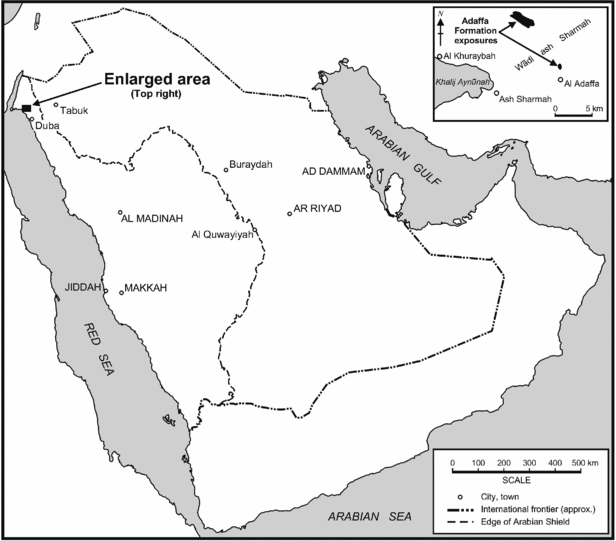
In 2004, a palaeontological research team from the Saudi Geological Survey recovered vertebrate bone debris and fossil wood fragments from a series of limonitic sandstone cuestas in the vicinities of Aynunah and Wadi Azlam, both north of Duba on the Red Sea coast, NW Saudi Arabia (Fig. 1). Subsequent collecting in 2005 and 2006 yielded further material, including some diagnostic elements attributable to marine turtles, crocodiles, plesiosaurs and aquatic lizards (mosasaurs and small varanoids). Dinosaur, bony fish and shark fossils were also found at the site but are the subject of separate studies.
Map of the Arabian Peninsula showing geographical location of the field study area (enlarged) relative to the Palaeozoic Arabian Shield boundary and approximate international borders.

The Phanerozoic sedimentary sequences around Aynunah and Wadi Azlam have been extensively surveyed for their petroleum potential. They comprise part of a widely distributed Late Cretaceous to Neogene succession deposited in troughs of the Maqnah massif and Ifal Basin in the SE Midyan region between the Gulf of Aqaba and Red Sea (Remond & Teixido, Reference Remond, Teixido, with the collaboration of Motti, Vasquez-Lopez, Vial and Villemur1980; Clark, Reference Clark1986; Hughes et al. Reference Hughes, Perincek, Grainger, Abu-Bshait and Jarad1999; Hughes & Johnson, Reference Hughes and Johnson2005). Clark (Reference Clark1986) defined the Late Cretaceous rocks at these localities as the Adaffa Formation, named after the small village of Adaffa in Wadi ash Sharmah; see Clark (Reference Clark1986, p. 5, fig. 3) for a detailed locality map.
Previous records of vertebrate fossils from the Adaffa Formation include a titanosaurid sauropod bone and indeterminate turtle shell fragments described in a confidential Saudi Aramco report ‘A. Milner, N. Morris & P. Jeffery, unpub. report, Natural History Museum, London, 1993’, and recently summarized by Hughes & Johnson (Reference Hughes and Johnson2005). Material subsequently recovered from the Adaffa Formation was assessed in 2006–2007 as part of a joint Saudi–Australian vertebrate palaeontology research program. This paper describes the marine reptile remains, the first documented Late Cretaceous assemblage from Saudi Arabia (the only other record is a reworked plesiosaur tooth fragment from the Paleocene–Eocene Lina Member of the Aruma Formation, NE Saudi Arabia: Thomas et al. Reference Thomas, Roger, Halawani, Memesh, Lebret, Bourdillon, Buffetaut, Cappetta, Cavelier, Dutheil, Tong and Vaslet1999), and discusses their potential palaeobiogeographical relationships.
2. Geological setting
The Late Cretaceous Adaffa Formation is a thick (up to 200 m) accumulation of yellow to pale reddish cross-bedded quartz arenite sandstone grading upwards to thin marl, siltstone and fine-grained sandstone beds (Remond & Teixido, Reference Remond, Teixido, with the collaboration of Motti, Vasquez-Lopez, Vial and Villemur1980; Clark, Reference Clark1986; Hughes et al. Reference Hughes, Perincek, Grainger, Abu-Bshait and Jarad1999; Hughes & Johnson, Reference Hughes and Johnson2005). A conglomeritic layer containing granite cobbles and phosphatic nodules forms the base of the sequence; ferricrete/silcrete horizons are locally abundant in areas of epigenetic enrichment (Remond & Teixido, Reference Remond, Teixido, with the collaboration of Motti, Vasquez-Lopez, Vial and Villemur1980; Clark, Reference Clark1986; Hughes et al. Reference Hughes, Perincek, Grainger, Abu-Bshait and Jarad1999; Hughes & Johnson, Reference Hughes and Johnson2005). The Adaffa Formation forms the lowermost unit of the Late Cretaceous to Palaeogene Suqah Group, a series of pre-Red Sea rift strata that extend from the Usfan region in the Jiddah Basin, north into the Ifal Basin of the Mydian region, NW Saudi Arabia (Filatoff & Hughes, Reference Filatoff and Hughes1996; Hughes et al. Reference Hughes, Perincek, Grainger, Abu-Bshait and Jarad1999; Hughes & Johnson, Reference Hughes and Johnson2005). Filatoff & Hughes (Reference Filatoff and Hughes1996, p. 539, fig. 2) and Hughes & Johnson (Reference Hughes and Johnson2005, p. 57, fig. 5) have published detailed stratigraphical columns showing the disposition of Suqah Group units in the Red Sea area.
The Adaffa Formation has been correlated with lower Campanian to lower Maastrichtian strata on the basis of pollen and dinoflagellate remains (Filatoff & Hughes, Reference Filatoff and Hughes1996). It represents the oldest Suqah Group unit cropping out in the Midyan and rests unconformably on Proterozoic basement rocks of the Arabian Shield. The uppermost layers of the Adaffa Formation are thought to contact strata of the middle Tertiary Tayran Group (Sharik Formation sensu Clark, Reference Clark1986); however, this boundary is poorly defined and largely obscured by Quaternary sands and gravels (Hughes et al. Reference Hughes, Perincek, Grainger, Abu-Bshait and Jarad1999; Hughes & Johnson, Reference Hughes and Johnson2005). In the Aynunah and Wadi Azlam areas (SE Midyan), the Adaffa Formation mainly occupies basement lows in the Maqnah massif and two small graben structures called the Sharmah and Aynunah troughs (sensu Remond & Teixido, Reference Remond, Teixido, with the collaboration of Motti, Vasquez-Lopez, Vial and Villemur1980). Macrofossils from these outcrops are found in thin limonitic beds towards the top of the main sandstone sequence. Lithological features together with palynological evidence suggest deposition under marginal marine conditions, probably linked to minor transgressive episodes extending southeast from the Gulf of Suez (Brown, Reference Brown1970; Filatoff & Hughes, Reference Filatoff and Hughes1996). The frequent occurrence of non-marine vertebrate remains, including dinosaur bones, ceratodont lungfish toothplates, together with large quantities of wood, support this inferred close proximity to land. Coarse clastic sediments form the remaining bulk of the Adaffa Formation and are thought to derive from coastal (predominantly supratidal) outlet channels emptying a moderately high-energy braided river complex possibly fed by flash-flood events (Filatoff & Hughes, Reference Filatoff and Hughes1996).
3. Survey of the marine reptile material
The Adaffa Formation marine reptile remains are represented by isolated bones and teeth. Most of the specimens are indeterminate fragments and exhibit extensive surface corrosion (e.g. edge rounding) consistent with damage by wave action and/or currents prior to burial. Typically, individual elements do not occur within concentrated masses (e.g. bone beds) but are randomly distributed throughout the exposed horizons. All of the fossil material is housed in the Paleontological Collection of the Saudi Geological Survey (SGS), Jiddah, Kingdom of Saudi Arabia.
3.a. Chelonians
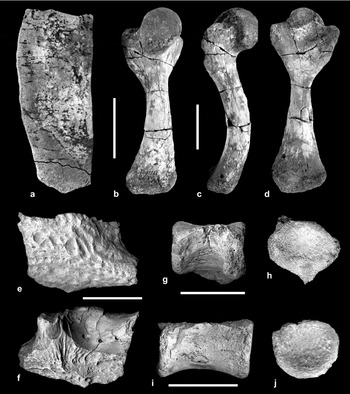
The current collection of Adaffa Formation marine turtle remains includes mainly indeterminate shell fragments and a femur attributable to the marine-littoral pleurodiran group Bothremydidae. The frequently recovered shell pieces are thick (up to approximately 20 mm) with a smooth surface that displays no distinct dorsal ornamentation. A large section (105.4 mm long) comprising two incomplete fused plates (SGS 004-10; Fig. 2a) with an acutely angled edge and flat, slightly eroded surface probably represents part of a posterior plastron (see Gaffney, Tong & Meylan, Reference Gaffney, Tong and Meylan2006 for comparisons). The large femur (128.6 mm long; SGS 006-84; Fig. 2b–d) has a sigmoid diaphysis and evidence of an intertrochanteric fossa present between the distal tibia and fibula facets. Bardet et al. (Reference Bardet, Cappetta, Pereda Suberbiola, Mouty, Al Maleh, Ahmad, Khrata and Gannoum2000) reported a closely comparable specimen from the Maastrichtian phosphates of Syria and attributed it to a ‘Nigeremys group’ bothremydid (incorporated into Taphrosphyini sensu Gaffney, Tong & Meylan, Reference Gaffney, Tong and Meylan2006).
Chelonian and crocodyliform remains from the Adaffa Formation of Saudi Arabia. (a) Bothremydid plastron fragment with highlighted inter-plate suture (SGS 004-10) in ventral view. Bothremydid right femur (SGS 006-84): (b) ventral; (c) lateral; (d) dorsal views. Crocodyliform cranial fragment (SGS 004-32): (e) dorsal; (f) ventral views. Dyrosaurid cervical centrum (SGS 006-204): (g) lateral; (h) anterior views. Dyrosaurid dorsal centrum (SGS 006-16): (i) lateral; (j) anterior views. Scale bar represents 30 mm in (a–d) and 20 mm in (e–j).

3.b. Crocodyliforms
Crocodilian remains are rare and represented by a single cranial fragment together with some isolated vertebrae. The cranial fragment (37.2 mm long; SGS 004-32; Fig. 2e, f) cannot be attributed to a specific taxon. The vertebrae include a laterally constricted cervical centrum (22.3 mm long; SGS 006-204; Fig. 2g, h) missing the neural arch but with amphicoelous articular faces and a prominent crest-like hypophysis (broken off near its base). A small dorsal centrum (27.7 mm long) with unfused neural arch (SGS 006-16; Fig. 2i, j) also displays amphicoelous articular faces; Please check RRH. Is it OK? both of these are here referred to indeterminate dyrosaurid crocodyliforms (see Jouve, Bouya & Amaghzaz, Reference Jouve, Bouya and Amaghzaz2006; Schwartz, Frey & Martin, Reference Schwartz, Frey and Martin2006 for comparisons).
3.c. Plesiosaurians
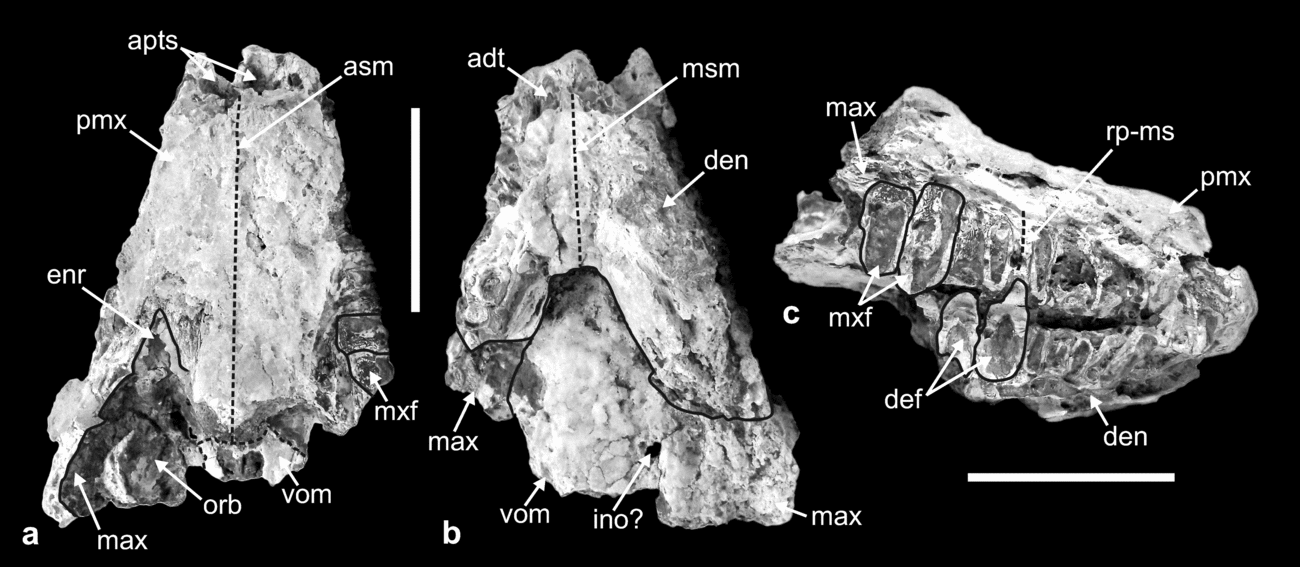
The only recognizable plesiosaur fossil currently recovered from the Adaffa Formation (found at Wadi Azlam) is the rostral section of a small skull (122.9 mm long, 77.6 mm wide; SGS 006-20; Fig. 3a–c), which is severely weathered and heavily encrusted with gypsum. The short preorbital segment (formed by the premaxillae), including up to five pairs of premaxillary teeth, enlarged maxillary fangs, and short mandibular symphysis (50.6 mm long as preserved) suggests attribution to an indeterminate elasmosaurid (see Kear, Reference Kear2005).
Plesiosaur remains from the Adaffa Formation of Saudi Arabia. Elasmosaurid skull rostrum and mandibular symphysis (SGS 006-20): (a) dorsal; (b) ventral; (c) right lateral views. Abbreviations: adt – anterior dentary teeth; apts – anterior premaxillary tooth sockets; asm – approximate snout midline; def – dentary fang; den – dentary; enr – external naris region; ino? – possible internal narial opening; max – maxilla; msm – median symphysis midline; mxf – maxillary fang; orb – orbit; pmx – premaxilla; rp-ms – reconstructed premaxillary-maxillary suture; vom – vomer. Scale bars represent 50 mm.

3.d. Aquatic squamates
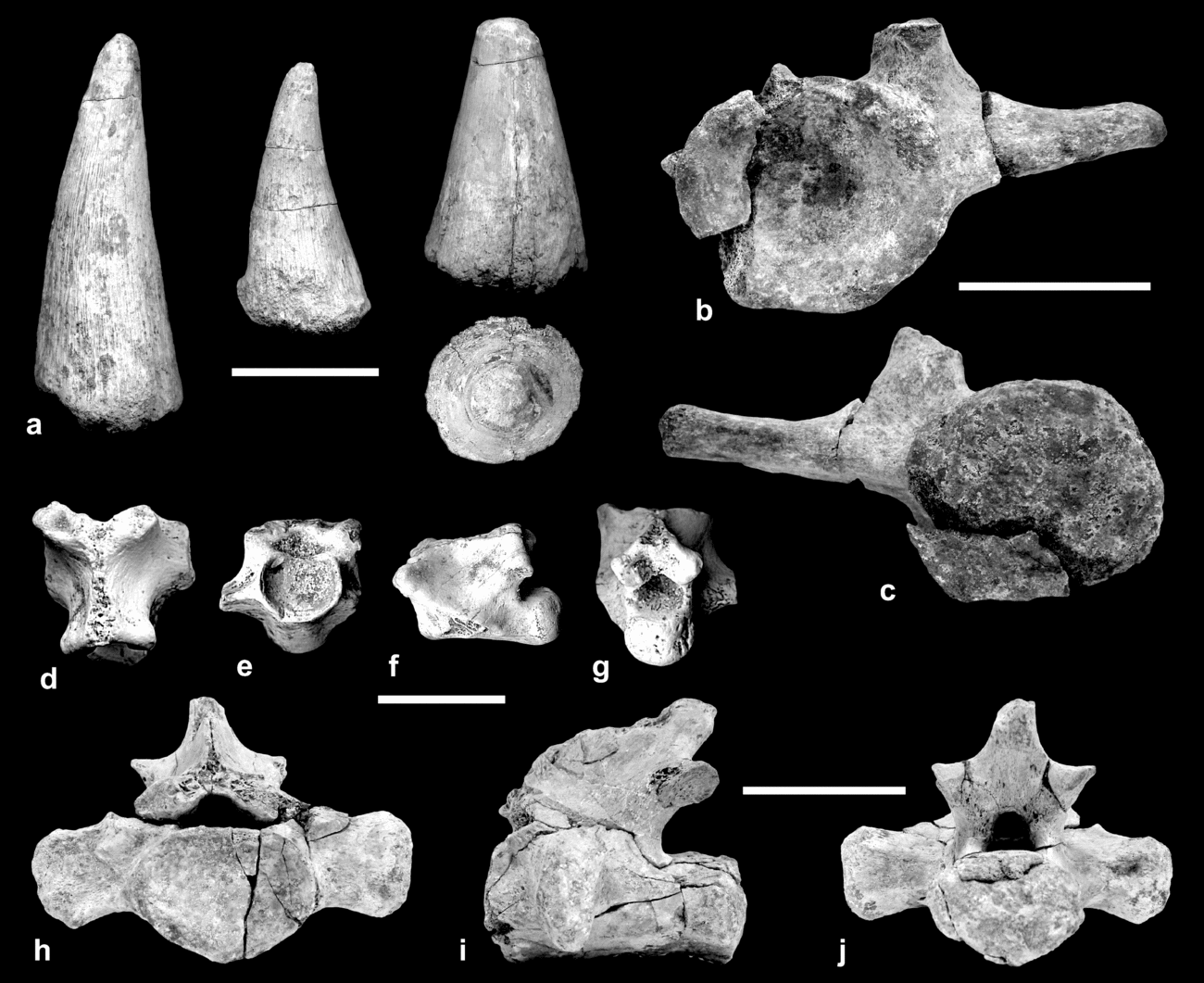
Mosasaur remains are abundant in the Adaffa Formation and include diagnostic teeth and vertebrae. The teeth are represented by large (34.7–76.7 mm high, 15.4–29.3 mm basal mesodistal length) shed crowns (Fig. 4a) that are either straight or slightly recurved. The enamel (where preserved) is thin (~ 0.5 mm) and smooth with very weak striations; unusually there is no evidence of strong carinae. The circular basal cross-sections and sub-equal, convex labial and lingual faces are consistent with the mosasaurine genus Prognathodon Dollo, Reference Dollo1889 (Bardet et al. Reference Bardet, Pereda Suberbiola, Iarochène, Bouya and Amaghzaz2005a).
Aquatic squamate remains from the Adaffa Formation of Saudi Arabia. (a) Prognathodon teeth (SGS 006-217) in labial and apical (bottom right) views. Mosasaurid pygal vertebra (SGS 006-542): (b) anterior; (c) posterior views. Indeterminate small varanoid dorsal vertebra (SGS 004-70): (d) dorsal; (e) anterior; (f) left lateral; (g) posterior views. Plioplatecarpine mosasaurid dorsal vertebra (SGS 006-340): (h) anterior; (i) lateral; (j) posterior views. Scale bar represents 30 mm in (a, h–j), 50 mm in (b, c) and 10 mm in (d–g).

Identifiable vertebrae include a distinctly plesiomorphic (sensu Debraga & Carroll, Reference Debraga, Carroll, Hecht, Macintyre and Clegg1993; Bell, Reference Bell, Callaway and Nicholls1997) mosasaurid pygal (SGS 006-542; Fig. 4b, c) with centrum length > height (86.8 mm long, 68.4 mm high), equidimensional (sub-circular) condyle/cotyle and anteriorly positioned, inclined transverse process (broken off on left side). A dorsal vertebra (54 mm long, 28.3 mm high; SGS 006-340; Fig. 4h–j) with dorsoventrally compressed, weakly heart-shaped condyle/cotyle, anteriorly positioned, vertically elongate synapophyses and no apparent accessory zygantral articulations (prezygopophyseal region damaged) is reminiscent of plioplatecarpines (sensu Bell, Reference Bell, Callaway and Nicholls1997; Bell & Polcyn, Reference Bell and Polcyn2005). Several other indeterminate vertebrae (approximately 11 mm long, 10 mm proximal width, 4.5 mm high; Fig. 4d–g) with obliquely oriented (visible ventrally), weakly reniform condyles/cotyles and inclined zygopophyses are comparable to small aquatic varanoids; these have been reported elsewhere from Maastrichtian deposits in Syria (Bardet et al. Reference Bardet, Cappetta, Pereda Suberbiola, Mouty, Al Maleh, Ahmad, Khrata and Gannoum2000) and North Africa, the latter attributed to Pachyvaranus crassispondylus by Arambourg (Reference Arambourg1952).
4. Palaeobiogeographical implications of the assemblage
Although fragmentary, the Adaffa Formation marine reptile remains represent the first documented Late Cretaceous assemblage from Saudi Arabia, and are thus an important new addition to the late Mesozoic record for the Arabian Peninsula. Recognizable taxa include bothremydid turtles, dyrosaurid crocodilians, elasmosaurid plesiosaurs, mosasaurine and plioplatecarpine mosasaurs and small aquatic varanoids, all of which are typical of the southern Tethyan realm (e.g. Bardet et al. Reference Bardet, Cappetta, Pereda Suberbiola, Mouty, Al Maleh, Ahmad, Khrata and Gannoum2000), and have been previously reported from Campanian–Maastrichtian deposits elsewhere in the Middle East (e.g. Arambourg et al. Reference Arambourg, Dubertret, Signeux and Sornay1959; Raab, Reference Raab1963; Werner & Bardet, Reference Werner and Bardet1996; Lapparent de Broin & Werner, Reference Lapparent de Broin and Werner1998; Bardet et al. Reference Bardet, Cappetta, Pereda Suberbiola, Mouty, Al Maleh, Ahmad, Khrata and Gannoum2000; Bardet & Pereda Suberbiola, Reference Bardet and Pereda Suberbiola2002; Christiansen & Bonde, Reference Christiansen and Bonde2002; Bardet et al. Reference Bardet, Pereda Suberbiola, Iarochène, Bouyahyaoui, Bouya and Amaghzaz2004; Zalmout, Mustafa & Wilson, Reference Zalmout, Mustafa and Wilson2005) and North Africa (e.g. Arambourg, Reference Arambourg1952; Bardet et al. Reference Bardet, Pereda Suberbiola, Iarochène, Bouyahyaoui, Bouya and Amaghzaz2004, Reference Bardet, Pereda Suberbiola, Iarochène, Amalik and Bouya2005a,b). Bothremydid turtles and dyrosaurid crocodilians in particular are diagnostic elements of Late Cretaceous faunas throughout the Mediterranean Tethys (see Hua & Buffetaut, Reference Hua, Buffetaut, Callaway and Nicholls1997; Gaffney, Tong & Meylan, Reference Gaffney, Tong and Meylan2006 for respective summaries) and are consistent with the inshore depositional setting of the Adaffa Formation; the retention of weight-bearing limbs (rather than paddles) and probable benthic-oriented lifestyle in bothremydids is thought to have necessitated occupation of littoral habitats (Lapparent de Broin & Werner, Reference Lapparent de Broin and Werner1998).
Elasmosaurid plesiosaurs are well documented from Late Cretaceous coastal marine palaeoenvironments in the Middle East and elsewhere around the globe (e.g. Welles, Reference Welles1962; Werner & Bardet, Reference Werner and Bardet1996; Bardet et al. Reference Bardet, Cappetta, Pereda Suberbiola, Mouty, Al Maleh, Ahmad, Khrata and Gannoum2000; Bardet & Pereda Suberbiola, Reference Bardet and Pereda Suberbiola2002; Gasparini, Salgaldo & Casadío, Reference Gasparini, Salgaldo and Casadío2003). Unfortunately, remains from the Adaffa Formation are too incomplete to draw any meaningful palaeobiogeographical comparisons.
The Adaffa Formation aquatic squamates are represented by widespread high-level taxa (e.g. mosasaurine and plioplatecarpine mosasaurids) and one identifiable genus: the ubiquitous mosasaurine Prognathodon. This pandemic taxon has been described from Campanian–Maastrichtian strata in New Zealand (Welles & Gregg, Reference Welles and Gregg1971; Wiffen, Reference Wiffen1990), Europe (Lingham-Soliar & Nolf, Reference Lingham-Soliar and Nolf1989; Dortangs et al. Reference Dortangs, Schulp, Mulder, Jagt, Peeters and De Graaf2002; Bardet, Corral & Pereda Suberbiola, Reference Bardet, Barbin, Laurain and Janin1997; Bardet et al. Reference Bardet, Corral and Pereda Suberbiola1997; Lindgren, Reference Lindgren2004), North America (Russell, Reference Russell1967) and Africa (Lingham-Soliar, Reference Lingham-Soliar1994; Bardet et al. Reference Bardet, Pereda Suberbiola, Iarochène, Bouya and Amaghzaz2005a), and is abundant in the Late Cretaceous deposits of the Middle East (Bardet et al. Reference Bardet, Cappetta, Pereda Suberbiola, Mouty, Al Maleh, Ahmad, Khrata and Gannoum2000; Bardet & Pereda Suberbiola, Reference Bardet and Pereda Suberbiola2002; Christiansen & Bonde, Reference Christiansen and Bonde2002).
The occurrence of marine reptiles in the Adaffa Formation reflects the close proximity of the northern Arabian Platform to open marine environments of the southern Neo-Tethys during the latest Cretaceous. Marine incursions into this region are characterized by distinctly Mediterranean faunas (Brown, Reference Brown1970), and in accordance, the Adaffa Formation marine reptiles show close similarities to those reported from elsewhere in the southern Tethyan region (e.g. Bardet et al. Reference Bardet, Cappetta, Pereda Suberbiola, Mouty, Al Maleh, Ahmad, Khrata and Gannoum2000). Further exploration of the Adaffa Formation should therefore yield taxa that are common to this biotic zone, and in general reflect the warm equatorial palaeolatitudinal belt that stretched across the Middle East and North Africa during Late Cretaceous times (Bardet et al. Reference Bardet, Cappetta, Pereda Suberbiola, Mouty, Al Maleh, Ahmad, Khrata and Gannoum2000; Bardet & Pereda Suberbiola, Reference Bardet and Pereda Suberbiola2002).
Acknowledgements
Thanks to Saudi Geological Survey President Dr Z. A. Nawab for his generous support of the joint Saudi–Australian palaeontology research program. We are indebted to Mr M. A. Halawani of the Saudi Geological Survey for his invaluable field assistance and geological expertise. Nathalie Bardet and a second anonymous reviewer provided constructive comments on the manuscript. The Australian Research Council, Museum Victoria, and the South Australian Museum supplied additional support for preparation and analysis of the fossil material.