





No CrossRef data available.
Article contents
Checklist of the species of notothenioid fishes
Published online by Cambridge University Press: 19 April 2021
Abstract
We provide our perspective on the species-level taxonomy of notothenioid fishes, the dominant component of the fish fauna of Antarctica. There are 140 species in 45 genera, an increase of 15% since the previous summary in 2000. Biogeographically, 30 species are non-Antarctic, 33 are sub-Antarctic and 77 are Antarctic. The checklist is documented with footnotes that provide the rationale for our decisions. Supplementary Material provides additional details for our decisions on two species of Pogonophryne.
Keywords
Information
- Type
- Opinion
- Information
- Copyright
- Copyright © Antarctic Science Ltd 2021
References
Balushkin, A.V. 1991. Review of green notothenias, Gobionotothen, Balushkin (Nototheniidae) of the Antarctic and Subantarctic. Journal of Ichthyology, 31, 42–55.Google Scholar
Balushkin, A.V. 1992. Classification, phylogenetic relationships, and origins of the families of the suborder Notothenioidei (Perciformes). Journal of Ichthyology, 32, 90–110.Google Scholar
Balushkin, A.V. 2000. Morphology, classification, and evolution of notothenioid fishes of the Southern Ocean (Notothenioidei, Perciformes). Journal of Ichthyology, 40, Supplement 1, S74–S109.Google Scholar
Balushkin, A.V. 2013. A new species of Pogonophryne (Perciformes: Notothenioidei: Artedidraconidae) from the deep Ross Sea, Antarctica. Trudy Zoologicheskogo Instituta, 317, 119–124 [In Russian; diagnosis in English].Google Scholar
Balushkin, A.V. 2014. Taxonomic status of goby-like notothens of the genus Gobionotothen Balushkin (Nototheniidae) from the Kerguelen Plateau (Southern Ocean) and Jordan's Rule. Journal of Ichthyology, 54, 615–619.CrossRefGoogle Scholar
Balushkin, A.V. 2016. Systematics of the Antarctic thornfishes of the genus Bovichtus (Bovichtidae) of the seamounts of the New Zealand Basin. Journal of Ichthyology, 56, 499–507.CrossRefGoogle Scholar
Balushkin, A.V. & Korolkova, E.D. 2013. New species of plunderfish Pogonophryne favosa sp. n. (Artedidraconidae, Notothenioidei, Perciformes) from the Cosmonauts Sea (Antarctica) with the description in artedidraconids of unusual anatomical structures-convexitas superaxillaris. Journal of Ichthyology, 53, 562–574.CrossRefGoogle Scholar
Balushkin, A.V. & Spodareva, V.V. 2013a. Dwarf toad plunderfish Pogonophryne minor sp. n. (Artedidraconidae; Notothenioidei; Perciformes) - a new species and one of the smallest species of autochthonous ichthyofauna of marginal seas of the Antarctic continent. Journal of Ichthyology, 53, 1–6.CrossRefGoogle Scholar
Balushkin, A.V. & Spodareva, V.V. 2013b. Pogonophryne skorai sp. n. (Perciformes: Artedidraconidae), a new species of toadlike plunderfish from the Bransfield Strait and coastal waters of the South Shetland Islands, Antarctica. Russian Journal of Marine Biology, 39, 190–196.CrossRefGoogle Scholar
Balushkin, A.V. & Spodareva, V.V. 2013c. Pogonophryne sarmentifera sp. nov. (Artedidraconidae; Notothenioidei; Perciformes) - the deep-water species of Antarctic plunderfishes from the Ross Sea (Southern Ocean). Trudy Zoologicheskogo Instituta, 317, 275–281 [In Russian; diagnosis in English].Google Scholar
Balushkin, A.V. & Spodareva, V.V. 2015. New species of the toad plunderfish of the “Albipinna” group, genus Pogonophryne (Artedidraconidae) from the Ross Sea (Antarctica). Journal of Ichthyology, 55, 757–764.CrossRefGoogle Scholar
Balushkin, A.V., Petrov, A.F. & Prutko, V.G. 2010. Pogonophryne brevibarbata sp. nov. (Artedidraconidae, Notothenioidei, Perciformes) - a new species of toadlike plunderfish from the Ross Sea, Antarctica. Proceedings of the Zoological Institute Academy of Sciences USSR, 314, 381–386 [In Russian; English abstract].Google Scholar
Bowen, B.W., Forsman, Z.H., Whitney, J.L., Faucci, A., Hoban, M., Canfield, S.J., et al. 2020. Species radiations in the sea: what the flock? Journal of Heredity, 111, 10.1093/jhered/esz075CrossRefGoogle ScholarPubMed
Bravo, R., Lloris, D., Pequeño, G. & Rucabado, J. 1999. Revisión de las distintas especies del género Bovichtus (Perciformes, Bovichtidae) citadas para el cono sur americano y península Antártica. Revista de Biologia Marina y Oceanografia, 34, 123–137 [In Spanish; English abstract].Google Scholar
Causse, R., Ozouf-Costaz, C., Koubbi, P., Lamy, D., Eleaume, M., Dettai, A., Duhamel, G., Busson, F., Pruvost, P., Post, A., Beaman, R.J. & Riddle, M.J. 2011. Demersal ichthyofaunal shelf communities from the Dumont d'Urville Sea (East Antarctica). Polar Science, 5, 272–285.CrossRefGoogle Scholar
Ceballos, S.G., Roesti, M., Matschiner, M., Fernández, D.A., Damerau, M., Hanel, R. & Salzburger, W. 2019. Phylogenomics of an extra-Antarctic notothenioid radiation reveals a previously unrecognized lineage and diffuse species boundaries. BMC Evolutionary Biology, 19, 10.1186/s12862-019-1345-zCrossRefGoogle ScholarPubMed
Cziko, P.A. & Cheng, C.-H.C. 2006. A new species of nototheniid (Perciformes: Notothenioidei) fish from McMurdo Sound, Antarctica. Copeia, 4, 752–759.CrossRefGoogle Scholar
Dettai, A., Berkani, M., Lautrédou, A.-C., Couloux, A., Lecointre, G., Ozouf-Costaz, C. & Gallut, C. 2012. Tracking the elusive monophyly of nototheniid fishes (Teleostei) with multiple mitochondrial and nuclear markers. Marine Genomics, 8, 10.1016/j.margen.2012.02.00CrossRefGoogle ScholarPubMed
Dettai, A., Adamowizc, S.J., Allcock, L. & Arango, C.P., et al. 2011a. DNA barcoding and molecular systematics of the benthic and demersal organisms of the CEAMARC survey. Polar Science, 5, 298–312.CrossRefGoogle Scholar
Dettai, A., Lautrédou, A.-C., Bonillo, C., Goimbault, E., Busson, F., Causse, R., et al. 2011b. The actinopterygian diversity of the CEAMARC cruises: barcoding and molecular taxonomy as a multi-level tool for new findings. Deep-Sea Research Part II, 58, 250–263.CrossRefGoogle Scholar
Dornburg, A., Federman, S., Eytan, R.I. & Near, T.J. 2016a. Cryptic species diversity in sub-Antarctic islands: A case study of Lepidonotothen. Molecular Phylogenetics and Evolution, 104, 32–43.CrossRefGoogle Scholar
Dornburg, A., Eytan, R.I., Federman, S., Pennington, J.N., Stewart, A.L., Jones, C.D. & Near, T.J. 2016b. Molecular data support the existence of two species of the Antarctic fish genus Cryodraco (Channichthyidae). Polar Biology, 39, 10.1007/s00300-015-1859-9.CrossRefGoogle Scholar
Duhamel, G., Gasco, N. & Davaine, P. 2005. Poissons des îles Kerguelen et Crozet. Guide régional de l'océan Austral. Patrimoines naturels, vol. 63. Paris: Muséum national d'Histoire naturelle, 419 pp.Google Scholar
Eakin, R.R., Eastman, J.T. & Matallanas, J. 2008. New species of Pogonophryne (Pisces, Artedidraconidae) from the Bellingshausen Sea, Antarctica. Polar Biology, 31, 1175–1179.CrossRefGoogle Scholar
Eakin, R.R., Eastman, J.T. & Near, T.J. 2009. A new species and a molecular phylogenetic analysis of the Antarctic fish genus Pogonophryne (Notothenioidei: Artedidraconidae). Copeia, 4, 705–713.CrossRefGoogle Scholar
Eakin, R.R., Riginella, E. & La Mesa, M. 2015. A new species of Artedidraco (Pisces: Artedidraconidae) from the Weddell Sea, Antarctica. Polar Biology, 38, 1597–1603.CrossRefGoogle Scholar
Eastman, J.T. 2020. The buoyancy-based biotope axis of the evolutionary radiation of Antarctic cryonotothenioid fishes. Polar Biology, 43, 10.1007/s00300-020-02702-6.CrossRefGoogle Scholar
Eastman, J.T. & Eakin, R.R. 2000. An updated species list for notothenioid fish (Perciformes; Notothenioidei), with comments on Antarctic species. Archive of Fishery and Marine Research, 48, 11–20.Google Scholar
Eastman, J.T. & La Mesa, M. 2021. Neuromorphological disparity in deep-living sister species of the Antarctic fish genus Trematomus. Polar Biology, 44, 10.1007/s00300-020-02794-0.CrossRefGoogle Scholar
Fricke, R., Eschmeyer, W.N. & Fong, J.D. 2020a. Species by family/subfamily. http://researcharchive.calacademy.org/research/ichthyology/catalog/SpeciesByFamily.asp., accessed 2 June 2020.Google Scholar
Fricke, R., Eschmeyer, W.N. & van Der Laan, R., eds. 2020b. Eschmeyer's Catalog of Fishes: Genera, Species, References. http://researcharchive.calacademy.org/research/ichthyology/catalog/fishcatmain.asp., accessed 2 June 2020.Google Scholar
Ghigliotti, L., Cheng, C.C.-H., Ozouf-Costaz, C., Vacchi, M. & Pisano, E. 2015. Cytogenetic diversity of notothenioid fish from the Ross Sea: historical overview and updates. Hydrobiologia, 761, 373–396.CrossRefGoogle Scholar
Gon, O. & Heemstra, P.C., eds. 1990. Fishes of the Southern Ocean. Grahamstown: J.L.B. Smith Institute of Ichthyology, 462 pp.Google Scholar
Hardy, G.S. 1988. A revision of Bovichtus Cuvier, 1831 (Pisces: Bovichthyidae) from Australasia, with description of a new deepwater species from the New Zealand Subantarctic. Journal of Natural History, 22, 1639–1655.CrossRefGoogle Scholar
Iwami, T. & Kock, K.-H. 1990. Channichthyidae. In Gon, O. & Heemstra, P.C., eds. Fishes of the Southern Ocean. Grahamstown: J.L.B. Smith Institute of Ichthyology, 381–399.Google Scholar
Kock, K.-H. 2005. Antarctic icefishes (Channichthyidae): a unique family of fishes. A review, Part I. Polar Biology, 28, 862–895.CrossRefGoogle Scholar
Koerber, S. 2009. From sponges to primates: Emendation of 30 species nomina dedicated to the Swedish zoologist Einar Lönnberg. Zootaxa, 2201, 63–68.CrossRefGoogle Scholar
Kuhn, K.L. & Near, T.J. 2009. Phylogeny of Trematomus (Notothenioidei: Nototheniidae) inferred from mitochondrial and nuclear gene sequences. Antarctic Science, 21, 10.1017/S0954102009990253CrossRefGoogle Scholar
La Mesa, M., Vacchi, M., Iwami, T. & Eastman, J.T. 2002. Taxonomic studies of the Antarctic icefish genus Cryodraco Dollo, 1900 (Notothenioidei: Channichthyidae). Polar Biology, 25, 384–390.CrossRefGoogle Scholar
Last, P.R., Balushkin, A.V. & Hutchins, J.B. 2002. Halaphritis platycephala (Notothenioidei: Bovichtidae): a new genus and species of temperate icefish from southeastern Australia. Copeia, 2, 433–440.CrossRefGoogle Scholar
Lautrédou, A.-C., Bonillo, C., Denys, G., Cruaud, C., Ozouf-Costaz, C., Lecointre, G. & Dettai, A. 2010. Molecular taxonomy and identification within the Antarctic genus Trematomus (Notothenioidei, Teleostei): How valuable is barcoding with COI. Polar Science, 4, 333–352.CrossRefGoogle Scholar
Lautrédou, A.-C., Hisinger, D.D., Gallut, C., Cheng, C.-H.C., Berkani, M., Ozouf-Costaz, C., et al. 2012. Phylogenetic footprints of an Antarctic radiation: the Trematominae (Notothenioidei, Teleostei). Molecular Phylogenetics and Evolution, 65, 87–101.CrossRefGoogle Scholar
Lecointre, G., Gallut, C., Bonillo, C., Couloux, A., Ozouf-Costaz, C. & Dettaï, A. 2011. The Antarctic fish genus Artedidraco is paraphyletic (Teleostei, Notothenioidei, Artedidraconidae). Polar Biology, 34, 10.1007/s00300-011-0974-5.CrossRefGoogle Scholar
Mayr, E. & Ashlock, P.D. 1991. Principles of systematic zoology, 2nd ed. New York: McGraw-Hill. 475 pp.Google Scholar
Miya, T., Gon, O., Mwale, M. & Poulin, E. 2016. Molecular systematics and taxonomic status of three latitudinally widespread nototheniid (Perciformes: Notothenioidei) fishes from the Southern Ocean. Zootaxa, 4061, 381–396.CrossRefGoogle ScholarPubMed
Near, T.J., Dornburg, A., Harrington, R.C., Oliveira, C., Pietsch, T.W., Thacker, C.E., et al. 2015. Identification of the notothenioid sister lineage illuminates the biogeographic history of an Antarctic adaptive radiation. BMC Evolutionary Biology, 15, 10.1186/s12862-015-0362-9.CrossRefGoogle ScholarPubMed
Near, T.J., Macguigan, D.J., Parker, E., Struthers, C.D., Jones, C.D. & Dornburg, A. 2018. Phylogenetic analysis of Antarctic notothenioids illuminates the utility of RADseq for resolving Cenozoic adaptive radiations. Molecular Phylogenetics and Evolution, 129, 10.1016/j.ympev.2018.09.001CrossRefGoogle ScholarPubMed
Neyelov, A.V. & Prirodina, V.P., 2006. Description of Harpagifer permitini sp. nova (Harpagiferidae) from the sublittoral zone of South Georgia and redescription of the littoral H. georgianus Nybelin. Journal of Ichthyology, 46, 1–12.CrossRefGoogle Scholar
Prirodina, V.P. 2000. On the systematic position of littoral and deep-water species of the genus Harpagifer (Harpagiferidae, Notothenioidei) from Macquarie Island with a description of two new species. Journal of Ichthyology, 40, 488–494.Google Scholar
Prirodina, V.P. 2002. Redescription of littoral and deep-sea species of the genus Harpagifer (Harpagiferidae, Notothenioidei) off islands of the Indian Ocean Sector of the Southern Ocean with the description of a new species. Journal of Ichthyology, 42, 701–712.Google Scholar
Prirodina, V.P. 2004. Harpagifer crozetensis sp. nova (Harpagiferidae, Notothenioidei), a new species from the littoral of the Crozet Islands (Indian Ocean Sector of the Antarctic). Journal of Ichthyology, 44, 395–399.Google Scholar
Sanchez, S., Dettaï, A., Bonillo, C., Ozouf-Costaz, C., Detrich III, H.W. & Lecointre, G. 2007. Molecular and morphological phylogenies of the Antarctic teleostean family Nototheniidae, with emphasis on the Trematominae. Polar Biology, 30, 10.1007/s00300-006-0170-1.CrossRefGoogle Scholar
Shandikov, G.A. 2011. Channichthys richardsoni sp. n., a new Antarctic icefish (Perciformes: Notothenioidei: Channichthyidae) from the Kerguelen Islands area, Indian sector of the Southern Ocean. Journal of V. N. Karazin Kharkiv National University, Series: Biology, Issue 14, No. 971, 125–134.Google Scholar
Shandikov, G.A. & Eakin, R.R. 2013. Pogonophryne neyelovi, a new species of Antarctic short-barbeled plunderfish (Perciformes, Notothenioidei, Artedidraconidae) from the deep Ross Sea. ZooKeys, 296, 59–77.CrossRefGoogle Scholar
Shandikov, G.A., Eakin, R.R. & Usachev, S. 2013. Pogonophryne tronio, a new species of Antarctic short-barbeled plunderfish (Perciformes: Notothenioidei: Artedidraconidae) from the deep Ross Sea with new data on Pogonophryne brevibarbata. Polar Biology, 36, 273–289.CrossRefGoogle Scholar
Sheiko, B. 2019. Comments on the nomenclature of genus- and family-series taxa of notothenioid fishes (Perciformes, Notothenioidei). Bionomina, 16, 10.11646/bionomina.16.1.3CrossRefGoogle Scholar
Smith, P.J., Steinke, D., Dettai, A., Mcmillan, P., Welsford, D., Stewart, A. & Ward, R.D. 2012. DNA barcodes and species identifications in Ross Sea and Southern Ocean fishes. Polar Biology, 35, 1297–1310.CrossRefGoogle Scholar
Spodareva, V.V. & Balushkin, A.V. 2014. Description of a new species of plunderfish genus Pogonophryne (Perciformes: Artedidraconidae) from the Bransfield Strait (Antarctica) with a key for the identification of species of the group “marmorata”. Journal of Ichthyology, 54, 1–6.CrossRefGoogle Scholar
Stewart, A.L. 2015. Family Bovichthyidae. In Roberts, C.D., et al. eds. The fishes of New Zealand, vol. 4. Wellington: Te Papa Press, 1434–1437.Google Scholar
Van Der Laan, R. & Fricke, R. 2020. Eschmeyer's Catalog of fishes: Family-group names. (http://www.calacademy.org/scientists/catalog-of-fishes-family-group-names/). Electronic version accessed 2 June 2020Google Scholar
Voskoboinikova, O.S. & Kellermann, A. 1993. Gvozdarus balushkini sp. n. from the Weddell Sea (Pisces, Perciformes: Nototheniidae). Zoosystematica Rossica, 2, 313–316.Google Scholar
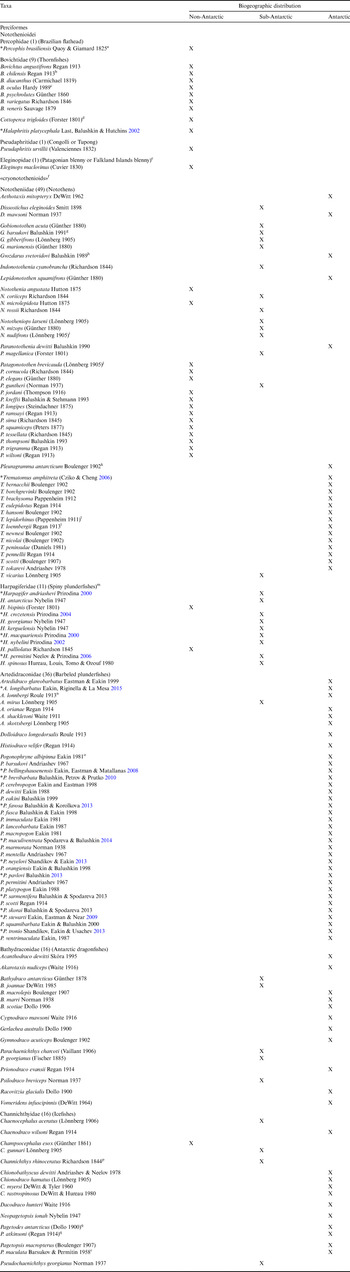
Table I. Checklist of 140 notothenioid species, 30 non-Antarctic, 33 sub-Antarctic and 77 Antarctic, in 45 genera. Asterisk (*) precedes names of 19 species described after publication of Eastman & Eakin (2000) or subsequently reassigned to the Notothenioidei.

Eastman and Eakin supplementary material
Eastman and Eakin supplementary material

PDF
92.4 KB
 You have
Access
- 54
- Cited by
Introduction
Once primarily of interest for their physiological adaptations for life in subzero waters, the notothenioid fishes of Antarctica are now the objects of research in other areas of biology as well as the target of an industrial fishery. They are also increasingly recognized as exemplars of marine adaptive radiation and this opens additional avenues for research in organismal biology (Bowen et al. Reference Bowen, Forsman, Whitney, Faucci, Hoban and Canfield2020, Eastman Reference Eastman2020). Species are the vehicle of macroevolution and the entities that display components of adaptation including specialization and regression of features as well as aspects of organ system development, gene expression and population structure (Mayr & Ashlock Reference Mayr and Ashlock1991, p. 22). Biologists studying all aspects of fish biology require accurate information about the number and the scientific nomenclature of their subjects. Frequently it is difficult for those who are not specialists in a given group to grasp the taxonomic complexities related to the number, naming and validity of species. In 2000 we published a checklist of 122 species in 43 genera - the number of notothenioid species that we considered valid at that time (Eastman & Eakin Reference Eastman and Eakin2000). The checklist was based on the 93 Antarctic species recognized in Fishes of the Southern Ocean (Gon & Heemstra Reference Gon and Heemstra1990), plus the new species described after its publication, minus those placed in synonymy. We also included the non-Antarctic component of the fauna, an element absent from Fishes of the Southern Ocean. The checklist has apparently proven useful and has been cited 92 times, including this year, in Scopus (www.scopus.com), and 126 times in Google Scholar (www.scholar.google.com). However, the number of species has increased by 18 (15%) and we now recognize 140 species and 45 genera and believe the time is opportune for the revised checklist provided in Table I, our view of the species-level taxonomy of notothenioids.
Checklist of 140 notothenioid species, 30 non-Antarctic, 33 sub-Antarctic and 77 Antarctic, in 45 genera. Asterisk (*) precedes names of 19 species described after publication of Eastman & Eakin (Reference Eastman and Eakin2000) or subsequently reassigned to the Notothenioidei.
a Through the use of DNA sequences from 10 nuclear genes, previously never employed in phylogenetic analyses, Percophis brasiliensis was resolved, with strong support, as the sister lineage of notothenioids (Near et al. Reference Near, Dornburg, Harrington, Oliveira, Pietsch and Thacker2015). The support from morphology is minimal but not conflicting. Given the absence of any persuasive prior or alternative hypotheses for a sister group, this is definitely an advance.
b Bravo et al. (Reference Bravo, Lloris, Pequeño and Rucabado1999) have placed Bovichtus elongatus and B. argentinus in the synonymy of Bovichtus chilensis. This paper appeared too late to be included in our 2000 list.
c Although Balushkin (Reference Balushkin2016) has placed Bovichtus oculus in the synonymy of B. psychrolutes, Stewart (Reference Stewart and Roberts2015) continues to recognize B. oculus as valid, as do we. Bovichtus oculus is known from the holotype in the Museum of New Zealand Te Papa Tongarewa (NMNZ P. 018510), and from two other specimens in the same collection tentatively identified as B. oculus. Although Balushkin (Reference Balushkin2016, pp. 632 and 637) indicates that he examined a radiograph of this holotype and measured its eye diameter, it is doubtful that the specimen he examined was the holotype. Records held by the NMNZ provide no evidence that the specimen was ever radiographed or that it was ever sent out on loan. Bovichtus oculus has eyes with a horizontal eye diameter < 9.0 times in SL, the most important character in distinguishing it from other species of bovichtids including B. psychrolutes (Hardy Reference Hardy1988). Balushkin reports that in his radiograph this value was 9.2–9.4 times in SL, not the 8.2 in SL reported by Hardy in his table 1. He also states that his measurements place the holotype in the range of eye diameters for B. psychrolutes and therefore that it is this latter species. However, re-measurement of the NMNZ type specimen of B. oculus using two different calipers showed that the eye was a little smaller than recorded by Hardy, but still < 9 times in SL. The actual measurements were: bony eye diameter = 13.04 mm; SL = 109.15 mm = 8.37 in SL or 11.94% of SL (Andrew Stewart, Collection Manager, Fishes, NMNZ, personal communication to J.T. Eastman, 12 December 2016.) Given this information, we continue to recognize B. oculus as a valid species. It should also be noted that, based on information in Eschmeyer's Catalog of Fishes, the correct date for this species is 1989, not 1988 as indicated in our 2000 list, because the article was not published until 1989.
d We follow Balushkin (Reference Balushkin1992, Reference Balushkin2000) in considering Cottoperca gobio (Günther 1861) as a junior synonym of C. trigloides (Forster 1801). Some South American ichthyologists continue to recognize the South American population as Cottoperca gobio (Günther 1861).
e The spelling of this name has gone back and forth between Eleginopidae/Eleginopsidae. Sheiko (Reference Sheiko2019) recently resolved this matter by determining that the correct stem is Eleginop-, not Eleginops-, and therefore the correct name for the family is Eleginopidae.
f Although Cryonotothenioidea bears the suffix of a superfamily, Near et al. (Reference Near, Dornburg, Harrington, Oliveira, Pietsch and Thacker2015, Reference Near, Macguigan, Parker, Struthers, Jones and Dornburg2018) have employed this and several other rank-free names for various notothenioid clades. Although rank-free names do not comply with the International Code of Zoological Nomenclature (Sheiko Reference Sheiko2019), cryonotothenioids has begun to appear in the literature as a convenient way of referring to the clade that radiated in Antarctica and that encompasses 91% (128/140) of notothenioid species. We think it is acceptable to use it informally with the understanding that it is a non-Code compliant, colloquial name for the five families of the Antarctic clade. Use of left («) and right (») guillemets or double chevrons (as «cryonotothenioids») indicates that the name is non-Code compliant (Sheiko Reference Sheiko2019).
g Duhamel et al. (Reference Duhamel, Gasco and Davaine2005, pp. 327 and 334) are not convinced that there is sufficient evidence to prove that Gobionotothen barsukovi is distinct from G. acuta. Although Balushkin (Reference Balushkin2014) has supplemented his original description (Balushkin Reference Balushkin1991) of G. barsukovi with meristic data from additional specimens, there are no genetic data and we also remain skeptical about the validity of this species. A recent molecular phylogenetic study supported the validity of G. acuta and G. marionensis, but did not include specimens of G. barsukovi (Miya et al. Reference Miya, Gon, Mwale and Poulin2016).
h Voskoboinikova & Kellermann (Reference Voskoboinikova and Kellermann1993) have described another species of Gvozdarus, G. balushkini, from the Weddell Sea based on a single 30 mm SL specimen. This seems premature to us given the dearth of information about G. svetovidovi, a species known from only two specimens.
i Using a combination of morphological and molecular genetic data, Dornburg et al. (Reference Dornburg, Federman, Eytan and Near2016a) determined that Lepidonotothen nudifrons consists of two cryptic species: L. nudifrons around South Georgia and the South Sandwich Islands, and L. cf. nudifrons in the area of the Antarctic Peninsula. Obviously, the cryptic species will not be recognized until it has been formally described and named. The genus of these species is now Nototheniops.
j Patagonotothen supposedly contains cryptic species that have not been named (Ceballos et al. Reference Ceballos, Roesti, Matschiner, Fernández, Damerau, Hanel and Salzburger2019).
k The correct name is now back to Pleuragramma antarcticum, not P. antarctica (Sheiko Reference Sheiko2019).
l Until recently, there had never been any question about the validity of the sister species Trematomus lepidorhinus and T. loennbergii. However there have been reports of investigators being unable to distinguish specimens of these species morphologically or through the use of mitochondrial COI gene barcodes or nuclear gene DNA sequences (Lautrédou et al. Reference Lautrédou, Bonillo, Denys, Cruaud, Ozouf-Costaz, Lecointre and Dettai2010, Reference Lautrédou, Hisinger, Gallut, Cheng, Berkani and Ozouf-Costaz2012, Causse et al. Reference Causse, Ozouf-Costaz, Koubbi, Lamy, Eleaume, Dettai, Duhamel, Busson, Pruvost, Post, Beaman and Riddle2011, Dettai et al. Reference Dettai, Adamowizc, Allcock and Arango2011a, Reference Dettai, Lautrédou, Bonillo, Goimbault, Busson and Causse2011b, Smith et al. Reference Smith, Steinke, Dettai, Mcmillan, Welsford, Stewart and Ward2012). However, these species are distinguished by next-generation DNA sequencing (RADseq) (Near et al. Reference Near, Macguigan, Parker, Struthers, Jones and Dornburg2018). Karyological studies also support the existence of two species (Ghigliotti et al. Reference Ghigliotti, Cheng, Ozouf-Costaz, Vacchi and Pisano2015), as does morphological divergence of the sense organs and brains, and their preferred habitat depths (Eastman & La Mesa Reference Eastman and La Mesa2021). Therefore we continue to recognize these two species as valid and suggest that the difficulty in identifying at least some of the Indian Ocean specimens is attributable to phenotypic plasticity in the dimensions of the head in T. lepidorhinus (Eastman & La Mesa Reference Eastman and La Mesa2021).
m Since 2000 five new species of Harpagifer have been described on the basis of being either the “soft” littoral form or deeper-dwelling “spiny” form at a given island (Prirodina Reference Prirodina2004). The primary morphological difference between the species in each pair is in the degree of head spination, especially the extent of development of the supraorbital ridge and its protuberances. Duhamel et al. (Reference Duhamel, Gasco and Davaine2005, p. 328, 358) question the validity of Harpagifer andriashevi Prirodina Reference Prirodina2000, H. nybelini Prirodina Reference Prirodina2002, H. crozetensis Prirodina Reference Prirodina2004 and H. macquariensis Prirodina Reference Prirodina2000. Although it was described after the publication of their book, Harpagifer permitini Neyelov & Prirodina Reference Neyelov and Prirodina2006 should probably added to this group. Duhamel et al. (Reference Duhamel, Gasco and Davaine2005) consider the species in this genus to be “extremely polymorphic” and caution that, based on their samples from the MNHN collections, meristic data do not discriminate the species. They also state that the diagnoses of the species of Harpagifer are also heavily reliant on the degree of development of the supraorbital protuberance, a highly subjective character showing intermediate degrees of development in species from coastal areas. This situation would obviously benefit from the perspective that molecular genetic data could provide.
n This is a recent change in the spelling of the name of this species. It incorporates the corrections of Koerber (Reference Koerber2009) with respect to the use of diacritical vowels and diphthongs in the scientific names of certain notothenioid species dedicated to the Swedish zoologist Einar Lönnberg. Koerber's corrections are accepted and included in Eschmeyer's Catalog of Fishes.
o We view two additional species of Pogonophryne, P. minor Balushkin & Spodareva Reference Balushkin and Spodareva2013a and P. pallida Balushkin & Spodareva Reference Balushkin and Spodareva2015, as doubtful and they are not included in the list. See Eakin's critiques in Supplemental material 1 concerning these two species.
p There are widely differing opinions about the number of species of Channichthys, a genus endemic to the Kerguelen Plateau. Iwami & Kock (Reference Iwami, Kock, Gon and Heemstra1990) and Kock (Reference Kock2005) recognize only C. rhinoceratus. Balushkin (Reference Balushkin2000) recognizes four species. Duhamel et al. (Reference Duhamel, Gasco and Davaine2005) recognize C. rhinoceratus, C. velifer and suggest the existence of a single undescribed species. In considering the species level taxonomy of Channichthys, Duhamel et al. (Reference Duhamel, Gasco and Davaine2005) state that (page 368, French to English translation using Google Translate, with [bracketed material] added by us):
”The systematics and biology of Channichthys require a complete overhaul because the original descriptions were very imprecise. Following the original description of C. rhinoceratus from the coastal region, another species, C. rugosus, [Channichthys rugosus Regan 1913, based on a single 400 mm specimen, with no drawing provided] was minimally described from the same area and then later placed in synonymy. The specimens subsequently captured on the plateau have led to the description of a profusion of new species that need to be reexamined to draw conclusions on their status and to correctly redefine C. rhinoceratus (as well as other species, valid nor not). In addition, the measurements carried out on individuals greatly depend on the condition of the specimen at the time of death (often gaping opercula and mouth open …) and only meristic characters can then be used. The report of C. rhinoceratus at Marion from an otolith in a gentoo penguin (P. papua) [stomach presumably?] has never been validated by the capture of other complete specimens. The initial descriptions of the larvae of C. rhinoceratus and C. velifer, then those of C. rhinoceratus and C. rugosus, add to the confusion because no series is complete and valid.”
Adding to the uncertainty about the number of species of Channichthys, Shandikov (Reference Shandikov2011) described Channichthys richardsoni and implied that, based on his previous work, there are a total of nine species of Channichthys around Kerguelen. Eschmeyer's Catalog of Fishes also indicates that there are nine valid names for species of Channichthys. Therefore, given the confusion over the number of species and the possible existence of phenotypic plasticity in C. rhinoceratus, we think it is best to maintain a conservative approach by recognizing only C. rhinoceratus until a comprehensive analysis, including genetic data, lends some clarity to this situation.
q These two species were formerly in the genus Cryodraco. Sheiko (Reference Sheiko2019, p. 66) has determined that, according to the Principle of Priority, the name Pagetodes Richardson 1844 stands as the valid senior isonym of Cryodraco Dollo, 1900. Dornburg et al. (Reference Dornburg, Eytan, Federman, Pennington, Stewart, Jones and Near2016b) provide molecular data in support of previous morphological data (La Mesa et al. Reference La Mesa, Vacchi, Iwami and Eastman2002) documenting the validity of the two species of Pagetodes (formerly Cryodraco).
r Sheiko (Reference Sheiko2019) has determined that the correct spelling is Pagetopsis maculata, not P. maculatus.
Methods
Since the publication of our original checklist, we have monitored the literature for descriptions of new species and changes in nomenclature and rendered judgments on their validity, especially in the case of the artedidraconids where 10 new species of Pogonophryne have been described since 2000. The most noteworthy large-scale change since 2000 is that the South Atlantic species Percophis brasiliensis Quoy & Giamard 1825 has been identified as the sister lineage of notothenioids and is now included in this clade that is nested within the Perciformes (Near et al. Reference Near, Dornburg, Harrington, Oliveira, Pietsch and Thacker2015). Ichthyologists have different interpretations of notothenioid taxonomy and we do not attempt to accommodate these or every change in nomenclature necessitated by relationships revealed in molecular phylogenetic studies. The validity of the latter will be determined through expansion of taxonomic coverage, replication of results, and eventual adoption and usage. We retain the traditional notothenioid family names (Balushkin Reference Balushkin2000). The species-level taxonomy presented here reflects the results of some well-substantiated molecular phylogenetic analyses including the amalgamation of the genera Cryothenia and Pagothenia into Trematomus (Sanchez et al. Reference Sanchez, Dettaï, Bonillo, Ozouf-Costaz, Detrich III and Lecointre2007, Kuhn & Near Reference Kuhn and Near2009, Dettai et al. Reference Dettai, Berkani, Lautrédou, Couloux, Lecointre, Ozouf-Costaz and Gallut2012, Near et al. Reference Near, Dornburg, Harrington, Oliveira, Pietsch and Thacker2015, Reference Near, Macguigan, Parker, Struthers, Jones and Dornburg2018). The polyphyly in the genus Artedidraco has been confirmed (Lecointre et al. Reference Lecointre, Gallut, Bonillo, Couloux, Ozouf-Costaz and Dettaï2011, Near et al. Reference Near, Macguigan, Parker, Struthers, Jones and Dornburg2018), but not yet resolved with new generic names so we retain the status quo. Next-generation DNA sequencing (RADseq) supports the monophyly of the genus Pogonophryne and the relationships among the species groups, but the number of species remains unsettled (Near et al. Reference Near, Macguigan, Parker, Struthers, Jones and Dornburg2018, p. 275).
The authoritative source for fish taxonomy is Eschmeyer's Catalog of Fishes (www.calacademy.org), specifically the sections by Fricke et al. (Reference Fricke, Eschmeyer and Fong2020a, Reference Fricke, Eschmeyer and van Der Laan2020b) and Van der Laan & Fricke (Reference Van Der Laan and Fricke2020). The existing nomenclature for notothenioids has been subjected to a recent analysis of its grammatical accuracy (Sheiko Reference Sheiko2019) and adherence to the International Code of Zoological Nomenclature (www.iczn.org), and these findings have been incorporated into Eschmeyer's Catalog. We follow Eschmeyer's Catalog for the nomenclature for species, authorities and dates. We provide a reference for each of the 19 species either described or reassigned to the Notothenioidei after 2000, documentation for all other species is available in Eschmeyer's Catalog. Recognition of a species as a biological entity is a subjective decision, however the validity of the name applied to it is not, and the Code applies only to the latter. Eschmeyer's Catalog recognizes more species (167) than we do (140) and “assumes that all new species described in the past 10 years are valid”. It is impossible for even the highly experienced ichthyologists maintaining Eschmeyer's Catalog to render judgment on the biological validity of each of the several hundred new species of fishes that appear in publications each year. The differences between the counts in Eschmeyer's Catalog and our counts are attributable to the fact that our familiarity and experience with notothenioid fauna, and knowledge of the associated literature, allows us to vet the descriptions of new species and to take a critical approach in recognizing those that show minimal morphological divergence and an undocumented amount of genetic divergence as in, for example, some recently described species of Pogonophryne and Channichthys.
Acknowledgements
We thank Richard van der Laan for providing help in interpreting information on notothenioids in Eschmeyer's Catalog of Fishes. Andrew Stewart (NMNZ, Te Papa) provided considerable insight into number of species of Bovichtus found in New Zealand waters. Mario La Mesa and an anonymous reviewer also provided useful comments that have been incorporated.
Author contributions
Both authors participated in the analysis, writing and final approval of this paper. Richard Eakin was primarily responsible for our decisions regarding the validity and recognition of the species of Artedidraconidae.
Supplemental material
Supplemental Material provides Richard Eakin's rationale for excluding Pogonophryne minor Balushkin & Spodareva 2013 and P. pallida Balushkin & Spodareva Reference Balushkin and Spodareva2015 from the checklist by placing them in synonymy. This material is found at https://doi.org/10.1017/S0954102020000632.