INTRODUCTION
Trees in seasonally tropical dry forests possess several functional traits that permit them to endure severe water stress for 5–7 mo of the year (Borchert Reference BORCHERT1994a). Canopy trees on drying soils (usually the middle and upper slopes and along intermittent low-order streams) typically respond to the extended drought by abscising leaves (Borchert Reference BORCHERT1994a). Occasionally, however, these seasonally dry forests experience a rainfall event during the dry season, and the precipitation can be sufficient to cause bud break and leaf extension in many tree species (Bullock & Solis-Magallanes Reference BULLOCK and SOLIS-MAGALLANES1990).
While the magnitude of the recharge of the soil and thus the plant response would vary with soil texture and slope position, it has been argued that, very generally, the minimal amount of rain required for drought-deciduous trees to flush a cohort of leaves during the dry season is between 20–50 mm during one event (or perhaps a few temporally close events) (Bullock & Solis-Magallanes Reference BULLOCK and SOLIS-MAGALLANES1990, Daubenmire Reference DAUBENMIRE1972, Myers et al. Reference MYERS, WILLIAMS, FORDYCE, DUFF and EAMUS1998). But of course the phenological response to sudden water availability will not be ‘all-or-nothing’. Although the relationship has not been studied, we hypothesize that there will be a positive correlation between water receipt and quantitative tree responses such as proportion of buds burst or leaf area index, at least for a single stand where, necessarily, soil texture and slope position would be held constant. A gradient of irrigation experiments could delineate this response, but field experiments of this sort have so far been limited to extremely large amounts of water (Borchert Reference BORCHERT1994b, Wright & Cornejo Reference WRIGHT and CORNEJO1990). This experimental coupling of the tree response to varying irrigation amounts in a leafless forest stand in western Mexico represents our first objective.
Invariably, leaves flushed by an ephemeral rainfall event subsequently desiccate as the soil rapidly becomes too dry (Borchert Reference BORCHERT1994b). What is the net effect for the tree of this brief expenditure on leaves? One possibility is that the flushed leaves are functioning for too brief a period to offset their carbon costs. This could cause a reduction in the total leaf area and xylem growth in the subsequent wet season. Conversely, the trees may enjoy a net benefit from the short period of leaf deployment; indeed, many of these species may have evolved a capacity to take advantage of rare intense dry-season precipitation. The only study we can find on the effect of dry-season rainfall on subsequent tree growth is from Bullock (Reference BULLOCK1997), who argued that there was no apparent net effect on subsequent growth; but those results were problematic in that the trees were not all within the same stand and thus may have received very different amounts of dry-season rain. The second hypothesis of this study then is that trees in a single stand will experience a net change in their relative growth rate (RGR), proportional to the dry-season irrigation intensity, during the subsequent wet season.
A third objective involves the effect of dry-season rainfall and the subsequent flushing of leaves on radial wood formation; a subject that has received little attention (Bullock Reference BULLOCK1997, Heinrich & Banks Reference HEINRICH and BANKS2006, Jacoby Reference JACOBY1989). Given that the prolonged drought characterizing seasonally dry forests leads to a cessation in cambial activity, at least for the drought-deciduous species (Baker et al. Reference BAKER, BUNYAVEJCHEWIN, OLIVER and ASHTON2005, Buckley et al. Reference BUCKLEY, BARBETTI, WATANASAK, D'ARRIGO, BOONCHIRDCHOO and SARUTANON1995, Lopez-Ayala et al. Reference LOPEZ-AYALA, VALDEZ-HERNANDEZ, TERRAZAS and VALDEZ-LAZALDE2006, Worbes Reference WORBES1999, Worbes & Junk Reference WORBES and JUNK1989), then, clearly, our ability to use the rings of tropical tree species for stand reconstructions (Baker et al. Reference BAKER, BUNYAVEJCHEWIN, OLIVER and ASHTON2005) or climate response studies (Enquist & Leffler Reference ENQUIST and LEFFLER2001) will be hampered if false rings due to dry-season rain events are common. For reconstructions, if all the trees within a stand show the same false rings then we may misinterpret a sudden event (e.g. a hurricane) for a much more gradual event. If trees from many stands are used in a climatological study, and false rings induced by dry-season rainfall (e.g. thunderstorms) vary from site to site, then crossdating will become extremely difficult. For the irrigated stands, we hypothesize that the likelihood of a false ring will be proportional to the watering intensity.
Our final objective is to use long-term records from the nearby Chamela research station to determine the probability of a dry-season storm sufficient to cause a particular level of bud burst or ring formation. That is, given a functional relationship between the irrigation intensity and the leaf flushing response, we can estimate, at least for the species we are examining, the likely number of times per century they would receive sufficient dry-season rainfall to burst their buds.
MATERIALS AND METHODS
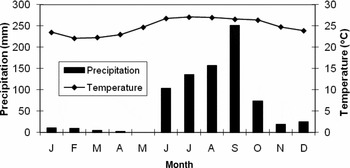
This work was conducted on the well-dissected Pacific coast of Mexico in the state of Jalisco during the dry seasons of 2007 and 2008. The study area, on private land in an early stage of regrowth (most stems were about 15–20 y old, with a crown diameter averaging only 1.5 m), was located approximately 4 km south of the Estacion Biologia de Chamela (19° 30′N, 105° 03′W) and 1 km from the ocean. The stand, dominated by small-stemmed trees (2–8 cm dbh) with an average height of 5.6 m, was located about 70 m asl on steeply sloping ground. The soil had little organic matter aside from the thick veneer of recently fallen leaves, and was derived from pyroclastic deposits (a mix of stones and volcanic ash). The area receives an annual average of 763 mm of precipitation (Figure 1) with over 80% falling between the months of June and November (Bullock Reference BULLOCK1986). The mean annual temperature is 25 °C with little fluctuation throughout the year because of the moderating effect of the ocean (Figure 1).
Annual precipitation (mm) and temperature (C) distribution at Chamela, Jalisco.

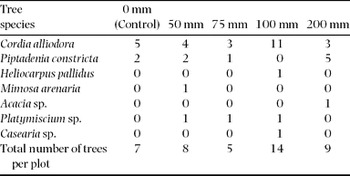
On a steep slope, four irrigation plots were used, each measuring 5 × 5m, with a minimum of 8 m between the edges of any two plots. A modest buffer was created by choosing the plots so that the enclosed trees were > 0.5 m from the edge. A control plot, also 25 m2, was located 15 m away from the nearest irrigation plot. All trees located within the plots were included in the study; all were deciduous. There were between five and 14 trees included in the study from each plot, with an average of three individuals per species per plot (Table 1). The tree species found in the plots were Cordia alliodora (Ruiz and Pav.) Oken, Piptadenia constricta Macbride, an Acacia sp., Mimosa arenaria var. leiocarpa (Willd.) Poir., Platymiscium sp., Heliocarpus pallidus Rose and a Casearia sp. The only species used in the statistical analyses were C. alliodora and P. constricta as they were the only ones found on almost every plot. (The species recognized only to genus neither flowered nor fruited during periods when we visited in 2007 and 2008.)
The number of trees per species per irrigation intensity (mm).

In the dry season of 2007, all trees used in the study were marked by cambial wounding at breast height (1.37 m), with 2 cm2 of bark removed to a depth sufficient to cut through the cambium. Tree diameter (dbh) was measured near the wound and the point of measurement marked with paint prior to irrigation.
Water was distributed across any one plot so that every square metre received approximately the same amount of water. The buffer zone received the same amount of water as the rest of the interior of each plot. Plots were irrigated from 11–14 March 2007 and received an amount of water varying from 0 (the control) to 200 mm (Table 1) on a single day.
The degree of subsurface seepage of water into the soil outside of plots was determined using two 1-m2 test blocks well off to the side of the irrigation plots. Water equivalent to the highest irrigation intensity (200 mm) was applied to each square metre. Two hours later, soil was excavated from the test area to gauge the extent of lateral and downslope subsurface flow.
The leaf and flowering responses of the trees were monitored daily for 40 d following the 2007 irrigation. The leaf response, an amalgam of number of leaf buds opened and leaf size, was ordinally quantified on a scale of 0–3, with 0 = no response; 1 = weak response with only a few, underdeveloped leaves appearing; 2 = moderate response where 20–80% of buds were opened, but many leaves were not full size; and 3 = full response with essentially all buds opened and leaves full size. Only P. constricta flowered following irrigation; for this species the flowering response was quantified dichotomously as: 0 = no response; 1 = a range from partial response (a few flowers developing) to complete flowering (inflorescences fully developed and covering > 75% of the crown).
During the dry seasons of 2007 and 2008, calipers were used to measure changes in stem diameter. These measurements were made at the same place on the trunk and at the same time each day (between 07h00 and 08h00) to avoid the effect of diurnal fluctuations in stem water content.
In January 2008, after the wet season, a random selection of our only two common species, C. alliodora and P. constricta, were cut down. A stem disc was taken at the point of cambial wounding. These discs were then sanded using progressively finer sand paper (80 to 240 grit size). Tree rings were examined using a stereo microscope. Xylem was examined from the scar tissue to the bark and compared with previous growth rings for any abnormalities that may have been caused by irrigation (i.e. any visible indication of cambial activation due to irrigation, and, if so, whether there were two growth rings for the year).
Weather records for the past 31 y were obtained from the meteorological station at La Estacion Biologia de Chamela, located 4 km from the stand, to determine the frequency distribution of rainfall events during the dry season.
Spearman rank correlation was used to compare irrigation intensity with three different responses: leaf extension, flower development, and relative growth rate (RGR). RGR was calculated as RGR = (ln W2 – ln W1)/(t2 –t1); where W1 and W2 are tree diameters (dbh) at times t1 and t2.
RESULTS
Cordia alliodora and P. constricta comprised 81% of the trees (Table 1). All leaves and flowers produced in response to watering in 2007 were completely desiccated by the end of the study period (about 40 d after irrigation). No rain fell during this interval. No fruit developed from flowers.
Essentially all the water applied to a plot stayed within its perimeter. There was no surface flow during the slow application of water. In the two excavated 1-m2 areas downslope from the irrigated plots, the 200-mm intensity of water application caused very little subsurface flow despite the steep slope, with water extending only about 20 cm downslope (and about 20 cm in depth) in a conical shape from the downslope plane of the 1-m2 area. Further, there was essentially no lateral subsurface movement of water on this steep slope.
Interestingly, trees outside the plots showed almost no effect from the irrigation. Only a few trees at the outside edge of the 200-mm irrigation plot showed any response: a few leaves emerged.
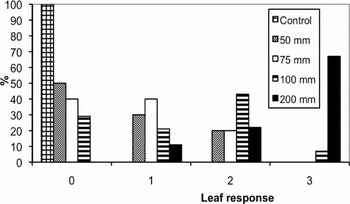
All irrigated plots showed some leaf response (Figure 2). For all individuals lumped (regardless of species), there was a significantly positive relationship between the ordinal growth response measure and the irrigation intensity (Spearman rank correlation corrected for ties; P < 0.01; n = 43). For the two common species, C. alliodora and P. constricta, separately, the Spearman rank correlation was even more significant than when all species were aggregated (P < 0.001; n = 25 or 10, respectively).
Leaf response of individual trees of seven species (scaled as 0 to 3 where 0 = no response, 1 = weak response, 2 = moderate response and 3 = full response) as a function of water receipt (mm).

Flower production in response to irrigation occurred only for P. constricta and only at the 200-mm watering intensity. Two of the five P. constricta trees receiving 200 mm were completely in flower (fully developed inflorescences across the entire crown), another two showed a weak flowering response (a few inflorescences; many of them only partially developed), and one tree showed no response at all. The Spearman rank correlation between irrigation intensity and flowering response was significant (corrected for ties; P = 0.021; n = 10).
The scar tissue produced due to wounding of the cambium served as a point of reference for wood growth since irrigation. All individuals of all species produced exactly one growth ring in the wet season of 2007 following cambial wounding. That is, no intensity of irrigation yielded a false growth ring; we found no anatomical evidence within the single 2007 ring of an initial period of cambial growth and cessation. In short, there was no evidence for any cambial growth during the dry-season leaf deployment. (Examples for C. alliodora and P. constricta are shown in Figure 3a, b.) There were, however, a few cases of partial rings developing during the wet season of 2007, but this is not unusual for trees in this region (see examples in Figure 3).
Cross sections of Cordia alliodora (a) and Piptadenia constricta (b) showing the lack of change in wood anatomy of the final growth ring (wet season of 2007) following irrigation. The arrow represents the post-irrigation xylem of 2007. Note the examples of partial rings in 2005 (a) and 2004 and 2006 (b). Scale: the length of the arrow would be 1.5 mm (a) or 2.4 mm (b).

There was no significant relationship between the subsequent relative growth rate (RGR for dbh increase) of these trees at the end of the 2007 rainy season and either irrigation intensity or leaf response. Likewise, performing the correlation separately for the species C. alliodora and P. constricta yielded results that were not statistically significant (Spearman rank correlation corrected for ties; P > 0.4 in all cases).
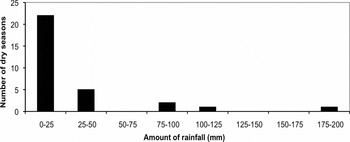
Meteorological records for the study area were examined for a 31-y period (Figure 4). In only 4 y were there rainfall events in the dry season exceeding 75 mm; and there was only one rainfall event (177 mm) in the past 31 y that was comparable in magnitude to our most intense irrigation treatment (i.e. 200 mm).
Dry-season rainfall at Chamela from 1977–2007.

DISCUSSION
All trees, regardless of species, flushed more leaves as the irrigation intensity increased. For P. constricta flowering also significantly increased with intensity although the sample size was quite small. All the leaves and flowers were desiccated within a few weeks following the watering episode, similar to the trees in Costa Rica irrigated by Borchert (Reference BORCHERT1994b).
The two most common species, C. alliodora and P. constricta, normally initiate leaf abscission in October or November, and subsequently flush new leaves soon after the first rains of the wet season in June (Borchert Reference BORCHERT1994c, Bullock & Solis-Magallanes Reference BULLOCK and SOLIS-MAGALLANES1990), and this is typical of the deciduous species in western Mexico. Some flushing response to rare precipitation events appears to be normal for woody species in tropical dry forests (Borchert Reference BORCHERT1994b, Bullock Reference BULLOCK1986, Bullock & Solis-Magallanes Reference BULLOCK and SOLIS-MAGALLANES1990, Myers et al. Reference MYERS, WILLIAMS, FORDYCE, DUFF and EAMUS1998). This generalization is not valid, however, for wetter tropical areas where heavy applications of water by Wright & Cornejo (Reference WRIGHT and CORNEJO1990) led to leaf emergence in only 4 of 29 species. Based on natural dry-season rainfall events, it has been argued that the minimal amount of precipitation required for drought-deciduous trees to flush at least some leaves is between 20–50 mm (Bullock & Solis-Maganalles 1990, Daubenmire Reference DAUBENMIRE1972, Myers et al. Reference MYERS, WILLIAMS, FORDYCE, DUFF and EAMUS1998). (The required amount would of course depend greatly on the rate at which the soil retained the added moisture; in turn, this retention capacity would be a function of soil texture and slope angle.) The trees on the coarse-textured slope used in this experiment were more resistant to flushing than expected; even at 50 mm, half the trees showed no response at all. At the other extreme, with 200 mm of water, essentially all trees showed a very strong response. Likewise, Borchert (Reference BORCHERT1994b) applied 200–280 mm in Costa Rica and obtained full leaf emergence from a number of tree species.
For C. alliodora or P. constricta, no false ring developed in response to any intensity of irrigation. Indeed, there was no detectable alteration in the wood anatomy of the 2007 (wet season) ring for any individual. It is likely that no reactivation of the cambium occurred in the weeks following irrigation; perhaps there was simply too little time before water stress was re-established or before an auxin gradient could be well-established.
Bullock (Reference BULLOCK1997) found no effect of dry-season rainfall on the amount of subsequent radial growth for two western Mexico tree species over the course of a decade, but this could have been merely because any effect was swamped by other factors such as inter-annual differences in rainy-season total precipitation. The results presented here are more compelling evidence for the lack of any effect on radial growth from extreme dry-season events because all the trees received the same amount of rainy-season water. Given that we could find no evidence of cambial growth due to even intense irrigation, it is possible that any net carbon gain was allocated to the root system. If so, any benefit from this subsurface deployment of resources was undetectable in the first subsequent ring in the trunk.
These small trees (average crown diameter about 1.5 m) must have correspondingly limited root systems. Trees immediately outside the plots showed no response except adjacent to the 200-mm-intensity plot where a few trees had a limited amount of leaf deployment. (By contrast, the much larger trees of Borchert (Reference BORCHERT1994b) showed a response even when several m outside his irrigated plots.) Likewise, we discerned no difference in response within a plot for trees near the 0.5-m buffer vs those in the middle (although, at most, these trees could only be 2 m apart). Given our demonstration that there was little subsurface flow in these very dry soils, it appears that the great majority of the roots of these trees lay within the 25-m2 plots, and thus a rainfall with a measured intensity equal to one of our irrigations, should have an equivalent effect on budburst.
Judging from the 31-y record at Chamela, dry-season precipitation exceeding 75 mm, and therefore causing a moderate degree of flushing among most trees, would occur about once each 8 y. A full canopy of newly emerged leaves for a stand (based on our subset of species) would require on the order of 200 mm, and this should occur only a few times per century. While it might be instructive to fit a longer record to a probability distribution suitable for extreme events (such as the Gumbel distribution), nonetheless it is clear from this study that, at least in western Mexico, an extreme dry-season rainfall event should only occur a few times during the lifetime of a tree – the typical canopy tree age presumably being on the order of a century (based on unpublished ring counts of a few of the largest individuals in the area). This rarity, coupled with the lack of a false ring response, means that both community dynamics studies (via stand reconstructions such as those of Baker et al. Reference BAKER, BUNYAVEJCHEWIN, OLIVER and ASHTON2005) and dendroclimatological studies can proceed without the investigator worrying about the confounding effect of extreme dry-season precipitation events causing the same false rings throughout a stand.
ACKNOWLEDGEMENTS
Help in the field was provided by Octavio Sanchez Lieja and Gumersindo Sanchez. Funding was provided by NSERC (to DFG) and CONACyT (to MQ).