Introduction
Cognitive impairments have been consistently demonstrated in schizophrenia spectrum patients (Bilder et al., Reference Bilder, Reiter, Bates, Lencz, Szeszko, Goldman and Kane2006; Kahn & Keefe, Reference Kahn and Keefe2013). These cognitive impairments are also present in individuals at risk of developing psychosis (MacCabe et al., Reference MacCabe, Wicks, Löfving, David, Berndtsson, Gustafsson and Dalman2013), prior to illness onset (Keefe et al., Reference Keefe, Perkins, Gu, Zipursky, Christensen and Lieberman2006) and in healthy relatives of patients (McIntosh, Harrison, Forrester, Lawrie, & Johnstone, Reference McIntosh, Harrison, Forrester, Lawrie and Johnstone2005; Sitskoorn, Aleman, Ebisch, Appels, & Kahn, Reference Sitskoorn, Aleman, Ebisch, Appels and Kahn2004).
The long-term course of cognition and its functional implications are still under debate (Zanelli et al., Reference Zanelli, Mollon, Sandin, Morgan, Dazzan, Pilecka and Reichenberg2019).
Social deterioration in schizophrenia (Velthorst et al., Reference Velthorst, Fett, Reichenberg, Perlman, van Os, Bromet and Kotov2017) might reflect a parallel deterioration in cognition since cognition seems to relate to functionality (Bowie et al., Reference Bowie, Leung, Reichenberg, McClure, Patterson, Heaton and Harvey2008; Green, Reference Green2006).
Previous longitudinal investigations have achieved inconsistent results. Evidence has been provided of a progressive decline (Fett et al., Reference Fett, Velhorst, Reichemberg, Ruggero, Callahan, Fochtmann and Kotov2020) or at least a lack of improvement (Albus et al., Reference Albus, Hubmann, Mohr, Hecht, Hinterberger-Weber, Seitz and Küchenhoff2006; Bilder et al., Reference Bilder, Reiter, Bates, Lencz, Szeszko, Goldman and Kane2006; Øie, Sundet, & Rund, Reference Øie, Sundet and Rund2010) that might start before illness onset (Meier et al., Reference Meier, Caspi, Reichenberg, Keefe, Fisher, Harrington and Moffitt2014) and is sometimes limited to specific functions (Juuhl-Langseth, Holmén, Thormodsen, Oie, & Rund, Reference Juuhl-Langseth, Holmén, Thormodsen, Oie and Rund2014; Stirling et al., Reference Stirling, White, Lewis, Hopkins, Tantam, Huddy and Montague2003). However, a lack of deterioration (Bergh et al., Reference Bergh, Hjorthøj, Sørensen, Fagerlund, Austin, Secher and Nordentoft2016; Rodríguez-Sánchez et al., Reference Rodríguez-Sánchez, Ayesa-Arriola, Pérez-Iglesias, Periañez, Martinez-Garcia, Gomez-Ruiz and Crespo-Facorro2013), even in phases prior to illness onset, has also been reported (Carrión et al., Reference Carrión, Walder, Auther, McLaughlin, Zyla, Adelsheim and Cornblatt2018). Neuroimaging findings support these two bodies of evidence (Niendam et al., Reference Niendam, Ray, Iosif, Lesh, Ashby, Patel and Carter2018; Vita, De Peri, Deste, & Sacchetti, Reference Vita, De Peri, Deste and Sacchetti2012).
Certain intermediate variables might help to explain the discrepancies. Some of these variables might be the duration of untreated psychosis (Norman & Malla, Reference Norman and Malla2001; Rund, Reference Rund2014), the possible toxic effects on the brain of total accumulated time of psychosis after treatment (Barder et al., Reference Barder, Sundet, Rund, Evensen, Haahr, ten VeldenHegelstad and Friis2015; Rund et al., Reference Rund, Barder, Evensen, Haahr, ten VeldenHegelstad, Joa and Friis2016), the course of symptomatology (Bergh et al., Reference Bergh, Hjorthøj, Sørensen, Fagerlund, Austin, Secher and Nordentoft2016; Ventura, Thames, Wood, Guzik, & Hellemann, Reference Ventura, Thames, Wood, Guzik and Hellemann2010), the age of onset (Rajji, Ismail, & Mulsant, Reference Rajji, Ismail and Mulsant2009), sex (Goldstein et al., Reference Goldstein, Seidman, Goodman J, Koren, Lee, Weintraub and Tsuang1998), or the effects of pharmacological treatments on the brain (Vita, De Peri, Deste, Barlati, & Sacchetti, Reference Vita, De Peri, Deste, Barlati and Sacchetti2015).
Most studies examine short follow-up periods. Studies that follow patients for longer periods, as long as 10 years, have reported a lack of deterioration. However, the size of the samples in these studies was small (Hoff, Svetina, Shields, Stewart, & DeLisi, Reference Hoff, Svetina, Shields, Stewart and DeLisi2005), or control groups were lacking (Bergh et al., Reference Bergh, Hjorthøj, Sørensen, Fagerlund, Austin, Secher and Nordentoft2016; Rund et al., Reference Rund, Barder, Evensen, Haahr, ten VeldenHegelstad, Joa and Friis2016). A recent study following a large sample of first-episode patients with psychosis and controls for a 10-year period concluded that cognitive decline after illness onset was present, although the decline varied across specific functions (Zanelli et al., Reference Zanelli, Mollon, Sandin, Morgan, Dazzan, Pilecka and Reichenberg2019).
Our group has previously described a stable course of cognition in the short-term and mid-term in a large cohort of first-episode psychosis patients compared with controls (Rodríguez-Sánchez et al., Reference Rodríguez-Sánchez, Pérez-Iglesias, González-Blanch, Pelayo-Terán, Mata, Martínez and Crespo-Facorro2008, Reference Rodríguez-Sánchez, Ayesa-Arriola, Pérez-Iglesias, Periañez, Martinez-Garcia, Gomez-Ruiz and Crespo-Facorro2013). Currently, we aim to extend the follow-up period to 10 years. In addition, we explore possible relationships between the course of cognition and certain clinical and sociodemographic variables.
Methods
Study setting
The data for the present investigation were obtained from the PAFIP study conducted at the Marqués de Valdecilla University Hospital, Spain. A detailed description is provided elsewhere (Pelayo-Terán et al., Reference Pelayo-Terán, Pérez-Iglesias, Ramírez-Bonilla, González-Blanch, Martínez-García, Pardo-García and Crespo-Facorro2008).
According to international standards for research ethics, this programme was approved by the local institutional review board.
Subjects
During the period from February 2001 to 2018, all referrals to the PAFIP were screened for patients who met the following criteria: (1) 15–60 years of age; (2) lived in the catchment area; (3) were experiencing their first episode of psychosis; (4) had no prior treatment with antipsychotic medication or, if previously treated, a total lifetime of adequate antipsychotic treatment of less than 6 weeks; and (5) met the DSM-IV criteria for brief psychotic disorder, schizophreniform disorder, schizophrenia, not otherwise specified (NOS) psychosis or schizoaffective disorder. In this study, patients with a diagnosis of schizoaffective disorder at the 6-month diagnostic interview (DSM-IV criteria) were excluded from the analyses. The reasons for this exclusion are explained in detail in Rodríguez-Sánchez et al. (Reference Rodríguez-Sánchez, Pérez-Iglesias, González-Blanch, Pelayo-Terán, Mata, Martínez and Crespo-Facorro2008). In brief, this exclusion is because patients with schizoaffective disorder seem to show a different cognitive performance profile compared to patients with schizophrenia spectrum disorder.
All patients included in the present study were initially randomized to haloperidol, olanzapine and risperidone according to a clinical trial protocol that has been described elsewhere (Crespo-Facorro et al., Reference Crespo-Facorro, Rodríguez-Sánchez, Pérez-Iglesias, Mata, Ayesa, Ramirez-Bonilla and Vázquez-Barquero2009). The three antipsychotics were equally effective in treating cognitive deficits of psychosis at 1 year (Crespo-Facorro et al., Reference Crespo-Facorro, Rodríguez-Sánchez, Pérez-Iglesias, Mata, Ayesa, Ramirez-Bonilla and Vázquez-Barquero2009).
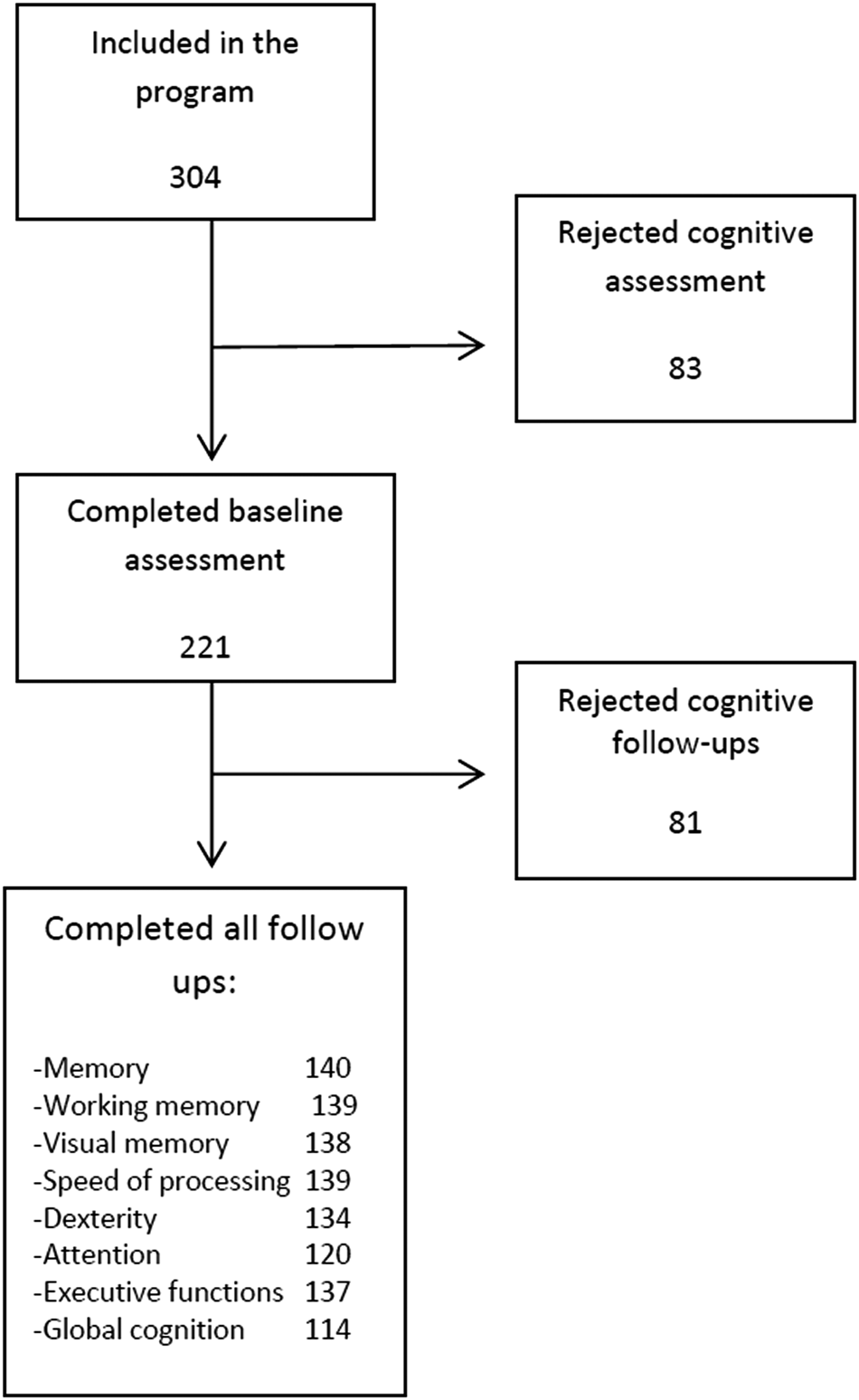
Of the 304 (originally 307 and reduced to 304 after diagnosis change), study patients who met the inclusion criteria, 221 (71.98%) individuals undertook at least the baseline cognitive assessment protocol, and 140 patients completed all follow-ups for at least one cognitive function. These latter were the target for the current work (see Fig. 1).
Selections of patients.

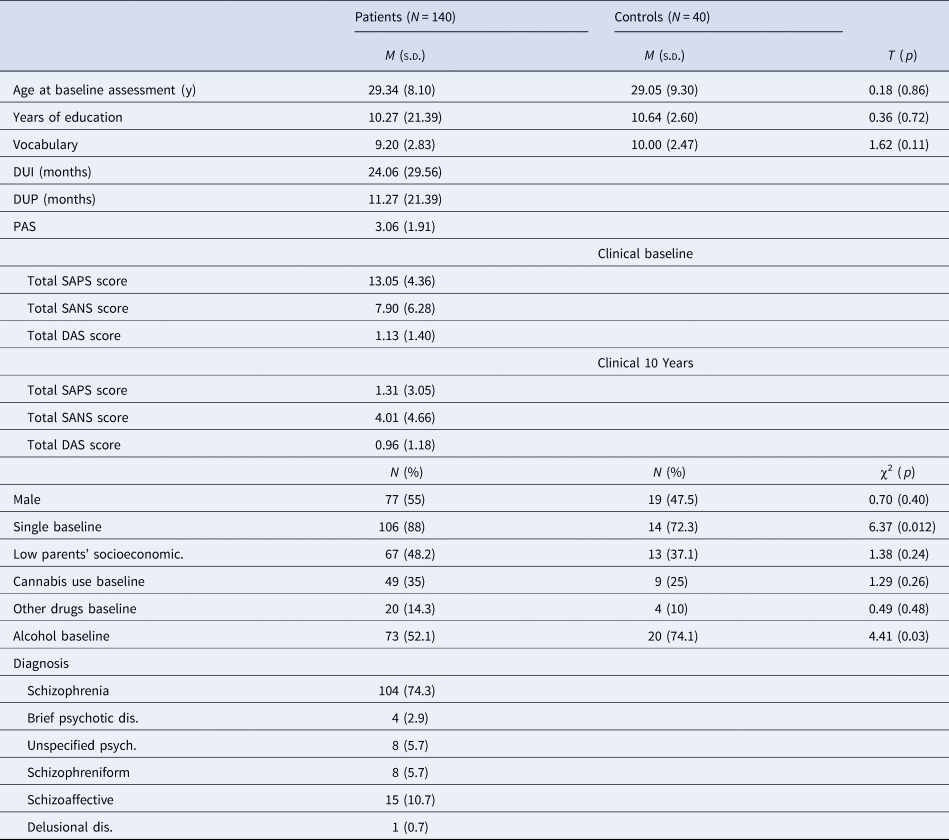
The demographic and clinical characteristics of the sample that completed all three assessments (N = 140) are presented in Tables 1 and 2.
Clinical and sociodemographic data of patients and controls

PAS, premorbid adjustment scale; SAPS, scale for the assessment of positive symptoms; SANS, scale for the assessment of negative symptoms; DAS, disability assessment schedule.
Parents' socioeconomic level was established with the following classification: major professionals; minor professionals; smaller business owners; semiskilled workers; unskilled workers; unknown.
Drug use classification of patients into users or non-users of drugs (particularly cannabis) was based on interviews.
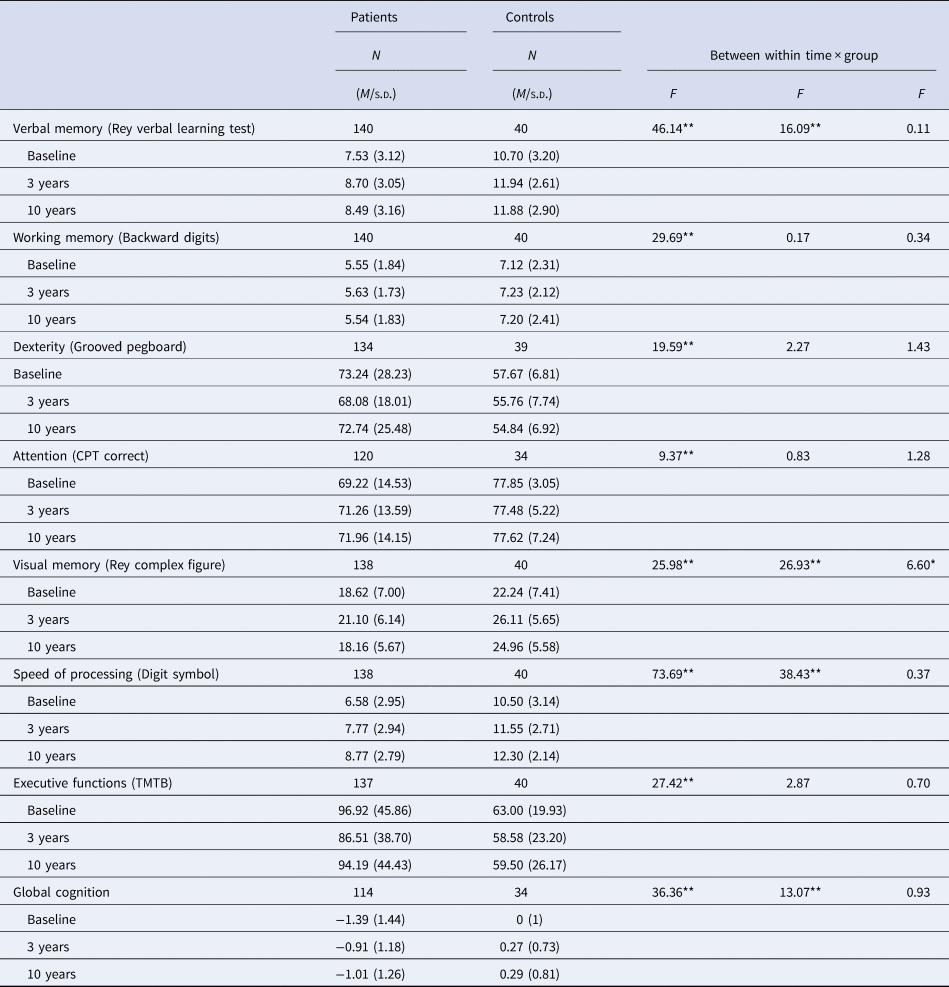
Descriptives and results of repeated measures ANOVA
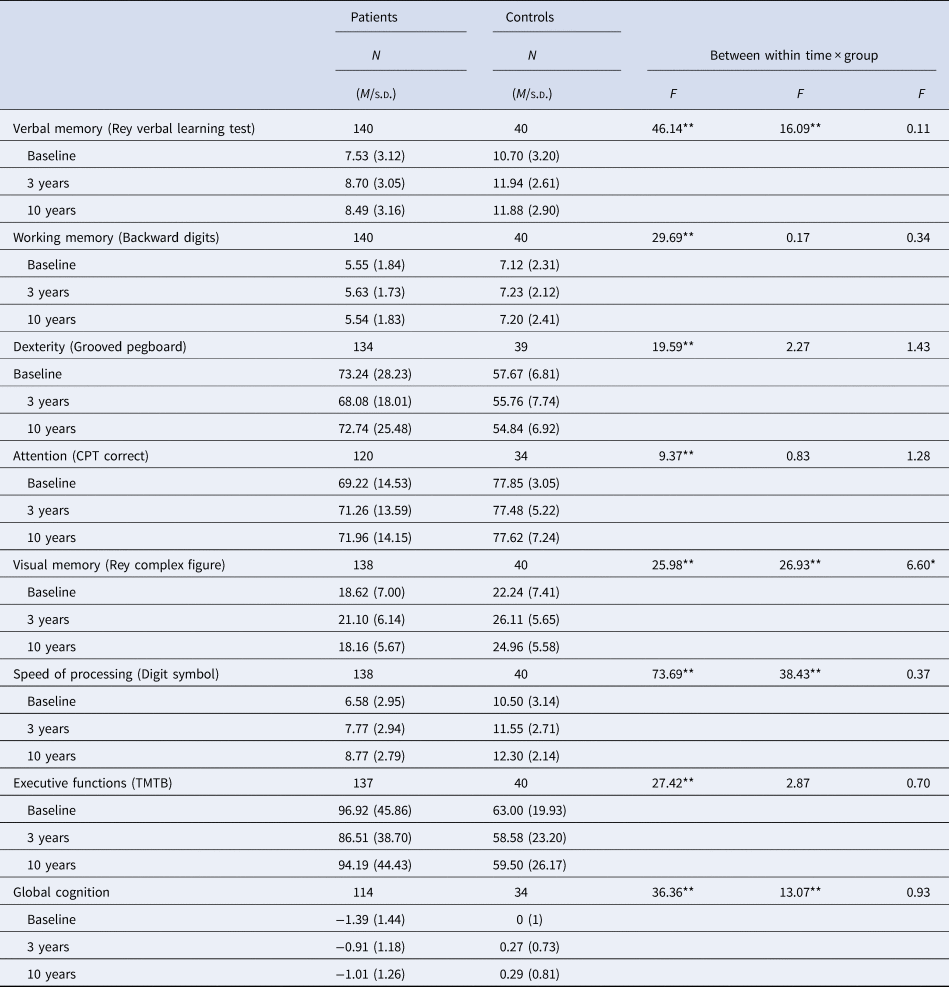
Scores on the grooved pegboard (dexterity) and TMTB (executive functions) are in the opposite direction; that is, higher scores indicate worse performance. The significance threshold for the main contrasts after Bonferroni correction was set at 0.006 (0.05/8).
** p < 0.002; * p < 0.05.
Post hoc analyses:
Between-group differences were significant at all time points in every cognitive function.
Within-group differences in patients showed significant sustained increases in memory (baseline to 3 and 10 years), speed of processing (significant increase among all time points) and attention (baseline to 10 years). In contrast, global cognition only increased from baseline to 3 years. Finally, dexterity and visual memory showed significant increases from baseline to 3 years, followed by a significant decrease from 3 to 10 years.
Within-group differences in controls showed significant increases only in speed of processing.
As seen in Table 2, the number of subjects who contributed data for each specific cognitive domain varied slightly. This happened because not all patients adequately completed all the cognitive tests in each follow-up cognitive evaluation.
In order to detect potential biases subjects that completed all cognitive assessments were compared to those that only completed the baseline assessment and those who did not complete any assessment at all.
A group of healthy subjects with no current or past history of psychiatric illness was recruited through advertisements within the local community and underwent the same cognitive assessments. Of 59 subjects finally recruited, 40 agreed to participate in the cognitive study (see Table 1 for demographics). To detect potential biases these subjects were compared to 19 who did not undergo cognitive assessments.
Both groups (patients and controls) had a certain similar amount of missing data. This was not due to dropouts (subjects failing to attend assessments) but to the impossibility of conducting certain tests at certain times. The assessment of attention was particularly affected, as shown in Table 2. However, the causes of these missing data were not attributable to the characteristics of the subjects themselves but to organizational problems and were therefore randomly distributed between the subjects. As will be discussed, this loss of data did not allow for the calculation of global cognition scores for all subjects.
Clinical and functional assessments
The clinical and functional assessments considered for the current study were those obtained at baseline and at 10 years. All data (including sociodemographic data) are shown in Table 1.
Clinical symptoms of psychosis were assessed by means of the Scale for the Assessment of Positive Symptoms (SAPS) and Scale for the Assessment of Negative Symptoms (SANS).
To rate functionality, we used the global disability item from the Spanish version of the Disability Assessment Schedule (DAS) (Janca et al., Reference Janca, Kastrup, Katschnig, López-Ibor, Mezzich and Sartorius1996). The premorbid adjustment was measured by means of the Premorbid Adjustment Scale (PAS) general adjustment score (Cannon-Spoor, Potkin, & Wyatt, Reference Cannon-Spoor, Potkin and Wyatt1982). The duration of untreated psychosis (DUP) and the duration of untreated illness (DUI) were also recorded. The two concepts were defined as the time from the first continuous psychotic symptom to the initiation of adequate antipsychotic drug treatment (DUP) and the time from the first nonspecific symptoms related to psychosis to the initiation of adequate antipsychotic drug treatment (DUI).
Neuropsychological assessment
In all the assessments, the same cognitive functions were examined, and the same tests were used to measure them: (1) verbal memory: Rey Auditory Verbal Learning Test (RAVLT) long-term recall score; (2) visual memory: Rey Complex Figure test (RCFT) long-term recall score; (3) motor dexterity: grooved pegboard (GP), time to complete with dominant hand; (4) executive functions: Trail Making Test part B (TMTb); (5) working memory: WAIS III-Backward Digits (BD) total score; (6) speed of processing: WAIS III-Digit Symbol (DS) standard total score; (7) attention: Continuous Performance Test Degraded-Stimulus (CPT-DS), the total number of correct responses.
It must be noted that the scores on the TMTb and GP are opposite to the others; that is, in these tests, higher scores indicate worse performance.
Finally, an index to reflect global cognition was also calculated. The scores of patients and controls at each time point were standardized to the mean and standard deviation of the controls at baseline. This was calculated separately for each cognitive test. The TMTb and GP scores were inverted. Following this procedure, we obtained the relative gap between the performance of the patients and controls for each cognitive score at each time point. Then, the standardized scores were averaged to obtain a global cognition score. Only 114 patients and 34 controls had the three assessments in the seven tests to allow this measure to be obtained. Finally, to explore differences between those patients who cognitively improved over time (stability) v. those whose cognitive performance decreased over time (decline), we divided the entire sample into two groups. The decline group included those patients whose global cognition score at 10 years was farther from that of the controls than at baseline (i.e. those patients whose gap in global cognition with respect to the controls had increased). In contrast, the stability group included patients whose global cognition score was at an equal distance or closer to that of the controls at 10 years than at baseline.
The WAIS III vocabulary test was used as a premorbid IQ estimator for covariation purposes if necessary (Rodríguez-Sánchez et al., Reference Rodríguez-Sánchez, Ayesa-Arriola, Pérez-Iglesias, Periañez, Martinez-Garcia, Gomez-Ruiz and Crespo-Facorro2013). The cognition testers were blind to medications, adverse event status and the use of concomitant medications as well as to clinical and functional status.
Statistical analyses
T tests were used to compare continuous variables between patients and controls, and the chi-square test was utilized to study nominal variables.
Repeated analyses of variance (ANOVA-r) were performed for each cognitive domain with the group (patient v. control) as the between-subject factor and time (baseline v. 3-year v. 10-year assessments) as the within-subject factor. The effects of time (longitudinal dimension), group (cross-sectional dimension) and time by group (interaction effect) were examined. All post hoc comparisons were Bonferroni corrected.
To control the possible effect of the initial performance (regression to the mean), an additional set of analyses was performed. Both groups were compared by means of univariate ANCOVA in cognitive change scores. These change scores were calculated for each cognitive domain by subtracting the baseline scores from the 10-year scores. In this analysis, baseline performance was used as a covariate. The Statistical Package for Social Science (IBM SPSS Statistics for Windows, version 23) was used for statistical analyses. All statistical tests were two-tailed, and significance was determined at the 0.05 level.
Results
Representativeness of the sample
To estimate the representativeness of the final sample, we compared those subjects who had completed the full follow-up (N = 140) v. those who completed only baseline evaluation (N = 81) v. those who attended the programme but did not complete any cognitive evaluation (N = 83) in a large set of clinical and sociodemographic variables. The results of these comparisons are shown in the supplementary data. In brief, at baseline, all three groups were comparable with regard to clinical and functional variables. However, 10 years after treatment initiation, the patients who completed all cognitive assessments seemed to have had a better clinical and functional course, showing less symptomatology as measured by the SAPS, the SANS and the DAS and a higher proportion of clinically stable patients (See supplementary data).
In the case of controls the only difference between those that participated (N = 40) in the cognitive study and those who did not (N = 19) was a higher proportion of males in the group that did not participate in the cognitive study (47.5% v. 78.9% p = 0.02) (see supplementary data).
Comparison with healthy controls
The comparison with the healthy controls (HC) in sociodemographics is shown in Table 1. The patients and HCs were comparable in terms of age, years of education and premorbid IQ. Since these variables were homogeneous between groups no covariation was considered necessary in further analyses. Patients showed a higher proportion of alcohol usage at baseline.
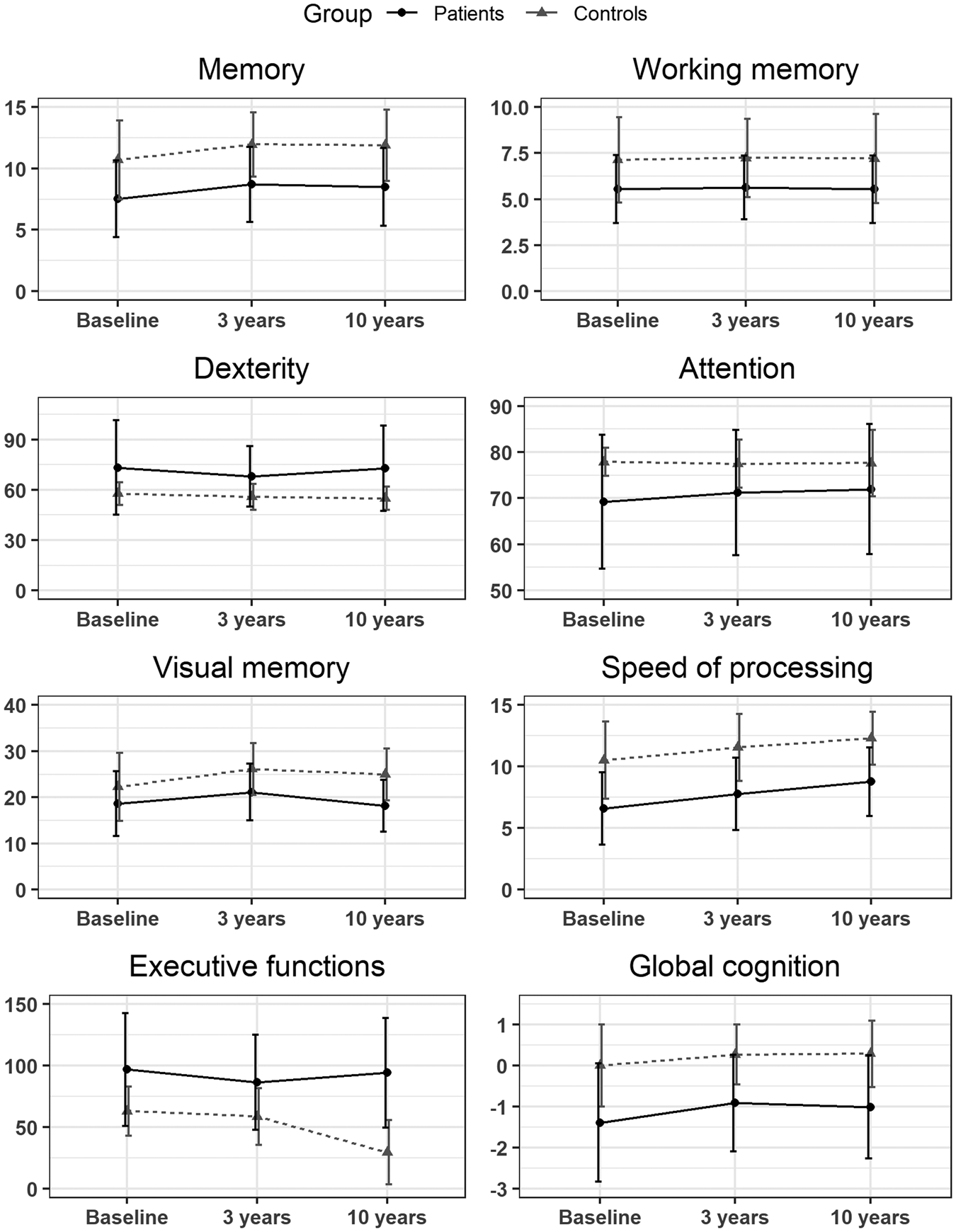
Performance on cognitive variables can be seen in Fig. 2.
Performance of patients and controls in cognitive dimensions along the ten year period.

Between-group effects
The results of cognitive performance in the patients and controls at baseline, 3-year and 10-year follow-up assessments are shown in Table 2 and Fig. 2. The effect sizes and observed power of contrast are provided in the supplementary data. The main group effects were significant in all cognitive domains. Post hoc analyses showed that the patients were significantly outperformed by the HCs at each time point for all cognitive variables (see Table 2 footnotes).
Within-group effects
The main effects of time were indicative of significant changes in performance on all variables except for working memory (backward digits) (see Table 2).
With regard to the patients, post hoc analyses revealed a significant improvement from baseline to 3 years, followed by a significant drop back to baseline scores in the following period for some variables (e.g. dexterity, EEFF and visual memory). For other variables, improvements occurred from baseline to 3 years with subsequent stabilization (e.g. verbal memory, GCS and attention). Finally, for some other variables, improvements were sustained throughout the 10-year period (e.g. speed of processing).
Post hoc analyses of performance in the HC group showed significant improvements only in the speed of processing variable. However, although the differences did not reach significance, the course of performance variations in the HCs during the 10 years of follow-up mostly paralleled that are shown in the patients.
Time × group effects
No interaction effect reached the required significance threshold after Bonferroni correction.
Change scores: comparison between groups
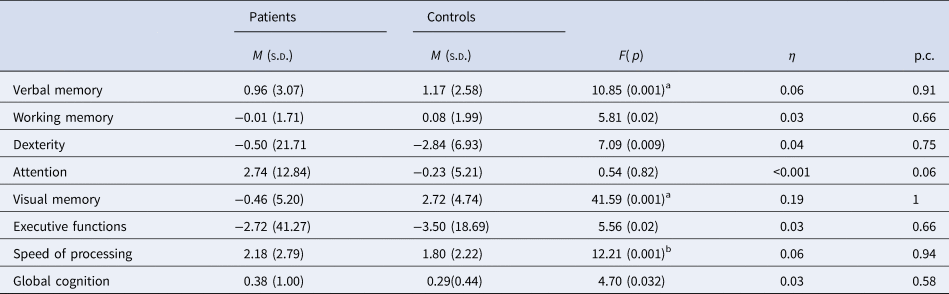
Three comparisons reached the required significance threshold of 0.006 (0.05/8) after Bonferroni correction: the HCs increased their scores to a greater degree than the patients in the verbal and visual memory tasks, whereas the patients increased their scores to a greater degree on the speed of processing task (see Table 3).
ANCOVA comparison of patients v. controls in difference scores (10 years minus baseline) covarying for baseline performance

Significance is set at 0.006. The effect size and power of contrast are also reported.
a Controls improve in a greater proportion.
b Patients improve in greater proportion.
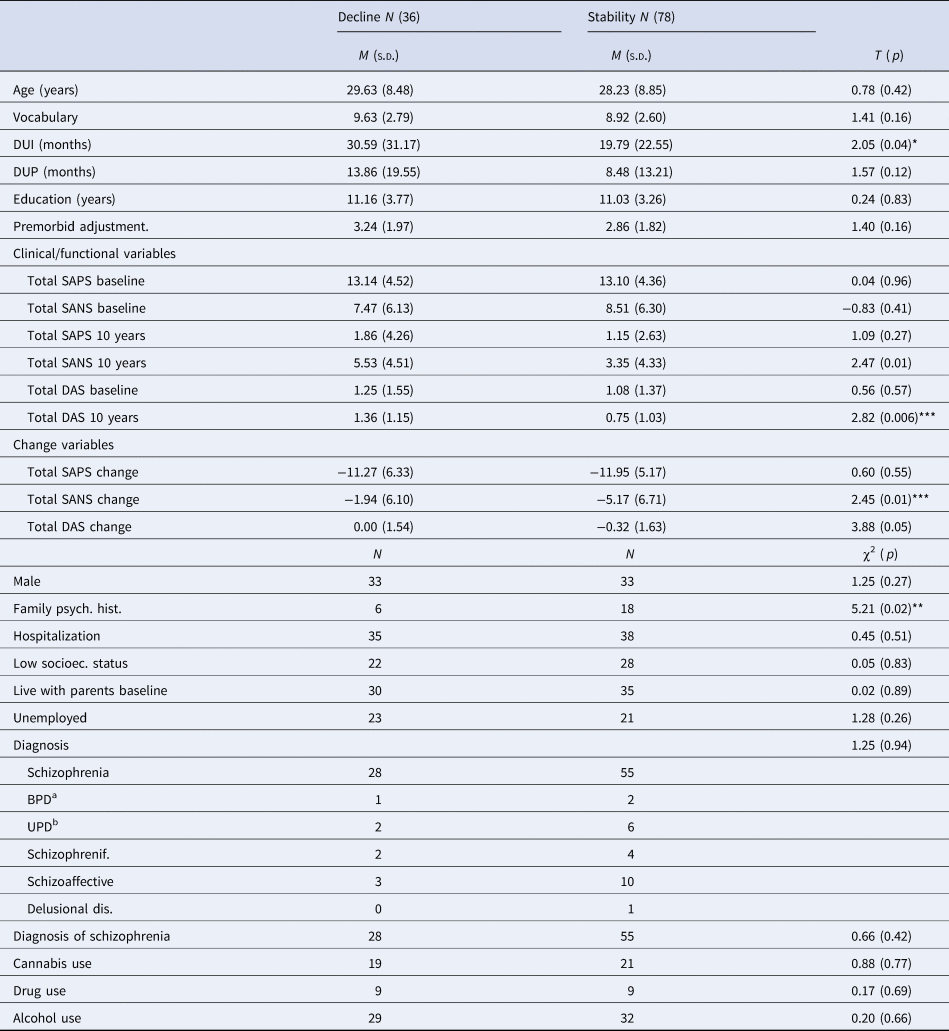
Sociodemographic and clinical characteristics of the decline and stability groups
The decline group showed a longer DUI and a lower percentage of subjects with a family psychiatric history. At 10 years, the decline group showed less functionality. The decline group also achieved lower improvements in negative symptoms (see Table 4).
Sociodemographic clinical and functional variables in decline v. stability samples

Comparisons of change variables were made independently and baseline scores were covaried.
* A Bonferroni correction was applied for multiple comparisons of potential continuous predictor variables, i.e. age, vocabulary, education, DUP, DUI, premorbid adj. baseline SAPS, SANS and DAS: 0.05/9 = 0.006.
**A Bonferroni correction was applied for multiple comparisons of potential discrete predictor variables, i.e. sex, family psych. history, hospitalization, low socioecon. status, unemployment, diagnosis, cannabis use, drug use and alcohol use: 0.05/9 = 0.006.
***A Bonferroni correction was applied for multiple comparisons of concomitant variables, i.e. 10-year SAPS, SANS, DAS, SAPS change and SANS change and DAS change: 0.05/6 = 0.008.
a Brief psychotic disorder.
b Unspecified psychotic disorder.
However, it must be noted that after Bonferroni corrections, all significances disappeared. Therefore, it was not possible to identify any variable as a predictor of decline or as a specific concomitant feature.
Discussion
Our findings showed that the patients were outperformed by the HCs in all cognitive variables at every time point. However, longitudinally, the course of cognition in both groups followed a similar course.
When both groups were compared in terms of change scores, three between-group differences were observed: the HCs increased their scores to a greater degree than the patients in the verbal and visual memory tasks, whereas the patients increased performance to a greater degree in the speed of processing task. Additionally, a comparison between patients who showed a stable cognitive course and patients who cognitively declined showed that the latter had a worse clinical course. However, the differences were not significant after adjustment for multiple comparisons. Therefore, no specific feature concomitant with cognitive decline could be conclusively identified. Similarly, no variable could be identified as a possible meaningful predictor of decline.
Comparisons with healthy controls
Most cognitive functions showed a similar longitudinal course in both groups. However, a few exceptions were observed. A greater increase in the speed of processing was unexpectedly found in the patients. A possible explanation could be that after clinical stabilization, patients returned to premorbid functioning. Alternatively, and not incompatible with the prior explanation, a closer inspection of the scores suggested that the level of performance achieved by the HCs might have reached a ceiling effect (see Table 2). It must be noted that in the general population, the mean score on digit symbols is 10 with a standard deviation of 3. Therefore, the controls increased from normal scores to close to one standard deviation with respect to the reference population group. However, the results for verbal and visual memory suggested the possibility of a relative deterioration in these functions in the patients.
Several studies have described declines in memory (Fett et al., Reference Fett, Velhorst, Reichemberg, Ruggero, Callahan, Fochtmann and Kotov2020; Frangou, Hadjulis, & Vourdas, Reference Frangou, Hadjulis and Vourdas2008; Hoff et al., Reference Hoff, Svetina, Shields, Stewart and DeLisi2005; Zanelli et al., Reference Zanelli, Mollon, Sandin, Morgan, Dazzan, Pilecka and Reichenberg2019). Zanelli et al. (Reference Zanelli, Mollon, Sandin, Morgan, Dazzan, Pilecka and Reichenberg2019) reported deterioration that was restricted to memory function, verbal abilities and IQ, with stability in other cognitive functions. They proposed the possibility of fluid cognitive functions following a static course, whereas crystallized abilities (e.g. memory, verbal abilities and IQ) might follow a progressive deterioration. In contrast, we consider that a deteriorating course restricted to just one cognitive function in a generalized stability scenario may not be a parsimonious explanation. Performance in certain tasks, such as memory or verbal ability, is highly dependent on the accumulation of experience. When the assessments are repeated (experience or practice effect), impairment (even static) would result in an increasing lag relative to nonimpaired subjects. If this is true, a stable course common to all cognitive functions might be sufficient to explain the observed heterogeneity (some functions decline, whereas others do not). Previous studies have suggested that children who subsequently develop schizophrenia exhibit early cognitive impairments that remain stable but cause developmental lags (Mollon, David, Zammit, Lewis, & Reichenberg, Reference Mollon, David, Zammit, Lewis and Reichenberg2018; Reichenberg et al., Reference Reichenberg, Caspi, Harrington, Houts, Keefe, Murray and Moffitt2010). Consistently, MacCabe et al. (Reference MacCabe, Wicks, Löfving, David, Berndtsson, Gustafsson and Dalman2013) attributed the cognitive decline observed in verbal ability to the failure of patients to achieve the level of functioning of their peers and not to an actual decline.
It is probable that the use of alternative content in the tasks used to measure these functions might rule out this cumulative lag effect. If this is true, it can be predicted that the use of alternate tasks is likely to attenuate the differences observed in verbal memory abilities in different studies.
Overall, our findings suggest a lack of deterioration in cognition in patients with psychosis 10 years after illness onset. The explanations for the apparently discrepant findings on verbal and visual memory fit within this frame.
Literature supporting the lack of cognitive deterioration in psychosis in the early years after illness onset is abundant (Bora & Murray, Reference Bora and Murray2014; Irani, Kalkstein, Moberg, & Moberg, Reference Irani, Kalkstein, Moberg and Moberg2011). Studies examining longer time periods are scarce; however, they tend to reflect consistent findings (Barder et al., Reference Barder, Sundet, Rund, Evensen, Haahr, ten VeldenHegelstad and Friis2015; Hoff et al., Reference Hoff, Svetina, Shields, Stewart and DeLisi2005; Rund et al., Reference Rund, Barder, Evensen, Haahr, ten VeldenHegelstad, Joa and Friis2016; Zanelli et al., Reference Zanelli, Mollon, Sandin, Morgan, Dazzan, Pilecka and Reichenberg2019).
Comparisons between the decline and stability subgroups
Although a general stability of cognition defines the psychosis group as a whole, a significant minority of subjects actually show cognitive deterioration. In the sample whose data allowed us to estimate a global cognitive decline measure (N = 114), we found that 31.6% of the subjects had worse cognitive performance over time. This proportion is similar to the 37.74% of patients who worsened in more than two cognitive functions described by Sánchez-Torres et al. (Reference Sánchez-Torres, Moreno-Izco, Lorente-Omeñaca, Cabrera, Lobo, González-Pinto and Cuesta2018).
As in previous reports (Bergh et al., Reference Bergh, Hjorthøj, Sørensen, Fagerlund, Austin, Secher and Nordentoft2016; Hoff et al., Reference Hoff, Svetina, Shields, Stewart and DeLisi2005), we also found a relationship between amelioration in negative symptoms and improvements in cognitive functions. In addition, the stable patients showed less social disability at 10 years. Studies focused on functional outcomes have also noted heterogeneity among individuals within the psychosis group (Ayesa-Arriola et al., Reference Ayesa-Arriola, Ortíz-García de la Foz, Martínez-García, Setién-Suero, Ramírez, Suárez-Pinilla and Crespo-Facorro2019).
These findings raise the possibility of the existence of different types of psychosis in addition to those considered by diagnostic taxonomies. In fact, subdivisions by diagnoses have not been related to any specificity in cognitive profiles (Zanelli et al., Reference Zanelli, Mollon, Sandin, Morgan, Dazzan, Pilecka and Reichenberg2019).
Although the main body of longitudinal research on cognition does not support the hypothesis of deterioration, discrepant findings can be found in studies that examine long periods of time (Øie et al., Reference Øie, Sundet and Rund2010; Stirling et al., Reference Stirling, White, Lewis, Hopkins, Tantam, Huddy and Montague2003). Neuroimaging studies have shown the existence of degenerative processes in the brain that might follow different rates of progression at different ages (Cropley et al., Reference Cropley, Klauser, Lenroot, Bruggemann, Sundram, Bousman and Zalesky2017). This notion could be in accordance with the findings of cognitive decline in geriatric schizophrenia populations (Harvey et al., Reference Harvey, Silverman, Mohs R, Parrella, White, Powchik and Davis1999). It also might be possible for cognitive decline to occur at adolescence and be unnoticed given that most research has studied adults (Øie et al., Reference Øie, Sundet and Rund2010)
Another explanation might rely on the concept of cognitive reserve. It has been proposed that cognitive reserve might attenuate the effects of brain deterioration (Van Rheenen et al., Reference Van Rheenen, Cropley, Fagerlund, Wannan, Bruggemann, Lenroot and Pantelis2019). In fact, educational level and unemployment, which could be considered indirect measures of cognitive reserve, have been reported to predict cognitive courses (Bergh et al., Reference Bergh, Hjorthøj, Sørensen, Fagerlund, Austin, Secher and Nordentoft2016). Unfortunately, our study failed to replicate this result.
It is also possible that different pathophysiological mechanisms could be related to different stages of the illness (Kurtz, Reference Kurtz2005). This would help to explain the cognitive deterioration observed in samples of geriatric patients.
Finally, it is also possible to assume the existence of specific subgroups of subjects who are affected by different pathophysiological mechanisms. Studies of different brain and cognition biomarkers (Bak et al., Reference Bak, Ebdrup, Oranje, Fagerlund, Jensen, Düring and Hansen2017; Clementz et al., Reference Clementz, Sweeney, Hamm, Ivleva, Ethridge, Pearlson and Tamminga2016) have identified different subgroups of subjects encompassed within the schizophrenia diagnosis. These subgroups have been supported by external measures such as social functioning and may represent different pathways to clinically similar psychoses (Clementz et al., Reference Clementz, Sweeney, Hamm, Ivleva, Ethridge, Pearlson and Tamminga2016). The fact that we observed an equal distribution of schizophrenia diagnostic types within both groups might add support to this idea.
Limitations
One of the limitations of our study concerns the representativeness of the sample. Out of 304 patients followed in our study, only between 120 (39.47%) and 140 (46.05%) completed sufficient assessments to be studied. This raises the possibility of the lack of representativeness of the subjects finally studied. We compared the group of patients who had fully completed follow-ups with those who only started the cognitive study and those who did not start it at all (supplementary material). The patients who completed all the follow-ups had better premorbid adjustment, were more likely to be drug users at illness onset and showed less symptomatology at 10 years. However, we verified that they did not differ in baseline cognition from the group that completed only the baseline assessment (all ps over 0.10; data not shown). Nevertheless, selection bias cannot be ruled out; therefore, the results should be considered with caution.
Another limitation may be related to age. The subjects studied were adults but were relatively young even after completion of the full 10-year follow-up period. Therefore, we could not rule out the effect of the cognitive decline occurring at ages previous or subsequent to the study period.
Furthermore, the role of pharmacological treatments was not addressed. However, prior evidence suggests that this may be a less relevant factor with regard to cognition than previously thought (Crespo-Facorro et al., Reference Crespo-Facorro, Rodríguez-Sánchez, Pérez-Iglesias, Mata, Ayesa, Ramirez-Bonilla and Vázquez-Barquero2009).
In sum, although the cognitive course in schizophrenia spectrum disorders considered as a whole population is not suggestive of a degenerative process, it is possible to identify a subgroup of subjects who show cognitive decline. The existence of different biotypes included within the schizophrenia diagnosis might explain the discrepancies found in the literature on cognitive and other biological variables.
Future research should address the study of psychosis with regard to classifications of patients based on profiles of biological variables such as cognition.
Supplementary material
The supplementary material for this article can be found at https://doi.org/10.1017/S0033291720002408.
Acknowledgements
This work was supported by the Instituto de Salud Carlos III (PI14/00639 and PI14/00918). No pharmaceutical companies financially supported the study.
Conflict of interest
No conflict of interests.
Ethical standards
The authors assert that all procedures contributing to this work comply with the ethical standards of the relevant national and institutional committees on human experimentation and with the Helsinki Declaration of 1975, as revised in 2008.