When we think about the Third Reich, the first images that come to mind are not those associated with buying and selling. Though an increasing number of studies have appeared on consumer habits and policies toward consumers, the literature on the Nazi period has been dominated by a focus on production, specifically war production. For every study of the consumer economy, there have been dozens on the Four-Year Plan, the use of foreign and slave labor, and heavy industry. In recent years a number of historians have begun to question this imbalance. Hartmut Berghoff and Wolfgang Koenig have argued that the regime encouraged “virtual consumption” through images of a future postwar era of peace and prosperity: the people's car, the people's refrigerator, and other products that would be available to all once victory had been achieved.Footnote 1 Nancy Reagin and Irene Guenther have provided compelling material on the responses of female consumers to the decreasing availability of many household items, starting with the introduction of the autarkic Four-Year Plan.Footnote 2 Nonetheless, this recent wave of interest in issues of consumption has tended to concentrate on the prewar years of the regime; after 1939, most historians merely emphasize the growing shortage of goods as the war dragged on. One exception is Goetz Aly, who has maintained that allegiance to the regime was secured through the dissemination of goods stolen from Jews and the occupied territories.Footnote 3 But his arguments have not convinced everyone, and his focus on the distribution of goods merely as a means of generating political support says little about how it fit in with wider patterns of consumer expectations and long-term economic thinking.
This article seeks to broaden the debate by maintaining that discussions about buying and selling in the Volksgemeinschaft were much more significant within official circles than has been previously thought. Indeed, there were theoretical and practical links between advertising, consumption, and the politics of imperialist expansion. As a means of exploring these links, this study focuses on Heinrich Hunke, the main figure within the Werberat der Deutschen Wirtschaft (Advertising Council for the German Economy). Also a prolific writer on economics and the holder of a number of other state and party positions, Hunke led a group of economic theorists, advertisers, and businessmen who defended commerce, and advertising in particular, as economically and politically critical, even into the war years. In making their case, Hunke and those around him were seeking to secure their own livelihoods and legitimacy within Nazi Germany and to lay the groundwork for a prosperous and politically unified postwar German Empire. While Hunke's work was upended by the collapse of the regime, such planning and the reforms that came out of it did have implications for the consumer paradise that eventually emerged in the Federal Republic. The influence of Hunke and his colleagues in the 1930s and 1940s did indeed save advertising from itself, helped to prepare Germany for prosperity in the postwar era, and promoted the concept of a “new Europe.” Happily, the Germany and Europe that emerged after 1945 were not as they had imagined, and yet the transnational quality to Hunke's vision is startling in its perspicacity.
When considering consumer consumption in Germany, many historians, including Adam Tooze most recently, emphasize that purchasing power remained low in the 1930s.Footnote 4 Albrecht Ritschl, however, maintains that the worst of the Depression was over by 1932, and that the upswing that followed cannot be chiefly attributed to Keynesian deficit spending in the form of building projects, state employment schemes, or rearmament policies of the new Nazi-led government.Footnote 5 “With or without Hitler,” Ritschl insists, recovery was “on the doorstep,” and long-term unemployment was becoming less and less of a threat.Footnote 6 While the debate remains alive and his perspective does not dominate, oral history evidence seems to corroborate Ritschl's statistical findings that stress improvement in the private sector.Footnote 7 From these sources, we learn that compared to the upheavals of the 1920s and the Depression years of the early 1930s, many individuals (at least, those not targeted by the regime) developed a sense of optimism about their economic futures.Footnote 8 This optimism did not extend to the purchase of large-ticket items; household appliances and cars remained beyond the reach of the vast majority of Germans until the post-1945 period. The “virtual consumption” of such items, however, relied on this optimism—the confidence that ownership was just around the corner. In the meantime, men and women were able to take pleasure in a wide array of relatively inexpensive nonessential consumer products and leisure activities that were available until the early 1940s.Footnote 9
Preparing for and sustaining the war effort were always the top priorities of the regime and its supporters in the business community, but those priorities cannot be disassociated from Hitler's goals of raising the standard of living for members of the Volk.Footnote 10 If the decadent, racially mixed Americans had achieved a high standard of living, the racially superior Germans should certainly enjoy the same. Many businessmen with links to the civilian economy before and after 1939 were clearly motivated by self-interest to safeguard profits and maintain market share wherever possible. But Nazi leaders also worried about the impact of totally dismantling the civilian economy; most remained convinced that deprivation on the home front had been the chief cause of defeat in 1918.Footnote 11 The goal, then, was to encourage virtual consumption and sustain some level of real consumption under controlled conditions. Within this political environment, however, there were men who continually advocated for retail trade and advertising as more than ways to build or maintain public support. Even after the onset of war, they argued that commerce could further the ideological goals of the regime and lay the groundwork for a new Nazi-led European order. The mechanics of individual consumption and the advertising industry that lubricated it were more than just a means of stabilizing the Nazi government.
Foremost among these advocates was Heinrich Hunke. Born in 1902, Hunke joined the National Socialist German Workers' Party (Nationalsozialistische Deutsche Arbeiterpartei, or NSDAP) in 1928 and served in the Reichstag from 1932 until 1945. Trained first as a primary school teacher, he was working for the military when he was recruited in early 1933 by the Ministry of Propaganda to prepare an office for the coordination of German advertising. The Werberat was created by legal acclamation later that year. Despite having no experience in private industry, Hunke served as vice president for the Werberat from its inception and took over as president in 1939, following the tenure of Ernst Reichard.Footnote 12 He served in that capacity until the end of the war. Goebbels also chose him to head the Foreign Department of the Ministry of Propaganda in 1940. In addition, as Gauwirtschaftsberater for Berlin, Hunke was a key figure in the aryanization of Jewish businesses in the capital. He believed in Germany's economic potential and supported the expansionist, racist war to reach that potential. In November 1938, Hunke applauded the exclusion of Jews from the German economy: “With the liquidation of Jewish influence in the German economy, the national solution to the Jewish question nears its end. Its final solution, however, is a matter that is beyond our total control. It is an international issue.”Footnote 13 Perhaps the most influential economic theorist of his day,Footnote 14 he also served as founding editor of the leading Nazi economics journal Die Deutsche Volkswirtschaft (DDV) from its beginnings in 1932 until its dissolution in 1944—the same year he was named to the Board of Directors of Deutsche Bank.Footnote 15 In these positions Hunke delivered hundreds of speeches and wrote dozens of books and articles in which he argued that consumption and advertising to spur consumption were economically and ideologically sound ventures and essential to his vision of a postwar, Nazi-led “new order” for Europe.Footnote 16
Making the case for advertising and individual consumption was not a simple task even when war preparation is removed from the discussion. The advertising industry suffered from a dubious reputation in Germany before 1933.Footnote 17 When the Nazis came to power, age-old concerns about the ability of ads to manipulate the consumer with lies and cheap tricks were compounded by critiques of foreign influence on design and strategy. Complaints about aggressive salesmanship became more openly anti-Semitic. As one author explained in the Nazi daily newspaper Völkischer Beobachter shortly after the start of the war in 1939, there was great joy in fighting the “Jewish salesmania.” He continued, “We National Socialists welcome the fact that consumer goods production has fallen” and are pleased “to combat the suggestion by Jews that every member of the community must consume as much as possible.”Footnote 18 For many National Socialists, the promotion and fulfillment of selfish individual desires were symptoms of racial ill health. Calls for a higher standard of living were at times overshadowed by rhetoric that championed the attainment of racial unity through sacrifice and classlessness, spirituality over materialism.Footnote 19 The preexisting doubts about advertising and the consumption it presumed to generate, therefore, were voiced more loudly after 1933 and could easily be employed to mobilize support for belt-tightening and eventually for rationing.
There are two particular moments in the history of the Nazi regime that are especially fruitful for evaluating how government officials and the business community related to the consumer market.Footnote 20 As Volker Berghahn explains, by 1935 the country had emerged from the Depression and was welcoming a new generation of managers—many of them replacing Jews or aging executives who were unwilling, or at least reluctant, to “get in line.” The new cohort was ambitious and looked forward to finding a niche for their products in the new regime, even after—or especially after—the Four-Year Plan made competition for resources tighter. The second shift, which is more central to this essay, occurred in 1940–1942. It is true that by this time the availability and advertising of consumer products had dropped dramatically, and in some cases had ceased altogether, but this was also the high point of German military success, and many business managers, advertisers, and Werberat officials were looking with anticipation toward Germany's immediate economic future. Before the reality of Stalingrad dashed so many hopes, those with connections to the Werberat in Germany saw their mission as twofold: continuing to defend the advertising industry and beginning to prepare for a peacetime commercial paradise in the greater Reich.
By the early 1930s, the NSDAP had a large enough following among advertisers for its influence to be visible in the major trade journal Die Reklame. The party claimed to recognize the important role advertisements could play in reviving the economy, and the emphasis the movement placed on its own propaganda and imagery seemed to confirm such platitudes. After 1933, the rapid coordination of the industry by Goebbels's Propaganda Ministry seemed to prove the sincerity of earlier promises, while signaling to others the further curtailment of artistic and commercial freedoms. As with other cultural media, including the fine arts and the press, the Werberat sought productive ways to exercise its semi-official authority rather than its censorship powers.Footnote 21 In other words, Hunke imagined a Werberat that focused less on policing and more on producing meaning through ads—visual and textual messages that would bolster Germany's economic and ideological goals.Footnote 22
From the start, Hunke also saw the Werberat's mandate as one that reached beyond Germany's borders. Foreign promotion of German goods and more generally the brand “Germany” (Außlandswerbung) was increasingly important as the decade wore on—economically critical, in fact, to a regime that was in dire need of hard currency, and politically necessary to improve the image of the dictatorship abroad. For Heinrich Hunke personally, the Werberat afforded him the chance to work toward a realization of his theoretical vision of a National Socialist economy and society. As Hunke remembered in later years, “The Ad Council of the German Economy offered a unique opportunity to get to know leaders within the German and foreign economies, European statesmen, and brilliant economists and mayors, to hear their views and experiences, to develop new ideas, to offer trust and win trust.”Footnote 23 The military successes of the first half of the war confirmed to Hunke and his colleagues and supporters in industry that this economic transformation would not stop at Germany's prewar borders. Consequently, in the early 1940s, they began in earnest to prepare for a postwar European economy led by Germany and fueled by a consumer society based on Nazi principles rather than what they demonized as the “liberal economics” championed by Great Britain and its American ally.
Consumption was particularly significant to National Socialists' understanding of the differences between the British market economy and their own economic principles. As Hunke and his associates noted, the energy and productivity of liberal capitalism was a model to be emulated, but where it faltered was in its failure to manage the consumption side of the equation—“the allocation of goods.” As a supporter of industry, and advertising in particular, Hunke was careful to be explicit that the entrepreneur had a place in the new economic order. Writing in 1943, he emphasized the central role to be played by the entrepreneur as the bearer of innovation and creativity in assuring Europe's economic future.Footnote 24 It was natural in the evolution of economic thinking, argued one of IG Farben's executives in Hunke's journal at the start of 1941, that all theoretical and managerial efforts would turn away from the “solved” matter of production to issues of consumption. Rejecting the “Jewish-marxist” solution of a planned economy, he and others set as their goal the “rational use of the powerful energy of production in the service of the Volksgemeinschaft.”Footnote 25
The scant literature that exists on the Werberat concludes that the body had little influence at the time and no impact on West Germany's economy or cultural landscape.Footnote 26 I will argue, however, that Hunke's vision of a “purposeful” Nazi-led European economy and the policies implemented through the Werberat as the first steps in achieving this postwar goal did leave a lasting legacy for West Germany.Footnote 27 A number of the Werberat's key initiatives helped to lay the groundwork for West Germany's consumer economy by cleansing advertising of its disreputable image and promoting the sense that advertisements could be used in the service of the public good. The Werberat also helped some large firms keep their brand names alive among the population through the war years and promoted the nascent field of market research.Footnote 28 Furthermore, Hunke and his colleagues were key proponents of developing a postwar continental marketplace. Theirs was not an easy task in a decade of rearmament and war, but with the help of large German consumer goods manufacturers, the Werberat legitimized buying and selling in the Third Reich—supporting a trend that anticipated and fueled the postwar abundance.Footnote 29
What steps did the Werberat take before the onset of war? First, a new language had to be developed about consumption that fit with the ideology of the racial community. As was explained in the leading trade journal for advertisers just months after the takeover of power, “It is precisely the new Volksgemeinschaft that sweeps away both snobbish aestheticism on the one hand and crass materialism on the other, and which, by bridging class differences and therefore also distinctions of taste, works toward a grand and unambiguous appreciation for authenticity, beauty, and propriety that is held in common by all Germans.”Footnote 30 Such formulations allowed for individual consumption. Though the goal was to bridge class differences, the author did not speak of eliminating them. Second, Reichard and Hunke were careful to define broadly the significance of advertising (Werbung) in the new economy. Hunke insisted that recipe booklets for housewives about the advantages of eating asparagus and pamphlets explaining “National Socialist agriculture policies” were just as central to their aims as placing catchy spots in newspapers and magazines (“Classifieds help sales,” and “Advertising is not too expensive”) to promote private investment in advertising.Footnote 31 Spending equal amounts of money on domestic and foreign activities in its first years, the Werberat also busily set up a network of individuals and associations around the world to report back on global market trends and opportunities and “correct false notions about German economic policy,” while providing financial support for trade shows and exhibits in Germany and abroad.Footnote 32 From the start, then, the Werberat's officials felt that advertising was essential to a whole host of economic and cultural activities. To ensure that it served National Socialism well in all these capacities—becoming an “expression of the economic ethos and achievement” of the VolkFootnote 33—a thorough overhaul of the entire advertising industry was in order.
In terms of specific reforms of the advertising industry, the removal of “undesirable” practitioners was far-reaching. All professionals, from ad agency executives down to window dressers, were required to attain licenses that were prohibited to so-called enemies of the Reich. The National Socialist Association of German Advertisers (NSRDW) newsletter Ruf der Werbung regularly printed the names of those welcomed into the ranks of the profession and those who had been struck from the mandatory association, according to Werberat regulations. In early 1937, the newsletter boasted that 3,000 men and women had been excluded due to “inadequate professional achievement or because of their foreignness to the profession [Berufsfremdheit], for example, their ancestry.”Footnote 34 The periodic printing of names and addresses of advertisers kicked out of the profession should be read as an attempt to demonstrate the willingness of National Socialist advertisers to undertake their own “necessary sorting and cleansing” of the industry.Footnote 35
The Werberat also spearheaded an extensive and broadly supported campaign to rationalize the industry, which meant the introduction of regulations to standardize the pricing and sizing of print ads. This process of rationalization did much to clean up the public image of the business side of advertising, which had appeared incomprehensible to all but a few insiders. American ad men working in Berlin before 1933 agreed with German critics of advertising that the industry had been rife with corruption. As George Butler of the J. Walter Thompson ad agency remembered, the Berlin branch chief struggled with the new language, and he “didn't like the German ways of doing business, either; none of us did… . Cheating was universal.”Footnote 36 The Werberat cracked down on the irregular negotiation that went on between publishers and advertisers of special discounts or bonuses for repetition or large quantities of advertisements. Publishers were also required to disclose their circulation rates and net sales—data that advertisers felt was not presented truthfully, if at all.
The Werberat also sought to improve the reputation of the industry through the establishment of the Reichswerbeschule (Reich Advertising School) on Berlin's Wittenbergplatz in the heart of the capital's west-end shopping district. Paradoxically, the institute's curriculum was reminiscent of the one made famous by the embattled Bauhaus design school in that its students were offered a holistic selection of courses. The school boasted that its students would graduate with the entire set of skills needed by the modern ad executive, copywriter, or graphic artist, from artistic training to business and psychology courses. The school, which was planned as a model to be replicated in other cities, supported the claims made by advertisers that they were well trained, upstanding professionals with degrees to prove it—members of the Bildungsbürgertum, not swindlers. Its location, too, which enjoyed a view of the famous KaDeWe department store, announced a certain reconciliation with bourgeois consumerism that was not lost in the press coverage of the school's opening (Figure 1).Footnote 37
The new Reichswerbeschule in Berlin situated at the heart of the west-end shopping district. Deutsche Werbung, no. 12 (1936).

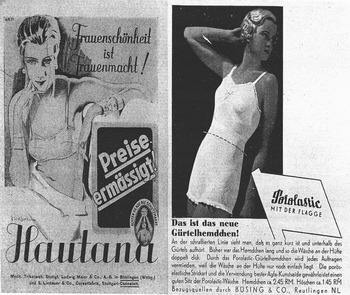
In terms of the content of advertisements, members of the Werberat and practitioners talked about the birth of a “clean German advertising,” by which they meant a style that eschewed international trends in favor of homegrown methods that allegedly protected the moral righteousness of the Volk and educated its members through truthful presentation of a product's merits. Though National Socialist ideology was in these ways to be infused in all manner of product promotions (be they print or film ads, trade shows, or educational exhibits), advertisements were not to debase the movement through kitschy replication of its symbols or slogans. By mid-decade certain restrictions had brought an official end to some of the most obvious excesses of the industry. Pharmaceutical ads were required to name potential side effects and were no longer permitted to promise more than could likely be delivered.Footnote 38 Famous personalities were prohibited from receiving payment for product endorsements. English and French words and phrases were removed from ad copy, and Gothic script was reintroduced in place of the “international” sans-serif typefaces of the republican era. Limits were placed on sexually explicit ads and ads for tobacco products.Footnote 39Figure 2 showed ad designers the proper way to advertise women's lingerie. Though such “before and after” comparisons were common in advertisers' trade journals after 1933, discussions of how to represent acceptable feminine style and comportment appeared particularly frequently, providing evidence for Irene Guenther's claims that these remained unresolved issues in Hitler's Germany.Footnote 40 After an initial flurry of product promotions that linked items to the party, its institutions, leading figures, and slogans, Werberat regulations were able to limit such abuses by mid-decade. Gemeinschaftswerbung (ads that promoted an entire sector), such as ads for milk or regional handicrafts, became more popular. The Werberat offered small grants toward the production of these ads in the spirit of community and as a way to promote smaller regionally based industries.Footnote 41 Other reforms were less successful; enthusiasm for gothic type faded quickly, for example, and even the Werberat was inconsistent in its use of the antiquated typeface. Aesthetically, no radical departure can be identified in the ads of the era. The move toward ad designs that incorporated larger amounts of text to convince the reader of a product's usefulness, though preferred by the regime as more educational and less reliant on the emotional lure of the art posters that had been the mainstay of the German ad industry, simply reflected long-term trans-Atlantic trends rather than a unique Nazi innovation.Footnote 42 Nonetheless, Hunke cited the steady increase in the number of advertisements produced in Germany throughout the 1930s, and concluded in the Werberat's annual reports that its influence through these and other reforms was leading to growing confidence in the economic value of ads among business owners, and to greater trust in the claims made by ads among consumers.Footnote 43
Advertising “yesterday and today”: The seductive vamp of the Weimar era was to be replaced by the statuesque, sporty Nazi female ideal. Seidels Reklame, no. 4 (April 1936): 106.

Of course, not everyone was as pleased with the changes introduced by the Werberat as Heinrich Hunke. In addition to those purged from their jobs, some advertisers and business owners found the regulations erected roadblocks to sales, and others simply disregarded the continual flood of new rules—which were presented in language that was considered Byzantine at best.Footnote 44 The Werberat had its enemies within the state bureaucracy as well. The Justice Ministry mounted the most vociferous campaigns against the Werberat, charging that this non-governmental body was encroaching on its territory—de facto writing law and prosecuting infractions. In February 1937, the Akademie für Deutsches Recht's committee on competition and trademark law drew the conclusion that the Werberat's extra-judicial authority (Neben-Gerichtsbarkeit) had to end. It insisted that the Werberat had no legal right to censure companies for unfair business practices by withholding their right to advertise. Without the authority to do so, members of the committee concluded, the Werberat would be unable to enforce its regulations and therefore should be disbanded. These legal minds were confident that the courts were perfectly able to monitor businesses, as they had always done.Footnote 45 Such turf warfare was common within the polycratic dictatorship, but Hunke was not bent on deflecting criticism of the Werberat solely in order to defend his piece of the pie. He was convinced that there were economic and ideological reasons to advocate for advertisers, manufacturers, and consumers vis-à-vis the government.
New challenges facing the advertising industry at the start of the war came from those critics who believed advertising was a nonessential service, one that distracted citizens from the seriousness of the conflict, used up scarce resources (particularly paper), and sought only to line the pockets of private corporations rather than serving the nation. One possibility, therefore, was to restrict the Werberat's activities to the policing of new regulations on the advertising of rationed and unavailable goods. But Hunke and others within the Werberat never saw their main task as a punitive one. In speeches, articles, and images, Werberat members, advertisers, and businessmen alike sought to counter their detractors in the early months of the war.Footnote 46 Hunke admitted that the onset of hostilities had rocked the industry, but he claimed that in the months that followed, the tens of thousands of men and women who worked in advertising had rallied and found a place in the new war economy. Time and again, he stressed the three priorities of the German economy at war: arms, exports, and consumption (in that order).Footnote 47 There was a danger, Hunke insisted, in believing that all aspects of the economy not tied to the production of war materiel had to disappear. Exports and domestic consumption were vital to the war effort, and advertising could stimulate both.
Hunke and his colleagues, therefore, set out to highlight the positive contributions they believed could be made by the industry throughout the growing empire. For them the war was seen as necessitating more than ever before an expansion of their work “to achieve freely the changes in feeling and understanding necessary to prepare the way for German goods in foreign lands.”Footnote 48 It is not surprising that ad men were recruited into the Propaganda Ministry. Design skills aside, many believed advertisements were a terrific way to sell German products and German authority abroad. Back home within the Altreich, the Werberat also maintained its relevance by partnering with large companies on massive projects aimed at educating consumers about the best ways to manage wartime shortages of food and household goods and accept the new ersatz products.
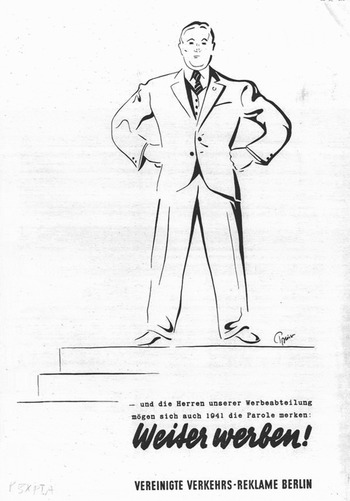
The specter of World War I and discontent on the home front remained on everyone's minds, but Hunke also made claims about the necessity of ads in purely economic terms: the importance of keeping thousands employed in ad-related jobs, and powering the economy by influencing consumer behavior at home and abroad.Footnote 49 Moreover, Hunke and others argued that ads were an important cultural asset. With the recent reforms to the industry ushered in by the Werberat, its members felt confident that ads now offered a “mirror image of the times” in the same way that newspapers did, and as such had intrinsic cultural value.Footnote 50 Therefore, in these terms—political, economic, cultural—advertisements for advertising continued to appear through the first half of the war. Presenting the practitioner as duty bound, rather than profit-driven, one full-page image in the country's nazified trade journal Die Deutsche Werbung reminded readers that the slogan for 1941 was “continue to advertise” (weiter werben).Footnote 51 The ad man was pictured standing strong, legs outstretched, hands on hips, ready to do his part for National Socialist Germany (Figure 3).Footnote 52 Even after the fortunes of war began to turn against Germany, the Werberat held on, despite a shrinking budget and continued calls for its dismantling, by relying on Goebbels's powerful patronage and by repeatedly emphasizing the value of its work—the ability of advertisements to produce meaning for consumers at home and abroad about daily life in war and the future peace.Footnote 53
A show of solidarity behind the war effort—ad men ready to do their part in the coming year. Deutsche Werbung 33, no. 21 (December 1940): 769.

Indeed, ads provided a number of services for the country during the war. Most importantly, the ubiquitous presence of ads brought the war home to Germans in an easily digestible way. As an article in Deutsche Werbung explained in 1940, there were three types of war-related ads: those that showed soldiers' “joys and suffering” (primarily the former); those that showed the home front and the changes occasioned by the conflict; and those that educated consumers about shortages and unavailable goods. The author provided examples of ads, including Figures 4, 5, and 6, that highlighted the camaraderie of the soldierly experience, the benefits of gasoline shortages that encouraged walking to work, and the pleasure occasioned by the novel presence of cheerful female postal deliverers. It was important, ad designers were reminded by the accompanying text, to use both “tact and skill” in representing daily life in time of war. Humor, too, helped people accept the more unsettling and potentially traumatic aspects of the war, such as the absence of loved ones and the presence of women in heretofore masculine forms of employment.Footnote 54 Other ads stressed the possibility of life continuing unchanged. Nivea skin cream ads were considered a model for two reasons. On the one hand they pictured bathing beauties “browning” in the summer sun, hardly touched by the conflict—images that were likely welcome to men in the service and reminded readers on the home front that some forms of leisure and relaxation were still possible. On the other hand, many Nivea ads provided detailed instructions on how to enjoy the sun safely. Such instructions not only fit well with the ideological goals of building a healthy Volk, but also represented an example of the Werberat's desired “enlightenment” ads, explaining the product's usefulness to the rational consumer. In the Nivea ads pictured in Figures 7 and 8 from the summer of 1941, we can see both of these aims at work. In “Dear Husband,” a young wife pictured with her daughter writes to her beloved at the front that all is well, while reminding readers to be mindful of shortages and the health concerns of spending time in the summer sun:
This picture best answers your rather worried questions. … It proves most clearly that we are 1) healthy, 2) cheerful and enjoying each other, 3) Heidi is no longer pale-faced, 4) we are having good weather, 5) we are both savoring unbridled the summer sun and can easily handle it, and 6) we repeatedly apply Nivea-Crème daily, always remembering both sides. Heidi covers my back like an expert and uses Nivea according to today's necessary frugality. Of course, tanning with Nivea oil would go more quickly, but one can barely find it now. But that doesn't matter, we have plenty of time, and slow tanning is surely the most prudent.Footnote 55
Three examples of advertisements that might help Germans cope with the changes brought on by war by emphasizing soldierly camaraderie, the health benefits of shortages, and a more attractive streetscape populated by female workers. Deutsche Werbung 33, no. 17 (October 1940): 569–570.


Winning advertisements for Nivea crème, summer 1941. The wife of future Federal Republic President Theodor Heuss, Elly Heuss-Knapp penned the copy and design for these ads, which sought to reassure and educate readers. Courtesy of Beiersdorf AG.


The trend toward ads that “educated” the consumer was brought to new heights in the massive campaigns to teach female consumers how to live with the shortages and ersatz products of the war years. Under the authority of Hunke's Werberat, the Reich Committee for National Economic Enlightenment (Reichsausschuss für Volkswirtschaftliche Aufklärung, RVA) led a series of large-scale programs, including one to teach women how to wash clothes properly and use less soap and detergent around the house.Footnote 56 For this initiative, the RVA partnered with the three major manufacturers of cleaning products (Henkel, Böhme Fettchemie, and Sunlicht) from 1939 until the last year of the war. Hunke was particularly proud of this collaboration between “private economy and public enlightenment,” and he noted in his annual report for 1940 that the companies involved “deserved particular mention” for putting all their publicity resources at the disposal of the campaign.Footnote 57 This was no exaggeration. The partnership between the RVA and these three corporations produced millions of brochures and print ads and tens of thousands of lectures and displays to encourage women to relearn washing techniques.
There were numerous reasons for deeming the conservation of these consumer items worthy of such attention. The fat needed for good-quality soaps and detergents was in short supply during the war, and the economic value of the clothes and linens cared for by Germany's women was estimated at six billion RM.Footnote 58 It would be impossible to replace such textiles during the war, so every effort had to be made to stretch the serviceability of those garments already in homes. Moreover, as David Ciarlo and Uta Poiger have made clear, racial tropes about cleanliness had been employed to sell German soap products since the nineteenth century.Footnote 59 Though the Wilhelmine Empire was a thing of the past, consumers in Nazi Germany were likely to have deep memories about what the whitening of their laundry meant in terms of hygiene and racial supremacy—beliefs that were intensified by the overtly racist language of the war after 1941 (see Figure 9). Surely, the RVA literature about proper washing techniques was propaganda in the most basic political sense, an explicit attempt to shape the actions of citizens to suit the needs of the regime. But the companies involved also made the most of it as an opportunity to advertise their products with an eye toward the future.
“Poor thing, so black! Give this a try.” Racist cartoon from within an article by Paul Mundhenke that appeared in the Henkel publication, Blätter vom Haus, 1938. It is unclear whether this sketch was ever used in the popular press (Henkel Konzernarchiv, H30).

The easiest way for the participating firms to turn this educational literature into ads for their own products was to insert the name of the company and its brands on the brochures and posters. Through 1941, including this sort of information was acceptable to the RVA as long as the rest of the text was “neutral.” In other words, it was fine to say, “Sunlight will show you how to save soap. Follow these easy tips.” In July 1941, however, the Reich Price Commissioner changed the definition of neutral. Starting in 1942 the propaganda was supposed to be neutral and anonymous, but the three companies involved frequently ignored the new restriction.Footnote 60 Doing so served to remind consumers that what they were using to clean their clothes was not their beloved Persil or Fewa. Despite RVA complaints, some of the literature the corporate partners created encouraged female consumers to compare their current frustrations with the various ersatz cleaners with their fond memories of immaculate white sheets and sparkling dishes.Footnote 61 It helped that the RVA allowed Henkel, the makers of Persil, to take charge of the literature about white textiles.Footnote 62 The brand's iconic Weisse Dame (white lady) was no longer present in these publications, but those women who sought the best ways to whiten their laundry even in the darkest days of the war would be reminded by campaign literature that Henkel's Persil set the standard. Similarly, Böhme Fettchemie's product Fewa, which had cornered the fine wash market in the prewar years, handled the informational brochures and lectures about how best to care for delicate natural and synthetic fibers, and so could easily reach its customer base through these efforts.
After the first two years of the war, when it appeared the fighting would soon be over, these companies were happy to have forged a relationship with the regime that they believed would position them well for success in peacetime. The head of marketing at Henkel, Paul Mundhenke, recognized that even after the war was won, business conditions would not return to the prewar status quo. He expected that governmental control would remain tight and that only a few brands would survive, meaning that the “struggle for markets, at least within the German people's economy, would be considered a waste of energy.” He concluded that while advertising would continue, some of the old “fighting spirit” would be gone. But Mundhenke was generally satisfied with this prediction, confident that the work done by Henkel's brands during the war had positioned them well with all offices that mattered for the advertising of consumer items, “Werberat, RVA, Frauenwerk, and others.”Footnote 63 Persil would be back in a new Germany-led Europe.
In some regards, Mundhenke was right. Though Germany did not win the war, he correctly foresaw that only some brands would survive—few more well-known than Persil. When we think about the reemerging popularity of these brand names in the postwar period, we must recognize that the enthusiasm with which they were greeted did not stem solely from a romanticization of the prewar period. We must also consider the hard work done by the Werberat, its RVA, and these companies during the war itself. Hunke was thinking ahead in 1943 when he declared that in order for the civilian economy to recover quickly, a girl who came of age during the war needed to learn the brand names of household products in preparation for peacetime.Footnote 64 And so Germany's women were primed for the moment when “Persil ist wieder da” (“Persil is back”),Footnote 65 because Henkel and likewise Sunlicht and Böhme Fettchemie had partnered with the Werberat, RVA, and women's party organizations in order to use war-time propaganda to show their own products as the truly proper ways to wash.
Henkel's chief marketer was not the only one in Germany linked to consumer products industries thinking about the postwar economy in the early 1940s. Envisioning how buying and selling might fit in the economy of a Nazi-led Europe became a major preoccupation of advertisers writing in their trade journals. Believing they had dispelled the cloud of suspicion that hung over advertising at the start of Hitler's reign, they now worked to convince others to reinvest once peace returned. Just as Mundhenke indicated, these reports also predicted that after victory, “advertising will remain mobilized” and “will never again have free rein to run amok like wild horses as was the case in the liberal economic system.” Though the wartime economy was a step in the right direction, advertisers insisted that experience gained during the conflict positioned them to take on an even greater role in peacetime, when the store shelves would be full again. In the new era, the “specialists” of the Reichswerbeschule would replace any remaining “half-educated dilettantes” and complete the task of creating an advertising style that truthfully described the “usefulness” of the product for the individual and wider community.Footnote 66
With the war apparently moving toward victory, new opportunities emerged for advertisers to demonstrate their value abroad as well. As Werberat president Hunke had argued all along, advertisers performed a necessary role in the struggle to win the hearts and minds (to use today's phrasing) of those in the occupied territories. In early 1940, despite tensions over control, a partnership was forged between the Wehrmacht, Foreign Ministry, and Propaganda Ministry that gave birth to the magazine Signal (Figure 10).Footnote 67 This biweekly illustrated circulated throughout the continent and even at times in northern Africa, appearing over the course of the war in an astounding twenty-five languages. The magazine was not sold within the Altreich, but a German version did exist for those who could read the language in the annexed territories of the east. Ads for well-known German name-brand products, such as the ad for Zeiss binoculars in Figure 11, Dr. Oetker foods, or Pelikan pens and inkFootnote 68 were included along with extensive war coverage, some feel-good social and cultural content about films and local customs, and discussion of the present and future European economy by Hunke and others. The goal was to create a European equivalent of Life magazine in terms of layout—a glossy, colorful image of Europe during the war that would sell the German view of the struggle along with the idea of Germany as occupying force and future benefactor.Footnote 69 Ads for the Reich lottery, such as the example in Figure 12, which depicted young couples celebrating winnings that will help them establish their life together, are particularly compelling in this regard. Even when other magazines and newspapers were releasing smaller and shorter issues, resorting to poor production quality, or disappearing all together, Signal continued largely unaffected, with access to rationed paper, the most talented photographers, and the best equipment. For example, in February 1944, according to the expressed wishes of General Alfred Jodl, twenty color-capable presses were found in Paris and charged with the printing of Signal covers in order to stay at par with the American magazine Victory, which had been introduced in 1942 to counter Signal's presumed success.Footnote 70
German-language cover of Signal, February 1941. Courtesy of Anne S. K. Brown Military Collection, Brown University Library.

Dutch-language ad for Zeiss binoculars, which emphasizes the unsurpassed quality associated with this German brand. Signaal (November, 1940). Courtesy of Anne S. K. Brown Military Collection, Brown University Library.

Days of prosperity ahead. Dutch-language ad for the German Reich Lottery. Signaal (October 1940). Courtesy of Anne S. K. Brown Military Collection, Brown University Library.

Numerous German ad men were involved in the production of Signal, including Fritz Solm, who apparently had the original idea for a publication to showcase the “new Europe.” It is not surprising that Solm was the one to suggest the magazine. Educated at Columbia University and married to a British woman, Solm had worked in the New York office of the American ad firm J. Walter Thompson (JWT) in the 1920s. He was sent to Germany at the end of the decade to work in the Berlin branch of JWT and bought the business after 1933 in a rather acrimonious deal with his former employers. Solm changed the company's name but continued to run it in the style of an Anglo-American full-service agency.Footnote 71 Also a member of the SS and close friends with Heinrich Hunke, Solm worked for the RVA during the war after his private contracts dried up and remained a leading figure at Signal to the end of the war.Footnote 72
In articles that appeared in Signal and elsewhere, Hunke and others associated with the Werberat saw the greatest immediate potential in developing the economies of southeastern Europe. Even before the war began, efforts were made to integrate the consumer markets of the nations to the east into the Reich's sphere of influence. In 1938, Schicht detergents of Vienna was brought on board to lead the local RVA washing campaign in the Ostmark. The following year, the Werberat introduced extensive regulations for dealing with German and Czech language ads in the Sudetenland's daily press. Also in 1938, Hunke took the first of a series of trips to the Balkans, stopping in Greece, Yugoslavia, Bulgaria, and Turkey. Before each of these visits, he received information about his hosts' political and personal characteristics, as well as tips about the local culture.Footnote 73 The initial trip was a memorable one for the director of the Werberat. It led him to make visits to capital cities and trade show sites part of his regular routine. On these trips, Hunke and his companions discussed German export goods, investigated what the new territories could offer the Reich, and explored the potential for further development both in terms of raw materials to fuel German growth and in terms of building a local consumer goods market.Footnote 74 Though historians would not agree with his rosy view of integration, in 1941 Hunke claimed that the Werberat had contributed greatly to the creation of a Nazi-led sphere of economic influence that benefited the entire region.Footnote 75
On the one hand, the visits and the reports undertaken by Werberat delegations make clear the regime's and German industry's intentions to exploit these foreign lands for Germany's immediate betterment.Footnote 76 On the other hand, Hunke's goals for southeast Europe went beyond milking the region for its natural resources.Footnote 77 Hunke wrote years later that at the time he believed a unified European market could be established within fifteen years under Nazi leadership—a Europe that would “break the British monopoly” on trade.Footnote 78 For Hunke, writing in 1941, the greatest roadblock to German prosperity in the last century had been the British stranglehold on international commerce, which had led to the “systematic neglect of the German east and European southeast.”Footnote 79 The establishment of a “continental European community” faced many hurdles, he admitted, among which the most daunting perhaps was the industrialization of the agrarian southeast. Essential to meeting this challenge would be “the awakening of new needs” among the population, which Hunke emphasized was often overlooked as an important strategy in the vitalization of any economy. Germany's ability to consume the products of the southeast was “practically unlimited,” but the marketability of sophisticated German goods in the southeast depended on whether that region's “cult of the primitive” could be overcome.Footnote 80 They needed to learn to consume—and that is where advertising, via exhibits and trade shows, films, speeches, and print ads, could help. By creating consumer desire, Hunke insisted, ads would further the Nazi cause more generally. “An underestimated aid to political propaganda” in the occupied territories, advertisements had the power to reconcile conquered peoples with the German way of life, while ensuring continued prosperity for those at home.Footnote 81
These ventures were slowed by the path the war took after 1942. Thereafter travel became much more difficult and resources much scarcer. The Werberat's offices on Unter den Linden were bombed in January 1943, and the Reichswerbeschule was also completely destroyed by the Allies. Yet even in the darkest months of the war, Hunke and his skeletal staff were still at work, dreaming of the future. In September 1943, Hunke published his most important DDV article under the title, “The Central Questions of the Present Economic-Political Struggle,” also sometimes referred to in the scholarly literature as his “Ten Theses.”Footnote 82 He began with answers to the three burning economic issues of the day, including his favorite topic, “the economic order of the future.” And in dealing with each of these he arrived at the ten principles on which his vision of German and European political economy was based. Among the ten, he declared full employment and military readiness as goals of the future post-victory economy. He stressed again the need for the coordination but not the planning of the economy: “Lead, don't manage!” (Führen, nicht verwalten!) Entrepreneurial spirit and know-how must be safeguarded, and private property should find its rightful “moral and economic” place. Hunke rejected critics who declared German policies to be nothing more than “a claim to power or an attempt at exploitation.” In contrast, he insisted that Europe's economic community would strive only toward military and economic security. Trade beyond Europe would continue, and the one goal of the new European community would be reached: “Security and the raising of living standards through our own strength and cooperation.”Footnote 83 For Hunke, then, prosperity was dependent on German victory and expansion, because stabilization of the market could only be assured by the removal of the political threats (that had become military targets): the Jews and the British “trade monopoly.”
A very different consumer society from the one Hunke had envisioned did begin to appear, a decade later, under very different political circumstances. Yet he and other members of the Werberat, advertisers, and makers of consumer products all did their part to prepare Germany for this bounty.Footnote 84 They contributed to the professionalization of advertising and supported international trends that predated the 1930s, such as market research and copy designed to convince through explanation. In the early 1940s brand names were kept alive in the minds of shoppers, generating anticipation for their return after they were no longer available on store shelves. They also spread the word about the possibilities of an economic bloc that could challenge the historic dominance of Britain and the emerging dominance of its American ally. We know that the business community perceived the Werberat to have done something “good” for Germany, because it survived the war untarnished as an instrument of propaganda, unlike the rest of Goebbels's ministry. Advertisers after 1945 could proudly claim their prior participation in the Werberat or its campaigns, and be welcomed into the West German advertisers' association as representing positive reform in the quest for fair representation of a product's worth.Footnote 85 Hunke, too, rapidly reintegrated into the West German public sector, serving in Lower Saxony's Landtag and as assistant secretary in the state's finance ministry from 1955 until 1967.Footnote 86 And though his plans for a unified European economy under German tutelage did not come to fruition, a European bloc anchored by the West German economy did emerge as a counterbalance to American dominance. The connections between Nazi economic plans and postwar integration and prosperity, therefore, were not limited to Nazi investment in heavy industry. Strategies used during the Third Reich to market German goods, and many of the people who had employed these methods, made the transition to the postwar era. In fact, as West Germans “pushed [politics] to the sidelines” Footnote 87 and the economy took center stage, men such as Hunke were able to adapt key lessons that predated the Nazi economy or in some cases emerged during Hitler's reign. When Hans Domizlaff, the former Siemens and Reemtsma (cigarettes) branding guru, was asked personally by Hunke in 1939 to provide advice on selling German goods in Switzerland, Domizlaff responded by explaining that Hunke should think less about political ideals in his approach to foreign markets.Footnote 88 What mattered most when selling goods was reputation for quality: “Made in Germany” was the place to start.