Choice and self-determination have been concepts central to policies shaping services for people with disability in the United Kingdom, North America and Australia over the past four decades (Crozier, Muenchberger, Colley, & Ehrlich, Reference Crozier, Muenchberger, Colley and Ehrlich2013; Hatton et al., Reference Hatton, Emerson, Robertson, Gregory, Kessissoglou and Walsh2004). The replacement of large institutional facilities with small community-based residential services has often been justified on the basis that smaller services are likely to increase everyday choice and control for people with disability (Emerson & Hatton, Reference Emerson and Hatton1996; Felce, Reference Felce, Mansell and Ericsson1996; Mansell & Ericsson, Reference Mansell, Ericsson, Mansell and Ericsson1996). The United Nations Convention on the Rights of Persons with a Disability (UNCRPD), ratified by the Australian Government in July 2008, specifies a range of basic human rights (United Nations, 2007). A number of these relate to the right of people with disability to have autonomy and independence, including freedom to make their own choices.
In Australia, recent government policy and legislation has further increased the focus on choice and empowerment as a central value for disability services (Casey, Jones, & Keyzer, Reference Casey, Jones and Keyzer2013). However, people with disability continue to experience limitations in opportunities for everyday choice making (Bigby, Clement, Mansell, & Beadle-Brown, Reference Bigby, Clement, Mansell and Beadle-Brown2009; Fyson & Cromby, Reference Fyson and Cromby2012). This is further compounded by often complex and multi-faceted cognitive and communication issues which impact decision making and are common following ABI (Finlay, Reference Finlay2008; Knox, Douglas, & Bigby, Reference Knox, Douglas and Bigby2013).
Everyday Choice Making Following Acquired Brain Injury
Recovery following ABI is a complex process, characterised by a long-term course with significant individual variability (Ponsford, Sloan & Snow, Reference Ponsford, Sloan and Snow2012). Cognitive communication and executive function issues often persist following ABI, impacting a person's ability to participate in choice making or retain capacity for informed decision making (Knox et al., Reference Knox, Douglas and Bigby2013). Pre-injury life preferences and values may influence decision making following ABI, and support provided (Carney, Reference Carney2015). There has been significant research undertaken internationally on decision making, impulse control and cognitive competency following ABI (Bechara & Van Der Linden, Reference Bechara and Van Der Linden2005; Bonatti et al., Reference Bonatti, Zamarian, Wagner, Benke, Hollosi, Strubreither and Delazer2008; Dreer, DeVivo, Novack, Krzywanski, & Marson, Reference Dreer, DeVivo, Novack, Krzywanski and Marson2008; Reid-Proctor, Galin, & Cummings, Reference Reid-Proctor, Galin and Cummings2001; Wood & McHugh, Reference Wood and McHugh2013). However, to date, there have been very few studies published that specifically examine the everyday choice afforded to people with severe ABI who require supported community living (Winkler, Holgate, Sloan, & Callaway, Reference Winkler, Holgate, Sloan and Callaway2012; Winkler, Sloan, & Callaway, Reference Winkler, Sloan and Callaway2007, Reference Winkler, Sloan and Callaway2010). Most empirical research on the choice opportunities for people with disability has focused on people with developmental disabilities moving from institutions to smaller community-based settings (Emerson & Hatton, Reference Emerson and Hatton1996; Finlay, Reference Finlay2008; Jenkinson, Reference Jenkinson1993; Stancliffe & Parmenter, Reference Stancliffe and Parmenter1999; Wehmeyer, Reference Wehmeyer1996).
Evidence in the developmental disability field demonstrates that enhancing personal control in everyday life through choice making is associated with improved quality of life, greater independence and a sense of personal dignity (Duncan-Myers & Huebner, Reference Duncan-Myers and Huebner2000; Huebner, Johnson, Bennett, & Schneck, Reference Huebner, Johnson, Bennett and Schneck2003; O'Connor & Vallerand, Reference O'Connor and Vallerand1994; Wallhagen, Strawbridge, Kaplan, & Cohen, Reference Wallhagen, Strawbridge, Kaplan and Cohen1994). Numerous international studies have compared smaller community-based facilities with larger congregate care settings for people with developmental disabilities. These studies have found that, when people with a developmental disability are relocated from large congregate institutions to small community-based homes, there is increased staff contact and improved opportunities for everyday choices (Emerson & Hatton, Reference Emerson and Hatton1996; Kim, Larson, & Lakin, Reference Kim, Larson and Lakin2001; Young, Ashman, Sigafoos, & Grevell, Reference Young, Ashman, Sigafoos and Grevell2001; Young, Sigafoos, Suttie, Ashman, & Grevell, Reference Young, Sigafoos, Suttie, Ashman and Grevell1998). However, these outcome studies have also found that moving from an institutional to a small-scale community-based setting does not guarantee that an ‘institutional’ staff culture will not emerge, nor does it automatically ensure increased choice and control for people with disability (Felce, Reference Felce, Mansell and Ericsson1996; Mansell & Ericsson, Reference Mansell, Ericsson, Mansell and Ericsson1996). This research suggests that the relationship between where a person resides and their outcomes, including opportunities for everyday choices and supported decision making, is a complex one.
Supported Decision Making
Adoption of the UNCRPD in Australia has brought into focus the place of supported decision making for people with cognitive communication impairment (Carney, Reference Carney2015). This has included the Australian Law Reform Commission examining changes from the traditional view of capacity and decision making – that is starting with the question of whether the person has the capacity to make decisions – to the preferred approach of asking what level of support, or mechanisms, are necessary for people to express their will and preferences (Australian Law Reform Commission, 2014). These reforms include recognition of the varying levels of support a person may require (no or minimal support through to high or full support) and that, at each of these levels, a person may appoint supporter/s to assist them. Recognition has also been given to the influence of social circumstance, life stage, living situation and the cause of cognitive impairment on the need for assistance in decision making (Carney, Reference Carney2015; Knox et al., Reference Knox, Douglas and Bigby2013). Supported decision making necessary for people with cognitive impairment has also come into focus in the context of current disability reforms in Australia (Browning, Bigby, & Douglas, Reference Browning, Bigby and Douglas2014), including ‘accommodation and other choices opened up by the National Disability Insurance Scheme’ (Carney, Reference Carney2015, p.51).
The National Disability Insurance Scheme (NDIS)
Australia's National Disability Insurance Scheme (NDIS) was launched in key trial sites across Australia in July 2013, with a plan for full scheme implementation nationally by 2018–2019. The NDIS has been designed to enable people with disability to exercise choice making in the pursuit of their goals and aspirations, with associated planning and delivery of necessary equipment and supports (Commonwealth of Australia, 2013). The UNCRPD stipulates that people with a disability should have the ‘opportunity to choose their residence and where and with whom they live on an equal basis with others, and not be obliged to live in particular living arrangements’ (United Nations, 2007). However, at present the housing and disability sectors in Australia are not resourced sufficiently for people who require access to high levels of daily support. This group, who typically have complex care needs, are often admitted to RAC nursing homes because there are no other options available to meet their needs (Ryan, Lopata, & Yeomans, Reference Ryan, Lopata and Yeomans2010; Winkler et al., Reference Winkler, Sloan and Callaway2007).
Young People in Residential Aged Care
Currently over 6,200 people under 65 years live in RAC, nearly 600 of whom are under 50 years of age (AIHW National Aged Care Data Clearinghouse, 2014). Most young people in RAC have an ABI (58%), while others have late onset neurological disabilities such as multiple sclerosis (13%) and Huntington's disease (9%) (Winkler et al., Reference Winkler, Sloan and Callaway2007). Supporting people with ABI living in RAC to make choices is complicated by the fact that many (48%) have difficulty communicating their basic needs due to a range of cognitive and communication impairments and level of awareness (i.e., orientation to or awareness of surrounding environment) can also be affected (Winkler et al., Reference Winkler, Sloan and Callaway2010). Previous research has found that young people living in RAC experience boredom, loneliness and distress at not being able to have choices regarding or participate in valued activities both at home and in the community (Strettles, Bush, Simpson, & Gillet, Reference Strettles, Bush, Simpson and Gillet2005; Winkler, Farnworth, Sloan, & Brown, Reference Winkler, Farnworth, Sloan and Brown2011; Winkler et al., Reference Winkler, Sloan and Callaway2007).
Australian Young People in Residential Aged Care Initiative
In February 2006, the Council of Australian Governments (COAG) agreed that the Australian Government, states and territories would work together to reduce the number of younger people with disabilities living in RAC (Council of Australian Governments, 2006). Governments jointly established and funded a five-year Younger People in Residential Aged Care (YPIRAC) programme, providing $244 million nationally, with $60 million of this funding applied to the Victorian YPIRAC programme. There were 221 people under 50 years living in RAC in Victoria at the commencement of the programme (Australian Institute of Health and Welfare, 2010). Through the initiative, which ended in June 2011, a total of 22 new disability SSA services for 104 people moving or being diverted from RAC were developed across a range of sites in metropolitan Melbourne and regional Victoria (Winkler et al., Reference Winkler, Holgate, Sloan and Callaway2012).
The current research aimed to measure the difference in the opportunities to make everyday choices between two groups of younger people with ABI – those living in RAC (Winkler et al., Reference Winkler, Sloan and Callaway2007) and those who had moved from RAC to live in SSA. This study also aimed to examine the qualitative experiences of 20 people with ABI with regard to everyday choice making after they had moved out of RAC into community-based SSA. This study employed mixed methods design with independent comparison groups.
Method
Participants
Potential participants in this study were identified through the following inclusion criteria: (1) they were receiving supports funded through the Victorian YPIRAC initiative; (2) they had nominated, or an appointed next of kin had nominated them, to be supported to move out of RAC, and had accepted a place in a Victorian Department of Human Services’ – funded SSA developed through the initiative; and (3) they had an ABI. A total of twenty participants meeting these criteria were recruited. Data on a group of 45 people with ABI living in RAC were drawn from a previous published study by the research group (Winkler et al., Reference Winkler, Sloan and Callaway2007).
Procedures
Ethics approval was obtained from the relevant State Government Department of Health Human Research Ethics Committee. People who had received funding through the Victorian YPIRAC initiative were identified by the Department of Health and Human Services (DHHS) in Victoria and were recruited through a written invitation from the researchers that was sent by DHHS. If the person or, where they were unable to respond directly to the invitation, their nominated next of kin, wanted to hear more about the research or consider participation, they returned a form with the person / next of kin's contact details to the researchers. The research group then made contact to explain the study, and undertake approved explanatory and consent processes for participation. Two researchers completed all data collection – both were allied health professionals who had experience working and researching with people with ABI.
Measures
Demographic data and detail regarding support needs were collected using a customised demographic survey and the Care and Needs Scale (CANS) (Tate, Reference Tate2004). Level of awareness was rated by the researcher using a previously published tool developed by the research group (Winkler et al., Reference Winkler, Sloan and Callaway2007). This tool is observational in nature, non-standardised and psychometric data are not available (Winkler et al., Reference Winkler, Sloan and Callaway2010). Using this tool, the researchers assigned participants to one of the following descriptive (rather than diagnostic) categories: fully aware – the individual is awake and alert and consistently demonstrates an awareness of themselves and their environment, and is oriented to time, place and person; partially aware – the individual is conscious and awake but may demonstrate rapid forgetting, disorientation to time and place and significant levels of confusion; and minimally aware – the individual's conscious state is severely reduced, and includes people described as in a minimally conscious state, vegetative state and post coma unresponsiveness. Eleven key items from the RCS (Hatton et al., Reference Hatton, Emerson, Robertson, Gregory, Kessissoglou and Walsh2004) were administered.
Care and Needs Scale (CANS)
The CANS was developed as a measure of the type and amount of support people with ABI need in everyday life (Tate, Reference Tate2004). The CANS consists of eight categories and two sections. Section One asks the rater to select, from a checklist of 24 items, any care and support needs that apply to the individual. This checklist covers areas such as tracheostomy management, mobility, continence, simple meal preparation, interpersonal relationships and informational or emotional supports. The individual is then assigned to one of five groups (Groups A to E) according to their level of support need, with the rater's clinical reasoning then used to determine the length of time that the individual can be left alone (Level 1–8). The CANS scoring has subsequently been revised (Soo et al., Reference Soo, Tate, Hopman, Forman, Secheny, Aird and Coulston2007); however, the original tool scoring was used in this study to compare to the CANS data previously collected on the RAC group (Winkler et al., Reference Winkler, Sloan and Callaway2007). The CANS was used as a summary measure of support need due to its excellent inter-rater reliability across allied health disciplines (Soo et al., Reference Soo, Tate, Hopman, Forman, Secheny, Aird and Coulston2007) and the availability of a manualised approach to use within data collection by the two researchers (Tate, Reference Tate2011).
Resident Choice Scale (RCS)
Originally designed for use with people with intellectual disabilities, the RCS assesses service practices for promoting choice by measuring a range of environmental opportunities provided in a person's accommodation setting. This scale has 26 items, which are rated on a four-point scale (1= nothing mentioned/no opportunity/person considered by informant to be incapable of making choices in this area; 2 = some procedure(s) mentioned but unlikely to give person much real choice; 3 = some procedure(s) mentioned through which person can express preferences but final say does not rest with person; 4 = procedure(s) in place for person to express preferences and these are final unless clearly inappropriate or dangerous). The RCS is administered by interview with the person with disability, or a key informant. Choice regarding some of these items on the RCS were simply not available to people living in RAC (e.g., household routines, keeping pets, recruitment of staff, who the person lives with) and thus were not used in the 2007 study (Winkler et al., Reference Winkler, Sloan and Callaway2007). Thus, for comparative purposes, the current study only administered these same 11 items.
Semi-Structured Interview
In addition to the quantitative data collected, an in-depth interview was conducted with the person with ABI living in SSA and/or their nominated next of kin. Where the person had the cognitive communication capacity to participate, the interview was completed with the person with ABI either on their own or, if it was their stated preference, with a family member present. Alternatively, if consent had been provided by a next of kin and it was observed by the researcher that the person with ABI required a primary family informant due to either cognitive and/or communication impairment, the interview was completed with that informant.
The semi-structured interviews followed a set of topics with questions designed to elicit the lived experience of younger people moving from RAC to SSA, including changes observed since they moved into SSA and opportunities for choice making (see Appendix 1). The semi-structured format allowed the researchers to modify the interview considering participants’ cognitive and/or communication ability or to accommodate a family informant.
Data Analysis
The demographic, CANS and RCS data were entered into the Statistical Package for Social Sciences (SPSS) software package version 19 (SPSS, 2010). SPSS was used to produce descriptive statistics to summarise the characteristics of, and opportunities for choice offered to, participants. The results obtained from the RCS in this study were compared with the RCS results from the group of people with ABI living in RAC, all of whom were yet to receive services through the YPIRAC initiative (Winkler et al., Reference Winkler, Sloan and Callaway2007). Group differences in continuous data were assessed with Mann–Whitney U tests because some of the results were not normally distributed.
Interviews were audio-taped, transcribed verbatim and imported to NVIVO 8 (QSR International Pty Ltd, 2008) for qualitative data management. Pseudonyms were allocated to all participants following transcription. A qualitative comparative method of inductive thematic analysis was used (Braun & Clarke, Reference Braun and Clarke2006; Corbin & Strauss, Reference Corbin and Strauss2008). This approach acknowledges that analysis is shaped to some extent by the researchers’ disciplinary knowledge and standpoint, with themes and patterns within the data identified in relation to the research questions (Braun & Clarke, Reference Braun and Clarke2013). Thematic analysis was used for a number of reasons, including that it can be applied across a range of theoretical and epistemological approaches; it offers a rich and detailed account of qualitative data; and it allows a contextualised method where exploration of individual experiences is examined and understood within the context of environmental and societal impacts (Braun & Clarke, Reference Braun and Clarke2006).
Fortnightly telephone meetings between the two researchers involved in data collection and the chief investigator were held during the data collection period. These provided opportunity to discuss interview processes, emerging findings and reflections. Reflective journals were kept by the two researchers undertaking the interviews. The journals included the researchers’ subjective thoughts and feelings as well as observations within, and reflections upon, the interview process (Krefting, Reference Krefting1991). These were examined prior to, and during thematic analysis, acknowledging the personal reflexivity the researchers brought into the research (Braun & Clarke, Reference Braun and Clarke2013; Krefting, Reference Krefting1991).
Interview data were analysed as a complete data set by one of the two qualitative researchers using Braun and Clarke's six phases of thematic analysis (Braun & Clarke, Reference Braun and Clarke2013). The interview transcripts were read and re-read to ensure familiarisation. Following this, data were coded and initial emerging data patterns were identified based on the research aims (Corbin & Strauss, Reference Corbin and Strauss2008). Categories of emerging themes were then identified and mapped. Ongoing analysis and review revealed that two coding categories could be combined due to their similarity. Thus, from an initial six themes identified in relation to the research questions, five final themes emerged based on the completed qualitative analysis.
Results
Quantitative Data
Participants included 14 males and 6 females with a mean age of 40 years (SD=9.8 years). Participants were on average 8 years post injury, and had lived in RAC for 6.5 years (SD=6.2 years) prior to moving to SSA. The average length of time the participants had lived in the new SSA was 12 months (SD=16.7 months), and they lived with between two to nine other residents in this new setting. Seventy per cent of participants had some form of verbal communication whist 25% had only augmentative communication ability, and one person used a combination of verbal communication for single utterances and an augmentative communication device.
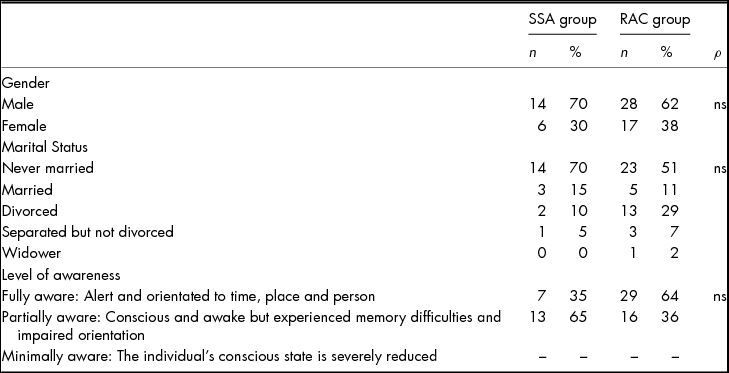
Six participants were interviewed alone, five participants nominated to be interviewed with a family member and nine participants required a primary family informant due to either cognitive and/or communication impairment. Family informants included three sets of parents, two mothers, one father, two siblings and, for one person, their partner was their key family informant. The comparative group with ABI living in RAC included 28 males and 17 females with an ABI, with a mean age of 42 years (R=20–50 years, SD=7.2 years) (Winkler et al., Reference Winkler, Sloan and Callaway2007). There were no statistically significant differences between the two groups on characteristics such as age, gender, length of time living in RAC or level of awareness (Mann–Whitney U, chi-square). See Table 1
Demographics of People Living in SSA (n=20) and RAC (n=45)

Note. ns = not significant.
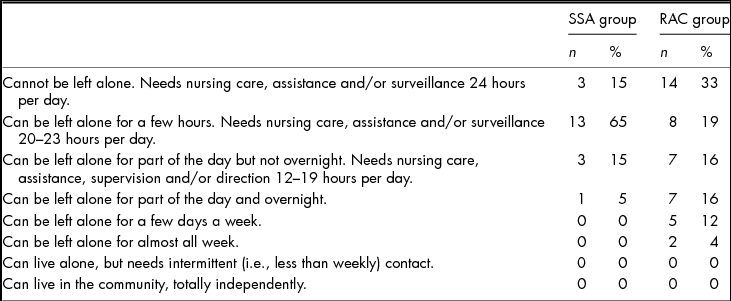
Support needs of both groups, as measured by the CANS, were high with 100% of the SSA group and 84% of the RAC group requiring at least daily support. Of note, the remaining 16% of the RAC group could be left alone for days through to most of the week. There were no statistically significant differences between the two groups with regard to the amount of time they could be left alone (Mann–Whitney U). See Table 2.
Level of Support Needs (CANS) of People Living in SSA (n=20) and RAC (n=43)
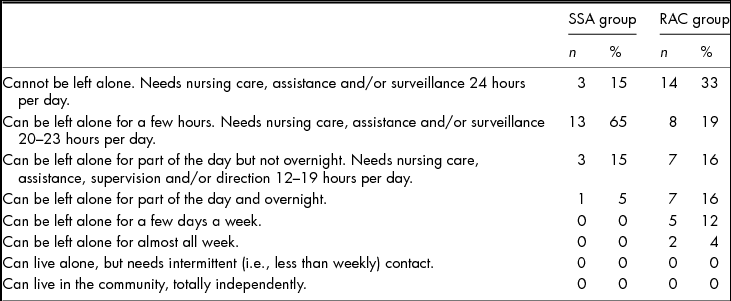
Note. CANS data missing for two RAC participants.
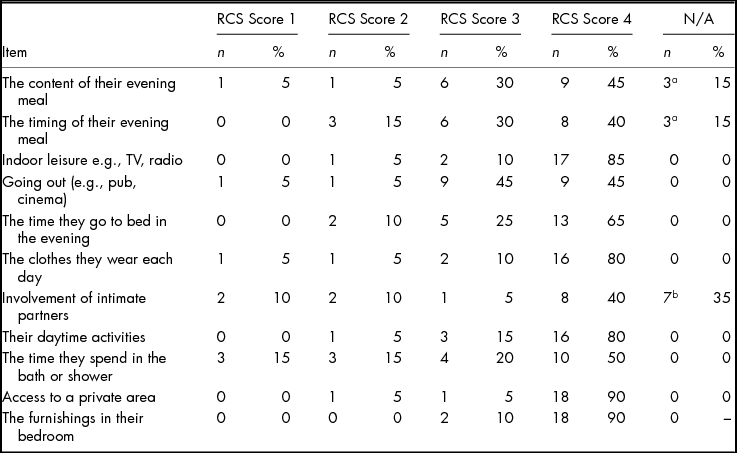
Providing the support people with complex care needs require to make everyday choices and life decisions is crucial to fostering dignity and self-determination (Victorian Government Department of Human Services, 2002). Some people with ABI in the group that moved out of RAC still had limited opportunities to make everyday choices, with a score of 2 or less indicating little or no real choice available (Table 3). However, higher percentages were shown in the categories where some procedures were in place for the person to express their preferences (score of 3 or 4 on the RCS).
Resident Choice Scale (RCS) (Hatton et al., Reference Hatton, Emerson, Robertson, Gregory, Kessissoglou and Walsh2004) Data of People Living in SSA (n=20)
Notes.
a Not applicable due to requirement for timed PEG feeding.
b Not applicable as the person did not have an intimate partner.
RCS Score 1 = Nothing mentioned, no opportunity.
RCS Score 2 = Some procedure(s) mentioned but nothing likely to give the person much real choice.
RCS Score 3 = Some procedures mentioned through which person can express preferences but final say does not rest with the person.
RCS Score 4 = Procedures in place for person to express preferences and these are final unless clearly inappropriate or dangerous.
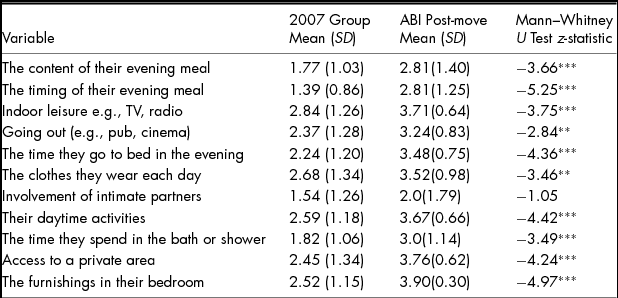
Key areas in which participants living in SSA were given the most opportunity to express their choices were: furnishings in their bedroom, access to a private area, clothing and indoor leisure options. They were afforded the least choice in the timing and content of their evening meal and the involvement of an intimate partner (noting this item was relevant for 13 of the 20 participants). The results summarised in Table 4 indicate that participants who had moved out of RAC to live in an SSA had more choice in 10 out of 11 items than people living in RAC prior to the YPIRAC initiative. The only item that was not significantly different was the involvement of intimate partners.
Differences in Choice Between Two Groups – People Living in RAC (n=45) and People with ABI Who had Moved Out of RAC (n=20)
**ρ < 0.01, ***ρ < 0.001.
Qualitative Data
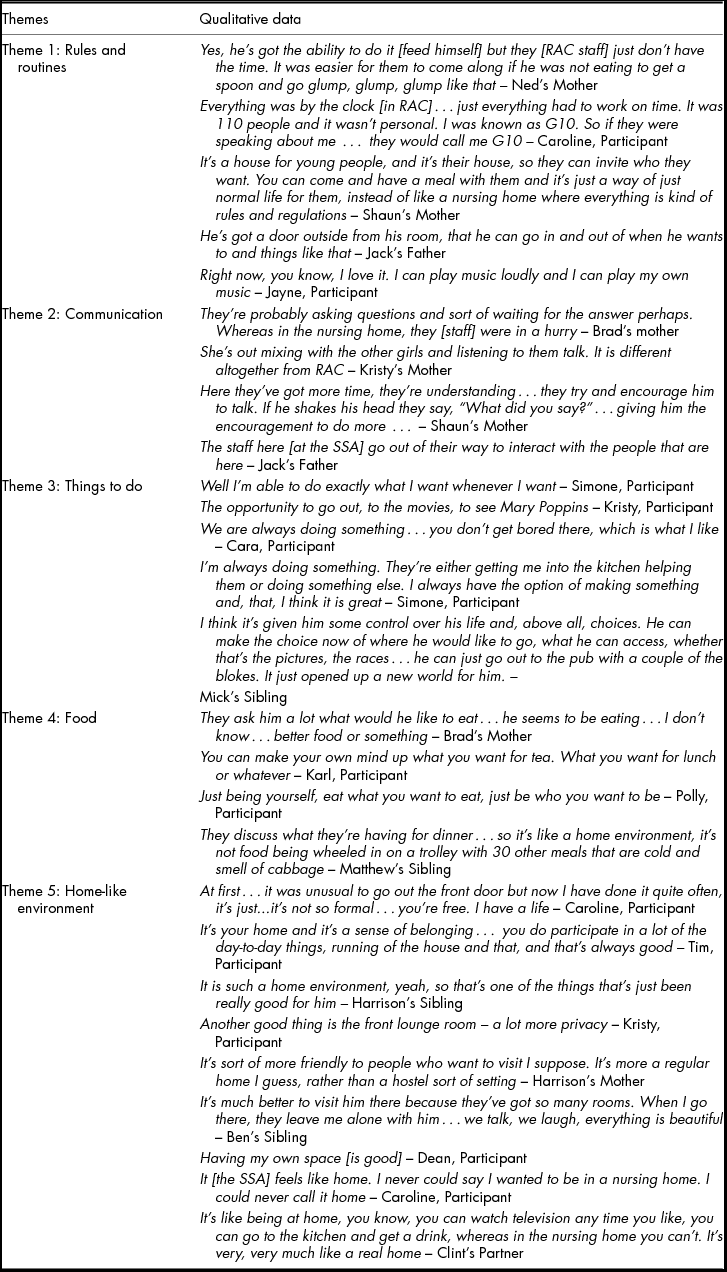
The qualitative data analysis generated five final themes relating to the research questions. These were: rules and routines, communication, things to do, food and home-like environment. Table 5 provides a summary of qualitative themes and associated data by respondent.
Summary Table of Themes and Qualitative Data
Rules and Routines
Previous research involving people with disability living in RAC has identified the institutional RAC environment as offering impersonal support services, which are tightly scheduled and focus on staff efficiency rather than the needs and preferences of residents (Commonwealth of Australia, 2009; Winkler et al., Reference Winkler, Farnworth, Sloan and Brown2011). In the current study, many participants and their families referred to the institutional elements of their past experiences of living in RAC, such as rigid routines revolving around the needs of staff rather than individual residents. Reflecting on the differences between the SSA and life in RAC, Ned's mother reported, ‘Yes, he's got the ability to do it [feed himself] but they [RAC staff] just don't have the time. It was easier for them to come along if he was not eating to get a spoon and go glump, glump, glump like that’. Others described feeling part of a regimented system when they had lived in RAC, within which it was difficult to express choice or find freedom in their daily lives. They were constrained by the presence of security codes, locked doors and visitor sign-in books, as well as inflexible routines for bathing, meals and going to bed. Caroline stated, ‘Everything was by the clock [in RAC]. . .just everything had to work on time. It was 110 people and it wasn't personal. I was known as G10. So if they were speaking about me . . . they would call me G10’.
The new SSA services developed through the Victorian YPIRAC initiative offered accommodation for between two to nine residents – this is significantly less than the number of residents in RAC, which in Australia averages 66 people (Australian Institute of Health and Welfare, 2012). Many participants and their families reported that SSA provided a more personal, home-like setting which afforded greater opportunity for flexibility and choice of routines, and less rules. Shaun's mother stated, ‘It's a house for young people, and it's their house, so they can invite who they want. You can come and have a meal with them and it's just a way of just normal life for them, instead of like a nursing home where everything is kind of rules and regulations’.
Communication
Only 35% of participants in this study were fully aware and 30% utilised alternative and augmentative communication, varying from advanced use of an electronic speaking aide to use of a letter board or inconsistent single gesture. The cognitive and communication impairments experienced by people with severe ABI are a significant barrier to being provided with opportunities to make everyday choices. Family members in the current study reported that SSA staff had more time to encourage interactions with participants as well as the skills to facilitate both verbal and non-verbal communication for the person with disability to make everyday choices. Staff having the capacity to engage with the person with disability was critical to supporting residents to make choices in the SSA environment. In contrast to RAC, participants living in SSA reported staff were able to spend more 1:1 time interacting with residents and getting to know them and their preferences. Staff had time to ask residents questions and wait for people with communication impairments to respond. Shaun's mother reported, ‘Here they've got more time, they're understanding. . .they try and encourage him to talk. If he shakes his head, they say ‘What did you say?’. . .Giving him the encouragement to do more than what he can do’. Brad's mother stated, ‘They're probably asking questions and sort of waiting for the answer perhaps. Whereas at the nursing home, they were in a hurry’. It was apparent in this study that, in general, staff in SSA had more time and capacity to get to know residents and support them to make everyday choices.
Things To Do
A previous qualitative study found that one of the outcomes younger people anticipated in moving out of RAC related to having more freedom and opportunities to participate in everyday activities both at home and in the community (Winkler et al., Reference Winkler, Farnworth, Sloan and Brown2011). Participants in the current study reported that a significant factor influencing their decision to accept the offer of a place in an SSA was the possibility that the new service could provide them with more activity options and everyday choices. A number reported that since moving from RAC to SSA they had more choice regarding what they do during the day. This included activities both within the home and in the community. Simone said, ‘Well I'm able to do exactly what I want whenever I want’. Mick's sibling reported, ‘I think it's given him some control over his life and, above all, choices. He can make the choice now of where he would like to go, what he can access, whether that's the pictures, the races. . .he can just go out to the pub with a couple of the blokes. It just opened up a new world for him’.
Food
Participants were strong in their opinion regarding the lack of choice and taste in the food provided previously in RAC. For some, this was a key reason for wanting to move out. Both participants and families reported increased choice and control related to meals in SSA, when compared with RAC. After moving out of RAC, many participants found much joy in being able to choose what they would eat, and plan meals with the other residents. Matthew's sibling stated, ‘They discuss what they're having for dinner. . .so it's like a home environment, it's not food being wheeled in on a trolley with 30 other meals that are cold and smell of cabbage.’
Home-Like Environment
Previous studies have identified the lack of private space within RAC as a significant barrier to the maintenance of relationships with family and friends (Senate Community Affairs References Committee, 2005; Strettles et al., Reference Strettles, Bush, Simpson and Gillet2005; Stringer, Reference Stringer1999; Winkler et al., Reference Winkler, Farnworth, Sloan and Brown2011). Some SSA services had a separate lounge that enabled residents to spend time with friends and family in privacy. Both residents and family reported that this made a difference to the quality of time spent with family and friends, when compared with the limited private spaces available in RAC. This was exemplified by Ben's sibling, who stated, ‘It's much better to visit him because they've got so many rooms. When I go there, they leave me alone with him. . .we talk, we laugh, everything is beautiful’.
The improved opportunities to have choice and control were strongly linked to the physical scale and design of most SSAs. The small scale of the SSA environments provided residents with opportunities to participate in everyday activities and routine household decisions that were not possible in the larger, institutional RAC environment. Clint's partner stated, ‘It's like being at home, you know, you can watch television any time you like, you can go to the kitchen and get a drink, whereas in the nursing home you can't. It's very, very much like a real home’. Some SSA staff encouraged the participants to choose furniture, home-wares and even paint colours for rooms and this was illustrated in both the quantitative and qualitative findings in this study. This choice regarding furnishings helped participants to develop a sense of belonging within and ownership of the new home. Harrison's sibling reported, ‘It is such a home environment, yeah, so that's one of the things that's just been really good for him’.
Good access to areas in and outside the SSA fostered a sense of independence and freedom for residents. Some residents reported that being able to freely enter and exit their home made a significant difference to their sense of control in community living. This was in contrast to the RAC environment, where a security system on exits meant that some participants were not able to choose to go outside independently. Caroline stated, ‘At first. . .it was unusual to go out the front door but now I've done it quite often, . . .it's not so formal. . .you're free. I have a life’.
The qualitative themes and positive changes identified were consistent with many of the significant differences found on the RCS when comparing people living in RAC with the group who moved from RAC to SSA (see Table 4). However, similar to the quantitative data, there was no mention of increased choice related to the involvement of an intimate partner in the qualitative interviews. While participants living in SSA were clearly offered greater opportunities to make everyday choices than the group in RAC, there still appears to be considerable room for increasing the choices offered to the participants in SSA. Procedures were not in place for some participants living in SSA to make those basic choices typically taken for granted, including the contents (40%) or timing (45%) of their evening meal, going out (55%) or the time they spend in the bath or shower (50%) (see Table 3). Ideally, procedures in any supported living environment should foster choice making in all of the items listed in Table 3, including involvement with an intimate partner.
Discussion
This study provides valuable insights into the opportunities for everyday choice making afforded to young people who have made the transition from RAC to SSA. These insights build on evidence from a limited number of studies regarding young people with ABI moving from RAC (Strettles et al., Reference Strettles, Bush, Simpson and Gillet2005; Stringer, Reference Stringer1999; Winkler et al., Reference Winkler, Farnworth, Sloan and Brown2011) and more extensive research involving people with developmental disabilities and significant cognitive and communication impairments who have moved from large institutions to more home-like environments (Emerson & Hatton, Reference Emerson and Hatton1996; Kim et al., Reference Kim, Larson and Lakin2001; Young, Reference Young2006; Young et al., Reference Young, Ashman, Sigafoos and Grevell2001; Young et al., Reference Young, Sigafoos, Suttie, Ashman and Grevell1998).
This study found that both the built environment and the attitudinal environment (i.e., practices of paid support staff) had a significant impact on the everyday choices available to people with severe ABI. The domestic scale and home-like physical environment of the SSAs provided more opportunities for participation in household activities and everyday decisions. The SSAs provided more individualised and person-centred support compared with the rigid routines of RAC where staff were perceived to have less time to listen and respond to the specific needs and preferences of residents. However, the areas for which more limited choice remained (including timing and content of meals and timing of personal care) highlight the potential restrictions in choice making imposed by shared staffing arrangements for a number of residents in SSA. In the design and development of future housing and support options for people with ABI, the physical design of housing, number of co-residents, and culture and ratio of staff to residents, need to be considered in order to maximise choice making.
Power is a dominant feature of the interactions between people with severe disabilities and the people who are paid to support them (Finlay, Reference Finlay2008; Jenkinson, Reference Jenkinson1993). Power permeates the everyday interactions of staff and residents, in the way that people talk to each other, in what utterances and non-verbal cues are responded to or ignored, and in how spaces are opened up for people to express preferences or are shut down (Jenkinson, Reference Jenkinson1993). People with severe ABI in SSA are highly dependent on disability support workers to facilitate opportunities for choice making, particularly when cognitive communication issues are present. For those participants in this study, staff in the SSAs came to know the person and their preferences. There are many opportunities throughout the day – many small changes in service practice – that can give a person with severe disability a greater deal of control (Finlay, Reference Finlay2008), the opportunity to participate in decision making (Knox et al., Reference Knox, Douglas and Bigby2013) and to communicate their choices (Browning et al., Reference Browning, Bigby and Douglas2014). Often these changes need only for staff to recognise the opportunities and do not require any additional resources (Beamer & Brookes, Reference Beamer and Brookes2001).
People with significant cognitive and communication impairments are often most at risk of limited opportunities to exercise choice and control over their lives (Finlay, Reference Finlay2008). This study demonstrates the critical need to build, develop and maintain living environments for people with ABI with high and complex care needs that provide the opportunities for everyday choice making that others take for granted. The current reforms relating to supported decision making work to address the risks posed to person-centredness arising for individuals with disability who have limited agency (Browning et al., Reference Browning, Bigby and Douglas2014; Carney, Reference Carney2015; Productivity Commission, 2011). Given the emphasis on choice in the UNCRPD and Australia's NDIS, further research is required regarding the support in decision making and choices afforded to people with disability by both disability support providers and the wider community. In addition, research on the features of built and attitudinal environment that build real and balanced choice for a person is necessary. This may include examination of environmental control and home automation systems, and other assistive technologies, and how they may influence choice making within daily life.
In line with previous research, which found that young people with disability living in RAC were not supported to make their own decisions (Stringer, Reference Stringer1999), the qualitative data gathered in this study illustrated that participants who had moved from RAC to SSA had most often experienced extremely limited opportunity for choice making within their daily routines in RAC. As such, any improvement in choices afforded once the person had moved to SSA were seen as significant at the time of data collection. It would be valuable to follow up this cohort to examine if expectations for choice making adjust over time, or grow as more opportunities are afforded. Such follow-up research would also allow examination of the attitudinal environment of paid support longitudinally and how this impacts choice making.
Limitations
The findings from this study should be considered in light of the small sample size of people with ABI living in SSA recruited into the study, coupled with the larger comparative sample size of people living in RAC. Given the cognitive communication impairments experienced, data were gathered from family informants for some participants, posing limitations in this research. Memory impairment of the participant, or differing family perspectives on choice making, also had capacity to influence rating of the items on the RCS and interview responses. Two researchers gathered qualitative data; however, one researcher only completed thematic analysis. Analysis by two researchers with consensus would have been optimal, but was beyond the budget of this project, and thus a range of other strategies to ensure trustworthiness were implemented.
The RCS is one of the few tools available to measure everyday opportunities for choice. Only 11 of the RCS items were used in this study, for direct comparison with a previous study of young people in RAC, posing some limitations. The RCS was designed for and has only been validated for people with developmental disabilities. Further research is required to either validate the use of the RCS with people with ABI or develop an alternative measure of the opportunities for choice afforded to people with severe ABI. Following on, consideration of research design which includes structured observation of opportunities for choice making within living environments may be a useful addition in future research.
Conclusion
This study highlights that everyday choices that most of us take for granted, such as the time we go to bed or food we have to eat, are not available for some young people living in RAC. People with ABI who moved from living in RAC to SSAs were offered more opportunities to make everyday choices when compared with the RAC group. Factors that facilitated opportunities for choice included the higher staff to resident ratios, lower number of co-residents and more homelike physical spaces in SSA.
Although there has been research on the impact of ABI on supported decision making and competency to make legal decisions (Bonatti et al., Reference Bonatti, Zamarian, Wagner, Benke, Hollosi, Strubreither and Delazer2008; Reid-Proctor et al., Reference Reid-Proctor, Galin and Cummings2001; Wood & McHugh, Reference Wood and McHugh2013) there is limited research in relation to everyday choice making and self-determination following ABI (Winkler et al., Reference Winkler, Sloan and Callaway2010). This is the first known study that examines the impact of a housing and support environment on opportunities for people with ABI to make everyday choices. More research is required to understand potential facilitators and barriers to fostering and maintaining opportunities for choice and control for people with ABI living with high levels of daily support, as is offered in SSA.
Financial Support
This research received no specific grant from any funding agency, commercial or not-for-profit sectors.
Conflict of Interest
None.
Ethical Standards
The authors assert that all procedures contributing to this work comply with the ethical standards of the relevant national and institutional committees on human experimentation and with the Helsinki Declaration of 1975, as revised 2008.
Appendix: Semi-structured interview schedule
Person 1 (Name):
Person 2 (Name / Relationship to Person 1):
1. Tell me about where you / your family member live/s now?
2. How long have you / your family member lived here?
3. What do you / your family member like about living here?
4. What do you / your family member dislike about living here?
5. How does this place (and the supports you / your family member receive here) meet your / your family member's everyday needs and choices?
6. Do you / your family member have any needs or choices that aren't met?
7. What were your / your family member's key reasons for deciding to move out of RAC?
8. What were the key reasons you / your family member decided to move here?
9. Has moving out made a difference to your / your family member's life?
10. If yes, what is different between life now and life in RAC?
11. What is the main thing/s you / your family member expected to be different by moving here?
12. Is there anything you / your family member are / is able to do now that you / your family member weren't previously (in RAC)? e.g., daily activities; social or community activities.