I. INTRODUCTION
Compared with crystalline alloy materials, bulk metallic glasses (BMGs) exhibit higher strength and specific strength due to their disordered structures and structural uniformity.Reference Johnson1–Reference Ashby and Greer3 Intensive efforts including the optimization of alloy composition, enhancement of glass-forming ability (GFA), and improvement of mechanical properties have been made due to their great potential application as advanced structural materials.Reference Ashby and Greer3–Reference Ionue, Shen and Chang5 How to design desirable BMGs with superhigh mechanical strength has brought up extensive attention. It has been clarified that there exists universal linear relationships between strength and Young’s modulus (E) or shear modulus (G) for metallic glasses.Reference Lewandowski and Lowhaphandu6–Reference Johnson and Samwer8 Generally, elastic constants (M) of a designed glassy alloy are related to those of the constituent elements. It can be roughly calculated with an equation of  , where Mi and fi denote the corresponding elastic constant and atomic concentration of the constituent elements, respectively.Reference Wang9, Reference Zhang and Greer10 On the other hand, metallic glasses containing small-atomic size metalloid exhibit higher elastic moduli due to the formation of local solute-centered coordination polyhedra, which are the manifestation of intensive chemical short-range order caused by the strong covalent metal–metalloid bonds.Reference Sheng, Luo, Alamgir, Bai and Ma11 Moreover, the elastic moduli and mechanical properties of metallic glasses can be improved by appropriately tuning the fraction of metalloid elements.Reference Gu, Poon, Shiflet and Widom12 Therefore, it is advantageous to design a high-strength metallic glass consisting of metallic elements with high elastic moduli and metalloid elements with appropriate chemical interaction.
Co-based BMG alloys with high GFA are among the best candidates to develop new structural metallic materials with ultrahigh strengths and elastic moduli. For example, Co–Fe–Si–B–Nb BMGs with high E of about 210 GPa show high strengths exceeding 4000 MPa.Reference Ionue, Shen and Chang13 Co–Fe–Ta–B glassy alloy, which is the strongest bulk metallic material known so far, exhibits ultrahigh fracture strength and high E reaching 5185 MPa and 268 GPa, respectively.Reference Inoue, Shen, Koshiba, Kato and Yavari14 These results shed light on the design of metallic glasses with ultrahigh strength.
In this article, B-rich Co65B35 binary alloy is selected as a precursor alloy according to the above analysis. GFA of this Co–B binary alloy is not high enough to produce bulk samples (J.F. Wang and T. Zhang, unpublished data). Ta element is selected to partially substitute for Co based on the large mismatch in atomic sizes and moderate negative heating of mixing for Ta–Co and Ta–B atomic pairs, which are beneficial for the improvement of GFA,Reference Inoue15, Reference Inoue16 together with the high elastic moduli of Ta compared with most of other metallic elements.17 Glass formation and thermal and mechanical properties of the designed Co65–xTaxB35 (at.%, x = 5–10) alloys were evaluated. These alloys exhibit high GFA, ultrahigh strength and specific strength, high Vickers hardness, and distinct plastic deformation. The relationships between the excellent compressive mechanical properties and other physical properties related to the elastic moduli and thermal properties for the alloys are discussed.
II. EXPERIMENTAL
A Co–B prealloy with B content of 40 at.% was prepared by induction melting pure Co (99.9 mass%) and pure B (99.99 mass%) in a high-purity argon atmosphere. Co-based alloys with a nominal composition of Co65–xTaxB35 (at.%, x = 5–10) were then prepared by arc melting the mixings of pure Co, Ta (99.99 mass%) metal, and the Co–B prealloy in a Ti-gettered high-purity argon atmosphere. The ingots were remelted several times to ensure homogeneity. BMGs with diameters up to 2 mm were produced by injection mold casting method. Ribbons of these alloys with a dimension of ∼50 μm in thickness and ∼2 mm in width were prepared by the single-roller melt-spinning method.
The amorphous structure of the as-cast and as-spun samples was identified by x-ray diffraction (XRD) using a Dmax2200PC Rigaku x-ray diffractometer with Cu Kα radiation (Rigaku, Tokyo, Japan). The thermal properties characterized by glass transition, crystallization, and melting behaviors were investigated by a NETZSCH DSC 404 C differential scanning calorimetry (DSC; NETZSCH, Selb, Germany) at a heating rate of 0.67 K/s for low-temperature region and a relatively low heating rate of 0.33 K/s for high-temperature region. Uniaxial compression testing was conducted at an ambient temperature using mechanical testing machine at a strain rate of 4.2 × 10⁻⁴ s−1. The testing samples with a gauge aspect ratio of 2:1 were cut from the as-cast 1-mm cylindrical rods. The compression tests were performed at least in triplicate for each BMG. Deformation and fracture morphologies were observed with JSM 5800 scanning electron microscopy (SEM, Tokyo, Japan). Vickers hardness (H v) was measured using a Vickers hardness indenter with a load of 1.96 N and a loading time of 10 s. At least seven indents were performed for each sample and the average value was adopted. The density (ρ) was measured by Archimedes’ method using a Sartorius balance (Readability: 10 μg) (Sartorius, Gottingen, Germany). The elastic properties were determined with an Olympus Panametrics-NDT 5900PR ultrasonic testing device (Olympus, Waltham, MA) using ultrasonic pulse-echo techniques. Glassy samples with a dimension of 2 mm in diameter and 4 mm in length were adopted for these measurements. The elastic constants, i.e., Poisson’s ratio (v), Young’s modulus (E), shear modulus (G), and bulk modulus (B), can be calculated using the measured data of longitudinal and transverse sound velocities (v l and v t). The error bands of the calculation elastic constants are below 5%.
III. RESULTS AND DISCUSSION
A. Glass formation and thermal properties
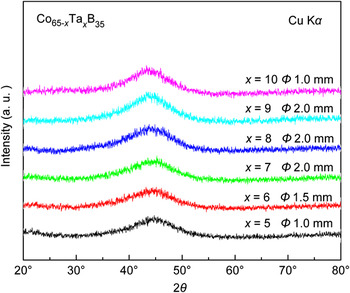
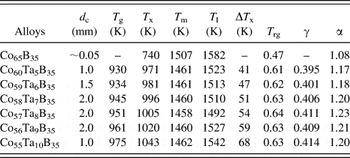
Figure 1 shows the XRD patterns of the as-cast glassy rods of Co65–xTaxB35 (at.%, x = 5–10) alloys with maximal diameters. Only a broad diffuse peak is observed for each pattern, indicating the fully amorphous structure of these samples within the resolution of the x-ray measurement conditions. For comparison, the GFA of binary Co65B35 alloy (J.F. Wang and T. Zhang, unpublished data) without Ta was also evaluated, as listed in Table I. The critical size for glass formation (d c) can be significantly increased from ∼0.05 mm in thickness for binary Co65B35 alloy to 2 mm in diameter for ternary Co65–xTaxB35 with x = 7–9. The introduction of Ta with proper contents is beneficial to the improvement of GFA of the resulting alloys.
X-ray diffraction patterns of Co65–xTaxB35 (at.%, x = 5–10) bulk metallic glasses (BMGs).

The critical sizes (d c), thermal properties, and parameters of Co65–xTaxB35 (at.%, x = 0, 5–10) glassy alloys. T g, T x, T m, and T l are the glass transition temperature, the onset temperature of crystallization, the melting temperature, and the liquidus temperatures, respectively. ΔT x = T x – T g, T rg = T g/T l, γ = T x/(T g + T l), and α is a parameter described in Ref. Reference Davies and Lewis18.

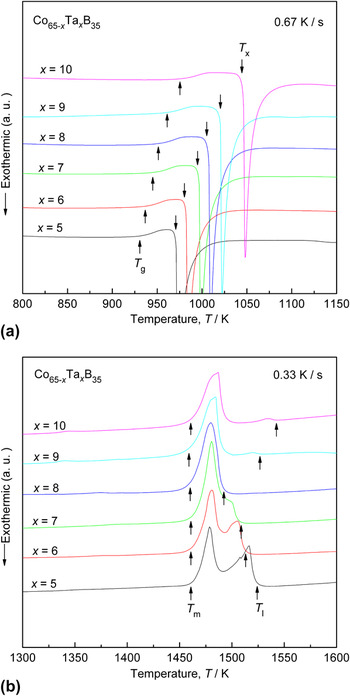
The glass transition, crystallization, and melting behavior of these glassy alloys are shown in Figs. 2(a) and 2(b). Characteristic temperatures, i.e., the glass transition temperature (T g), the onset temperature of crystallization (T x), the melting temperature (T m), and the liquidus temperature (T l) of the Co-based BMGs are listed in Table I. Distinct glass transition followed by a wide supercooled liquid region before crystallization can be observed in Fig. 2(a). With the increase of Ta content from 5 to 10 at.%, T g increases from 930 to 975 K and the supercooled liquid region ΔT x (ΔT x = T x – T g) coincidently enlarges from 41 to 68 K, which indicate that the thermal stability can be improved by the introduction of Ta. Different from T g and ΔT x, T l first decreases with increasing Ta content, reaching a minimum value of 1492 K at 8 at.%Ta, and followed by a remarkable increase with the further increase of Ta content. The T m remains almost unchanged over the whole content range of Ta substitutions. The melting behavior for the alloys with 5 at.%Ta takes place through two endothermic stages. The temperature interval between two endothermic peaks gradually decreases with increasing Ta content until two peaks merge into a single endothermic peak at 8 at.%Ta. Further increase of Ta content to 10 at.% induces a deviation from the eutectic point. All these melting behaviors indicate that the present alloys exhibit the same eutectic event, and the alloy with 8 at.%Ta is the closest to the eutectic point. The Co–Ta–B alloys with the Ta content of 7–9 at.% with the highest GFA lie in the vicinity of eutectic point according to the XRD and DSC analyses. This result is consistent with the well-known principle that deep eutectic is preferable for glass formation.Reference Cohen and Turnbull19–Reference Highmore and Greer21
Differential scanning calorimetry curves of Co65–xTaxB35 (at.%, x = 5–10) BMGs: (a) glass transition and crystallization behaviors at a heating rate of 0.67 K/s; (b) melting behaviors at a heating rate of 0.33 K/s.

A lot of glass-forming criteria related with thermal properties, e.g., the reduced glass transition temperature (T rg = T g/T l) proposed by Turnbull,Reference Turnbull22 the supercooled liquid region (ΔT x = T x – T g) by Inoue et al.,Reference Inoue, Zhang and Masumoto23γ parameter [γ = T x/(T g + T l)] by Lu and Liu,Reference Lu and Liu24 and α parameter (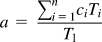 , where ci and Ti are the atomic fraction and melting temperature of element i, respectively, and T l is the liquidus temperture of alloy) by Davies and Lewis,Reference Davies and Lewis18 have been extensively used to predict and elucidate GFA of various kinds of metallic glasses. These glass-forming parameters of the Co–Ta–B BMGs are listed in Table I. For comparison, the data of Co65B35 alloy are also listed (J.F. Wang and T. Zhang, unpublished data).Compared with the Co65B35 binary alloy, the Co65–xTaxB35 (at.%, x = 5–10) alloys exhibit higher T rg of 0.61–0.64, wider ΔT x of 41–68 K, larger γ parameters of 0.395–0.414, and larger α of 1.17–1.23 due to the addition of Ta element. Thus, the introduction of Ta in Co–B alloy is beneficial to stabilize supercooled liquid and promote GFA. However, it can be noticed that quantitative correlation between all of the glass-forming parameters and the experimentally determined GFA reflected by d c is not strictly followed as listed in Table I. Only the tendency for the change of T rg and α, strongly determined by the appearance of eutectic point at 8 at.%Ta, is approximately consistent with the variation of d c. These disagreements have also been reported for other BMG systems.Reference Madge and Greer25–Reference Li, Kim and Yi28 Therefore, the glass-forming criteria can be only assistant in optimizing the composition for high GFA but cannot be considered as accurate indicators for the composition prediction.
B. Mechanical properties of Co–Ta–B BMGs
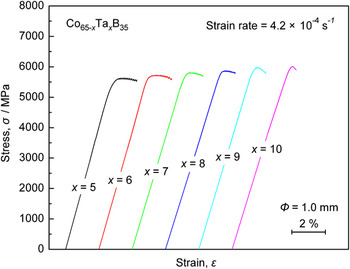
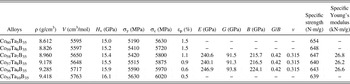
Figure 3 shows the true compressive strain–stress curves for the Co65–xTaxB35 ternary alloy rods. With the increment of Ta content, the yield strength (σ y) and compressive strength (σ c) increase gradually, whereas the plastic strain (ε p) is depressed. The Co–Ta–B BMGs exhibit ultrahigh σ y of 5.2–5.6 GPa and σ c of 5.6–6.0 GPa, as well as distinct ε p of 0.5–1.5%. The specific strength of the Co–Ta–B BMGs is also calculated as 639–654 N·m/g, which is as high as widely used carbon-fiber-reinforced polymers in aerospace and automotive fields, but whose strength is 6 times lower.Reference Ashby29 The strength and specific strength are higher than those of any bulk crystalline or glassy alloys so far reported.Reference Ashby and Greer3, Reference Ashby29 The Co-based BMGs also present high Vickers hardness (H v) up to 16.1 GPa, which is slightly lower than W46Ru37B17 alloy, the hardest amorphous alloy known so far.Reference Ohtsuki, Tamura, Takeuchi, Yoda and Ohmura30 However, bulk samples of the W–Ru–B alloy cannot be produced because of its poor GFA.
Compressive true stress–strain curves of Co65–xTaxB35 (at.%, x = 5–10) glassy rods.

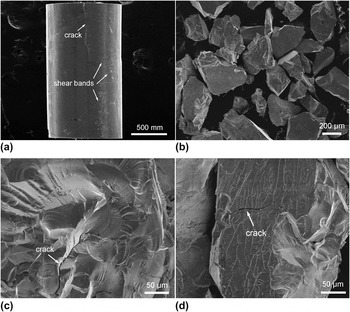
As a typical sample, the deformed and fracture specimens of Co60Ta5B35 BMG were investigated by SEM. Figure 4(a) displays the lateral morphology of the cylindrical sample unloaded after ∼1.2% plastic deformation. Multishear bands and shear steps are visible on the sample face responsible for the significant plastic deformation. The multishear bands are composed of two kinds: the primary shear bands that are declined by ∼45 degree to the direction of applied load and the secondary shear bands developed by branching and interaction of the primary ones and tilted at ∼45 degree to the main shear planes. A crack, as shown in Fig. 4(a), formed from the top surface and propagated along axial direction, is associated with the fracture failure of whole sample. After fracture, the sample splits into pieces of small fragments as shown in Fig. 4(b), similar to other brittle Fe- and Co-based BMGs.Reference Ionue, Shen and Chang13, Reference Inoue, Shen, Yavari and Greer31–Reference Fan, Zhang, Mao, Shen and Inoue34 The fracture surface of the fragments exhibits mixed feature composed of shell-like and vein-like patterns, which are characteristics of fracture surface for brittle and plastic metallic glasses, as shown in Figs. 4(c) and 4(d). Microcracks are visible in the fragments with both kinds of patterns identified by arrows. It is suggested that the rapid propagation of microcracks associated with instability of multishear bands is responsible for the fragmented fracture.
Scanning electron microscopy images of the deformed and fractured samples for Co60Ta5B35 BMG: (a) the outline surface of the deformed sample; (b) fracture fragments; the morphology of the fragments with (c) shell patterns, and (d) vein-like patterns.

Recently, a possible correlation of plasticity and elastic properties, related to G/B (where G is shear modulus, B is bulk modulus) and v (where v is Poisson’s ratio), for BMGs was reported.Reference Wang9, Reference Zhang and Greer10, Reference Lewandowski, Wang and Greer35 It is claimed that metallic glasses with low G/B values below 0.41–0.43, or equivalently with high v above 0.31–0.32 are expected to exhibit significant plastic deformation. In this study, the elastic constants of our Co–Ta–B BMGs with d c of 2 mm were also measured, as listed in Table II. The values of G/B and v of the Co-based BMGs are 0.42 and 0.315, respectively, which is within the critical range of G/B and v for the transition from plastic to brittle fracture behavior. Therefore, we can find both kinds of fracture features for brittle BMGs, (e.g., Mg- and part of Fe Co-based ones) and plastic BMGs (e.g., Zr- and Pd-based ones) in our samples.
Compressive mechanical properties, elastic constants, and related physical properties of Co65–xTaxB35 (at.%, x = 5–10) BMGs. ρ, V, H v, σ y, σ c, ε p, E, G, B, and ν are density, molar volume, Vickers hardness, yield strength, compressive strength, plastic strain, respectively. E, G, B, and v are Young’s modulus, shear modulus, bulk modulus, and Poisson’s ratio, respectively.

C. Correlations among mechanical properties and related properties
As the strongest bulk metallic materials known so far, the ternary Co–Ta–B glassy alloys with simple elemental composition, high thermal stability, ultrahigh hardness, obvious plasticity, and good GFA can be regarded as a good model system to study deformation behavior and mechanism for this kind of ultrahigh strength structural materials. We selected several well-known correlation models regarding mechanical properties and related properties of BMGs, i.e., strength versus elastic modulus, strength versus thermal properties, elastic constants versus thermal properties, and hardness versus elastic modulus, and validated them in our ultrahigh strength Co-based BMG system.
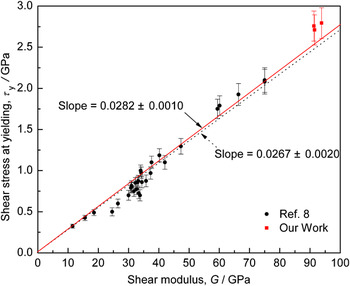
It has been reported that there exists a rough linear relation between compressive strength (σ c) and Young’s modulus (E), i.e., σ c ≈ 0.02E.Reference Lewandowski and Lowhaphandu6, Reference Wang7 Considering that the yield strength (σ y) of metallic glasses is determined by critical shear motion of atomic clusters, Johnson and SamwerReference Johnson and Samwer8 built a better linear relationship between shear stress at yielding (τ y = σ y/2) and shear modulus (G) at room temperature for 30 BMG compositions, as described by:

where γc is the critical shear strain. Figure 5 shows the relationship between G and τ y for various BMGs. Our Co-based BMGs obey the linear correlation [Eq. (1)], indicating that the rule is effective in predicting mechanical properties of BMGs with high strength up to 6 GPa. The value of γ c is revised to be 0.0282 ± 0.0010, which is slightly higher than previously reported value of 0.0267 ± 0.0020.Reference Johnson and Samwer8
Relationship between shear stress (τ y) and shear modulus (G) for various BMGs including the ultrahigh strength Co-based BMGs developed in this study.

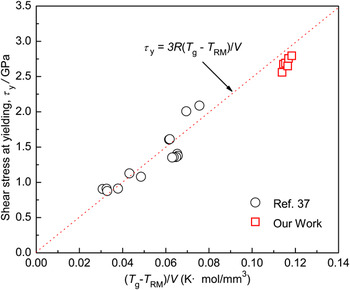
Early reports implied a possible relationship between strength and thermal properties, i.e., T g or T l, in BMG systems.Reference Ionue, Shen and Chang5, Reference Ionue and Takeuchi36 By incorporating the molar volume (V), an universal scaling law derived from the fundamental thermodynamics was further proposed by Liu et al.Reference Liu, Liu, Wang, Inoue, Sakurai and Chen37 to uncover an inherent relationship of the τ y with T g and V. An equation was proposed as:
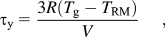
where R is the gas constant and T RM is the room temperature. The model has been validated within 15 various BMGs with well-defined yielding in Zr-, Cu-, Ni-, and Fe-based alloy systems. Because of the catastrophic fracture before yielding for all of the reported Co-based BMGs, the validation of this model in Co-based BMGs is not provided. However, the model can be further checked with our plastic Co-based BMGs due to the easy determination of τ y. Figure 6 shows the values of τ y as a function of calculated (T g – T RM)/V for 15 various BMGsReference Liu, Liu, Wang, Inoue, Sakurai and Chen37 marked as black circle and our developed Co-based BMGs marked as red square. The slope of the dot line in the τ y versus (T g – T RM)/V graph is 3R. The experimental data of our alloys are in good accordance with the calculated ones by Eq. (2). This agreement indicates that mechanical properties for Co-based BMGs can also be predicted using T g and V.
Relationship between shear stress (τ y) and (T g – T RM)/V for various BMGs including the ultrahigh strength Co-based BMGs developed in this study. The solid line is plotted following Eq. (2), i.e., τ y = 3R(T g – T RM)/V.

Moreover, the correlation of T g (or T l) with elastic properties was also provided for metallic glasses.Reference Wang7, Reference Wang9, Reference Ionue and Takeuchi36, Reference Dyre, Olsen and Chrisrensen38 Based on the concept of topological fluctuations related through local elastic energy, a universal model, describing a quantitative relationship between Tg and elastic constants, was proposed by Egami et al.,Reference Egami, Poon, Zhang and Keppens39 as described by:
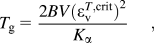
where  is the critical volume strain before the environment relaxes at the temperature T, and K α = [3(1–v)/2/(1–2v)] is a factor depending on the Poisson ratio (v). The value of
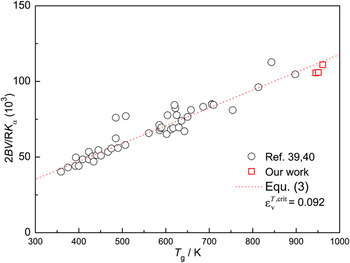
 can be equal to 0.092 at room temperature. The validation of this model was proved in various BMG-forming systems with a wide range of T g, including the La–Al–Co system with low T g.Reference Li, Stoica, Wang and Park40 Our Co-based BMGs present a high T g of ∼950 K, which is out of the range of the reported evaluation using the model. However, experimental values of T g and the calculated ones of 2BV/K α exhibit a good match with predicted ones for the Co-based BMGs using the model, which can be identified by the dashed line in Fig. 7. This result indicates that a quantitative relationship between T g and elastic constants can be extended to Co-based BMGs with high elastic modulus and thermal stability.
Correlation between 2BV/RK α and T g for various BMGs including the ultrahigh strength Co-based BMGs developed in this study. The dashed line is plotted according to Eq. (3) with 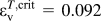 .

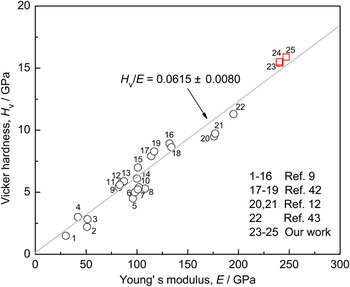
The correlation between Young’s modulus (E) and Vickers hardness (H v) as H v/E ≈ 0.06 for metallic glasses is proposed by Whang et al.Reference Whang, Polk, Giessen, Masumoto and Suzuki41 In addition, a more detailed analysis performed by Ohtsuki et al.Reference Ohtsuki, Tamura, Takeuchi, Yoda and Ohmura30 indicates that the relationship can be built as H v/E ≈ 0.064 ± 0.005 for metal–metal amorphous alloy system and H v/E ≈ 0.057 ± 0.007 for metal–metalloid amorphous system. Recently, the slope of H v versus E for BMGs was proposed to be ∼0.05 by Wang.Reference Wang7 The discrepancy of the values of H v/E might be caused by different E values obtained using different testing methods from various reports. In this study, E and H v obtained via identical testing methods were used for analysis. Ultrasonic pulse-echo evaluation for E and Vickers hardness testing for H v were used to re-evaluate the relationship between E and H v for various BMG systems including the Co-based BMGs developed in this study. H v as a function of E was plotted in Fig. 8. A good linear correlation between E and H v can be expressed by H v/E ≈ 0.0615 ± 0.0070.
Relationship between Vickers hardness (H v) and Young’s modulus (E) for various BMGs. The compositions of these BMGs are listed as follows: 1. Ce70Al10Ni10Cu10, 2. Nd60Al10Fe20Co10, 3. Mg65Cu25Tb5, 4. La55Al25Cu10Ni5Co5, 5. Pd77.5Si16.5Cu6, 6. Pd40Ni10Cu30P20, 7. Zr41Ti14Cu12.5Ni10Be22.5, 8. Pd40Ni40P20, 9. Zr57Ti5Cu20Ni8Al10, 10. Cu50Zr45Al5, 11. Zr65Al10Ni10Cu15, 12. Cu50Zr50, 13. Zr57Nb5Cu15.4Ni12.6Al10, 14. Zr46.75Ti8.25Cu7.5Ni10Be27.5, 15. Cu60Hf10Zr20Ti10, 16. Ni50Nb50, 17. Ni45Ti20Zr25Al10, 18. Ni40Cu5Ti17Zr28Al10, 19. Ni39.8Cu5.97Ti15.92Zr27.86Al9.95Si0.5, 20. Fe64Mo14C15B6Er1, 21. Fe64Cr3Mo10P10C10B3, 22. Fe65Cr2Mo9P10C8B6, 23. Co58Ta7B35, 24. Co57Ta8B35, and 25. Co56Ta9B35.

As discussed above, the correlations of compressive mechanical properties with elastic constants and thermal properties for the Co–Ta–B BMGs show good consistency with various well-known universal models so far. The understanding of the deformation mechanism and the design of desirable properties for this kind of ultrahigh strength BMGs are significant in scientific research and industrial applications.
IV. SUMMARY
The GFA, thermal properties, compressive mechanical properties, and elastic constants of the Co65–xTaxB35 (at.%, x = 5–10) BMGs produced by copper mold casting were investigated. The following results can be drawn from the above:
(1) The Co65–xTaxB35 (at.%, x = 5–10) BMGs with critical diameters (d c) of 1.0–2.0 mm exhibit high glass transition temperature (T g) of 930 K to 975 K, reduced glass transition temperature (T rg) of 0.61–0.64, supercooled liquid region (ΔT x) of 41–68 K, and α parameter of 1.17–1.23. The GFA of these alloys is quantitatively correlated with T rg and α.
(2) The alloys show ultrahigh yield strength (σ y) of 5190–5630 MPa, compressive strength (σ c) of 5630–6020 MPa, high specific strength of 639–654 N·m/g, and distinct plastic strain (ε p) of 0.5–1.5% as well as high Vickers hardness of (H v) up to 16.1 GPa, which are the strongest bulk metallic materials known so far. The fracture morphology shows a mixed feature composed of shell-like and vein-like patterns.
(3) For the Co–Ta–B BMGs developed in this study, the correlations among compressive mechanical strength, elastic moduli, and thermal properties are consistent with various well-known universal criteria of metallic glasses.
ACKNOWLEDGMENTS
This work is supported by the National Basic Research Program (973 Program) (Grant No. 2007CB613900), Natural Science Foundation of China (Grant No. 51071008), and Fundamental Research Funds for the Central Universities.