Obesity is an important health issue worldwide due to its increasing prevalence as well as its occurrence at an early age.1–Reference de Onis, Blössner and Borghi3 Obesity is usually related to insulin resistance and glucose metabolism disorders. Adipose tissue deposited in subcutaneous and visceral tissues plays an important role in the development of insulin resistance due to its secretion of active proteins.Reference Iacobellis and Leonetti4 The first step of treatment in obese children with insulin resistance is planning the diet, changing lifestyle and increasing physical activity.Reference Tagi, Giannini and Chiarelli5 Pharmacological treatment is given to cases when primary prevention methods are insufficient.Reference Akhlaghi, Matson, Mohammadpour, Kelly and Karimani6,Reference Chao, Wadden, Berkowitz, Chao and Wadden7 It has been demonstrated in randomised clinical studies that metformin which is a biguanide derivative reduces insulin resistance in adults by decreasing fasting glucose level and insulin concentrations. Obesity at an early age is closely related to ischemic heart disease as well as it is also closely related to non-ischemic heart diseases such as arrhythmia (especially increases the risk of atrial fibrillation).Reference Khokhar, Umpaichitra, Chin and Perez-Colon8–Reference El-Assaad, Al-Kindi, Saarel and Aziz11 It has been known that electromechanical delay predicts atrial fibrillation and it has been demonstrated that obese children have electromechanical delay.Reference Temiz, Güneş and Güneş12 However, the effects of metformin on electromechanical delay in obese children with insulin resistance have not been known.
Epicardial adipose tissue correlates with visceral adipose tissue and causes a local inflammatory response and increased insulin resistance with similar pathophysiology which ultimately results in cardiovascular risk increase.Reference Ziyrek, Kahraman, Ozdemir and Dogan13 Although findings are indicating a decreasing effect of metformin on epicardial adipose tissue in adults, there has been no information related to this issue in the paediatric population.
The study aimed to evaluate the effects of metformin on electromechanical delay and epicardial adipose tissue of children using metformin for insulin resistance.
Materials and methods
Study population
In this prospective observational study, a total of 87 patients aged between 8 and 18 years who had been followed in Kahramanmaraş Sütçü İmam University Pediatric Endocrinology and Metabolism Outpatient Clinic between August 2018 and March 2020 was screened. Among these patients, 35 patients who could not lose weight despite diet and exercise and received metformin for insulin resistance were analysed. Five patients who did not have echocardiographic epicardial adipose tissue measurement and electromechanical delay measurement before treatment were excluded from the study. Thirty patients whose clinical features were recorded with echocardiographic and laboratory values were included in the study. Metformin was started to patients for insulin resistance with an appropriate dose to their height/weight. Clinical, echocardiographic and laboratory findings of patients were evaluated after 3 months of metformin treatment. Anthropometric measurements such as weight and height were performed by endocrinology outpatient clinic nurse while patients were wearing only underwear. Body mass index was calculated as a person’s weight in kilograms divided by the square of height in metres. Homeostatic Model Assessment for Insulin Resistance value was calculated with the formula of Fasting Glucose (mg/dl) × Fasting Insulin (uIU/ml)/405.Reference van der Aa, Fazeli Farsani, Kromwijk, de Boer, Knibbe and van der Vorst14,Reference Shashaj, Luciano and Contoli15
Pre-treatment and post-treatment echocardiographic evaluations of all patients were performed by the same cardiology specialist. Epicardial adipose tissue was evaluated with standard echocardiographic evaluation, whereas atrial electromechanical delay was evaluated with tissue Doppler. The same cardiologist evaluated pre-discharge trans-thoracic echocardiography results of 20 randomly selected patients to assess the reproducibility of epicardial adipose tissue thickness and tissue Doppler parameters for the atrial electromechanical delay. Using the Bland–Altman method, the mean difference in terms of intra-observation was 3.8% (0.23 ± 0.54%), indicating good reproducibility.
The effects of metformin on all parameters were evaluated after recording demographics and laboratory values.
Echocardiography
Echocardiographic assessment and measurement of epicardial adipose tissue were done by identifying the echo-free space between the outer lining of the myocardium and the visceral layer of the pericardium. Its measurement was made perpendicularly to the free wall of the right ventricle in the parasternal long-axis window. The level of the measurement was at mid ventricle and the timing was set to end-diastole, with an average of three cardiac cycles being taken. Aortic annulus was accepted as the anatomic landmark to align the ultrasound beam perpendicular to the right ventricular free wall.Reference Iacobellis, Lonn and Lamy16
Tissue Doppler echocardiography
The pulsed Doppler sample volume was placed at the level of the left ventricle (lateral mitral annulus, septal mitral annulus) and right ventricle (tricuspid annulus) from an apical four-chamber view. The time interval from the onset of the P-wave on surface ECG to the beginning of the late diastolic wave (Am), which is called PA, was gained from the lateral mitral annulus (PA lateral), the septal mitral annulus (PA septal) and RV tricuspid annulus (PA tricuspid). The difference between PA septum and PA tricuspid (PA septum − PA tricuspid) was identified as an intra-atrial electromechanical delay, while the difference between PA lateral and PA tricuspid (PA lateral − PA tricuspid) was identified as an inter-atrial electromechanical delay.Reference Gunes, Sokmen and Kaya17
Statistical analysis
All statistical analyses were performed using SPSS version 14 (SPSS Inc., Chicago, Illinois, United States of America) software package. Statistical significance was set to a two-sided p-value < 0.05. Data were expressed as mean ± standard deviation for continuous variables and as counts and percentages for categorical variables. The normality assumption of the data was determined using the Kolmogorov–Smirnov test. The Student’s t-test was used to compare continuous variables, while the chi-square and Fisher’s exact tests were used to compare categorical variables. Correlations of continuous variables were assessed using Pearson correlation analysis.
Results
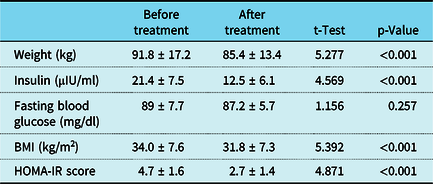
The mean age of included 30 patients was 14.3 ± 2.1. Seventeen (57%) patients were female, and 13 (43%) were male. Serum insulin levels significantly decreased after 3 months of metformin monotherapy (21.4 ± 7.5 mIU/L versus 12.5 ± 6.1; p < 0.001). There was no significant decrease between pre-treatment and post-treatment serum glucose levels (89 ± 7.7mg/dl versus 87.2 ± 5.7; p = 0.257). However, there was a significant decrease in Homeostatic Model Assessment for Insulin Resistance value after 3 months of metformin treatment (4.7 ± 1.6 versus 2.7 ± 1.4; p < 0.001). Similarly, weight and body mass index significantly decreased after 3 months of metformin monotherapy (91.8 ± 17.2 kg versus 85.4 ± 13.4; p < 0.001 and 34.0 ± 7.6 versus 31.8 ± 7.3; p < 0.001, respectively) (Table 1).
Baseline characteristics of study patients
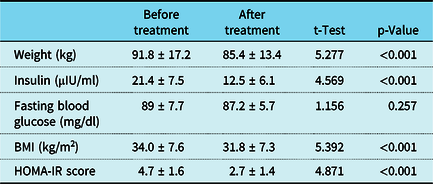
BMI = body mass index, HOMA-IR = Homeostatic Model Assessment for Insulin Resistance.
Data are presented as mean ± standard deviation, and p < 0.05 was considered statistically significant.
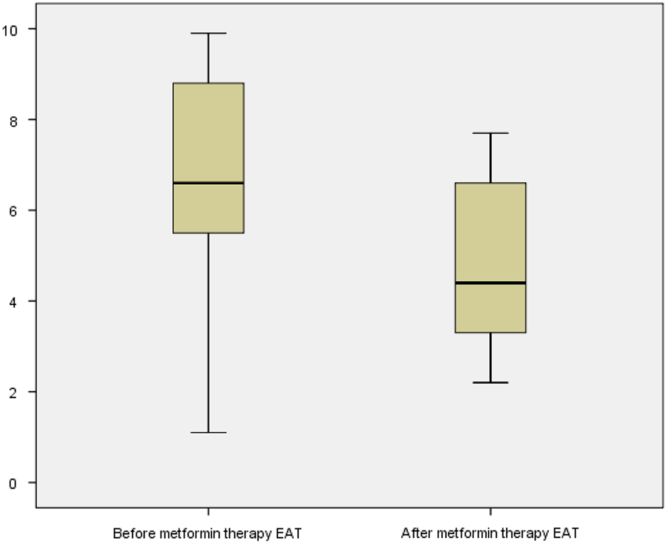
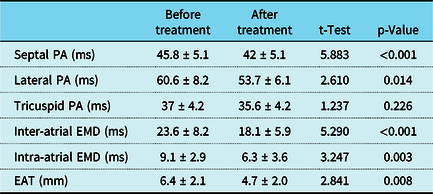
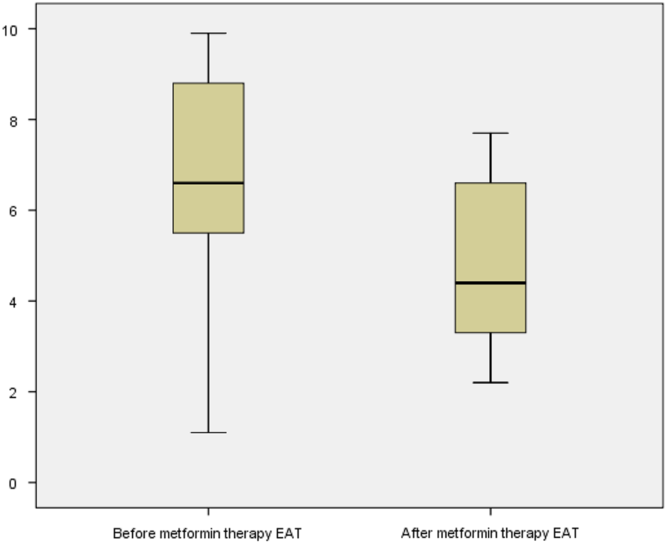
Epicardial adipose tissue thickness significantly decreased after 3 months of metformin monotherapy (6.4 ± 2.1 mm versus 4.7 ± 2.0; p = 0.008) (Fig 1, Table 2). Furthermore, inter-atrial electromechanical delay and intra-atrial electromechanical delay also significantly decreased after 3 months of metformin monotherapy (23.6 ± 8.2 ms versus 18.1 ± 5.8; p < 0,001 and 9.1 ± 2.9 ms versus 6.3 ± 3.6; p = 0.003, respectively) (Table 2).
The comparison of epicardial adipose tissue thickness (EAT) values before and after metformin therapy
Comparison of the atrial electromechanical coupling parameters measured by tissue Doppler imaging
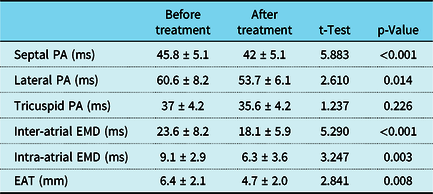
PA = time interval from the onset of P-wave on surface ECG to the beginning of Am wave interval with tissue Doppler echocardiography; EMD = electromechanical delay; EAT = epicardial adipose tissue.
Data are presented as mean ± standard deviation, and p < 0.05 was considered statistically significant.
Discussion
This study is the first study demonstrating the effect of metformin on epicardial adipose tissue and atrial electromechanical delay of obese children. In our study, it was observed that epicardial adipose tissue, inter-atrial and intra-atrial conduction significantly decreased in obese children using metformin.
Epicardial adipose tissue is the visceral adipose deposit causing local inflammation with pathophysiologic features of other visceral adipose tissue.Reference Gastaldelli and Basta18–Reference Marchington, Mattacks and Pond21 It has been shown that adipose distribution in the abdominal region is correlated with epicardial adipose tissue in both obese adults and the paediatric population.Reference Iacobellis, Corradi and Sharma19 Therefore, the relationship between epicardial adipose tissue and insulin resistance and cardiovascular diseases in adult and paediatric obese patients has been investigated in many studies, and an association between epicardial adipose tissue and these diseases has been demonstrated.Reference Iacobellis, Ribaudo and Assael22,Reference Gastaldelli, Morales, Marraccini and Sicari23 In a study, it was shown that epicardial adipose tissue predicts insulin resistance.Reference Güneş, Güneş and Temiz24 The first-line treatment of obese children with insulin resistance includes diet plan, lifestyle change and increased physical activity.Reference Tagi, Giannini and Chiarelli5 Pharmacological treatment is used in cases when primary prevention methods fail. Metformin is the first-choice drug for reducing insulin resistance. Metformin inhibits liver gluconeogenesis, increases peripheral glucose intake and decreases insulin demand, thereby decreases insulin resistance.Reference Wróbel, Marek, Kajdaniuk, Rokicka, Szymborska-Kajanek and Strojek25 The effect of metformin on body weight and visceral adipose tissue has also been investigated in some studies and demonstrated metformin significantly decreases body weight in children with insulin resistance.Reference Yanovski, Krakoff and Salaita26 Both reduced insulin resistance and reduced visceral adipose tissue may cause epicardial adipose tissue. The effect of metformin use on epicardial adipose tissue was investigated, and it decreases the epicardial adipose tissue.Reference Ziyrek, Kahraman, Ozdemir and Dogan13 Similarly, metformin use in obese children with insulin resistance decreased epicardial adipose tissues in our study.
It has been demonstrated that atrial electromechanical delay predicts arrhythmias in studies conducted with adults and children.Reference Temiz, Güneş and Güneş12–Reference Yagmur, Cansel and Acikgoz28 Although its mechanism has not been completely understood in obesity, pro-inflammatory cytokines like interleukin-1, interleukin-6 and tumour necrosis factor-α which are secreted from visceral and epicardial adipose tissue may cause atrial electromechanical delay by causing inflammation in atrial tissue.Reference Nerlekar, Brown and Muthalaly29 A decrease in visceral and epicardial adipose tissue may also cause a decrease in electromechanical delay by further reducing existing inflammation. In our study, a decrease in electromechanical delay after metformin may be explained by the decreasing effect of metformin use on epicardial adipose tissue and body mass index. Besides, metformin may demonstrate its anti-inflammatory effects by activating protein kinase activated by adenylate monophosphate, antioxidant activity and insulin sensitivity and then this anti-inflammatory effect may cause improvement in electromechanical delay by suppressing inflammation in atrial tissue.Reference Saisho30,Reference Zheng, Chen and Li31
Metformin inhibits hepatic glucose production by inhibiting direct and indirect gluconeogenesis in the liver, improves insulin-sensitive glucose utilisation in muscle tissue, increases levels of the kinase activity of insulin receptors and glucose transporter type 4, reduces insulin resistance in post-receptor level and causes a reduction in visceral adipose tissue with these effects.Reference Rena, Hardie and Pearson32 In our study, it was also demonstrated that serum insulin values, body mass index, Homeostatic Model Assessment for Insulin Resistance and the body weight of the patients decreased after metformin treatment.
Conclusion
To the best of our knowledge, our study is the first study demonstrating the decreasing effect of metformin use on epicardial adipose tissue and atrial electromechanical delay of obese children with insulin resistance. Metformin use in obese children with insulin resistance may provide a reduction in cardiovascular complications in their future life by providing a significant decrease in epicardial adipose tissue and atrial electromechanical delay values. Metformin could become the aspirin of the 21st century for obesity.
There are some limitations to our study. The main limitation is small sample size. Lack of inflammatory marker measurement is another limitation. Echocardiographic epicardial adipose tissue measurement is a linear measurement and it may not be able to evaluate total epicardial adipose volume in various myocardial localisations. MRI may be more sensitive in the evaluation of total epicardial adipose tissue. Also, not being able to demonstrate an association between waist circumference and epicardial adipose tissue due to a lack of measurement of waist circumference is another limitation. Additionally, intra-observer electromechanical delay was not evaluated. Inter-atrial and intra-atrial electromechanical delay obtained by tissue doppler investigation was not correlated with invasive inter-atrial and intra-atrial electromechanical delay. In conclusion, further detailed studies with larger samples are needed for clarifying the positive effects of metformin on epicardial adipose tissue and electromechanical delay values of obese children and its underlying mechanisms.
Acknowledgements
None.
Financial Support
This research received no specific grant from any funding agency, commercial or not-for-profit sectors.
Conflict of Interest
None.
Ethical Standards
This study was approved by the Ethical Committee of Kahramanmaraş Sütçü İmam University School of Medicine. Parental consent was obtained using an opt-out approach.