Introduction
Aid-dependent low-income countries (LICs) have been the subject of impassioned discussions in the international aid community over the last decades. Are these countries able to determine or negotiate their own domestic policies and development strategies? Or to what extent does their dependence on external factors, such as international development aid, steer policy development? There is evidence for both sides of the debate (Chandler, Reference Chandler1991).
This paper analyses Cambodia's ability to design its own health policy, as an aid-dependent LIC in Southeast Asia. Health policy – understood here as policies in the field of health care provision and access to health care – is a key sector for Cambodia, given the proportion of poor people in the country (Annear et al., Reference Annear, Bigdeli and Jacobs2011). Despite efforts to date, the majority of Cambodians – 89 per cent of women and 92 per cent of men – still do not have health protection, according to the 2010 Demographic and Health Survey (DHS).Footnote 1
A lot of research has been done on social policy building in high-income countries (HICs), but not in LICs. In this paper, we borrow a methodological and conceptual framework, developed to analyse HIC policies and attempt to test their relevance for a LIC such as Cambodia (Walt and Gilson, Reference Walt and Gilson1994).
We will first present the economic, political and health conditions of Cambodia, which describe the context of the challenges of health policy. We will then explore how social policy research in LICs has been framed within a range of conceptual frameworks. After describing our empirical research methods, we will examine the institutional configurations and power relationships structuring the social policy negotiating dynamics. Finally, we will discuss the relevance of our findings to the issue of the autonomy of an aid-dependent country in shaping its own social policy.
Forming health policy in Cambodia: a considerable challenge
Cambodia represents an interesting case in Southeast Asia. Surrounded by powerful and influential neighbours, such as Thailand and Vietnam, and subject to the increasing intervention of China, Cambodia has seen important economic growth and social development over the past two decades. The Human Development Index (HDI) for Cambodia has risen from 0.41 in 1995 to 0.54 in 2012. Nevertheless, Cambodia remains one of the poorest countries in Asia. In 2012, the average GDP per capita was USD 2,095. This is low compared to other countries of the region and the world.
Recent Cambodian history inflicted terrible wounds on the country's social structure. The Khmer Rouge regime, 1975–80, was directly responsible for the death of about 25 per cent of the Cambodian population.Footnote 2 The political unrest of the 1980s and the Vietnamese occupation also weakened the country. By the beginning of the 1990s, Cambodia's health care sector had been completely dismantled. There were no more than a few hundred trained health care professionals (doctors, nurses and other health specialists) to care for nine million inhabitants (Hang Chuon Naron, Reference Hang Chuon Naron2009).
Today, Cambodia is a multi-party democracy operating under a constitutional monarchy; since 2004, Norodom Sihamoni has been its king. Prime Minister Hun Sen has played a decisive political role in the country since 1985. The Cambodian legal system has evolved, influenced by the French legal system, royal decrees, traditional laws and communist legislation. The Cambodian Popular Party (CPP), under the aegis of Prime Minister Hun Sen, is the most important party in Cambodia. At the moment, there is no strong contention between the political parties concerning health policy.
Corruption, defined as ‘the abuse of a public service for the purposes of personal accumulation of wealth’, is a significant occurrence in Cambodia (Chandler, Reference Chandler1991). In 2009, the country ranked 117 out of 175 countries in media freedom, according to Reporters Sans Frontières (Reporters Without Borders). Transparency International ranked Cambodia 158 (equally with four other countries) out of 180 for indications of perceived corruption. In recent years, generalised corruption has considerably complicated the management of funds allocated to the health sector.
Sanitary and social conditions remain difficult. Cambodia has to tackle a ‘double epidemiological burden’, facing pathologies commonly seen in developing countries (tuberculosis, dengue, malaria, diseases connected to the lack of hygiene, etc.), and the emergence of diseases specific to more prosperous societies (diabetes, cardiovascular diseases, high blood pressure, cancer, etc.). Cambodia is weakly equipped for these challenges. Sanitary infrastructures are deficient, secure medicines are insufficient and medical staff are not thoroughly trained.
Self-medication and self-treatment are common practices in Cambodia (Poursat, Reference Poursat2004). Medicines are regularly bought and used without any medical control. All types of medicines (such as antibiotics) are easily available, but not always checked as medicines should be. Private doctors and traditional therapists, more or less rigorously trained, are frequently consulted. According to the 2010 Demographic and Health Survey (DHS), only around 25 per cent of the population sought first treatment in the public sector. Public authorities do not (yet) control this lucrative private health care sector and public facilities are under-used (Annear et al., Reference Annear, Bigdeli and Jacobs2011). As in other countries in the region, unofficial payments are often added to official prices (Meessen et al., Reference Meessen, Pei, Criel and Bloom2008). Public health care staff are poorly paid, encouraging doctors and nurses to work in the private sector. This lack of regulation encourages abuses regarding service price setting and quality (Duffau and Diaz Pedregal, Reference Duffau and Diaz Pedregal2009).
This results in high mortality and morbidity in Cambodia. According to UNDP (2005), WHO (2007), and CIA (2010) figures, the average life expectancy at birth is sixty-two years, the infant mortality rate is 53 per 1,000 and the maternal mortality ratio is one of the highest in the world, over 300 for every 100,000 live births. According to WHO (2002), the main diseases causing death in Cambodia are AIDS (10 per cent), tuberculosis (8 per cent), diarrhoea (7 per cent) and infections following birth (7 per cent).
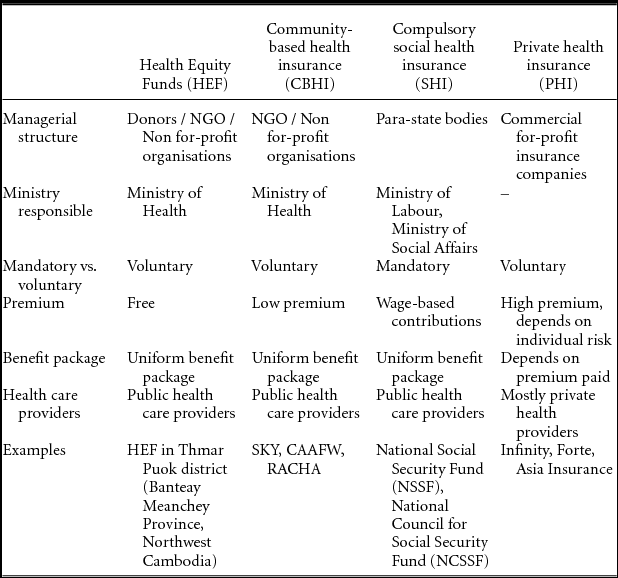
Structuring and financing the health care sector is key in developing Cambodia. The country has opted for an insurance system (social health insurance, community-based insurance and private health insurance), and an assistance system (health equity funds). These schemes are mentioned in the Health Strategic Plan for 2008 to 2015 (Ministry of Health, 2007) and in the National Social Protection Strategy for the Poor and Vulnerable (2011–2015) (Royal Government of Cambodia, 2011). The four main schemes are the following:
1. Health equity funds (HEF) are designed for the poor and are under the direction of the Ministry of Health.
2. Community-based health insurance (CBHI) is an associative form of social protection, also under the direction of the Ministry of Health.
3. Compulsory social health insurance (SHI) is for civil servants, depending on the Ministry of Labour and the Ministry of Social Affairs.
4. Private health insurance (PHI) exists for the wealthy.
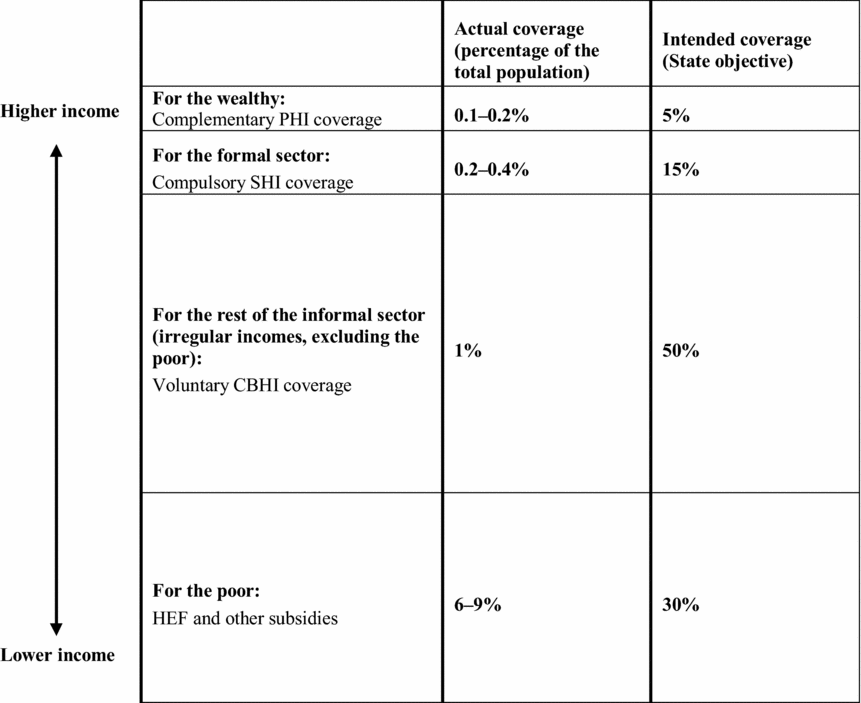
The main characteristics of these four schemes are presented in Table 1. Figure 1 shows the intended and the actual coverage of the population affiliated with each scheme.
Main characteristics of the four public health protection schemes in Cambodia

Distribution of the population according to the four schemes of health protection in Cambodia Source: Ministry of Health (2008); 2010 Demographic and Health Survey.
Currently, these four schemes, each designed for a specific portion of the population and under the aegis of a specific Ministry, represent a challenge to creating a national health policy.Footnote 3 In fact, Cambodian social protection has been conceived on the basis of two criteria: individual wealth (need and capacity to contribute) and employment type (formal or informal sector). And, despite all efforts, the majority of Cambodians – 89 per cent of women and 92 per cent of men – still do not have health insurance (DHS, 2010).
The Cambodian government finances only 10 per cent of the total health spending. International donors contribute more than 20 per cent of the expenses, while users pay for the remaining two-thirds of the expenses (Hang Chuon Naron, Reference Hang Chuon Naron2009).
This cost is a considerable burden for the average household in Cambodia, especially in rural areas. Out-of-pocket health care expenses, on average, represent USD 25 per person per year, which is equivalent to a month's income for people living in rural areas.
Cambodia's dependence on international aid is obvious in the health sector, as well as in other social sectors. Despite the economic growth of the last few years and the prospect of oil exploration in the region, Cambodia still needs international aid. The country is supported by twenty donors, which gave more than a billion dollars or 10 per cent of the country's GDP in 2009. It is a highly aid-dependent country, raising the question of whether it can autonomously negotiate its own health policy.
The shaping of public policies in low-income countries: the need for a comprehensive framework
Five points should be made regarding the need for a comprehensive framework to analyse the design and implementation process of health policy in a LIC:
1. Following Lindblom's work (Reference Lindblom1959), public policies evolve in a gradual way: political decisions only marginally change the current situation, the status quo. Most of the time, public decision makers are forced to ‘muddle through’, according to the information and the time they have. This approach, referred to as ‘incremental’, considers it unrealistic to think that policies can be formulated according to a rational or optimal model. In the 1960s, this theory was a reaction to the mechanical vision which prevailed. In the linear approach of the 1930s, public policies were seen as rational answers to clearly identified public problems (Parsons, Reference Parsons1995). They were seen as following a clear sequential development (Jones, Reference Jones1970). As we will see in the discussion, the incremental approach is the most appropriate to analyse our data.
2. Knowledge of the history and the functioning of institutions are also key in understanding the continuity of public policy trajectories (David, Reference David1985). In the 1980s and 1990s, controversies focused on rational choice or institutionalism (Fischer et al., Reference Fischer, Miller and Sidney2006) through the concept of ‘path dependency’. This concept underlines the importance of past choices in explaining current decisions.
3. It is important to recognise the multiplicity of stakeholders and the importance of ‘power relations’ when analysing the design and implementation process of a policy. Until the beginning of the 1990s, health policies and social protection programmes were mostly analysed in developing countries with a technical lens, neglecting the role of the stakeholders and the importance of context (Walt and Gilson, Reference Walt and Gilson1994). Later, in the 1990s and in early twenty-first century, academics started to try to explain the success or failure of health policies. From then on, the social policy paradigm has changed, taking into account the importance of power relations in the decision-making process (Walt, Reference Walt1994; Reich, Reference Reich1995). Nevertheless, according to Gilson and Raphaely (Reference Gilson and Raphaely2008), this new approach has evolved slowly. Most of the work focusing on the analysis of health policies and social protection in developing countries deals with fragmented problems. It does not thoroughly analyse the underlying political processes in the health and social protection systems, or make use of the notion of ‘power’, which lends insight into the cleavages between stakeholders.
4. Stakeholders’ interests have to be taken into account together with other factors that may influence the design of a public policy in a LIC. Palier and Surel (Reference Palier and Surel2005) proposed an original approach based on the concept of three ‘I’s’: Ideas (general ideas for policy change), Interests (stakeholders’ interests) and Institutions (‘path dependency’ and historical consequences). The authors argue that these three ‘I’s’ need to be examined: the combinations and the hierarchical organisation of these three elements enable the description of the various sequences of a public policy. We will address this issue in the discussion.
5. The search for a comprehensive analytical framework for public policies in a LIC has to use theories and typologies elaborated in the context of high-income countries cautiously. Gøsta Esping-Andersen's typology of welfare states (Reference Esping-Andersen1990), one of the most disseminated, was designed in the context of developed countries and a capitalist economy. However, its relevance for LICs has proved quite limited. Indeed, LICs have important budgetary constraints, face different demographic trends and tend to have a substantial informal sector. In this regard, Destremau and Lautier (Reference Destremau and Lautier2007) have proposed three types of social protection schemes for developing countries: type 1, in which social protection spreads slowly but continuously (Tunisia, Colombia, Mexico); type 2, in which the evolution of the social protection regime faces so many difficulties that it stays underdeveloped (Mali, Philippines); and type 3, which is characterised by the distinction between a State system, with a poorly developed public sector, and a private insurance system (for disease, retirement) which is spreading fast. Cambodia belongs to this third type.
Methodology
This research relies on two field studies conducted in January and February 2009 and in April 2010. The research deals with describing and analysing the process of a social policy ‘being made’. To achieve this objective, the most suitable methodology for collecting the necessary information is a qualitative approach (Rist, Reference Rist, Denzin and Lincoln2000; Exworthy et al., Reference Exworthy, Peckham, Powell and Hann2011).
The work follows a ‘comprehensive paradigm’, i.e., an interpretative or holistic approach. The objective is to understand the dynamics of an ‘action system’ shaped by institutional constraints, power relations and limited resources (Walt et al., Reference Walt, Shiffman, Schneider, Murray, Brugha and Gilson2008).
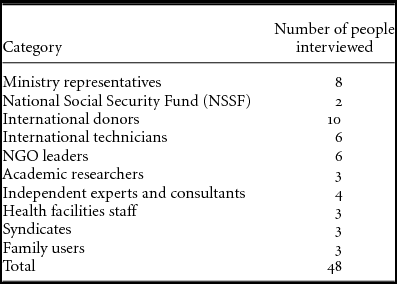
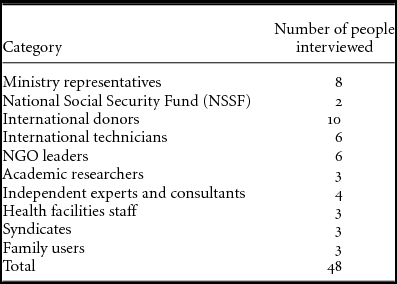
In this research, forty-eight people were interviewed, including ministry representatives, international donors, international technicians, NGO leaders, academic researchers, independent experts and consultants, trade unions, health facility staff and households (see Table 2).
Number of people interviewed by professional category
Participants were selected in a purposeful way, according to the principles of qualitative data collection. The goal was ‘to produce the maximum amount of information’ by questioning people with different profiles, directly involved in, or doing independent research on, the studied process. Interviews lasted 1.5 hours on average (from forty-five minutes to a little over two hours). They were conducted in English or French. All the interviews were recorded and completely transcribed.
From 2009 to 2013, we also conducted a documentary review on the shaping of health policies and social protection in Cambodia, consulting theories on public policy making that were shaped in Western countries while trying to assess whether the concepts could be applied in a LIC such as Cambodia.
We used an iterative approach between the data and the analysis to strengthen our results (Huberman and Miles, Reference Huberman, Miles, Denzin and Lincoln1994). After manually coding the data collected, we used thematic content analysis, as described by Blanchet and Gotman (1995): transversely cutting statements that refer to the same theme from one interview to another in order to build coherence between the statements. This type of analysis is particularly adapted to extract explanatory models from practices, representations or processes. In our case study, transversal themes gradually appeared. They were tested in a systematic way from one interview to another to evaluate their relevance, stability and exhaustiveness.
This analysis revealed different themes. Besides the three themes evoked in the section ‘Forming health policy in Cambodia’ – the quality of and access to public health facilities, historic evolution of public health protection and merchandising of health care – the analysis reveals three other themes, which are developed through the ‘Results’ section below: influence of stakeholders (the first four results), coordination between stakeholders (results 5 to 8) and decision-making processes of public authorities (the two last results).
Results: institutional configurations and power relationships
Ten main results can be found from our case study.
1. In shaping and sustaining the existing health protection mechanisms, five groups of stakeholders are particularly powerful:
• Cambodian government ministries – Health, Labour, Social Affairs and Finance – that formally select and regulate the national strategy;
• international donors – the World Bank, USAID, AFD, AusAid, DFID – that financially support projects and activities;
• international experts – academic researchers and independent consultants;
• international organisations for cooperation – WHO, GTZ, UNICEF – that finance some projects, but are mainly recognised for their technical and strategic expertise;
• international NGOs – Gret, Swiss Red Cross – that design and implement projects in the field.
Four of these five categories of stakeholders are foreign. Only one group, the government ministries, is Cambodian. This does not necessarily mean that the Cambodians are the weakest participants. Nevertheless, it shows the reality of foreign influence on the design and implementation of a health policy in Cambodia.
When asked about the most influential stakeholders in Cambodia, an international expert stated:
Amongst stakeholders, (the) WHO plays a big role, not (in) project implementation . . . but especially as advisers to the Ministry of Health. So WHO has done a lot of the work to assist the ministry in the health equity fund policy, CBHI policy, national health strategy, financing strategy, (and) health protection strategy. Most of that comes from WHO. (Academic Researcher C)
2. Not all the Cambodian Ministries have the same interests. As in any country, each Ministry has its own objectives, resources and vision. For instance, the Ministry of Health is responsible for health equity funds and community-based health insurance (see Table 1 above), designed for the poor and the informal sector, respectively (Figure 1). Thus, the Ministry of Health's rationale for health protection will differ from that of the Ministry of Labour, which is in charge of the formal sector. Nevertheless, we can consider these ministries as a single group of stakeholders, as they claim the same legal prerogatives and they represent the government's will. Alliances between specific stakeholders, excluding groups of stakeholders, or even between individuals, dividing a single institution, can happen, but are not prominent in observations of social dynamics in Cambodia.
At the Ministry of Health, we try to shape political directions on health protection consistent with other Ministries. It is not always easy, and not always the case, but I think that our fields and targets are well defined so we don't get in other Ministries’ way. (Ministry Representative R)
3. Important social groups, such as health care staff and patients, stay outside the decision-making process. The total absence of popular participation in the public discussion on health protection is a fact. Medical professionals (hospital directors, doctors, health workers, etc.) do not appear as important stakeholders in shaping public policy. Isolated from consultants and decision makers, they do not play any significant role in the public domain as independent stakeholders. Their only influence on public decisions is to express their points of view through international experts or international NGOs who may consult them. The top of the medical hierarchy may totally follow the governmental policy vision, using the need to rebuild the country to avoid the democratic debate:
We have to follow the Health Strategic Plan from the Ministry of Health. I think there is no need to discuss on that topic, as we all need to go on the same direction to build up the health sector. (Hospital Director B)
4. The media (press, television and radio) also remain very quiet on the processes and the decisions made in the public sector. As a result, the Cambodian population is very poorly informed regarding current developments in the health sector.
I don't know what the national decisions on health are. I am glad to be sent to be cured to the Khmer-Soviet Friendship Hospital thanks to the NGO which pays my fees. (Patient M)
5. Within the diversity of international stakeholders, two groups dominate. The first includes the individuals and the organisations offering technical expertise (international consultants, co-operation organisations and NGOs). The second is made up of international donors, who provide loans and grants to the health sector. These stakeholders interact in defined places of influence, which we define as ‘forums’ (Jobert and Muller, Reference Jobert and Muller1987). These forums are governed by their own stakes, rules and dynamics (Fouilleux, Reference Fouilleux2000).
The Social Health Insurance Committee (SHIC) has historically played a crucial role as the first official place of discussion and bargaining between stakeholders working on health policy in Cambodia. The SHIC is an inter-ministerial committee, with representatives from the Ministries of Health, Labour, Social Affairs, Economy and Finance, and Planning, as well as from the Council of Ministers. It also gathers representatives of the Cambodian National Insurance Company, Caminco, the WHO, the French NGO Gret (as representatives of the Community-Based Health Insurance network), and NGOs Medicam, the GTZ, and the ILO. From the beginning of the century, the SHIC has played a very important role in coordinating the actions of the various stakeholders. The WHO, the German co-operation agency GTZ and, to a lesser extent, the NGO Gret have been the leaders in designing a public strategy and shaping joint actions.
6. Donors and international co-operation organisations manage their own forums. Their negotiations are framed as a ‘pooled fund’, i.e., a group sharing its financial funds to allocate them to collectively defined actions. There are currently two main pooled funds in Cambodia. The first is the Joint Partnership Arrangement Group that includes seven international donors and co-operation organisations (relevant country in brackets): the World Bank; AFD (France), BTC (Belgium), DFID (Britain), AusAid (Australia), the United Nations Population Fund UNFPA and the United Nations Children's Fund UNICEF. This pool has provided USD 145 million to finance the Health Sector Support Project 2 (HSSP 2) for 2008–15.
USAID is the second fund pool, in the sense that it represents a large-scale source of funding. In Cambodia, USAID mainly finances health equity funds, but also finances programmes to tackle AIDS and improve maternity care.
Other donors and co-operation organisations, such as the WHO and the GTZ, remain independent of these two pools. They provide modest funds but are recognised by other stakeholders for their technical experience.
7. International donors openly recognise that they tend to import their own social protection model, based on their own national experience, both from the conviction that their own model is the best and from self-interest: along with a model go expertise, services and material devices (software, smart cards, etc.) that represent exports.
DFID's position internationally has generally been to support the abolition of user fees, which I guess reflects our own experience in the national health system. (Donor Representative K)
8. Despite the forums and pooled funds, the health care sector in Cambodia is seen as highly disjointed. In practice, this fragmentation leads to weak accountability.
Cambodia [is] an amazingly dysfunctional system . . . Health is one of the worst sectors because there are so many donors and so much money. So it's highly, highly disjointed. Despite all the talks of harmonization and alignment, there is none. (Donor Representative I)
9. Although these tensions among stakeholders complicate Cambodian government decisions, the government has a certain degree of freedom not to follow any one donor's point of view.
At the very beginning, the Ministry of Health wanted a framework for the CBHI [community health-based insurance], and then thought about health financing in general, and then another one wanted to include social health insurance, and then social health protection. So it doesn't come from the top, it's growing constantly. (Ministry Representative J)
[The NGO] Gret started health insurance in 1998–99 and started showing the results, involving people . . . And then policy makers say that is good, and then some international experts say we have to push for policies . . . So it's not easy to say if it's bottom-up or top-down . . . It is probably the best way to do for a country that is so dependent on external support. (International Expert U)
Indeed, despite a painful history, in a few years the Cambodia government seems to have taken back some control of the political and social situation. It is a crucial step in the balance of power and co-operation between stakeholders.
The large number of NGOs and official donor organizations is quite huge. You compare it to Laos, for example, they virtually don't allow the entry of NGOs at all. But in Cambodia many, many are there. And because Cambodia was desperate in the 1980s, isolated and (under) the embargo, when things opened in 1993, everybody rushed in and that started to push the situation. (NGO Leader E)
10. It is difficult to anticipate government decisions, whether resulting from a bargain or an authoritarian act, according to the circumstances of the particular situation.
Two years ago, the World Bank and various other banks discussed the ‘pro-poor’ projects. During ministerial meetings, everybody agreed on pro-poor projects. And at the end of a meeting, the Prime Minister . . . said that now, wealthy people should no longer go to Bangkok or Ho Chi Minh City to be cured, but that the Ministry should make sure that the wealthy people go to hospitals in Phnom Penh . . . For many days they have just said that pro-poor policy was a priority! And the Prime Minister says that it is necessary to take care of the wealthiest, and everybody follows! (NGO Leader H)
The Government has decided overnight to stop all the public service salary supplements. We used to give a salary supplement of 300 dollars to the hospital staff to make the staff work during the afternoon: now, it's finished. All the salary supplements we gave to the staff to work in villages for the antiretroviral distribution program: finished. Of course, this has very important impacts for health, when we know that average wages are very low.
So there was a general outcry from donors and NGOs. It happened in December 2009. We were informed fifteen days before . . . It was rough. The United States ambassador, the United Nations representative sent letters, without any success. The Cambodian Prime Minister had decided. (NGO Leader M)
According to the government and international experts, NGOs and donors, the government often asserts its will. Only its capacity for implementation can be considered weak. The causes for this are many: lack of resources, little expertise and the strategic calculation of a government that prefers to concentrate its resources on sectors that are not supported by the international community.
There's quite a lot of support of social health protection here in Cambodia but the capacity to implement this policy is still limited. (Donor Representative A)
Discussion
We can see from these results that the government's strategy is to make decisions gradually, following a process of trial and error. This incremental way of shaping policies shows how pragmatic the Cambodian government is on these issues. In contrast to the ‘rationalist approach’, where public decisions are taken following a rational procedure (Jones, Reference Jones1970), this ‘incremental approach’ shows how the government shapes its policy in a constrained environment, i.e., without always having perfect information at the right time. Instead of making a theoretical and absolutely rational decision, in practice decision makers vote for a satisfactory solution. From all possible alternatives, they ratify a selection previously tried by their advisers or employees. In other words, they ‘muddle through’ (Lindblom, Reference Lindblom1959).
In Cambodia, ministries shape their public policies, according to the results they observe on the ground. As seen above, this was the case when the government let the NGO Gret develop its CBHI, and then began to legislate on it. In this context, public policies make more and more sense because they are constantly being experimented with and progressively adapted in an incremental approach. This ‘method’ of making public policy is quite close to the European welfare state building during the nineteenth and twentieth centuries, the ‘invention of the social’ (Donzelot, Reference Donzelot1994).
According to Lee and Goodman (Reference Lee, Goodman, Lee, Buse and Fustukian2002), developing countries do not really control the reforms and policies they conduct in the health sector, while international stakeholders dominate. On the contrary, our results clearly show that in the Cambodian context, the government remains the final decision maker concerning public policies within its territory.
The opening of a ‘window of opportunity’ depends on the perceived urgency of a social problem and the will of coordination of the stakeholders. Three factors explain the shaping, at any one moment, of the health policy in Cambodia: (1) health protection is perceived as a clearly identified public problem; (2) the international community offers the possibility of shaping and implementing this policy, due to its financing capacity and its expertise; and (3) the government decides to legally and institutionally move forward in this sector.
This confirms the views of Walt et al. (Reference Walt, Shiffman, Schneider, Murray, Brugha and Gilson2008) that ‘[Health] policy may be made within government, by non-government actors, and by organizations external to the health system. However, such processes of “making” policy are not necessarily overt or clearly bounded. The ways in which decisions “emerge” rather than taking place at a single point in time, and which are often unobservable to the researcher, can be particularly difficult to unpack and explain’ (Exworthy, Reference Exworthy2007).
When referring to the three ‘I’s’ theory (Palier and Surel, Reference Palier and Surel2005), ideas, interests, and institutions are all important to the construction of the health protection scheme in Cambodia. The general ideas for policy change have widely influenced the international community and therefore the loans and grants distributed by international donors. Personal interests of stakeholders, such as Ministry representatives, NGO leaders, Cambodian trade unions, etc., have also shaped formal negotiations on social schemes. Finally, Cambodian history has profoundly impacted health institutions and community behaviour towards social health protection. However, as these elements interact with each other, it is quite difficult to organise them hierarchically and therefore to try to classify them, as suggested by Palier and Surel.
Our results indicate that, in the case of an aid-dependent and low-income country, such as Cambodia, the multiplicity of stakeholders which influence the policy-making process does not completely prevent decision making by the government. In this sense, the Cambodian government does retain some autonomy.
Encouragingly, interest in health policy in Cambodia has risen in a very short span of time. The government's strategy is now established; funds and technical expertise are recognised as important. The government has managed to project an overall view for social health protection. It succeeds in making its own decisions in a context strongly influenced by foreign stakeholders, in particular donors and the private sector.
Conclusions
Cambodia is one out of many low-income and aid-dependent countries that is trying to shape its health policy in an environment influenced by a number of external interests and stakeholders. Moreover, it is doing so after a long period of war and civil disturbance, which makes the process even more complicated. Indeed, Cambodia was until a few years ago a ‘war-torn state’, characterised by armed conflict, a prolonged civil war and the aftermath of an auto-genocide. Even today, it still has features of a ‘weak state’ (Nay, Reference Nay2013), where informal networks and institutions have become the main channels of service delivery, including health care delivery.
The capacity of the government to control the significant development of the private health care sector is not yet established. This is probably the major challenge for the government today. Meanwhile public facilities remain under-used; 75 per cent of the population seeks treatment first in the private sector. This maintains the use of health services being at a high cost for individuals and does not favour the development of good-quality public health care.
Moreover, the quality of care in the public sector needs to be improved. The government remains uncertain about whether it should allocate more funds to improve staff training, health infrastructure or health incentives as a priority investment. In addition, health professionals need to be included in decision making, but it remains to be seen whether or not they will opt for merely defending their own corporate interests at the expense of accessible and quality health care for the community.
Finally, one can wonder how social cohesion can be secured and how the four health protection schemes can ease social tensions. These are the weaknesses (or the challenges) of the contemporary social health protection arrangements in Cambodia.
Despite these challenges, the Cambodian government is taking a stand on ‘important’ points by, for example, securing more equitable and universal access to health care, within schemes that reduce users’ financial risk. Government influence has developed to the point that, today, international donors and NGOs have to form pools and/or negotiate in committees to be influential. This clearly shows the increasing autonomy of the Cambodian government.
To improve health protection coverage and reduce health inequities, criteria other than individual wealth and the type of work could be taken into account. Some schemes could target vulnerable individuals such as the elderly, disabled, patients suffering from chronic diseases, etc. Others should take into account less socially powerful groups such as women, children, ethnic minorities, homosexuals and so on. Vouchers given to pregnant women are a move in that direction.
The way in which Cambodia can overcome these challenges and seize opportunities in the near future will be instructive to other less-developed countries that are moderately or highly dependent on international aid.
Acknowledgements
We deeply thank all the interviewees in Cambodia for their time and the information they shared. We also express gratitude to Gret for having financed the field research and particularly Cédric Salze for his insightful comments. Thank you to Kristof Decoster for his skilful editing work. We finally acknowledge our debt to the editors and reviewers of the Journal of Social Policy for their thorough reading of former versions of the article.