1 Introduction
Our motivations for using certain linguistic structures extend far beyond the objective properties of the situations described by them. Speakers do not only report on the world as they perceive it, they also evaluate situations and the contexts in which they occur and may even aim to generate certain effects on the part of the addressee with their speech. This evaluative function of language is reflected not only in the lexical choices we make (e.g. the use of expressive language such as English bastard; Potts Reference Potts2007), it can also motivate choices of grammatical construal (see e.g. Gras Reference Gras and Evans2016 on the use of insubordinate constructions to express a special type of directive in Spanish). This is most clearly reflected in contexts in which two competing constructions can be used without there being any objective meaning differences: as we will argue in this paper, in which we concentrate on the aspectual progressive–simplex opposition across languages and across time, speakers can specifically deploy the progressive in order to stand out, i.e. to be extravagant.
The notion of extravagance, which was first used by Darwin to refer to the evolutionary advantages of extravagant beauty for birds, was introduced in the study of language change by Haspelmath (Reference Haspelmath1999) – who created the term to refer to Keller’s (Reference Keller1994: 97) dynamic maxim ‘talk in such a way that you are noticed’ – and recently operationalized by Petré (Reference Petré2017). These scholars convincingly argue that the wish of speakers for their message to be noticed constitutes an important motivation for the grammaticalization of certain constructions. Paradoxically, then, the first step towards the ‘normalization’ or conventionalization of a construction (a process inherently associated with grammaticalization) involves what might be called ‘ab-normalization’. The change begins when individuals’ use of a certain unexpected form is adopted by peers wishing to identify with these individuals and thus the form spreads further in the linguistic community (e.g. the rise in use of I kid you not in the past decades after it was introduced in a popular American novel and adopted by US television host Jack Paar; Cryer Reference Cryer2010). In this paper, we define linguistic extravagance as a signaling mechanism that consists in the exploitation of a construction that is unexpected in a given context as a way for speakers to indicate that the situation they are reporting is somehow non-canonical or that the circumstances surrounding a conventional use of the construction do not pertain. While specific motivations for extravagant language use may vary – disapproval, intensity, intimacy, flippancy, etc. – its main intended effect is increased attention towards what is being said. This take on extravagance slightly diverges from the way in which it is conceived in diachronic analyses, in that it does not assume that a construction’s extravagance potential is a function (in the mathematical sense) of the relative novelty of the construction. We do not deny that new (and therefore unexpected) constructions may be used to stand out. An example would be by means of: as pointed out by Haspelmath (Reference Haspelmath1999), speakers started using this construction instead of the more canonical preposition with (as in by means of a hammer rather than with a hammer) for the sole purpose of differentiating themselves by means of their speech, yet the construction lost its non-canonical quality in the course of its development. However, the supposition that an advanced stage of grammaticalization results in an automatic loss of extravagance (recall e.g. Haiman’s (Reference Haiman and Williams2014: 78–80) claim that language that is necessary cannot also be ‘decorative’) obscures the fact that certain constructions keep appearing in extravagant contexts across languages, irrespective of their degree of grammaticalization.
In this paper, we will demonstrate that the progressive, which occurs in a number of languages as a more or less grammaticalized marker, is one of those constructions, and we will link its noticeable potential for extravagant usage to the specific semantics of this aspectual category. In doing so, we challenge received accounts of progressive aspect as primarily indicating the internal development of an event, reflected in frequently recurring temporal expressions such as ‘ongoingness’, ‘unboundedness’, ‘duration’ or ‘incompleteness’ in previous descriptions (see e.g. Dahl Reference Dahl1985, Leech Reference Leech2004). These notions are certainly relevant for describing the prototypical uses of progressive constructions, such as (1)–(3), respectively featuring the English ‘be + V-ing’ construction, French ‘être en train de + V-inf’ and one of the Dutch progressives, the motion-verb construction ‘lopen te + V-inf’:

Yet a purely temporal account of the semantics of the progressive in these languages does not suffice to capture various other occurrences attested in corpora. This is for instance the case in the English example in (4) (taken from the Corpus of Contemporary American English COCA; Davies Reference Davies2008–), which features a progressive performative construction, or the use of the French and Dutch progressives for the expression of irritating habitual situations, illustrated in (5) and (6) (taken from, respectively, the Corpus de Langue Parlée en Interaction CLAPI [Corpus of Spoken Language in Interaction] and the CGN (see footnote 2)):

In each of these examples, a simplex construal would be equally appropriate from a purely grammatical perspective: the habits in (5)–(6) might just as well have been described in these languages by using a simple-present form, and the simple present is in fact the default form to be expected with canonical uses of performative verbs (such as warn) in English. Yet in view of the sense of irritation present in these cases a progressive construal appears more felicitous. We will argue in this paper that examples such as (4)–(6) and similar cases in other languages can be accounted for by looking beyond the temporal semantics of the progressive. As we will demonstrate on the basis of synchronic and diachronic (corpus) data, the progressive is often recruited to construe situations as real (i.e. actually occurring) but not necessary (i.e. not instantiating a structural property of the world and in this sense not in principle predictable). This sense of epistemic contingency can be seen as the most schematic meaning of progressive constructions across languages, directly instantiated in their prototypical temporal (continuative/durative) uses, but also motivating extended uses that do not concern temporal development. There are cases, in other words, where the progressive is solely recruited to construe situations as in a way non-canonical (real but surprising). This will happen primarily in present-time contexts (i.e. with present progressives), as the combination of the progressive construction’s schematic meaning of contingency on one hand, and the epistemically non-consolidated status at the time of speaking of ongoing (and therefore incomplete) events typically reported in the progressive on the other provides extra motivation for exploiting its potential as a marker of extravagance. While past progressives are expected to follow suit in this development, striking new uses that would qualify as starting a cycle of extravagance (think of are you wanting to… and similar examples in Present-day English) will always be initiated in the present-tense paradigm, or so we predict. By describing the progressive’s propensity for expressing this type of extravagance as an instantiation of the schema proposed above, our study ties in with cognitive-semantic approaches that see verbal categories, such as tense and aspect, in modal rather than temporal terms at the most abstract level of analysis (Langacker Reference Langacker1991, Reference Langacker, Patard and Brisard2011; Brisard Reference Brisard and Brisard2002; De Wit Reference De Wit2017a).
While the notion of extravagance has been connected to the domain of diachrony, epistemic contingency is a concept that has up to now only received attention in synchronic analyses of the progressive. A central contribution of our study is that it aligns the two concepts in a unifying account of progressive constructions, applicable across time and across languages. Concretely, the relationship between the uses of a progressive construction, as these change over time and differ across languages, and the construction’s extravagance potential needs to be conceived of as (i) continually evolving (from a diachronic perspective), whereby the progressive constitutes some sort of moving target to which extravagant interpretations are assigned in ever-extending contexts, and as (ii) associated with different usage types, depending on the degree of entrenchment of the construction in a given language (from a cross-linguistic perspective). In other words, the contexts in which progressives receive extravagant readings may vary across time and space, but extravagant uses remain constantly present. As mentioned above, we will argue that the schematic meaning of epistemic contingency of the progressive is the reason why the progressive keeps finding these new ways to stand out rather than giving up its extravagant nature as it conventionalizes in certain contexts, as other constructions would do.Footnote [3] Thus, extravagance and epistemic contingency can basically be considered as two sides of the same semantic coin: the notion of extravagance highlights the social (pragmatic/interpersonal) component of the progressive and thus of its use, whereas the concept of epistemic contingency concerns its meaning (reference to unpredictable and specifically surprising events).
We start our discussion in Section 2 by pointing to the historical importance of the association of the progressive with extravagant usage. On the basis of diachronic corpus data and existing descriptions, we demonstrate that early-stage progressives in English, Dutch and French were significantly more frequently used to make situations stand out than their non-progressive counterparts. These observations pertain to the pivotal role of extravagance for the initial development of a construction (as pointed out in grammaticalization studies by Haspelmath Reference Haspelmath1999 and Petré Reference Petré2017). Yet, as the examples in (4)–(6) indicate and as we will further demonstrate in Section 3 on the basis of synchronic corpus data, contemporary speakers of English, Dutch and French can also still use the progressive for reasons of extravagance, i.e. to stand out (see, among others, Franckel Reference Franckel1989, De Wit, Patard & Brisard Reference De Wit, Patard and Brisard2013, De Wit & Brisard Reference De Wit and Brisard2014, Anthonissen, De Wit & Mortelmans Reference Anthonissen, De Wit and Mortelmans2019). These data constitute a first piece of evidence in favor of our claim that there is something inherent to the semantics of the progressive that makes it particularly susceptible to such usages. A second piece of evidence comes from the fact that other, genetically and geographically unrelated, languages have extravagant progressive uses too, as we will show in Section 4. In the Niger-Congo language Igbo, Western Armenian, Albanian, and many Bantu languages, the progressive is used both for prototypical temporal uses and to qualify situations in a certain way. In our fifth and final section before the conclusion, we present our account of the semantics of the progressive in terms of epistemic contingency. In line with De Wit & Brisard (Reference De Wit and Brisard2014), we argue that this modal category constitutes the construction’s most schematic meaning, and that it gives rise to both prototypical temporal and extravagant uses. The association of progressive aspect with epistemic contingency basically derives from the fact that progressives only combine with dynamic verbs, which denote more ephemeral situations that are bounded in time.
2 Extravagance as a motivation for the grammaticalization of the progressive in English, Dutch and French
This section provides evidence that early instances of progressive constructions in three West-European languages (English, Dutch, and French) are significantly more often employed when a writer wanted the expressed situation to stand out. In Section 2.1 we explain how we met the non-trivial challenge of identifying and quantifying extravagant uses in historical corpus data. Sections 2.2–2.4, then, accumulate evidence from English, Dutch and French that there is an intimate relation between early-stage progressive constructions and extravagance.
2.1 Method
In order to establish whether or not early uses of the progressive show a special connection to extravagance two types of information are required. First, we need principled criteria to decide whether or not a particular utterance can be assumed to stand out among other utterances. Second, we need to establish whether such extravagant utterances are construed significantly more commonly with a progressive than with a simplex tense.
As regards the first criterion, we assume, in line with Langacker (Reference Langacker1987: 304–306), that elements in the linguistic context may elaborate schematic elements present in the meaning of a construction. For example, the adverb yesterday elaborates the past-time meaning of the English simple past. Since such an elaboration can only take place if the meanings of the construction and the contextual element are compatible, we regard context (i.e. elements present within a sentence and in the surrounding co-text) as a reliable indication of the relevance of a particular meaning element. We have reason to believe that our assumption that various contextual elements ‘conspire’ in order to create a particular meaning effect is even more relevant in the case of extravagance: as pointed out by Petré (Reference Petré2017: 230), ‘redundancy is a common linguistic manifestation of extravagant language use’ (see also Detges & Waltereit (Reference Detges and Waltereit2002): 187). The assumption of redundancy allows us to operationalize extravagance and at the same time avoid the pitfall of circularity when evidence would only be based on the presence or absence of the construction itself. Concretely, this means that progressive uses will be categorized as extravagant when they are accompanied by specific contextual cues. A first set of such cues consists of emphatic markers, including adverbials or modifiers indicating surprise, intensification or irritation, punctuation (i.e. exclamation marks), or focal constructions (clefts, left-dislocation, topicalization), which qualify the utterance as somehow out of the ordinary. We furthermore took into account the contextual cue of speaker involvement, under the assumption that ‘involved’ (i.e. personally more urgent) utterances are in higher need of being noticed. Involvement was assigned whenever the speaker/subject referent was either physically participating in the situation or inevitably affected by it, as in (7).

Finally, we also included adverbials of current time and place (now, as we speak, here) co-occurring with present progressives. Such deictic adverbials draw attention to the currency of the situation, arguably making the statement more noticeable (since their reference is usually more or less evident from the use of a present progressive). The relation between temporal now and the construed saliency of an event has also been explicitly argued for in Altshuler (Reference Altshuler, Aloni, Bastiaanse, de Jager and Schulz2010) (and see Defour Reference Defour2007 for an analysis along those same lines of extended meanings of now).
As regards the second criterion, we adopt the method described in Petré (Reference Petré2017: 233–236), which takes as its starting point the concept of minimal pair. Minimal pairs have been a traditional means of identifying fine-grained semantic distinctions, by revealing how felicitous either alternative is in a particular context. Petré (Reference Petré2017) has transferred the idea of using minimal pairs to extracting semantic distinctions from historical corpora in a radically usage-based way. A traditional method of examining the variation between two constructions in corpus linguistics is by analyzing random (or exhaustive) samples from both constructions. An important shortcoming of this approach is that it ignores the difference between independent uses of the constructions and those where they are actually competing. When examining extravagance in progressives we should compare progressives exclusively with simple (or non-progressive)Footnote [4] tense uses that are used in an otherwise near-identical context, the major difference being the presence or absence of extravagance. This is exactly what a minimal pair achieves in experimental research. To approximate this kind of setup, we selected all instances of the progressive in each of our corpora and randomly matched them to an instance of the equivalent simple tense that differs from the progressive as little as possible. Concretely, they had to match in terms of specificity (e.g. if the progressive instance was specific, the matched simple tense could not be generic), tense (e.g. present only matches present) as well as main verb (identical infinitives), and clause type (e.g. main clauses match main clauses). The result is a pair of samples, where each instance in the progressive sample has a corresponding instance in the simple/non-progressive sample that is used under highly similar conditions. An example is given in (8a, b):

After randomly matching progressive instances with minimally different non-progressive instances, we verified whether or not the two minimal pair items differed in terms of extravagance, using the criteria described above.
The basic methodology described here is applied to all three languages below. Overall, we collected 514 seventeenth-century progressives for English, and for 470 of these we found a minimal pair, 69 sixteenth-to-nineteenth-century progressives for Dutch, 61 of which could be paired to a non-progressive, and 34 eighteenth-century progressives for French, each of them matched with a non-progressive. In view of these substantial frequency differences, the English data are treated slightly differently than the data from French and Dutch. Generally, the data collection was more selective for English, being limited to specific present-tense main clause instantiations dating from the seventeenth century, and it also took into account inter-generational differences, which could not be measured for Dutch and French. Given the more limited amount of data for French and Dutch, we also had to take into account non-present-tense and non-specific occurrences for French and Dutch.Footnote [5] Despite these differences and the comparatively low frequencies for French and Dutch, the results are strikingly similar, suggesting that the general method of comparing pairs yields robust results. The English data are based on the EMMA corpus of Early Modern authors (Petré et al. Reference Petré, Anthonissen, Budts, Manjavacas, Standing, Silva and Strik2018, Petré et al. Reference Petré, Anthonissen, Budts, Manjavacas, Silva, Standing and Strik2019); for Dutch, we used the citation corpus from Woordenboek der Nederlandsche Taal [Dictionary of the Dutch Language]; the French data were collected in Frantext.Footnote [6]
2.2 Extravagance and the Early Modern English progressive
In Present-day English the progressive has become a core grammatical part of the verbal paradigm, and is required in finite clauses in the present tense whenever reference is made to an ongoing dynamic situation.

In Early Modern English the progressive was still grammaticalizing and the general situation was considerably different. Before its grammaticalization, in Old English, the construction ‘be + Ving’ was essentially a combination of a copula and an adjectival participle.Footnote [7] The original adjectival quality of the participle is evidenced in its co-occurrence with adverbs (as in This treatment is very relaxing, a feature that persists into Present-day English) and adjectival morphology (e.g. case endings in Old English). The basic function of this construction is to assign a temporary quality to a subject. A proper progressive construction, in contrast, minimally codes the simultaneity of an activity with the reference point (time of speaking in the present or temporal frame in the past). This was not a requirement originally, as is made clear in a sentence such as (10), where weren wuniende ‘were living’ does not refer to an ongoing situation at topic time, but to a past-before-past.

Some contexts, however, naturally induced the idea of ‘activity taking place at point X in time’. An example is (11):

In the course of Middle English, this sense of ongoingness becomes part of the semantics of the construction. At first this only happens in the past tense, where this reinterpretation was supported by the common occurrence of ‘be + Ving’ in subordinate sentences (what is currently known as the framing use of the progressive). Petré (Reference Petré2016) argues that, as the present tense generally lacked a context conducive to reinterpretation, extension to the present tense only occurred after the new semantics had been well established in the past tense. This expansion speeds up between the sixteenth and seventeenth centuries, when the frequency of the progressive is tripled. The progressive further grammaticalized in Late Modern English and was fully integrated into the verbal paradigm, as witnessed in the Late Modern appearance of passive progressives (e.g. he’s being bullied) (see e.g. Smitterberg Reference Smitterberg2005).
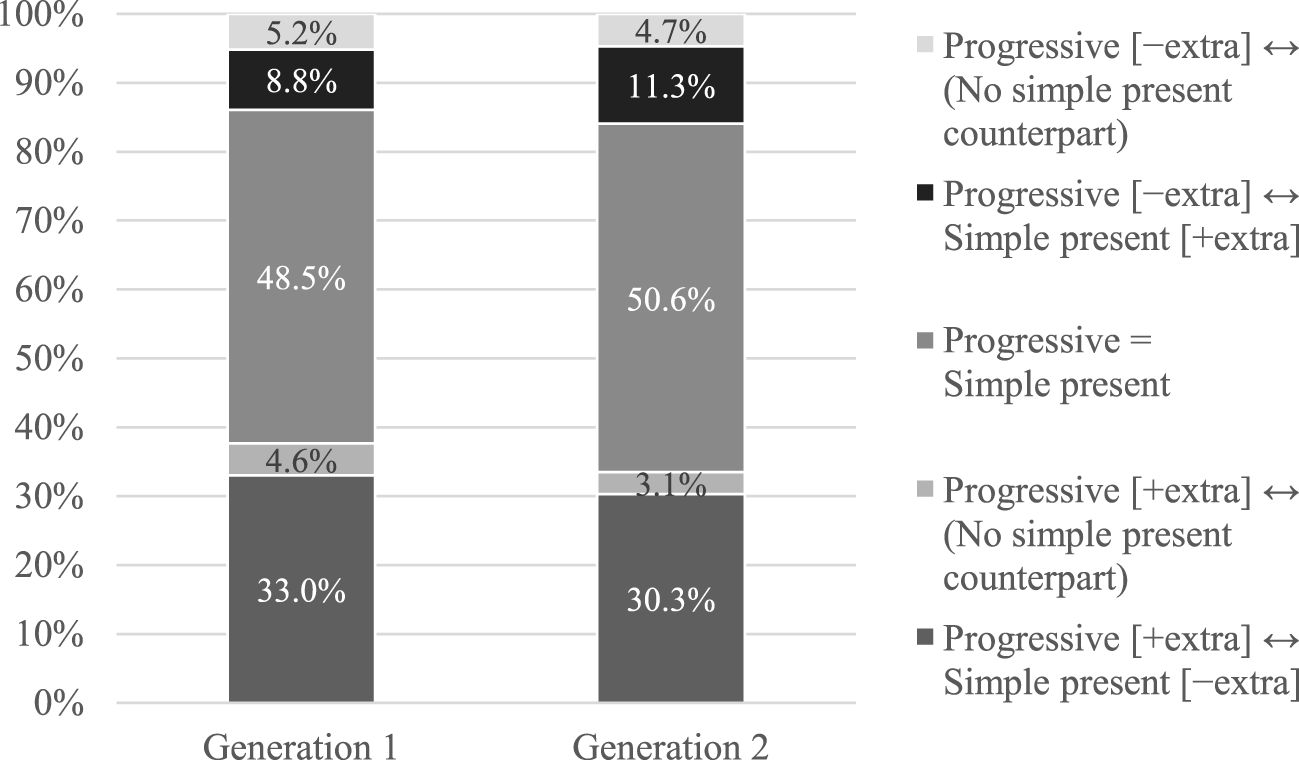
Throughout the seventeenth century, however, the progressive remained optional in the present tense. Petré (Reference Petré2017) analyzes progressive uses in texts by ten seventeenth-century authors from two different generations – the first consists of writers born between 1607 and 1615; the second between 1626 and 1631. The paper argues that these uses were initially motivated by the expressive potential of the progressive. Not only was the construction novel, it was also more explicit than its simple tense equivalent in coding a situation as ongoing. For the current paper we have extended the data set in Petré (Reference Petré2017) with two more authors. For all data we calculated the extravagance scores for the two generations as a ternary value: progressive is (more) extravagant [+extra], whereas the simple present is not (or less so) [ $-$extra]; both members of a pair are on a par in terms of extravagance; the progressive is not extravagant (or less so) [
 $-$extra] whereas the simple tense is (or is more so) [+extra]. In some cases we were unable to find a good candidate for a minimally different counterpart. These are listed separately.
Association of the Early Modern English progressive with extravagance.

Figure 1 indicates that over a third of the progressive occurrences in the early seventeenth century can be classified as more extravagant than their non-progressive counterparts. Feeding the numbers for each of the combinations (less, equally, more extravagant) into a chi-square test for goodness of fit (where expected values represent a random distribution of observed extravagance values over both progressive and non-progressive) twice (for each generation) yields a p-value < .001. In generation 1, the largest deviation is found in the values where the progressive is extravagant and the non-progressive is not, which suggests that the progressive is indeed significantly correlated with the addition of extravagance. In generation 2, the largest deviance is that between the observed instances where the progressive is less extravagant and the (much) higher number of expected instances. The number of instances where the progressive is more extravagant than the non-progressive is also higher than expected, but much less so than in generation 1. This might suggest that the extravagant quality of the progressive has decreased a little in generation 2. This decrease, however, is not significant according to a Kendall’s rank correlation test comparing both generations by ranking the progressive’s extravagance value from lower ( $-$1) over equal (0) to higher and generation from first to second (tau-b =
 $-$0.04, p=0.31). Yet it is still undeniable that the English progressive has lost its special trait of extravagance in contexts where it has become grammatically obligatory, a development whose first signs might be present in our historical data. This observation is not unlike that of Kiparsky & Condoravdi (Reference Kiparsky, Condoravdi, Brian Joseph and Ralli2006) with regard to negative concord: in an initial stage an optional lexeme is added to emphasize the negation, but this emphatic quality is lost when this lexeme becomes obligatory (in keeping with the so-called Jespersen cycle).
While the slight decrease noted may also seem to contradict our general hypothesis – viz. that the semantics of epistemic contingency makes the progressive inherently suitable for emphasizing the unusual nature of a situation – two observations can be made that reconcile the theory with the data. First, the progressive continues to expand to new contexts after it had become obligatory in present-tense declaratives. To this day the progressive remains optional in a number of contexts, and notably frequently signals extravagance if used in those contexts, as discussed in more detail in Section 3.2. Second, we can observe a shift in the nature of the context in these Early Modern data that pertains to the more inherent quality of the progressive. In the first generation, 59.3% (n = 64) of instances where the progressive was found to be more extravagant than the simple tense (i.e. the bottom series in Figure 1) were accompanied by a deictic time adverb meaning ‘now’ (mostly now itself). In generation 2, this figure has dropped to 31.9% (n = 97). The observed shift is statistically highly significant (chi-square p-value < .001). We would like to interpret this as follows. At first the extravagant quality of the progressive seems to have been at least partially the result of its unexpected use for encoding ongoing situations – prior to its grammaticalization it was essentially a stative copular construction. The presence of deictic adverbs indicating present time may not have been altogether redundant at this point, as it helped the interpretation. What is more, one might argue that the extravagant effect initially is mostly the effect of coercing the construction to encode ongoingness (a coercion effect that needs to be distinguished from that exerted by the progressive itself, once grammaticalized, on stative verbs). This is the type of extravagance that is a function of a construction’s novelty, and which one expects to wear out once it has conventionalized. Conventionalization also implies that the presence of present-time adverbials is no longer strictly required, which explains its decrease. Importantly, the extravagant nature of the construction, as judged by the context, persists even after conventionalization set in (but before it has become obligatory). This, then, may be precisely due to its inherent quality of epistemic contingency.
2.3 Extravagance and the rise of progressive constructions in Dutch
Progressive aspect in Dutch differs from its English counterpart in a number of important ways. There are, first of all, various progressive constructions that have grammaticalized in different degrees: apart from the prepositional ‘aan het “at the” + V-inf’ construction, speakers of Dutch also make use of posture- and motion-verb progressives, viz. ‘zitten/staan/liggen/lopen te “sit/stand/lie/run to” + V-inf’. The original postural or motional meaning of these verbs has faded when they function as progressive markers. In (12), for instance, the subject is clearly not standing upright while racing:

Despite their relatively frequent use in Present-day Dutch, the lower degree of grammaticalization of the Dutch progressive constructions is reflected in the fact that their use is not obligatory with dynamic verbs in the present-tense paradigm, as opposed to what is the case in English: both the progressive and the simple tense are allowed in concurrent-event reports (see, among others, Lemmens (Reference Lemmens2005) and Anthonissen et al. (Reference Anthonissen, De Wit and Mortelmans2019) for more details on the marking of progressive aspect in Present-day Dutch).
The diachrony of progressive aspect in Dutch has attracted considerably less scholarly attention than that of its English analogue, yet there are some notable existing studies. Van den Toorn (Reference Van den Toorn1975) discusses the diachrony of posture- and motion-verb progressives, while van der Horst (Reference van der Horst2005) offers insight into the history of the prepositional construction. Van der Horst (Reference van der Horst2008) includes a discussion of all the various progressive constructions in his historical overview of Dutch syntax. None of these works specifically concentrates on non-temporal, extravagant uses of early progressives, yet the data they present are revealing. The earliest attestations of grammaticalized posture- and motion-verb progressives as we know them nowadays date from the 16th century. In the course of the seventeenth century, ‘zitten/staan/liggen te + V-inf’ and ‘lopen + V-inf’ without te (translating respectively as ‘sit’, ‘stand’, ‘lie’, and ‘walk’) became more entrenched, and they persisted as grammaticalized expressions of progressive aspect throughout the centuries, up to the present. Interestingly for our purposes, right from the start, there appear to have been extravagant uses of these posture- and motion-verb progressives. Consider, for instance, the following examples from van der Horst (Reference van der Horst2008: Part V, 1191, 1197), both dating from the seventeenth century:

In the eighteenth and nineteenth centuries, too, extravagant uses, particularly in contexts involving a sense of irritation, are not uncommon among the examples listed by van der Horst (Reference van der Horst2008: Part VI, 1461; Part VII, 1790):

Similar observations can be made about the prepositional ‘aan het + V-inf’ construction, which originated in the sixteenth century. Early attestations of this construction frequently had an ingressive meaning (van der Horst Reference van der Horst2005), and they would often occur without the auxiliary zijn ‘be’. Just like their postural and motional counterparts, these non-finite uses of ‘aan het + V-inf’ often carry an extravagant overtone in van der Horst’s examples, in that they involve situations that are in a way out of the ordinary. Consider, for instance, the following sixteenth-century instance, in which the speaker highlights how intensively he is working (van der Horst Reference van der Horst2005: 132):Footnote [8]

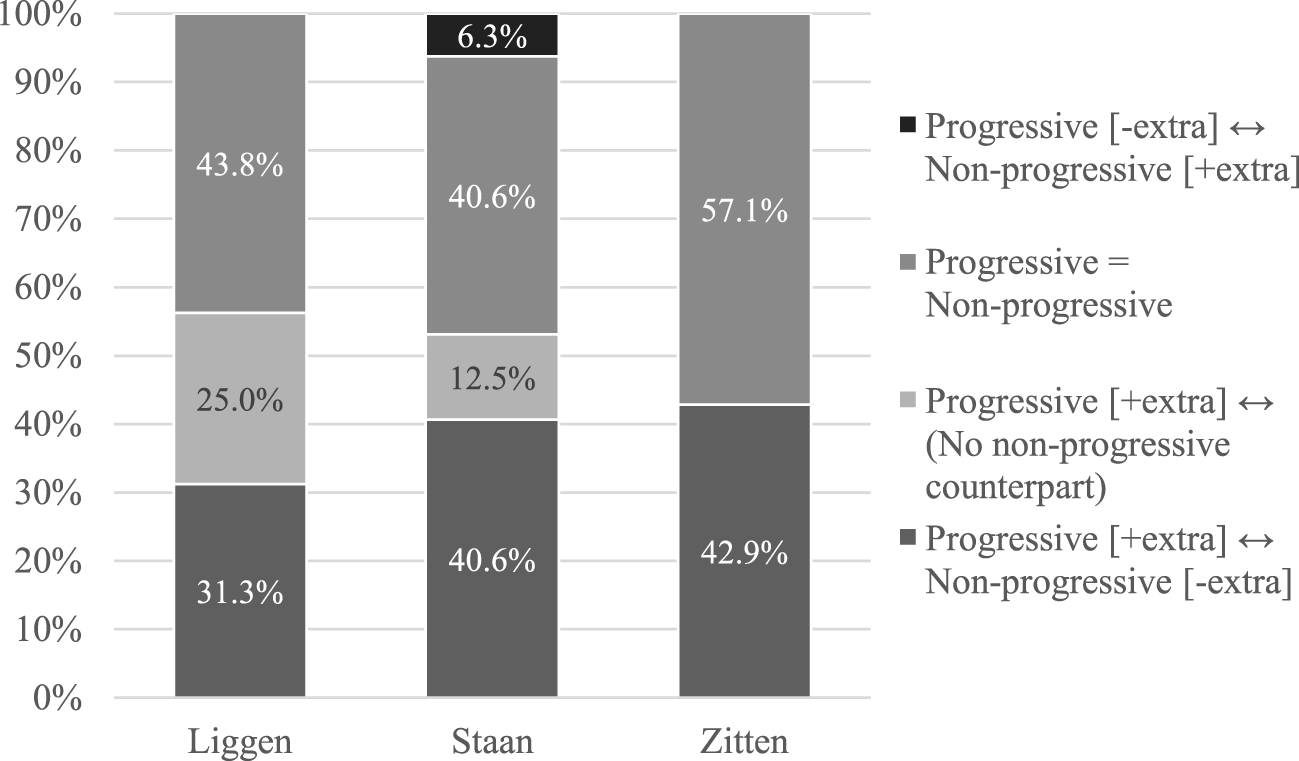
In order to verify whether these random examples are indicative of a more systematic association of older-stage Dutch progressives with extravagance, we consulted the citation corpus of the Woordenboek der Nederlandsche Taal. In total, we collected 32 progressive uses of staan, 21 of zitten, and 16 of liggen. This includes both serial verb uses, in which the posture verb is followed by ‘en “and” + inf’ (which have all but disappeared in contemporary Dutch), as well as instances with infinitival complementation (with or without te ‘to’). We could not find any progressive uses of ‘lopen (te) + V-inf’. For aan het, we found twelve progressive uses, yet since all but one of these examples featured inchoative-verb auxiliaries rather than zijn, they cannot be paired with non-progressive tenses to measure their propensity for expression of extravagance (i.e. a non-progressive tense would not have been a viable alternative since it does not express inchoativity).Footnote [9] In other words, we only have 69 (posture-verb) corpus examples, dating from the sixteenth until the 19th century, that can be used to measure the association of older-stage Dutch progressives with extravagance. Nevertheless, even for such a small amount of data, a comparison with non-progressive tenses on the basis of minimal pairs is revealing. For our selection of non-progressive minimal-pair items we used almost the same methodology as the one that was applied to the English data (even if we could not apply syntactic restrictions in terms of tense and specificity, as mentioned above) – the most important difference being that, given the extended time period covered in the corpora, we needed to stipulate that minimal-pair items had to be found within a 60-year timespan from one another. As mentioned above, we also took into account non-present and non-specific instances, but still made sure the two minimal-pair items were minimally different (e.g. a present progressive was matched with a present tense whenever possible). In spite of the relatively small size of the corpora, we were always able to extract a sufficient amount of non-progressive occurrences for each verb – even if, as can be inferred from Figure 2, this does not mean that there are always viable minimal-pair counterparts among these occurrences.Footnote [10] Example (18) constitutes an illustration of two minimal-pair items found for staan, both attested in seventeenth-century Dutch.

This example illustrates that the progressive – non-progressive opposition can indeed reflect a difference in extravagance, and as Figure 2 indicates for each of the posture-verb constructions, this is not an isolated case.
Association of sixteenth- to nineteenth-century Dutch posture-verb progressives with extravagance.

While the numbers for each verb separately are not sufficiently large to test for significance, their overall similar behavior justifies a combined goodness of fit test, which, similar to the English data, yields a p-value < .001. Once again, the largest deviation is found in the values where progressive is extravagant and non-progressive is not, which suggests that the progressive is indeed significantly correlated with the addition of extravagance.
Both for staan and liggen we attested a number of uses for which we could not find a non-progressive counterpart – it is noteworthy that, very often, these progressive attestations feature a sense of extravagance, sometimes intrinsically related to the semantics of the verb involved (e.g. verbs with negative emotional uses like malen ‘mull’, schimpen ‘railing’ or haspelen ‘reel’). The absence of non-progressive examples might thus indicate that verbs that express a heightened sense of involvement or irritation more naturally feature the progressive, though this would have to be verified on the basis of larger samples. All in all, the data presented in this section demonstrate that, from their early stages of development onwards, posture-verb progressives have been used for the expression of extravagance, and very preliminary indications suggest that this holds for lopen te and aan het progressives as well.
2.4 Extravagance and the rise of the French ‘être en train de + V-inf’ construction
The history of the French ‘être en train de + V-inf’ progressive has been described in various works, including Pusch (Reference Pusch2003), Do-Hurinville (Reference Do-Hurinville2007), Mortier (Reference Mortier2008) and De Wit et al. (Reference De Wit, Patard and Brisard2013). These authors point to the availability in the past of a relatively wide array of progressive constructions (some of them already attested in Late Latin, see Bertinetto Reference Bertinetto and Dahl2000: 562) that have all disappeared: ‘être “be” + present participle’, ‘être après “be after” + infinitive’, ‘être à “be at” + infinitive’ and the motion-verb construction ‘aller “go” + gerund’, which still exists, but only in very formal registers (Pusch Reference Pusch2003, Mortier Reference Mortier2008). ‘Être en train de + V-inf’ was attested from the sixteenth century onwards, yet rather than conveying an aspectual meaning, it referred to ‘being in the (right) mood, in the (right) disposition to (doing something)’ (Do-Hurinville Reference Do-Hurinville2007: 33). This is illustrated in the following example, dating from the mid-sixteenth century, which we extracted from the Frantext corpus:

In the course of the eighteenth century, ‘être en train de + V-inf’ acquired its contemporary aspectual function, gradually replacing the alternative periphrases towards the middle of the nineteenth century. Unlike its English counterpart, though, the construction is not obligatorily used for concurrent event reports, and it is also less frequent overall (Mortier Reference Mortier2008: 5).
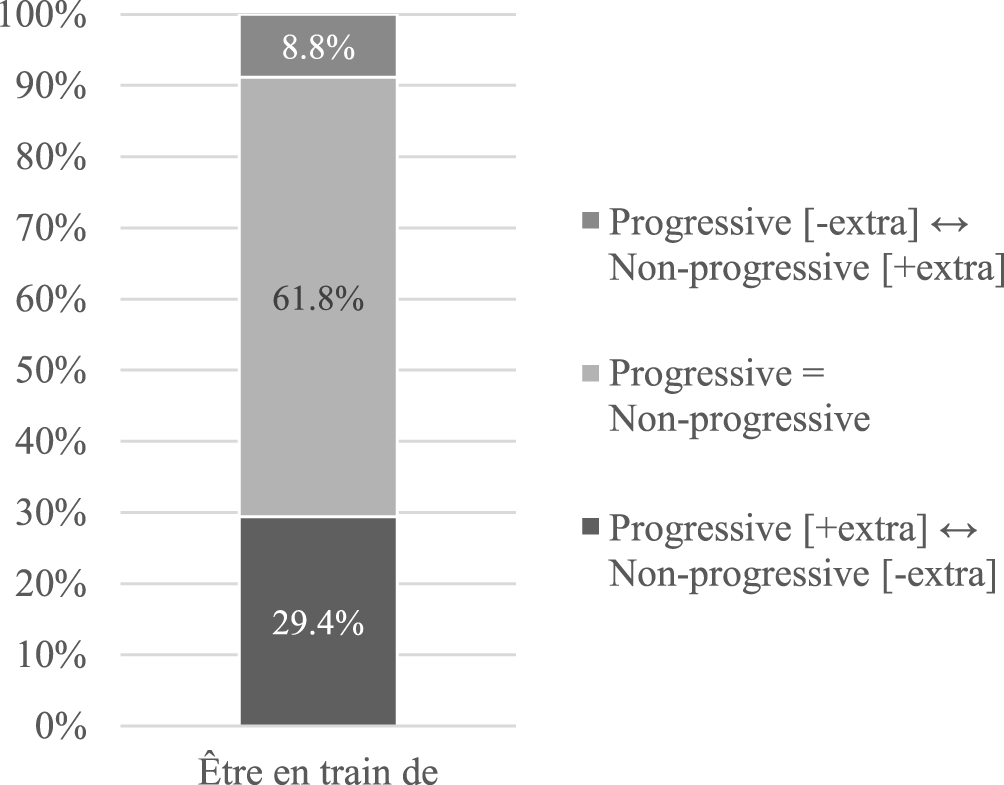
Since none of the aforementioned studies contains specific information or data pointing to the potential role of extravagance in the early stages of development of ‘être en train de + V-inf’, we analyzed the occurrences of the construction in texts dating from 1701 until 1800 collected from the Frantext database – resulting in a total of 34 instances (we also looked at data from 1550 until 1699, yet progressive uses of ‘être en train de + V-inf’ turned out to be all but absent then). Again, every progressive attestation was matched with a non-progressive counterpart, using the same criteria as for the Dutch progressives. Just like with the Dutch progressive constructions, extravagant uses can be attested early on, as seen in example (20a), which clearly features a sense of intensification/heightened involvement (as opposed to (20b)):

Again, in spite of the low number of eighteenth-century corpus attestations of ‘être en train de + V-inf’, an analysis of the minimal pairs retrieved reveals that the early French progressive is significantly more frequently associated with extravagant meanings than its non-progressive counterparts (p < .05). This can also be inferred from Figure 3.
Association of the eighteenth-century French progressive with extravagance.

2.5 Young progressives, aspect and extravagance
In this section, we have shown that the early English and French progressives, as well as Dutch posture-verb progressives, were used to express extravagance at the onset of their development. In doing so, we have offered an additional contribution to the growing body of research indicating that a language user’s wish to be noticed constitutes a pivotal factor in the early stages of grammaticalization of a construction. We have strong reasons to believe that our observations can be extended to historical data on progressives in other languages. The fact that extravagant uses are attested in the initial stages of grammaticalization, thus preceding (and, in fact, causing) the further spread and entrenchment of canonical aspectotemporal uses, has important implications for claims about general grammaticalization paths proposed for tense and aspect markers (see e.g. Hengeveld Reference Hengeveld, Heine and Narrog2011). Frequently, ‘special’ (i.e. non-aspectotemporal) uses of aspectotemporal constructions are considered (pragmatic) extensions, resulting from some interaction between (a specific) context and the canonical temporal meaning of these constructions. While we do not claim that the inverse is true – we do not go as far as to say that aspectual uses of the progressive are diachronically derived from extravagant uses – our data do show that extravagant uses can trigger more widespread aspectual usage. In Section 5, we will discuss the more theoretical implications of the relationship between extravagant and aspectotemporal uses on one hand, and the way in which they are related to the schematic meaning of epistemic contingency that we posit for this construction on the other. However, before we do so, we will argue in the subsequent sections that the association of progressive marking and extravagance is not an exclusive feature of ‘young’ progressives.
3 Extravagant uses of the Dutch, French and English progressives: Synchronic data
In Section 2, we have offered evidence suggesting that older-stage progressives were recruited by speakers to convey a sense of extravagance. The question this raises is: do these progressives lend themselves to extravagant uses simply because of their novelty? Or is there anything specific about the progressive that makes it take on extravagant readings? In the remainder of this paper, we will argue that, while progressives, just like other new constructions (such as by means of), may be inherently prone to express non-canonicity in early stages of their development, they continue to be used by speakers as a means to make a situation stand out, which is generally not the case with other constructions. In this section, we discuss the extravagant uses of the progressive in Present-day Dutch, French and English. In order to identify extravagant uses, we deployed the same parameters as we did for the diachronic data analysis. For those examples featuring such contextual indices of extravagance, we verified whether or not they were interchangeable with a simple (or non-progressive) tense and whether this would indeed result in differences in degree of extravagance rather than in aspecto-temporal differences, reflected in the absence of extravagance indices in the simplex attestation. We therefore based ourselves on native-speaker intuitions (in the case of Dutch) and corpus attestations, whereby we again verified whether there was a difference in extravagance between the progressive attestation and a minimally different non-progressive one. Consider, for instance, the following two examples extracted from the COCA corpus:

In (22), the progressive is used to report an ongoing past event. This sense of ongoingness would not be present if a simple past were used (in fact, a sequential reading would arise in which Maria starts telling about practicing her singing after the speaker interrupted her). In those cases, the progressive is unequivocally used for aspecto-temporal reasons. Yet this does not appear to be the case in (21), in which the speaker is clearly irritated by the reported event (note ‘knucklehead’ and ‘God help us all’), and the telling is represented as in a way non-obvious. In our view, this sense of irritation would be less discernable if a simple present were used – and this is confirmed by the attestation of examples such as (23), which, just like (21), involves a re-interpretation of a previously introduced stretch of discourse, yet unlike (21), the speaker appears to take a relatively neutral stance with respect to what is being said or, if that is not the case, appears to at least come across as reporting something in a matter-of-fact way. One of the ways of projecting this detached attitude in English is exactly by using the simple present:Footnote [11]

Therefore, example (21) can be classified as an extravagant use of the English progressive – and this is the procedure that we applied to each of the examples discussed in this section.
In what follows we will first analyze extravagant uses of the progressive in Dutch and French (Section 3.1) and then move on to extravagant uses of the English progressive (Section 3.2). As observed in Sections 2.3 and 2.4, an important difference between progressive marking in English versus Dutch and French is its obligatory status in English with dynamic verbs in the present. This entails that it is hard to unequivocally establish that the use of the English progressive in such reports is purely motivated by the speaker’s wish to have a situation stand out, since the simple tense was not a viable option anyway. Therefore, we will be zooming in on those contexts in which, from an aspectual perspective, both the simple and the progressive tense can be used (or in which the simple tense is even preferred for ‘neutral’ descriptions), i.e. states, performatives, habituals and so-called interpretive contexts. For Dutch and French, no such restrictions are necessary.
3.1 Dutch and French
De Wit & Patard (Reference De Wit and Patard2013) and Anthonissen et al. (Reference Anthonissen, De Wit and Mortelmans2019) point out that, apart from expressing temporal meanings such as ongoingness, duration and incompletion, the Dutch and French progressive constructions can be specifically exploited to construe situations as non-canonical. Anthonissen et al. (Reference Anthonissen, De Wit and Mortelmans2019) base their analysis on a corpus study of 2,465 prepositional, posture- and motion-verb progressives found in the CGN, complemented with a native-speaker survey, consisting of minimal pairs. De Wit & Patard (Reference De Wit and Patard2013) analyze 191 present-tense occurrences of ‘être en train de + V-inf’ in CLAPI, Frantext and CFPP2000 (Branca-Rosoff et al. Reference Branca-Rosoff, Fleury, Lefeuvre and Pires2012). In each of these studies, progressive attestations were classified as temporal or modal/non-temporal on the basis of the first set of contextual criteria used by Petré (Reference Petré2017), i.e. the presence of accompanying emphatic markers and constructions. The classification was carried out by multiple annotators, who each went through the different examples and had to agree on every attestation. Anthonissen et al. (Reference Anthonissen, De Wit and Mortelmans2019) conclude that more than half of the progressive examples attested in the CGN (1,243) feature a sense of ‘(inter)subjectivity’ (i.e. our extravagance). De Wit & Patard (Reference De Wit and Patard2013) attest 82 non-temporal instances among their attestations of ‘être en train de + V-inf’. We have already given two illustrations of such extravagant uses for French and Dutch in (5) and (6) above. In these examples, repeated here in (24) and (25), the reported event is clearly irritating for the speaker – a sense of irritation that would not be as conspicuous if a simple tense had been used (recall also the English example cited in (21) above).

The Dutch ‘lopen te + V-inf’ construction appears to be particularly susceptible to such expressions of irritation, according to Anthonissen et al. (Reference Anthonissen, De Wit and Mortelmans2019): 30 out of 43 motion-verb progressives attested in the CGN carry connotations of annoyance on the part of the speaker. However, the other Dutch progressive constructions lend themselves to such uses as well; this is most notably the case for posture-verb progressives, but also for the prepositional construction – see, for instance, (26):

While it is possible to refer to an ongoing event like this with the simple present in Dutch, resulting in a more matter-of-fact report, the use of progressive marking conveys an additional qualification of that event (as a response to the previous question ‘What’s wrong?’). Similarly, examples involving a sense of intensification, such as (27) and (28), naturally feature a progressive, whereas the use of simple tenses, though not impossible, would yield a more neutral (less involved) representation.

While the French and Dutch progressives may on the one hand trigger intensified readings, they are also attested in contexts in which the speaker wants to qualify what she is saying by downplaying the force of the utterance. Such tentative uses are illustrated in (29) and (30):

It might appear counterintuitive to analyze these tentative uses and the intensified ones cited in (27) and (28) as similar extravagant uses of the progressive. Contextual indications of tentativeness were also not attested among our extravagant diachronic data. Yet qualifying a situation, and thus making it stand out in comparison with a more neutral, matter-of-fact report, is what unites intensified and tentative uses. Just like in negative emotional contexts (expressing irritation or annoyance), they point to a more involved attitude of the speaker towards what she is saying.
The fact that examples such as these are attested in contemporary French and Dutch shows that the progressive constructions in these languages are still used to generate special, extravagant meaning effects, despite their relative ‘age’. Corpus studies and native-speaker surveys carried out by De Wit et al. (Reference De Wit, Patard and Brisard2013) and Anthonissen et al. (Reference Anthonissen, De Wit and Mortelmans2019) reveal that the examples cited in this section are not isolated cases, but that they are, in fact, relatively frequent and therefore a systematic part of contemporary French and Dutch grammar.
3.2 English: New contexts for standing out
Despite the high frequency in Present-day English of present progressives as an unmarked way of referring to an ongoing event, it appears that the progressive has retained its potential of being used in other contexts that normally select the simple tense, and that, once again, its (optional) use in these contexts is motivated by the speaker’s wish to construe the reported event as non-obvious. Consider, for instance, the following example (from a post 9/11 Optic Nerve top secret assessment, monitoring webcam use in the early 21st century to detect terrorist activity, as cited in HyperNormalisation, Adam Curtis, BBC, 2016):

Formally, the choice of the author to use a progressive passive infinitive is certainly marked. There are no objective (temporal) reasons why the construction should be more appropriate than its simple alternative. We contend, instead, that the progressive allows the author to emphasize the (subjective) outrage at the reported situation, which is presented as both new and surprising and involving not yet consolidated knowledge about the world (this is possible in the given time frame, the early 2000s, when this technology was just emerging; note that, given the prominence of expressions like appear and surprising, it is the author’s perception and subjective reaction which are indexed by the progressive(s) in this fragment, and not, on an inchoative reading, the objectively merging nature of the technology).
Other instances of progressive marking where a simplex tense would be expected involve cases of stative coercion, in which a stative predication is exceptionally given a dynamic construal (Michaelis Reference Michaelis2011). Quite frequently, these cases of coercion are motivated by the speaker’s wish to be more tentative for instance, I was hoping, I’m thinking, what are you wanting to…, etc. On the other hand, there are also decidedly non-tentative extravagant uses of stative verbs taking the progressive – see, for instance, McDonald’s slogan in (32):

Here, the progressive is used to emphasize how much the speaker is loving the experience of eating, say, a burger. By means of the progressive, the slogan underscores that this is not a run-of-the-mill event or habit.
Stative contexts are one type of context canonically featuring the simple tense in English, though in recent history it has been shown that the use of the progressive with stative verbs seems to be on the rise (van Gelderen Reference van Gelderen2017). Another context in which we frequently attest extravagant uses of the progressive are performative sentences, as illustrated in (4) above. Performatives are aspectually special – in English at least (see De Wit, Brisard & Meeuwis Reference De Wit, Brisard and Meeuwis2018) – because they take the simple present rather than the present progressive, unlike other present-time event reports. Yet, as pointed out by De Wit & Michaelis (Reference De Wit and Michaelis2018), despite the overwhelming statistical preference for the simple present, progressive performatives are possible as well – (33), for instance, constitutes an act of advising and (34) is a plea, and the same would be true if a simple present were used (both examples have been taken from COCA):

De Wit & Michaelis (Reference De Wit and Michaelis2018) found such progressive performatives most frequently with verbs from particular illocutionary classes, namely exercitives (which involve acts of deciding ‘in favor of or against a certain course of action, or the advocacy of it’ (Austin Reference Austin1962: 154), such as warning and ordering). On the other hand, behabitives (which express socially mediated affective states including regret, sorrow, and gratitude), commissives (promises or other commitments on the part of the speaker) and verdictives (which ‘consist in the giving of a finding, official or unofficial, upon evidence or reasons as to value of fact’ (Austin Reference Austin1962: 152)) are less likely to take on progressive marking. Again, various special meaning effects are generated when the progressive is used instead of the simple present in all these contexts: more emphasis is put on the performative act (35), or conversely, the act may once again be expressed in a more tentative manner (36):

Yet other contexts that are usually associated with simple marking in English are habitual utterances. When reference to a habit involves a sense of particular emotional intensity or irritation on the part of the speaker, progressive construals come naturally, just like in Dutch and French. This is frequently noted in descriptive grammars (see e.g. Leech (Reference Leech2004): 52) and illustrated in (37) and (38), taken from the Santa Barbara Corpus of Spoken American English SBC (De Wit & Brisard (Reference De Wit and Brisard2014): 81):

In (37), the repeated use of the adverb really accompanying the progressive form indexes the insistence on the part of the speaker (‘horses that I’m really using as opposed to those that I may use incidentally’), while in (38) it is clear from the context that the current sleeping habits reported by the speaker are presented as problematic.
A final type of context that involves extravagant progressives in contemporary English are so-called interpretive (or ‘interpretative’; Ljung Reference Ljung1980) utterances. In such contexts, the progressive is used to re-examine, so to speak, an event whose interpretation is presented as not straightforward. In the following SBC example, the speaker (who is describing the discourse of civil-rights activist Jesse Jackson) first uses simple tenses (says and talks), but then switches to the progressive (is really talking) to emphasize what is meant:

The contrast that is implied here is one between appearances (reported in the simple present) and realities (reported in the progressive). We suggest that the progressive adds a sense of extra-ordinariness to the reality that is revealed, especially in contexts where that reality seems to conflict (or otherwise generate tensions) with appearances or commonly held beliefs. Note that in cases like (39), it is clearly the same event that is referred to on each occasion (says, talks, is talking), but construed differently. This is also true in the following example from COCA, which illustrates that the simple tenses are not barred from interpretive contexts (say), yet shows at the same time that a more hedged report of the interpretation process (initiated by It sounds to me) calls for a progressive construal (are saying):

Taken together, these data demonstrate that the English progressive has not in fact shed its potential to express extravagant meanings over the course of the centuries. Certainly, as we pointed out in Section 2.2, its obligatory use in present dynamic contexts has eroded the progressive’s capacity to create a meaningful contrast with respect to the simplex tenses in identical contexts, yet the fact that it still functions as a marker of extravagance in those contexts in which it is interchangeable with the simple tenses is both empirically viable and theoretically relevant, and therefore in need of an explanation, as proposed in Section 5. As a final set of data which we believe corroborate this analysis, we now turn to non-temporally motivated progressive uses in languages other than English, Dutch and French.
4 Extravagant uses of the progressive beyond Romance and Germanic
In this section we briefly discuss data from other, typologically diverse languages – i.e. Western Armenian, Albanian, the Niger-Congo language Igbo, and various Bantu languages – in which it has been observed that progressives do more than express temporal notions of ongoingness.Footnote [12]
Donabédian-Demopoulos (Reference Donabédian-Demopoulos2012) points out that evidential and progressive constructions are frequently used in Western Armenian for the expression of what she calls salience. These ‘salient’ uses exist alongside prototypical evidential/aspectual uses. The progressive, construed by means of the particle kor in postposition, is not obligatorily used for ongoing event reports, just like in French and Dutch, and it is frowned upon by descriptive grammarians, yet its use is relatively widespread in spoken Western Armenian. The range of non-aspectual usage types of kor attested by Donabédian-Demopoulos (Reference Donabédian-Demopoulos2012: 8–10) is remarkably similar to the ones described for French, Dutch and English in Section 3: it can combine with both dynamic and (coerced) stative verbs for the expression of re-interpretation, indignation, strong regret, emphasis and dramatic tension. For instance, in (41), which is notably analogous to many uses of English I’m telling you (De Wit & Brisard (Reference De Wit and Brisard2014): 84–85), the progressive is not used to construe the denoted event as ongoing, but rather to present it in a more forceful fashion for argumentative purposes:

While there may be various motivations for the speaker to choose the progressive in contexts in which the simple present would be equally viable, what they all share is a sense of non-obviousness (or ‘non quelconque’ [not ordinary/whatever] in Donabédian-Demopoulos’ terms). The related notion of salience as it is used by Donabédian-Demopoulos is highly similar to the sense of extravagance as we have defined it in this study. What makes this parallel between the progressive in Western Armenian, on the one hand, and in French, Dutch and English, on the other hand, all the more striking is that these languages are not directly related typologically, nor have they been in contact in the course of their development. The progressive constructions in all these languages have developed too recently for their semantics to be related to shared Indo-European ancestry, so there must be another factor motivating the entirely independent attestation of extravagant uses in Western Armenian and in Western European languages.
Another Indo-European language that features noteworthy progressive uses is Albanian. As pointed out by, among others, Borshi (Reference Borshi2011), Albanian has two progressive constructions, one formed by means of the particle po, the other formed by means of the auxiliary ‘jam “be” + the particle duke + present participle’. It is the former construction, which is attested most frequently, that interests us most here, as it also serves an ‘emphatic’ function (Newmark, Hubbard & Prifti Reference Newmark, Hubbard and Prifti1982: 36; Borshi Reference Borshi2011: 76; Joseph Reference Joseph2011: 31–34). More precisely, while it is attested in prototypical contexts of expressing ongoingness, speakers of Albanian equally use po (which could be glossed as ‘yes’/‘precisely’/‘exactly’) to highlight what is really going on here and now. Again, this is done in contexts that involve non-obvious events or in which the circumstances surrounding the speech event are somewhat out of the ordinary (e.g. in cases where the speaker wants to emphasize her authority; Borshi Reference Borshi2011: 77); in other words, the progressive is once more used for extravagant purposes.
Both Western Armenian kor and Albanian po are not obligatorily used in dynamic contexts. This indicates that these two progressive constructions have attained a comparatively low degree of grammaticalization, and it might therefore be argued that the extravagant readings that are associated with them are a result of their relative novelty and unexpectedness. However, we have already seen in Section 3.2 that this account does not capture our observations on English, and evidence from yet another group of languages, i.e. Bantu languages, suggests that there is something more fundamental about the semantics of progressive aspect that makes it intrinsically relatable to extravagant uses. In his study of the relationship between the present progressive and verb focus in Bantu, Güldemann (Reference Güldemann2003: 323) analyzes the progressive as an ‘inherently focused verb category’, observing that there is a remarkable isomorphism across Bantu languages between the forms used for the expression of progressive aspect and those used for predication focus (i.e. focus on the verbal lexeme and on the auxiliaries accompanying this lexeme). The pre-verbal marker ni-, for instance, is used in Bantu languages of Zones E and J to express predication focus, as is indicated by means of underlining in the translation of the Kikuyu (E51) example in (42). In a closely related language like Kamba (E55), ni- appears both in focal (43a) and in progressive contexts (43b). In yet other related languages, such as Haya (J22), ni- is only used to express present ongoingness, as in (44) (for more details, see Güldemann Reference Güldemann2003: 324, 333–335):

Similar observations are reported for other focal/progressive markers. Güldemann (Reference Güldemann2003: 343–346) offers various pieces of evidence suggesting that there is a unidirectional grammaticalization path from focus to progressive in Bantu (note also analyses within the framework of Functional Discourse Grammar that would predict the opposite direction of change; see Hengeveld Reference Hengeveld, Heine and Narrog2011). The fact that progressive constructions evolve out of focus markers constitutes a strong indication of the functional association between the two categories. Focal information, as defined by Güldemann (Reference Güldemann2003: 329), following Dik (Reference Dik1997), ‘is that information which is relatively the most important or salient in the given communicative setting’. The vast literature on information structure contains many additional refinements of this basic definition of focus, yet it is clear that the notion as it is used to analyze Bantu languages is – just like Donabédian-Demopoulos’ term ‘salience’ – intimately related to the notion of extravagance presented in this paper (though they are not the same; there are, for instance, no dedicated syntactic constructions for expressing extravagance, on analogy with focus constructionsFootnote [14]). In other words, the data from Bantu constitute yet another, crucial illustration of the propensity of progressive marking to be used with situations that the speaker wishes to present as somehow out of the ordinary. Note, finally, that preliminary evidence suggests that these observations extend to other African languages beyond Bantu: as pointed out by Emenanjo (Reference Emenanjo1987), the Niger-Congo language Igbo features a so-called ‘progressive-unexpected’ construction which is geared to the expression of non-obvious events.
5 Epistemic contingency as the schematic meaning of the progressive
The data presented in Sections 2–4 demonstrate that the progressive is recruited for purposes of expressing extravagance in a variety of languages, irrespective of its degree of grammaticalization. While sheer novelty may be a pivotal impetus for the initial development and spread of the progressive in the verbal paradigm of a given language, the fact that progressive marking continues to appear in such contexts even when it has more generally developed as a (possibly obligatory) marker of ongoingness suggests that there is something inherent to the semantics of the category that makes it suitable for expressing the less-than-obvious (and that, therefore, every progressive construction that has not developed into a general imperfective in principle has the potential to be used for purposes of expressing extravagance). Building on the analysis of the English progressive in De Wit & Brisard (Reference De Wit and Brisard2014), we will argue in this section that the progressive indicates epistemic contingency at the most schematic level of analysis, and that it is therefore essentially a modal category (see De Wit Reference De Wit2017a: Chapter 2 for a defense of such a modal conception of tense and aspect constructions). This analysis reflects our general conviction, advocated in, among others, De Wit (Reference De Wit2017a: 6–7), that if an account can be proposed that unifies the different usage types attested, this account is to be preferred to an analysis that is exclusively formulated in terms of polysemous relations between several concrete usage types (some semantic, others possibly pragmatic/derived), for the latter seems to miss out on a generalization. In any case, semantic networks like this usually do not solely consist of horizontal extension relations and involve schemas capturing commonalities across usage types. Concretely, applied to the progressive, this entails that the schematic modal meaning of contingency gives rises to more specific temporal and non-temporal usage types, as we will argue in what follows.
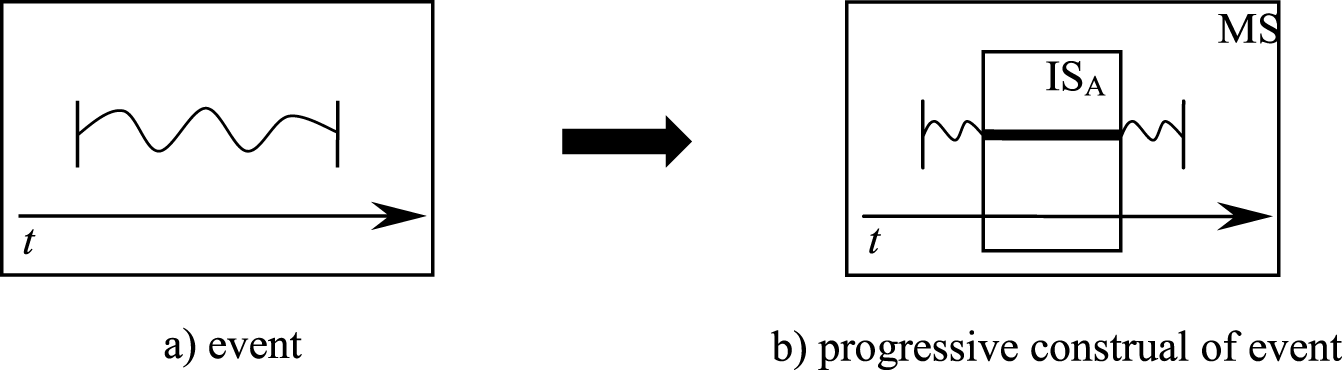
It is widely accepted that progressive aspect involves an internal viewpoint on a situation, just like imperfective aspect (e.g. Comrie Reference Comrie1976, Dahl Reference Dahl1985, Michaelis Reference Michaelis2004). However, the crucial difference between imperfective aspect and progressivity is that the former can combine with both stative and dynamic verbs, whereas the latter only occurs with dynamic verbs (De Wit Reference De Wit2017a). Whenever progressives do combine with verbs that are canonically stative, they trigger an actional shift by coercing these verbs into dynamic ones, as we have discussed in Section 3.2 for English (recall the McDonald’s slogan I’m loving it, cited in (32) above). It is this intrinsic association with dynamic verbs that underlies the meaning of contingency that we assign to the progressive. Dynamic verbs denote events, i.e. situations that are presented as bounded and, typically, internally heterogeneous, such as walking home or working out. By zooming in on such events, the progressive creates an internal perspective that disregards their boundaries (Smith Reference Smith1997: 73–75). A fruitful way of analyzing this imperfectivization process typifying the progressive can be found in Cognitive Grammar analyses that refer to the notion of scope (Langacker Reference Langacker2001, De Wit & Brisard Reference De Wit and Brisard2014. In this cognitively oriented theory, the overall conceptual content evoked by an expression is called its maximal scope (MS). Its immediate scope (IS) is that portion of the maximal scope that is immediately relevant for a particular linguistic purpose and that delineates the profile of the expression (i.e. what it refers to). The progressive can then be analyzed as imposing an aspectual immediate scope (ISA) that restricts the profile of a dynamic verb by excluding its endpoints and abstracting away from the relative heterogeneity of successive subintervals (Langacker Reference Langacker2001: 258). As a result, the boundaries of the process referred to by the verb are deferred to the expression’s maximal scope, which means that they are not profiled, yet they are still part and parcel of the expression’s overall semantics and relevant by implication for how it functions, e.g. in the coercion of stative verbs (much like we cannot normally talk about someone’s hands without also having some background conception of their entire body). Figure 4 below depicts this imperfectivization process.
Imperfectivization of an event.

Hence, by definition, progressive construals necessarily involve backgrounded boundaries in the expression’s maximal scope, as illustrated in Figure 4b. This entails that progressives across languages are associated with referring to singular dynamic events, the majority of which are fleeting and have no special status in terms of carrying any structural information about the world (again, as opposed to habits, states, etc.). In other words, progressive marking and reference to real if incidental situations seem inherently linked, and it is this link, we suggest, that forms the basis for the meaning of contingency that we assign to both temporal and non-temporal uses, and that we define as ‘real but not necessary’.Footnote [15] In English, for instance, we can talk about a systematic modal contrast between the simple and progressive variants of the present tense, because the former is so tightly associated with reference to structural situations (states, persistent habits, etc.) and the latter with more ephemeral ones (singular events, basically). This is reminiscent of what Goldsmith & Woisetschlaeger (Reference Goldsmith and Woisetschlaeger1982) call the ‘phenomenal’ quality of (a range of uses of) the English progressive. In our view, this contingent quality expressed by the English progressive is instantiated in all of its uses, be they temporal or other. Temporal uses referring to ongoing singular events also involve contingent situations (not by definition, but in the vast majority of cases), even if expressing their contingency is in those cases not what the speaker primarily has in mind. For example, in (1) (I’m trying to get in, but I can’t find my keys), the event of trying to get in does not describe a typical characteristic, neither of the speaker (it is not expressed that they do this habitually) nor of the situation itself (which the speaker could have suggested by adding again). Such incidental situations are not construed as in any way informative about the world beyond their very occurrence. A similar analysis can be proposed for temporal uses of the present progressive in the other languages discussed in this paper. In case of the non-temporal, extravagant uses of the progressives that we have analyzed, the meaning of contingency is what motivates their use directly, i.e. qualifying the situation they are reporting is what they’re about, regardless of any referential preoccupations with expressing ongoingness. In those cases, the primary point in using the progressive lies in indicating that an event is not ordinary or obvious, and its characteristic meaning of contingency is exploited for the purpose of expressing extravagance.
Each of the languages discussed in this paper reserves some of the uses of progressive marking for referring to unusual events or expressing non-obviousness. Since we did not conduct a full-fledged typological study, it is difficult to claim unequivocally that every language will actually exploit the modal potential of its progressive construction (if it has one) by using it for the expression of extravagance, but at the very least we propose that if such a pattern is observed, it can be motivated along the lines of the conceptual configurations (involving issues of scope, salience) and network relations (involving linked elaborations of a shared schema) informing our analysis.
6 Conclusion
In this paper we have demonstrated on the basis of diachronic and synchronic data from a variety of languages that (present) progressives are particularly liable to be used for the expression of extravagance. We have defined extravagant language use as a signaling mechanism that consists in the exploitation of an unconventional construction in a given context as a way for speakers to indicate that there is something non-canonical about the situation that they are reporting. Constructions that recently emerged in a given language naturally lend themselves to such extravagant exploitation, since they are by definition to a certain extent unconventional. This is why the English, Dutch and French progressives were notably often recruited in extravagant contexts at the onset of their development. However, while the relative frequency with which these progressives occur in extravagant contexts may have decreased in the course of their development as a result of the fact that they became naturally associated with (or even obligatorily used in) present-time event reports, our synchronic data reveal that Present-day English, Dutch and French progressives continue to be used for extravagant purposes. This suggests that there is something inherent about progressive aspect that makes it liable to such extravagant usage, and this is confirmed by data from other, typologically diverse languages, in which the progressive equally appears in certain contexts for the sole purpose of highlighting. We have accounted for this intrinsic association of progressive aspect and extravagance in the form of a cognitive-semantic analysis of the progressive in terms of epistemic contingency. That is, progressive constructions across languages are recruited for the expression of situations that are real, but not necessary, in that they do not involve structural (but rather incidental) properties of the world. Extravagant uses of progressives constitute direct instantiations of this modal schema (which we characterize as ‘epistemic contingency’).
Our analysis thus reveals that extravagance is not as transient a property as diachronic studies suggest: it is not only sheer novelty and association with certain (groups of) individuals that determine the extent to which grammatical constructions lend themselves to extravagant usage, the semantics of these constructions also contributes to their extravagance potential. In our paper, we have exclusively concentrated on the progressive, yet we might expect that other (aspectual) constructions that are inherently associated with ephemeral states of affairs, notably the perfect (see De Wit Reference De Wit2017b), can also be used for the expression of non-canonicity across languages, irrespective of their degree of grammaticalization. The attestation of extravagant usage types of aspectual constructions challenges the received assumption that a temporal meaning is basic and suggests, instead, that we need to look beyond the temporal import of aspectual constructions in order to analyze their semantics in a unified fashion.