Introduction
Frey's syndrome, also termed gustatory sweating, typically refers to the phenomenon of increased facial sweating and/or flushing after parotid surgery. In German departments of otorhinolaryngology, Frey's syndrome is the most common indication for botulinum toxin treatment.Reference Matthes, Kruegel, Karapantzou, Winterhoff and Laskawi1 Since the first reports of its successful use,Reference Drobik and Laskawi2, Reference Drobik and Laskawi3 botulinum toxin has become widely accepted as a safe and effective treatment for Frey's syndrome. As a result, other treatment options, such as topical or systemic anticholinergic drugs and several surgical approaches,Reference Clayman, Clayman and Seagle4 are now rarely used.
In clinical practice, most patients with Frey's syndrome require one or two intradermal injections of botulinum toxin to the affected skin area in order to decrease symptoms. However, there are occasional cases in which the same skin area requires repeated injections. There are also rare cases in which other parts of the face develop gustatory sweating.
This study aimed to provide a detailed description of the treatment course of Frey's syndrome patients treated at our institution, and to develop a simplified classification system with which to categorise treatment response. In addition, we also reviewed the literature on botulinum toxin treatment for Frey's syndrome, in order to verify our classification system and to compare our results with a broader database.
Materials and methods
We undertook a standard chart review for all Frey's syndrome patients who had been treated at our institution with botulinum toxin, in order to compile a detailed description of their treatment course. We excluded any patients with gustatory sweating proven not to be a result of previous parotid gland surgery.
In general, we had at least one contact with the patient before initiating botulinum toxin treatment. During this contact, the patient was given comprehensive information on the treatment intervention, and was asked to identify which skin areas were affected (i.e. after several sweat-provoking meals). We only performed the Minor test in inconclusive cases, as it is well known that the iodine-starch test overestimates the areas affected in everyday situations;Reference Minor5–Reference Laccourreye, Akl, Gutierrez-Fonseca, Garcia, Brasnu and Bonan7 in any case, most patients already have a detailed knowledge of which skin areas are affected during eating.
Each patient was treated with botulinum toxin type A (Dysport; Ipsen Pharma, Ettlingen, Germany), supplied as a 500 U vial diluted in 2.5 ml physiological saline. Ten units of botulinum toxin type A were injected intradermally per square centimetre of skin, within the previously determined affected area. Treatment success was evaluated after 10 days via a follow-up telephone call. Patients were encouraged to contact our institution with any symptoms. During the follow-up call, the duration of the treatment effect was established.
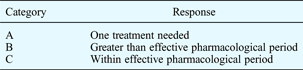
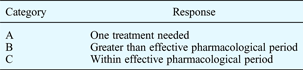
After identifying four simplified types of treatment course, we established a classification system for treatment response (Table I). Type A cases showed no symptom recurrence after a single intervention. In type B cases, the symptom-free period extended beyond the pharmacologically active period of 10 to 14 weeks. Type B cases also included patients with recurrent symptoms who did not undergo repeated treatment. In type C cases, the symptom-free period was in accordance with the pharmacologically active period.
Botulinum toxin treatment response classification
In order to obtain comparable data from a larger number of patients, an extensive literature review was performed, using the PubMed database and the key words ‘Frey's syndrome’, ‘gustatory sweating’ and ‘botulinum toxin’. The references of selected studies were also analysed. The minimum required patient characteristics were age, gender, number of treatments and duration of effect, for individual cases; additional information was recorded as provided.
This literature search identified 89 papers. Forty-nine were review articles so were excluded. Thirty-two were inappropriate for inclusion as they did not fulfil the criteria for individual patient identification, or appeared to evaluate similar patient cohorts. Four studies used botulinum toxin serotypes B or F, so were not included because of problematic comparability. Four papers were appropriate for inclusion.
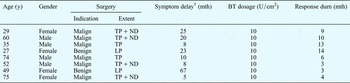
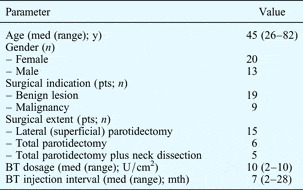
Therefore, the final cohort analysed consisted of patients from our own study plus patients previously reported in the four studies identified by our literature review (Tables II and III).
Characteristics of 8 current patients*

* Treated at the authors' institution. †Time between surgery and symptoms. Y = years; mth = months; BT = botulinum toxin A; durn = duration; malign = malignant lesion; TP = total parotidectomy; ND = neck dissection; benign = benign lesion; LP = lateral parotidectomy
Characteristics of total cohort*

* Thirty-three patients: eight current cases plus 25 cases from literature review. Med = median; y = years; pts = patients; BT = botulinum toxin type A; mth = months
The Mann–Whitney U-test for unpaired data was used to determine differences in potential influencing factors.
Results
The literature review identified four publications fulfilling our inclusion criteria, reporting a total of 25 patients. Our retrospective chart review identified eight cases of Frey's syndrome treated at our own institution. Thus, our total analysis included 33 patients with Frey's syndrome (Table III).Reference Wang and Wang6, Reference Bakke, Thorsen, Bardow, Dalager, Thomsen and Reguer8–Reference Capaccio, Torretta, Osio, Minorati, Ottaviani and Sambataro10
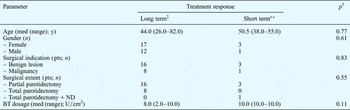
Statistical analysis identified no significant correlation between treatment course and patient age, gender or the extent of primary salivary gland surgery. There was no significant correlation between botulinum toxin dosage (injected into the affected skin area) and time between treatments (Table IV). Because of a limited number of patients with a type A response, it was statistically possible to compare only long-term responders (i.e. patients with a type A or type B response) with short-term responders (i.e. patients with a type C response).
Analysis of potential influences on treatment response*

* For total cohort (33 patients). †Mann–Whitney U-test for unpaired data. ‡Response types A and B; **response type C. Med = median; y = years; pts = patients; ND = neck dissection; BT = botulinum toxin type A
Discussion
Frey's syndrome occurs most frequently after parotid gland surgery, and is rare after submandibulectomy. Since the first reports of treatment of Frey's syndrome with subcutaneous botulinum toxin injection,Reference Drobik and Laskawi2, Reference Drobik and Laskawi3 data on the prolonged response to such treatment have accumulated. When used to treat nerve and/or muscular dysfunction, the effective duration of botulinum toxin is approximately 10 to 14 weeks, after which axonal resprouting overcomes the medically induced paralysis or weakness. Early reports, with relatively short follow-up periods, expressed the hope that Frey's syndrome could be cured with botulinum toxin.Reference Laccourreye, Muscatelo, Naude, Bonan and Brasnu11, Reference Blitzer and Sulica12 More recent publications have reported prolonged treatment responses of six to 18 months.Reference Laskawi, Drobik and Schonebeck13, Reference Hartl, Julieron, LeRidant, Janot, Marandas and Travagli14 Within our patient cohort, we observed several different treatment response types (see Table I), which caused us to question whether it was possible to identify specific patient criteria which might influence treatment response.
There is consensus in the literature that age and gender do not appear to influence the effective duration of botulinum toxin;Reference Laccourreye, Akl, Gutierrez-Fonseca, Garcia, Brasnu and Bonan7 this is consistent with our findings.
Our study explored the association between treatment effect and the extent of salivary gland surgery, as extensive surgery may result in more damage to the parasympathetic fibres during extended tissue mobilisation around the facial nerve. However, we found no correlation between botulinum toxin effect duration and the extent of primary surgery; this is in agreement with other reports.Reference Hartl, Julieron, LeRidant, Janot, Marandas and Travagli14
We also studied the type of primary excised lesion, as malignant tumours usually require more aggressive surgery, with more destructive effects on the surrounding tissue. Furthermore, surgical trauma would presumably affect the chemokines in the neighbouring tissue, which could interfere with post-operative nerve regeneration. However, again, we found no correlation between lesion type and treatment response, either in our own cohort or in cases identified from the literature review.Reference Hartl, Julieron, LeRidant, Janot, Marandas and Travagli14, Reference Laskawi, Ellies, Rödel and Schoenebeck15 Furthermore, Hartl et al. Reference Hartl, Julieron, LeRidant, Janot, Marandas and Travagli14 found that the status of a previous malignancy was not associated with any quality of life improvement after treatment for gustatory sweating.
Several authors have found that the botulinum toxin treatment response is not influenced by the total amount of botulinum toxin or the total size of the skin area affected.Reference Laccourreye, Akl, Gutierrez-Fonseca, Garcia, Brasnu and Bonan7, Reference Laskawi, Ellies, Rödel and Schoenebeck15 However, other reports have found that the botulinum toxin dosage does have an effect on treatment response.Reference Nolte, Gollmitzer, Loeffelbein, Hölzle and Wolff16, Reference Guntinas-Lichius17 Guntinas-LichiusReference Guntinas-Lichius17 prospectively compared two groups of patients: one given 10 U/cm2 botulinum toxin A (Dysport) and the other given 20 U/cm2. The mean effect duration was prolonged in the higher dosage group (at 16.5 months) compared with the lower dosage group (8.3 months); the former response would be categorised as type B according to our classification system. Cantarella et al. Reference Cantarella, Berlusconi, Mele, Cogiamanian and Barbieri18 studied a case series treated with botulinum toxin serotype B, and found that all patients had type B treatment responses (using our classification system) after 12 months' follow up; however, because of the different botulinum toxin serotype used, these patients were not included in our analysis.
Upon careful consideration of the differing follow-up times reported in the literature, we believe that some of the reported patients showing a type A treatment response may in fact have shown type B responses given longer term follow up.Reference de Bree, Duyndam, Kuik and Leemans19 In addition, the effects of retreatment vary between patients. Several authors have reported patients in whom repeated botulinum toxin injections resulted in a progressive reduction of the facial area affected, and a progressive increase in the duration of treatment effect, over successive treatments.Reference Laccourreye, Akl, Gutierrez-Fonseca, Garcia, Brasnu and Bonan7, Reference de Bree, Duyndam, Kuik and Leemans19, Reference Martos Díaz, Bances del Castillo, Mancha de la Plata, Naval Gías, Martínez Nieto and Lee20 However, others have described patients in whom repeated injections had no such effect on the size of the affected facial area or the duration of treatment effect.Reference Laskawi, Drobik and Schonebeck13, Reference Guntinas-Lichius17
Of special interest are those Frey's syndrome patients who, following botulinum toxin treatment, demonstrate relapse of gustatory sweating within the pharmacologically effective period (i.e. type C response with early relapse); such cases are unusual but not rare.Reference Wang and Wang6, Reference de Bree, Duyndam, Kuik and Leemans19 Our analysis revealed no special characteristics in these patients (e.g. regarding previous salivary gland surgery or botulinum toxin treatment) (Table IV). These findings are valuable for the pre-treatment management of Frey's syndrome patients. The possibility of a shorter than expected botulinum toxin treatment effect should be discussed during the consent process, and the unpredictability of treatment duration formally acknowledged, especially in countries where the labelling of botulinum toxin A does not include Frey's syndrome as an approved indication for usage. Additionally, there has been a report of three patients with Frey's syndrome (verified with Minor's test) who were resistant to botulinum toxin treatment, even with repeated injections.Reference Luna Ortiz, Rascon Ortiz, Sanson Riofrio, Villavicencio Valencia and Mosqueda Taylor21 Again, these patients showed no special characteristics regarding gender or previous surgery.
The development of gustatory sweating is poorly understood. It remains to be elucidated why some patients do not describe symptoms until 11 years after salivary gland surgery,Reference Wang and Wang6 why post-operative gustatory sweating has been observed in patients receiving pre-operative radiotherapy for parotid cancer,Reference Hartl, Julieron, LeRidant, Janot, Marandas and Travagli14 and why some patients show a relationship between gustatory sweating and neuralgic pain. Martos Diaz et al. Reference Martos Díaz, Bances del Castillo, Mancha de la Plata, Naval Gías, Martínez Nieto and Lee20 reported a patient with Frey's syndrome who was able to stop his medication for concomitant trigeminal neuralgia after receiving botulinum toxin treatment. In a large cohort, Laskawi et al. Reference Laskawi, Ellies, Rödel and Schoenebeck15 observed progressive extension of the affected facial skin area to include previously untouched retroauricular and hirsute areas of the head. These latter findings are consistent with one case in our cohort, a woman who demonstrated new, submental sweating in an area approximately 5 cm away from the treated facial region, after four courses of botulinum toxin injections, following resection of a parotid carcinoma.
One explanation for the development of such ‘ectopic’ sweating areas could be parasympathetic nerve fibre regeneration, using lower occipital nerves or greater auricular nerve branches as guiding structures.Reference Laskawi, Ellies, Rödel and Schoenebeck15
• Frey's syndrome is more common after salivary gland surgery than previously recognised
• Intradermal botulinum toxin injection is most effective during the pharmacological action period
• However, treatment response varies widely, regardless of gender, age, and surgical extent and indication
• Accurate pre-treatment counselling may prevent patient misunderstanding and dissatisfaction
Several hypotheses have been suggested to explain the longer-lasting effect of botulinum toxin on gustatory sweating, compared with its effect on other symptoms. One theory has proposed a mechanism of progressive atrophy of sweat glands, or of the muscular fibres surrounding sweat glands.Reference Laccourreye, Muscatelo, Naude, Bonan and Brasnu11 However, if this were the case, one would expect a more homogeneous effect after the first injection, rather than the considerable observed differences in post-operative symptom onset and botulinum toxin response time, and the occasional extension of affected areas after repeated treatments.Reference Laccourreye, Muscatelo, Naude, Bonan and Brasnu11, Reference Laskawi, Drobik and Schonebeck13
In our opinion, a more satisfactory explanation is poor autonomic nerve regeneration in an unevenly scarred area.Reference Laskawi, Drobik and Schonebeck13 Even so, we were surprised that we found no relationship between botulinum toxin response duration and age, gender or malignancy extent.
The limitations of our study include the differences in the studies identified from our literature review, as regards patient cohorts, diagnostic tests, treatment protocols and follow-up regimens. A potential bias may have arisen from the aforementioned short follow-up times used in earlier reports. Therefore, we critically selected individual patients from the identified case series publications, which decreased the total number of analysed patients but enabled a more homogeneous database. Statistical evaluation of our three response category groups was not possible because of the small cohort size. However, we believe our approach was valid overall because it enabled better comparison of the different injection protocols used in various patient cohorts. It would have been interesting to analyse the size of the affected skin area following repeated botulinum toxin injections, and the time interval between retreatments; however, data on these parameters were not available.
Conclusion
Our results demonstrate that Frey's syndrome should be considered a dynamic process in which the stimulus for aberrant reinnervation of parasympathetic nerve fibres can be decreased, in some patients, using higher doses of botulinum toxin per unit area. However, patient responses are individual and unpredictable, and relapses occur at differing time points and skin areas.
Our findings may help clinicians to offer better pre-treatment advice to patients, including the possible need for multiple treatments, thus preventing misunderstanding and dissatisfaction. Furthermore, our suggested treatment response classification system may enable more effective categorisation of therapeutic results.