Bankruptcy is generally regarded as a countercyclical phenomenon, and a rapid increase in bankruptcy is viewed as one of the defining features of the Great Depression. According to historian Morton Keller, “The Depression greatly increased both personal and corporate bankruptcy and kindled demands for reform of the system.”Footnote 1 Yet when personal, or wage earner bankruptcy as it was then called, is separated from business bankruptcy, the relationship between bankruptcy and income growth during the Depression is less clear.Footnote 2 Nationally, the number of wage earner bankruptcies per 100,000 people did not increase sharply after the crisis began in late 1929. As incomes fell and unemployment rose during the depths of the Depression, wage earner bankruptcy even dipped briefly. During 1934 and 1935 wage earner bankruptcy rebounded, then it fell again, with a lag, subsequent to the second steep decline in income in 1937.Footnote 3
The relationship between the national wage earner bankruptcy rate and income fluctuations was driven by the variations in the state-specific laws governing creditor-debtor relations. Differences in laws regarding garnishment dominated. States with pro-debtor garnishment laws had lower rates of wage earner bankruptcy before the Depression and experienced little increase in bankruptcy during the Depression. In contrast, states with pro-creditor garnishment laws had higher rates of bankruptcy before the Depression and experienced bigger increases in bankruptcy rates during the Depression. Our estimates show that if all states had enacted pro-creditor garnishment laws, the wage earner bankruptcy rate in the average state in 1930 might have been 30 percent higher, or 34 per 100,000 persons instead of 26 per 100,000.
Garnishment laws enabled a creditor to claim part of a defaulting debtor's wages by court order. A few states prohibited the garnishment of wages; in some states, only a small fraction of wages could be garnished; in other states, garnishment laws made it easy for a creditor to claim a large fraction of a debtor's wages. Workers also feared garnishment because they could be fired as a result of a judgment.Footnote 4 If creditors found it hard to garnish in a state, wage earners had little to fear and therefore had little need of the federal bankruptcy law. In other words, a pro-debtor legal environment in those states cushioned the impact of crisis on workers with respect to wage earner bankruptcy.
Identifying the causal effect of garnishment law on the wage earner bankruptcy rate is complicated by the fact that garnishment laws rarely changed. Their effects, therefore, cannot be easily separated from other unmeasured state-specific effects in an otherwise desirable fixed-effects regression framework. We proceed as follows. After a discussion of available bankruptcy statistics, we provide background on the legal framework governing debtor-creditor relations, and we construct a compendium of state debtor-creditor laws. On the face of it, differences between the levels of wage earner bankruptcy rates in the states are strongly related to the individual elements of state debtor-creditor law. We show that states did not construct consistently pro-debtor or pro-creditor legal environments and that states did not alter laws in response to macroeconomic conditions. For these reasons, we feel confident that the regression results reported in the final section of the article capture a causal relationship between state garnishment law and the use of the federal bankruptcy law by wage earners in that state. We use a combination of estimation techniques to show that garnishment law had the largest influence on whether a state had a high wage earner bankruptcy rate or a low one, and that a strong countercyclical pattern exists only in states with pro-creditor garnishment law.
DEBTOR-CREDITOR LAW ACROSS THE STATES
The term “bankruptcy” is sometimes used synonymously with economic failure, but bankruptcy statistics in the United States refer only to the use of the federal bankruptcy law. The federal bankruptcy law in effect in the 1920s and early 1930s was essentially the law passed in 1898.Footnote 5 The 1898 Bankruptcy Act allowed a creditor to petition the court to begin bankruptcy proceedings against a business debtor; creditor-initiated petitions were called involuntary petitions. However, a creditor was barred from initiating involuntary bankruptcy against a wage earner or farmer, so this article is concerned with only debtor-initiated, or voluntary, cases.Footnote 6
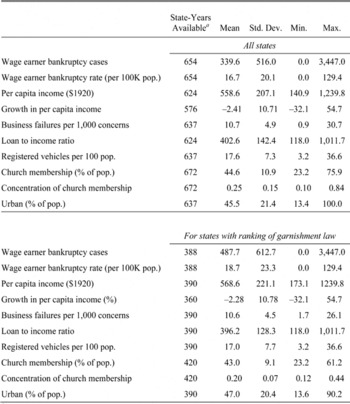
The number of wage earner bankruptcy cases closed in each federal district court during the fiscal years ending June 30 was reported by occupation in the Annual Report of the Attorney General of the United States.Footnote 7 We track wage earner bankruptcy rates by state beginning in 1920 and ending in 1932, when reporting of the occupational series was suspended. Wage earners were employees of establishments owned by others. The statistics reported here exclude those in professional occupations (doctor, lawyer), shop owners (merchants), and owners of manufacturing concerns, however small. There was wide variation in the use of the bankruptcy law by wage earners from state to state. The number of wage earner bankruptcy cases closed per state-year averaged almost 340, with a standard deviation of 516. Wage earner bankruptcy cases per 100,000 persons in the state averaged 16.7Footnote 8 with a standard deviation of 20.1.
When a debtor petitioned for bankruptcy, collection actions under traditional creditors' remedies were stopped; a meeting of creditors was called; the debtor's nonexempt assets were liquidated; and the proceeds were distributed on a pro rata basis among like creditors. The debtor could then apply for a discharge of any remaining debt. Usually only fraudulent or illegal behavior prevented a discharge. Thus, after 1898, a wage earner in default could choose between declaring bankruptcy under the federal law or allowing creditors to pursue the traditional collection remedies as allowed under state law.Footnote 8
The collection remedies available to the creditor depended first on whether the debt was secured. If the debt was secured, the creditor could claim that property if the debtor defaulted. If the debt was unsecured, the creditor first had to obtain a court judgment in his favor and then have the sheriff or another officer of the court execute the judgment. A judgment could be executed by seizing and selling some of the debtor's property. Garnishment allowed a creditor to go after assets that were in the possession of a third party. Garnishment was most often used to obtain wages that had not yet been paid to the debtor; it was less frequently applied to bank accounts or other assets. When a wage earner defaulted, garnishment was (and is still) the most important of the traditional creditors' remedies.Footnote 9 Importantly, states set exemptions that placed limits on both the amount of property and the amount of wages that could be taken to satisfy debts under any traditional creditor's remedy.
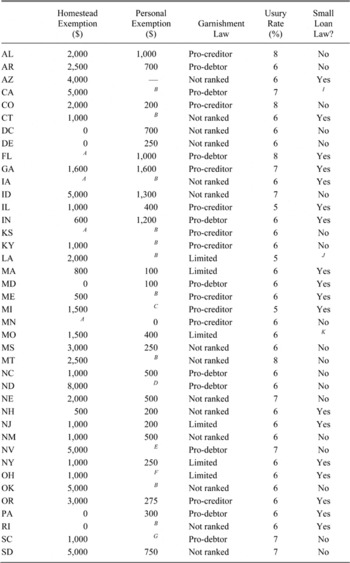
In 1839 Texas became the first state to define a property exemption. As shown in Table 1, states typically defined both a homestead exemption and a personal property exemption. Most states defined the homestead exemption in dollars, which averaged $2,070 with a maximum of $8,000 in the 1920s. A few states specified the homestead exemption in terms of a quantity of land. By the 1920s about two-thirds of states defined personal exemptions in dollars, with exemptions averaging $656 with a maximum of $2,000, but 13 states exempted only an itemized list of personal assets, such as family Bibles, items of clothing, and tools. State property exemptions were carried over into bankruptcy law. Debtors who petitioned for bankruptcy under the 1898 Act were entitled to the property exemptions defined by their state of residence.
SUMMARY OF DEBTOR-CREDITOR LAW ACROSS THE STATES, 1920–1932

A Homestead exemption defined in acres.
B Personal exemption itemized.
C Decreased from 850 to 500 in 1932.
D Increased from 1,000 to 1,500 in 1932.
E Increased from 2,200 to 3,200 in 1932.
F Increased from 250 to 1,000 in 1932.
G Decreased from 800 to 500 in 1932.
HEstablished dollar amount equal to 400 in 1932.
I Passed in 1931.
J Passed in 1932.
K Passed in 1927.
Sources:
See the text.

Petitioning for bankruptcy halted other collection actions, including garnishment. State garnishment law was important to bankruptcy precisely because a wage earner in default could choose between allowing garnishment or filing for bankruptcy. If he filed for bankruptcy, he kept his future income but lost any assets in excess of the state-defined property exemptions. If he allowed garnishment, he kept his assets but lost a fraction of his future income, determined by the wage exemption defined in the state's garnishment law. For the wage earner, then, the choice of whether to declare bankruptcy or leave his creditors to use state garnishment law depended on how much of his wages were subject to garnishment and how likely it was that his creditor would actually collect using the state's garnishment procedures.
During the 1920s and 1930s state garnishment laws varied widely in terms of both wage exemptions and procedures. The starting point for the description of garnishment laws in Table 1 is a study commenced in 1934 on behalf of the Bureau of Labor Statistics and the Department of Remedial Loans of the Russell Sage Foundation.Footnote 10 The study identified state law as pro-creditor, limited, or pro-debtor. Pro-creditor laws were ones that did not appear to leave enough for the support of the average wage earner's family; limited laws left an adequate amount for support of a family; pro-debtor laws were ones in which wages were generally not subject to garnishment. Other things equal, a more pro-creditor garnishment law gave the wage earner more incentive to choose bankruptcy to protect against loss of wages. The original study covered 23 states, and we classify an additional seven states using other sources.Footnote 11
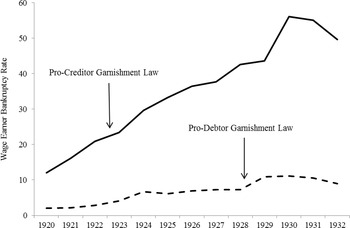
Contemporary observers were mindful of the direct effect of pro-creditor garnishment law on the decision of the wage earner to petition for bankruptcy once in default. In 1905 the Annual Report of the Attorney General laid the blame for Alabama's high wage earner bankruptcy rate on its garnishment laws. “[Due to] a state statute affecting the right to attach or garnish wages or salary of the laboring class, hundreds of poor unfortunates with liabilities in many instances less than $500, have been driven to seek relief under the federal law as a matter of preservation.”Footnote 12 It was not only Alabama. Figure 1 shows states with pro-creditor garnishment had wage earner bankruptcy rates nine times larger than states with pro-debtor garnishment law. Moreover, in the average state with a pro-creditor garnishment law, there was a notable spike in wage earner bankruptcy rates coinciding with the onset of the Depression in fiscal year 1930.
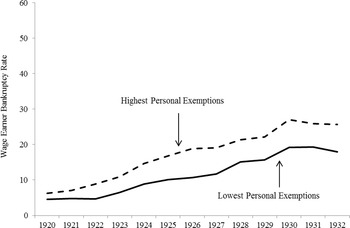
Differences in property exemptions were also important. Figure 2 shows that states with the most generous personal property exemptions (highest quartile) had wage earner bankruptcy rates that were double the rates in states with the least generous (lowest quartile) personal exemptions. Differences in the homestead exemption between states had no visible impact on wage earner bankruptcy.
Property exemptions had less of an impact on bankruptcy rates than garnishment because most wage earners had few assets, real or personal, to protect. For instance, a 1930/31 study of 263 bankrupt wage earners in Boston found that 183 held no real estate at all, and only two held non-mortgaged real estate.Footnote 13 In 1930 in the U.S. nationwide, 84 percent of wage earner bankruptcy cases closed were classified as no-asset cases; less than 3 percent of wage earner bankrupts had assets over $100.Footnote 14
PRO-CREDITOR GARNISHMENT INCREASED WAGE EARNER BANKRUPTCY RATES

The bankrupt wage earners also had relatively small liabilities. A 1932 analysis of wage earner cases closed in 1930 in the ten districts with the highest numbers of bankruptcy cases revealed that liabilities were less than $2,000 in 74 percent of cases and less than $1,000 in half of the cases. The liabilities enumerated when wage earners declared bankruptcy were unsecured debt including rent, store credit, doctors' bills, and cash loans.
The market for cash loans was regulated by states in two ways. During the 1920s and 1930s states had usury laws that set maximum lending rates that ranged from 5 to 8 percent (see Table 1).Footnote 15 The extent to which the interest rate ceilings were actually binding is not known, but binding ceilings likely inhibited the ability of lenders to offer loans to high-risk borrowers by increasing interest rates. The belief that usury laws drove some borrowers to loan sharks prompted the Russell Sage Foundation to draft and promote a Uniform Small Loan Law beginning in 1913. The small loan law offered an exception to the usury law. Lenders who complied with the regulations set forth in the law were allowed to charge higher interest rates for loans under $600. About half of all states passed a version of the Uniform Small Loan Law by 1933, including four states that passed one between 1920 and 1932 (see Table 1).Footnote 16 There is some evidence that wage earners obtained cash loans under these laws to effectively refinance the purchase of assets obtained through installment contracts.Footnote 17
GENEROUS PERSONAL EXEMPTIONS INCREASED WAGE EARNER BANKRUPTCY RATES

Examination of Table 1 shows that states did not have consistently pro-debtor or pro-creditor legal environments. Only Colorado took a strictly pro-creditor stance on all dimensions: no small loan law, the highest usury limit, low personal exemptions, and pro-creditor garnishment law. Louisiana was the only state with a pro-debtor stance on every dimension: a small loan law, a usury limit of 5 percent, personal exemptions over $2,000, and limited garnishment law.
ESTIMATING THE EFFECT OF GARNISHMENT LAW ON THE LEVEL OF BANKRUPTCY
In all studies of the influence of laws on economic outcomes, a common concern is the possible endogeneity of the law. We considered the possibility that states changed their laws governing creditor-debtor relations in response to economic conditions; however, states rarely changed exemptions. For example, only seven states changed homestead exemptions in the first half of the twentieth century. Only two states changed homestead exemptions between 1920 and 1933.Footnote 18 In fact, the only predictor of the property exemptions in a state in the 1990s were the exemptions the state had allowed in 1920.Footnote 19
The very fact that the laws seldom changed creates a second common econometric problem. The problem is that, while we must be concerned about omitted variable bias in the estimation of the determinants of the wage earner bankruptcy rate, state-fixed effects used to control for other time-invariant features are nearly collinear with the time-invariant laws.
Estimation Strategy
In a review of the literature on bankruptcy after World War II, Michelle White notes that, because state-fixed effects absorb the effect of the time-invariant legal variables, studies employing fixed effects generally find that time-invariant laws do not have a statistically significant effect on the bankruptcy rate.Footnote 20 To get around the problem, some recent studies of modern bankruptcy have used county or zip code level data. Analysis of 1999–2001 data at the zip code level, for instance, indicates that garnishment law still matters, even though federal laws and Supreme Court decisions have greatly reduced state-to-state variations.Footnote 21 Of course, zip code level data do not exist for the 1920s and 1930s.
Until recently, researchers estimating the effect of time-invariant variables using panel data have used random effects models. When we use the instrumental variables technique for random effects suggested by Jerry Hausman and William Taylor, the results are highly sensitive to our choice of which variables are assumed to be endogenous.Footnote 22 Moreover, random effects shares the poor small sample properties of all generalized least squares techniques. The small number of states and other data restrictions discussed below sometimes leave us with small samples.
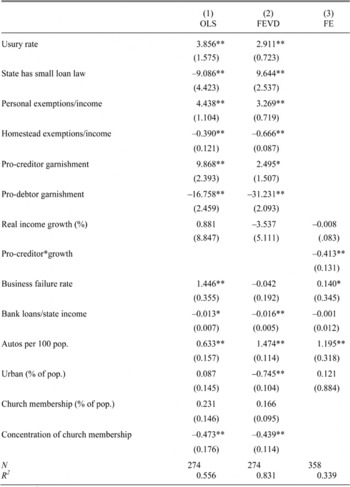
No single estimation technique provides convincing estimates of the size of the effect of the property exemptions and garnishment laws on the wage earner bankruptcy rate. Our strategy is to compare the OLS results from the pooled panel cross-section time series (which are subject to omitted variable bias) to the results from a recently developed procedure called fixed-effect vector decomposition (FEVD).Footnote 23 The results, reported in columns 1 and 2 of Table 3, consistently show that a state's choice of garnishment law is the single best predictor of the wage earner bankruptcy rate. The OLS model is
![\[
\begin{array}{c}
\[{r_{st}} = \alpha + {L_s}\gamma + {X_{st}}{\beta _{}} + {\delta _t} + {\varepsilon _{st}}\]
\end{array}
\](https://static.cambridge.org/binary/version/id/urn:cambridge.org:id:binary:20151127043450921-0716:S0022050712000095_eqn1.gif?pub-status=live)
where rst is the wage earner bankruptcy rate in each state s and year t. The vector Ls includes state-specific but time-invariant laws, including the property exemptions and the severity of garnishment law described in the previous section and summarized in Table 1. The vector Xst includes macroeconomic indicators and other controls. Descriptive statistics of the variables included are given in Table 2; the bottom panel of Table 2 gives descriptive statistics for the states that have a characterization of garnishment law in Table 1.
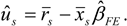
Fixed-effect vector decomposition is a three-stage estimation procedure. The first stage estimates the usual fixed-effects model:  where us is the state-fixed effect and the other variables are defined as in the OLS model. The within-estimator identifies the state effect as the part of the mean of the state bankruptcy rate that cannot be explained by the time-varying variables:
DESCRIPTIVE STATISTICS

a The District of Columbia is treated as a state.
Sources:
See the text.
The second stage of the procedure estimates by OLS the effect of the time-invariant elements of L on the fixed effects  where φ is a constant term and υs is an error term. This stage decomposes the state-fixed effect into the part that can be explained by the legal environment and the part that cannot. In the third stage, after adjusting the degrees of freedom, the results from the second-stage estimation are included in a pooled OLS re-estimation of the full model, so that
 The inclusion of υs in the final stage accounts for the part of the original state effect that is due to still-omitted variables. The coefficient on υs is expected to equal one after correction for heteroscedasticty or serial correlation.
The merits of FEVD have been debated, but it is clear that for consistency of the estimator the key assumption of FEVD is the exogeneity of the time-invariant independent variable.Footnote 24 Given that the laws were typically adopted before our time period begins and that the control variables incorporate many factors that describe changes in the economic situation, it is plausible that the laws can be treated as exogenous during the time period of the analysis.
RESULTS AND INTERPRETATION
Recall that, after a wage earner is in default, the influence of state laws is unambiguous. A pro-creditor state garnishment law or larger state-defined property exemptions make bankruptcy more attractive. However, the overall effect of these laws on the bankruptcy rate in the population is not so straightforward. To understand why, decompose the bankruptcy rate (r) into its component parts: r = i × d × b. The fraction of the population that petitions for bankruptcy (r) is the product of the fraction of the population that is indebted (i), the fraction of the indebted population that defaults (d), and the fraction of the defaulting population that chooses bankruptcy (b).
Effect of the State Laws
Higher usury limits are expected to increase the supply of credit available to wage earners, increasing the indebtedness rate (i). Among those wage earners who obtained credit, higher usury rates might have increased the debt burden and increased the probability of default (d). Both effects lead us to expect a positive coefficient on the usury limit. In OLS and FEVD results in Table 3, an increase in the usury rate of 1 percentage point was associated with an increase in the wage earner bankruptcy rate of about 3 per 100,000.
The small loan law is also expected to increase the supply of credit and the indebtedness rate (i), but it is expected to reduce the rate of default (d) by reducing high-interest illegal loans. In the OLS specification, this last effect seems to dominate; in state-years in which a small loan law was present the state had about nine fewer wage earner bankruptcies per 100,000 people. This result is strongly influenced by the passage of a small loan law during the period in four states that had below average wage earner bankruptcy rates. In the FEVD specification, the sign is driven by the within-state effect and is positive, which indicates that the passage of the small loan law failed to stem the tide of increasing bankruptcy in the 1920s.
PRO-CREDITOR GARNISHMENT EXPLAINS VARIATIONS IN WAGE EARNER BANKRUPTCY, 1920–1932

* = Significant at the 10 percent level.
** = Significant at the 5 percent level.
Notes:
The figures in parentheses are t-statistics. Constant terms estimated but not reported.
Sources:
See the text.
More generous property exemptions, measured here as the ratio of the property value exempted to state income in 1920 dollars, are expected to directly increase the bankruptcy rate (r) by increasing the fraction of the defaulting population that chooses bankruptcy (b). But creditors know this and can be expected to react to the lower probability of collection by decreasing the supply of credit, which is expected to decrease the bankruptcy rate (r) by decreasing the fraction indebted (i). The OLS and FEVD results in columns 1 and 2 of Table 3 show that the direct effect of higher personal property exemptions on declarations of bankruptcy dominated. The OLS estimates indicate that, if the personal property exemption was equal to the state per capita income (as it was in the median state) but then doubled, wage earner bankruptcies might increase by 4.4 per 100,000 people. As Figure 2 illustrates, this is a relatively small effect.
Higher homestead exemptions relative to per capita income are associated with lower wage earner bankruptcy rates. The size of effect is small compared to the effect of the personal exemptions. As discussed above, wage earners were unlikely to have real estate, so the homestead exemption is a less important determinant of the wage earner bankruptcy rate than we might expect it to be for the overall bankruptcy rate or for the bankruptcy rate among farmers.
Garnishment law can have as many as three effects on the bankruptcy rate. Pro-creditor garnishment law increases the exposure of the debtor to collection and therefore increases the attractiveness of bankruptcy among those in default (increasing r by increasing b). Here again, creditors are likely to respond by reducing the supply of credit in expectation of a lower probability of collection, which decreases r by decreasing i. Lastly, if wage earners observe others being garnished, pro-creditor garnishment law may decrease the demand for credit decreasing the indebtedness rate (i) and the bankruptcy rate (r).
In both the OLS and FEVD specifications, states with pro-creditor garnishment law have higher bankruptcy rates than states with pro-debtor laws. The gap of about 30 bankruptcies per 100,000 people is larger, in fact, than the bankruptcy rate in the average state. A switch in the law from pro-debtor garnishment to pro-creditor garnishment would have moved a state from the bottom quartile to the top quartile in terms of the wage earner bankruptcy rate. These results are consistent with Figure 1, which shows relatively steady and low rates of bankruptcy in the states with pro-debtor garnishment law and the high-and-rising rates in states with pro-creditor garnishment law.
Effect of Macroeconomic Conditions
There is no support for the claim that wage earner bankruptcy is countercyclical in the OLS and FEVD specifications. Growth in state per capita income is not related to the level of the wage earner bankruptcy rate in the typical state.Footnote 25 The sign of the coefficient is not stable across specifications and the standard errors are large.
Having excluded growth as the primary cause of differences in the bankruptcy rate between states, we turn now to a more direct investigation of the countercyclicality of wage earner bankruptcy. To measure the extent to which changing macroeconomic conditions within a state generated changes in that states' wage earner bankruptcy rate, we use a fixed-effects specification. To measure the extent to which the relationship between growth and bankruptcy is mediated by garnishment law, we interact “pro-creditor” garnishment and the growth of state per capita income. Results are reported in column 3 of Table 3. Growth and the wage earner bankruptcy rate are strongly and negatively related only in the states with pro-creditor garnishment law. In those states, higher growth reduced bankruptcy. When income fell in 1930, a pro-creditor state could expect to see an increase in the wage earner bankruptcy rate. But it would take a large decline in growth to close the gap between pro-creditor and pro-debtor states: growth would have to fall by 2.5 percentage points to induce an increase in the bankruptcy rate of just 1 per 100,000. The main effect of growth is also negative, but very close to zero. This is consistent with the divergence in trends seen in Figure 1: in pro-debtor states, the crisis is not visible in the wage earner bankruptcy rate, while in pro-creditor states, crisis brings wage earners to bankruptcy court to stop the garnishment of their falling and uncertain incomes and to preserve their jobs.Footnote 26
Additional Controls
Because state unemployment series are not available for this period, we include the business failure rate in the state as a measure of stability of income for wage earners in all three specifications shown in Table 3.Footnote 27 The business failure rate and the wage earner bankruptcy rate are positively related in the OLS and fixed-effects specifications.
We include two measures of the supply of credit: the ratio of total bank loans to aggregate state personal incomeFootnote 28 and the number of registered vehicles per 100 persons in the state.Footnote 29 Although commercial banks financed the sales finance companies and personal finance companies through which wage earners accessed credit markets, the effect of bank loans on the wage earner bankruptcy rate is negative and small. On the other hand, automobile debt added to the fixed obligations of the wage earner, and is associated with more wage earner bankruptcies.
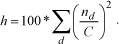
To capture differences in the social environment in the states, we include measures of urbanization and churchgoing in the regressions. The effect of a larger urban population is negative in the FEVD specification; however in the fixed-effects estimates increasing urbanization within a state has a positive effect with a large standard error. In the literature on bankruptcy in the late twentieth century, churchgoing is said to indicate a social environment that values promise-keeping (reducing b and r).Footnote 30 Church membership may also provide a source of insurance by connecting wage earners to a social network.Footnote 31 We control for the percentage of the population of each state that belonged to any religious congregation in 1926, and we measure the extent of the social network using a Herfindahl-type index of concentration of members within congregations.Footnote 32 Higher church membership is associated with higher wage earner bankruptcy rates, but the effect is small and not statistically significant. The negative coefficient on the index indicates that belonging to a larger church-based social network had a protective effect. States with larger concentrations of churchgoers in a small number of congregations have lower wage earner bankruptcy rates.
CONCLUSION
The crisis of 1929/30 did not send as many wage earners to bankruptcy court as the conventional view has presumed. It was primarily wage earners in states with pro-creditor garnishment laws who sought the protection of the federal bankruptcy court in order to avoid losing part of their income, some of their assets, or, in some cases, their employment. In most states, though, traditional creditors' remedies were relatively unthreatening and workers had little need to halt collection actions by filing a bankruptcy petition. In most states, bankruptcy was not countercyclical.
Study of the federal law governing wage earner (personal) bankruptcy cannot be fruitfully conducted outside of the context of competing or complementary state laws governing garnishment, exemptions, and interest rates. David Skeel reached similar conclusions regarding the importance of context in his work on the law of corporate reorganization.Footnote 33 Given that the propensity to use the bankruptcy law is tied to incentives embedded in other laws, future work on the effects of bankruptcy on the broader economy should take care to explicitly consider legal interactions.
 The index is
 For further discussion, see Hansen and Hansen, “Religion.”