1. INTRODUCTION
In an age of global history, it remains interesting to identify local motives for transnational engagement. World War I provides a case in point. The United States during the nineteenth century, despite the many ways in which the state related to developments outside its expanding borders, officially entertained the idea that its interests were “aloof” from European affairs. When war broke out in Europe in August 1914, few expected that the United States would come to take an active role in the conflict, even if the war would obviously touch many of its economic, social, and cultural interests. In this essay, I will consider the period of American neutrality from the perspective of an outspoken American elite—a milieu with a strong public voice, a mostly white urban upper-middle class at home in cultural institutions such as universities, newspapers, or publishing houses along the East Coast and in urban centers in the Midwest and on the West Coast. For this milieu, the war in Europe exuded a peculiar fascination.Footnote 1
I will take a look at a phenomenon whose underlying structure and significance has largely escaped historical investigation: the pre-1917 role of American volunteers in Europe during World War I. I will argue that the motivation for engagement abroad and the public representation of volunteers in the United States assumes particular relevance in the context of the country's ongoing political consolidation.Footnote 2 Elsewhere in this special issue, Jennifer D. Keene highlights the war's impact on demands by women and African Americans for inclusion in the American polity through recognition of their civil rights. Among Americans I focus on in this essay, men (but not women) volunteers had the right to vote in the United States.Footnote 3 Instead of looking at the war as a political phenomenon to be resolved between national states, however, I will suggest that nonpolitical motives led Americans to support the Allies. They initially chose to volunteer for personal reasons. It was only after they were engaged in the war for some time that the war began to be perceived from the perspective of a federal or national U.S. citizenship. The year 1917 became a crossroads as American entry into the war aligned individual initiative with public duty. Some volunteers assumed new roles legitimized by their country, but others abandoned a war they no longer considered relevant. Unlike American volunteer efforts that preceded American entry into World War II, therefore, the pre-1917 story reveals the novelty of U.S. global engagement and a national role even for a select group of Americans. Recent literature on Americans in the world throughout the World War I period seeks to highlight actors other than governmental ones.Footnote 4 I endorse this shift but in the context of a war that resulted from decisions made by governments, I retain the political focus as an analytical tool by taking seriously the potential of American volunteers’ U.S. citizenship.
2. MOTIVES FOR VOLUNTEERING
After war broke out in Europe in August 1914, President Woodrow Wilson warned Americans that they may become “divided in camps of hostile opinion, … involved in the war itself in impulse and opinion if not in action.”Footnote 5 No previous war had prompted such concerns for divisions within American society. Despite Wilson's warning, however, Americans soon took sides. Some even engaged in the war itself.Footnote 6 Among the countries in which Americans were active, Great Britain and France stood out because they attracted the largest number of American volunteers or because they received outsize public attention in the United States.
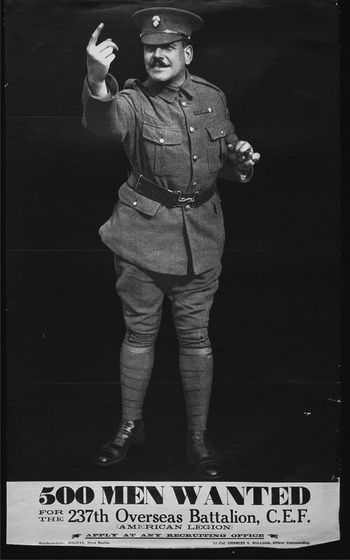
Most Americans who traveled to the European war zone tried to do so in British or Canadian ranks. During the period of American neutrality between August 1914 and May 1917, tens of thousands enlisted in the Canadian Expeditionary Forces (CEF). Before the U.S. government insisted on a name change in November 1916, all-American battalions in the CEF were known as the “American Legion.” They comprised Americans who lived in Canada or had crossed the border to volunteer for military service.Footnote 7 Some of them hoped to join flying units, but this required an oath of allegiance to the British crown, which introduced the prospect of losing U.S. citizenship.Footnote 8 In 1916, the New York Times observed that U.S. volunteers in Canada “all feel very keen about their citizenship and take it for granted that there will be some to question it.”Footnote 9 Americans sought to keep a low profile and their decision “almost invariably” involved “a separation from home ties and home interests.” This held true even when Americans joined British relief organizations without an oath of allegiance.Footnote 10 While most American volunteers served with the British and Canadian forces, however, they received little contemporary press coverage while their Francophile counterparts drew wide public attention. Because Francophile volunteers came to define key aspects of war volunteerism in the American public, I will focus on the peculiar motives for American engagement in France and on the organizational structures that grew out of them.
Recruiting poster for 237th battalion or “American Legion” in the Canadian Expeditionary Force (CEF). Library of Congress.

Nearly six thousand Americans volunteered for France during the neutrality period, most of them outside the military. Americans joined hospitals as nurses or doctors, they drove ambulance cars along the front or distributed relief in Paris and throughout France, and they entered the military as soldiers and pilots. Americans who fought in the French army hardly feared a loss of U.S. citizenship since France did not demand an oath of allegiance. All volunteers supporting France could rely on the public panache that came with their work and they could proudly advertise their efforts back home. The volunteers’ motives for the different types of engagement—from medical to military—were more alike than they were different. Their public statements serve as evidence for justification rather than motivation, but their motives may be inferred from a consideration of the choices they made to become volunteers, choices made in the context of contemporary options. Such an analysis will have to heed the particulars of individual cases of volunteers, arriving at a broader assessment by way of contrasting different types of volunteers. Given the space constraints in this essay, I would like to introduce as a case I consider representative of the larger group that of William Gorham Rice, Jr., a Harvard student who decided to become a volunteer ambulance driver in France in 1916.Footnote 11
In the spring of that year, Rice worked toward a Bachelor of Laws when he began floating the idea of taking the summer off to volunteer for war service abroad. His family had little sense for adventurism. Rice's father looked back on a career as paymaster of New York's National Guard. He had been secretary to State Governor Grover Cleveland in the 1880s. In 1916, he was a member of the New York State Civil Service Commission, which oversaw the state's employment practices. Rice's mother was involved in several relief organizations. Her son openly discussed the matter of going abroad with his parents, and even if this meant that they would see their only child voluntarily enter the danger zone abroad, they supported him. The family pondered several options, among them joining the Commission for Relief for Belgium (CRB). Founded by former mining engineer Herbert Hoover in London, the CRB, beginning in late 1914, successfully negotiated with the German occupying forces in Belgium and with the British government to allow food to be brought through the British blockade to the occupied zones in Belgium and Northern France. Volunteering for the CRB was in line with the family's pacifist leanings, certified by their friendship with Oswald Garrison Villard, editor of the New York Evening Post and an advocate of U.S. neutrality. Yet in a letter to his parents, Rice considered it “lucky the CRB does not want me” because this left his favored option, driving an ambulance car behind the front in France.Footnote 12
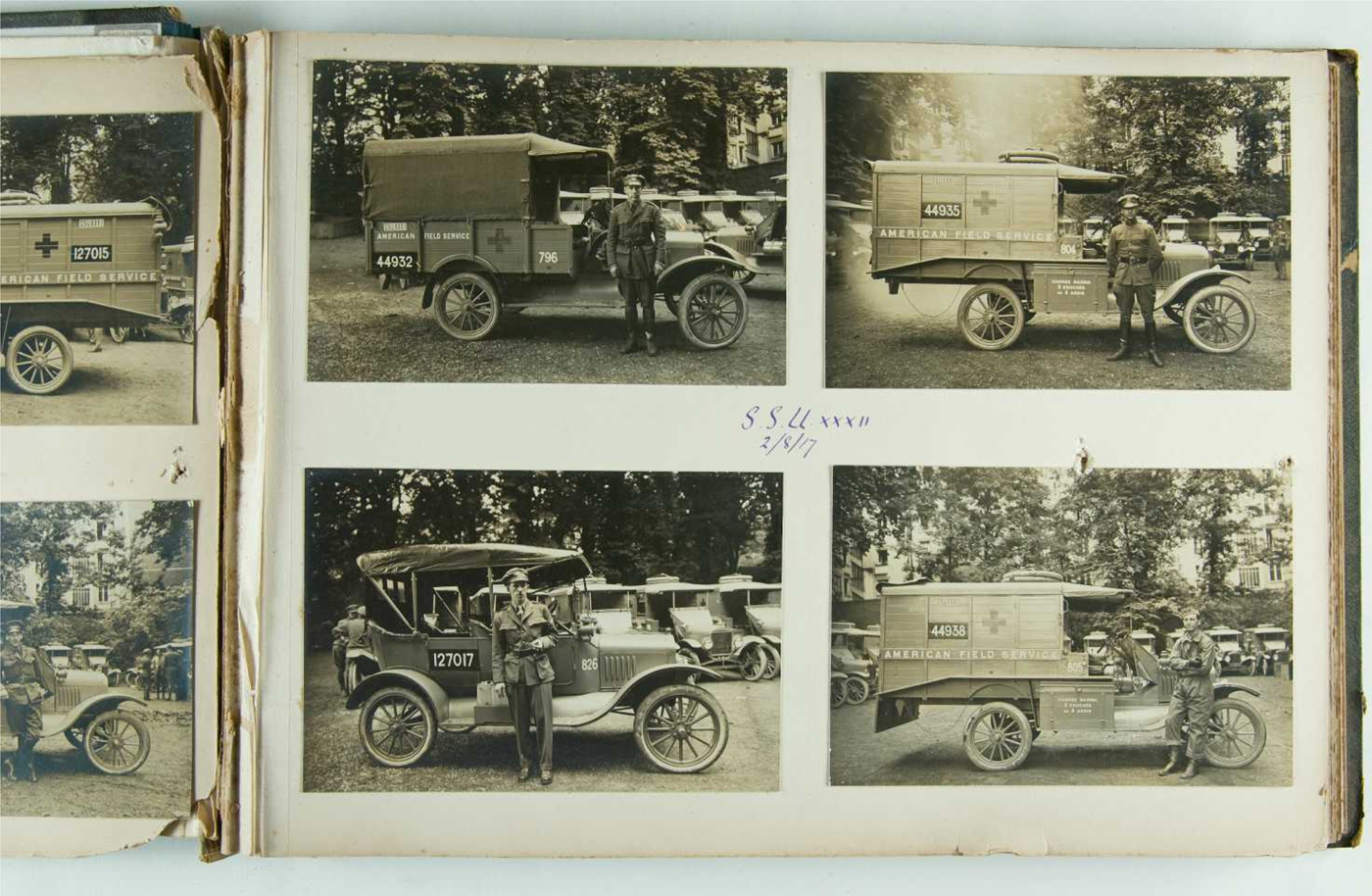
Rice had decided to join the American Ambulance Field Service (AAFS), an organization that staffed Model-T Ford cars with American drivers, assembled them as units with their own insignia, and put them under French command along the Western front. Ambulance service was more dangerous than distributing food in Belgium and occupied France. CRB volunteers required diplomatic skill in overseeing food distribution while German officers watched over them. While CRB volunteers occasionally lamented their unexciting work, the AAFS provided an opportunity for openly siding with France. The Geneva Convention bound ambulance drivers to aid soldiers of all nationalities, but obviously the Americans’ service under French command had the effect of releasing French men to serve in combat units.
The danger as an opportunity for a personal challenge and the allure of aiding “gallant” France provided a motivational tandem that set volunteer efforts in France apart from work on behalf of England and Canada (where doubts arose about volunteers’ loyalty to the United States) and in Belgium (where volunteers considered work to be dull). The humanitarian aspect of ambulance work made it palatable for parents who disliked the idea of outright military service. In a letter to his parents from Harvard in spring 1916, Rice emphasized that “I am glad I am going to see War + France + help serve Humanity + Justice.” To him the European War opened up the prospect of an uplifting personal experience. Rice hinted at a political justification, but he did not consider himself to be part of an interventionist avant-garde seeking to align the United States with France in a war against Germany. Instead, he wished to stand on the side of “Justice.” Rather than conceiving of his own country as an actor supporting such universal “Justice,” Rice considered France to be its contemporary protagonist.
On the day of her son's departure from New York in July 1916, Rice's mother wrote the first letter her son was to receive abroad. “Our thoughts will constantly be with you—you cannot realize how often!,” she wrote to him. “All I ask you is to remember this and remember our great love for you and that you are the only one of the young generation we have.” She felt pride in her only child taking the momentous step of going abroad: “Your courage, your desire to serve, your interest in the large scents of the world, fill us with joy and admiration. Above all, your splendid, noble, character, strong, clean spiritual, delights us.”Footnote 13 Rice's father soon added that he was well aware of the danger involved in the work. “It is a great experience to serve as you are doing,” he wrote. “God grant you safe return to us after your duty there is done.”Footnote 14 The political context of the war abroad thus remained absent from these letters. Letters such as the ones Rice exchanged with his parents show that to many volunteers in France, the war provided a valuable opportunity for a personal experience ennobled by serving a prestigious culture. For an upper-middle class milieu with roots in East Coast cities and universities, the safe distance of traditional American noninterference in European affairs opened up a cultural (and not a political) perspective on the war abroad. Today, such a perspective is surprising only if we forget that the United States never before had entered a war in European and that few expected the country to do so in 1915 and 1916. Meantime, a range of volunteer organizations in France (and support structures in the United States) translated initial motivations into stable patterns.
3. AMERICAN VOLUNTEER ORGANIZATIONS IN EUROPE
In August 1914, the American Ambulance Hospital in the prosperous Paris suburb of Neuilly-sur-Seine had turned into a hub for American engagement in France.Footnote 15 The hospital attracted American nurses, who offered to work without pay, and teams from prominent medical schools such as Harvard.Footnote 16 American business leaders in Paris, some of them facilitating U.S. loans and material for the French war effort, founded the American Relief Clearing House for France and her Allies (ARCH). During the period of U.S. neutrality and with the aid of the French government and private American support, this organization provided transportation of relief goods from New York to Paris at no charge to dispatching organizations. Since the early days of the war, the American Red Cross (ARC) had funneled funds raised in the United States to the various belligerent countries according to the donor's request. Germany and France had attracted the most funds.Footnote 17 When the ARC curtailed relief efforts in Europe in 1915, the Clearing House became its official representative. Unlike the ARC, however, it was designed to support France and her Allies only. During the neutrality period, ARCH became the logistical backbone for more than 200 American relief organizations active in France who came to rely on ARCH's free transatlantic transportation services.Footnote 18 ARCH was a quiet but essential facilitator for organizations such as the American Fund for French Wounded (AFFW) whose American women volunteer drivers delivered clothing and other goods from more than 150 American committees to hospitals around France.Footnote 19
Unit S.S.U. 32 at the Paris headquarters of the AAFS before heading out to serve along the front with the French army in February 1917. AFS Foundation, Thalwil, Switzerland.

While the network of AFFW committees spanned the American continent, nothing came to symbolize transatlantic volunteerism to the American public as boldly as driving an ambulance car along the front in France. Organizations such as the American Volunteer Motor-Ambulance Corps (AVMAC) and the AAFS attracted Americans of college age (such as William Gorham Rice) who were eager for a challenging experience.Footnote 20 “There is not an American worth calling such,” Theodore Roosevelt explained in 1916 after viewing a film showing American ambulance drivers in France, “who is not under a heavy debt of obligation to these boys for what they have done. We are under an even greater debt to them than the French and Belgians are.” He pointed out that “the most important thing a nation can possibly save is its soul, and these young men have been helping this nation to save its soul.”Footnote 21
The AAFS initially worked with the American Ambulance Hospital to develop a transport service that met hospital trains arriving nightly in Paris. But individual ambulance car units soon broke away to serve with the French army closer to the trenches. In April 1915, A. Piatt Andrew, a former director of the U.S. Mint who had traveled to France in December 1914 to join the American Ambulance Hospital as a volunteer, convinced the French military to allow some of the Hospital's ambulance units to serve closer to the front. Rather than transporting the wounded in Paris, the ambulance drivers in the new units drove to and from dressing stations near the battlefields over shell-torn roads, sometimes in the line of fire. While there were other American volunteer ambulance groups in Europe at the time, the American Ambulance Field Service (later to be known as the “American Field Service”) became the largest with more than 2,200 volunteers in 1917. “There is not much in that kind of life but plain, hard, uncomfortable work,” noted Richard Norton, the instigator of an AAFS rival organization. But despite (or because) of the unwelcoming nature of work along the front, drivers coveted frontline assignments. In the AAFS, drivers who misbehaved were relegated to safer routes in Paris as a punishment.Footnote 22 Other American volunteer organizations shared the appreciation of danger and excitement. Isabel Lathrop, who led the AFFW, considered it unfair that newcomers from the United States immediately were sent for dangerous service near the front when “girls who work faithfully perhaps six months in this stupid work” might still be toiling in the organization's packing room in Paris.Footnote 23
From the inception of American ambulance work, the French army wished elite universities to provide the manpower.Footnote 24 Between 1915 and 1917, drivers such as William Gorham Rice, Jr. were recruited at universities such as Harvard, Princeton, Yale, the University of Chicago, and the University of California, Berkeley. In a letter to the parents of a student who considered joining an ambulance service in France, Harvard president A. Lawrence Lowell noted that they “get an experience, an insight into a great historic struggle, that can hardly fail to be of great value throughout their lives.” Lowell's comment reflected the privileged background of most volunteers who could afford to serve in France. Drivers for AVMAC, preferably of the “gentleman-clubman type,” had to pay their way to New York City and on to Paris, and cover costs for uniforms, blankets, helmets, and galoshes. The AAFS, too, usually required candidates to pay for travel and equipment. This was essential, one AAFS official argued, “if the volunteer spirit were to be kept alive.”Footnote 25
Having spent time near the front as ambulance drivers or on the front as soldiers, some American volunteers became restless and joined an even more exciting and dangerous service as pilots, either in the British army and navy or in the French army.Footnote 26 More than 180 Americans became pilots in the French army, some of them in an all-American unit initially known as “Lafayette Escadrille.” Some flyers were veterans of the French Foreign Legion, among them Eugène Bullard, an African American expatriate who took up arms for France as his adopted homeland and its relative racial egalitarianism.Footnote 27 During the period of American neutrality, hundreds of Americans flew as pilots in British and French flying squadrons. More than 300 flew for the Royal Flying Corps and the Royal Naval Air Service during the entire war, paying for flight training out of their own pockets. In 1915, the French government endorsed the idea for an all-American squadron as this daring engagement promised to promote the French cause in the United States. Two hundred sixty-five Americans served in French squadrons during the war, including thirty-eight in the “Lafayette Escadrille.” While World War I introduced mass warfare with little room for personal initiative, the public celebrated fighter pilots as a new “cavalry of the clouds.”
The motivational incentives of danger and of cultural glory contrast with the appeal that work in Belgium had for Americans such as William Gorham Rice, Jr. While ambulance drivers as well as soldiers proudly supported France and her Allies, American volunteers who helped distribute relief to civilians in occupied Belgium and Northern France had to preserve a stance of neutrality as they maneuvered between the Allies and the Central Powers. Taking advantage of U.S. neutrality to operate its own fleet of ships and cross the blockades of belligerent powers, the CRB acted as a “piratical state organized for benevolence.”Footnote 28 The CRB financed its massive operations through loans provided by the Allies supplemented by donations from countries around the world, including the United States. One hundred thirty-nine volunteers were on the ground in the areas occupied by Germany in Belgium and Northern France to distribute relief while German officers watched their every step to prevent them from mingling with civilians.Footnote 29 By the war's end, the CRB had distributed 5.7 million tons of food to 9.5 million civilians in occupied Belgium and Northern France.Footnote 30 In the United States before 1917, however, this immense achievement lacked the appeal of a personal challenge and the public luster of closing ranks with France while America remained neutral.
4. PRO-ALLIED VOLUNTEERS AS CULTURAL TEMPLATES FOR AMERICA
The range of options for volunteer engagement in the war zone was tied to distinct but overlapping milieus in the United States. The Commission for Relief in Belgium's mission rhymed with pacifist leanings and impartiality, even if supporting the CRB remained compatible with favoring the Allies. William Gorham Rice, Jr.’s parents were progressives who appreciated relief for Belgium but eventually demurred to their son's interest in more challenging work in France. And as noted above, an overall assessment of the historical significance of American volunteers during the neutrality period will have to take note of the outsized public role played by the relative small number of Francophile volunteers.
Despite President Wilson's 1914 demand that the “United States must be neutral in fact, as well as in name,” American volunteers aiding the Allies were in touch with a network of organizations who advertised their efforts back home.Footnote 31 Had the overall intention to volunteer for the Allies been political, an obvious next step would have been to demand that the United States enter the war. But volunteers and their supporters rarely, if ever, made such demands in public.Footnote 32 Some came close. Robert Bacon, president of the American Hospital in Paris and a former U.S. secretary of state in late 1914 pointed to the German violation of Belgian neutrality and argued that there “are many men who consider that this nation is shirking its duty by maintaining a policy which may be interpreted as giving tacit assent to acts involving us morally and much more intimately than has yet been expressed.”Footnote 33 Myron T. Herrick, American ambassador to France in 1914 and an instigator of early Francophile relief efforts in Paris, upon his return to the United States in December 1914 suggested that “to be neutral means that we may profit from blood and tears of nations in agony, and that there is no obligation on us to do more than give a little from our surplus.” He proposed “active neutrality … which will cause Europe to think of us when this war is over, not as the commercial-minded sellers of munitions and supplies alone, but as the large-hearted, freehanded people who have cared for the wounded and dying.”Footnote 34 To call for intervention, of course, would have raised difficult questions, such as what war aims the country would pursue, how it would go about fighting the war, and how it would deal with internal conflict. William Jennings Bryan, who left President Woodrow Wilson's cabinet because he felt that the Unites States took too harsh a position vis-à-vis Germany, represented a large portion of American public opinion that viewed the conflict as a remote matter on distant shores in which the United States should not get involved.Footnote 35 To campaign against this perspective would have been a challenge indeed.Footnote 36 But the peculiar motivation of volunteers who later claimed to have been an American “vanguard” helps explain their political reluctance.
This reluctance was rooted in the motivational constellation for volunteering abroad. Had volunteers campaigned for an American political commitment to the Allies, they would have prepared the ground for turning their personal choice into an obligation for all American citizens. By not calling for intervention, they avoided taking a political stance back home. In 1917, of course, the U.S. government would decide to enter the conflict, a decision that opened up integrational perspectives many volunteers had ignored. Excluded groups in American society then sought to use the war as an opportunity for inclusion based on citizenship.Footnote 37 During the neutrality period, an American elite represented by volunteers, despite its powerful role in society, also remained unintegrated. Instead of taking a political stance in the American public, its presentation of the Allies served to advertise its own achievements. In line with Henry F. May's observation, a “dominant minority” sought to mobilize the Allies’ cultural prestige for its own standing in American society.Footnote 38
Because of its ethnic ties, support for other countries at war in Europe was remarkably different from American support for the Allies. After Italy entered the war, for example, thousands of Italian Americans from across the United States responded to calls for reservists. As they waited to embark for Europe in New York City in 1916, they were supported by the Society for Italian Immigrants.Footnote 39 Polish Americans hoped that siding with the Allies would result in an independent Poland. Irish Americans also hoped for independent homelands, but in so doing, they opposed the British. Nonethnic support for Germany was limited. The sense of camaraderie enjoyed by Americans in Paris contrasted with Americans’ fear of German violence in Munich when they were “unavoidably detained” there.Footnote 40 German Americans were the nation's best-organized ethnic group and both before and after 1917, and some questioned their loyalty to the United States.Footnote 41 Early in the war, thousands of reservists flocked to German consulates in American cities to register for service in the German army even though it would be all but impossible to travel through the British blockade. With supporters of Austria-Hungary, German Americans in March 1916 organized a bazaar at New York City's Madison Square Garden that drew tens of thousands of visitors and raised $750,000 for the German Red Cross. An organizer complained to the New York Times that there “are thousands in this country who are pro-English and pro-French who blame us former residents of Germany if we express our belief in the Fatherland at this time.” He added that “while we are pro-German they are pro-Ally, and why should we not be pro-German while this country of our adoption is not directly involved in the war?”Footnote 42
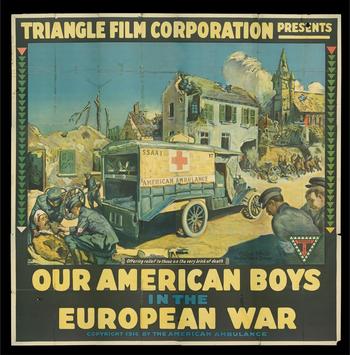
Assuming the perspective of a well-connected urban elite, some American volunteers who supported the Allies responded to such competition by insisting that their cultural commitment to the Allies provided a gold standard for a commitment to the United States. American volunteers fighting in the Allied armies increasingly put their dedication on display. American supporters of Britain kept a low profile, but Francophile volunteers in 1915 and 1916 did not hesitate to advertise both France and their own role abroad. One ambulance service set itself apart from the ARC, which sent relief units to Germany as well as France. “I am proud of belonging to an organization which serves France alone,” explained AAFS founder A. Piatt Andrew in 1916.Footnote 43 In 1915 and 1916, a stream of pro-Allied publications, visual images, and events across the country celebrated France as America's “gallant sister republic.”Footnote 44 At “Allied Bazaars” in Boston and New York, volunteer organizations were supported by the French government in advertising their efforts. The program committee proudly pointed out to visitors of the New York bazaar that it “is believed that this is the first time that official [French] government recognition has been extended to a semi-private enterprise of this character.”Footnote 45 A journalist added that for many “who could not afford a trip to Europe, a visit [to the bazaar] has proved a not unsatisfactory substitute.”Footnote 46 Films such as Our American Boys in the European War were shot by the AAFS with the aid of the French government.Footnote 47 Competition among Francophile American organizations boosted their effort and impact. In publications and interviews, writers such as Edith Wharton elicited not just humanitarian aid but sympathy for the Allied cause.Footnote 48
Advertising a 1916 film shot by the AAFS and the French government. Archives of the American Field Service and AFS Intercultural Programs, New York City.

In an atmosphere of competing loyalties that Wilson had sought to prevent, some volunteers took another step and tied their involvement abroad to an “integrational” policy that turned the volunteer into a cultural template for American citizenship by providing warlike experiences at home. Before April 1917, supporters of American military preparedness pressed for an expansion of the U.S. military and the mobilization of recruits into National Guard units that could be called up for war.Footnote 49 In late 1914, Robert Bacon, former president of the American Ambulance Hospital of Paris, had criticized American acquiescence to the German violation of Belgian neutrality. In January 1916, he had moved on to tout the virtues of the soldier's life for all Americans, and of the army for America. “A large aggregation of people with varying and conflicting ideals, lacking cohesion, does not constitute a nation,” Bacon explained.
I believe that there is an American spirit, that there is an American opinion, which will manifest itself in no weak, inactive, negative, neutral way, when once the public consciousness is aroused.Footnote 50
The preparedness campaign remained isolationist and calls for a general draft were tied to a social and cultural agenda.Footnote 51 Ironically, policy ideas represented by some American volunteers with the Allies came to be associated with a spirit of national integration that ran counter to the ideal of personally seeking out a meaningful challenge, an ideal that had steered many of them into service abroad.
5. FROM CULTURAL DISTINCTION TO NATIONAL CITIZENSHIP?
The entry of the United States into World War I in April 1917 became a watershed. American women volunteers could now choose to cooperate with the ARC, an organization empowered to establish a monopoly for American relief efforts abroad.Footnote 52 Wilson explained the conscription of American men as “in no sense a conscription of the unwilling” and a “selection from a nation which has volunteered in mass.”Footnote 53 The army assumed control of American operations in Europe. As volunteer ambulance services were taken over by the new United States Army Ambulance Service (USAAS) during the summer of 1917, units were visited by army recruiters. Drivers could join the USAAS or return home. By fall, about 50 percent of AFS drivers had enlisted. Even fewer drivers enlisted from the more elitist AVMAC.Footnote 54 Many felt that their experience should translate into higher ranks. Some were sniffed about the loss of status. Unless their leader Richard Norton remained in command, one driver wrote, “they won't see our tails for dust.”Footnote 55 John Dos Passos, who had joined the AVMAC in the spring of 1917, later recalled how Norton, with a monocle “gleaming in his eye,” had presented his drivers with a dramatic departure: “‘As gentlemen volunteers you enlisted in this service and as gentlemen volunteers I bid you farewell.’”Footnote 56 AFS founder A. Piatt Andrew chose to accept a role in the USAAS but he complained that “we have now to compete with the army, which has unlimited authority and money and can draw one after another of our men away by inducement and command.” He added that this meant “the end of the Field Service as such—the end of our freedom and distinction.”Footnote 57