Introduction
Does rights talk influence public opinion on pro–lesbian and gay policies? According to a Los Angeles Times article released in March of 2012, proponents of lesbian and gay rights issues have found that focusing on equality and civil rights does not significantly contribute to mobilizing public support for some lesbian- and gay-friendly policies, like same-sex marriage (Lopez Reference Lopez2012). Following the November 2012 election in Washington State, researchers with Third Way, a moderate think tank, released polling data suggesting that Washingtonians who voted for same-sex marriage did so because LGBTFootnote 1 rights groups minimized the use of rights-based frames in their advocacy (Brydum Reference Brydum2012; Hatalsky and Trumble Reference Hatalsky and Trumble2012). Recognizing the limits of rights frames, successful statewide marriage equality campaigns utilized alternatives to rights frames throughout the 2010s by adopting messaging that emphasized love and commitment and prospective same-sex couples' desire to enjoy the blessings of marriage (Solomon Reference Solomon2014). However, there is very little data available that explains why focusing on equality and civil rights does not seem to persuade voters.
Do rights frames impact public opinion when it comes to lesbian and gay issues? Does a special rights frame (a counter–gay and lesbian rights frame, which challenges quests for equal rights, like LGBT-inclusive antidiscrimination policy, by asserting that such rights are unnecessary claims for special treatment) influence public opinion more than pro–lesbian and gay equal rights frames? We approach these questions using data drawn from a survey experiment to provide a controlled look at whether these frames have an effect.
The survey experiment we employ makes our study unique. Past scholarship has largely not combined rights discourse theory with experimental survey techniques in order to determine whether rights frames can alter and manipulate public opinion. Legal mobilization scholars have primarily used in-depth interviews and content analyses in order to explore activists' use of rights frames in their struggles to achieve social movement goals (Pedriana Reference Pedriana2006; Bernstein, Marshall, and Barclay Reference Bernstein, Marshall, Barclay, Barclay, Bernstein and Marshall2009; Fisher Reference Fisher, Barclay, Bernstein and Marshall2009). Public opinion researchers, by contrast, have used experimental techniques to determine how framing influences group dynamics, how framing impacts the way that citizens understand issues, and what accounts for viewpoint shifts on lesbian and gay rights policies (Brewer Reference Brewer2002,Reference Brewer2003; Price, Nir, and Cappella Reference Price, Nir and Cappella2005). However, public opinion research has not utilized experimental survey techniques in order to examine how rights frames, as theorized by legal mobilization scholars, influence public opinion. As a result, this study adds a new dynamic to current research on rights discourses and public opinion on lesbian and gay issues.
Furthermore, this study provides three additional benefits meant to fill in gaps in prior research on framing and rights discourse and raise new issues of interest to both public opinion and sociolegal scholars. First, we investigate whether Brewer's (Reference Brewer2002) findings concerning the efficacy of the equal rights frame are still applicable in today's political atmosphere. Brewer studied an equality frame, which asserted that those who identify as gay or lesbian deserve equal rights, because mainstream LGBT social movement organizations and the media commonly used it at the time. The experiment concluded that the equality frame influenced how participants understood lesbian and gay issues, including antidiscrimination policy. However, since Brewer's study, proponents of lesbian and gay rights have shifted away from equal rights framing in some of their advocacy, particularly their same-sex marriage advocacy. As a result, it is possible that there has been a shift in how the equality frame influences public opinion on pro–lesbian and gay policies. Our study explores whether the equal rights frame continues to resonate among the heterosexual public over a decade after Brewer's study.
Second, the survey experiment examined in this study contains two rights frames as experimental conditions: an equal rights frame and a special rights frame.Footnote 2 Many previous studies solely focus on the equal rights frame, examine the rights frames used by pro–lesbian and gay rights groups against the morality frames (frames emphasizing homosexuality as an immoral, religious transgression) used by opponents of gay and lesbian rights, or explore how opponents use morality frames with respect to lesbian and gay issues (Hull Reference Hull2001; Miceli Reference Miceli2005; Gaines and Garand Reference Gaines and Garand2010; Mucciaroni Reference Mucciaroni2011). These studies do not test how the public responds to pro– and anti–lesbian and gay rights frames. Our research fills in this gap by exploring how both rights movement frames (equal rights frames) and countermovement frames (special rights frames) influence the heterosexual public in a specific state context.
Finally, our study contributes to sociolegal research by investigating the extent to which rights serve as a resource and constraint for social movements, as theorized by some legal mobilization scholars (McCann Reference McCann1994; Goldberg-Hiller Reference Goldberg‐Hiller2002; Lovell Reference Lovell2012). According to these scholars, rights can serve as a resource for mobilization among countermovement activists, and, in doing so, limit the opportunities available for social change, while simultaneously creating opportunities for change for social movement activists by generating new understandings of community and public support for unrecognized rights claims. We add to this scholarship by exploring how equal rights and special rights frames serve as resources and constraints for a social movement's ability to mobilize public opinion in support of lesbian and gay antidiscrimination policy in a specific state context. Because of their contingency on context and audience, we argue that rights frames often impact public opinion in ways that defy the expectations of the activists who deploy them.
We test how exposure to pro– and anti–lesbian and gay rights frames impacts heterosexual public opinion in Washington State on a policy that has long been important to the LGBT rights movement: changing existing antidiscrimination laws to incorporate sexual orientation. Our experiment appeared in the 2011 Washington Poll, and we used it to test three hypotheses. Hypothesis 1: The equal rights frame increases support for antidiscrimination laws. Hypothesis 2: The special rights frame decreases support for antidiscrimination laws. Hypothesis 3: Both the equal rights and the special rights frames have the largest impact on those who are ambivalent about gay and lesbian rights. We expected that those whose minds were made up on the issue of gay rights and the status of lesbians and gay men in society would be less influenced by framing effects than those who were ambivalent about these issues.
The first section of this article analyzes how public opinion and sociolegal scholars have studied rights discourse, framing, and counter-rights discourse, and includes a brief discussion of recent pro–gay and lesbian policy in Washington State. This section engages in current research in order to ground the theory that undergirds our hypotheses further. The second section explains the data, measures, and methodology that we use in our study. The third section illustrates the results of our survey experiment, briefly delineating our core findings. The last section discusses the implications and broader merits of our findings for both future research and social movement activism. This final section explores our core findings and delves into what they reveal about the limits of rights and the interconnection between movement and countermovement rights frames.
Overall, our study finds that the special rights frame continues to weaken heterosexual support for lesbian and gay antidiscrimination policy in Washington State, while the equal rights frame has no effect or elicits greater opposition among certain voters. Those who are ambivalent on lesbian and gay policies are not likely to be influenced by the equal rights frame, but more likely to be influenced by the special rights frame. Our findings suggest that it is not surprising that large increases in support for some LGBT rights issues, like same-sex marriage, have coincided with movement organizations minimizing equal rights language in some settings. It makes sense for LGBT organization activists to follow their current framing strategy, which focuses more on love, commitment, and personal narratives in some arenas given our findings (Solomon Reference Solomon2014; Wofford Reference Wofford2014). Furthermore, our study supports many sociolegal scholars' contentions that distinctions between equal rights and special rights frames are convoluted rather than simply contradictory and, thus, the persuasive power of frames depends largely on audience and context. Aware that our findings are limited by region, time, and the various methodological pitfalls of survey experimentation, we contend that our findings speak to a greater need in sociolegal and public opinion research on social movements to recognize and respond to the ways in which rights frames influence public opinion.
Theories of Framing, Rights Discourse, and Social Change
(A) Frames in Thought and Frames in Mobilization: Influencing Public Opinion on LGBT Rights
How framing is defined and studied diverges greatly in public opinion and sociolegal scholarship. In public opinion research, framing refers to the process by which people form an understanding of an issue or reorient how they conceive of an issue with respect to particular values (Chong and Druckman Reference Chong and Druckman2007). Through survey experimentation, some scholars find that framing by opinion leaders (like political leaders and pundits) and mass media organizations shapes public understandings of contemporary problems and the merits of potential resolutions (Nelson and Kinder Reference Nelson and Kinder1996; Nelson, Clawson, and Oxley Reference Nelson, Clawson and Oxley1997). From this general understanding of framing, research in public opinion scholarship can be divided into two subsets. First, research on frames in communication analyzes trends in elite discourse and focuses on the phrases, terms, images, or presentation styles a given speaker uses when relaying information to another person (Gamson and Modigliani Reference Gamson and Modigliani1987; Cappella and Jamieson Reference Cappella and Jamieson1997; Druckman Reference Druckman2001). Second, frames in thought refers to studies that focus on how framing impacts an individual's understanding of a given issue (Goffman Reference Goffman1974). Because this study uses a survey experiment to test whether these frames have an effect on individual conceptualizations of an issue, we are concerned with the branch of public opinion research that delves into frames in thought.
Public opinion scholars have studied frames in thought in order to account for how different frames influence public understandings of lesbian and gay rights issues (Brewer Reference Brewer2002; Craig et al. Reference Craig, Martinez, Kane and Gainous2005; Price, Nir, and Cappella Reference Price, Nir and Cappella2005). Price, Nir, and Cappella's (2005) work, using data collected by the Electronic Dialogue Project, tests how the civil union and homosexual marriage frames, combined with the equal rights and special rights frames, influence group support for granting legal standing to same-sex partnerships. The study concludes that the tested framing manipulation influences how groups discuss same-sex unions and that the effects of the framing manipulation are contingent on a group's ideological make-up. Price, Nir, and Cappella suggest a connection between framing and ideology on public support of gay and lesbian rights issues. Brewer's (Reference Brewer2002) study, referenced above, uses a laboratory experiment exposing participants to different types of frames embedded in media coverage, and finds that participants who are given a particular frame are likely to discuss gay rights with framing language. Although Brewer's and Price, Nir, and Cappella's studies use frames that include rights language, neither study illuminates whether or not rights framing has persuasive power when it comes to public opinion about lesbian and gay policies.
While public opinion scholars study framing in communication and framing in thought, legal mobilization scholars adopt an entirely different understanding of framing. One of the most commonly used definitions of framing, or collective action frames, in legal mobilization scholarship is grounded in the social movement theory understanding of frames as the “schemata of interpretation that enable individuals to ‘locate, perceive, identify, and label’ occurrences within their space and the world at large” (Benford and Snow Reference Benford and Snow2000, 614; see also Gamson and Meyer Reference Gamson, Meyer, McAdam, McCarthy and Zald1996; Zald Reference Zald, McAdam, McCarthy and Zald1996; Williams Reference Williams, Snow, Soule and Kriesi2004). This is very similar to the general understanding of framing in public opinion research described above; however, it is also dissimilar, because framing in legal mobilization scholarship is further used to describe group mobilization around a collective grievance. Framing in legal mobilization research occurs when a group agrees that it has a grievance, the group selects a method (e.g., a discourse) for expressing this grievance that calls upon a specific solution, and the method selected is used to mobilize support for the grievance's resolution.
We adopt an overarching understanding of framing in this study that incorporates both the public opinion and the legal mobilization approaches. We strive to strike a balance between the legal mobilization understanding of the role frames play in defining group grievances and the frames in thought understanding from public opinion research, which emphasizes the role that frames play in influencing how individuals conceive of issues. For this reason, our study focuses on two of the most prominent collective action frames utilized by LGBT rights activists and opponents in group mobilization, the equal rights frame and the special rights frame, and explores how these frames shape individual support for a pro–gay and lesbian antidiscrimination policy.
We further incorporate the idea that issues related to sexuality stem from personal convictions, religious values, and morality. As a result, lesbian- and gay-friendly issues are seen as easy issues or issues understood at a gut level that require “almost no supporting contextual factual knowledge, no impressive reasoning ability, no attention to the nuances of political life” (Carmines and Stimson Reference Carmines and Stimson1989, 11). Previous research also supports the contention that lesbian- and gay-friendly policies are the type of issues that “prove susceptible to the influence of changing situational cues,” like rights-based frames (Dancey and Goren Reference Dancey and Goren2010, 689; see also Dyck and Pearson-Merkowitz Reference Dyck and Pearson‐Merkowitz2012). We argue that since lesbian and gay antidiscrimination policy is an easy issue that nevertheless is susceptible to situational cues like rights frames, it is possible that those who are ambivalent about a lesbian and gay issues will be more persuaded by rights-based frames than those who are more decided on that issue. Alternatively, researchers have also found that ambivalence may result in people choosing moderate opinions on surveys (Mulligan Reference Mulligan2013). Thus, our study will explore whether rights frames might alter the moderate trend traditionally exhibited by those who are ambivalent about political issues.
(B) Rights Discourse and the Law: The Interconnection Between the LGBT Rights Movement and Countermovement
Many scholars have identified the equal rights and special rights frames as dominant frames impacting public debate on lesbian and gay rights issues (Goldberg-Hiller and Milner Reference Goldberg‐Hiller and Milner2003; Dudas Reference Dudas2005; Dugan Reference Dugan2005; Richman Reference Richman2005). Both frames are also examples of master frames in social movement advocacy. According to Pedriana (Reference Pedriana2006), the law and legal arguments about rights are a type of master frame with a theoretical power and importance that span a variety of social movement and cultural contexts, including both pro- and counter-rights movements (see also Benford and Snow Reference Benford, Snow, Morris and Mueller1993).
The equal rights frame asserts that gay men and lesbians have the right to equal treatment under the law, and in order for this right to be fully achieved legislatures should adopt laws that protect individuals from discrimination based on sexual orientation and gender identity or expression, that outlaw hate crimes based on sexual orientation and gender identity or expression, and that enable the formal recognition of same-sex relationships (Richman Reference Richman2005). Hence, LGBT rights activists often argue that LGBT-identified individuals have the right to be treated equally: in other words, they adopt an equal rights frame in their advocacy.
On the other hand, the countermovement has developed a special rights frame, a countermobilization frame that “infuses conservative political action with nationalistic ardor … [and] convinces [conservatives] that their opposition is necessary for protecting the American way of life” (Dudas Reference Dudas2005, 725; see also Goldberg-Hiller Reference Goldberg‐Hiller, Barclay, Bernstein and Marshall2009). The purpose of the special rights frame is to secularize countermobilization discourse and tap into fundamental cultural values concerning individualism and prejudicial views of lesbian, gay, bisexual, and transgender people (Herman Reference Herman1997; Stone Reference Stone2012). According to the countermovement's special rights frame, when LGBT rights activists assert that laws need to be changed to effect equal treatment, these activists are asking for more rights than the average American receives. Consequently, LGBT rights opponents argue that LGBT activists' call for equal rights amounts to nothing more than special rights claiming.
The scholarship on the relationship between rights movement and countermovement rights discourses is complicated and heavily debated in sociolegal research. Some of the principal research on the relationship between movement and countermovement strategizing argues that rights movement litigation provokes political reaction from countermovement groups that, in turn, undercuts rights litigation successes (Klarman Reference Klarman2004; Rosenberg Reference Rosenberg2008; Klarman Reference Klarman2013). According to this scholarship, there is a causal link between the strategizing efforts of movements and countermovements. Countermovements organize and develop political discourses, like the special rights discourse, in direct response to litigation successes. Thus, Klarman (Reference Klarman2013) argues that the countermovement activism that culminated in more than 25 state constitutional amendments banning same-sex marriage was the direct result of pro–same-sex partnership judicial decisions in 1999 and 2003, in Vermont and Massachusetts respectively. Scholarship that adopts a causal understanding of countermobilization tends to think of rights movement and countermovement strategizing as operating in two different political spaces. Rights movements pursue litigation advances, and countermovements react to these advances with alternative antirights mobilization.
By contrast, other sociolegal scholars adopt a multicausal understanding of the relationship between rights movements and countermovements. For these scholars, countermovement strategizing is intertwined with promovement strategizing and is not merely reactionary. Some of this scholarship sees rights movement mobilization as initiating both countermovement mobilization and, more optimistically, argues that rights mobilization also contributes to important rights movement advances (Eskridge Reference Eskridge2002; Andersen Reference Andersen2005; Keck Reference Keck2009). For example, Keck (Reference Keck2009) analyzes LGBT rights movement litigation and argues that this litigation has both fueled countermobilization and expanded the rights of LGBT persons by mobilizing the public in support of these rights, which has led to policy advances like increased governmental recognition of same-sex relationships.
Another variant of sociolegal scholarship that recognizes that rights advocacy can spur both countermobilization and movement advances adopts a broader understanding of what encompasses law. According to this understanding, the law includes judicial decisions and the use of legal rights discourse in the mobilization of public support or opposition to rights advances (McCann Reference McCann1994; Goldberg-Hiller Reference Goldberg‐Hiller2002; Lovell Reference Lovell2012). These scholars adopt the theoretical understanding that both social movement activists and everyday people often use the law in order to mobilize support for their causes (Zemans Reference Zemans1983; Hull Reference Hull2001; Bernstein, Marshall, and Barclay Reference Bernstein, Marshall, Barclay, Barclay, Bernstein and Marshall2009; Fisher Reference Fisher, Barclay, Bernstein and Marshall2009; Dorf and Tarrow Reference Dorf and Tarrow2014). Using this broader understanding of law, these scholars argue that there is an affinity between movement and countermovement forces and that a countermovement has tremendous influence on the discourse and agenda adopted by a rights movement and vice versa.
Rather than seeing the relationship between movement and countermovements as a causal chain, this final group of scholars argues that there is a symbiotic or intertwined relationship between the strategizing of rights movement proponents and opponents. The activism of LGBT rights movement opponents is not always purely reactionary, but can also push issues onto the agenda of LGBT organizations due to the triangular relationship between rights movements, countermovements, and grassroots advocacy (Dorf and Tarrow Reference Dorf and Tarrow2014). Furthermore, countermovement strategizing has more metrics than mere court cases; it also includes legal, political, and cultural dimensions (Schachter Reference Schachter2009). This study embraces the theoretical understanding of rights discourses described by these scholars. These legal mobilization scholars analyze the constitutive role of legal rights by adopting an inclusive definition of the law that emphasizes the effects and development of legal norms, legal symbols, and legal rights discourses across and through movements and countermovements.
(C) Recent Lesbian and Gay Policy in Washington State
Since 2000, the Washington State legislature has enacted a variety of laws addressing gay and lesbian issues. Some of the most significant laws passed in Washington over the past decade include H.B. 2661, commonly known as the Anderson-Murray Anti-Discrimination Bill, which added sexual orientation and gender identity to the state's antidiscrimination statutes in 2006; S.B. 5688, commonly known as the “everything but marriage” law, which extended the rights and benefits of domestic partnerships to same-sex couples, and was approved by statewide vote in 2009; and S.B. 6239, Washington's marriage equality law, which expanded civil marriage to same-sex couples, and was approved by statewide vote in 2012 (2006 Wash. Laws 2661; 2009 Wash. Laws 5688; 2012 Wash. Laws 6239; Garber Reference Garber2006; La Corte Reference La Corte2006; Turnbull, Tu, and Kelleher Reference Turnbull, Tu and Susan2009; Hansen Reference Hansen2012). Each of these laws is indicative of increasingly strong mobilization around gay and lesbian issues in Washington State, centered primarily in Seattle, King County, and the surrounding area.
Interestingly, although Washington has experienced statewide gay and lesbian policy successes, there has been very little published research on the framing strategies advanced by activists in these campaigns. Lesbian and gay rights activists in Washington undoubtedly engaged in large-scale public education and political mobilization campaigns in 2009 and 2012 when S.B. 5688 and S.B. 6239 were brought to statewide vote via Referendum 71 and Referendum 74, respectively. Voters in Western Washington frequently support liberal and Democratic candidates and issues, and the region is regularly cited as one of the most liberal areas of the United States. However, the state as a whole is more ideologically monolithic; voters in Eastern Washington predominantly vote for conservative and Republican issues and candidates (Webley Reference Webley2013). As a result, in order to win at the statewide level, referenda and initiatives in Washington must appeal to more conservative voters in addition to voters who identify as liberal.
Given the distinctive political environment in Washington State, the experience of the LGBT rights movement in Washington provides a case for understanding how historically liberal gay rights issues have been framed in ways that appeal to more conservative and moderate voters. The little research on framing around gay and lesbian policy in Washington State has focused on same-sex marriage. Research conducted by the bipartisan think tank Third Way suggests that love and commitment framing more effectively influences voters' views about same-sex marriage in Washington than rights framing (Hatalsky and Trumble Reference Hatalsky and Trumble2012). This research contrasts with earlier studies conducted by scholars like Brewer (Reference Brewer2002,Reference Brewer2003) and Price, Nir, and Cappella (2005), who suggest that rights framing does have some efficacy when it comes to gay and lesbian rights issues. Our study investigates this apparent inconsistency by delving into how rights framing influences heterosexual sentiment on antidiscrimination policy in Washington State.
We have selected lesbian and gay antidiscrimination policy because it presents a least likely case to uncover framing effects. This is because the Washington State legislature enacted the Anderson-Murray Anti-Discrimination Bill, incorporating sexual orientation and gender identity into the state's antidiscrimination statutes, in 2006 with widespread support (2006 Wash. Laws 2661; Garber Reference Garber2006; La Corte Reference La Corte2006). An attempt to bring this change to Washington's antidiscrimination law to a statewide vote failed to obtain enough signatures for a referendum in 2006. The recent passage of a lesbian and gay antidiscrimination law in Washington indicates that there is broad popular support for this particular issue in the state.Footnote 3 In addition to the broad popular support for Washington's 2006 antidiscrimination law, there is another reason why we believe that antidiscrimination policy provides a good dependent variable: there were few competing frames in the media that could complicate our analysis in 2011. Including sexual orientation in antidiscrimination policy was not a salient issue in Washington State in 2011. Because it was not featured heavily in the media in 2011, it likely did not interact with other preexisting frames or images that could color peoples' perception of including sexual orientation in antidiscrimination policy (Lippmann Reference Lippmann1965; Zaller Reference Zaller1992). As a result, any movement between the control and experimental groups' (the groups that receive the rights frames) perceptions of lesbian and gay antidiscrimination policy implies that the effect is largely coming from our experimental manipulation.
Yet, our survey experiment took place at a unique political moment in the movement for marriage equality in Washington State: between the passage of the 2009 of a law extending the rights and benefits of marriage to same-sex domestic partners and the 2012 legalization of marriage equality in the state. Thus, at the time we conducted our survey experiment, same-sex marriage was quickly becoming a major statewide political issue. We conducted our survey experiment on the Washington Poll in autumn 2011, about two months before the start of a legislative session that would include the passage of a law legalizing same-sex marriage in the state. In 2012, this law was brought to a statewide referendum and passed with broad public support—making Washington State one of the first states to legalize same-sex marriage by popular vote. It is possible that some who participated in our survey conflated our antidiscrimination policy statement with statewide same-sex marriage policy for this reason.
However, we contend that Washington's unique political climate in 2011 will actually help us to explore in greater detail the importance of context when considering the persuasiveness of rights frames. Further, we believe that this context makes our survey experiment even more relevant to the present national political climate. The United States is currently grappling with nationalization of same-sex marriage in the wake of 2015 Supreme Court case Obergefell v. Hodges. At the same time, broad federal antidiscrimination protections have not yet been extended to gay men and lesbians (the policy tested by our survey experiment) or to transgender and gender nonconforming individuals. Thus, we are currently experiencing a political climate in which how the public perceives extending antidiscrimination protections is influenced by the politics of same-sex marriage. Our survey experiment offers the unique opportunity to explore the persuasive power of rights frames around antidiscrimination policy in a state political context that somewhat mirrors the present national political climate with respect to same-sex marriage.
Data, Measures, and Methodology
This study is based on a survey experiment that appeared on the 2011 Washington Poll, which included 1,067 registered Washington State voters. The survey was in the field between October 10th and November 3rd, 2011, and was overseen by researchers at the University of Washington. Trained undergraduates conducted the interviews via telephone. They called both landline and cell phone numbers. The survey lasted approximately twenty minutes. In addition to our survey experiment, which we discuss shortly, the survey instrument included questions about favorability toward minority groups, trust toward the media, and job approval of various public figures. Demographic questions, including sexual orientation, were included at the end of the survey. Only heterosexual respondents (n = 1,037) were used in the analysis.Footnote 4
The survey included a question about support for same-sex marriage, which was asked well before our experiment. Another survey experiment about immigration reform, two five-question batteries, and two additional policy questions separated the same-sex marriage question and our experiment. In coding the survey, respondents were independently randomized into control or treatment conditions for each experiment. Therefore, there were minimal priming effects from the marriage question on our experiment.
We used the response to the same-sex marriage question as a proxy for preexisting support for lesbian and gay rights generally. The same-sex marriage question had four listed response options in addition to options for “don't know” and refusals:
-
(1) Gay and lesbian couples should have the same legal right to marry as straight couples.
-
(2) Gay and lesbian couples should be able to have the same legal rights as straight couples, but it should not be called marriage.
-
(3) There should be domestic partnerships that give gay and lesbian couples only some of the benefits and protections of marriage.
-
(4) There should be no legal recognition of gay and lesbian couples.
Our survey experiment took place roughly fifteen minutes into the twenty-minute survey. Interviewees were randomized into either one of the experimental conditions (the special rights or equal rights frames) or the control condition (in which interviewees skipped straight to the dependent variable). Interviewees were subsequently asked the dependent variable: whether or not they supported an antidiscrimination law that included sexual orientation. The exact wording of (1) the equal rights frame, (2) the special rights frame, and (3) the antidiscrimination question are included below:
-
(1) Equal Rights Frame: “The right to equality plays an important role in United States history. The Fourteenth Amendment of the Constitution says that no State can deny, to any person, the equal protection of the laws. Throughout our nation's history we have made strides to further increase equality and stop discrimination.”
-
(2) Special Rights Frame: “The Constitution already guarantees equality. Minority groups who are calling for greater rights are, in fact, asking for special treatment or special rights. In other words, these groups are asking for more benefits or rights than the average American receives.”
-
(3) Opinion on Antidiscrimination law: “Please tell me if you agree or disagree with the following statement: We should change our antidiscrimination laws so that gays and lesbians are protected from unwanted discrimination and prejudice.”
There were, initially, six possible response categories for the dependent variable. Interviewers were instructed to read four response categories, which ranged from “strongly disagree” to “strongly agree.” The order of the responses was randomly rotated. Two unread categories, “don't know” and “refused,” were also available options.
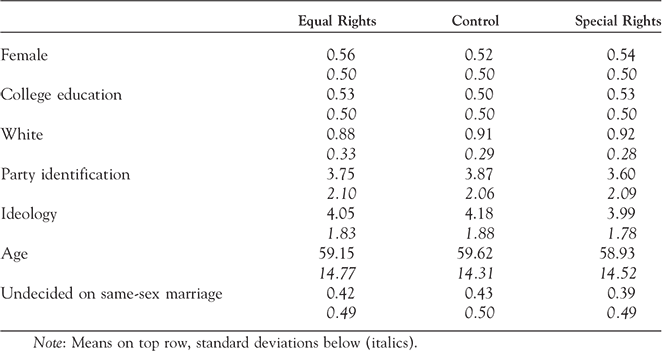
Table 1 serves as a randomization check on the experiment. It provides heterosexual sample means and standard deviations of independent covariates of interest for each group. The groups appear evenly split. Overall, there were 380 heterosexual respondents in the equal rights frame, 318 in the special rights frame and 339 in the control condition.
Means and Standard Deviations of Key Variables by Experimental Condition, Respondents Who Identify as Heterosexual

| Equal Rights | Control | Special Rights | |
|---|---|---|---|
| Female | 0.56 | 0.52 | 0.54 |
| 0.50 | 0.50 | 0.50 | |
| College education | 0.53 | 0.50 | 0.53 |
| 0.50 | 0.50 | 0.50 | |
| White | 0.88 | 0.91 | 0.92 |
| 0.33 | 0.29 | 0.28 | |
| Party identification | 3.75 | 3.87 | 3.60 |
| 2.10 | 2.06 | 2.09 | |
| Ideology | 4.05 | 4.18 | 3.99 |
| 1.83 | 1.88 | 1.78 | |
| Age | 59.15 | 59.62 | 58.93 |
| 14.77 | 14.31 | 14.52 | |
| Undecided on same-sex marriage | 0.42 | 0.43 | 0.39 |
| 0.49 | 0.50 | 0.49 |
Note: Means on top row, standard deviations below (italics).
We further checked randomization by running t tests for each of the demographic variables listed in Table 1, comparing the sample means in the equal rights and control conditions, the special rights and control conditions, and the equal rights and special rights conditions. Because there were three conditions to compare across seven demographic measures, we ran 21 t tests. Out of these 21 t tests, none of the t scores were significant at the 0.95 level, and only two were significant at the 0.9 level.Footnote 5 This suggests that the randomization was largely successful.
Our methodology tests our study's three hypotheses: (1) that the equal rights frame increases support for antidiscrimination laws, (2) that the special rights frame decreases support for antidiscrimination laws, and (3) that these effects are most pronounced for those who are ambivalent about LGBT rights. We used two techniques to test these hypotheses. First, we used difference in means tests to determine if there were significant differences in the dependent variable by experimental condition. This method is reasonable because we randomized the conditions, so the effects of potential confounders should be minimal. Second, we relaxed the assumptions of no confounding by running ordered logistic regressions. We present these results in a table of regression coefficients, but also calculate relevant predicted probabilities to ease interpretation of the models.
We used the full heterosexual sample for all tests of Hypothesis 1 and Hypothesis 2. To test Hypothesis 3, we divided the heterosexual sample into three groups: (1) those who supported same-sex marriage, (2) those who opposed same-sex marriage, and (3) those who were ambivalent about recognizing same-sex relationships. We divided our sample in this manner because we hypothesize that having a strong position on a specific issue like same-sex marriage is a good proxy for being more decided and, therefore, less persuadable on LGBT issues more generally.
There are many possible ways to operationalize those who are ambivalent about gay rights. Ultimately, we operationalized ambivalence to include everyone who was not at either extreme of the issue of same-sex marriage. This includes those who reported support for full civil unions, those who reported support for limited domestic partnerships,Footnote 6 and those who did not know their policy preference.Footnote 7
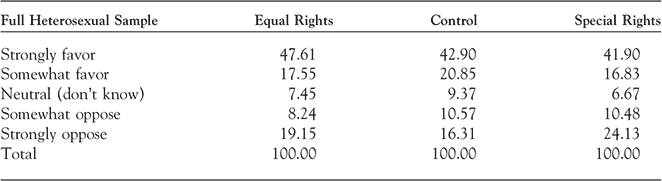
In our analysis we recoded the dependent variable (support for antidiscrimination laws) as follows: rather than drop the “don't know” respondents from the analysis, we recoded them as a middle category. Thus, our dependent variable ranges from one to five, with one representing those who strongly support antidiscrimination laws and a five representing those who strongly oppose such laws.Footnote 8 Table 2 provides descriptive statistics for the dependent variable by experimental condition.
Contingency Table of Support for Sexual Orientation–Inclusive Antidiscrimination Law, by Experimental Condition

| Full Heterosexual Sample | Equal Rights | Control | Special Rights |
|---|---|---|---|
| Strongly favor | 47.61 | 42.90 | 41.90 |
| Somewhat favor | 17.55 | 20.85 | 16.83 |
| Neutral (don't know) | 7.45 | 9.37 | 6.67 |
| Somewhat oppose | 8.24 | 10.57 | 10.48 |
| Strongly oppose | 19.15 | 16.31 | 24.13 |
| Total | 100.00 | 100.00 | 100.00 |
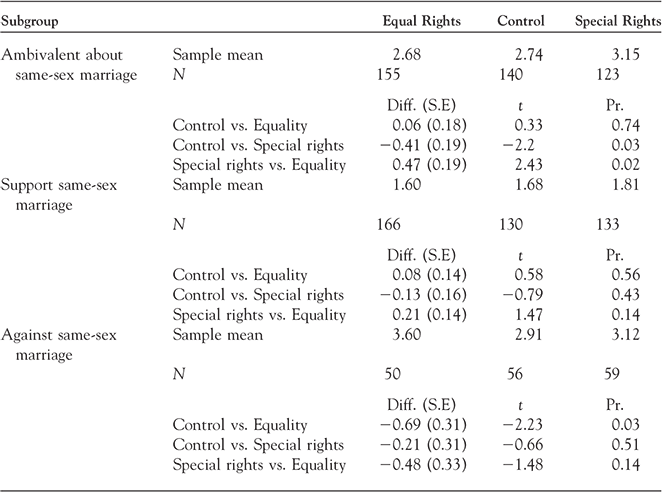
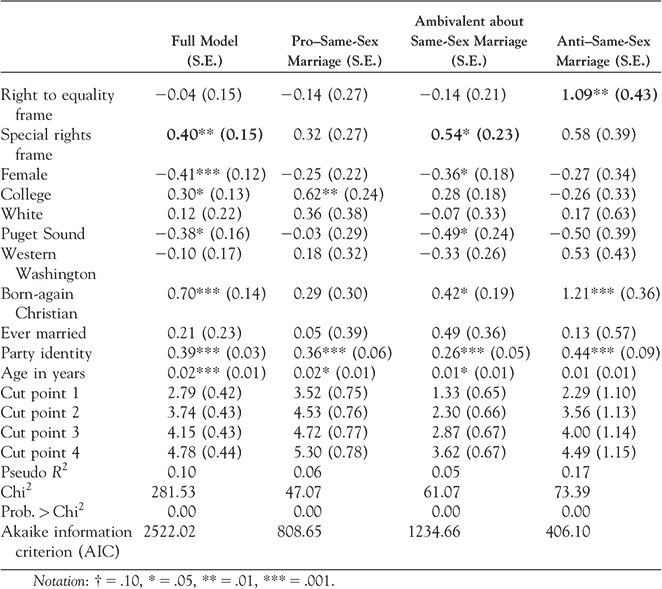
Ultimately, the results of our analysis are found in Tables 3 to Tables 5 and in Figure 1. Table 3 presents the results of the difference in means tests for the full sample, testing Hypotheses 1 and 2. Table 4 does the same, but divides the sample into preexisting attitudes on gay and lesbian rights, testing Hypothesis 3. We adjusted for potential confounders in our ordered logistic regression models to further test our hypotheses, the results of which are found in Table 5 and Figure 1.
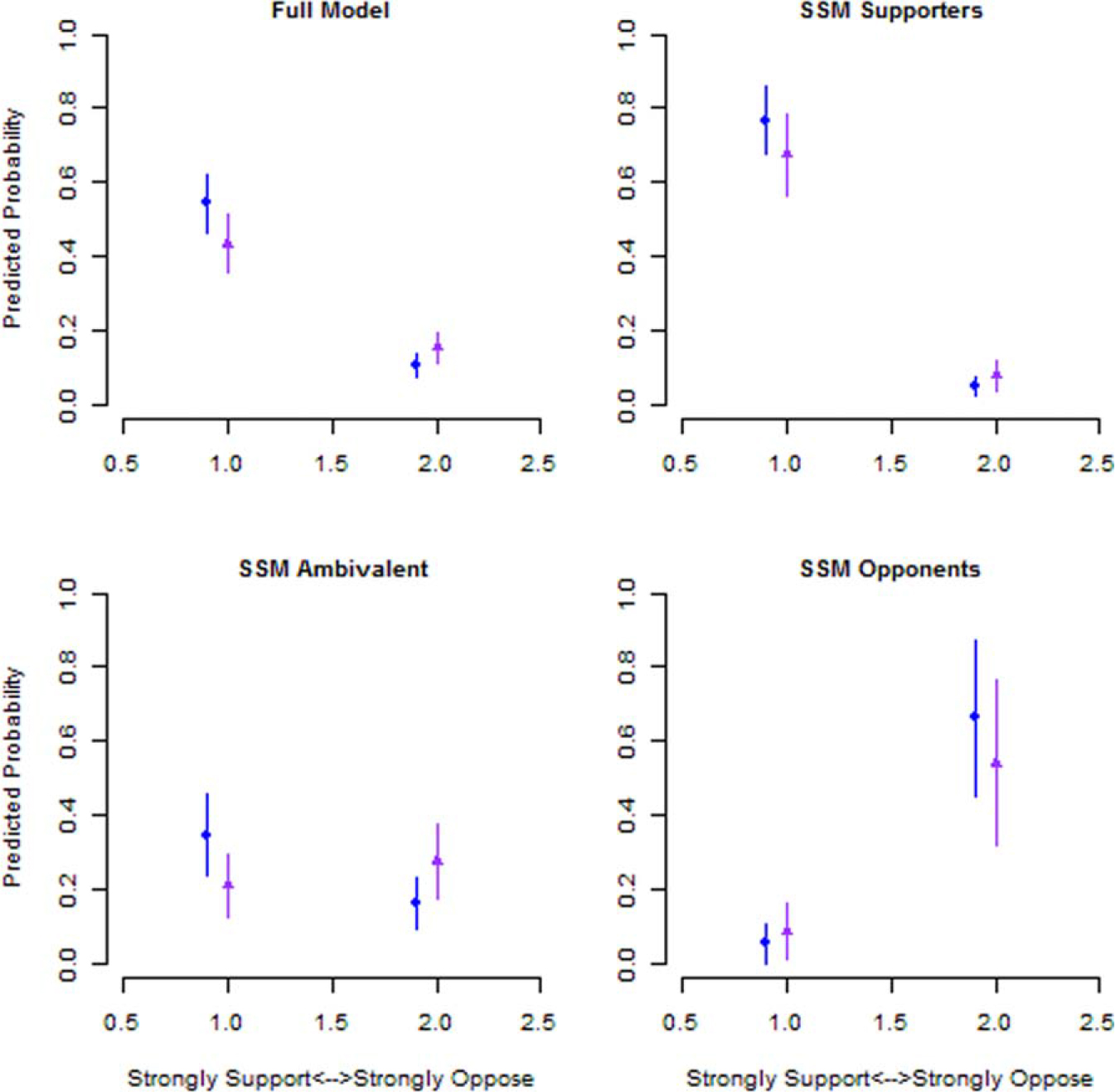
Predicted Probabilities for Models 1 (1a: Full Model) through 4 (1d: Anti–same-sex Marriage). Predicted probabilities are shown for Strongly Support and Strongly Oppose response options for both the equal rights frame (blue diamonds) and special rights frame (purple triangle). Error bands are the 95% confidence intervals calculated for the predicted probabilities. Most notable is that the special rights frame decreases the predicted probability for supporting antidiscrimination laws in all models, whereas the equal rights frame has little effect in all respondents but anti–same-sex marriage respondents. Exposure to the equal rights frame increases the probability that an opponent of same-sex marriage will oppose antidiscrimination laws. [Color figure can be viewed at wileyonlinelibrary.com]

Difference in Means, Full Heterosexual Sample

| Full Heterosexual Sample | Equal Rights | Control | Special Rights |
|---|---|---|---|
| Sample mean | 2.34 | 2.37 | 2.58 |
| N | 376 | 331 | 315 |
| Difference in Mean (S.E.) | t | Pr. | |
| Control vs. Equality | 0.03 (.12) | 0.24 | 0.81 |
| Control vs. Special rights | −0.22 (.12) | −1.73 | 0.08 |
| Special rights vs. Equality | 0.24 (.12) | 1.97 | 0.05 |
Difference in Means, by Attitudes about Same-Sex Marriage

| Subgroup | Equal Rights | Control | Special Rights | |
|---|---|---|---|---|
| Ambivalent about same-sex marriage | Sample mean | 2.68 | 2.74 | 3.15 |
| N | 155 | 140 | 123 | |
| Diff. (S.E) | t | Pr. | ||
| Control vs. Equality | 0.06 (0.18) | 0.33 | 0.74 | |
| Control vs. Special rights | −0.41 (0.19) | −2.2 | 0.03 | |
| Special rights vs. Equality | 0.47 (0.19) | 2.43 | 0.02 | |
| Support same-sex marriage | Sample mean | 1.60 | 1.68 | 1.81 |
| N | 166 | 130 | 133 | |
| Diff. (S.E) | t | Pr. | ||
| Control vs. Equality | 0.08 (0.14) | 0.58 | 0.56 | |
| Control vs. Special rights | −0.13 (0.16) | −0.79 | 0.43 | |
| Special rights vs. Equality | 0.21 (0.14) | 1.47 | 0.14 | |
| Against same-sex marriage | Sample mean | 3.60 | 2.91 | 3.12 |
| N | 50 | 56 | 59 | |
| Diff. (S.E) | t | Pr. | ||
| Control vs. Equality | −0.69 (0.31) | −2.23 | 0.03 | |
| Control vs. Special rights | −0.21 (0.31) | −0.66 | 0.51 | |
| Special rights vs. Equality | −0.48 (0.33) | −1.48 | 0.14 |
Besides experimental condition, the variables in our models are party identification, education level, gender, region, age, race, marital status, and affiliation as a born-again Christian. Many of the covariates were recoded as dummy variables. These included gender (female = one), race (white = one), education (at least a college degree = one), marital status (currently married or widowed = one), region (control region is Eastern Washington), and evangelical Protestant affiliation (born-again Christian = one). Party identification was coded from one to seven, and age was coded in years.
Results
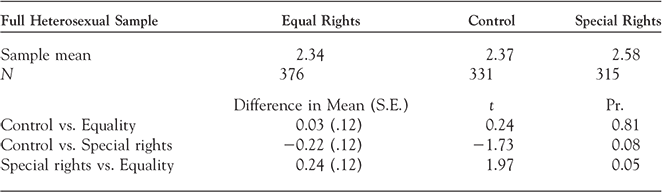
Table 3 provides a summary of heterosexual sample means by experimental condition and the results of the difference of means tests for the dependent variable, which was scaled from one to five, with one representing strong support for antidiscrimination laws and five representing strong opposition.
Ordered Logistic Regression Results

| Full Model (S.E.) | Pro–Same-Sex Marriage (S.E.) | Ambivalent about Same-Sex Marriage (S.E.) | Anti–Same-Sex Marriage (S.E.) | |
|---|---|---|---|---|
| Right to equality frame | −0.04 (0.15) | −0.14 (0.27) | −0.14 (0.21) | 1.09 ** (0.43) |
| Special rights frame | 0.40 ** (0.15) | 0.32 (0.27) | 0.54 * (0.23) | 0.58 (0.39) |
| Female | −0.41 *** (0.12) | −0.25 (0.22) | −0.36 * (0.18) | −0.27 (0.34) |
| College | 0.30 * (0.13) | 0.62 ** (0.24) | 0.28 (0.18) | −0.26 (0.33) |
| White | 0.12 (0.22) | 0.36 (0.38) | −0.07 (0.33) | 0.17 (0.63) |
| Puget Sound | −0.38 * (0.16) | −0.03 (0.29) | −0.49 * (0.24) | −0.50 (0.39) |
| Western Washington | −0.10 (0.17) | 0.18 (0.32) | −0.33 (0.26) | 0.53 (0.43) |
| Born-again Christian | 0.70 *** (0.14) | 0.29 (0.30) | 0.42 * (0.19) | 1.21 *** (0.36) |
| Ever married | 0.21 (0.23) | 0.05 (0.39) | 0.49 (0.36) | 0.13 (0.57) |
| Party identity | 0.39 *** (0.03) | 0.36 *** (0.06) | 0.26 *** (0.05) | 0.44 *** (0.09) |
| Age in years | 0.02 *** (0.01) | 0.02 * (0.01) | 0.01 * (0.01) | 0.01 (0.01) |
| Cut point 1 | 2.79 (0.42) | 3.52 (0.75) | 1.33 (0.65) | 2.29 (1.10) |
| Cut point 2 | 3.74 (0.43) | 4.53 (0.76) | 2.30 (0.66) | 3.56 (1.13) |
| Cut point 3 | 4.15 (0.43) | 4.72 (0.77) | 2.87 (0.67) | 4.00 (1.14) |
| Cut point 4 | 4.78 (0.44) | 5.30 (0.78) | 3.62 (0.67) | 4.49 (1.15) |
| Pseudo R 2 | 0.10 | 0.06 | 0.05 | 0.17 |
| Chi2 | 281.53 | 47.07 | 61.07 | 73.39 |
| Prob. > Chi2 | 0.00 | 0.00 | 0.00 | 0.00 |
| Akaike information criterion (AIC) | 2522.02 | 808.65 | 1234.66 | 406.10 |
Notation: #7591;†=.10,
* =.05,
** =.01,
*** =.001.
There is very little evidence for Hypothesis 1, but some support for Hypothesis 2. The .03 point difference between the sample average for the equal rights condition and the control condition is not statistically significant. However, the mean of the heterosexual sample that received the special rights condition is .22 points higher (more opposed) than both the control condition (t = −1.73, p = .08) and .24 points higher than the equality condition (t = 1.97, p = .05). This similar magnitude suggests that the equal rights frame is having a muted effect compared to the effect of the special rights frame, providing evidence for Hypothesis 2 (that the special rights discourse decreases support) but not Hypothesis 1 (that the equal rights discourse increases support for antidiscrimination policy).
Table 4 shows the heterosexual sample means for those who were ambivalent about same-sex marriage, compared to those who were already decided about this issue. Those who heard the special rights frame and were ambivalent about marriage were less likely to support antidiscrimination laws compared to those who heard the control condition (t = −2.2, p = .03) and the equality frame (t = 2.43, p = 0.02). These differences, 0.41 and 0.47 more likely to oppose antidiscrimination laws, respectively, are roughly double those of the full heterosexual sample.
We include in Table 4 those who were pro– and anti–same-sex marriage to contrast with respondents who were ambivalent about same-sex marriage. There is no statistically significant difference between any of the conditions for these respondents. Support for antidiscrimination laws is high across experimental conditions among respondents who already supported gay and lesbian rights.
Table 4 also provides strong evidence that the equal rights frame elicits further opposition to adding sexual orientation to antidiscrimination policy among respondents opposed to same-sex marriage. The heterosexual sample that opposed same-sex marriage and heard the equality frame had a mean score that was 0.69 points higher (more opposed) than the control (t = −2.23, p = 0.03). This stands in contrast to our expectations in Hypotheses 1 and 3. There is an experimental effect for those who already had strong opinions on gay and lesbian issues and the movement is not in the expected direction (i.e., the direction predicted in Hypothesis 1). Exposure to the equal rights frame seems to decrease support further for including sexual orientation in antidiscrimination laws among those who oppose same-sex marriage.
The results of the ordered logistic regressions shown in Table 5 add further nuance. The full model (Model 1) tests Hypotheses 1 and 2, while the remaining models (Models 2 to 4) test Hypothesis 3. Model 1 does not provide evidence for Hypothesis 1; the equal rights frame did not increase support for altering antidiscrimination law to encompass sexual orientation. However, it does provide strong evidence for Hypothesis 2; the special rights frame decreased support for altering antidiscrimination law to encompass sexual orientation. The estimated coefficient is statistically significant, and the sign is in the expected direction.
Model 3, which tests how those who are ambivalent about the legal recognition of same-sex couples respond to the rights frames, provides support for Hypothesis 3 and echoes the findings of the difference of means tests. Respondents who are ambivalent about same-sex marriage are more likely to oppose changing antidiscrimination laws to encompass sexual orientation when exposed to the special rights frame, but do not react to the equal rights frame. Models 2 and 4 also echo the results of the difference of means tests. Model 4 found that when those who are against the legal recognition of same-sex couples are exposed to the equal rights frame, they are more likely to oppose including sexual orientation in antidiscrimination policy than when they are in the control condition. The special rights frame had no effect compared to the control condition on this subgroup. Model 2 found no framing effects among those who already supported same-sex marriage.
Figure 1 shows predicted probabilities calculated from these models and provides a more substantive interpretation for these coefficients. We see that being exposed to the special rights frame makes respondents less willing to support changing antidiscrimination laws to include sexual orientation. Specifically, in the full model, which encompasses all heterosexual interviewees, someone exposed to the special rights frame has a 43 percent predicted probability of strongly supporting altering these laws, 11 percentage points lower than someone exposed to the equal rights frame (54 percent). We see the same trend among those heterosexual respondents who were ambivalent about same-sex marriage; there is a 14 percentage point gap in strongly supporting antidiscrimination laws between those exposed to the equal rights frame (35 percent) and the special rights frame (21 percent).
The figure also demonstrates the increased opposition to antidiscrimination laws when respondents who opposed same-sex marriage heard the equal rights frame. When faced with the equal rights frame, there was a 66 percent predicted probability that a same-sex marriage opponent would strongly oppose such laws. In comparison, if that respondent heard the special rights treatment, he or she had only a 54 percent predicted probability of strong opposition, a 12 percentage point decrease.
Discussion: Framing, Mobilization, and the Limits of Rights
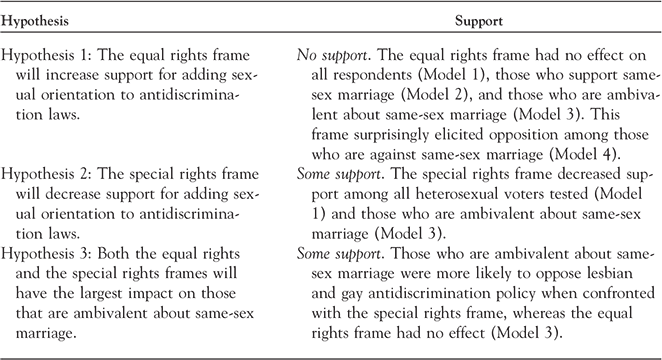
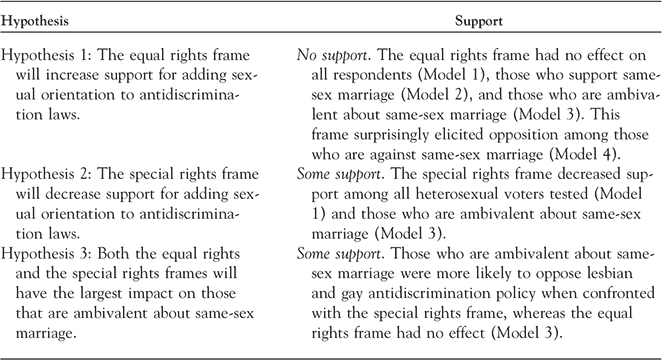
As the results above indicate, the rights frames did influence how interviewees responded to including sexual orientation in the state's antidiscrimination policy. Support for the hypotheses is summarized in Table 6. We did not find support for Hypothesis 1, which posited that the equal rights frame would increase support for such a law. We found support for Hypothesis 2, which asserted that the special rights frame would reduce support for an antidiscrimination law. We also found support for Hypothesis 3; the special rights frame had a statistically significant effect in the ambivalent, less decided group but not in the groups that held stronger convictions about same-sex marriage. Interestingly, our analysis suggests that respondents who were against same-sex marriage (Model 4 in Table 5) are more likely to oppose antidiscrimination laws when they are exposed to the equal rights frame than when they are in the control condition. Additionally, the equal rights frame has no statistically significant effect on those who support or hold ambivalent positions about legal recognitions for same-sex couples.
Summary of Support for Hypotheses
| Hypothesis | Support |
|---|---|
| Hypothesis 1: The equal rights frame will increase support for adding sexual orientation to antidiscrimination laws. | No support. The equal rights frame had no effect on all respondents (Model 1), those who support same-sex marriage (Model 2), and those who are ambivalent about same-sex marriage (Model 3). This frame surprisingly elicited opposition among those who are against same-sex marriage (Model 4). |
| Hypothesis 2: The special rights frame will decrease support for adding sexual orientation to antidiscrimination laws. | Some support. The special rights frame decreased support among all heterosexual voters tested (Model 1) and those who are ambivalent about same-sex marriage (Model 3). |
| Hypothesis 3: Both the equal rights and the special rights frames will have the largest impact on those that are ambivalent about same-sex marriage. | Some support. Those who are ambivalent about same-sex marriage were more likely to oppose lesbian and gay antidiscrimination policy when confronted with the special rights frame, whereas the equal rights frame had no effect (Model 3). |
Given our results, we present three potential explanations. First, the equal rights discourse might serve as a proxy for “liberal” or be a core component of liberal identity. That is, the equal rights frame may be a master frame that taps into liberal identity by invoking language and values that span multiple movements, including the civil rights movement and the women's rights movement, in addition to the LGBT rights movement. As a result, those who support same-sex marriage, who are also more likely to identify as liberal, already think about equal rights when they hear a liberal policy position like including sexual orientation in antidiscrimination laws. For these individuals, thus, the equal rights frame has no effect.
Second, rights discourses are constitutive in that they simultaneously serve as resources and constraints for rights movements. They give rights advocacy movements a means of defining collective grievances for mobilization purposes while also influencing how countermovements perceive and respond to calls for social change. Hence, it is reasonable for the equal rights frame to elicit opposition to adding sexual orientation to antidiscrimination policy among those who oppose same-sex marriage and for the special rights discourse to elicit opposition among heterosexual voters and those who are ambivalent about same-sex marriage in Washington State at the same time.
Third, rights discourses are the result of the symbiotic and intertwined mobilization strategizing of rights movements and countermovements—they are part of the interlocked struggle between each movement. As a result, it is possible that those who oppose same-sex marriage are reminded of the perceived threat posed by the LGBT rights movement when they hear the equal rights frame. For this reason, these individuals are more likely to oppose lesbian and gay antidiscrimination policy when confronted with the equal rights frame.
(A) Equal Rights as a Proxy for “Liberal”: Rights Discourse as a Master Frame in the LGBT Rights Movement
Our study provides no support for the contention that the equal rights frame is persuasive among the heterosexual public. While Brewer (Reference Brewer2002) demonstrated that this frame continued to influence how the public understood lesbian and gay issues in 2002, today this may no longer be the case for heterosexual voters on at least some issues, like supporting pro–lesbian and gay antidiscrimination policy. We argue that the equal rights frame's indifferent effect on those who already support the legal recognition of same-sex couples may lend some insight as to why. Many who strongly support lesbian and gay rights identify with the ideological left (Pew Research Religion & Public Life Project 2012). We believe that the longstanding presence of the equal rights frame within liberal ideology may explain why this frame does not have an effect on those who support same-sex marriage.
The equal rights frame has been part of the ideological psyche of those on the political left since at least the 1950s and 1960s, when both African Americans and women adopted it in order to express their grievances and organize support for their social causes in civil rights movement and women's rights movement activism (Benford and Snow Reference Benford, Snow, Morris and Mueller1993; Richman Reference Richman2005; Pedriana Reference Pedriana2006). As a result, the equal rights frame could currently be so ingrained in liberal identity that it already impacts and guides liberal perceptions of political policies whether or not liberals are aware of it. In other words, for liberals the equal rights frame is linked with their internal ideology and values and, as a result, serves as a proxy for “liberal.” For those who support same-sex marriage, the equal rights frame does not further mobilize them in support of adding sexual orientation to antidiscrimination policy because they are already always thinking about policy through an equal rights/liberal lens regardless of whether or not they are confronted with a rights frame.
(B) Rights as Constitutive: Rights Discourse as a Resource and Constraint for the LGBT Rights Movement
The support for Hypothesis 2 (that the special rights frame will reduce support for including sexual orientation in antidiscrimination law), given the lack of support for Hypothesis 1 (that the equal rights frame will increase support), is likewise quite intriguing. Although the failure of the equal rights frame is different from what was anticipated in Hypothesis 1, the opposition to lesbian and gay antidiscrimination policy that the special rights frame elicits actually supports legal mobilization scholars' research regarding the constitutive nature of rights discourse within social movements.
McCann (Reference McCann1994) asserts that the primary project of legal mobilization is “to analyze the constitutive role of legal rights both as a strategic resource and as a constraint for collective efforts to transform or ‘reconstitute’ relationships among social groups” (7, emphasis added; see also Goldberg-Hiller Reference Goldberg‐Hiller2002; Lovell Reference Lovell2012). For McCann and many legal mobilization scholars, the development of a grievance discourse is not limited to rights movement activists, but also encompasses the discursive strategies of countermovement groups. Thus, one would expect rights and counter-rights discourses to have varying persuasive ability depending on context and audience—as the dueling discourses in our survey experiment do.
The special rights discourse appears to be effective in influencing greater opposition to a pro–lesbian and gay policy among some heterosexual voters in Washington State, at least at the moment the survey experiment occurred. In contrast, the equal rights discourse appears both unable to influence public opinion in general and to effect greater opposition to the same policy among certain populations in Washington State. In accordance with the arguments of legal mobilizations scholars, it may be that, because rights discourse is indeterminate and constitutive, the meaning of rights varies greatly depending on context, space, and time. Thus, when considering how to use a rights frame in heterosexual public advocacy, it is crucial for activists to consider the multiplicity of factors that influence the interpretation of rights. That is, advocates should consider carefully the audience and political context through which rights are interpreted when using rights framing.
(C) The Interconnection between Movement and Countermovement Discourse
The final explanation for our results combines the constitutive understanding of rights discussed above with sociolegal scholarship that argues that movement and countermovement advocacy is interconnected rather than merely causally linked. The most intriguing finding in our study is that those who oppose same-sex marriage likewise oppose adding sexual orientation to antidiscrimination policy when confronted with the equal rights frame to an even greater degree than when they are confronted with either the special rights frame or no frame at all. It is possible that, for those opposed to same-sex marriage, equal rights occupies the same political space as the special rights frame. Thus, for those who are opposed to same-sex marriage, hearing the equal rights is a reminder of the opposition and is perceived as a direct threat to their own identity in the political struggle to maintain the dominant social order. Consequently, reminded of a moral and political threat, these individuals respond more negatively to adding sexual orientation to antidiscrimination policy when they hear the equal rights frame than when they hear no frame or the special rights frame alone.
This argument is supported by sociolegal scholarship that finds that there is an interconnected, symbiotic relationship between the strategizing of rights advocacy movements and countermovements. Same-sex marriage, some argue, became a leading LGBT rights issue because of the anticipatory countermobilization conducted by the countermovement when the public and elected officials largely opposed that issue (Dorf and Tarrow Reference Dorf and Tarrow2014; see also Fetner Reference Fetner2008). The LGBT rights movement largely adopted same-sex marriage as a movement issue in response to countermovement mobilization and grassroots pressure to respond to countermovement advocacy. Similarly, the countermovement developed the special rights discourse out of a desire to mobilize supporters and reach out to the broader public in response to LGBT rights movement mobilization. Due to this interconnection between rights advocacy and countermobilization, our findings support the contention that, when using rights frames in advocacy, it is important to recognize that these frames can be assimilated in vastly different ways depending on audience and context.
Conclusions
Given that the equal rights frame was unable to influence public opinion on antidiscrimination policy within the limited confines of our survey experiment in Washington State, a future study is necessary in order to determine if another, non–rights based frame is better suited for pro–lesbian and gay advocacy on antidiscrimination policy in similar state contexts. The news reports discussed at the beginning of this study argue that pro–lesbian and gay advocates have had more success mobilizing the public around same-sex marriage by using personal narratives and discourse frames that focus on love and commitment. Future research could test this assertion by using a survey experiment, similar to the one conducted in this study, that tests non–rights based framing (e.g., love and commitment frames) and special rights framing in order to determine which framing strategy most resonates with the American public with respect to antidiscrimination policy.
Future research should also explore why the equal rights discourse continues to elicit opposition among some of the heterosexual public and does not have an effect on at least some LGBT rights movement issues. Presumably, the equal rights discourse once resonated with large segments of the American public during the early days of the civil rights movement. However, when the discourse is applied to lesbian and gay antidiscrimination policy in Washington State today, it appears to have the opposite of its intended effect among those opposed to same-sex marriage and no effect at all among the heterosexual population at large. Might this suggest a divergence between LGBT and traditional civil rights movement politics, or is the American public merely oversaturated with the equal rights frame in some contexts? Is it possible that the equal rights frame's alignment with liberal identity somehow invokes skepticism rather than support among those who oppose same-sex marriage? Future research should delve into these questions in order to understand more fully how rights and non–rights based discourses operate in LGBT politics in contemporary America.
LGBT rights movement leaders now believe that the equal rights frame does not move the average voter on same-sex marriage in at least some contexts (Brydum Reference Brydum2012; Lopez Reference Lopez2012). This study suggests the equal rights frame may now be ineffective on other gay and lesbian issues beyond same-sex marriage in some arenas. While hearing a special rights frame is associated with a lower probability of support for antidiscrimination laws, there is little evidence to suggest that invoking equal rights has a positive effect on support for these laws. What's more unexpected is that exposure to the equal rights frame appears to generate increased opposition among those who are already opposed to some lesbian and gay civil rights. Overall, the survey experiment reported here does indicate that rights discourses have the ability to influence public opinion; however, the impact of discourses differs depending on the audience and context. Given the complexity and unpredictability of our findings, it is our hope that additional research will further uncover the mechanisms of rights framing and the dynamics of other discourses that surround the struggle over lesbian and gay rights.