Introduction
Addressing mental health in an era of smart decarceration
For the first time in nearly four decades, the incarcerated population in the United States has begun to level off and decline, suggesting that mass incarceration has reached a tipping point.Reference Epperson and Pettus-Davis 1 Additionally, there is growing empirical evidence that incarceration does not meet its stated goals of increasing public safety and rehabilitating individuals; in most cases, incarceration does just the opposite.Reference Travis, Western and Redburn 2 Incarceration is also not applied evenly, as people of color and people with behavioral health disorders are grossly overrepresented in jails and prisons.Reference Mauer 3 –Reference Fazel and Danesh 5 In recent years, criminal justice systems across the country have begun to develop new decarceration policies and practices in attempts to reduce the overuse of incarceration.Reference Doob and Webster 6 However, decarceration efforts will be most successful if they intentionally target and reverse disparities, an approach termed “smart decarceration.”Reference Epperson, Pettus-Davis, Epperson and Pettus-Davis 7
This article presents a smart decarceration approach to addressing mental health disparities in the criminal justice system, with a particular focus on probation. First, we discuss the role of probation within the criminal justice system and the complex needs of probationers with serious mental illnesses (SMI). We then describe the multistage collaborative development of an intervention that focuses on building a therapeutic relationship between probation officers and probationers with SMI in order to better address their unique and complex needs. We present findings on intervention content as a result of a stakeholder-engaged process, as well as acceptability and feasibility findings through qualitative interviews and observations with probation officers and probationers with SMI.
Probation as a key site for intervention
There are nearly seven million people under the control of the U.S. criminal justice system and more than half of these individuals are on probation, making probation the largest segment of the criminal justice system.Reference Kaeble, Glaze, Tsoutis and Minton 8 Probation entails a “community supervision” sentence, often in lieu of incarceration, with specific court-ordered conditions such as abstinence from substances, avoiding additional criminal activity, and engaging in rehabilitative supports. People on probation are at a critical juncture, either successfully completing the terms of probation and exiting the criminal justice system or violating the terms of their supervision and falling deeper into the system via incarceration.
For decades, a persistent overrepresentation of people with mental illnesses has been documented in the criminal justice system.Reference Steadman, Osher, Robbins, Case and Samuels 4 , Reference Fazel and Danesh 5 As a result, probation departments across the United States supervise approximately half a million probationers with SMI, which includes schizophrenia spectrum, bipolar spectrum, and major depressive disorders.Reference Skeem, Emke-Francis and Eno Louden 9 As highlighted in the Sequential Intercept Model,Reference Munetz and Griffin 10 a framework that details opportunities for intervening with justice-involved persons with SMI, service provision is needed across continuous points of contact in the criminal justice system. Key tasks of those who work throughout the system include identifying justice-involved persons with SMI and providing them with linkages to mental health treatment, counseling and psychiatric care, as well as other needed wraparound services such as family, housing, and employment supports. Despite probation being an optimal site for intervention, there is limited research that has fully developed the capacity of probation to meet the multifaceted legal and treatment needs of justice-involved persons with SMI.Reference Epperson, Wolff, Morgan, Fisher, Frueh and Huening 11 , Reference Wolff, Frueh and Huening 12
Addressing the complex needs of persons with SMI presents unique challenges to probation departments. When persons with SMI are sentenced to probation, the symptoms of their disorders often hinder the individual’s ability to successfully comply with the terms of their probation, further exacerbating the difficulties associated with successful community tenure. 13 Compared with those without mental illnesses, probationers with SMI have a greater likelihood of violating their probation and are at higher risk of reincarceration.Reference Louden, Skeem, Camp and Christensen 14 Probationers with SMI are also more likely to have a co-occurring substance use disorder than those without SMI,Reference Lurigio, Cho, Swartz, Johnson, Graf and Pickup 15 resulting in a greater need for integrated treatment services for both types of disorders.Reference Solomon, Draine and Marcus 16 Meeting the treatment needs of probationers with SMI while simultaneously assessing and intervening on criminogenic risk factors have become tandem goals for probation departments.Reference Morgan, Flora, Droner, Miles, Varghese and Steffan 17 , Reference Babchuk, Lurigio, Canada and Epperson 18
Due to the influx of individuals with SMI in probation departments, specialized mental health probation caseloads have grown considerably over the last 25 years. Consisting of probation officers who have been trained in supervising probationers with SMI, specialized mental health probation is one of the most prevalent criminal justice/mental health collaborative models, next to mental health courts, and has been designed to more effectively meet the needs of probationers with SMI. In specialized mental health probation units, probation officers are tasked with serving dual law enforcement and case management types of functions. For example, specialized probation officers receive mental health training, work to establish relationships with local mental health treatment and wraparound service providers, and utilize problem-solving approaches (eg, case management, counseling techniques) to better link probationers with SMI to needed services.Reference Babchuk, Lurigio, Canada and Epperson 18
Research on the positive effects of specialized probation on reducing criminal justice involvement for probationers with SMI has grown in recent years. In a longitudinal study designed to test whether use of specialized mental health caseloads resulted in better public safety outcomes than standard probation programming, those probationers assigned to specialized probation were less likely to be rearrested for any crime than probationers in the standard group, with this effect lasting for up to 5 years after program enrollment.Reference Skeem, Manchak and Montoya 19 Another study found a greater decrease in jail days for people on specialized probation compared with probationers with SMI on standard probation, although there was also an increase in probation violations.Reference Wolff, Epperson, Shi, Huening, Schumann and Rubinstein 20 In a study comparing specialized and standard probation approaches, specialized mental health probation officers were able to establish higher quality relationships with probationers, participate more directly in probationer treatment, utilize positive compliance strategies, and report fewer violations than the standard probation group.Reference Manchak, Skeem, Kennealy and Louden 21 Most recently, Skeem et al found that use of specialized mental health caseloads was more cost-effective than standard probation in supervising probationers with SMI due to savings associated with reduced recidivism and behavioral health care costs.Reference Skeem, Montoya and Manchak 22
Importance of the therapeutic relationship
A positive working relationship between professional and client is a key ingredient in effective delivery of human services.Reference Epperson, Thompson, Lurigio and Kim 23 This working relationship is achieved through a shared understanding of goals, clear assignment of therapeutic tasks, and development of a bond between worker and client.Reference Bordin 24 Studies across a range of therapeutic services have identified essential therapist characteristics that positively influence the working relationship, including attributes such as warmth, empathy, and trustworthiness and techniques such as exploration, reflection, and conveying support.Reference Ackerman and Hilsenroth 25 Thus, the therapeutic relationship (also referred to as working relationship or working alliance) is a strong predictor of clinical outcomes, particularly for people with mental health and substance use disorders.Reference Martin, Garske and Davis 26
Growing evidence demonstrates that the importance of building a therapeutic relationship is also critical within criminal justice settings such as probation, and this is particularly true of programs that work with clients with SMI.Reference Canada and Epperson 27 Studies examining the effectiveness of specialized programming for justice-involved persons with SMI consistently agree that sole reliance on surveillance and punishment is ineffective at improving mental health and preventing further criminal justice involvement.Reference Lamberti 28 Working with probationers with SMI complicates the work of the probation officer to include roles such as advocate, helper, and confidant, and conflict between these support-oriented and law enforcement roles can hamper the effective work of probation officers.Reference Clear and Latessa 29 , Reference West and Seiter 30 In order to successfully navigate these roles, officers must build a positive therapeutic relationship with their clients in order to address sensitive issues such as mental health symptoms and specific treatment needs.Reference Seiter and West 31 , Reference Skeem and Eno Louden 32
Although limited in scope, several empirical studies have shown that a positive probation officer/client therapeutic relationship is related to several desired outcomes, including reduced substance use,Reference Blasko, Friedmann, Rhodes and Taxman 33 response to treatment for spousal abuse,Reference Brown and O'leary 34 and reduced criminal recidivism, including lessened time spent in jail.Reference Skeem, Eno Louden, Polaschek and Camp 35 –Reference Walters 37 Although most research on the therapeutic relationship in community supervision settings has been conducted with the general probation and/or parole population, some work has explored this relationship specifically among justice-involved persons with SMI, identifying key characteristics of a positive therapeutic relationship such as caring, fairness, trust, and support.Reference Epperson, Thompson, Lurigio and Kim 23 , Reference Latessa, Lemke, Makarios and Smith 38 , Reference Kennealy, Skeem, Manchak and Eno Louden 39 Moreover, successful engagement of justice-involved persons with SMI is related to an increased sense of procedural justice (or fairness) and lower perceptions of coercion, both of which are indicators of higher participation in mental health treatment and criminal justice programming.Reference Canada and Watson 40 –Reference Watson and Angell 41
In a study conducted by members of the study team,Reference Epperson, Canada, Thompson and Lurigio 43 qualitative interviews with 21 probation officers were conducted to better understand how officers in a specialized mental health probation unit, mental health court, and standard probation program utilize different supervision approaches and balance the perceived dual roles of law enforcement and rehabilitation when working with SMI probationers. As part of the same study, researchers analyzed data from a sample of 98 probationers with SMI who completed the Dual-Role Relationship Inventory—Revised (DRI-R),Reference Skeem, Eno Louden, Polaschek and Camp 35 as well as qualitative interviews in which probationers discussed their experiences with probation officers while on specialized and standard probation. The DRI-R was developed to assess the quality of relationships between justice-involved individuals and the professionals who supervise them, and the developers state that the instrument is best validated for probation and parole settings.Reference Skeem, Eno Louden, Polaschek and Camp 35 After controlling for significant covariates, probationers in mental health court rated the quality of their relationships with their probation officers higher than probationers in specialized mental health probation or standard probation groups.Reference Epperson, Thompson, Lurigio and Kim 23 However, officers who were assigned to supervise mental health caseloads were perceived by the probationers under their supervision as more caring, trustworthy, supportive, and less authoritarian than those probationers assigned to standard probation. The authors conclude that being treated with genuine care, fairness, and support is therapeutic and can be transformative for probationers with SMI. The challenge, however, is the operationalization of these ideas into regular day-to-day practices within probation programs.Reference Epperson, Thompson, Lurigio and Kim 23 Some existing probation officer training programs address core correctional practices including limited content on relationship quality, but these approaches have not been adapted for probationers with SMI.Reference Robinson, Lowenkamp, Holsinger, VanBenschoten, Alexander and Oleson 44 , Reference Smith, Schweitzer, Labrecque and Latessa 45
Although these studies demonstrate that the quality of the relationship between officer and client is a critical ingredient in achieving better mental health and criminal justice outcomes, no evidence-based interventions have been developed to target this relationship among probationers with SMI. The purpose of this study was to engage in a collaborative process to develop a probation officer-led intervention that aims to enhance the therapeutic relationship between officers and probationers with SMI. We discuss a systematic process of engagement with a range of stakeholders to identify core intervention components, and assess their acceptability and feasibility in a real-world probation setting. Within this approach, the building of a therapeutic relationship is conceptualized as a foundational element on which additional intervention components can be delivered to facilitate service engagement and reduce criminal justice involvement for people with SMI on probation.
Methods
BIPSE intervention development process
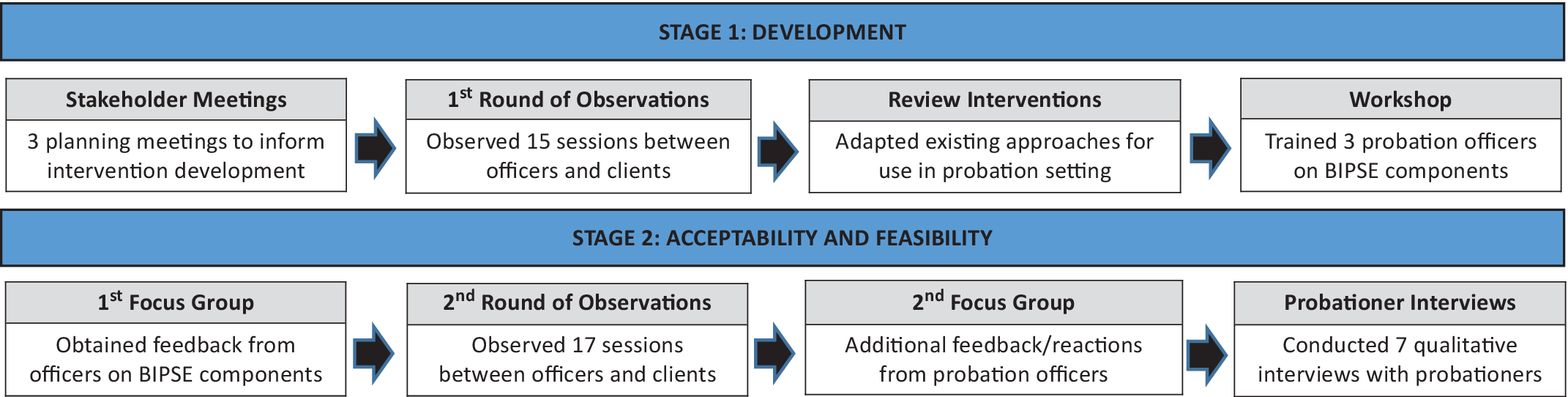
This section focuses on the iterative process undertaken by our team to develop and refine an intervention, named Brief Intervention to Promote Service Engagement (BIPSE), designed specifically to assist probation officers who work with people on probation with SMI. We took a “design for implementation” approach to the development of this intervention, in which we sought to engage key stakeholders in an iterative planning process, in order to accelerate the intervention’s implementation in a real-world probation setting.Reference Epperson and Sawh 46 The process began by convening collaborative stakeholder meetings with staff from the proposed implementation site—a specialized mental health probation unit within a large Midwestern U.S. adult probation department. Stakeholder meetings were comprised of probation officers and unit supervisors, community-based mental health treatment providers, individuals with SMI who were previously on probation, and representatives from local and regional advocacy groups. Three stakeholder meetings were held over the course of 6 months, with an average of 15 stakeholders attending each meeting. Each stakeholder meeting focused on generating priority areas for intervention through a process of facilitated discussion, consensus-building, and articulation of follow-up action steps. Between stakeholder meetings, members of the research team conducted literature and intervention reviews to identify content and approaches that aligned with topics prioritized by the stakeholder group. We also held additional consultation meetings with probation staff and supervisors in order to gain a better sense of the unit’s practices and procedures.
The stakeholder meetings helped to elicit probation officer priorities, tasks, and roles, and also elucidated personal and treatment needs of persons with SMI on probation. Several consistent themes emerged from these meetings, most of which focused on enhancing the probation process to help probationers with SMI connect to needed services in order to achieve greater stability and avoid unnecessary punishment. These conversations often came back to the central issue of the relational dynamics between probation officer and client, and the foundational importance of clients being able to trust and engage with their probation officer in order to discuss issues of mental health, substance use, relationships, and other personal needs. This theme resonated with earlier research our team had done with probationers with SMI, who emphasized the interconnection of trust, support, and caring as powerful components of a relationship with their probation officer that facilitated motivation and engagement in services.Reference Epperson, Thompson, Lurigio and Kim 23 Furthermore, stakeholder meetings addressed logistical issues such as existing training and stated needs of officers, examination of current probation protocols and required paperwork, and officer acceptability of intervention concepts.Reference Epperson and Sawh 47
Next, members of the research team observed 15 scheduled sessions with mental health unit probation officers and their clients with SMI in order to better understand the context and environment in which probation supervision meetings take place. Observations of probation officer/client interactions yielded important information, which further assisted the research team in identifying components to incorporate into the BIPSE intervention. Many scheduled sessions were not completed because of client no-shows, and completed sessions were often quite brief, with few concrete activities to structure the sessions beyond monitoring compliance of court-ordered probation conditions. Individual officers did exhibit behaviors to facilitate connection with their clients, but these strategies seemed to be limited to personal style and conversational approaches, and they were not embedded in routine probation processes. Following this first round of observations, the research team reviewed the existing research literature to identify interventions and approaches being used with the probation population. Interventions from other disciplines were also reviewed (eg, medicine, social work) to see whether it might be possible to adapt them for use within the mental health probation setting.
Collectively, the stakeholder meetings, our observations of probation officer/client interactions, and our review of the existing intervention literature led to the articulation of three key intervention components that were critical to the probation process for people with SMI: (1) engagement; (2) shared decision-making; and (3) strategic case management. The first two components, engagement and shared decision-making, were conceptualized as foundational components to establish a strong therapeutic relationship on which strategic case management approaches could be built (in this article, we will focus on these two relational components). Within these components, the research team developed and/or modified a variety of tools and activities that could be used by probation officers to develop and strengthen the therapeutic relationship (Figure 1).
Brief Intervention to Promote Service Engagement: development process.

Assessing BIPSE components
To vet the acceptability and feasibility of the BIPSE intervention materials, we conducted a three-stage process within the specialized mental health probation unit. First, we facilitated a 2-hour workshop in which we presented the materials to three probation officers who were randomly selected from the available mental health unit team. These probation officers were given a BIPSE intervention binder containing an overview of the intervention and draft activities/tools for use with their clients. Some examples of activities include a cost/benefit worksheet, goal-setting exercises, introduction to use of the teach-back method, and development of an overview of probation roles and expectations. During the workshop, we facilitated role play scenarios in which officers practiced various activities.
Following this workshop, we held two focus groups with these three officers—one immediately following the workshop and the other approximately 3 months later. In the interim, officers were asked to try out some or all of the activities with their clients as they seemed relevant and applicable. Second, during that same 3-month period, we observed 17 sessions between these three probation officers and their clients to assess whether and how any of the activities in the workshop were being used. Third, we conducted seven interviews with probationers assigned to these three probation officers to better understand how officers interact with their clients and assist them in adhering to the terms of their probation, getting linked to treatment and other needed wraparound supports, achieve their goals, and the extent to which the components of engagement and shared decision-making facilitated these processes.
Focus groups and individual probationer interviews were audio recorded and transcribed verbatim. For observations of sessions between probation officers and clients, field notes were written at the conclusion of each meeting. The focus group and interview transcripts and observation notes were analyzed for thematic content related to the development of a therapeutic relationship within the context of a specialized mental health probation unit.
Results
The iterative and stakeholder-engaged BIPSE development process led to the articulation of two key intervention components that target the development of a therapeutic relationship between probation officer and client: (1) engagement and (2) shared decision-making. Within the BIPSE intervention, these two components are viewed as a necessary foundation on which strategic case management services can be delivered to address mental health needs, criminal risks, and attending to the multiple support and compliance-monitoring functions that are required when supervising probationers with SMI. In this section, we describe the two relational BIPSE components of engagement and shared decision-making, as well as findings from focus groups, observations and interviews on the feasibility and acceptability of activities and processes related to each component. We also present findings on the re-examination of probation officer roles in the context of building a therapeutic relationship with clients.
BIPSE component: engagement
Engagement as a core relational practice
Probation settings are characterized by an overarching climate of power differentials and compliance-monitoring in which the enforcing of probationers’ adherence to court conditions typically relies on punitive sanctions and, in cases of repeated noncompliance, unsuccessful termination from probation and incarceration.Reference Epperson, Sarantakos, Thompson and Self 48 Successful engagement of probationers with SMI is the first and core focus area of BIPSE, serving as a foundation for other intervention components. Through our previous review of relevant literatures and interventions, we have identified several promising characteristics that informed engagement-focused intervention activities. First, intentional engagement should begin with the probation officers’ very first encounter with a probationer, and the first several months of probation supervision are a key period for continued engagement activities. Initial engagement activities we included in BIPSE involve an initial phone check-in prior to the first probation meeting,Reference McKay, Hibbert and Hoagwood 49 discussion of probationer life goals and incorporation of some of these goals into the probation relationship and treatment planning,Reference Ward and Brown 50 and use of key motivational interviewing techniques such as affirmation and reflective listening.Reference Walters, Clark, Gingerich and Meltzer 51
Opportunities for engagement
In our workshop of BIPSE components with probation officers, we defined engagement as “Effort made by the officer to connect with and develop a relationship with a client in such a way that encourages and maintains the client’s active interest and participation in completing probation successfully.” Elements of engagement that were discussed as being most salient were building rapport, demonstrating respect, seeking feedback, focusing on immediate concerns, and clarifying the process of probation. Probation officers noted that effective engagement was a critical component of their work in supervising probationers with SMI. As one officer stated: “It’s important that they are not only engaged in what is asked of them on probation but engaged in their treatment, because it’s a very collaborative effort between the treatment providers and us to get them through probation successfully.” Several probationers also reflected in their interviews that attempts by their probation officer to engage and connect with them were appreciated and effective, as illustrated by this quote from a probationer who had previously been on probation in another unit: “It’s completely different. It’s like coming here, I’m not afraid. I’m not fearful, like, oh am I going to be in trouble if I go there and see them? I’m kind of like, excited to come here, it’s like a little therapy session.”
One element of engagement that was deemed highly acceptable by officers and probationers was the task of clarifying the process and expectations of probation. Probationers expressed that they were not always aware of all the terms and requirements of specialized mental health probation and thought that it would be helpful to have more communication around these requirements and how probation officers could support them. Officers also acknowledged that existing intake materials were somewhat confusing for their clients with SMI, and that providing clear and understandable expectations could be a key task in early probation engagement. In response to the presentation of the teach-back method, an approach commonly used in healthcare settings to ensure that information was communicated effectively,Reference Dinh, Bonner, Clark, Ramsbotham and Hines 52 one probation officer noted how this approach could facilitate engagement and relationship-building: “I also see the usefulness of the teach-back method. Especially how on the back end, you can do like a review with the client, make sure that they understand what’s expected of them. I think that it promotes their engagement in probation as well as in whatever task is being set before them. I think it promotes the relationship between the client and the officer as well.”
BIPSE component: shared decision-making
Shared decision-making is well-established as a critical element for persons with SMI to actively and meaningfully participate in their treatment to achieve better outcomes.Reference Joosten, DeFuentes-Merillas, De Weert, Sensky, Van Der Staak and Jong 53 –Reference Adams, Drake and Wolford 55 For many probationers with SMI, probation serves as the gateway for linkage to needed mental health treatment and other wraparound supports. Thus, it is critical for probationers with SMI to share decision-making opportunities with their probation officer in the context of their probation supervision. However, power differentials present barriers to probationers having a more active role in their treatment, and officers are frequently unable to scale back their own power to facilitate greater involvement by probationers.Reference Epperson, Canada, Thompson and Lurigio 43 A core focus area of BIPSE involves helping officers to identify and utilize opportunities for probationers with SMI to make collaborative decisions regarding their treatment plans.
Facilitating shared decision-making
In the BIPSE workshop, we stressed that it is important for probation officers to clearly explain the dynamics of probation, the various roles and functions officers must take on, and the responsibilities and expectations of probationers. Establishing open communication between officer and client is critical to creating an environment in which probationers with SMI feel empowered to express their preferences. Therefore, probation officers must be trained to identify key opportunities where probationers can be invited to discuss options and weigh-in on decisions.Reference Elwyn, Frosch and Thomson 56 BIPSE incorporates several structured activities for probation officers through which they can facilitate shared decision-making with their SMI clients about issues such as treatment referrals, timing and location of probation appointments, articulation of goals and objectives, and building of problem-solving skills. During initial BIPSE development, we incorporated elements of shared decision-making to facilitate greater participation by probationers in probation activities, increased choice-making, reduced perceived coercion, and increased perceptions of procedural justice, as each of these mechanisms has been shown to be related to greater service engagement (Figure 2).Reference Watson and Angell 41 , Reference Joosten, DeFuentes-Merillas, De Weert, Sensky, Van Der Staak and Jong 53 , Reference Munetz, Ritter, Teller and Bonfine 57
Brief Intervention to Promote Service Engagement: intervention components and targets.

Probation officers and probationers alike endorsed the acceptability of the BIPSE intervention component of shared decision-making. As one officer stated regarding their work with probationers with SMI, “If they are having input on the decision of maybe where to do treatment or what type of treatment program they want to enter, they are more likely to engage in and complete it successfully. It kind of helps them come to a more prosocial way of thinking through working with them and making better decisions.” Beyond treatment-focused decisions, the goal-setting BIPSE component, in which probation and nonprobation-related goals are elicited from the client, generated an opportunity for probation officers to learn about their client’s goals and priorities and how to form a shared approach to achieving them. Reflecting on this as a positive experience with their probation officer, one probationer stated, “Yeah, they try to help you figure out what your goals are…she (officer) pretty much wants to know my goals.”
During our observations of officer and probationer meetings, one officer elected to utilize the BIPSE cost/benefit worksheet to discuss an issue of probationer noncompliance. In response to a probationer testing positive for drug use, the probation officer employed the worksheet to elicit from the probationer their perceptions of the negative and positive aspects of using drugs. Through the completion of the worksheet, the probationer revealed that using drugs helped them to escape feelings of loneliness, as they have a deep desire to be in an intimate relationship. Learning this new information, the probation officer was able to validate the probationer’s feelings and acknowledge their personal goal. As opposed to using a punitive-based approach, the officer’s use of the cost/benefit worksheet facilitated a collaborative discussion on how to avoid future drug use in which the probationer was an active participant. The officer later reflected on this interaction and how it helped navigate role conflict, stating, “That could have been a challenging confrontation, but instead I felt like we were working on the problem together.”
Re-examining probation officer roles
During the focus group immediately following the BIPSE workshop, probation officers expressed that they would be willing to try using some of the tools we provided in their day-to-day practice. However, officers pointed out that they already informally used aspects of several of these relational strategies. Officers also liked the way in which certain tools were designed and could envision using them with their clients as these tools provided a way for them to incorporate input from their clients into the session. Officers acknowledged that they often struggled with connecting with their clients, stating that many clients were unable or unwilling to open up to them. What became clear through our observations of probation meetings was that officers may occasionally employ relational strategies with their clients, but these attempts were somewhat haphazard and not connected to clear relational targets or probation processes. Additionally, officers may find it difficult to develop a therapeutic relationship in the midst of navigating tasks such as supervision, monitoring, and providing services and supports. Through our workshopping of intervention activities and providing feedback after observations, officers began to appreciate the importance of more intentionally incorporating relationship-building strategies into their regular practice, and utilizing BIPSE activities to structure and track their efforts. In this way, officers expressed a desire to build a more formalized skill set on therapeutic relationship-building with their clients.
Many of the feasibility concerns expressed by officers demonstrated limited attention to the multiple roles that probation officers embody. Although discussed in previous research as dual roles of care and control,Reference Skeem, Eno Louden, Polaschek and Camp 35 most of the structured processes and procedures that probation officers are expected to employ support the law enforcement or surveillance role. For example, we suggested that probation officers attempt to contact their new clients by phone prior to their first intake session. Although officers agreed that this could be an effective early engagement strategy, they also noted that intakes are often scheduled at the last minute, and calling ahead of time would likely be infeasible. Additionally, officers noted that a cost–benefit component was included in their existing risk assessment case planning paperwork. However, officers’ use of this cost–benefit activity seemed to be more focused on criminogenic risk reduction, and not on cultivation of a therapeutic alliance. Our observations of probation sessions confirmed that most of the officers’ activities were driven by required paperwork and case supervision tasks, and the bulk of these tasks were not directly related to therapeutic relationship-building.
Discussion
Probation officers that work with clients with SMI essentially occupy two complex and sometimes conflicting roles: a law enforcement role as an officer of the court, and a supportive role to identify treatment needs and coordinate care. This article details a process of intervention development to help officers develop a therapeutic relationship with probationers with SMI while fulfilling these two roles. Through a multistaged “design for implementation” approach, relational elements were identified as core components of effective intervention for probationers with SMI. Focusing on the therapeutic relationship between probation officer and client is supported by research that demonstrates that, particularly for probationers with SMI, the quality of the relationship is predictive of increased treatment engagement and reduced recidivism.Reference Manchak, Skeem, Kennealy and Louden 21 , Reference Skeem, Montoya and Manchak 22 Despite this evidence, no interventions currently exist that focus on the enhancement of the therapeutic relationship between probationers with SMI and their officers. As part of an overall intervention approach, key BIPSE relational components of engagement and shared decision-making are conceptualized as building the foundation of a therapeutic relationship, on which other intervention components can be built to facilitate use of mental health services and reduce criminogenic risk.
The process of the BIPSE intervention development yielded many important findings that can inform enhancement of the therapeutic relationship between probation officers and probationers with SMI. As emphasized in stakeholder meetings and in interviews with probationers, power imbalances between officer and client are a clear barrier to the development of rapport and the establishment of a collaborative working alliance. Additionally, lack of clear communication around individual and shared roles and responsibilities can result in probationers with SMI disengaging from meaningful involvement in probation supervision and related services in the community. The BIPSE component of engagement helps to overcome these barriers by establishing early and supportive methods of communication and relationship-building that demonstrate supportive officer roles and respond to immediate concerns of the probationer. By incorporating targeted elements of active listening and respect, officers can counteract perceptions of being overly punitive and harsh, replacing them with approaches that represent fairness and caring. In this way, BIPSE could serve to help officers navigate the multiple roles and identities that they must take on when supervising clients with SMI.
Shared decision-making as a core BIPSE element demonstrates promise in creating a working alliance between probationer and officer in which collaboration toward agreed-upon goals can emerge. Identifying opportunities for shared decision-making requires officers to re-examine their roles and the limitations of their own power within the therapeutic relationship. Through our workshopping of BIPSE components and focus groups with probation officers, we were able to collaboratively identify initial opportunities for a shared process between officer and client. One such example is in cases of noncompliance, wherein officers can explore the underlying issues that their clients are experiencing, and jointly develop a response that is both meaningful and supportive. This process does not require officers to cede their power, but rather to reframe the demonstration of power in order to form mutual agreement on goals and tasks with clients.
The activities related to BIPSE components of engagement and shared decision-making were viewed favorably by both probation officers and clients. However, officers suggested that they were already engaging in therapeutic relationship-building by demonstrating empathy and respect to their clients. Although a personal disposition of respect and empathy is certainly conducive to better relationship quality, we found that officers tended to rely upon common probation structures and routine practices, often to the detriment of enhancing their relationships with clients. By focusing on key relational targets and concrete associated activities, BIPSE attempts to structure and enhance relationship-building approaches by probation officers that had previously been haphazard or unplanned.
The importance of active involvement from a range of stakeholders in the BIPSE “design for implementation” development process cannot be overstated. Through our collaboration with probation officers, current and former probationers with SMI, community treatment providers and advocates, we were able to develop a shared understanding of the challenges of providing effective probation supervision to clients with SMI. Providing opportunities for probation officers to practice BIPSE activities, and eliciting feedback from probationers resulted in meaningful input on the intervention. As a result, the BIPSE components that have been developed serve to expand the scope and role of probation officers while also acknowledging the real-world constraints of supervising large caseloads with limited resources.
Our findings related to BIPSE development and refinement support the promise of additional research on the intervention. Existing activities related to engagement and shared decision-making should be further refined and tailored to fit within common probation practices, and approaches must be identified to efficiently document the delivery of intervention activities and connect them to probation officer expectations and procedures. These processes will lead to the development of a BIPSE treatment manual, which will include a more full development of the strategic case management component. Ultimately, BIPSE will be pilot tested to assess preliminary effects on hypothesized intervention targets of the therapeutic relationship, client motivation, participation in services, and perceived coercion and procedural justice. These targets will then be assessed against short-term outcomes of probation attendance, adherence, and completion, as well as longer-term outcomes of sustained mental health service engagement, mental health stability, and reduced recidivism.
Conclusion
The therapeutic relationship between probation officer and client is a critical component to programmatic success for people with SMI on probation. This study demonstrates that meaningful criminal justice-based interventions to enhance the therapeutic relationship can be built in ways that are both acceptable to officers and probationers, and feasible to implement in specialized probation practices. If interventions such as BIPSE prove to be effective, additional evidence-based interventions can be built upon this foundation of the therapeutic relationship to achieve positive mental health and criminal justice outcomes for probationers with SMI.
Acknowledgments
We would like to acknowledge the members of our stakeholder panel, people currently and formerly on probation, and probation officers for their collaborative work on this project. Additionally, we acknowledge research assistants Jesse Self, Emily Claypool, and Kathryn Frances who assisted with stakeholder meetings, focus groups, and interviews.
Funding
This work was supported by the National Institute of Mental Health (grant #K01MH103446).
Disclosure
Matthew W. Epperson, Leon Sawh, and Sophia P. Sarantakos do not have any disclosures.