Tetralogy of Fallot with pulmonary atresia represents a heterogeneous group of congenitally malformed hearts, exhibiting considerable morphologic variability, particularly with respect to the source of pulmonary arterial flow. The morphologic patterns may range from simple imperforate nature of the pulmonary valve, with branch confluent and well developed intrapericardial pulmonary arteries, to the arrangement in which there is absence of the intrapericardial pulmonary arteries, with pulmonary arterial supply derived exclusively from systemic-to-pulmonary collateral arteries.
Primarily because of the heterogeneity of the disease, several issues continue to be a matter of some controversy with regard to management. Chief among these is whether there is a single surgical approach that addresses all patients. Other issues revolve around the timing, if ever, of closure of the ventricular septal defect, and whether there is a difference between flow to the lungs provided by native intrapericardial pulmonary arteries as opposed to systemic-to-pulmonary collateral arteries. In this review, we summarise the individualized approach we have adopted to this group of defects over the past decade, our goals being: to achieve a biventricular intracardiac repair with the least number of operations, basing the flow to the lungs on the native intrapericardial pulmonary circulation whenever possible, and using unifocalized collateral arteries only when necessary.
Material and methods
Population of patients
We included all patients who undertook all of their surgical treatment at our centre for tetralogy of Fallot with pulmonary atresia over a consecutive period of 10 years. Although the presence or absence of systemic-to-pulmonary collateral arteries places patients in two distinct categories with respect to surgical options, we considered it essential to include both groups in our analysis. The groups share the same aetiology, but with different degrees of severity. They also share a common natural history, as patients without collateral arteries can potentially develop them should treatment be delayed or neglected. Moreover, the group with collateral arteries represents a continuum, and shows a transition in the clinicopathological presentation of patients without such collateral arteries. In addition, patients with two or less collateral arteries are managed like those without collateral arteries. We included in our analysis, therefore, patients with and without collateral arteries, thus providing a basis for understanding the grading and up-scaling in the complexity of surgical approach from one group to the other, as well as clarifying the foundation of our classification, which is based on the source of flow of blood to the lungs.
The study was approved by the institutional Review Board of the University Hospitals Case Medical Center, Case Western Reserve University, Cleveland, Ohio, and the requirement for informed consent was waived. Hospital, operative, and clinic records were reviewed, including pre- and post-operative echocardiographic and cardiac catheterization reports. Variables relating to outcome selected for the purpose of statistical analysis included the ratio of right ventricular to left ventricular pressures after complete repair, the number of cardiac catheterization procedures undertaken during the period of treatment, the number of surgical operations, and the group-wise mortality. The ratio of right-to-left ventricular pressures was measured directly in the operating room after complete repair.
Classification
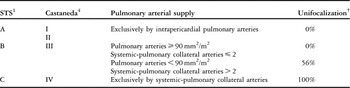
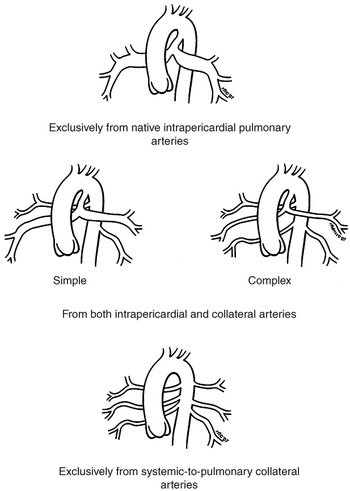
Patients were grouped with some modification (see Fig. 1 and Table 1), according to the classification recommended by the Society of Thoracic Surgeons.Reference Tchervenkov and Roy1 We grouped them into those whose pulmonary blood flow was derived exclusively from the native intrapericardial pulmonary arteries, those with flow derived exclusively from systemic-to-pulmonary collateral arteries, and those in whom it was derived from both the intrapericardial and the collateral arteries, terming the latter group the mixed type. We further divided this mixed group into simple and complex subtypes based on the pulmonary arterial index,Reference Nakata, Imai and Takanashi2 this being the sum of cross-sectional areas of the intrapericardial pulmonary arteries indexed to the body surface area, being greater than or less than 90 millimetres squared per metre squared, respectively, and the number of major collateral arteries, these being less than or greater than 2 collateral arteries, respectively.
Classification of tetralogy of Fallot with pulmonary atresia emphasizing the propensity for unifocalization of the arterial supply to the lungs.

† – Rate of unifocalization required to achieve a complete repair, as based on our experience.
Operative strategy
Patients in whom arterial flow to the lungs was derived exclusively from the intrapericardial native pulmonary arterial circulation (see Table 1 and Fig. 1) are candidates for a complete repair during one procedure that includes closure of the ventricular septal defect and reconstruction of the right ventricular outflow tract by means of either placement of a transjunctional patch, or interposition of a conduit from the right ventricle to the pulmonary arteries. Particularly in infants less than six months of age, an interatrial communication of approximately 4 millimetres in diameter is secured, either by tightening a patent oval foramen or fenestrating an intact interatrial septum. This provides a source of right-to-left shunting, often useful in the early postoperative period, and especially in younger patients. The ratio of right-to-left ventricular pressures is measured at the completion of the operative procedure in all cases. We, like others, accept a ratio of less than 0.75 as representing an adequate repair.
Patients with the mixed type of pulmonary arterial flow (see Table 1 and Fig. 1) undergo an initial palliative procedure followed by a complete repair at a separate operation. The goal of the initial palliative procedure is to promote the growth of the hypoplastic native intrapericardial pulmonary arteries, and may be accomplished by means of construction of a modified Blalock-Taussig shunt, insertion of a transjunctional patch, or the interposition of a conduit from the right ventricle to the pulmonary arteries, the decision taken depending on the size of the intrapericardial pulmonary arteries and the presence of subpulmonary muscular atresia. Prior to complete repair, all patients undergo cardiac catheterization, with possible interventional procedures as a means of recruiting bronchopulmonary segments into the pulmonary circulation, and occluding systemic-to-pulmonary collateral arteries that supply segments of lung in dual fashion. A complete intracardiac repair without unifocalization is performed as described below. Unifocalization of the systemic-to-pulmonary collateral arteries is undertaken if less than 10 bronchopulmonary segments of lung are supplied by the intrapericardial pulmonary arteries, or if the right and left pulmonary arteries have significant segmental stenosis that are not amenable to interventional cardiac catheterization procedures. The unifocalization procedure is performed as described below. A complete intracardiac repair is then performed, basing the arterial flow to the lungs on the unifocalized pulmonary circulation as described below.
Patients in whom flow to the lungs is derived exclusively from systemic-to-pulmonary collateral arteries (see Table 1 and Fig. 1) undergo an initial midline, single-stage unifocalization, with insertion of a conduit from the right ventricle to the new pulmonary arteries as discussed below. Intracardiac repair is performed in a separate operation, also as discussed below.
Midline complete unifocalization
Surgical unifocalization, as described by Reddy and associatesReference Reddy, Liddicoat and Hanley3 but with modifications, is performed if less than 10 pulmonary segments are supplied by the intarpericardial pulmonary circulation. In brief, the mediastinum is re-entered through the previously made midline sternotomy. Collateral arteries are identified and mobilized extensively according to their origin. In cases of peripheral collateral arteries, the right and left pleurae are opened widely anterior to the phrenic nerves, and the collateral arteries are divided proximally and routed posterior to the phrenic nerve. Central collateral arteries, arising from the descending aorta in the posterior mediastinum, or from brachiocephalic arteries between the aorta and trachea, and in the subcarinal space above the dome of the left atrium, are likewise widely mobilized into their respective hilums. As many collateral arteries as possible are unifocalized without cardiopulmonary bypass for as long as the clinical condition allows. Just before commencing cardiopulmonary bypass, all collateral arteries are ligated at their origin to ensure controlled perfusion, and unifocalization is achieved with partial cardiopulmonary bypass instituted at moderate hypothermia with the heart beating. The divided collateral arteries are shortened as much as possible, and are anastomosed to each other in side-to-side, tissue-to-tissue fashion. These unifocalized arteries are then transferred to the native intrapericardial pulmonary arteries, typically in an end-to-side fashion, but occasionally in a side-to-side fashion with patch augmentation.
Indications and conduct of the intracardiac repair
Patients are considered eligible for intracardiac repair if no sizable systemic-to-pulmonary collateral arteries remain, at least 10 bronchopulmonary segments of lung are supplied by the intrapericardial pulmonary arteries, the ratio of pulmonary to systemic flows is more than or equal to 2:1 on cardiac catheterization, and the pulmonary vascular resistance is judged to be low.
The repair is performed through a midline sternotomy using moderately hypothermic cardiopulmonary bypass. An aortic cross-clamp is applied and the heart is arrested with an infusion of cold blood potassium cardioplegia. All sources of known pulmonary arterial flow are controlled, and any known pulmonary arterial stenoses are repaired, primarily with the heart empty but beating. Through a right atriotomy, the ventricular septal defect is examined and closed either with an autologous pericardial patch if available, or prosthetic material if not. Attention is directed to the subpulmonary infundibulum, which is opened to excise any obstructing infundibular muscle bundles. The incision may be extended into the branches of the pulmonary trunk to widen any remaining stenosis. The repair is completed either by placing a transjunctional patch within the right ventricular outflow tract, or interposing a conduit between the distal pulmonary arteries and the infundibulotomy. Particularly in infants weighing less than 5 kilograms, an interatrial communication is secured, either by tightening a patent oval foramen or fenestrating an intact interatrial septum. The ratio of ventricular pressures is measured at the completion of the operative procedure, with the patient off cardiopulmonary bypass.
Analysis of data
All analyses were performed using SAS statistical software (version 9.1; SAS Institute, Inc, Cary, NC). Categorical data are presented as percentages accompanied by the number of cases. Continuous data are presented as the mean plus or minus the standard deviation, or medians with ranges, as appropriate. The descriptive analysis includes demographic data, the ratio of right-to-left ventricular pressures after complete repair, procedures per patient until complete repair, rate of surgical reoperations, and group-wise mortality. Time from complete repair to death or last known follow-up visit or reoperation was analyzed using Kaplan-Meier analysis. A probability value of less than 0.05 was considered significant.
Results
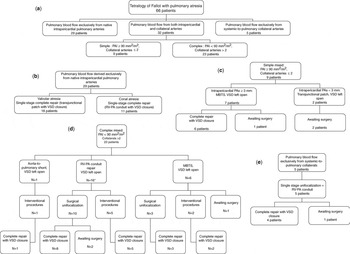
Over a consecutive ten-year period, we treated 82 consecutive patients with tetralogy of Fallot and pulmonary atresia. Of these, 16 were referred after receiving their primary operation at an outside institution and were excluded from this analysis. We analysed the remaining 66 patients, classifying them into four groups according to the scheme shown in Figures 1 and 2a. The preoperative demographic representation of the overall group is shown in Table 2.
Classification scheme of patients based on the source of pulmonary flow.

Flow diagrams (a, b, c, d and e) demonstrating classification, treatment methods and outcomes for different groups of patients (PAs, Pulmonary arteries; PAI, pulmonary artery index; VSD, ventricular septal defect; RV, right ventricle; MBTS, modified Blalock-Taussig shunt). *One patient died after initial palliation.

Preoperative demographics of the patients studied.

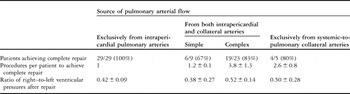
All 29 patients in whom pulmonary arterial flow was derived exclusively from the native intrapericardial pulmonary arteries, accounting for 44% of the overall group (Fig. 2a, b), underwent an initial single-stage, complete intracardiac repair. This included transatrial closure of the ventricular septal defect, and reconstruction of the right ventricular outflow tract by means of a transjunctional patch in 11 patients, or insertion of a conduit from the right ventricle to the pulmonary arteries in 18 patients. There was one death from low cardiac output, following complete repair using a homograft conduit. The mean ratio of ventricular pressures for the group was 0.42 plus or minus 0.09.
In 32 of the patients, accounting for 48% of the overall group (Fig. 2a, c, d), there was mixed flow to the lungs, derived from both intrapericardial and collateral arteries. These patients were further subdivided into a group of 9 patients with simple lesions, and 23 with complex anatomy according to the criterions laid down above.
All patients with simple morphology underwent an initial palliative procedure (see Fig. 2c), which consisted of either a modified Blalock-Taussig shunt in 7 patients, or insertion of a transjunctional patch in the other 2 patients. At the time of cardiac catheterization, each of these patients had a significant increase in the size of their pulmonary arteries, and all had a ratio of pulmonary to systemic flows of at least 2 to 1. A complete intracardiac repair had been completed in 6 patients, while 3 await surgery. There have been no early or late deaths, and the average mean ratio of ventricular pressures was measured at 0.38 plus or minus 0.27. As this group had only two or less collateral arteries, no surgical unifocalization procedure was needed, and the collateral arteries were either coiled preoperatively, or ligated intraoperatively during complete intracardiac repair.
All the 23 patients with the complex variant of pulmonary flow, accounting for 35% of the entire group (Figs. 2a, d) also underwent an initial palliative procedure. This included placement of a conduit from the right ventricle to the pulmonary arteries in 16 patients, construction of a modified Blalock-Taussig shunt in 6 patients, and a direct anastomosis of the pulmonary trunk to the aorta in the other patient. There was one death, presumed to be due to low cardiac output, this following insertion of a homograft conduit.
Following the initial palliative procedure, cardiac catheterization demonstrated at least 10 bronchopulmonary segments supplied by the intrapericardial pulmonary circulation in 8 patients. Interventional cardiac catheterization procedures alone, which included occasional dilation of stenotic pulmonary arteries and coil-embolization of collateral arteries that were dually supplying segments of lung, were sufficient to prepare the patient for a complete intracardiac repair without surgical unifocalization. These 8 patients have completed their intracardiac repair without the need for unifocalization.
The 13 remaining patients in the complex group with mixed arterial supply, however, had less than 10 bronchopulmonary segments supplied by the intrapericardial pulmonary arteries, and underwent unifocalization as described above. After unifocalization, interventional cardiac catheterization procedures were common, and included dilation of stenotic pulmonary arteries, often with cutting balloons, and coil-embolization of collateral arteries of segments of lung with dual supply. To date, intracardiac repair has been completed in 11 of the 13 patients as described above, and 2 await surgery.
Of the 23 patients in the complex group, 1 (4%) died, 8 (35%) underwent complete repair without surgical unifocalization, 11 (48%) underwent complete repair with surgical unifocalization, and 3 (13%) await surgery to complete repair. The mean ratio of ventricular pressures for the group was measured as 0.52 plus or minus 0.14.
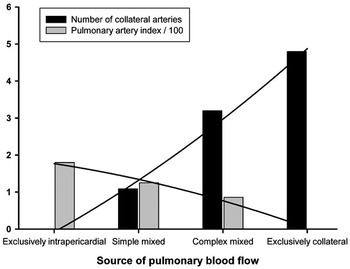
All patients with mixed flow who had a pulmonary arterial index measured to be greater than 90 millimetres squared per metre squared were able to undergo a complete intracardiac repair without the need for surgical unifocalization. An inverse relationship was found between the preoperative pulmonary arterial index and number of collateral arteries (Fig. 3, Spearman correlation coefficient of −0.98 and probability value of 0.02). This cut-off for the index correlates roughly to 2 collateral arteries. All patients who met these two criterions, namely a pulmonary arterial index of greater than 90 millimetres squared per metre squared and who had less than 2 collateral arteries, underwent successful completion of their intracardiac repair without unifocalization.
Relationship between the pulmonary arterial index and number of systemic-to-pulmonary collateral arteries for the 4 groups, showing an inverse relationship.

In 5 patients, accounting for 8% of the overall population (Fig. 2a, e), pulmonary arterial flow was derived exclusively from major systemic-to-pulmonary collateral arteries, with absence of the intrapericardial pulmonary arteries. All the patients underwent an initial midline single-stage unifocalization, as described above, with insertion of a conduit from the right ventricle to the unifocalized pulmonary arteries. The initial palliative procedure was followed with a complete intracardiac repair during a separate operation in four patients, and one awaits complete repair. The mean ratio of ventricular pressures was measured at 0.50 plus or minus 0.28.
All patients who underwent surgical unifocalization underwent a midline single-stage procedure. No patients required sequential unifocalization. We, and others, believe that any collateral artery above the diaphragm can be accessed through a median sternotomy by opening both pleural spaces completely. The midline sternotomy has to be somewhat extended and the sternum widely separated. Entering both pleural spaces, and sequentially bringing each of the lungs out, allows one to gain exposure from the diaphragm to the aortic arch. Moreover, our patients had a mean age of 7.8 plus or minus 6.4 months, making the midline approach relatively easy. Lastly, most of the collateral arteries encountered rise from the posterior mediastinum, and access can be achieved through opening the floor of the pericardial reflection in the transverse sinus and dissecting the posterior mediastinal soft tissues to expose the targeted aortic segment.
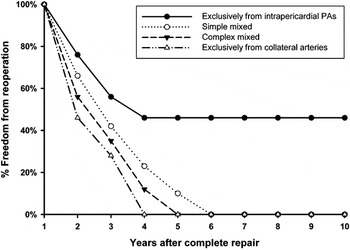
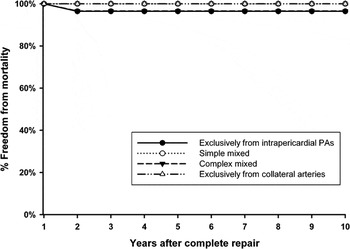
To date, for the entire group, a complete intracardiac repair has been achieved in 58 of the 66 patients (88%), with 6 patients (9%) awaiting complete intracardiac repair. For each group, the number of patients achieving a complete repair, the average number of procedures per patient to achieve complete repair, and the post-repair right-to-left ventricular pressure ratios is given in Table 3. The freedom from reoperation after 10 years, and survival, is shown in Figures 4 and 5. The overall survival for the group, with 2 patients dying, is 97% at a mean follow-up of 5.6 plus or minus 2.3 years, with a range from 1 to 10 years.
Outcomes following surgical procedures.

Kaplan-Meier freedom from reoperation for 4 groups.

Kaplan-Meier actuarial survival for 4 groups after complete repair.

Discussion
Castaneda and associatesReference Castaneda, Mayer and Hanley4 categorized tetralogy of Fallot with pulmonary atresia into four groups based on the anatomy of the pulmonary arteries (see Table 1). In their first and second groups, flow of blood to the lungs is provided exclusively by native intrapericardial pulmonary arteries, the single difference being that the pulmonary trunk is present in the first group, but absent in the second. In their third group, pulmonary arterial flow is provided by both native intrapericardial pulmonary arteries and systemic-to-pulmonary collateral arteries, much like our mixed group. In their final group, pulmonary arterial flow is provided exclusively by systemic-to-pulmonary collateral arteries, in absence of the native intrapericardial pulmonary arteries.
A simpler classification is suggested by The Society of Thoracic Surgeons “Congenital Heart Surgery Nomenclature and Database Project,Reference Tchervenkov and Roy1 albeit also based on pulmonary arterial flow (see Table 1). In their first group, pulmonary flow is derived exclusively from the native intrapericardial pulmonary arteries; in the second group from both native and collateral arteries; and in their third group exclusively from collateral arteries.
The two schemes, along with the one we have used in our study, closely resemble each other, but show some important differences (Table 1, Fig. 1). The principal issue concerning management revolves around the need to unifocalize the collateral arteries in order to achieve a complete intracardiac repair. An analysis of the relationship between the pulmonary arteral indexReference Nakata, Imai and Takanashi2 and the number of collateral arteries found a statistically significant inverse relationship between these two measurements (Fig. 3). When relating these two variables, and looking at the pulmonary artery index as a continuous variable, with the frequency of unifocalizing the systemic-to-pulmonary collateral arteries, a reliable cut-off can be made at a pulmonary arterial index of 90 millimetres squared per metre squared and the preoperative presence of 2 collateral arteries. Specifically, patients who met these criterions, producing our mixed but simple group, are surgically akin to patients with no systemic-to-pulmonary collateral arteries, in that they do not require unifocalization in order to achieve a complete intracardiac repair. Moreover, patients in the mixed but complex group are more akin to those in whom flow to the lungs is derived exclusively from systemic-to-pulmonary collateral arteries, who regularly rely on unifocalization to achieve a complete repair.
The 2 groups shown in Table 1 are simple to address from a surgical perspective. Patients in whom pulmonary flow is derived exclusively from native intrapericardial pulmonary arteries can safely and reliably undergo a complete intracardiac repair in one operation.Reference Hennein, Mosca, Urcelay, Crowley and Bove5 Conversely, patients who have no intrapericardial pulmonary arteries, in whom pulmonary flow is exclusively provided by systemic-to-pulmonary collateral arteries, always require unifocalization in order to achieve a complete repair.Reference Duncan, Mee and Prieto6–Reference Carotti, Albanese, Minniti, Guccione and Di Donato8 These two distinct and disparate groups can be readily distinguished and accordingly treated. No further subdivision is necessary.
It is the group of patients in whom pulmonary flow is derived from both the native and the collateral arteries that pose the greatest challenge. Historically, some have advocated that, in the presence of a balanced circulation, no intervention, either surgical or by catheterization, is warranted.Reference Somerville9 Contemporary management, nonetheless, usually involves surgical intervention as a means of achieving a complete repair to improve quality of life and longevity. The two main surgical approaches in current use can be simplified as those that always unifocalize, or those that selectively unifocalize, as a means of achieving a complete intracardiac repair. The risks and merits of these two approaches have given rise to some controversy.
Some authors advocate early unifocalization, in a single stage, of all major systemic-to-pulmonary collateral arteries, with or without concomitant intracardiac repair.Reference Reddy, Liddicoat and Hanley3, Reference Reddy, McElhinney and Amin7, Reference Reddy, Petrossian, McElhinney, Moore, Teitel and Hanley10–Reference Abella, De La Torre, Mastropietro, Morici, Cipriani and Marcelletti12 Earlier reports with this contemporary approachReference Reddy, Liddicoat and Hanley3 suggested a 90% probability of achieving a concomitant successful intracardiac repair, although more recent reports have decreased the probability to less than 70%. Other authors use the total neopulmonary arterial index,Reference Reddy, McElhinney and Amin7 defined as the sum of the pulmonary arterial indexReference Nakata, Imai and Takanashi2 with the sum of cross-sectional areas of systemic-to-pulmonary collateral arteries indexed to the body surface area to determine the timing of the intracardiac repair. Patients with a total neopulmonary arterial index of at least 150 millimetres squared per metre squared underwent single-stage unifocalization and intracardiac repair, while the remainder undergo a preliminary palliative procedure followed by subsequent unifocalization and intracardiac repair.
Advocates of the approach always to unifocalize contend that collateral arteries removed from the systemic circulation at an early age act much like the intrapericardial pulmonary arteries, and that a high rate of intracardiac repair, fewer reoperations, an acceptable operative mortality, and a low ratio of right-to-left ventricular pressures can be achieved. CriticsReference Gupta, Odim, Levi, Chang and Laks13, Reference Cho, Puga and Danielson14 however, point to the complexity of the operative procedure, the steep learning curve, the higher mortality rate, and contend that collateral pulmonary arteries do not act like native intrapericardial pulmonary arteries in the long term.
The approach based on selective unifocalization involves unifocalization of the collateral arteries when deemed appropriate, often decided upon on a case-by-case basis, often requiring a series of operation.Reference Duncan, Mee and Prieto6, Reference Gupta, Odim, Levi, Chang and Laks13, Reference Pagani, Cheatham, Beekman, Lloyd, Mosca and Bove15–Reference Amark, Karamlou and O’Carroll19 Compared to early single-stage unifocalization, this more traditional approach has the benefit of longer term follow-up,Reference d’Udekem, Alphonso and Norgaard18, Reference Norgaard, Alphonso, Cochrane, Menahem, Brizard and d’Udekem20–Reference Mee22 and proponents point to a high intracardiac repair rate, low mortality, and low postoperative pressure ratios.Reference Duncan, Mee and Prieto6, Reference Gupta, Odim, Levi, Chang and Laks13, Reference Pagani, Cheatham, Beekman, Lloyd, Mosca and Bove15–Reference Amark, Karamlou and O’Carroll19 Furthermore, advocates of this approach claim that collateral arteries, possibly being dilated bronchial arteries, are physiologically dissimilar to native intrapericardial pulmonary arteries, and are therefore unfavourable conduits in the long term. For example, at a follow-up of 3.2 ± 4 years in 60 systemic-to-pulmonary collateral arteries that had been unifocalized in 31 patients, 26 had thrombosed, 12 had stenosis greater than 50%, and serial measurements of the remaining 29 systemic-to-pulmonary collateral arteries showed no growth.Reference d’Udekem, Alphonso and Norgaard18 Critics of the selective approach point to the more frequent operative procedures and interventional cardiac catheterizations that are required. Moreover, this approach does not address those patients in whom there is absence of the intrapericardial pulmonary arteries.Reference Duncan, Mee and Prieto6, Reference Carotti, Albanese, Minniti, Guccione and Di Donato8, Reference Yagihara, Yamamoto and Nishigaki16, Reference Metras, Chetaille, Kreitmann, Fraisse, Ghez and Riberi17, Reference Amark, Karamlou and O’Carroll19
We treated our patients using an individualized approach. They were classified according to the morphology of their pulmonary circulation and the need to undergo surgical unifocalization in order to achieve a complete intracardiac repair (Table 1). After classification, patients in whom pulmonary flow is derived exclusively from the native intrapericardial pulmonary arteries are deemed able safely and reliably to undergo a single-stage complete intracardiac repair.Reference Hennein, Mosca, Urcelay, Crowley and Bove5, Reference Amark, Karamlou and O’Carroll19 At the other end of the spectrum are patients in whom pulmonary flow is derived exclusively from collateral arteries. Here, a single-stage unifocalization through a midline sternotomy is warranted in order to create a new pulmonary arterial confluence, which can then be connected to the right ventricle by means of a conduit. The intracardiac repair may be performed at the same time or at a separate operation. We favour the latter option.
There then remain those patients in whom pulmonary flow is derived in mixed fashion. Here, patients with the simple-variant can reliably and safely undergo a complete repair without unifocalization, as the native pulmonary arteries will grow and supply all bronchopulmonary segments. From this perspective, patients with this simple variant are analogous to those in whom pulmonary flow is derived exclusively from the intrapericardial pulmonary arteries; in that both can reliably undergo a complete intracardiac repair based exclusively on the intrapericardial pulmonary vessels.
Conversely, patients with the complex variant of mixed arterial supply cannot reliably undergo intracardiac repair based on the intrapericardial pulmonary arteries alone. These severely hypoplastic pulmonary arteries are prone to stenoses and thromboses, and cannot be reliably depended upon exclusively to provide flow to all bronchopulmonary segments. These patients resemble those in whom pulmonary flow is derived exclusively from collateral arteries, in that unifocalization is typically necessary in order to achieve a complete repair.
Our study is limited by its observational and retrospective nature, and its lack of a control group. The unique approach described here makes it difficult to compare our data with that of others. The absence of a universally accepted method to quantitate the capacitance and compliance of the pulmonary vascular bed makes it difficult to compare different schemes for management. Our follow-up is short, but we will continue to follow our population of patients.
In conclusion, the major variability in patients with tetralogy of Fallot and pulmonary atresia reflects the source of pulmonary arterial flow. We have presented a scheme for classifying such patients, based largely on that of the Society of Thoracic Surgeons, but amended to account for the eventual need for surgical unifocalization in order to achieve an intracardiac repair. Using this revised scheme, patients that can safely and reliably undergo a complete intracardiac repair without the need for surgical unifocalization, along with those that consistently need surgical unifocalization in order to do so, are readily identified. Basing the specific operative approach on the morphology of the pulmonary supply at the time of presentation leads to a high rate of complete repair, and limits the number of operative procedures. The approach is associated with a low operative mortality, an acceptable postoperative ratio of right-to-left ventricular pressures, and perhaps most importantly, bases the completed repair whenever possible on flow through the native intrapericardial pulmonary arteries.