Introduction
Stenoma catenifer Walsingham (Lepidoptera: Elachistidae) is an avocado (Persea americana Miller [Lauraceae]) pest that is a specialist on plants in the Lauraceae. Its natural range extends from Mexico into Central and South America (Hoddle & Hoddle, Reference Hoddle and Hoddle2008a). This moth is an important pest in many areas with commercial and subsistence avocado cultivation because developing larvae cause damage to the pulp and seed. Infested fruit are disfigured externally due to the accumulation of piles of frass at tunnel openings, and this damage is often coupled with pronounced chalky white stains from oozing perseitol (Hoddle & Hoddle, Reference Hoddle and Hoddle2008a,Reference Hoddle and Hoddleb,Reference Hoddle and Hoddlec). Larvae can also complete development inside green twigs and stems in the absence of avocado fruit (Wolfenbarger & Colburn, Reference Wolfenbarger and Colburn1966, Reference Wolfenbarger and Colburn1979).
S. catenifer is not known to be present in the United States. However, the 2007 authorization of exports of fresh avocado fruit from Mexico into California has significantly increased the risk of S. catenifer establishing in this major Hass avocado production area of the USA (Hoddle & Hoddle, Reference Hoddle and Hoddle2008a). The invasion threat from importation of fresh avocados was realized in 2000 when S. catenifer established in the Galápagos Islands after being accidentally imported inside fruit that originated in Ecuador (Landry & Roque-Albelo, Reference Landry and Roque-Albelo2003). It has been estimated that larvae damage ∼90% of the bi-annual crop, which has effectively eliminated a locally-produced food in the Galápagos (Hoddle, Reference Hoddle2009).
In response to this identifiable incursion threat, we initiated a proactive chemical ecology research program on S. catenifer in Guatemala, with the primary goal of identifying the insect's sex pheromone so that it could be developed as a tool for the detection and sampling of this pest. In particular, pheromone-baited traps would be useful for monitoring export orchards in areas with endemic S. catenifer populations, and for proactive monitoring in countries receiving fresh fruit from these exporting regions, so that incipient populations could be detected rapidly and possibly eradicated while still highly localized (Hoddle & Hoddle, Reference Hoddle and Hoddle2008a,Reference Hoddle and Hoddleb; Hoddle et al., Reference Hoddle, Millar, Hoddle, Zou and McElfresh2009). The sex pheromone of S. catenifer was identified as (9Z)-9,13-tetradecadien-11-ynal (Millar et al., Reference Millar, Hoddle, McElfresh, Zou and Hoddle2008), and initial field tests demonstrated that this single component attracted male moths (Hoddle et al., Reference Hoddle, Millar, Hoddle, Zou and McElfresh2009).
The next phase of field testing was initiated to develop robust protocols for operational use of the pheromone by growers, regulatory personnel and other end-users. Our objectives in the work described here were: (i) the identification of the most effective pheromone dispenser for deployment in sticky traps; (ii) determining the most effective height at which pheromone traps should be hung in trees; (iii) assessing the average distance that male S. catenifer can fly in one night; and (iv) ascertaining the number of pheromone traps needed per orchard to detect low density populations of S. catenifer.
Methods
Field sites
Five commercial Hass orchards and one Booth avocado orchard in Guatemala, and one commercial Hass orchard in Mexico were used in field evaluations of the S. catenifer pheromone over the period 14 Nov 2008 to 14 Jan 2009. These included: (1) A 5-ha Hass orchard consisting of 800 10-year-old trees in San Miguel Dueñas, Sactepéquez, Guatemala (14° 31.461′N; 90° 46.579′W; elevation 1500 m). This orchard was picked immediately prior to this study, but 356 missed fruit were found, most of which showed obvious external signs of S. catenifer feeding damage. These fruit were removed from the orchard for rearing of S. catenifer. (2) A 3-ha Hass orchard with 720 5-year-old trees with mature fruit in Santa Ana, Sactepéquez, Guatemala (14° 32.980′N; 90° 43.203′W; elevation 1583 m). Observable fruit damage in this orchard was rare. (3) A 0.6 ha Hass orchard with 102 nonbearing trees 30 years of age and heavily top-worked in Antigua Sactepéquez, Guatemala (14° 32.480′N; 90° 44.169′W; elevation 1521 m). This orchard had no observable S. catenifer damage. (4) A 1.1 ha Hass orchard with 170 trees ranging from two years to 15 years of age bearing mature fruit in Antigua Sactepéquez, Guatemala (14° 34.271′N; 90° 43.179′W; elevation 1771 m). Fruit damage in this orchard was rare. (5) A 76 ha orchard with 10,789 nonbearing 9-year-old Booth avocado trees in Escuintla, Escuintla Guatemala (14° 23.999′N; 91° 06.282′W; elevation 420 m). This orchard had no observable S. catenifer damage. (vi) A 2-ha Hass orchard with 250 fruit-bearing 5-year-old trees in Quetzaltenango, Quetzaltenango Guatemala (14° 45.126′N; 91° 40.393′W; elevation 1474 m). This orchard had no observable fruit damage. (vii) A 2.5-ha Hass orchard with 250 7-year-old non-bearing trees in Tapachula, Chiapas Mexico (15° 04.600′N; 92° 15.404′W; elevation 730 m). This orchard had no observable S. catenifer damage and trees were grown as an over-story to shade coffee.
Evaluation of pheromone dispensers
Four different pheromone dispensers impregnated with pheromone were concurrently evaluated for their ability to attract male moths. The four dispensers tested were: (i) 11×5 mm gray rubber septa (West Pharmaceutical Services, PA); (ii) 11×5 mm white rubber septa (West Pharmaceutical Services, PA); (iii) white 1-ml low-density polyethylene (LDPE) screw-cap vials (Wheaton Scientific Products, NJ); (iv) plastic bags (2″×3″ Zipseal®, 2-mil LDPE, Fisher Scientific, NY). Pherocon 1C wing traps (Trécé, OK) were used for all trials, with unbaited traps included as controls to measure rates of incidental S. catenifer captures. The pheromone, synthesized as previously described (Hoddle et al., Reference Hoddle, Millar, Hoddle, Zou and McElfresh2009), was dissolved in hexane (Optima grade, Fisher Scientific, MO) and loaded onto gray and white septa at 333 μg septum−1 and into vials and plastic bags at 2 mg dispenser−1.
The five treatments were deployed at sites 1 (18–30 Nov 2008), 2 (19–27 Nov 2008) and 3 (23 Nov–1 Dec 2008). At all sites, wing traps with test lures were deployed at 1.75 m above the ground and hung just inside the canopy edge. Treatments were deployed as randomized blocks within tree rows, and each trap in a block was separated by a minimum of two trees. At least two tree rows were used to separate treatment blocks that were staggered so that traps were not directly opposite each other. At site 1, eight treatment blocks were set out, whereas at sites 2 and 3, two and one treatment blocks were set out, respectively. Treatments were deployed for four days, after which moth captures were recorded by treatment type. Traps in blocks were then re-randomized and re-deployed for a further four days. Traps at sites 1, 2 and 3 were re-randomized according to this 4-day timetable three, two and two times, respectively.
Data analysis
Pheromone dispenser and orchard effects were assessed using a generalized linear model, where moth counts were assumed to follow a Poisson distribution. Model parameters were estimated via maximum likelihood techniques using GENMOD in SAS (SAS Institute, 1999), where data were specified to follow a Poisson distribution with the following expected log mean function

where α represents the intercept effect, δi represents the differential effect of the ith lure type and θj represents the effect of the jth grove (McCullagh & Nelder, Reference McCullagh and Nelder1989).
Generalized linear model likelihood ratio tests were used to determine dispenser and orchard effects at the α=0.05 level of significance. The marginal log mean estimates for each lure type were then calculated using equation 1, and pair-wise mean contrast chi-square tests were computed. The wing traps lacking pheromone dispensers (i.e. the controls) did not catch any moths, hence this lure type was excluded from the generalized linear modeling analyses because of this zero count.
Evaluation of trap heights
Three different trap height placements were tested at five study sites. Three wing traps with gray septa (shown to be one of the best lures from the above study (see results below), and this type of lure had been used in all previous pheromone evaluations (Hoddle et al., Reference Hoddle, Millar, Hoddle, Zou and McElfresh2009)) impregnated with the S. catenifer pheromone at 333 μg septum−1 were placed at 0.15, 1.75 and 4.5 m above the ground within randomly selected trees. Three traps were hung in a single tree to reduce possible bias due to tree position effects, which could have confounded the influence of trap height on moth captures. The lowest trap was attached to a metal rod that was hammered into the ground next to the tree trunk. Traps hung at 1.75 and 4.5 m were hung from branches, and traps were positioned so that no traps overlapped vertically. Traps were inspected at all study sites every seven days, at which time the numbers of moths caught were recorded by site, tree number and trap height. Traps were left hanging in trees in which they were originally deployed. At sites 1–5, three traps were deployed in each of 35, 12, 12, 5 and 20 trees, respectively. Traps were deployed at sites 1, 2 and 3 from 13–27 Dec 2008; site 4 from Dec 15–29; and site 5 from 17 Dec 2008–14 Jan 2009.
Data analysis
Effects of the trap height, orchard and cumulative exposure on moth capture counts were assessed using a generalized estimating equation (GEE) in SAS (SAS Institute, 1999) where the count data was assumed to exhibit the following expected log mean function:

Where α represents the intercept effect, δi represents the differential effect of the ith lure height, θk represents the effect of the kth grove and β quantifies the cumulative exposure effect (time in weeks) (Hardin & Hilbe, Reference Hardin and Hilbe2003). The errors associated with this model were assumed to be independent across variables, but correlated within trees. For example, the error term was assumed to exhibit a compound symmetric error structure, which accounted for the three repeated measurements (low, intermediate and high trap heights) acquired across each tree over the course of this experiment (Hardin & Hilbe, Reference Hardin and Hilbe2003). The marginal log mean estimates for each lure height were then calculated using equation 2, and three pair-wise mean contrast chi-square tests (α=0.05 level of confidence) were computed and used to quantify the effect of height.
Estimating flight distances of male S. catenifer
S. catenifer were reared from Hass avocados showing signs of damage, which were harvested from study sites 1, 2 and 4. A total of 441 fruit were cumulatively picked from these field sites over 18–24 Nov 2008. Site 1 was harvested when this study commenced, and the removal of 356 fruit missed during the pick completely removed all fruit before pheromone trials commenced in this orchard. Totals of 75 and ten damaged fruit were collected from sites 2 and 4, respectively. Picked fruit were held in collapsible, ventilated insect rearing cages (BugDorm-2120, (60×60×60 cm), MegaView Science Education Services, Taichung, Taiwan) in a laboratory at 17±0.04°C and 41±2% RH under natural daylight of 12:12 (L:D). Fruit were inspected daily, and mature S. catenifer larvae wandering in cages searching for pupation sites were isolated and kept in labeled clear plastic cups with ventilated lids. After a 21-day holding period, all fruit were opened, and avocado seeds showing recent S. catenifer activity were cleaned of fruit pulp and isolated individually in labeled clear plastic cups with ventilated lids. The developmental fate of all larvae was recorded and used to develop a partial life table for S. catenifer. Pupae were isolated individually, adult moths were sexed upon emergence, and males were used for flight distance studies.
Studies investigating the flight distances of male S. catenifer were conducted in a 3-ha fallow asparagus field adjacent to the Hass avocado orchard at site 1. From a central release point in the middle of this field, a total of 27 2.5-m metal rods were hammered into the ground with the first stake in the center of the plot being the central release point for DayGlo (DayGlo Color Corp., Cleveland, OH) dusted male moths (see below). Four stakes radiated out from this center stake in a clockwise spiraling pattern at 2, 4, 8 and 16 m. At 32 m from the center, six traps were evenly spaced to form a circle. At 64 m, another six traps were placed in a circle and were aligned with the spaces between the 32-m traps. At 85 m from the center, another six traps were evenly spaced in a circle and were in alignment with traps placed at 32 m. At 100 m, four traps were placed due north, east, west and south from the center release stake. On each of these stakes (except the center stake), a wing trap was attached and loaded with a gray septum impregnated with the S. catenifer sex pheromone at 333 μg septum−1.
Marking and releasing male S. catenifer and assessment of marker toxicity
Male moths reared from picked fruit, as described above, were marked with fluorescent DayGlo powders 36 h after emergence. The DayGlo powders used were: (i) A-17 Saturn Yellow 6759B, (ii) A-11 Aurora Pink, (iii) A-19 Horizon Blue 6620A and (iv) A-15 Blaze Orange 6628 (DayGlo Color Corp, Cleveland, OH). Over the period 22 Dec 2008 to 13 Jan 2009, 15 male moths, which were all reared from harvested infested fruit, were marked and released. All males released on the same evening were marked with the same color dust in the laboratory 30 min prior to transportation to the study site one hour before sunset. Males were held individually in ventilated plastic vials that were attached to a metal pole in the center of the distance trap plot; the lid on the vial was then removed, and moths were left to emerge and fly on their own accord. Traps were inspected the following day for captured male moths. Traps with males were examined with a black light in the trunk of a car in the orchard. If males in traps fluoresced with one of the DayGlo color markers, the night of release was determined and the distance flown to that particular trap was noted and used to calculate the mean distance flown in one night. To ascertain if the DayGlo dusts used to mark males were acutely toxic, 12 female S. catenifer were marked in the same manner as males, and an additional seven unmarked females (experimental control) were maintained in the laboratory in ventilated plastic cups with 10% honey water and examined daily for survival. Females were used for toxicity assessments because all reared males (i.e. 15) were needed for flight tests. Differences in mean longevity between dusted and control female moths were tested for using Student's t-test at the 0.05 level.
Estimating the number of pheromone traps needed per orchard to detect S. catenifer
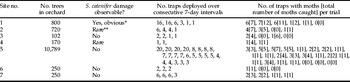
An empirical approach was taken to determine the minimum number of pheromone traps needed in an orchard to detect one male S. catenifer in a 7-day sampling period independently of orchard size. To investigate this, different numbers of pheromone traps were placed in randomly selected areas of the seven study orchards listed above. The initial numbers of traps deployed at each of the seven experimental sites depended on orchard size (big orchards were initially treated with more traps than smaller orchards), and starting trap numbers were to be doubled if no moths were caught or halved if at least one moth was captured in a 7-day period. This process was iterated for each orchard until randomly placed traps failed to detect S. catenifer, at which point this minimum number of traps was redeployed and tested again. No other pheromone experiments were being conducted in orchards when these trials were run; and for all study sites, except site 5, only one set of randomly placed pheromone traps was set out. At site 5, because of its large size (76 ha), this orchard was divided into seven 10-ha blocks. At any one time, 3–4 sets of traps were set out in 10- to 20-ha blocks that were separated by at least one untreated 10-ha block. Numbers of pheromone traps sequentially tested per study site are shown in table 1.
Number of pheromone traps iteratively deployed in commercial avocado orchards in Guatemala and Mexico to detect Stenoma catenifer and the number of traps and total number of moths caught from each trap series deployment.

* Damaged fruit observed within 15 min of orchard inspection;
** To detect 1–2 damaged fruit, >1 h of inspection in the orchard was needed.
Data Analysis
At each study site, the number of traps (n) that successfully attracted at least one male S. catenifer was assumed to follow a binomial(n,p) distribution. Since p defines the probability that a randomly placed trap captures at least one moth, the probability that none of the lures at a particular site attract at least one moth is (1−p)n. Hence, the probability that at least one moth was captured by at least one trap is:

where n is the number of traps deployed. Two attributes were used to relate p to unknown orchard infestation levels: (i) visual fruit damage (FD) estimates in orchards as either being zero, rare or common (table 1); and (ii) the ratio of the total number of moths caught each week to the total number of traps deployed in an orchard. This latter ratio was calculated by averaging the individual weekly ratios of total number of moths caught (M) to the total number of traps capturing at least one S. catenifer (T): M/T where M/T≥1 when T≥1, and we define M/T=1 when T=0. The average values of these weekly M/T ratios were used to define an empirical infestation (EI) level for each orchard.
Fruit damage (FD) and empirical infestation (EI) level estimates were then related to the site-specific p parameters using the following model:

In equation 4, the expected value (E) of the logit transformed capture probability in orchard i was specified to be a linear function of the log transformed EI value and raw FD value for that orchard. Solving this equation permitted the estimated intercept parameter ( ) to uniquely define
 for determining the total number of traps to deploy for detecting S. catenifer in orchards with low empirical infestation levels (EI=1) and no visible fruit damage (FD=0).
The parameters in equation 4 were estimated via maximum likelihood techniques using GENMOD in SAS (SAS Institute, 1999), where the data were specified to follow a binomial distribution with a canonical (i.e. logit) link function (McCullagh & Nelder, Reference McCullagh and Nelder1989). The intercept parameter estimate and its corresponding asymptotic standard error estimate were then used in conjunction with equation 3 to determine probability detection curves.
Results
Evaluation of pheromone dispensers
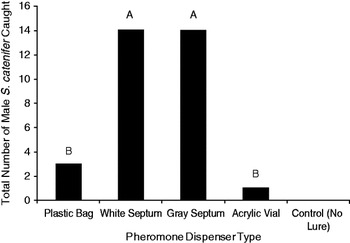
Significant differences in efficacy existed among the four different pheromone dispensers tested (χ2=21.29, df=3, P<0.0001), but not among the orchards (χ2=5.63, df=2, P=0.060). The gray and white septa exhibited equal efficacy, and both were superior to the polyethylene vial (χ2=6.50, df=1, P=0.01) and plastic bag dispensers (χ2=5.86, df=1, P=0.02), which were of similar low efficacy (fig. 1).
Total number of male Stenoma catenifer caught in wing traps baited with different dispenser types loaded with the S. catenifer sex pheromone and hung in Hass avocado trees at 1.75 m. Bars with the same letters are not significantly different at α=0.05.

Evaluation of trap heights
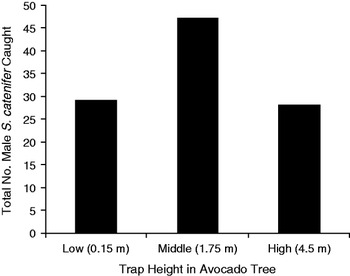
Traps hung at 1.75 m caught roughly half again as many adult male S. catenifer as those hung at the other two heights (fig. 2), but the GEE score test for an overall difference in the marginal log lure height means was not significant (χ2=5.2, df=2, P=0.075). Since trap height did not affect S. catenifer capture in the present study, we recommend 1.75 m, which is convenient for trap placement and monitoring.
Total number of male Stenoma catenifer caught in pheromone traps hung at three different heights in Hass avocado trees. No significant differences were found between trap heights.

Determination of flight distances of male moths, marker toxicity to females and partial life table for field collected S. catenifer larvae
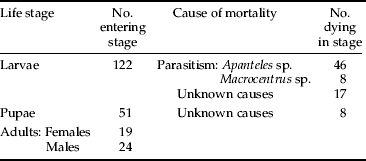
Of the 15 marked male moths released, four (i.e. 27%) were captured in traps. On average, captured males flew 67 m±12.52 m (range 32–85 m) in one night. All captured males were caught the night they were released. No significant differences in mean longevity of the 12 female S. catenifer dusted with DayGlo powder and the seven undusted control females that were maintained with 10% honey water in the laboratory were observed (t=−1.06, df=17, P=0.30). Dusted and undusted females lived on average for 7.2±0.81 days and 8.6±0.64 days, respectively, which is lower than that recorded by Nava et al. (Reference Nava, de Lara Haddad and Parra2005), where average female longevity at 20°C was 18 days. However, female longevity clearly indicated that DayGlo powder was not an acute toxicant to these moths. At time of death, females still had sufficient DayGlo dust on their bodies as to be readily observable with a black light. A partial life table for field collected S. catenifer, pooled across all collection sites, indicated that larval to adult survivorship rates at the time field studies were conducted was 35%. Two hymenopteran parasitoid species, a gregarious Apanteles sp. (9.50±0.47 cocoons per host larva) and a solitary Macrocentrus sp. were reared from S. catenifer larvae. Apanteles sp. accounted for 85% of parasitized larvae (table 2).
Partial life table for Stenoma catenifer larvae reared from Hass avocados harvested from four commercial orchards in Guatemala.

Larval to adult survivorship, 35%; parasitism, 58%; sex ratio, 44% female.
Numbers of traps needed to detect S. catenifer in commercial avocado orchards
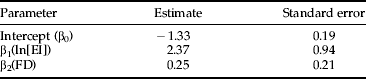
The χ2 parameter tests for equation 4 indicated that the intercept (β0) and ln(EI) (β1) parameter estimates were statistically significant (χ2=48.50, P<0.0001 and χ2=6.37, P=0.012, respectively), but the parameter estimate for FD was not significant (β2=1.41, P=0.24). Parameter values are shown in table 3. These results suggest that trap captures were influenced by the orchard's EI level. However, observed fruit damage levels did not relate significantly to trap captures, suggesting S. catenifer was often present in orchards at visually undetectable levels. Nonetheless, the fitted model adequately described the observed binomial count data, and the deviance score was statistically consistent with a Chi-square distribution (χ2=54.05, df=43, P=0.12). Consequently, this fitted equation was used to generate detection probability curves for various infestation scenarios.
Maximum likelihood parameter estimates with standard errors for equation 4.

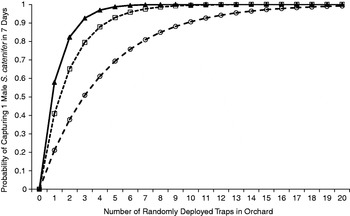
Figure 3 shows three detection curves for hypothetical orchards that exhibit low (EI=1), medium (EI=1.5) and high (EI=2) empirical infestation levels without visible fruit damage. These detection probability curves define the number of traps needed to successfully detect at least one male S. catenifer in each infestation scenario. Note that the model results for the low EI level are of particular interest here. The estimated intercept value in table 3 (−1.33) can be used to determine  :
 for this infestation scenario. Likewise, the corresponding asymptotic 90% lower confidence bound for this estimate is
 , implying that the corresponding 90% lower confidence bound for
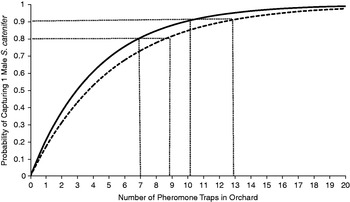
 is ≈0.172. These values were used in equation 3 to produce the low-infestation probability detection curve and corresponding asymptotic 90% lower confidence bound (equation 4). Based on these calculations, either seven or ten randomly placed pheromone traps in an orchard with low density moth populations would be needed to detect at least one male S. catenifer over a 7-day period with either 80% or 90% certainty, on average. Likewise, nine or 13 traps deployed in orchards would be needed to state with 90% confidence that at least one moth will be detected with either 80% or 90% certainty in a 7-day period (fig. 4).
Probability detection curves for capturing at least one male Stenoma catenifer over a 7-day period in hypothetical avocado orchards that exhibit low (EI=1; binomial probability (bp)=0.21), medium (EI=1.5; bp=0.409) and high (EI=2; bp=0.578) empirical infestation (EI) levels in the absence of visual fruit damage (–○–, low (EI=1); – □ –, intermediate (EI=1.5); –▲–, high (EI=2)).

The estimated low infestation probability detection curve for Stenoma catenifer with randomly placed pheromone traps in avocado orchards exhibiting no visual damage and a low trap capture empirical index (EI) value and the corresponding asymptotic 90% lower confidence bound (—, probability of detecting low S. catenifer infestations; - - - -, lower 90% confidence boundary).

Discussion
Of the four different dispenser types tested, our results showed that deployment of S. catenifer sex pheromone on gray or white rubber septa release devices resulted in the highest trap captures. Trap height placement has been shown previously to be an important variable affecting capture rates of some moth species (e.g. Cydia pomonella: Knight & Light, Reference Knight and Light2005) and not significant for others (e.g. Prays oleae: Kavallieratos et al., Reference Kavallieratos, Athanassiou, Balotis, Tatsi and Mazamenos2005). For S. catenifer, pheromone traps set at 0.5 and 4.5 m above the ground caught moths; however, traps set at 1.75 m within the canopy of avocado trees exhibited the highest moth capture rates. Fortuitously, gray rubber septa loaded with S. catenifer pheromone and hung at 1.75 m in tree canopies had been used in previous studies evaluating the attractiveness of blends of (9Z)-9,13-tetradecadien-11-ynal with potential minor pheromone components (Hoddle et al., Reference Hoddle, Millar, Hoddle, Zou and McElfresh2009). Consequently, results from previous trials are comparable to the results shown here.
Mark-recapture studies tentatively indicate that male S. catenifer can fly on average 67 m in one night, and the results presented here are the first known flight data for this moth. However, this flight distance estimate should be viewed with caution for the following reasons: (i) a low number of males were recaptured (just four from 15 released); (ii) flight studies were conducted in a large flat field that had no physical features to obstruct flight or disrupt pheromone plumes from traps; (iii) it is unknown whether the flight behavior of males is affected by DayGlo powders; and (iv) the trap array used became more rarified with increasing distance from the center of the plot because there was no concomitant increase in trap numbers to compensate for this montonic decrease in trap density. Consequently, with this experimental design, it was less likely that males would be trapped with increasing distance from the central release point of the study plot.
Despite the limitations of the flight study, it is possible that male moths may fly significantly further than this average recapture distance would indicate. S. catenifer is nocturnal, and moths begin flying immediately at dusk (18:00 h in Guatemala). However, males do not respond to pheromone until 02:30 h, and they cease flying to pheromone traps about three hours later, at 05:30 h (Hoddle et al., Reference Hoddle, Millar, Hoddle, Zou and McElfresh2009). Consequently, at least some of the marked males that were released into the recapture plot at 18:00 h may have flown out of the plot before they became receptive to pheromone in traps at 2:30 h (i.e. nine hours post-release). Also, bats were very common at the flight distance study site, and males released in the center of a 3-ha fallow field may have been vulnerable to predation before reaching traps. Low male recaptures resulting from acute mortality due to DayGlo dust seems unlikely because Dayglo-dusted female S. catenifer readily survived for seven days, and dusted males were recaptured in this study within 24 h of release. Males were not DayGlo dusted for toxicity trials in this study because too few were reared from harvested fruit, and all reared males (i.e. 15) were dusted and used for flight distance studies. This work demonstrated that mark-capture studies with S. catenifer are feasible, but it needs repeating with larger numbers of marked male S. catenifer, with traps deployed amongst avocado trees and DayGlo dust toxicity trials specifically for males.
The probabilistic modeling of S. catenifer captures from varying numbers of pheromone traps randomly placed in seven different-sized avocado orchards with different background densities of moth populations for 7-day periods suggests that relatively few traps (10–13) need to be deployed for relatively short periods of time to detect S. catenifer with 90% confidence. This number of traps for detection of S. catenifer in exporting orchards in areas with endemic populations should be used as a starting point from which further studies can be conducted to better refine understanding of the density of traps needed and their optimal placement to reliably detect S. catenifer in commercial orchards over the course of an entire year. For example, it is likely that small orchards ≤2-ha in size may need fewer traps (e.g. 2–5 randomly dispersed may be sufficient), whereas large orchards, similar to site 5 (76 ha) may be adequately monitored with 10–13 traps randomly deployed along picking trials or 2–3 tree rows in from service roads. Because the pheromone has an effective field lifetime of at least four weeks (Hoddle et al., Reference Hoddle, Millar, Hoddle, Zou and McElfresh2009), regular trap replacements will not be expensive or time consuming. A similar sampling strategy could be adopted for importing countries, deploying traps to detect S. catenifer incursions into high-risk areas such as commercial orchards near packing houses that import fruit from areas with endemic S. catenifer populations.
In addition to determining the presence or absence of S. catenifer in avocado orchards, the sex pheromone could be used to monitor population phenology throughout the year to provide estimates of the annual number of generations and relative population densities when orchards have and lack fruit. The pheromone also will permit easy determination of geographic and altitudinal distributions, possibly identifying the existence of areas in exporting nations that are naturally free of S. catenifer (e.g. perhaps at elevations >2000 m: Hoddle & Hoddle, Reference Hoddle and Hoddle2008b). Finally, the pheromone could also be used to provide additional insight into the basic ecology of this moth in natural areas (cf. Cervantes Peredo et al., Reference Cervantes Peredo, Lyal and Brown1999).
The attractiveness of the S. catenifer pheromone has been verified in regions outside of central Guatemala, the source region from which colonies of moths were initiated and subsequently reared for pheromone extraction (Millar et al., Reference Millar, Hoddle, McElfresh, Zou and Hoddle2008). The pheromone is also attractive to populations in Hass avocado orchards in Chiapas Mexico, and deployment of pheromone-baited traps in Piracicaba, Sao Paulo Brazil has also caught S. catenifer (J. Millar and A. Mafra-Neto, unpublished data). These results suggest that it is unlikely that there are geographically separated pheromone races of S. catenifer that use different pheromones.
It is also noteworthy that the traps baited with (9Z)-9,13-tetradecadien-11-ynal attracted substantial numbers of a related moth, Antaeotricha nictitans (Zeller) (Lepidoptera: Elachistidae: Stenomatinae). This moth was very abundant in traps set in avocado orchards at 400–700 m elevation in Escuintla Guatemala (site 5) and Tapachula Mexico (site 7). Captures of A. nictitans were 7–9 times higher than captures of S. catenifer at these sites. A. nictitans is easily separable from S. catenifer based on size (A. nictitans is larger) and numbers of spots on the forewings (A. nictitans has just one central spot; S. catenifer has many, especially at the distal margin of the forewing). Photographs comparing A. nictitans and S. catenifer are available (Hoddle, Reference Hoddle2009). The significance of the presence of this moth in avocado orchards is unknown because there is very little available information about its host-plant preferences (it has not been reared from avocados) or its associated natural enemy fauna. The Booth avocado orchard in Escuintla that yielded A. nictitans was completely surrounded by pineapple and rubber tree plantations. In Tapachula, the Hass avocado orchard was planted as a cover crop for coffee, and surrounding this coffee farm were native forest remnants and more coffee plantations. Based on trapping results, it may be reasonable to assume that A. nictitans has a close association with avocados because this is the only plant common to both sampling sites in Guatemala and Mexico. If this assumption is correct, A. nictitans may be a previously unknown pest of avocados grown at low elevations. The fact that A. nictitans responded strongly to the S. catenifer sex pheromone suggests that (9Z)-9,13-tetradecadien-11-ynal and/or the corresponding alcohol and aldehyde may be highly conserved as pheromone components amongst New World stenomatine moths. Sympatric species may reproductively isolate themselves temporally by producing and responding to their pheromones at different times. This possibility warrants further investigation in avocado orchards where both species of moth are present.
Acknowledgements
This research was supported in part by the California Avocado Commission and the University of California Hansen Trust. We are indebted to all of our cooperators in Guatemala and Mexico: Richard and Eugenia West, Hector Leal, Oscar Coy, members of Anaguacate, Fredy Ruano, Marina Duran, Luther Rankin, Scott McLaughlin, Francisco Infante, Alfredo Castillo, and the owners of La Rinconada, Popoyan, and La Libertad. John Brown of the USDA-ARS Systematic Entomology Laboratory, Washington DC provided identifications of moths captured in this study.