



1 Introduction
Lie conformal algebras were introduced by V. Kac [Reference Kac24] to give an axiomatic description of singular part of the operator product expansion of chiral fields in conformal field theory and have close connections with vertex algebras [Reference Kac24], infinite-dimensional Lie algebras satisfying the locality property [Reference Kac and Doebner25] and Hamiltonian formalism in the theory of nonlinear evolution equations [Reference Barakat, De sole and Kac9].
In the spirit of the Lie bialgebra theory of Drinfeld and others [Reference Drinfeld12], a bialgebra theory of Lie conformal algebras was developed by J. Liberati in [Reference Liberati31], together with conformal Manin triples and conformal classical Yang–Baxter equation (CCYBE). The operator form of the CCYBE was investigated in [Reference Hong and Bai18], where the definition of
 $\mathcal {O}$
-operators on Lie conformal algebras was introduced. It was shown that
 $\mathcal {O}$
-operators on Lie conformal algebras provide skew-symmetric solutions of the CCYBE, and left-symmetric conformal algebras introduced in [Reference Hong and Li22] naturally provide
 $\mathcal {O}$
-operators on the sub-adjacent Lie conformal algebras. These connections can be summarized in the diagram

On the other hand, the Novikov algebra is an important nonassociative algebra, introduced in connection with Hamiltonian operators in the formal variational calculus [Reference Gel’fand and Dorfman13, Reference Gel’fand and Dorfman14] and Poisson brackets of hydrodynamic type [Reference Balinsky and Novikov8]. It is also a subclass of the pre-Lie algebra which is closely related to numerous areas in mathematics and physics, such as affine manifolds and affine structures on Lie groups [Reference Koszul28], convex homogeneous cones [Reference Vinberg37], deformation of associative algebras [Reference Gerstenhaber15], and vertex algebras [Reference Bakalov and Kac6, Reference Bai, Li and Pei3]. A Gel’fand–Dormfan algebra (GD algebra) is a vector space equipped with a Novikov product and a Lie bracket together with a compatibility condition between the two products.Footnote 1 Note that a Novikov algebra is a GD algebra with the trivial Lie algebra structure. A GD algebra corresponds to a Hamiltonian pair, which plays a fundamental role in completely integrable systems (see [Reference Gel’fand and Dorfman13]). GD algebras related to differential Poisson algebras were studied in [Reference Kolesnikov, Sartayev and Orazgaliev27], and the variety of commutative GD algebras in which the Novikov algebras are commutative was shown to coincide with the variety of transposed Poisson algebras (see [Reference Sartayev36]).
GD algebras naturally give rise to Lie conformal algebras [Reference Xu39] (see Proposition 2.4). This construction of Lie conformal algebras in turn determines the axioms of GD algebras:

Quite much is known about GD algebras. Other than the study on Novikov algebras such as the classification of Novikov algebras in low dimensions [Reference Bai and Meng4], constructions of GD algebras from more commonly known algebra structures were given in [Reference Xu39]. GD algebras on certain infinite-dimensional Lie algebras or Novikov algebras were classified in [Reference Osborn and Zel’manov35, Reference Xu39]. Thus, Diagram (2) gives an effective way to produce Lie conformal algebras.
In this article, we lift Diagram (2) to the level of bialgebras by developing a bialgebra theory of Gel’fand-Dorfman algebras (GD algebras), which is a combination of a Lie bialgebra [Reference Chari and Pressley11] and a Novikov bialgebra [Reference Hong, Bai and Guo20] with some compatibility conditions. We show that GD bialgebras naturally correspond to a class of Lie conformal bialgebras and this correspondence in fact characterizes GD bialgebras. Since Novikov bialgebras are special GD bialgebras, Novikov bialgebras also correspond to a (smaller) class of Lie conformal bialgebras. Furthermore, as the bialgebra theories in the classical cases of Lie bialgebras and infinitesimal bialgebras, GD bialgebras are characterized by some matched pairs and Manin triples of GD algebras.
In connection with Diagram (1), we further introduce the Gel’fand–Dorfman Yang–Baxter equation (GDYBE) and show that skew-symmetric solutions of the GDYBE naturally provide GD bialgebras. The notion of
 $\mathcal {O}$
-operators on GD algebras is introduced to give skew-symmetric solutions of the GDYBE, while pre-Gel’fand-Dorfman algebras (pre-GD algebras) are introduced to provide
 $\mathcal {O}$
-operators on the associated GD algebras. Furthermore, the connection between GD algebras and Lie conformal algebras in Diagram (2) enriches to each of the induced notions of GD algebras in Diagram (1), yielding the following commutative diagram.

Thanks to this diagram, there is a natural construction of Lie conformal bialgebras from pre-GD algebras. Since Novikov bialgebras are special GD bialgebras, the commutative diagram also holds in the text of Novikov algebras.
Note that the Koszul dual of the operad of GD algebras is the operad of differential right Novikov–Poisson algebras (see [Reference Kolesnikov, Sartayev and Orazgaliev27]). Therefore, by [Reference Ginzburg and Kapranov16], there is a natural Lie algebra structure on the vector space of tensor product of a GD algebra and a differential right Novikov–Poisson algebra. Enriching this construction to the bialgebra level and generalizing the construction of infinite-dimensional Lie bialgebras developed in [Reference Hong, Bai and Guo20] from Novikov bialgebras should lead to a construction of more infinite-dimensional Lie bialgebras, obtained by GD bialgebras and a quadratic version of differential right Novikov-Poisson algebras, that is, differential right Novikov-Poisson algebras with nondgenerate symmetric bilinear forms satisfying certain invariant conditions.
Th article is outlined as follows. In Section 2, we introduce the notion of GD bialgebras and apply it to construct a class of Lie conformal bialgebras.
In Section 3, we define the GDYBE and
 ${\mathcal O}$
-operators for GD algebras as the operator form of the GDYBE. We show that skew-symmetric solutions of the GDYBE correspond to a class of solutions of the CCYBE. The relationship between
 $\mathcal {O}$
-operators on GD algebras and those on the corresponding Lie conformal algebras is established. Moreover, we show that there is a natural construction of Lie conformal bialgebras from pre-GD algebras.
In Section 4, two characterizations of GD bialgebras are given, in terms of matched pairs and Manin triples of GD algebras, respectively. Moreover, the correspondence between GD bialgebras and a class of Lie conformal bialgebras remains valid under the characterizations of the two types of bialgebras in terms of the corresponding matched pairs and Manin triples.
Notations. Let
 $\mathbf {k}$
be a field of characteristic
 $0$
and let
 $\mathbf {k}[\partial ]$
be the polynomial algebra with variable
 $\partial $
. All vector spaces and algebras over
 $\mathbf {k}$
(resp. all
 $\mathbf { k}[\partial ]$
-modules and Lie conformal algebras) are assumed to be finite-dimensional (resp. finite) unless otherwise stated, even though many results still hold in the infinite-dimensional (resp. infinite) cases. For a vector space A, let
 $$ \begin{align*} \tau:A\otimes A\rightarrow A\otimes A,\quad a\otimes b\mapsto b\otimes a,\;\;\;a,b\in A, \end{align*} $$
be the flip operator. The identity map is denoted by
 $\mathrm {id}$
. For a vector space V, we use
 $V[\lambda ]$
to denote the set of polynomials of
 $\lambda $
with coefficients in V. Let A be a vector space with a binary operation
 $\circ $
. Define linear maps
 $L_{\circ }, R_{\circ }:A\rightarrow \mathrm {End}_{\mathbf {k}}(A),$
respectively, by
 $$ \begin{align*} L_{\circ}(a)b:=a\circ b,\;\; R_{\circ}(a)b:=b\circ a, \;\;\;a, b\in A. \end{align*} $$
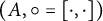
In particular, when
 $(A,\circ =[\cdot ,\cdot ])$
is a Lie algebra, we use the usual notion of the adjoint operator
 ${\mathrm {ad}}(a)(b):=[a,b]$
for all
 $a,b\in A$
.
2 GD bialgebras corresponding to a class of Lie conformal bialgebras
In this section, we introduce the notion of Gel’fand–Dorfman bialgebras (GD bialgebras) and show that they correspond to a class of Lie conformal bialgebras. Examples of Lie conformal bialgebras obtained from GD bialgebras are presented.
2.1 A correspondence between GD (co)algebras and Lie conformal (co)algebras
Recall that a Novikov algebra
 $(A, \circ )$
is a vector space A with a binary operation
 $\circ $
satisfying
 $$ \begin{align} (a\circ b)\circ c-a\circ (b\circ c)&=(b\circ a)\circ c-b\circ (a\circ c), \end{align} $$
 $$ \begin{align} (a\circ b)\circ c&=&(a\circ c)\circ b, \;\; a, b,c\in A. \end{align} $$
If
 $(A, \circ )$
only satisfies Eq. (4), then
 $(A, \circ )$
is called a pre-Lie algebra, also commonly known as a left-symmetric algebra.
Definition 2.1 [Reference Xu39] Let
 $(A, \circ )$
be a Novikov algebra and
 $(A, [\cdot , \cdot ])$
be a Lie algebra. If they also satisfy the following compatibility condition
 $$ \begin{align} [a\circ b, c]&-[a\circ c,b]+[a,b]\circ c-[a, c]\circ b-a\circ [b,c]=0,\;\; a, b, c\in A, \end{align} $$
then
 $(A, \circ , [\cdot , \cdot ])$
is called a Gel’fand-Dorfman algebra (GD algebra).
Remark 2.2 Note that such an algebra is called a Gel’fand-Dorfman bialgebra in [Reference Xu39]. To avoid confusion with the notion of the usual bialgebra consisting of an algebra and a coalgebra, we call it a GD algebra following [Reference Kolesnikov, Sartayev and Orazgaliev27]. We also point out that a Novikov algebra is defined to be a GD algebra with the trivial Lie algebra structure.
We next recall the notion of Lie conformal algebras.
Definition 2.3 [Reference Kac24]
A Lie conformal algebra R is a
 $\mathbf {k}[\partial ]$
-module with a
 $\lambda $
-bracket
 $[\cdot _\lambda \cdot ]$
which defines a
 $\mathbf {k}$
-bilinear map
 $R\times R\rightarrow R[\lambda ]$
satisfying
 $$ \begin{align*} & \textbf{(conformal sesquilinearity)}\ \ [\partial a_\lambda b]=-\lambda [a_\lambda b],~~~[a_\lambda \partial b]=(\lambda+\partial)[a_\lambda b],\\ &\textbf{(skew-symmetry)}\ [a_\lambda b]=-[b_{-\lambda-\partial}a],\\ &\textbf{(Jacobi identity)}\ \ [a_\lambda[b_\mu c]]=[[a_\lambda b]_{\lambda+\mu} c]+[b_\mu[a_\lambda c]],\quad a, b, c\in R. \end{align*} $$
A Lie conformal algebra R is called finite, if it is finitely generated as a
 $\mathbf {k}[\partial ]$
-module.
There is a natural correspondence between GD algebras and Lie conformal algebras which also characterizes GD algebras.
Proposition 2.4 [Reference Xu39]
Let
 $(A, \circ , [\cdot ,\cdot ])$
be a
 $\mathbf {k}$
-vector space with binary operations
 $\circ $
and
 $[\cdot ,\cdot ]$
. Equip the free
 $\mathbf {k}[\partial ]$
-module
 $R(A):=\mathbf {k}[\partial ]A(=\mathbf {k}[\partial ]\otimes _{\mathbf { k}} A)$
with the bilinear map
 $$ \begin{align*} [\cdot_\lambda \cdot]: R(A)\times R(A) \to R(A)[\lambda], \quad [a_\lambda b]:=\partial(b\circ a)+\lambda(a\star b)+[a,b],\;\; a, b\in A, \end{align*} $$
where
 $a\star b=a\circ b+b\circ a$
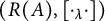
. Then
 $(R(A),[\cdot _\lambda \cdot ])$
is a Lie conformal algebra if and only if
 $(A, \circ , [\cdot ,\cdot ])$
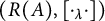
is a GD algebra. We call
 $(R(A),[\cdot _\lambda \cdot ])$
the Lie conformal algebra corresponding to (the GD algebra)
 $(A, \circ , [\cdot ,\cdot ])$
. In particular, if
 $(A, [\cdot ,\cdot ])$
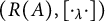
is abelian, we say that
 $(R(A),[\cdot _\lambda \cdot ])$
is the Lie conformal algebra corresponding to (the Novikov algebra)
 $(A, \circ )$
.
For convenience, in this article, we will use
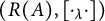 $(R(A),[\cdot _\lambda \cdot ])$
to denote the Lie conformal algebra corresponding to a given GD algebra
 $(A,\circ ,[\cdot ,\cdot ])$
or a given Novikov algebra
 $(A,\circ )$
.
There is also an equivalent interpretation in term of the coefficient algebra of
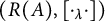 $(R(A),[\cdot _\lambda \cdot ])$
. That is, on the vector space
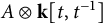 $A\otimes \mathbf {k}[t,t^{-1}]$
, the binary operation defined by
 $$ \begin{align*} [at^m, bt^n]=[a,b]t^{n+m} + n(a\circ b)t^{n+m-1}-m(b\circ a)t^{n+m-1},\;\;a, b\in A,\;\;m, n\in \mathbb Z, \end{align*} $$
where
 $at^m=a\otimes t^m$
, gives a Lie algebra if and only if
 $(A,\circ ,[\cdot ,\cdot ])$
is a GD algebra.
Recall [Reference Hong, Bai and Guo20, Reference Kozybaev, Umirbaev and Zhelyabin29] that a Novikov coalgebra
 $(A, \Delta )$
is a vector space A with a linear map
 $\Delta : A\rightarrow A\otimes A$
such that
 $$ \begin{align} (\mathrm{id}\otimes \Delta)\Delta(a)-(\tau\otimes \mathrm{id})(\mathrm{id}\otimes \Delta)\Delta(a)&=(\Delta\otimes \mathrm{id})\Delta(a)-(\tau\otimes \mathrm{id})(\Delta\otimes \mathrm{id})\Delta(a), \end{align} $$
 $$ \begin{align} (\tau\otimes \mathrm{id})(\mathrm{id}\otimes \Delta)\tau \Delta(a)=&(\Delta\otimes \mathrm{id})\Delta(a), \;\;a\in A. \end{align} $$
A Lie coalgebra
 $(L, \delta )$
is a vector space L with a linear map
 $\delta : L\rightarrow L\otimes L$
satisfying
 $$ \begin{align} \delta(a)&=-\tau \delta(a), \end{align} $$
 $$ \begin{align} & (\mathrm{id} \otimes \delta)\delta(a)-(\tau\otimes \mathrm{id})(\mathrm{id} \otimes \delta)\delta(a)=(\delta\otimes \mathrm{id})\delta(a),\;\;a\in L. \end{align} $$
Let
 $\langle \cdot , \cdot \rangle $
be the usual pairing between a vector space and its dual vector space. Let V and W be vector spaces. For a linear map
 $\varphi : V\rightarrow W$
, denote the transpose map by
 $\varphi ^{\ast }: W^{\ast }\rightarrow V^{\ast }$
given by
 $$ \begin{align*} \langle \varphi^{\ast}(f),v\rangle=\langle f, \varphi(v)\rangle,\;\;\; f\in W^{\ast}, v\in V. \end{align*} $$
Note that
 $(A, \Delta )$
is a Novikov coalgebra if and only if
 $(A^{\ast }, \Delta ^{\ast })$
is a Novikov algebra, and
 $(L, \delta )$
is a Lie coalgebra if and only if
 $(L^{\ast }, \delta ^{\ast })$
is a Lie algebra.
Next, we introduce the notion of a Gel’fand-Dorfman coalgebra.
Definition 2.5 A Gel’fand-Dorfman coalgebra (GD coalgebra) is a triple
 $(A, \Delta , \delta )$
where
 $(A, \Delta )$
is a Novikov coalgebra,
 $(A, \delta )$
is a Lie coalgebra, and they satisfy, for all
 $a\in A$
,
 $$ \begin{align} &(\mathrm{id} \otimes \delta)\Delta(a)-(\tau\otimes\mathrm{id})(\mathrm{id}\otimes \Delta)\delta(a) +(\tau\otimes\mathrm{id})(\mathrm{id} \otimes \delta)\tau \Delta(a)=(\Delta\otimes \mathrm{id})\delta(a)+(\delta\otimes \mathrm{id})\Delta(a). \end{align} $$
It is easy to check that
 $(A, \Delta , \delta )$
is a GD coalgebra if and only if
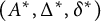 $(A^{\ast }, \Delta ^{\ast }, \delta ^{\ast })$
is a GD algebra.
Definition 2.6 [Reference Liberati31]
A Lie conformal coalgebra is a pair
 $(R,\delta )$
consisting of a
 $\mathbf {k}[\partial ]$
-module R and a
 $\mathbf {k}[\partial ]$
-module homomorphism
 $\delta : R\rightarrow R\otimes R$
such that Eqs. (9) and (10) hold for all
 $a\in R$
, where the
 $\mathbf {k}[\partial ]$
-module structure on
 $R\otimes R$
is defined by
 $\partial (a\otimes b)=\partial a \otimes b+a\otimes \partial b$
for a,
 $b\in R$
.
Remark 2.7 By the definition of Lie conformal coalgebras, a Lie conformal coalgebra
 $(R, \delta )$
is a Lie coalgebra
 $(R, \delta )$
in the ordinary sense with a
 $\mathbf {k}[\partial ]$
-module homomorphism
 $\delta : R\rightarrow R\otimes R$
.
Denote
 $\partial ^{\otimes ^2}:=\partial \otimes \mathrm {id}+\mathrm {id}\otimes \partial $
. A coalgebra analog of Proposition 2.4 is given as follows.
Proposition 2.8 Let
 $R(A)=\mathbf {k}[\partial ]A$
be the free
 $\mathbf {k}[\partial ]$
-module on a vector space A. Suppose that
 $\delta _0$
and
 $\Delta $
are
 $\mathbf {k}[\partial ]$
-module homomorphisms from
 $R(A)$
to
 $R(A)\otimes R(A)$
such that
 $\delta _0(A)\subset A\otimes A$
and
 $\Delta (A)\subset A\otimes A$
. Define a linear map
 $\delta : R(A)\rightarrow R(A)\otimes R(A)$
by first taking
 $$ \begin{align} \delta(a)=\delta_0(a)+(\partial\otimes \mathrm{id})\Delta(a)-\tau (\partial\otimes \mathrm{id})\Delta(a),~~~~a\in A, \end{align} $$
and then extending to
 $R(A)$
. Then
 $(R(A), \delta )$
is a Lie conformal coalgebra if and only if
 $(A, \Delta , \delta _0)$
is a GD coalgebra.
Proof Since
 $\delta _0$
and
 $\Delta $
are
 $\mathbf {k}[\partial ]$
-module homomorphisms,
 $\delta $
is a
 $\mathbf {k}[\partial ]$
-module homomorphism. Therefore,
 $\delta (a)=-\tau \delta (a)$
for all
 $a\in R(A)$
if and only if
 $\delta _0(b)=-\tau \delta _0(b)$
for all
 $b\in A$
.
By the definition of
 $\delta $
, we have
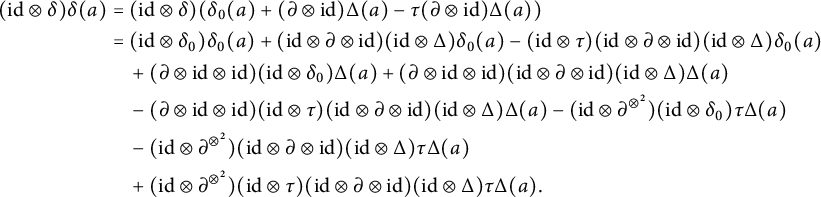 $$ \begin{align*} (\mathrm{id} \otimes \delta)\delta(a)&=(\mathrm{id} \otimes \delta)(\delta_0(a)+(\partial\otimes \mathrm{id})\Delta(a)-\tau (\partial\otimes \mathrm{id})\Delta(a))\\ &=(\mathrm{id}\otimes \delta_0)\delta_0(a)+(\mathrm{id}\otimes \partial\otimes \mathrm{id})(\mathrm{id}\otimes \Delta)\delta_0(a)-(\mathrm{id}\otimes \tau)(\mathrm{id}\otimes \partial\otimes \mathrm{id})(\mathrm{id}\otimes \Delta)\delta_0(a)\\ &\quad +(\partial\otimes \mathrm{id}\otimes \mathrm{id})(\mathrm{id}\otimes \delta_0)\Delta(a)+(\partial\otimes \mathrm{id}\otimes \mathrm{id})(\mathrm{id}\otimes \partial\otimes \mathrm{id})(\mathrm{id}\otimes \Delta)\Delta(a)\\ &\quad -(\partial\otimes \mathrm{id}\otimes \mathrm{id})(\mathrm{id}\otimes \tau)(\mathrm{id}\otimes \partial\otimes \mathrm{id})(\mathrm{id}\otimes \Delta)\Delta(a) -(\mathrm{id}\otimes \partial^{\otimes^2})(\mathrm{id}\otimes \delta_0)\tau \Delta(a)\\ &\quad -(\mathrm{id}\otimes \partial^{\otimes^2})(\mathrm{id}\otimes \partial \otimes \mathrm{id})(\mathrm{id}\otimes \Delta)\tau\Delta(a)\\ &\quad +(\mathrm{id}\otimes \partial^{\otimes^2})(\mathrm{id}\otimes \tau)(\mathrm{id}\otimes \partial\otimes \mathrm{id})(\mathrm{id}\otimes \Delta)\tau \Delta(a). \end{align*} $$
Similarly, we have
 $$ \begin{align*}(\delta\otimes \mathrm{id})\delta(a)&=(\delta_0\otimes \mathrm{id})\delta_0(a) +(\partial\otimes \mathrm{id}\otimes \mathrm{id})(\Delta\otimes \mathrm{id})\delta_0(a)\\ &\quad-(\tau\otimes \mathrm{id})(\partial\otimes \mathrm{id}\otimes \mathrm{id})(\Delta\otimes \mathrm{id})\delta_0(a) +(\partial^{\otimes^2}\otimes \mathrm{id})(\delta_0\otimes \mathrm{id})\Delta(a)\\ &\quad +(\partial\otimes \mathrm{id}\otimes \mathrm{id})(\partial^{\otimes^2}\otimes \mathrm{id})(\Delta\otimes \mathrm{id})\Delta(a) -(\tau\otimes \mathrm{id})(\partial\otimes \mathrm{id}\otimes \mathrm{id})(\partial^{\otimes^2}\otimes \mathrm{id})(\Delta\otimes \mathrm{id})\Delta(a)\\ &\quad -(\mathrm{id}\otimes \mathrm{id}\otimes \partial)(\delta_0\otimes \mathrm{id})\tau \Delta(a) -(\mathrm{id}\otimes \mathrm{id}\otimes \partial)(\partial\otimes \mathrm{id}\otimes \mathrm{id})(\Delta\otimes \mathrm{id})\tau \Delta(a)\\ &\quad +(\mathrm{id}\otimes \mathrm{id}\otimes \partial)(\mathrm{id}\otimes \partial\otimes \mathrm{id})(\tau\otimes \mathrm{id})(\Delta\otimes \mathrm{id})\tau \Delta(a). \end{align*} $$
Then by the cocommutativity of
 $\delta $
, considering the terms in
 $A\otimes A\otimes A$
,
 $\partial A\otimes A\otimes A$
,
 $\partial A\otimes \partial A\otimes A$
, and
 $\partial ^2A\otimes A\otimes A$
, the following equation
 $$ \begin{align*} (\mathrm{id}\otimes \delta)\delta(a)-(\tau\otimes \mathrm{id})(\mathrm{id}\otimes \delta)\delta(a)=(\delta\otimes \mathrm{id})\delta(a),\;\;a\in A, \end{align*} $$
holds if and only if the following equations hold.
 $$ \begin{align} &(\mathrm{id}\otimes \delta_0)\delta_0(a)-(\tau\otimes \mathrm{id}) (\mathrm{id}\otimes \delta_0)\delta_0(a)=(\delta_0\otimes \mathrm{id})\delta_0(a), \end{align} $$
 $$ \begin{align} &(\mathrm{id}\otimes \delta_0)\Delta(a)-(\tau\otimes \mathrm{id}) (\mathrm{id}\otimes \Delta)\delta_0(a) +(\tau\otimes \mathrm{id})(\mathrm{id}\otimes \delta_0)\tau \Delta(a) \end{align} $$
 $$ \begin{align} &\mbox{}\hspace{0.5cm}=(\Delta\otimes \mathrm{id})\delta_0(a)+(\delta_0\otimes \mathrm{id})\Delta(a),\nonumber\\ ~~&(\mathrm{id}\otimes \Delta)\Delta(a)-(\tau\otimes \mathrm{id})(\mathrm{id}\otimes \Delta)\Delta(a)=(\Delta\otimes \mathrm{id})\Delta(a)-(\tau\otimes \mathrm{id})(\Delta\otimes \mathrm{id})\Delta(a), \end{align} $$
 $$ \begin{align} ~~&(\tau\otimes \mathrm{id})(\mathrm{id}\otimes \Delta)\tau \Delta(a)=(\Delta\otimes \mathrm{id})\Delta(a), \quad a\in A. \end{align} $$
Then the conclusion follows directly.
Remark 2.9 Given a GD coalgebra
 $(A, \Delta , \delta _0)$
and the
 $\mathbf {k}[\partial ]$
-module
 $R(A)=\mathbf {k}[\partial ]A$
. The dual space
 $R(A)^{\ast }$
is isomorphic to
 $(\mathbf {k}[\partial ])^{\ast }\widehat {\otimes } A^{\ast } \cong A^{\ast }[[t]]$
. Here we take
 $\langle t^n, \partial ^m\rangle =n!\delta _{n,m}$
, as in [Reference Bakalov, D’Andrea and Kac5]. Equipped with the dual product
 $\delta ^{\ast }$
, where
 $\delta $
is given by Eq. (12), the Lie algebra
 $A^{\ast }[[t]]$
is defined by
 $$ \begin{align*} [ft^m, gt^n]=[f,g]t^{n+m} + n(f\circ g)t^{n+m-1}-m(g\circ f)t^{n+m-1},\;\;f, g\in A^{\ast},\;\;m, n\in {\mathbb Z}_{\geq 0}, \end{align*} $$
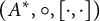
where
 $(A^{\ast }, \circ , [\cdot ,\cdot ])$
is the dual GD algebra of
 $(A, \Delta , \delta _0)$
. Note that
 $A^{\ast }[t]$
as a Lie subalgebra of
 $A^{\ast }[[t]]$
is just the annihilation algebra of
 $(R(A^{\ast }),[\cdot _\lambda \cdot ])$
(see [Reference Kac and Doebner25]).
2.2 GD bialgebras and the relationship with Lie conformal bialgebras
Let
 $(A,\circ , [\cdot ,\cdot ])$
be a GD algebra. Set
 $$ \begin{align*} a\star b:=a\circ b+b\circ a,\;\;a.(b\otimes c):=[a,b]\otimes c+b\otimes [a,c],\;\;a, b, c\in A.\end{align*} $$
Recall that a Lie bialgebra is a triple
 $(L, [\cdot ,\cdot ],\delta )$
such that
 $(L, [\cdot , \cdot ])$
is a Lie algebra,
 $(L, \delta )$
is a Lie coalgebra, and the following compatibility condition holds.
 $$ \begin{align*} \delta([a,b])=a.\delta(b)-b.\delta(a),\;\; a, b\in L. \end{align*} $$
Note that a Novikov algebra
 $(A,\circ )$
corresponds to an infinite-dimensional Lie algebra which is just the coefficient algebra of the Lie conformal algebra)
 $(R(A), [\cdot _\lambda \cdot ]$
(see [Reference Balinsky and Novikov8, Reference Kac and Doebner25]). This correspondence was lifted to the bialgebra case in [Reference Hong, Bai and Guo20]. The notion of Novikov bialgebras was introduced in [Reference Hong, Bai and Guo20] and it was shown that Novikov bialgebras correspond to a class of infinite-dimensional completed Lie bialgebras. We recall the definition of Novikov bialgebras as follows.
Definition 2.10 [Reference Hong, Bai and Guo20] A Novikov bialgebra is a tripe
 $(A,\circ ,\Delta )$
where
 $(A,\circ )$
is a Novikov algebra and
 $(A, \Delta )$
is a Novikov coalgebra satisfying
 $$ \begin{align} \Delta(a\circ b)=(R_{\circ} (b)\otimes \mathrm{id})\Delta (a)&+(\mathrm{id}\otimes L_{\star}(a))(\Delta(b)+\tau\Delta(b)), \end{align} $$
 $$ \begin{align} (L_{\star}(a)\otimes \mathrm{id})\Delta(b)-(\mathrm{id}\otimes L_{\star}(a))\tau\Delta (b)&=(L_{\star}(b)\otimes \mathrm{id})\Delta(a)-(\mathrm{id}\otimes L_{\star}(b))\tau\Delta(a), \end{align} $$
 $$ \begin{align} \quad (\mathrm{id}\otimes R_{\circ}(a)-R_{\circ}(a)\otimes \mathrm{id})(\Delta(b)+\tau\Delta(b))&=(\mathrm{id}\otimes R_{\circ}(b)-R_{\circ}(b)\otimes \mathrm{id})(\Delta(a)+\tau\Delta(a)), \end{align} $$
for all a,
 $b\in A$
.
Next, we introduce the notion of a GD bialgebra.
Definition 2.11 Let
 $(A, \circ , [\cdot ,\cdot ])$
be a GD algebra and
 $(A, \Delta , \delta )$
be a GD coalgebra. If
 $(A, \circ , \Delta )$
is a Novikov bialgebra,
 $(A, [\cdot ,\cdot ], \delta )$
is a Lie bialgebra and the following compatibility condition holds.
 $$ \begin{align} &\delta(b\circ a)+\Delta([a,b])=(R_{\circ}(a)\otimes \mathrm{id})\delta(b)+(L_{\circ}(b)\otimes \mathrm{id})\delta(a)\\ &\;\;\;\;\;\;\;\;\;+(\mathrm{id}\otimes L_{\star}(b))\delta(a)+a.\Delta(b)-(\mathrm{id}\otimes {\mathrm{ad}}(b))(\Delta(a)+\tau\Delta(a)),\;\;a, b\in A,\nonumber \end{align} $$
then
 $(A, \circ , [\cdot ,\cdot ], \Delta , \delta )$
is called a GD bialgebra.
Remark 2.12 Note again that the above definition of GD bialgebras is different from that in [Reference Xu39] which is now simply called a GD algebra. On the other hand, if
 $(A, \circ , [\cdot ,\cdot ], \Delta , \delta )$
is a GD bialgebra, then
 $(A, \circ , \Delta )$
is a Novikov bialgebra and
 $(A, [\cdot ,\cdot ], \delta )$
is a Lie bialgebra. Moreover, a Lie bialgebra can be regarded as a GD bialgebra in which
 $\circ $
and
 $\Delta $
are trivial, and a Novikov bialgebra can be regarded as a GD bialgebra in which
 $[\cdot ,\cdot ]$
and
 $\delta $
are trivial.
We introduce two special classes of GD bialgebras with
 $\Delta $
,
 $[\cdot ,\cdot ]$
and
 $\circ $
,
 $\delta $
being trivial, respectively.
Definition 2.13 Let
 $(A, \circ )$
be a Novikov algebra and
 $(A, \delta )$
be a Lie coalgebra. If
 $$ \begin{align*} \delta(b\circ a)=(R_{\circ}(a)\otimes \mathrm{id})\delta(b)+(L_{\circ}(b)\otimes \mathrm{id})\delta(a)+(\mathrm{id}\otimes L_{\star}(b))\delta(a),\;\;a, b\in A, \end{align*} $$
then the resulting GD bialgebra
 $(A, \circ , \delta )$
(with
 $\Delta $
and
 $[\cdot ,\cdot ]$
being trivial) is called a GD bialgebra of Novikov type.
Let
 $(L, [\cdot , \cdot ])$
be a Lie algebra and
 $(L, \Delta )$
be a Novikov coalgebra. If then
 $$ \begin{align*} &\Delta([a,b])=a.\Delta(b)-(\mathrm{id}\otimes {\mathrm{ad}}(b))(\Delta(a)+\tau\Delta(a)), \;\;a, b\in A, \end{align*} $$
the resulting GD bialgebra
 $(L, [\cdot ,\cdot ], \Delta )$
(with
 $\circ $
and
 $\delta $
being trivial) is called a GD bialgebra of Lie type.
Here are some examples of the two classes of GD bialgebras.
Example 2.14 Let
 $(A=\mathbf {k}e_1\oplus \mathbf {k}e_2, \circ )$
be the Novikov algebra given by [Reference Bai and Meng4]
 $$ \begin{align*} e_1\circ e_1&=e_2\circ e_1=e_2\circ e_2=0,\;\;\;e_1\circ e_2=e_2. \end{align*} $$
Define a linear map
 $\delta _0: A\rightarrow A\otimes A$
by
 $$ \begin{align*} \delta_0(e_1)&=0,\;\;\;\delta_0(e_2)=e_1\otimes e_2-e_2\otimes e_1. \end{align*} $$
One can check that
 $(A, \circ , \delta _0)$
is a GD bialgebra of Novikov type.
Let
 $(L=\mathbf {k}e_1\oplus \mathbf {k}e_2, [\cdot ,\cdot ])$
be the Lie algebra given by
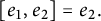 $[e_1,e_2]=e_2.$
Define a linear map
 $\Delta : A\rightarrow A\otimes A$
by
 $$ \begin{align*} \Delta(e_1)&=0,\;\;\;\Delta(e_2)=e_1\otimes e_2. \end{align*} $$
One can check that
 $(L, [\cdot ,\cdot ], \Delta )$
is a GD bialgebra of Lie type.
Definition 2.15 [Reference Liberati31]
A Lie conformal bialgebra is a triple
 $(R, [\cdot _\lambda \cdot ],\delta )$
such that
 $(R, [\cdot _\lambda \cdot ])$
is a Lie conformal algebra,
 $(R, \delta )$
is a Lie conformal coalgebra, and they satisfy the following equality:
 $$ \begin{align} a_\lambda \delta(b)-b_{-\lambda-\partial}\delta(a)&=\delta([a_\lambda b]),\;\;a, b\in R, \end{align} $$
where
 $a_\lambda \delta (b):=\sum ([a_\lambda b_{(1)}]\otimes b_{(2)}+b_{(1)}\otimes [a_\lambda b_{(2)}])$
if
 $\delta (b)=\sum b_{(1)}\otimes b_{(2)}$
, for all
 $a,b\in R$
.
Remark 2.16 In fact,
 $R\otimes R$
is a conformal module of
 $(R, [\cdot _\lambda \cdot ])$
defined by
 $$ \begin{align*} a_\lambda (b\otimes c)&=(a_\lambda b)\otimes c+b\otimes(a_\lambda c),\;\; \partial (b\otimes c)=\partial b\otimes c+b\otimes \partial c,\;\; a, b, c\in R. \end{align*} $$
Therefore, by the reduced cohomology of Lie conformal algebras developed in [Reference Bakalov, Kac and Voronov7], Eq. (21) just means that
 $\delta $
is a 1-cocycle of R with coefficients in
 $R\otimes R$
in the reduced complex.
Let a, b,
 $c\in R$
and set
 $\delta (b)=\sum b_{(1)}\otimes b_{(2)}$
. By the action of
 $\mathbf {k}[\partial ]$
on
 $R\otimes R$
, we obtain
 $$ \begin{align*} a_{-\lambda-\partial} \delta b&= \sum ([a_{-\lambda-\partial^{\otimes^2}} b_{(1)}]\otimes b_{(2)}+b_{(1)}\otimes [a_{-\lambda-\partial^{\otimes^2}}b_{(2)}]), \end{align*} $$
which is not equal to
 $\sum ([a_{-\lambda -\partial } b_{(1)}]\otimes b_{(2)}+b_{(1)}\otimes [a_{-\lambda -\partial }b_{(2)}])$
obtained from
 $a_\lambda \delta (b)\in (R\otimes R)[\lambda ]$
by substituting
 $\lambda $
by
 $-\lambda -\partial $
.
We establish the relationship between GD bialgebras and Lie conformal bialgebras.
Theorem 2.17 Let
 $(A, \circ , [\cdot , \cdot ])$
be a GD algebra. Suppose that
 $\delta _0$
and
 $\Delta $
are
 $\mathbf {k}[\partial ]$
-module homomorphisms from
 $R(A)$
to
 $R(A)\otimes R(A)$
such that
 $\delta _0(A)\subset A\otimes A$
and
 $\Delta (A)\subset A\otimes A$
. Then
 $(R(A), [\cdot _\lambda \cdot ], \delta )$
is a Lie conformal bialgebra with
 $\delta : R(A)\rightarrow R(A)\otimes R(A)$
defined by Eq. (12) if and only if
 $(A, \circ , [\cdot ,\cdot ], \Delta , \delta _0)$
is a GD bialgebra. We call
 $(R(A), [\cdot _\lambda \cdot ], \delta )$
the Lie conformal bialgebra corresponding to the GD bialgebra
 $(A, \circ , [\cdot ,\cdot ], \Delta , \delta _0)$
.
Proof By Proposition 2.8,
 $(R(A), \delta )$
is a Lie conformal coalgebra if and only if
 $(A, \Delta , \delta _0)$
is a GD coalgebra. Let
 $a,b\in A$
. Set
 $\delta _0(a)=\sum a_{(1)}\otimes a_{(2)}$
and
 $\Delta (a)=\sum \overline {a_{(1)}}\otimes \overline {a_{(2)}}$
. Then we get
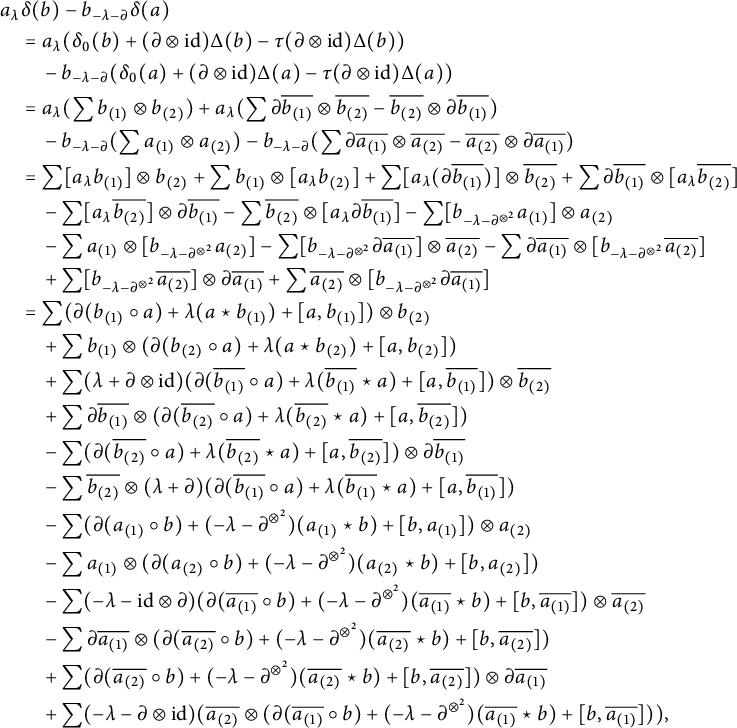 $$ \begin{align*} &a_\lambda \delta(b)-b_{-\lambda-\partial}\delta(a)\\ &\quad=a_\lambda(\delta_0(b)+(\partial\otimes \mathrm{id})\Delta(b)-\tau(\partial\otimes \mathrm{id})\Delta(b))\\ &\mbox{}\hspace{0.7cm}-b_{-\lambda-\partial}(\delta_0(a)+(\partial\otimes \mathrm{id})\Delta(a)-\tau(\partial\otimes \mathrm{id})\Delta(a))\\ &\quad =a_\lambda(\sum b_{(1)}\otimes b_{(2)})+a_\lambda(\sum \partial \overline{b_{(1)}} \otimes \overline{b_{(2)}}-\overline{b_{(2)}} \otimes \partial \overline{b_{(1)}})\\ &\mbox{}\hspace{0.7cm}-b_{-\lambda-\partial}(\sum a_{(1)}\otimes a_{(2)})-b_{-\lambda-\partial}(\sum \partial \overline{a_{(1)}} \otimes \overline{a_{(2)}}-\overline{a_{(2)}} \otimes \partial \overline{a_{(1)}})\\ &\quad=\sum [a_\lambda b_{(1)}]\otimes b_{(2)} +\sum b_{(1)}\otimes[a_\lambda b_{(2)}]+\sum [a_\lambda (\partial\overline{b_{(1)}})]\otimes \overline{b_{(2)}} +\sum \partial\overline{b_{(1)}}\otimes [a_\lambda \overline{b_{(2)}}]\\ &\mbox{}\hspace{0.7cm}-\sum [a_\lambda \overline{b_{(2)}}]\otimes \partial\overline{b_{(1)}} -\sum \overline{b_{(2)}}\otimes [a_\lambda \partial\overline{b_{(1)}}] -\sum [b_{-\lambda-\partial^{\otimes^2}} a_{(1)}]\otimes a_{(2)}\\ &\mbox{}\hspace{0.7cm}-\sum a_{(1)}\otimes [b_{-\lambda-\partial^{\otimes^2}}a_{(2)}] -\sum [b_{-\lambda-\partial^{\otimes^2}}\partial \overline{a_{(1)}} ]\otimes \overline{a_{(2)}} -\sum \partial \overline{a_{(1)}} \otimes [b_{-\lambda-\partial^{\otimes^2}} \overline{a_{(2)}}]\\ &\mbox{}\hspace{0.7cm}+\sum [b_{-\lambda-\partial^{\otimes^2}} \overline{a_{(2)}}]\otimes \partial\overline{a_{(1)}} +\sum \overline{a_{(2)}}\otimes [b_{-\lambda-\partial^{\otimes^2}}\partial \overline{a_{(1)}}]\\ &\quad= \sum (\partial(b_{(1)}\circ a)+\lambda(a\star b_{(1)})+[a,b_{(1)}])\otimes b_{(2)}\\ &\mbox{}\hspace{0.7cm} +\sum b_{(1)}\otimes (\partial(b_{(2)}\circ a)+\lambda(a\star b_{(2)})+[a, b_{(2)}])\\ &\mbox{}\hspace{0.7cm}+\sum (\lambda+\partial\otimes \mathrm{id})(\partial(\overline{b_{(1)}}\circ a)+\lambda(\overline{b_{(1)}}\star a)+[a,\overline{b_{(1)}}]) \otimes \overline{b_{(2)}}\\ &\mbox{}\hspace{0.7cm}+\sum \partial \overline{b_{(1)}}\otimes (\partial(\overline{b_{(2)}}\circ a)+\lambda(\overline{b_{(2)}}\star a) +[a,\overline{b_{(2)}}])\\ &\mbox{}\hspace{0.7cm}-\sum (\partial(\overline{b_{(2)}}\circ a)+\lambda(\overline{b_{(2)}}\star a)+[a,\overline{b_{(2)}}])\otimes \partial\overline{b_{(1)}}\\ &\mbox{}\hspace{0.7cm}-\sum \overline{b_{(2)}}\otimes (\lambda+\partial)(\partial(\overline{b_{(1)}}\circ a)+\lambda(\overline{b_{(1)}}\star a)+[a,\overline{b_{(1)}}])\\ &\mbox{}\hspace{0.7cm}-\sum (\partial (a_{(1)}\circ b)+(-\lambda-\partial^{\otimes^2})(a_{(1)}\star b)+[b, a_{(1)}])\otimes a_{(2)}\\ &\mbox{}\hspace{0.7cm}-\sum a_{(1)}\otimes (\partial(a_{(2)}\circ b)+(-\lambda-\partial^{\otimes^2})(a_{(2)}\star b)+[b, a_{(2)}])\\ &\mbox{}\hspace{0.7cm}-\sum(-\lambda-\mathrm{id}\otimes \partial)(\partial(\overline{ a_{(1)}}\circ b)+(-\lambda-\partial^{\otimes^2})(\overline{a_{(1)}}\star b) +[b,\overline{a_{(1)}}])\otimes \overline{a_{(2)}}\\ &\mbox{}\hspace{0.7cm}-\sum \partial\overline{a_{(1)}} \otimes(\partial (\overline{a_{(2)}}\circ b) +(-\lambda-\partial^{\otimes^2})(\overline{a_{(2)}}\star b)+[b,\overline{a_{(2)}}])\\ &\mbox{}\hspace{0.7cm}+\sum (\partial(\overline{a_{(2)}}\circ b)+(-\lambda-\partial^{\otimes^2})(\overline{a_{(2)}}\star b)+[b,\overline{a_{(2)}}])\otimes \partial \overline{a_{(1)}}\\ &\mbox{}\hspace{0.7cm}+\sum (-\lambda-\partial\otimes \mathrm{id})(\overline{a_{(2)}}\otimes (\partial( \overline{ a_{(1)}}\circ b)+(-\lambda-\partial^{\otimes^2}) (\overline{ a_{(1)}}\star b)+[b,\overline{ a_{(1)}}])), \end{align*} $$
and
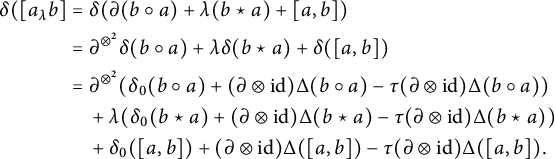 $$ \begin{align*} \delta([a_\lambda b]& = \delta(\partial(b\circ a)+\lambda(b\star a)+[a,b])\\ & =\partial^{\otimes^2}\delta(b\circ a)+\lambda \delta(b\star a)+\delta([a,b])\\ & = \partial^{\otimes^2}(\delta_0(b\circ a)+(\partial\otimes \mathrm{id})\Delta(b\circ a)-\tau(\partial\otimes \mathrm{id})\Delta(b\circ a))\\ &\quad +\lambda(\delta_0(b\star a)+(\partial\otimes \mathrm{id})\Delta(b\star a)-\tau(\partial\otimes \mathrm{id})\Delta(b\star a))\\ &\quad +\delta_0([a,b])+(\partial\otimes \mathrm{id})\Delta([a,b])-\tau(\partial\otimes \mathrm{id})\Delta([a,b]). \end{align*} $$
Since
 $\delta =-\tau \delta $
, we only need to consider the coefficients of
 $A\otimes A$
,
 $\partial A\otimes A$
,
 $\partial ^2 A\otimes A$
,
 $\partial A\otimes \partial A$
,
 $\lambda A\otimes A$
,
 $\lambda (\partial A\otimes A)$
and
 $\lambda ^2 A\otimes A$
. By comparing the coefficients of those terms in these vector spaces respectively, we obtain that the equation
 $$ \begin{align*} a_\lambda \delta(b)-b_{-\lambda-\partial}\delta(a)=\delta([a_\lambda b]), \;\;a, b\in A,\end{align*} $$
holds if and only if the following equations hold:
 $$ \begin{align} &\delta_0([a,b])=a.\delta_0(b)-b.\delta_0(a),\end{align} $$
 $$ \begin{align} &\delta_0(b\circ a)+\Delta([a,b])=\sum(b_{(1)}\circ a\otimes b_{(2)})+\sum [a,\overline{ b_{(1)}}]\otimes \overline{ b_{(2)}} +\sum \overline{ b_{(1)}}\otimes [a,\overline{ b_{(2)}}] \end{align} $$
 $$ \begin{align} &\;\;\;\;+\sum (b\circ a_{(1)})\otimes a_{(2)}+\sum a_{(1)}\otimes a_{(2)}\star b-\sum \overline{ a_{(1)}}\otimes [b,\overline{ a_{(2)}}] -\sum \overline{ a_{(2)}}\otimes [b,\overline{ a_{(1)}}],\nonumber\\ &\Delta(b\circ a)=\sum \overline{ b_{(1)}}\circ a\otimes \overline{ b_{(2)}}+\overline{ a_{(1)}}\otimes (\overline{ a_{(2)}}\star b)+\sum \overline{ a_{(2)}}\otimes \overline{ a_{(1)}}\star b, \end{align} $$
 $$ \begin{align} &\Delta(b\circ a)-\tau\Delta(b\circ a)=\sum \overline{ b_{(1)}}\otimes \overline{ b_{(2)}}\circ a-\sum \overline{ b_{(2)}}\circ a \otimes \overline{ b_{(1)}} -\sum (b\circ \overline{ a_{(1)}})\otimes \overline{ a_{(2)}} \end{align} $$
 $$ \begin{align} &\;\;\;\;+\sum \overline{ a_{(1)}}\otimes b\circ \overline{ a_{(2)}}-\sum (b\circ \overline{ a_{(2)}})\otimes \overline{ a_{(1)}}+\sum \overline{ a_{(2)}}\otimes b\circ \overline{ a_{(1)}},\nonumber\\ &\delta_0(b\star a)=\sum (a\star b_{(1)})\otimes b_{(2)}+\sum b_{(1)}\otimes (a\star b_{(2)})+\sum [a,\overline{ b_{(1)}}]\otimes \overline{ b_{(2)}} \end{align} $$
 $$ \begin{align} &\;\;\;\;\quad\quad -\sum \overline{ b_{(2)}}\otimes [a,\overline{ b_{(1)}}]+\sum a_{(1)}\star b \otimes a_{(2)}+\sum a_{(1)}\otimes (a_{(2)}\star b)\nonumber\\ &\quad\quad \;\;\;\;+\sum [b,\overline{ a_{(1)}}]\otimes \overline{ a_{(2)}}-\sum \overline{ a_{(2)}}\otimes [b,\overline{ a_{(1)}}],\nonumber\\ &\Delta(b\star a)=\sum \overline{ b_{(1)}}\circ a\otimes \overline{ b_{(2)}}+\sum (\overline{ b_{(1)}}\star a)\otimes \overline{ b_{(2)}} +\sum \overline{ b_{(1)}}\otimes \overline{ b_{(2)}}\star a \end{align} $$
 $$ \begin{align} &\;\;\;\;\quad\quad +\sum \overline{ a_{(1)}}\circ b \otimes \overline{ a_{(2)}}-\sum \overline{a_{(1)}}\star b \otimes \overline{ a_{(2)}}+\sum \overline{ a_{(1)}}\otimes \overline{ a_{(2)}}\star b\nonumber\\ &\;\;\;\;\quad\quad +\sum \overline{ a_{(2)}}\otimes \overline{ a_{(1)}}\star b+\overline{ a_{(2)}}\otimes \overline{ a_{(1)}}\star b,\nonumber\\ &\sum(\overline{ b_{(1)}}\star a)\otimes \overline{ b_{(2)}}-\sum \overline{ b_{(2)}}\otimes \overline{ b_{(1)}}\star a=\sum(\overline{ a_{(1)}}\star b)\otimes \overline{ a_{(2)}}-\sum \overline{ a_{(2)}}\otimes \overline{ a_{(1)}}\star b, \end{align} $$
for all
 $a, b\in A$
. It is straightforward to show that Eqs. (24), (25), (27), and (28) hold if and only if Eqs. (17)—(19) hold, and Eqs. (23) and (26) hold if and only if Eq. (20) holds. This completes the proof.
Theorem 2.17 has the following direct consequence.
Corollary 2.18 Let
 $(A, \circ )$
be a Novikov algebra. Let
 $\Delta : A\rightarrow A\otimes A$
be a linear map. Then
 $(R(A), [\cdot _\lambda \cdot ], \delta )$
is a Lie conformal bialgebra with the
 $\mathbf {k}[\partial ]$
-module homomorphism
 $\delta : R(A)\rightarrow R(A)\otimes R(A)$
given by
 $$ \begin{align} \delta(a)=&(\partial\otimes \mathrm{id})\Delta(a)-\tau (\partial\otimes \mathrm{id})\Delta(a),\;\;\;\;a\in A, \end{align} $$
if and only if
 $(A, \circ , \Delta )$
is a Novikov bialgebra.
We end the section with several examples of Lie conformal bialgebras corresponding to GD bialgebras by Theorem 2.17.
Example 2.19 The Lie conformal bialgebra
 $(R(A)=\mathbf {k}[\partial ]A=\mathbf { k}[\partial ]e_1\oplus \mathbf {k}[\partial ]e_2, [\cdot _\lambda \cdot ], \delta )$
corresponding to the GD bialgebra
 $(A, \circ , \delta _0)$
in Example 2.14 is given as follows.
 $$ \begin{align*} &[{e_1}_\lambda e_1]=[{e_2}_\lambda e_2]=0,\;\;\;[{e_1}_\lambda e_2]=\lambda e_2,\\ &\delta(e_1)=0, \;\;\; \delta(e_2)=e_1\otimes e_2-e_2\otimes e_1. \end{align*} $$
Similarly, the Lie conformal bialgebra
 $(R(L)=\mathbf {k}[\partial ]L=\mathbf { k}[\partial ]e_1\oplus \mathbf {k}[\partial ]e_2, [\cdot _\lambda \cdot ], \delta )$
corresponding to the GD bialgebra
 $(L, [\cdot ,\cdot ], \Delta )$
in Example 2.14 is given as follows.
 $$ \begin{align*} &[{e_1}_\lambda e_1]=[{e_2}_\lambda e_2]=0,\;\;\;[{e_1}_\lambda e_2]=e_2,\\ &\delta(e_1)=0, \;\;\; \delta(e_2)=\partial e_1\otimes e_2-e_2\otimes \partial e_1. \end{align*} $$
We also give examples of Lie conformal bialgebras from Novikov bialgebras.
Example 2.20 Let
 $(A=\mathbf {k}e_1\oplus \mathbf {k}e_2, \circ , \Delta )$
be the Novikov bialgebra from [Reference Hong, Bai and Guo20], defined by
 $$ \begin{align*} &e_1\circ e_1=e_1,\;\;e_2\circ e_1=e_2,\;\;e_1\circ e_2=e_2\circ e_2=0,\;\;\Delta(e_1)=e_2\otimes e_2, \;\; \Delta(e_2)=0. \end{align*} $$
Then, by Corollary 2.18, there is a Lie conformal bialgebra structure on
 $R(A)=\mathbf {k}[\partial ]A$
given by
 $$ \begin{align*} &[{e_1}_\lambda e_1]=(\partial+2\lambda)e_1,\;\;[{e_1}_\lambda e_2]=(\partial+\lambda)e_2,\;\;[{e_2}_\lambda e_2]=0,\\ &\delta(e_1)=\partial e_2\otimes e_2-e_2\otimes \partial e_2,\;\; \delta(e_2)=0. \end{align*} $$
Example 2.21 Let
 $(A=\mathbf {k}[x],\circ , \Delta )$
be the Novikov bialgebra given in [Reference Hong, Bai and Guo21], where
 $$ \begin{align*} &x^m\circ x^n=nx^{m+n-1},\;\;\Delta(1)=\Delta(x)=0,\;\;\Delta(x^n)=-\sum_{i=1}^{n-1}ix^{n-1-i}\otimes x^{i-1}, \;\;\; n\geq 2. \end{align*} $$
By Corollary 2.18, there is a Lie conformal bialgebra structure on
 $R(A)=\mathbf {k}[\partial ][x]$
given by
 $$ \begin{align*} &[{x^m}_\lambda x^n]=(m\partial+(m+n)\lambda)x^{m+n-1},\\ &\delta (1)=\delta(x)=0,\;\;\delta(x^n)=-\sum_{i=1}^{n-1} i(\partial x^{n-1-i}\otimes x^{i-1}-x^{i-1}\otimes \partial x^{n-1-i}), \;\; n\geq 2. \end{align*} $$
3 Gel’fand-Dorfman Yang–Baxter equation and the relationship with classical conformal Yang–Baxter equation
In this section, we investigate a special class of GD bialgebras which motivates us to introduce the notion of the Gel’fand-Dorfman Yang-Baxter equation (GDYBE). The operator form of the GDYBE is also studied. We show that an
 $\mathcal {O}$
-operator on a GD algebra associated with a representation produces a skew-symmetric solution of the GDYBE. It is also shown that a pre-GD algebra naturally induces an
 $\mathcal {O}$
-operator of the associated GD algebra and therefore a GD bialgebra. Moreover, the relationship between GDYBE and classical conformal Yang–Baxter equation (CCYBE) is investigated. Finally, we show that there is a natural construction of Lie conformal bialgebras from pre-GD algebras.
3.1 GDYBE,
 $\mathcal {O}$
-operators and pre-GD algebras

First, we recall some facts about the Novikov Yang–Baxter equation and classical Yang–Baxter equation.
Let
 $(A, \circ , [\cdot ,\cdot ])$
be a GD algebra. Let
 $r=\sum _\alpha x_\alpha \otimes y_\alpha \in A\otimes A$
and
 $r'=\sum _\beta x_\beta '\otimes y_\beta '\in A\otimes A$
. Set
 $$ \begin{align*}r_{12}\circ r'_{13}:=\sum_{\alpha,\beta}x_\alpha \circ x_\beta'\otimes y_\alpha\otimes y_\beta',\;\; r_{12}\circ r'_{23}:=\sum_{\alpha,\beta} x_\alpha\otimes y_\alpha\circ x_\beta'\otimes y_\beta',\;\;r_{13}\circ r'_{23}:=\sum_{\alpha,\beta} x_\alpha\otimes x_\beta'\otimes y_\alpha\circ y_\beta',\end{align*} $$
 $$ \begin{align*}r_{13}\circ r'_{12}:=\sum_{\alpha,\beta}x_\alpha\circ x_\beta'\otimes y_\beta'\otimes y_\alpha,\;\;r_{23}\circ r'_{13}:=\sum_{\alpha,\beta} x_\beta'\otimes x_\alpha\otimes y_\alpha\circ y_\beta',\end{align*} $$
 $$ \begin{align*}r_{12}\star r'_{23}:=\sum_{\alpha,\beta} x_\alpha\otimes y_\alpha\star x_\beta'\otimes y_\beta',\;\;r_{13}\star r'_{23}:=\sum_{\alpha,\beta} x_\alpha\otimes x_\beta'\otimes y_\alpha\star y_\beta',\end{align*} $$
 $$ \begin{align*}[r_{12}, r'_{13}]:=\sum_{\alpha,\beta} [x_\alpha, x_\beta']\otimes y_\alpha\otimes y_\beta',\;[r_{12}, r'_{23}]:=\sum_{\alpha,\beta} x_\alpha\otimes [ y_\alpha, x_\beta']\otimes y_\beta',\;[r_{13}, r'_{23}]:=\sum_{\alpha,\beta} x_\alpha \otimes x_\beta'\otimes[ y_\alpha, y_\beta'].\end{align*} $$
The equation

is called the Novikov Yang–Baxter equation (NYBE) in
 $(A, \circ )$
(see [Reference Hong, Bai and Guo20]), and the equation
 $$ \begin{align} \mathbf{C}(r):= & [r_{12}, r_{13}] +[r_{12}, r_{23}]+[r_{13},r_{23}]=0 \end{align} $$
is called the classical Yang–Baxter equation (CYBE) in
 $(A, [\cdot ,\cdot ])$
(see [Reference Chari and Pressley11]).
Proposition 3.1 Let
 $(A,\circ )$
be a Novikov algebra and
 $r\in A\otimes A$
. Define

Then,
 $(A,\circ , \Delta _r)$
is a Novikov bialgebra if and only if the following conditions hold.
 $$ \begin{align} &(\mathrm{id}\otimes (L_{\circ}(b\circ a)+L_{\circ}(a)L_{\circ}(b))+L_{\star}(a)\otimes L_{\star}(b))(r+\tau r)=0, \end{align} $$
 $$ \begin{align} &\;\;\;(L_{\star}(a)\otimes L_{\star}(b)-L_{\star}(b)\otimes L_{\star}(a))(r+\tau r)=0, \end{align} $$
 $$ \begin{align} &\Big(-L_{\star}(b)\otimes R_{\circ}(a)+L_{\star}(a)\otimes R_{\circ}(b)+R_{\circ}(a)\otimes L_{\circ}(b)-R_A(b)\otimes L_{\circ}(a)\\&\;\;\;\;\;+\mathrm{id}\otimes \big(L_{\circ}(a)L_{\circ}(b)-L_{\circ}(b)L_\circ(a)\big)-\big(L_\circ(a)L_\circ(b)-L_\circ(b)L_\circ(a)\big)\otimes \mathrm{id}\Big)(r+\tau r)=0,\nonumber \end{align} $$
 $$ \begin{align} &\Big(L_\circ(a)\otimes \mathrm{id}\otimes \mathrm{id}-\mathrm{id}\otimes L_\circ(a)\otimes \mathrm{id}\Big)\Big((\tau r)_{12}\circ r_{13}+r_{12}\circ r_{23}+r_{13}\star r_{23}\Big)\\&\hspace{0.3cm}+\Big((\mathrm{id}\otimes L_\circ(a)\otimes \mathrm{id})(r+\tau r)_{12}\Big)\circ r_{23}-\Big((L_\circ(a)\otimes \mathrm{id}\otimes \mathrm{id})r_{13}\Big)\circ (r+\tau r)_{12}+\Big(\mathrm{id}\otimes \mathrm{id}\otimes L_{\star}(a)\Big)\nonumber\\ &\Big(r_{23}\circ r_{13}-r_{13}\circ r_{23}-(\mathrm{id}\otimes\mathrm{id}\otimes \mathrm{id}-\tau\otimes \mathrm{id})(r_{13}\circ r_{12}+r_{12}\star r_{23})\Big)=0,\nonumber \end{align} $$
 $$ \begin{align} &(\mathrm{id}\otimes \mathrm{id}\otimes \mathrm{id}-\mathrm{id}\otimes \tau)(\mathrm{id}\otimes \mathrm{id}\otimes L_{\star}(a))(r_{13}\circ (\tau r)_{23} -r_{12}\star r_{23}-r_{13}\circ r_{12})=0,\;\;a, b\in A. \end{align} $$
Proof Note that
 $(A, \circ , \Delta _r)$
is a Novikov bialgebra if and only if
 $(A, \circ , -\Delta _r)$
is a Novikov bialgebra. Then, this proposition follows from [Reference Hong, Bai and Guo20, Theorem 3.22] directly.
Proposition 3.2 [Reference Chari and Pressley11]
Let
 $(A, [\cdot ,\cdot ])$
be a Lie algebra and
 $r\in A\otimes A$
. Define

Then
 $(A,[\cdot ,\cdot ], \delta _r)$
is a Lie bialgebra if and only if the following conditions hold.
 $$ \begin{align} &\Big({\mathrm{ad}}(a)\otimes \mathrm{id}+\mathrm{id}\otimes {\mathrm{ad}}(a)\Big)(r+\tau r)=0, \end{align} $$
 $$ \begin{align} &\Big({\mathrm{ad}}(a)\otimes \mathrm{id}\otimes \mathrm{id}+\mathrm{id}\otimes {\mathrm{ad}}(a)\otimes \mathrm{id}+\mathrm{id}\otimes \mathrm{id}\otimes {\mathrm{ad}}(a)\Big)\mathbf{C}(r)=0, \;\;a\in A. \end{align} $$
Such a Lie bialgebra is called a coboundary Lie bialgebra.
Theorem 3.3 Let
 $(A, \circ , [\cdot ,\cdot ])$
be a GD algebra and
 $r=\sum _\alpha x_\alpha \otimes y_\alpha \in A\otimes A$
. Let
 $\Delta _r$
and
 $\delta _r$
be the linear maps defined by Eqs. (32) and (38) respectively. Then
 $(A, \circ , [\cdot ,\cdot ], \Delta _r, \delta _r)$
is a GD bialgebra if and only if Eqs. (33)–(37), Eqs. (39) and (40) and the following equations hold.
 $$ \begin{align} &\Big(L_{\circ}(a)\otimes \mathrm{id}\otimes \mathrm{id}+\mathrm{id}\otimes L_{\star}(a)\otimes \mathrm{id}+\mathrm{id}\otimes \mathrm{id}\otimes L_{\star}(a)\Big)\mathbf{C}(r)\\&\qquad-(\mathrm{id}\otimes L_{\star}(a)\otimes \mathrm{id})[r_{13}, (r+\tau r)_{23}]-\sum_\beta\Big((R_{\circ}(x_\beta)\circ {\mathrm{ad}}(a))\otimes \mathrm{id}\Big)(r+\tau r)\otimes y_\beta\nonumber\\ &\qquad-(\mathrm{id}\otimes {\mathrm{ad}}(a)\otimes\mathrm{id})\big(r_{12}\circ r_{23}+\tau(r)_{12}\circ r_{13}+r_{13}\star r_{23}\big)-(\mathrm{id}\otimes \mathrm{id}\otimes {\mathrm{ad}}(a))\mathbf{N}(r)=0,\nonumber \end{align} $$
 $$ \begin{align} &(L_{\star}(a)\otimes \mathrm{id})(\mathrm{id}\otimes {\mathrm{ad}}(b))(r+\tau r)+\Big(\mathrm{id}\otimes ({\mathrm{ad}}(b)\circ L_{\circ}(a))\Big)(r+\tau r)=0, \ a, b\in A. \end{align} $$
Proof By Propositions 3.1 and 3.2, we only need to prove that Eqs. (11) and (20) hold if and only if Eqs. (41) and (42) hold, respectively, when
 $\Delta =\Delta _r$
and
 $\delta =\delta _r$
. Then for
 $a, b \in A$
, we have
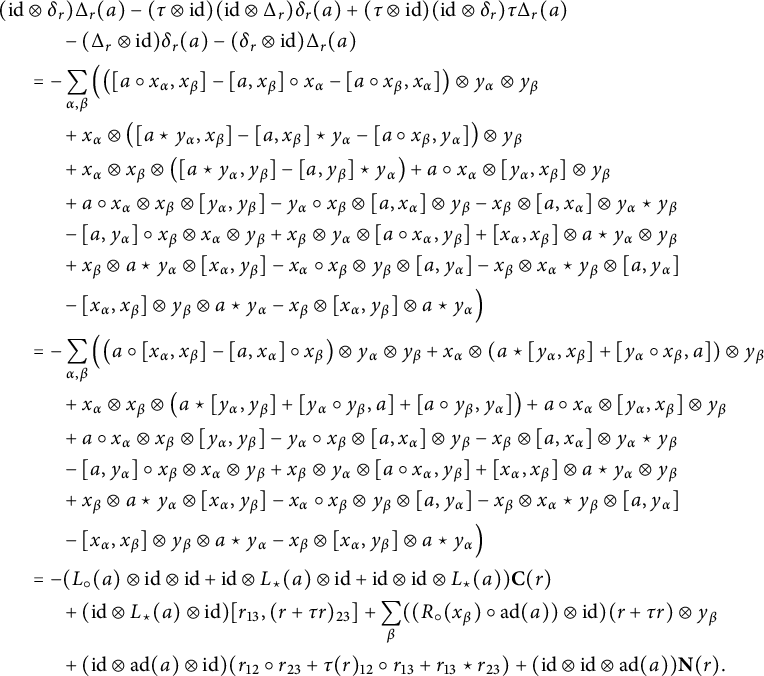 $$ \begin{align*} &(\mathrm{id}\otimes \delta_r)\Delta_r(a)-(\tau\otimes \mathrm{id})(\mathrm{id}\otimes\Delta_r)\delta_r(a)+(\tau\otimes \mathrm{id})(\mathrm{id}\otimes \delta_r)\tau \Delta_r(a)\\ &\quad\quad\quad -(\Delta_r\otimes \mathrm{ id})\delta_r(a)-(\delta_r\otimes \mathrm{id})\Delta_r(a)\\ &\mbox{}\hspace{0.5cm} = -\sum_{\alpha,\beta}\Big(\big([a\circ x_\alpha,x_\beta]-[a,x_\beta]\circ x_\alpha-[a\circ x_\beta,x_\alpha]\big)\otimes y_\alpha\otimes y_\beta\\ &\quad\quad\quad+x_\alpha\otimes\big([a\star y_\alpha, x_\beta]-[a,x_\beta]\star y_\alpha-[a\circ x_\beta,y_\alpha]\big)\otimes y_\beta\\ &\quad\quad\quad+x_\alpha\otimes x_\beta\otimes \big([a\star y_\alpha,y_\beta]-[a,y_\beta]\star y_\alpha\big)+a\circ x_\alpha \otimes [y_\alpha,x_\beta]\otimes y_\beta\\ &\quad\quad\quad+a\circ x_\alpha\otimes x_\beta\otimes[y_\alpha,y_\beta]-y_\alpha\circ x_\beta\otimes [a,x_\alpha]\otimes y_\beta-x_\beta\otimes [a,x_\alpha]\otimes y_\alpha\star y_\beta\\ &\quad\quad\quad-[a,y_\alpha]\circ x_\beta\otimes x_\alpha\otimes y_\beta+x_\beta\otimes y_\alpha\otimes [a\circ x_\alpha,y_\beta]+[x_\alpha,x_\beta]\otimes a\star y_\alpha\otimes y_\beta\\ &\quad\quad\quad+x_\beta\otimes a\star y_\alpha\otimes [x_\alpha,y_\beta]-x_\alpha\circ x_\beta\otimes y_\beta\otimes [a,y_\alpha]-x_\beta\otimes x_\alpha \star y_\beta\otimes [a, y_\alpha]\\ &\quad\quad\quad-[x_\alpha,x_\beta]\otimes y_\beta\otimes a\star y_\alpha-x_\beta\otimes [x_\alpha,y_\beta]\otimes a\star y_\alpha\Big)\\ &\mbox{}\hspace{0.5cm} =-\sum_{\alpha,\beta}\Big(\big(a\circ [x_\alpha,x_\beta]-[a,x_\alpha]\circ x_\beta\big)\otimes y_\alpha\otimes y_\beta+x_\alpha\otimes(a\star [y_\alpha,x_\beta]+[y_\alpha\circ x_\beta, a])\otimes y_\beta\\ &\quad\quad\quad+x_\alpha\otimes x_\beta\otimes \big(a\star [y_\alpha, y_\beta]+[y_\alpha\circ y_\beta,a]+[a\circ y_\beta,y_\alpha]\big)+a\circ x_\alpha \otimes [y_\alpha,x_\beta]\otimes y_\beta\\ &\quad\quad\quad+a\circ x_\alpha\otimes x_\beta\otimes[y_\alpha,y_\beta]-y_\alpha\circ x_\beta\otimes [a,x_\alpha]\otimes y_\beta-x_\beta\otimes [a,x_\alpha]\otimes y_\alpha\star y_\beta\\ &\quad\quad\quad-[a,y_\alpha]\circ x_\beta\otimes x_\alpha\otimes y_\beta+x_\beta\otimes y_\alpha\otimes [a\circ x_\alpha,y_\beta]+[x_\alpha,x_\beta]\otimes a\star y_\alpha\otimes y_\beta\\ &\quad\quad\quad+x_\beta\otimes a\star y_\alpha\otimes [x_\alpha,y_\beta]-x_\alpha\circ x_\beta\otimes y_\beta\otimes [a,y_\alpha]-x_\beta\otimes x_\alpha \star y_\beta\otimes [a, y_\alpha]\\ &\quad\quad\quad-[x_\alpha,x_\beta]\otimes y_\beta\otimes a\star y_\alpha-x_\beta\otimes [x_\alpha,y_\beta]\otimes a\star y_\alpha \Big)\\ &\mbox{}\hspace{0.5cm}=-(L_{\circ}(a)\otimes \mathrm{id}\otimes \mathrm{id}+\mathrm{id}\otimes L_{\star}(a)\otimes \mathrm{id}+\mathrm{id}\otimes \mathrm{id}\otimes L_{\star}(a))\mathbf{C}(r)\\ &\quad\quad\quad+(\mathrm{id}\otimes L_{\star}(a)\otimes \mathrm{id})[r_{13}, (r+\tau r)_{23}]+\sum_\beta((R_{\circ}(x_\beta)\circ {\mathrm{ad}}(a))\otimes \mathrm{id})(r+\tau r)\otimes y_\beta\nonumber\\ &\quad\quad\quad+(\mathrm{id}\otimes {\mathrm{ad}}(a)\otimes\mathrm{id})(r_{12}\circ r_{23}+\tau(r)_{12}\circ r_{13}+r_{13}\star r_{23})+(\mathrm{id}\otimes \mathrm{id}\otimes {\mathrm{ad}}(a))\mathbf{N}(r). \end{align*} $$
Therefore, Eq. (11) holds if and only if Eq. (41) holds. Similarly, we have
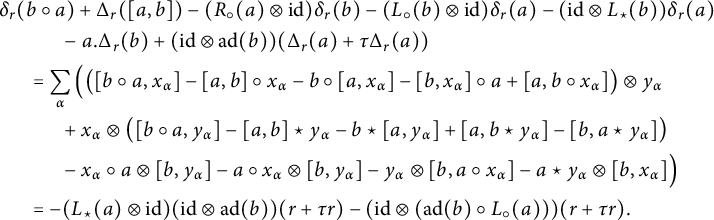 $$ \begin{align*} &\delta_r(b\circ a)+\Delta_r([a,b])-(R_{\circ}(a)\otimes \mathrm{id})\delta_r(b)-(L_{\circ}(b)\otimes \mathrm{id})\delta_r(a)-(\mathrm{id}\otimes L_{ \star}(b))\delta_r(a)\\ &\quad\quad\quad-a.\Delta_r(b)+(\mathrm{id}\otimes {\mathrm{ad}}(b))(\Delta_r(a)+\tau\Delta_r(a))\\ & \mbox{}\hspace{0.5cm}= \sum_\alpha \Big(\big([b\circ a,x_\alpha]-[a,b]\circ x_\alpha-b\circ [a,x_\alpha]-[b,x_\alpha]\circ a+[a,b\circ x_\alpha]\big)\otimes y_\alpha\\ &\quad\quad\quad+x_\alpha\otimes \big([b\circ a,y_\alpha]-[a,b]\star y_\alpha-b\star [a,y_\alpha]+[a,b\star y_\alpha]-[b,a\star y_\alpha]\big)\\ &\quad\quad\quad-x_\alpha \circ a\otimes [b,y_\alpha]-a\circ x_\alpha \otimes [b,y_\alpha]-y_\alpha\otimes [b, a\circ x_\alpha]-a\star y_\alpha \otimes [b,x_\alpha]\Big)\\ &\mbox{}\hspace{0.5cm}=-(L_{\star}(a)\otimes \mathrm{id})(\mathrm{id}\otimes {\mathrm{ad}}(b))(r+\tau r)-(\mathrm{id}\otimes ({\mathrm{ad}}(b)\circ L_{\circ}(a)))(r+\tau r). \end{align*} $$
Therefore, Eq. (20) holds if and only if Eq. (42) holds. Then the proof is completed.
Definition 3.4 Let
 $(A, \circ , [\cdot ,\cdot ])$
be a GD algebra and
 $r\in A\otimes A$
. The equation
 $$ \begin{align} \mathbf{N}(r)& =\mathbf{C}(r)=0 \end{align} $$
is called the Gel’fand-Dorfman Yang-Baxter equation (GDYBE) in A.
Proposition 3.5 Let
 $(A, \circ , [\cdot ,\cdot ])$
be a GD algebra and
 $r\in A\otimes A$
be a skew-symmetric solution of the GDYBE in A. Define
 $\Delta _r$
and
 $\delta _r$
by Eqs. (32) and (38), respectively. Then,
 $(A, \circ , [\cdot ,\cdot ], \Delta _r, \delta _r)$
is a GD bialgebra.
Proof It follows directly from Theorem 3.3.
Next, we investigate the operator form of the GDYBE. We first need to recall the notions of a representation of a Novikov algebra [Reference Osborn34] and of a GD algebra [Reference Wen and Hong38].
A representation of a Novikov algebra
 $(A,\circ )$
is a triple
 $(V, l_A,r_A)$
, where V is a vector space and
 $l_A$
,
 $r_A: A\rightarrow \mathrm {End}_{\mathbf {k}}(V)$
are linear maps satisfying
 $$ \begin{align} l_A(a\circ b-&b\circ a)v=l_A(a)l_A(b)v-l_A(b)l_A(a)v, \end{align} $$
 $$ \begin{align} l_A(a)r_A(b)v-&r_A(b)l_A(a)v=r_A(a\circ b)v-r_A(b)r_A(a)v, \end{align} $$
 $$ \begin{align} \ &l_A(a\circ b)v=r_A(b)l_A(a)v, \end{align} $$
 $$ \begin{align} &r_A(a)r_A(b)v=r_A(b)r_A(a)v, \;a, b\in A, v\in V. \end{align} $$
Let
 $(A, \circ , [\cdot , \cdot ])$
be a GD algebra and V be a vector space. Let
 $\rho _A$
,
 $l_A$
, and
 $r_A$
:
 $A \rightarrow \mathrm { End}_{\mathbf {k}}(V)$
be three linear maps. Then
 $(V, l_A, r_A, \rho _A)$
is called a representation of
 $(A, \circ , [\cdot , \cdot ])$
if
 $(V,\rho _A)$
is a representation of the Lie algebra
 $(A, [\cdot ,\cdot ])$
,
 $(V, l_A, r_A)$
is a representation of the Novikov algebra
 $(A, \circ )$
, and the following conditions are satisfied
 $$ \begin{align} &\;\;\rho_A(a)l_A(b)v+\rho_A(b\circ a)v+l_A([b,a])v-r_A(a)\rho_A(b)v-l_A(b)\rho_A(a) v=0, \end{align} $$
 $$ \begin{align} &\;\;\rho_A(a)r_A(b)v-\rho_A(b)r_A(a)v-r_A(b)\rho_A(a) v+r_A(a)\rho_A(b) v-r_A([a,b])v =0,\;\;\;a, b\in A,\; v\in V. \end{align} $$
Note that
 $(A, L_{\circ }, R_{\circ }, {\mathrm {ad}})$
is a representation of a GD algebra
 $(A, \circ , [\cdot ,\cdot ])$
, called the adjoint representation of
 $(A, \circ , [\cdot ,\cdot ])$
.
Proposition 3.6 Let
 $(A, \circ , [\cdot ,\cdot ])$
be a GD algebra and V be a vector space. Let
 $l_A$
,
 $r_A$
,
 $\rho _A: A\rightarrow \mathrm { End}_{\mathbf {k}}(V)$
be three linear maps. Define binary operations on the direct sum
 $A\oplus V$
of vector spaces as follows.
 $$ \begin{align} &(a+u)\bullet (b+v):=a\circ b+l_A(a)v+r_A(b)u, \end{align} $$
 $$ \begin{align} & [a+u, b+v]:=[a,b]+\rho_A(a)v-\rho_A(b)u,\;\;a, b\in A, u, v\in V. \end{align} $$
Then,
 $(A\oplus V, \bullet , [\cdot ,\cdot ])$
is a GD algebra if and only if
 $(V, l_A, r_A, \rho _A)$
is a representation of
 $(A, \circ , [\cdot ,\cdot ])$
. The GD algebra
 $(A\oplus V, \bullet , [\cdot ,\cdot ])$
is called the semi-direct product of
 $(A, \circ , [\cdot ,\cdot ])$
and its representation
 $(V, l_A, r_A, \rho _A)$
. We denote it by
 $A\ltimes _{l_A, r_A, \rho _A} V$
.
Proof It can be obtained either by a straightforward calculation or as a direct consequence of Proposition 4.4 by taking the trivial operations on
 $B=V$
.
Let
 $(A, \circ , [\cdot ,\cdot ])$
be a GD algebra and V be a vector space. Let
 $\varphi :A \rightarrow \mathrm { End}_{\mathbf {k}}(V)$
be a linear map. Define a linear map
 $\varphi ^{\ast }:A \rightarrow \mathrm { End}_{\mathbf {k}}(V^{\ast })$
by
 $$ \begin{align*} \langle \varphi^{\ast}(a)f, u\rangle & =-\langle f, \varphi(a)u\rangle,\;\;\; a\in A, f\in V^{\ast}, u\in V. \end{align*} $$
Proposition 3.7 Let
 $(A, \circ , [\cdot ,\cdot ])$
be a GD algebra and
 $(V, l_A, r_A, \rho _A)$
be a representation. Then
 $(V^{\ast }, l_A^{\ast }+r_A^{\ast }, -r_A^{\ast }, \rho _A^{\ast })$
is a representation of
 $(A, \circ , [\cdot ,\cdot ])$
.
Proof By [Reference Hong, Bai and Guo20, Proposition 3.3],
 $(V^{\ast }, l_A^{\ast }+r_A^{\ast }, -r_A^{\ast })$
is a representation of the Novikov algebra
 $(A, \circ )$
. Note that
 $(V^{\ast }, \rho _A^{\ast })$
is a representation of the Lie algebra
 $(A, [\cdot ,\cdot ])$
. Let
 $a,b\in A$
,
 $u\in V$
and
 $f\in V^*$
. Therefore, we only need to prove
 $$ \begin{align} &\rho_A^{\ast}(a)(l_A^{\ast}+r_A^{\ast})(b)f+\rho_A^{\ast}(b\circ a)f+(l_A^{\ast}+r_A^{\ast})([b,a]) f+r_A^{\ast}(a)\rho_A^{\ast}(b)f-(l_A^{\ast}+r_A^{\ast})(b)\rho_A^{\ast}(a)f=0, \end{align} $$
 $$ \begin{align} &-\rho_A^{\ast}(a)r_A^{\ast}(b)f+\rho_A^{\ast}(b)r_A^{\ast}(a)f+r_A^{\ast}(b)\rho_A^{\ast}(a)f-r_A^{\ast}(a)\rho_A^{\ast}(b)f+r_A^{\ast}([a,b])f=0. \end{align} $$
In fact, adding Eqs. (48) and (49) up, we obtain
 $$ \begin{align*} (l_A+r_A)(b)\rho_A(a)u-&\rho_A(b\circ a)u-(l_A+r_A)([b,a])u+\rho_A(b)r_A(a)u-\rho_A(a)(l_A+r_A)(b)u=0. \end{align*} $$
Then, we have
 $$ \begin{align*} &\langle \rho_A^{\ast}(a)(l_A^{\ast}+r_A^{\ast})(b)f+\rho_A^{\ast}(b\circ a)f+(l_A^{\ast}+r_A^{\ast})([b,a]) f+r_A^{\ast}(a)\rho_A^{\ast}(b)f-(l_A^{\ast}+r_A^{\ast})(b)\rho_A^{\ast}(a)f, u\rangle\\ &\mbox{}\hspace{0.5cm}=\langle f, (l_A+r_A)(b)\rho_A(a)u-\rho_A(b\circ a)u-(l_A+r_A)([b,a])u+\rho_A(b)r_A(a)u-\rho_A(a)(l_A+r_A)(b)u\rangle\\ &\mbox{}\hspace{0.5cm}= 0. \end{align*} $$
Remark 3.8 The adjoint representation
 $(A, L_{\circ }, R_{\circ }, {\mathrm {ad}})$
of a GD algebra
 $(A, \circ , [\cdot ,\cdot ])$
gives the representation
 $(A^{\ast }, L_{ \star }^{\ast }, -R_{ \circ }^{\ast }, {\mathrm {ad}}^{\ast })$
.
For a finite-dimensional vector space A, the isomorphism
 $$ \begin{align*}A\otimes A\cong \mathrm{Hom}_{\mathbf{k}}(A^*,\mathbf{k})\otimes A\cong \mathrm{Hom}_{\mathbf{k}}(A^*,A) \end{align*} $$
identifies an
 $r\in A\otimes A$
with a map from
 $A^*$
to A which we denote by
 $T^r$
. Explicitly, writing
 $r=\sum _{\alpha }x_\alpha \otimes y_\alpha $
, then
 $$ \begin{align*} T^r:A^*\to A, \quad T^r(f)=\sum_{\alpha}\langle f, x_\alpha\rangle y_\alpha,\;\; f\in A^*. \end{align*} $$
Proposition 3.9 Let
 $(A, \circ , [\cdot ,\cdot ])$
be a GD algebra and
 $r\in A\otimes A$
be skew-symmetric. Then, r is a solution of the GDYBE in
 $(A, \circ , [\cdot ,\cdot ])$
if and only if
 $T^r$
satisfies
 $$ \begin{align} &T^r(f)\circ T^r(g)=T^r(L_{\star}^{\ast}(T^r(f))g)-T^r(R_{\circ}^{\ast}(T^r(g))f), \end{align} $$
 $$ \begin{align} &[T^r(f), T^r(g)]=T^r({\mathrm{ad}}^{\ast}(T^r(f))g-{\mathrm{ad}}^{\ast}(T^r(g))f, \;\;\;f,~~g\in A^{\ast}. \end{align} $$
Proof Note that r is a solution of the GDYBE in
 $(A, \circ , [\cdot ,\cdot ])$
if and only if r is both a solution of the NYBE in
 $(A, \circ )$
and a solution of the CYBE in
 $(A, [\cdot ,\cdot ])$
. It is well known that r is a solution of the CYBE in
 $(A, [\cdot ,\cdot ])$
if and only if Eq. (55) holds (see [Reference Kupershmidt30]). By [Reference Hong, Bai and Guo20, Theorem 3.27], r is a solution of the NYBE in
 $(A, \circ )$
if and only if Eq. (54) holds. Then the conclusion follows.
Proposition 3.9 motivates us to give the following definition.
Definition 3.10 Let
 $(A, \circ , [\cdot ,\cdot ])$
be a GD algebra and
 $(V, l_A, r_A, \rho _A)$
be a representation of A. A linear map
 $T: V\rightarrow A$
is called an
 $\mathcal {O}$
-operator on
 $(A, \circ , [\cdot ,\cdot ])$
associated with
 $(V, l_A, r_A, \rho _A)$
if T satisfies
 $$ \begin{align} T(u)\circ T(v)&=T(l_A(T(u))v+r_A(T(v))u), \end{align} $$
 $$ \begin{align} [T(u),T(v)]&=T(\rho_A(T(u))v-\rho_A(T(v))u),\;\;u, v\in V. \end{align} $$
Eq. (56) means that T is an
 $\mathcal {O}$
-operator on the Novikov algebra
 $(A, \circ )$
associated with
 $(V, l_A, r_A)$
(see [Reference Hong, Bai and Guo20]); while Eq. (57) means that T is an
 $\mathcal {O}$
-operator on the Lie algebra
 $(A, [\cdot ,\cdot ])$
associated with
 $(V, \rho _A)$
(see [Reference Kupershmidt30]). On the other hand, by Proposition 3.9, if r is skew-symmetric, then r is a solution of the GDYBE in the GD algebra
 $(A, \circ , [\cdot ,\cdot ])$
if and only if
 $T^r$
is an
 $\mathcal {O}$
-operator on
 $(A, \circ , [\cdot ,\cdot ])$
associated with
 $(A^{\ast }, L_{\star }^{\ast }, -R_{\circ }^{\ast }, {\mathrm {ad}}^{\ast })$
. We give the following construction of solutions of the GDYBE from
 ${\mathcal O}$
-operators on GD algebras.
Theorem 3.11 Let
 $(A, \circ , [\cdot ,\cdot ])$
be a GD algebra and
 $(V, l_A, r_A, \rho _A)$
be a representation. Let
 $T: V\rightarrow A$
be a linear map which is identified with
 $r_T\in A\otimes V^{\ast } \subseteq (A\ltimes _{l_A^{\ast }+r_A^{\ast },-r_A^{\ast }, \rho _A^{\ast }} V^{\ast }) \otimes (A\ltimes _{l_A^{\ast }+r_A^{\ast },-r_A^{\ast }, \rho _A^{\ast }} V^{\ast })$
through
 $\mathrm {Hom}_{\mathbf {k}}(V, A)\cong A\otimes V^{\ast }$
. Then
 $r=r_T-\tau r_T$
is a solution of the GDYBE in the GD algebra
 $(A\ltimes _{l_A^{\ast }+r_A^{\ast },-r_A^{\ast }, \rho _A^{\ast }} V^{\ast }, \bullet , [\cdot ,\cdot ])$
if and only if T is an
 $\mathcal {O}$
-operator on
 $(A,\circ , [\cdot ,\cdot ])$
associated with
 $(V, l_A, r_A, \rho _A)$
.
Proof It follows directly by combining [Reference Hong, Bai and Guo20, Theorem 3.29] and [Reference Bai1, Section 2].
Definition 3.12 [Reference Hong, Bai and Guo20]
Let A be a vector space with binary operations
 $ \lhd $
and
 $\rhd $
. If for all a, b and
 $c\in A$
, they satisfy the following equalities:
 $$ \begin{align} &a\rhd(b\rhd c)=(a\rhd b+a\lhd b)\rhd c+b\rhd(a\rhd c)-(b\rhd a+b\lhd a)\rhd c, \end{align} $$
 $$ \begin{align} &a\rhd(b\lhd c)=(a\rhd b)\lhd c+b\lhd(a\lhd c+a\rhd c)-(b\lhd a)\lhd c, \end{align} $$
 $$ \begin{align} &(a\lhd b+a\rhd b)\rhd c=(a\rhd c)\lhd b, \end{align} $$
 $$ \begin{align} &(a\lhd b)\lhd c=(a\lhd c)\lhd b, \end{align} $$
then
 $(A,\lhd ,\rhd )$
is called a pre-Novikov algebra.
Definition 3.13 [Reference Xu and Hong40]
Let
 $(A, \lhd , \rhd )$
be a pre-Novikov algebra and
 $(A, \diamond )$
be a left-symmetric algebra. If they satisfy the following compatibility conditions:
 $$ \begin{align} &\;\;\;c\lhd(a\diamond b-b\diamond a)-a\diamond(c\lhd b)-(b\diamond c)\lhd a=-b\diamond(c\lhd a)-(a\diamond c)\lhd b, \end{align} $$
 $$ \begin{align} &\;\;\;(a\diamond b-b\diamond a)\rhd c+(a\lhd b+a\rhd b)\diamond c =a\rhd(b\diamond c)-b\diamond(a\rhd c)+(a\diamond c)\lhd b, a, b, c\in A, \end{align} $$
then the quadruple
 $(A,\lhd ,\rhd ,\diamond )$
is called a pre-Gel’fand-Dorfman algebra (pre-GD algebra).
Example 3.14 [Reference Xu and Hong40, Corollary 2.24]
Recall [Reference Loday32] that a Zinbiel algebra
 $(A, \cdot )$
is a vector space A with a binary operation
 $\cdot : A\otimes A\rightarrow A$
satisfying
 $$ \begin{align*} a\cdot (b\cdot c)=&(b\cdot a+a\cdot b)\cdot c,\;\;\;a, b, c\in A. \end{align*} $$
Let D be a derivation on
 $(A,\cdot )$
and
 $\xi $
,
 $k\in \mathbf {k}$
. Define
 $$ \begin{align*} &a\lhd b:=D(b)\cdot a+\xi b\cdot a ,~~a\rhd b:=a\cdot D(b)+\xi a \cdot b,\\ &a\diamond b:=k(a\cdot D(b)- D(a)\cdot b+\xi (a\cdot b-b\cdot a)), \;\;\; a, b\in A. \end{align*} $$
Then
 $(A,\lhd ,\rhd , \diamond )$
is a pre-GD algebra.
Remark 3.15 Pre-Novikov algebras, pre-GD algebras and Zinbiel algebras are particular cases of the dendriform splitting (2-successor) of an operad introduced in [Reference Bai, Bellier, Guo and Ni2]. See [Reference Kolesnikov, Mashurov and Sartayev26] for a more detailed discussion.
The relationship between GD algebras and pre-GD algebras is given as follows.
Proposition 3.16 [Reference Xu and Hong40, Proposition 2.19] Let
 $(A,\lhd ,\rhd , \diamond )$
be a pre-GD algebra. Define
 $$ \begin{align} a\circ b= & a\lhd b+a\rhd b,~~[a ,b]=a\diamond b-b\diamond a,\;\;\;a, b\in A. \end{align} $$
Then
 $(A,\circ ,[\cdot ,\cdot ])$
is a GD algebra, called the associated GD algebra of
 $(A, \lhd , \rhd , \diamond )$
. Moreover,
 $(A, L_{\rhd }, R_{\lhd }, L_\diamond )$
is a representation of the GD algebra
 $(A, \circ , [\cdot , \cdot ])$
. Conversely, let A be a vector space with binary operations
 $\rhd $
,
 $\lhd $
and
 $\diamond $
. If
 $(A, \circ , [\cdot , \cdot ])$
defined by Eq. (64) is a GD algebra and
 $(A, L_{\rhd }, R_{\lhd }, L_\diamond )$
is a representation of
 $(A, \circ , [\cdot , \cdot ])$
, then
 $(A, \lhd , \rhd , \diamond )$
is a pre-GD algebra.
The close relationship among pre-GD algebras,
 ${\mathcal O}$
-operators on GD algebras and solutions of the GDYBE can be formulated as follows.
Theorem 3.17
-
(a) Let
$(A, \circ , [\cdot ,\cdot ])$
be a GD algebra,
$(V, l_A, r_A, \rho _A)$
be a representation of
$(A, \circ , [\cdot ,\cdot ])$
and
$T: V\rightarrow A$
be an
$\mathcal {O}$
-operator associated with
$(V, l_A, r_A, \rho _A)$
. Then there exists a pre-GD algebra structure on V defined by
$$ \begin{align*} u\rhd v:=&l_A(T(u))v,\;\; u\lhd v:= r_A(T(v))u, \;\; u\diamond v:=\rho_A(T(u))v,\;\;\; u,~~v\in V. \end{align*} $$
-
(b) Let
$(A, \lhd , \rhd , \diamond )$
be a pre-GD algebra and
$(A, \circ , [\cdot ,\cdot ])$
be the associated GD algebra. Then the identity map is an
$\mathcal O$
-operator on
$(A, \circ , [\cdot ,\cdot ])$
associated with the representation
$(A, L_{\rhd }, R_{\lhd }, L_\diamond )$
. -
(c) Let
$(A, \lhd , \rhd , \diamond )$
be a pre-GD algebra and
$(A, \circ , [\cdot ,\cdot ])$
be the associated GD algebra. Let
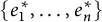
$\{e_1, \ldots , e_n\}$
be a linear basis of A and
$\{e_1^{\ast }, \ldots , e_n^{\ast }\}$
be the dual basis of
$A^{\ast }$
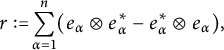
. Then (65)is a skew-symmetric solution of the GDYBE in the GD algebra
$$ \begin{align} r:= & \sum_{\alpha=1}^n(e_\alpha\otimes e_\alpha^{\ast}-e_\alpha^{\ast}\otimes e_\alpha), \end{align} $$
$A\ltimes _{L_\rhd ^{\ast }+R_\lhd ^{\ast }, -R_\lhd ^{\ast }, L_\diamond ^{\ast }}A^{\ast }$
.













Proof (a) and (b) follow from direct verification. For (c), since the identity map
 $\mathrm {id}: A\rightarrow A$
is an
 $\mathcal {O}$
-operator on
 $(A, \circ , [\cdot ,\cdot ])$
associated with
 $(A, L_\rhd , R_\lhd , L_\diamond )$
, the conclusion follows from Theorem 3.11.
3.2 GDYBE and classical conformal Yang–Baxter equation
We first recall the conformal classical Yang–Baxter equation [Reference Liberati31] which appears in the coboundary case of Lie conformal bialgebras.
Let
 $(R, [\cdot _\lambda \cdot ])$
be a Lie conformal algebra and
 $r=\sum _\alpha x_\alpha \otimes y_\alpha \in R\otimes R$
. Let
 $\partial ^{\otimes ^3}:=\partial \otimes \mathrm {id}\otimes \mathrm {id}+\mathrm {id}\otimes \partial \otimes \mathrm {id}+\mathrm {id}\otimes \mathrm {id}\otimes \partial $
. The conformal classical Yang–Baxter equation in R or simply CCYBE in R is the following equation:
 $$ \begin{align*} [[r,r]]&:= \sum_{\alpha,\beta}([{x_\alpha}_\mu x_\beta]\otimes y_\alpha\otimes y_\beta|_{\mu=\mathrm{id}\otimes \partial\otimes \mathrm{id}} \\ &\quad -x_\alpha\otimes [{x_\beta}_\mu y_\alpha]\otimes y_\beta|_{\mu=\mathrm{id}\otimes \mathrm{id}\otimes \partial}-x_\alpha\otimes x_\beta\otimes [{y_\beta}_\mu y_\alpha]|_{\mu=\mathrm{id}\otimes \partial\otimes \mathrm{id}}) \\ &\equiv 0 \;\; (\text{mod} ~~\partial \cdot (R\otimes R\otimes R)), \end{align*} $$
i.e.,
 $[[r,r]]$
belongs to the image of
 $\partial $
under the module action of
 $\mathbf {k}[\partial ]$
on
 $R\otimes R\otimes R$
given by
 $ \partial \cdot (x\otimes y\otimes z)=\partial ^{\otimes ^3}(x\otimes y\otimes z)$
for all x, y,
 $z\in R$
.
Proposition 3.18 [Reference Liberati31, Theorem 3.4]
Let R be a Lie conformal algebra. If
 $r=\sum _\alpha x_\alpha \otimes y_\alpha \in R\otimes R$
is a skew-symmetric solution of the CCYBE in R, then
 $(R, [\cdot _\lambda \cdot ], \delta )$
is a Lie conformal bialgebra, where
 $\delta $
is defined by
 $$ \begin{align} \delta(a)=a_\lambda r|_{\lambda=-\partial^{\otimes^2}}=\sum_\alpha ([a_\lambda x_\alpha]\otimes y_\alpha+x_\alpha\otimes [a_\lambda y_\alpha])|_{\lambda=-\partial^{\otimes^2}},\;\;a\in R. \end{align} $$
The relationship between GDYBE and CCYBE is given as follows.
Proposition 3.19 Let
 $(A, \circ , [\cdot ,\cdot ])$
be a GD algebra. Let
 $r \in A\otimes A$
be skew-symmetric and also naturally regarded as an element in
 $R(A)\otimes R(A)$
. Then
 $r\in R(A)\otimes R(A)$
is a solution of the CCYBE in
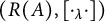 $(R(A),[\cdot _\lambda \cdot ])$
if and only if r is a solution of the GDYBE in A.
Proof Set
 $r=\sum _\alpha x_\alpha \otimes y_\alpha \in A\otimes A$
. Note that
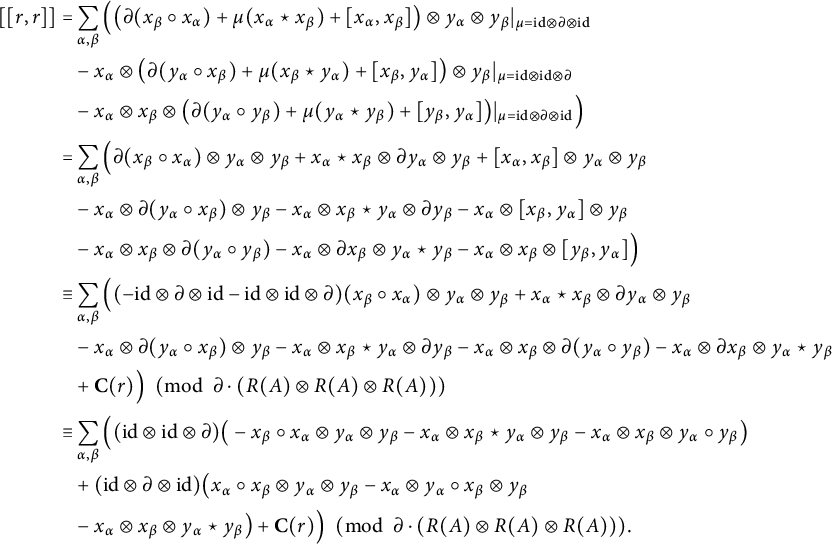 $$ \begin{align*} [[r,r]]=&\sum_{\alpha,\beta}\Big(\big(\partial(x_\beta\circ x_\alpha)+\mu({x_\alpha}\star x_\beta)+[x_\alpha, x_\beta]\big)\otimes y_\alpha\otimes y_\beta|_{\mu=\mathrm{id}\otimes \partial\otimes \mathrm{id}} \\ &-x_\alpha\otimes \big(\partial(y_\alpha\circ x_\beta)+\mu (x_\beta\star y_\alpha)+[x_\beta, y_\alpha]\big)\otimes y_\beta|_{\mu=\mathrm{id}\otimes \mathrm{id}\otimes \partial} \\ &-x_\alpha\otimes x_\beta\otimes \big(\partial (y_\alpha\circ y_\beta)+\mu(y_\alpha\star y_\beta)+[y_\beta, y_\alpha]\big)|_{\mu=\mathrm{id}\otimes \partial\otimes \mathrm{id}}\Big) \\ =&\sum_{\alpha,\beta}\Big(\partial(x_\beta\circ x_\alpha)\otimes y_\alpha\otimes y_\beta+{x_\alpha}\star x_\beta \otimes \partial y_\alpha\otimes y_\beta+[x_\alpha, x_\beta]\otimes y_\alpha\otimes y_\beta \\ &-x_\alpha\otimes \partial(y_\alpha\circ x_\beta)\otimes y_\beta-x_\alpha\otimes x_\beta \star y_\alpha\otimes \partial y_\beta-x_\alpha\otimes [x_\beta, y_\alpha]\otimes y_\beta \\ &-x_\alpha\otimes x_\beta\otimes \partial (y_\alpha\circ y_\beta)-x_\alpha\otimes \partial x_\beta\otimes y_\alpha\star y_\beta-x_\alpha\otimes x_\beta\otimes [y_\beta, y_\alpha]\Big) \\ \equiv &\sum_{\alpha,\beta}\Big((-\mathrm{id}\otimes \partial\otimes \mathrm{id}-\mathrm{id}\otimes \mathrm{id}\otimes \partial)(x_\beta\circ x_\alpha)\otimes y_\alpha\otimes y_\beta+{x_\alpha}\star x_\beta\otimes \partial y_\alpha\otimes y_\beta \\ &-x_\alpha\otimes \partial(y_\alpha\circ x_\beta)\otimes y_\beta-x_\alpha\otimes x_\beta \star y_\alpha\otimes \partial y_\beta-x_\alpha\otimes x_\beta\otimes \partial (y_\alpha\circ y_\beta)-x_\alpha\otimes \partial x_\beta\otimes y_\alpha\star y_\beta \\ &+\mathbf{C}(r)\Big)\;\; (\text{mod}~~\partial \cdot (R(A)\otimes R(A)\otimes R(A))) \\ \equiv& \sum_{\alpha,\beta}\Big((\mathrm{id}\otimes \mathrm{id}\otimes \partial)\big(-x_\beta\circ x_\alpha\otimes y_\alpha\otimes y_\beta-x_\alpha\otimes x_\beta\star y_\alpha\otimes y_\beta-x_\alpha\otimes x_\beta\otimes y_\alpha\circ y_\beta\big) \\ &+(\mathrm{id}\otimes \partial \otimes \mathrm{id})\big(x_\alpha\circ x_\beta\otimes y_\alpha\otimes y_\beta-x_\alpha\otimes y_\alpha\circ x_\beta\otimes y_\beta \\ &-x_\alpha\otimes x_\beta\otimes y_\alpha\star y_\beta\big)+\mathbf{C}(r)\Big)\;\; (\text{mod}~~\partial \cdot (R(A)\otimes R(A)\otimes R(A))). \end{align*} $$
Then it is straightforward to show that r is a solution of the CCYBE in
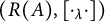 $(R(A),[\cdot _\lambda \cdot ])$
if and only if r is a solution of the GDYBE in A.
Let
 $r\in A\otimes A$
be a skew-symmetric solution of the GDYBE in a GD algebra
 $(A, \circ , [\cdot ,\cdot ])$
. Then, by Proposition 3.5,
 $(A, \circ , [\cdot ,\cdot ], \Delta =\Delta _r, \delta _0=\delta _r)$
with
 $\Delta _r$
and
 $\delta _r$
defined by Eqs. (32) and (38) respectively is a GD bialgebra. On the one hand, by Theorem 2.17, there is the corresponding Lie conformal bialgebra
 $(R(A), [\cdot _\lambda \cdot ], \delta )$
with
 $\delta $
defined by Eq. (12). On the other hand, by Proposition 3.19, r is a skew-symmetric solution of the CCYBE in
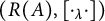 $(R(A),[\cdot _\lambda \cdot ])$
and hence by Proposition 3.18, there is a Lie conformal bialgebra
 $(R(A), [\cdot _\lambda \cdot ], \bar \delta )$
with
 $\bar \delta $
defined by Eq. (66).
Corollary 3.20 With the above notations, the two Lie conformal bialgebras
 $(R(A), [\cdot _\lambda \cdot ], \delta )$
and
 $(R(A), [\cdot _\lambda \cdot ], \bar \delta )$
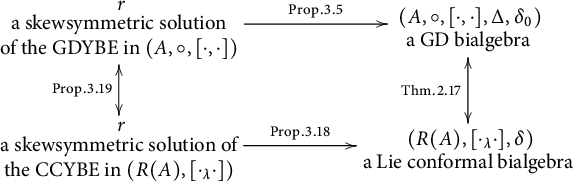
coincide. Moreover, we have the following commutative diagram.
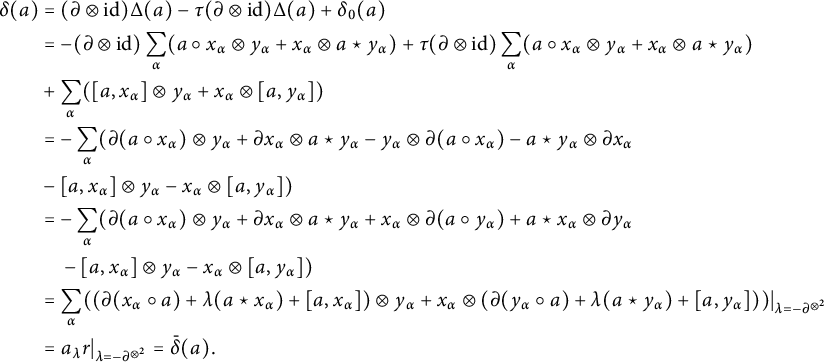
Proof Set
 $r=\sum _\alpha x_\alpha \otimes y_\alpha \in A\otimes A$
. Let
 $a\in A$
. Then we have
 $$ \begin{align*} \delta(a)&=(\partial\otimes \mathrm{id})\Delta(a)-\tau (\partial\otimes \mathrm{id})\Delta(a)+\delta_0(a) \\ &=-(\partial\otimes \mathrm{id})\sum_\alpha (a\circ x_\alpha\otimes y_\alpha+x_\alpha\otimes a\star y_\alpha)+\tau(\partial\otimes \mathrm{id})\sum_\alpha (a\circ x_\alpha\otimes y_\alpha+x_\alpha\otimes a\star y_\alpha) \\ &+\sum_\alpha ([a, x_\alpha]\otimes y_\alpha+x_\alpha\otimes [a, y_\alpha]) \\ &=-\sum_\alpha(\partial(a\circ x_\alpha)\otimes y_\alpha+\partial x_\alpha\otimes a\star y_\alpha-y_\alpha\otimes \partial(a\circ x_\alpha) -a\star y_\alpha \otimes \partial x_\alpha \\ &- [a, x_\alpha]\otimes y_\alpha-x_\alpha\otimes [a, y_\alpha]) \\ &=-\sum_\alpha(\partial(a\circ x_\alpha)\otimes y_\alpha+\partial x_\alpha\otimes a\star y_\alpha+x_\alpha\otimes \partial(a\circ y_\alpha) +a\star x_\alpha \otimes \partial y_\alpha \\ &\quad -[a, x_\alpha]\otimes y_\alpha-x_\alpha\otimes [a, y_\alpha]) \\ &=\sum_\alpha((\partial(x_\alpha\circ a)+\lambda(a\star x_\alpha)+[a,x_\alpha])\otimes y_\alpha+x_\alpha\otimes (\partial (y_\alpha\circ a)+\lambda (a\star y_\alpha)+[a,y_\alpha]))|_{\lambda=-\partial^{\otimes^2}} \\ &=a_\lambda r |_{\lambda=-\partial^{\otimes^2}}=\bar \delta(a). \end{align*} $$
The commutative diagram follows directly.
Definition 3.21 [Reference Kac24]
Let M and N be
 $\mathbf {k}[\partial ]$
-modules. A conformal linear map from M to N is a
 $\mathbf {k}$
-linear map
 $f: M\rightarrow N[\lambda ]$
, denoted by
 $f_\lambda : M\rightarrow N$
, such that
 $[\partial , f_\lambda ]=-\lambda f_\lambda $
. Denote the
 $\mathbf {k}$
-vector space of all such maps by
 $\text {Chom}(M,N)$
. It has a canonical structure of a
 $\mathbf {k}[\partial ]$
-module
 $$ \begin{align*}(\partial f)_\lambda =-\lambda f_\lambda.\end{align*} $$
Define the conformal dual of a
 $\mathbf {k}[\partial ]$
-module M by
 $M^{\ast c}=\text {Chom}(M,\mathbf {k})$
, where
 $\mathbf {k}$
is viewed as the trivial
 $\mathbf {k}[\partial ]$
-module, that is
 $$ \begin{align*}M^{\ast c}=\big\{f:M\rightarrow \mathbf{k}[\lambda]~~\big|~~f \text{ is } \mathbf{k}\text{-linear and}~~f_\lambda(\partial b)=\lambda f_\lambda b\big\}.\end{align*} $$
Let M be a finitely generated
 $\mathbf {k}[\partial ]$
-module. Set
 $\text {Cend}(M)=\text {Chom}(M,M)$
. Then, there is a Lie conformal algebra structure on
 $\text {Cend}(M)$
defined by
 $$ \begin{align} [f_\lambda g]_\mu v=f_\lambda (g_{\mu-\lambda} v)-g_{\mu-\lambda}(f_{\lambda} v), ~~~ f,~g\in \text{Cend}(M), v\in M. \end{align} $$
Denote this Lie conformal algebra by
 $\text {gc}(M)$
, which is called the general Lie conformal algebra of M.
Definition 3.22 [Reference Kac24]
Let M be a finitely generated
 $\mathbf {k}[\partial ]$
-module and R be a Lie conformal algebra.
 $(M, \rho )$
is called a representation of R if
 $\rho : R\rightarrow \text {gc}(M)$
is a homomorphism of Lie conformal algebras.
Remark 3.23 We denote the adjoint representation of R by
 $(R, {\mathrm {ad}}_R)$
, where
 ${\mathrm {ad}}_R(a)_\lambda b=[a_\lambda b]$
, with a,
 $b\in R$
. Let
 $(M, \rho )$
be a representation of R. There is also a dual representation
 $(M^{\ast c}, \rho ^{\ast })$
given as follows
 $$ \begin{align*} (\rho^{\ast}(a)_\lambda \varphi)_\mu u & =-\varphi_{\mu-\lambda}(\rho(a)_\lambda u),\;\;\;a\in R, \varphi\in M^{\ast c}, u\in M. \end{align*} $$
Proposition 3.24 [Reference Hong and Li22, Proposition 3.1]
Let R be a Lie conformal algebra, M be a
 $\mathbf { k}[\partial ]$
-module and
 $\rho : R\rightarrow \text {gc}(M)$
be a
 $\mathbf {k}[\partial ]$
-module homomorphism. Define a
 $\lambda $
-bracket on the direct sum
 $R\oplus M$
as
 $\mathbf { k}[\partial ]$
-modules as follows.
 $$ \begin{align} [(a+u)_\lambda (b+v)]:=&[a_\lambda b]+\rho(a)_\lambda v-\rho(b)_{-\lambda-\partial}u,\;\;a, b\in R, \; u, v\in M. \end{align} $$
Then
 $R\oplus M$
is a Lie conformal algebra if and only if
 $(M,\rho )$
is a representation of R. The Lie conformal algebra
 $R\oplus M$
is called the semi-direct product of R and its representation
 $(M,\rho )$
. We denote it by
 $R\ltimes _{\rho }M$
.
We next present the relationship between representations of GD algebras and a class of representations of the corresponding Lie conformal algebras.
Proposition 3.25 Let
 $(A, \circ , [\cdot ,\cdot ])$
be a GD algebra and
 $M=\mathbf {k}[\partial ]V$
which is free as a
 $\mathbf {k}[\partial ]$
-module on V. Define a
 $\mathbf {k}[\partial ]$
-module homomorphism
 $\rho _{l_A, r_A, \rho _A}: R(A)\rightarrow \text {gc}(M)$
by
 $$ \begin{align} {\rho_{l_A, r_A, \rho_A}(a)}_\lambda v&=\partial(r_A(a)v)+\lambda(l_A(a)v+r_A(a)v)+\rho_A(a)v,\;\;\; a\in A, v\in V, \end{align} $$
where
 $l_A$
,
 $r_A$
and
 $\rho _A: A\rightarrow \text {End}_{\mathbf {k}}(V)$
are linear maps. Then
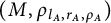 $(M, \rho _{l_A,r_A, \rho _A})$
is a representation of
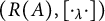 $(R(A),[\cdot _\lambda \cdot ])$
if and only if
 $(V, l_A, r_A, \rho _A)$
is a representation of
 $(A, \circ , [\cdot ,\cdot ])$
.
Proof Let a,
 $b\in A$
and u,
 $v\in V$
. Note that
 $$ \begin{align*} [(a+u)_\lambda (b+v)]&:=[a_\lambda b]+\rho_{l_A,r_A,\rho_A}(a)_\lambda v-\rho_{l_A,r_A,\rho_A}(b)_{-\lambda-\partial} u \\ &=\partial (b\circ a)+\lambda (a\star b)+[a,b]+\partial(r_A(a)v)+\lambda(l_A(a)v+r_A(a)v)+\rho_A(a)v \\ &\quad-(\partial(r_A(b)u)+(-\lambda-\partial)(l_A(b)u+r_A(b)u)+\rho_A(b)u) \\ &= \partial(b\circ a+l_A(b)u+r_A(a)v)+\lambda(a\star b+l_A(a)v+r_A(a)v+l_A(b)u+r_A(b)u) \\ &\quad+([a,b]+\rho_A(a)v-\rho_A(b)u). \end{align*} $$
Define
 $$ \begin{align*}(a+u)\bullet (b+v)&:=b\circ a+l_A(a)v+r_A(b)v,\ [a+u,b+v]\\ &:=[a,b]+\rho_A(a)v-\rho_A(b)u,\;\; a, b\in A, \;u, v\in V. \end{align*} $$
By Proposition 3.24,
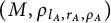 $(M, \rho _{l_A,r_A, \rho _A})$
is a representation of
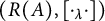 $(R(A),[\cdot _\lambda \cdot ])$
if and only if
 $R(A)\oplus M$
is a Lie conformal algebra with the
 $\lambda $
-bracket above. Note that
 $R(A)\oplus M=\mathbf {k}[\partial ](A\oplus V)$
is a Lie conformal algebra if and only if
 $(A\oplus V, \bullet , [\cdot ,\cdot ])$
is a GD algebra by Proposition 2.4. Then this conclusion follows by Proposition 3.6.
Remark 3.26 Let
 $(A, \circ , [\cdot ,\cdot ])$
be a GD algebra. Then the adjoint representation
 $(R(A), {\mathrm {ad}}_{R(A)})$
of
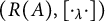 $(R(A), [\cdot _\lambda \cdot ])$
is exactly
 $(R(A), \rho _{L_{\circ }, R_{\circ }, {\mathrm {ad}}})$
.
By the proof of Proposition 3.25,
 $R(A)\ltimes _{\rho _{l_A, r_A,\rho _A}}M$
is just the Lie conformal algebra corresponding to the GD algebra
 $A\ltimes _{l_A,r_A,\rho _A} V$
.
Proposition 3.27 Let
 $(A, \circ , [\cdot ,\cdot ])$
be a GD algebra. Suppose that
 $(V, l_A, r_A, \rho _A)$
is a representation of
 $(A, \circ , [\cdot ,\cdot ])$
and
 $M=\mathbf {k}[\partial ]V$
which is free as a
 $\mathbf {k}[\partial ]$
-module on V. Then the representation
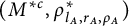 $(M^{\ast c}, \rho _{l_A,r_A,\rho _A}^{\ast })$
of
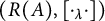 $(R(A),[\cdot _\lambda \cdot ])$
is just the representation
 $(\mathbf {k}[\partial ]V^{\ast }, \rho _{l_A^{\ast }+r_A^{\ast }, -r_A^{\ast }, \rho _A^{\ast }})$
.
Proof Note that
 $M^{\ast c}=\mathbf {k}[\partial ]V^{\ast }$
. Moreover, for all
 $a\in A$
,
 $f\in V^{\ast }$
and
 $v\in V$
, we have
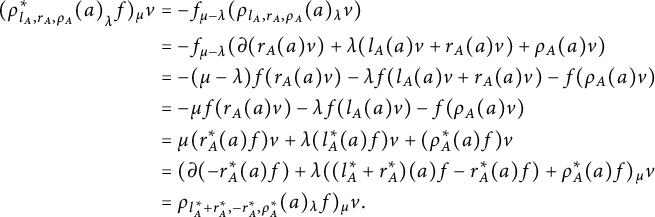 $$ \begin{align*} ({\rho_{l_A,r_A,\rho_A}^{\ast}(a)}_\lambda f)_\mu v&=-f_{\mu-\lambda}(\rho_{l_A,r_A, \rho_A}(a)_\lambda v) \\ &=-f_{\mu-\lambda}(\partial(r_A(a)v)+\lambda(l_A(a)v+r_A(a)v)+\rho_A(a)v) \\ &=-(\mu-\lambda)f(r_A(a)v)-\lambda f(l_A(a)v+r_A(a)v)-f(\rho_A(a)v) \\ &=-\mu f(r_A(a)v)-\lambda f(l_A(a)v)-f(\rho_A(a)v) \\ &= \mu(r_A^{\ast}(a)f)v+\lambda (l_A^{\ast} (a)f)v+(\rho_A^{\ast}(a)f)v \\ &=(\partial (-r_A^{\ast}(a)f)+\lambda((l_A^{\ast}+r_A^{\ast})(a)f-r_A^{\ast}(a)f)+\rho_A^{\ast}(a)f)_\mu v \\ &=\rho_{l_A^{\ast}+r_A^{\ast},-r_A^{\ast}, \rho_A^{\ast}}(a)_\lambda f)_\mu v. \end{align*} $$
Therefore,
 $\rho _{l_A,r_A, \rho _A}^{\ast }=\rho _{l_A^{\ast }+r_A^{\ast },-r_A^{\ast }, \rho _A^{\ast }}$
.
Definition 3.28 [Reference Hong and Bai18]
Let R be a Lie conformal algebra and
 $(M, \rho )$
be a representation of R. If a
 $\mathbf {k}[\partial ]$
-module homomorphism
 $T: M\rightarrow R$
satisfies
 $$ \begin{align*} [T(u)_\lambda T(v)]=&T(\rho(T(u))_\lambda v-\rho(T(v))_{-\lambda-\partial} u),\;\;\; u, v\in M, \end{align*} $$
then T is called an
 $\mathcal {O}$
-operator associated with
 $(M, \rho )$
.
Proposition 3.29 [Reference Hong and Bai18, Theorem 3.1]
Let R be a finite Lie conformal algebra which is free as a
 $\mathbf {k}[\partial ]$
-module and
 $r\in R\otimes R$
be skew-symmetric. Then r is a solution of the CCYBE in R if and only if
 $T_0^r=T_\lambda ^r|_{\lambda =0}$
is an
 $\mathcal {O}$
-operator associated with
 $(R^{\ast c}, {\mathrm {ad}}^{\ast })$
, where
 $T^r\in \text {Chom}(R^{\ast c}, R)$
is defined by
 $$ \begin{align} T_\lambda^r(u)=&\sum_iu_{-\lambda-\partial}(x_i)y_i,\;\;\; u\in R^{\ast c}, \text{where } r=\sum_i x_i\otimes y_i. \end{align} $$
Proposition 3.30 [Reference Hong and Bai18, Theorem 3.7]
Let R be a finite Lie conformal algebra and
 $(M, \rho )$
be a representation of R. Suppose that R and M are free as
 $\mathbf {k}[\partial ]$
-modules and
 $T_\lambda \in \text {Chom}(M, R)$
. Let
 $r_T\in R\otimes M^{\ast c}$
be the corresponding element through the
 $\mathbf {k}[\partial ]$
-module isomorphism
 $R\otimes M^{\ast c}\cong \text {Chom}(M, R)$
with the identification
 $(a\otimes f)_\lambda (u)=f_{\lambda +\partial ^R}(u)a$
(see [Reference Boyallian, Kac and Liberati10]), where
 $a\in R$
,
 $f\in M^{\ast c }$
,
 $u\in M$
and
 $\partial ^R$
represents that this
 $\partial $
acts on R. Then
 $T=T_\lambda |_{\lambda =0}$
is an
 $\mathcal {O}$
-operator associated with
 $(M, \rho )$
if and only if
 $r=r_T-\tau r_T$
is a skew-symmetric solution of the CCYBE in the semi-direct product
 $R\ltimes _{\rho ^{\ast }} M^{\ast c}$
.
Next, we give a correspondence between
 $\mathcal {O}$
-operators on GD algebras and
 $\mathcal {O}$
-operators on the corresponding Lie conformal algebras which follows from a direct check.
Proposition 3.31 Let
 $(A, \circ , [\cdot ,\cdot ])$
be a GD algebra. Suppose that
 $(V, l_A, r_A, \rho _A)$
is a representation of
 $(A, \circ , [\cdot ,\cdot ])$
. Then
 $T: V\rightarrow A$
is an
 $\mathcal {O}$
-operator on
 $(A, \circ , [\cdot ,\cdot ])$
associated with
 $(V, l_A, r_A, \rho _A)$
if and only if the
 $\mathbf {k}[\partial ]$
-module homomorphism
 $\widetilde {T}: \mathbf { k}[\partial ]V\rightarrow R(A)$
defined by
 $$ \begin{align} \widetilde{T}(v)=&T(v),\;\;v\in V, \end{align} $$
is an
 $\mathcal {O}$
-operator on
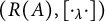 $(R(A),[\cdot _\lambda \cdot ])$
associated with
 $(\mathbf {k}[\partial ]V, \rho _{l_A, r_A, \rho _A})$
.
Similar to Corollary 3.20, there are the following two commutative diagrams.
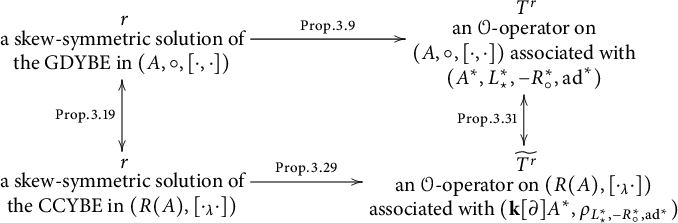
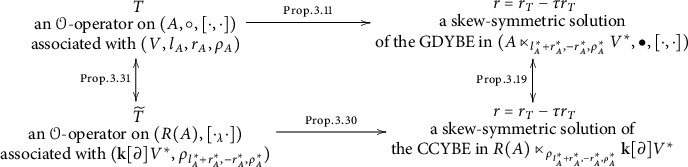
Definition 3.32 [Reference Hong and Li23]
A left-symmetric conformal algebra B is a
 $\mathbf {k}[\partial ]$
-module endowed with a
 $\mathbf {k}$
-linear map
 $\cdot _\lambda \cdot : B\otimes B\rightarrow B[\lambda ]$
such that
 $$ \begin{align*} (\partial a)_\lambda b=-\lambda a_\lambda b,\;\; a_\lambda (\partial b)=(\partial+\lambda) a_\lambda b, (a_\lambda b)_{\lambda+\mu}c -a_\lambda (b_\mu c)=(b_\mu a)_{\lambda+\mu}c-b_\mu (a_\lambda c),\;\;\; a, b\in B. \end{align*} $$
A correspondence between pre-GD algebras and a class of left-symmetric conformal algebras is given as follows.
Proposition 3.33 [Reference Xu and Hong40, Theorem 2.21]
Let
 $R(A)=\mathbf {k}[\partial ]A$
be a free
 $\mathbf {k}[\partial ]$
-module over a vector space A. Then
 $R(A)$
is a left-symmetric conformal algebra with the following
 $\lambda $
-products
 $$ \begin{align} a_\lambda b=\partial (b\lhd a)+\lambda (a\rhd b+b\lhd a)+a\diamond b,\;\;\; ~~a, b\in A,\end{align} $$
where
 $\lhd $
,
 $\rhd ,$
and
 $\diamond $
are three binary operations on A if and only if
 $(A, \lhd , \rhd , \diamond )$
is a pre-GD algebra. We call that
 $R(A)$
is the left-symmetric conformal algebra corresponding to
 $(A, \lhd , \rhd , \diamond )$
.
Proposition 3.34
-
(a) [Reference Hong and Li23, Proposition 2.5] Let B be a left-symmetric conformal algebra. Then, the
$\lambda $
-brackets (73)define a Lie conformal algebra structure on B, denoted by
$$ \begin{align} [a_\lambda b]=&a_\lambda b-b_{-\lambda-\partial}a,\;\;\; a, b \in B, \end{align} $$
$\mathfrak {g}(B)$
, which is called the sub-adjacent Lie conformal algebra of B. Therefore, the identity map
$\mathrm {id}$
on B is an
$\mathcal {O}$
-operator on
$\mathfrak {g}(B)$
associated with the representation
$(B, L_B)$
, where (74)
$$ \begin{align} {L_B(a)}_\lambda b=&a_\lambda b, \;\; a, b\in B. \end{align} $$
-
(b) [Reference Hong and Bai18, Corollary 4.6] Let T be an
$\mathcal {O}$
-operator on a Lie conformal algebra R associated with a representation
$(M, \rho )$
. Then there is a left-symmetric conformal algebra structure on M defined by (75)
$$ \begin{align} u_\lambda v&=\rho(T(u))_\lambda v,\;\;\; u, v\in M. \end{align} $$








Proposition 3.35 Let
 $(A, \lhd , \rhd , \diamond )$
be a pre-GD algebra and
 $(A, \circ , [\cdot ,\cdot ])$
be the associated GD algebra. Let
 $R(A)$
be the left-symmetric conformal algebra corresponding to
 $(A, \lhd , \rhd , \diamond )$
. Then, the sub-adjacent Lie conformal algebra of
 $R(A)$
is just the Lie conformal algebra
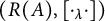 $(R(A),[\cdot _\lambda \cdot ])$
.
Proof Let a,
 $b\in A$
. Then, we have
 $$ \begin{align*} [a_\lambda b]&=a_\lambda b-b_{-\lambda-\partial}a\\ &= \partial (b\lhd a)+\lambda (a\rhd b+b\lhd a)+a\diamond b-(\partial (a\lhd b)+(-\lambda-\partial) (b\rhd a+a\lhd b)+b\diamond a)\\ &= \partial(b\lhd a+b\rhd a)+\lambda (a\rhd b+a\lhd b+b\rhd a+b\lhd a)+(a\diamond b-b\diamond a)\\ &= \partial(b\circ a)+\lambda(a\star b)+[a,b]. \end{align*} $$
Hence, we obtain the conclusion.
Proposition 3.36 Let
 $(A,\circ , [\cdot ,\cdot ])$
be a GD algebra. Suppose that T is an
 $\mathcal O$
-operator on
 $(A,\circ , [\cdot ,\cdot ])$
associated with a representation
 $(V,l_A,r_A, \rho _A)$
and
 $(V,\rhd ,\lhd , \diamond )$
be the pre-GD algebra defined by Eq. (65). Then the left-symmetric conformal structure on
 $\mathbf {k}[\partial ]V$
induced from the
 $\mathcal O$
-operator
 $\widetilde {T}$
on the Lie conformal algebra
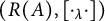 $(R(A),[\cdot _\lambda \cdot ])$
associated with the representation
 $(\mathbf {k}[\partial ]V, \rho _{l_A, r_A, \rho _A})$
is exactly the one corresponding to the pre-GD algebra
 $(V,\rhd ,\lhd , \diamond )$
.
Proof Let u,
 $v\in V$
. Then we have
 $$ \begin{align*} u_\lambda v&=\rho_{l_A,r_A,\rho_A}(\widetilde{T}(u))_\lambda v\\ &=\partial (r_A(T(u))v)+\lambda(l_A(T(u))v+r_A(T(u))v)+\rho_A(T(u))v\\ &= \partial (v\lhd u)+\lambda (u\rhd v+v\lhd u)+u\diamond v. \end{align*} $$
Therefore, the conclusion holds.
Corollary 3.37 Let
 $(A, \lhd , \rhd , \diamond )$
be a pre-GD algebra and
 $(A, \circ , [\cdot ,\cdot ])$
be the associated GD algebra. Let
 $R(A)=\mathbf {k}[\partial ]A$
be the left-symmetric conformal algebra corresponding to
 $(A, \lhd , \rhd , \diamond )$
. Thus
 $\mathfrak {g}(R(A))$
is the Lie conformal algebra
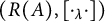 $(R(A), [\cdot _\lambda \cdot ])$
corresponding to
 $(A, \circ , [\cdot ,\cdot ])$
. Then the
 $\mathcal O$
-operator
 $\widetilde {\mathrm {id}_A}$
on the Lie conformal algebra
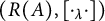 $(R(A), [\cdot _\lambda \cdot ])$
associated with
 $(R(A), \rho _{L_\rhd ,R_\lhd , L_\diamond })$
is exactly
 $\mathrm {id}_{\mathfrak {g}(R(A))}$
as the
 $\mathcal O$
-operator on
 $\mathfrak {g}(R(A))$
associated with the representation
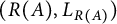 $(R(A), L_{R(A)})$
, where
 $L_{R(A)}$
is defined by Eq. (74).
Proof Obviously,
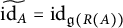 $\widetilde {\mathrm {id}_A}=\mathrm {id}_{\mathfrak {g}(R(A))}$
. Then it follows directly from Proposition 3.35.
Furthermore, considering the sufficient and necessary conditions in Propositions 3.31 and 3.33, we have the following commutative diagram.
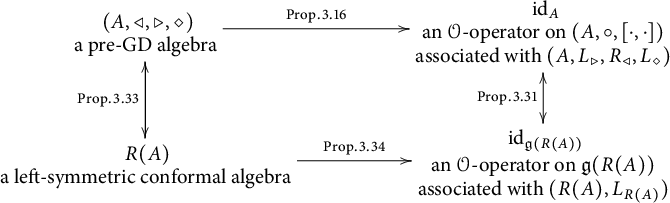
Combining the results above, we have
Theorem 3.38 Let
 $(A, \lhd , \rhd , \diamond )$
be a pre-GD algebra and
 $(A, \circ , [\cdot ,\cdot ])$
be the associated GD algebra. Define r by Eq. (65), which is a skew-symmetric solution of the GDYBE in the GD algebra
 $\hat A= A\ltimes _{L_\rhd ^{\ast }+R_\lhd ^{\ast }, -R_\lhd ^{\ast }, L_\diamond ^{\ast }}A^{\ast }$
. Then there is a Lie conformal bialgebra structure
 $\delta $
on the Lie conformal algebra
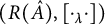 $(R(\hat A), [\cdot _\lambda \cdot ])$
with
 $\delta $
defined by Eq. (66). Moreover, it is exactly the one corresponding to the GD bialgebra
 $(\hat A, \circ , [\cdot ,\cdot ], \Delta , \delta _0)$
with
 $\delta $
defined by Eq. (12), where
 $\Delta =\Delta _r$
and
 $\delta _0=\delta _r$
are defined by Eqs. (32) and (38) respectively through r.
4 Relations of GD bialgebras with Manin triples, matched pairs and Lie conformal bialgebras
In this section, we present two characterizations of GD bialgebras in terms of matched pairs and Manin triples of GD algebras, respectively. Furthermore, the relations of the notions of matched pairs as well as Manin triples of GD algebras with the corresponding notions of the Lie conformal algebras are established.
4.1 Equivalent characterizations of GD bialgebras
Next, we recall the definitions of matched pairs of Novikov algebras and Lie algebras.
Definition 4.1 [Reference Hong17]
Let
 $(A,\circ _A)$
and
 $(B,\circ _B)$
be Novikov algebras. Let
 $l_A$
,
 $r_A: A \rightarrow \mathrm { End}_{\mathbf {k}}(B)$
and
 $l_B$
,
 $r_B: B \rightarrow \mathrm { End}_{\mathbf {k}}(A)$
be linear maps. If there is a Novikov algebra structure on the direct sum
 $A\oplus B$
of the underlying vector spaces of A and B given by
 $$ \begin{align} (a+x)\bullet (b+y)&:=\big(a\circ_A b+l_B(x)b+r_B(y)a\big)\nonumber\\ &\quad +\big(x\circ_B y+l_A(a)y+r_A(b)x\big),\;a, b\in A, x, y\in B,\end{align} $$
then we call the resulting sextuple
 $(A, B, l_A, r_A, l_B, r_B)$
a matched pair of Novikov algebras.
Definition 4.2 [Reference Majid33]
Let
 $(A, [\cdot ,\cdot ]_A)$
and
 $(B, [\cdot ,\cdot ]_B)$
be Lie algebras,
 $\rho _A: A \rightarrow \mathrm { End}_{\mathbf {k}}(B)$
and
 $\rho _B: B \rightarrow \mathrm { End}_{\mathbf {k}}(A)$
be linear maps. If there is a Lie algebra structure on the vector space
 $A\oplus B$
given by
 $$ \begin{align} [a+x, b+y]&:=([a,b]_A+\rho_{B}(x)b-\rho_{B}(y)a)\nonumber\\ &\quad +([x,y]_B+\rho_{A}(a)y-\rho_{A}(b)x),\;\; a, b\in A, x, y\in B, \end{align} $$
then we call the resulting quadruple
 $(A, B, \rho _{A}, \rho _{B})$
a matched pair of Lie algebras.
Definition 4.3 Let
 $(A, \circ _A, [\cdot ,\cdot ]_A)$
and
 $(B, \circ _B, [\cdot ,\cdot ]_B)$
be GD algebras. Let
 $l_A$
,
 $r_A$
,
 $\rho _A: A \rightarrow \mathrm { End}_{\mathbf {k}}(B)$
and
 $l_B$
,
 $r_B$
,
 $\rho _B: B \rightarrow \mathrm { End}_{\mathbf {k}}(A)$
be linear maps. If there is a GD algebra
 $(A\oplus B, \bullet , [\cdot ,\cdot ])$
where
 $\bullet $
and
 $[\cdot ,\cdot ]$
on
 $A\oplus B$
are given by Eqs. (76) and (77) respectively, then we call the resulting octuple
 $(A, B, l_A, r_A, \rho _{A}, l_B, r_B, \rho _{B})$
a matched pair of GD algebras.
Proposition 4.4 [Reference Wen and Hong38, Example 3.6, Theorem 3.7]
The octuple
 $(A, B, l_A, r_A, \rho _{A}, l_B, r_B, \rho _{B})$
is a matched pair of GD algebras if and only if
 $(A, B, l_A, r_A, l_B, r_B)$
is a matched pair of Novikov algebras,
 $(A, B, \rho _A, \rho _B)$
is a matched pair of Lie algebras,
 $(A, l_B, r_B, \rho _B)$
be a representation of
 $(B, \circ _B, [\cdot ,\cdot ]_B)$
,
 $(B, l_A, r_A, \rho _A)$
be a representation of
 $(A, \circ _A, [\cdot ,\cdot ]_A)$
and they also satisfy the compatibility conditions as follows.
 $$ \begin{align} &[a, r_B(x)b]_A-\rho_B(l_A(b)x)a-\rho_B(x)(b\circ_A a)+r_B(x)[b,a]_A+(\rho_B(x)b)\circ_A a \end{align} $$
 $$ \begin{align} &\;\;\;\;-l_B(\rho_A(b)x)a+b\circ_A (\rho_B(x)a)-r_B(\rho_A(a)x)b=0,\nonumber\\ &[a, l_B(x)b]_A-\rho_B(r_A(b)x)a-[b, l_B(x)a]_A+\rho_B(r_A(a)x)b+(\rho_B(x)a)\circ_A b \end{align} $$
 $$ \begin{align} &\;\;\;\;-l_B(\rho_A(a)x)b-(\rho_B(x)b)\circ_A a+l_B(\rho_A(b)x)a-l_B(x)[a,b]_A=0,\nonumber\\ &[y,r_A(a)x]_B-\rho_A(a)(x\circ_B y)-\rho_A(l_B(x)a)y+(\rho_A(a)x)\circ_B y-l_A(\rho_B(x)a)y \end{align} $$
 $$ \begin{align} &\;\;\;\;+r_A(a)[x,y]_B+x\circ_B (\rho_A(a)y)-r_A(\rho_B(y)a)x=0,\nonumber\\ &[x, l_A(a)y]_B-\rho_A(r_B(y)a)x-[y, l_A(a)x]_B+\rho_A(r_B(x)a)y+(\rho_A(a)x)\circ_B y\\ &\;\;\;\;-l_A(\rho_B(x)a)y-(\rho_A(a)y)\circ_B x+l_A(\rho_B(y)a)x-l_A(a)[x,y]_B=0, \;\;a, b\in A, x, y\in B.\nonumber \end{align} $$
Moreover, any GD algebra that can be decomposed into a linear direct sum of two GD subalgebras is obtained from a matched pair of GD algebras.
Definition 4.5 [Reference Hong, Bai and Guo20]
Let
 $(A,\circ )$
be a Novikov algebra. A bilinear form
 $(\cdot ,\cdot )$
on A is called invariant if it satisfies
 $$ \begin{align} (a\circ b,c)&=-(b, a\star c),\;\;\; a,b,c\in A. \end{align} $$
A quadratic Novikov algebra, denoted by
 $(A,\circ , (\cdot ,\cdot ))$
, is a Novikov algebra
 $(A,\circ )$
together with a nondegenerate symmetric invariant bilinear form
 $(\cdot ,\cdot )$
.
Recall that a bilinear form
 $(\cdot ,\cdot )_L $
on a Lie algebra L is called invariant if
 $$ \begin{align} ( [a, b], c)_L&=( a, [b, c])_L, \;\; a, b, c\in L. \end{align} $$
Definition 4.6 Let
 $(A, \circ , [\cdot ,\cdot ])$
be a GD algebra. If there is a bilinear form
 $(\cdot ,\cdot )$
such that
 $(A, \circ , (\cdot ,\cdot ))$
is a quadratic Novikov algebra and
 $(\cdot ,\cdot )$
is invariant on the Lie algebra
 $(A, [\cdot ,\cdot ])$
, then
 $(A, \circ , [\cdot ,\cdot ], (\cdot ,\cdot ))$
is called a quadratic GD algebra.
Definition 4.7 A (standard) Manin triple of GD algebras is a tripe of GD algebras
 $(A=A_1\oplus A_1^{\ast }, (A_1, \circ _{A_1}, [\cdot ,\cdot ]_{A_1}), (A_1^{\ast }, \circ _{A_1^{\ast }}, [\cdot ,\cdot ]_{A_1^{\ast }}))$
for which
-
(a) A is the linear direct sum of
$A_1$
and
$A_1^{\ast }$
; -
(b)
$(A_1, \circ _{A_1}, [\cdot ,\cdot ]_{A_1})$
and
$(A_1^{\ast }, \circ _{A_1^{\ast }}, [\cdot ,\cdot ]_{A_1^{\ast }})$
are GD subalgebras of A; -
(c) the bilinear form on
$A_1\oplus A_1^*$
given by (84)is invariant on both
$$ \begin{align} (a+f,b+g)=&\langle f, b\rangle+\langle g, a\rangle,\;\;\;\;a, b\in A_1, f, g\in A_1^{\ast}, \end{align} $$
$(A, \circ )$
and
$(A, [\cdot ,\cdot ])$
, that is,
$(A, \circ , [\cdot ,\cdot ], (\cdot ,\cdot ))$
is a quadratic GD algebra.









Next, we present an equivalence between Manin triples of GD algebras and some matched pairs of GD algebras.
Theorem 4.8 Let
 $(A, \circ _A, [\cdot ,\cdot ]_A)$
be a GD algebra. Suppose that there is a GD algebra structure
 $(A^{\ast }, \circ _{A^{\ast }}, [\cdot ,\cdot ]_{A^{\ast }})$
on
 $A^{\ast }$
. Then there is a Manin triple
 $(A\oplus A^{\ast }, (A, \circ _A, [\cdot ,\cdot ]_A), (A^{\ast }, \circ _{A^{\ast }}, [\cdot ,\cdot ]_{A^{\ast }}))$
if and only if
 $(A, A^{\ast }, L_{\star _A}^{\ast }, -R_{\circ _A}^{\ast }, {\mathrm {ad}}_A^{\ast }, L_{\star _{A^{\ast }}}^{\ast }, -R_{\circ _{A^{\ast }}}^{\ast }, {\mathrm {ad}}_{A^{\ast }}^{\ast })$
is a matched pair of GD algebras.
Proof Suppose that
 $(A, A^{\ast }, L_{\star _A}^{\ast }, -R_{\circ _A}^{\ast }, {\mathrm {ad}}_A^{\ast }, L_{\star _{A^{\ast }}}^{\ast }, -R_{\circ _{A^{\ast }}}^{\ast }, {\mathrm {ad}}_{A^{\ast }}^{\ast })$
is a matched pair of GD algebras. Then by the definition of matched pair, there is a GD algebra
 $(A\oplus A^{\ast }, \bullet , [\cdot ,\cdot ])$
such that
 $(A, \circ _{A}, [\cdot ,\cdot ]_{A})$
and
 $(A^{\ast }, \circ _{A^{\ast }}, [\cdot ,\cdot ]_{A^{\ast }})$
are its GD subalgebras. Moreover,
 $(A, A^{\ast }, L_{\star _A}^{\ast }, -R_{\circ _A}^{\ast }, L_{\star _{A^{\ast }}}^{\ast }, -R_{\circ _{A^{\ast }}}^{\ast })$
is a matched pair of Novikov algebras and
 $(A, A^{\ast }, {\mathrm {ad}}_A^{\ast }, {\mathrm {ad}}_{A^{\ast }}^{\ast })$
is a matched pair of Lie algebras. Then by [Reference Hong, Bai and Guo20, Theorem 3.10], the bilinear form
 $(\cdot ,\cdot )$
defined by Eq. (84) is invariant on
 $(A\oplus A^{\ast }, \bullet )$
. Similarly, since
 $(A, A^{\ast }, {\mathrm {ad}}_A^{\ast }, {\mathrm {ad}}_{A^{\ast }}^{\ast })$
is a matched pair of Lie algebras, the bilinear form
 $(\cdot ,\cdot )$
defined by Eq. (84) is also invariant on
 $(A\oplus A^{\ast }, [\cdot ,\cdot ])$
. Therefore,
 $(A\oplus A^{\ast }, (A, \circ _A, [\cdot ,\cdot ]_A), (A^{\ast }, \circ _{A^{\ast }}, [\cdot ,\cdot ]_{A^{\ast }}))$
is a Manin triple of GD algebras.
Conversely, suppose that
 $(A\oplus A^{\ast }, (A, \circ _A, [\cdot ,\cdot ]_A), (A^{\ast }, \circ _{A^{\ast }}, [\cdot ,\cdot ]_{A^{\ast }}))$
is a Manin triple of GD algebras. Then, by Proposition 4.4, the GD algebra
 $(A\oplus A^{\ast }, \circ , [\cdot ,\cdot ])$
is obtained from some matched pair
 $(A, A^{\ast }, l_A, r_A, \rho _A, l_{A^{\ast }}, r_{A^{\ast }}, \rho _{A^{\ast }})$
. Since
 $(\cdot ,\cdot )$
defined by Eq. (84) is invariant on
 $(A\oplus A^{\ast }, \circ )$
, we have
 $l_A=L_{\star _A}^{\ast }$
,
 $r_A=-R_{\circ _A}^{\ast }$
,
 $l_{A^{\ast }}=L_{\star _{A^{\ast }}}^{\ast }$
and
 $r_{A^{\ast }}=-R_{\circ _{A^{\ast }}}^{\ast }$
by [Reference Hong, Bai and Guo20, Theorem 3.10]. Similarly, since
 $(\cdot ,\cdot )$
defined by Eq. (84) is invariant on
 $(A\oplus A^{\ast }, [\cdot ,\cdot ])$
, we obtain
 $\rho _A={\mathrm {ad}}_A^{\ast }$
and
 $\rho _{A^{\ast }}={\mathrm {ad}}_{A^{\ast }}^{\ast }$
. Then the proof is completed.
Finally, we give an equivalence between certain matched pairs of GD algebras and GD bialgebras.
Theorem 4.9 Let
 $(A, \circ _A, [\cdot ,\cdot ]_A)$
be a GD algebra. Suppose that there is a GD algebra structure
 $(A^{\ast },\circ _{A^{\ast }}, [\cdot ,\cdot ]_{A^{\ast }})$
and let
 $(A,\Delta ,\delta )$
be the corresponding dual GD coalgebra. Then,
 $(A, A^{\ast }, L_{\star _A}^{\ast }, -R_{\circ _A}^{\ast }, {\mathrm {ad}}_A^{\ast }, L_{\star _{A^{\ast }}}^{\ast }, -R_{\circ _{A^{\ast }}}^{\ast }, {\mathrm {ad}}_{A^{\ast }}^{\ast })$
is a matched pair of GD algebras if and only if
 $(A, \circ _A, [\cdot ,\cdot ]_A, \Delta , \delta )$
is a GD bialgebra.
Proof Note that
 $(A, A^{\ast }, {\mathrm {ad}}_A^{\ast }, {\mathrm {ad}}_{A^{\ast }}^{\ast })$
is a matched pair of Lie algebras if and only if
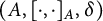 $(A, [\cdot ,\cdot ]_A, \delta )$
is a Lie bialgebra. Moreover,
 $(A, A^{\ast }, L_{\star _A}^{\ast }, -R_{\circ _A}^{\ast }, L_{\star _{A^{\ast }}}^{\ast }, -R_{\circ _{A^{\ast }}}^{\ast })$
is a matched pair of Novikov algebras if and only if
 $(A, \circ _A, \Delta )$
is a Novikov bialgebra by [Reference Hong, Bai and Guo20, Theorem 3.11]. Therefore we only need to prove that Eqs. (78)–(81) hold if and only if Eq. (20) holds when
 $l_A=L_{\star _A}^{\ast }$
,
 $r_A=-R_{\circ _A}^{\ast }$
,
 $l_B=L_{\star _{A^{\ast }}}^{\ast }$
,
 $r_B=-R_{\circ _{A^{\ast }}}^{\ast }$
,
 $\rho _A={\mathrm {ad}}_A^{\ast }$
and
 $\rho _B={\mathrm {ad}}_{A^{\ast }}^{\ast }$
.
Let
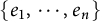 $\{e_1,\cdots , e_n\}$
be a basis of A and
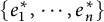 $\{e_1^{\ast }, \cdots , e_n^{\ast }\}$
be its dual basis. Let
 $$ \begin{align*} e_i\circ_A e_j=\sum_{k=1}^na_{ij}^ke_k,\;\;[e_i, e_j]_A=\sum_{k=1}^nb_{ij}^ke_k,\;\;\Delta(e_k)=\sum_{i,j=1}^nc_{ij}^ke_i\otimes e_j,\;\;\delta(e_k)=\sum_{i,j=1}^nd_{ij}^ke_i\otimes e_j. \end{align*} $$
Consequently,
 $e_i^{\ast } \circ _{A^{\ast }} e_j^{\ast }=\sum _{k=1}^n c_{ij}^ke_k^{\ast }$
and
 $[e_i^{\ast }, e_j^{\ast }]_{A^{\ast }}=\sum _{k=1}^n d_{ij}^ke_k^{\ast }$
. Moreover, we obtain
 $$ \begin{align*} &L_{\star_A}^{\ast}(e_i)e_j^{\ast}=-\sum_{k=1}^n(a_{ik}^j+a_{ki}^j)e_k^{\ast},\;\; -R_{\circ_A}^{\ast}(e_i)e_j^{\ast}=\sum_{k=1}^na_{ki}^je_k^{\ast},\;\;L_{\star_{A^{\ast}}}^{\ast}(e_i^{\ast})e_j=-\sum_{k=1}^n(c_{ik}^j+c_{ki}^j)e_k,\\ & -R_{\circ_{A^{\ast}}}^{\ast}(e_i^{\ast})e_j=\sum_{k=1}^nc_{ki}^je_k,\;\; {\mathrm{ad}}_A^{\ast}(e_i)e_j^{\ast}=-\sum_{k=1}^nb_{ik}^je_k^{\ast},\;\; {\mathrm{ad}}_{A^{\ast}}^{\ast}(e_i^{\ast})e_j=-\sum_{k=1}^nd_{ik}^je_k. \end{align*} $$
Let
 $a=e_i$
,
 $x=e_k^{\ast }$
and
 $b= e_j$
in Eqs. (78) and (79). Comparing the coefficients of
 $e_t$
gives
 $$ \begin{align} &\;\;\sum_{s=1}^n\Big(c_{sk}^jb_{is}^t-(a_{js}^k+a_{sj}^k)d_{st}^i+a_{ji}^sd_{kt}^s+b_{ji}^sc_{tk}^s-d_{ks}^ja_{si}^t-b_{js}^k(c_{st}^i+c_{ts}^i)-d_{ks}^ia_{js}^t+b_{is}^kc_{ts}^j\Big)=0, \end{align} $$
 $$ \begin{align} &\;\;\sum_{s=1}^n\Big(-(c_{ks}^j+c_{sk}^j)b_{is}^t+a_{sj}^kd_{st}^i+(c_{ks}^i+c_{sk}^i)b_{js}^t-a_{si}^kd_{st}^j-d_{ks}^ia_{sj}^t-b_{is}^k(c_{st}^j+c_{ts}^j)\\ &\qquad\qquad+d_{ks}^ja_{si}^t+b_{js}^k(c_{st}^i+c_{ts}^i)+b_{ij}^s(c_{kt}^s+c_{tk}^s)\Big)=0.\nonumber \end{align} $$
Let
 $a=e_i$
,
 $x=e_j^{\ast }$
and
 $y=e_k^{\ast }$
in Eqs. (80) and (81). Comparing the coefficients of
 $e_t^{\ast }$
, we obtain
 $$ \begin{align} &\sum_{s=1}^n\Big(a_{si}^jd_{ks}^t+c_{jk}^sb:{it}^s-(c_{js}^i+c_{sj}^i)b_{st}^k-b_{is}^jc_{sk}^t-d_{js}^i(a_{st}^k+a_{ts}^k)+d_{jk}^sa:{ti}^s-b_{is}^kc_{js}^t+d_{ks}^ia_{ts}^j\Big)=0, \end{align} $$
 $$ \begin{align} &\sum_{s=1}^n\Big(-(a_{is}^k+a_{si}^k)d_{js}^t+c_{sk}^ib_{st}^j+(a_{is}^j+a_{si}^j)d_{ks}^t-c_{sj}^ib_{st}^k-b_{is}^jc_{sk}^t-d_{js}^i(a_{st}^k+a_{ts}^k)\\ &\qquad\qquad\qquad \qquad +b_{is}^kc_{sj}^t+d_{ks}^i(a_{st}^j+a_{ts}^j)+d_{jk}^s(a_{it}^s+a_{ti}^s)\Big)=0.\nonumber \end{align} $$
Let
 $a=e_i$
and
 $b=e_j$
in Eq. (20). Comparing the coefficients of
 $e_s\otimes e_t$
, we get
 $$ \begin{align} &\sum_{k=1}^n\Big(a_{ji}^kd_{st}^k+b_{ij}^kc_{st}^k-d_{kt}^ja_{ki}^s-d_{kt}^ia_{jk}^s-d_{sk}^i(a_{jk}^t+a_{kj}^t)-c_{kt}^jb_{ik}^s-c_{sk}^jb_{ik}^t+b_{jk}^t(c_{sk}^i+c_{ks}^i)\Big)=0. \end{align} $$
It is straightforward to show that Eq. (87) holds if and only if Eq. (85) holds. By Eq. (85), we get
 $$ \begin{align*} \sum_{s=1}^n(a_{js}^k+a_{sj}^k)d_{st}^i&=\sum(c_{sk}^jb_{is}^t+a_{ji}^sd_{kt}^s+b_{ji}^sc_{tk}^s-d_{ks}^ja_{si}^t-b_{js}^k(c_{st}^i+c_{ts}^i)-d_{ks}^ia_{js}^t+b_{is}^kc_{ts}^j). \end{align*} $$
Substituting it into the expression on the left-hand side of Eq. (88), we find that Eq. (88) holds. Similarly, we also get that Eq. (86) holds by Eq. (85). Therefore, Eqs. (85)–(88) hold if and only if Eq. (85) holds. Replacing k, s and t in Eq. (89) by s, t and
 $k,$
respectively, we get that Eq. (85) holds if and only if Eq. (89) holds. Then, the proof is completed.
Theorems 4.8 and 4.9 give the following characterization of GD bialgebras.
Corollary 4.10 Let
 $(A, \circ _A, [\cdot ,\cdot ]_A)$
be a GD algebra. Suppose that there is a GD algebra structure
 $(A^{\ast }, \circ _{A^{\ast }},[\cdot ,\cdot ]_{A^{\ast }})$
on
 $A^{\ast }$
obtained from
 $\Delta :A\rightarrow A\otimes A$
and
 $\delta : A\rightarrow A\otimes A,$
respectively. Then the following conditions are equivalent.
-
(a)
$(A, \circ _A, [\cdot ,\cdot ]_A, \Delta , \delta )$
is a GD bialgebra; -
(b) There is a Manin triple
$(A\oplus A^{\ast }, (A, \circ _A, [\cdot ,\cdot ]_A), (A^{\ast }, \circ _{A^{\ast }}, [\cdot ,\cdot ]_{A^{\ast }}))$
; -
(c)
$(A, A^{\ast }, L_{\star _A}^{\ast }, -R_{\circ _A}^{\ast }, {\mathrm {ad}}_A^{\ast }, L_{\star _{A^{\ast }}}^{\ast }, -R_{\circ _{A^{\ast }}}^{\ast }, {\mathrm {ad}}_{A^{\ast }}^{\ast })$
is a matched pair of GD algebras.



4.2 Correspondences between GD bialgebras and Lie conformal bialgebras in terms of matched pairs and Manin triples
Now recall matched pairs of Lie conformal algebras.
Definition 4.11 [Reference Hong and Li22]
Let
 $R_1$
and
 $R_2$
be Lie conformal algebras,
 $\rho : R_1\rightarrow \text {gc}(R_2)$
and
 $\sigma : R_2\rightarrow \text {gc}(R_1)$
be
 $\mathbf {k}[\partial ]$
-module homomorphisms. If there is a Lie conformal algebra structure on the direct sum
 $R_1\oplus R_2$
as
 $\mathbf {k}[\partial ]$
-modules given by
 $$ \begin{align} &[(a+x)_\lambda (b+y)]=([a_\lambda b]+\sigma(x)_\lambda b-\sigma(y)_{-\lambda-\partial}a)+([x_\lambda y]+\rho(a)_\lambda y-\rho(b)_{-\lambda-\partial} x),\;\; \end{align} $$
for all
 $a, b\in R_1$
, and
 $x, y\in R_2$
, then
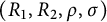 $(R_1, R_2, \rho , \sigma )$
is called a matched pair of Lie conformal algebras.
Remark 4.12 Let
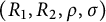 $(R_1,R_2,\rho ,\sigma )$
be a matched pair of Lie conformal algebras. If
 $R_2$
is abelian and
 $\sigma $
is trivial, then the Lie conformal algebra on the
 $\mathbf {k}[\partial ]$
-module
 $R_1\oplus R_2$
given by Eq. (90) is called the semi-direct product of
 $R_1$
and its representation
 $(R_2, \rho )$
. We denote it by
 $R_1\ltimes _\rho R_2$
.
Next, a correspondence between matched pairs of GD algebras and certain matched pairs of the corresponding Lie conformal algebras is given as follows.
Proposition 4.13 Let
 $(A, \circ _A, [\cdot ,\cdot ]_A)$
and
 $(B, \circ _B, [\cdot ,\cdot ]_B)$
be GD algebras. Let
 $l_A$
,
 $r_A$
,
 $\rho _A: A\rightarrow \text {End}_{\mathbf {k}}(B)$
and
 $l_B$
,
 $r_B$
,
 $\rho _B: B\rightarrow \text {End}_{\mathbf {k}}(A)$
be linear maps. Then
 $(R(A), R(B), \rho _{l_A,r_A, \rho _A}, \rho _{l_B, r_B, \rho _B})$
is a matched pair of Lie conformal algebras if and only if
 $(A, B, l_A, r_A, \rho _A, l_B, r_B, \rho _B)$
is a matched pair of GD algebras.
Proof The proof follows from a similar argument as the one for Proposition 3.25.
Corollary 4.14 Let
 $(A, \circ _A, [\cdot ,\cdot ]_A)$
and
 $(A^{\ast }, \circ _{A^{\ast }}, [\cdot ,\cdot ]_{A^{\ast }})$
be GD algebras. Then,
 $(R(A), {R(A)}^{\ast c}, {\mathrm {ad}}_{R(A)}^{\ast }, {\mathrm {ad}}_{{R(A)}^{\ast c}}^{\ast })$
is a matched pair of Lie conformal algebras if and only if
 $(A, A^{\ast }, L_{\star _A}^{\ast }, -R_{\circ _A}^{\ast }, {\mathrm {ad}}_A^{\ast }, L_{ \star _{A^{\ast }}}^{\ast }, -R_{\circ _{A^{\ast }}}^{\ast }, {\mathrm {ad}}_{A^{\ast }}^{\ast })$
is a matched pair of GD algebras.
Proof Note that
 ${\mathrm {ad}}_R=\rho _{L_{\circ _A}, R_{\circ _A}, {\mathrm {ad}}_A}$
. Therefore, by Proposition 3.27,
 ${\mathrm {ad}}_{R(A)}^{\ast }=\rho _{ L_{\star _A}^{\ast }, -R_{\circ _A}^{\ast }, {\mathrm {ad}}_A^{\ast }}$
. Similarly,
 ${\mathrm {ad}}_{{R(A)}^{\ast c}}^{\ast }=\rho _{ L_{\star _{A^{\ast }}}^{\ast }, -R_{\circ _{A^{\ast }}}^{\ast }, {\mathrm {ad}}_A^{\ast }}$
. Then the conclusion follows from Proposition 4.13.
Let V be a
 $\mathbf {k}[\partial ]$
-module. Recall [Reference Liberati31] that a conformal bilinear form on V is a
 $\mathbf {k}$
-bilinear map
 $\langle \cdot , \cdot \rangle _\lambda : V\times V\rightarrow \mathbf { k}[\lambda ]$
such that
 $$ \begin{align} \langle \partial u, v \rangle_\lambda=-\lambda \langle u, v \rangle_\lambda=-\langle u, \partial v \rangle_\lambda,\;\;\; u, v\in V. \end{align} $$
A conformal bilinear form is called symmetric if
 $\langle u, v \rangle _\lambda =\langle v, u \rangle _{-\lambda }$
for all u,
 $v\in V$
. A conformal bilinear form on a Lie conformal algebra R is called invariant if
 $$ \begin{align} \langle [a_\mu b], c \rangle_\lambda=\langle a, [b_{\lambda-\partial} c] \rangle_\mu,\;\;\;\;a, b, c\in R. \end{align} $$
Given a conformal bilinear form on a
 $\mathbf {k}[\partial ]$
-module V. Then we have a
 $\mathbf {k}[\partial ]$
-module homomorphism
 $L: V\rightarrow V^{\ast c}$
,
 $v\rightarrow L_v$
given by
 $$ \begin{align*} (L_v)_\lambda u=\langle v, u\rangle_\lambda, \;\;\;u\in V. \end{align*} $$
If L gives an isomorphism between V and
 $V^{\ast c}$
, then we say that this conformal bilinear form is nondegenerate.
A correspondence between quadratic GD algebras and Lie conformal algebras with a symmetric invariant nondegenerate conformal bilinear form is given as follows.
Proposition 4.15 Let
 $(A, \circ , [\cdot ,\cdot ])$
be a GD algebra. Suppose that there is a bilinear form
 $(\cdot , \cdot ): A\times A\rightarrow \mathbf {k}$
. Define a conformal bilinear form
 $\langle \cdot , \cdot \rangle _\lambda $
on
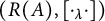 $(R(A), [\cdot _\lambda \cdot ])$
by
 $$ \begin{align} \langle a, b\rangle_\lambda=(a,b),\;\;\; a, b \in A. \end{align} $$
Then,
 $\langle \cdot , \cdot \rangle _\lambda $
is a symmetric invariant nondegenerate conformal bilinear form on
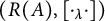 $(R(A), [\cdot _\lambda \cdot ])$
if and only if
 $(A, \circ , [\cdot ,\cdot ], (\cdot , \cdot ))$
is a quadratic GD algebra.
Proof Obviously,
 $\langle \cdot , \cdot \rangle _\lambda $
is symmetric and nondegenerate if and only if
 $(\cdot , \cdot )$
is symmetric and nondegenerate. Let a,
 $b,$
 $c\in A$
. Then, we have
 $$ \begin{align*} &\langle [a_\mu b], c \rangle_\lambda = \langle \partial(b\circ a)+\mu (a\star b)+[a,b], c \rangle_\lambda=-\lambda (b\circ a, c)+\mu (a\star b, c)+([a,b],c),\\ &\langle a, [b_{\lambda-\partial} c] \rangle_\mu =\langle a, \partial (c\circ b)+(\lambda-\partial)(b\star c) +[b,c]\rangle_\mu =\lambda (a, b\star c)-\mu (a, b\circ c)+(a, [b,c]). \end{align*} $$
Therefore,
 $\langle [a_\mu b], c \rangle _\lambda =\langle a, [b_{\lambda -\partial } c] \rangle _\mu $
if and only if
 $$ \begin{align*}-(b\circ a, c)=(a, b\star c),\;\; (a\star b, c)=-(a, b\circ c),\;\; (a, [b,c])=([a,b],c).\end{align*} $$
Note that
 $(\cdot , \cdot )$
is symmetric. Therefore, the conclusion holds.
Definition 4.16 [Reference Liberati31]
A (finite) conformal Manin triple of Lie conformal algebras is a triple of finite Lie conformal algebras
 $(R, R_0, R_1)$
, where R is equipped with a nondegenerate invariant symmetric conformal bilinear form
 $\langle \cdot , \cdot \rangle _\lambda $
such that
-
(a)
$R_0$
and
$R_1$
are Lie conformal subalgebras of R, and
$R=R_0\oplus R_1$
as
$\mathbf {k}[\partial ]$
-modules; -
(b)
$R_0$
and
$R_1$
are isotropic with respect to
$\langle \cdot , \cdot \rangle _\lambda $
, that is
$\langle R_i, R_i \rangle _\lambda =0$
for
$i=0$
,
$1$
.





Proposition 4.17 Let
 $(A, \circ _A, [\cdot ,\cdot ]_A)$
and
 $(A^{\ast }, \circ _{A^{\ast }}, [\cdot ,\cdot ]_{A^{\ast }})$
be GD algebras. Then,
 $( R(A\oplus A^{\ast }), R(A), R(A^{\ast }))$
is a conformal Manin triple with the bilinear form
 $$ \begin{align} \langle a+f, b+g\rangle_\lambda = \langle f, b\rangle+\langle g, a\rangle,\;\; a, b\in A, f, g\in A^{\ast}, \end{align} $$
if and only if
 $(A\oplus A^{\ast }, (A, \circ _A, [\cdot ,\cdot ]_A), (A^{\ast }, \circ _{A^{\ast }}, [\cdot ,\cdot ]_{A^{\ast }}))$
is a Manin triple of GD algebras associated with the bilinear form defined by Eq. (84).
Proof It follows from Proposition 4.15.
Proposition 4.18 Let R be a finite Lie conformal algebra which is free as a
 $\mathbf {k}[\partial ]$
-module and
 $(R, \delta )$
be a Lie conformal coalgebra. Suppose that there is a Lie conformal algebra structure on
 $R^{\ast c}$
which is obtained from
 $\delta $
. Then the following conditions are equivalent.
-
(a)
$(R, [\cdot _\lambda \cdot ], \delta )$
is a Lie conformal bialgebra; -
(b)
$(R\oplus R^{\ast c}, R, R^{\ast c})$
is a conformal Manin triple of Lie conformal algebras with the conformal bilinear form given by (95)
$$ \begin{align} \langle a+f, b+g\rangle_\lambda&=f_\lambda(b)+g_{-\lambda}(a), \;\;\; a, b\in R, f, g \in R^{\ast c}. \end{align} $$
-
(c)
$(R, R^{\ast c}, {\mathrm {ad}}_{R}^{\ast }, {\mathrm {ad}}_{R^{\ast c}}^{\ast })$
is a matched pair of Lie conformal algebras.




Proof By [Reference Liberati31, Theorem 3.9], Conditions (a) and (b) are equivalent. With a similar proof as that in [Reference Hong and Bai19, Theorem 3.6], one can check that Conditions (b) and (c) are equivalent.
Theorem 4.19 Let
 $(A, \circ _A, [\cdot ,\cdot ]_A, \Delta , \delta _0)$
be a GD bialgebra. Then the Lie conformal bialgebra
 $(R(A), [\cdot _\lambda \cdot ], \delta )$
with
 $\delta $
defined by Eq. (12) is exactly the one obtained from the conformal Manin tripe
 $(R(A\oplus A^{\ast }), R(A), R(A^{\ast }))$
given in Proposition 4.17, as well as the one from the matched pair
 $(R(A), R(A)^{\ast c}, {\mathrm {ad}}_{R(A)}^{\ast }, {\mathrm {ad}}_{{R(A)}^{\ast c}}^{\ast })$
of Lie conformal algebras given in Corollary 4.14.
Proof Since
 $(A, \circ _A, [\cdot ,\cdot ]_A, \Delta , \delta _0)$
is a GD bialgebra, the triple
 $(A\oplus A^{\ast }, (A, \circ _A, [\cdot ,\cdot ]_A), (A^{\ast }, \circ _{A^{\ast }}, [\cdot ,\cdot ]_{A^{\ast }}))$
is a Manin tripe of GD algebras associated with the bilinear form given by Eq. (84) and the octuple
 $(A, A^{\ast }, L_{\star _A}^{\ast }, -R_{\circ _A}^{\ast }, {\mathrm {ad}}_A^{\ast }, L_{\star _{A^{\ast }}}^{\ast }, -R_{\circ _{A^{\ast }}}^{\ast }, {\mathrm {ad}}_{A^{\ast }}^{\ast })$
is a matched pair of GD algebras by Corollary 4.10. By Proposition 4.17 and Corollary 4.14,
 $(R(A\oplus A^{\ast }), R(A), R(A^{\ast }))$
is a conformal Manin triple and
 $(R(A), R(A)^{\ast c}, {\mathrm {ad}}_{R(A)}^{\ast }, {\mathrm {ad}}_{{R(A)}^{\ast c}}^{\ast })$
is a matched pair of Lie conformal algebras. By Proposition 4.18, the Lie conformal bialgebra
 $(R(A), [\cdot _\lambda \cdot ], \overline {\delta })$
obtained from either the conformal Manin tripe
 $(R(A\oplus A^{\ast }), R(A), R(A^{\ast }))$
or the matched pair
 $(R(A), R(A)^{\ast c}, {\mathrm {ad}}_{R(A)}^{\ast }, {\mathrm {ad}}_{{R(A)}^{\ast c}}^{\ast })$
is given by
 $$ \begin{align*} \langle[f_\mu g], a\rangle_\lambda &=\sum_{(a)}f_\mu(a_{(1)})g_{\lambda-\mu}(a_{(2)})=(f\otimes g)_{\mu, \lambda-\mu}(\overline{\delta}(a)), \;\; a\in A, f, g\in A^{\ast}, \end{align*} $$
where
 $\overline {\delta }(a)=\sum _{(a)}a_{(1)}\otimes a_{(2)}$
. Let
 $a\in A, f, g\in A^{\ast }$
. Set
 $\delta _0(a)=\sum a_{(1)}\otimes a_{(2)}$
and
 $\Delta (a)=\sum \overline {a_{(1)}}\otimes \overline {a_{(2)}}$
. Then we have
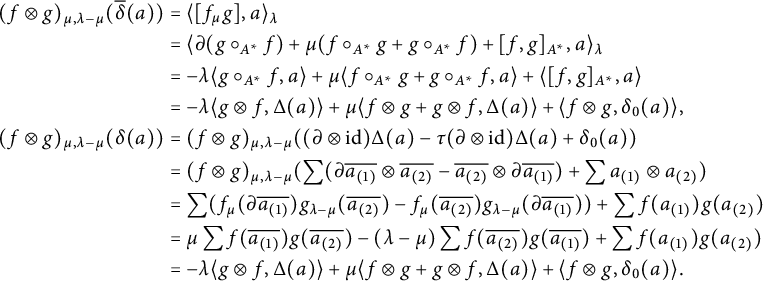 $$ \begin{align*} (f\otimes g)_{\mu, \lambda-\mu}(\overline{\delta}(a))&=\langle [f_\mu g], a\rangle_\lambda\\&=\langle \partial (g\circ_{A^{\ast}} f)+\mu(f\circ_{A^{\ast}} g+g\circ_{A^{\ast}} f)+[f,g]_{A^{\ast}}, a\rangle_\lambda\\&=-\lambda \langle g\circ_{A^{\ast}} f, a \rangle+\mu \langle f\circ_{A^{\ast}} g+g\circ_{A^{\ast}} f, a \rangle+\langle [f,g]_{A^{\ast}}, a \rangle\\&= -\lambda \langle g\otimes f, \Delta(a) \rangle +\mu \langle f\otimes g+g\otimes f, \Delta(a) \rangle+\langle f\otimes g, \delta_0(a)\rangle,\\(f\otimes g)_{\mu, \lambda-\mu}(\delta(a))&=(f\otimes g)_{\mu, \lambda-\mu}((\partial\otimes \mathrm{id})\Delta(a)-\tau(\partial\otimes \mathrm{id})\Delta(a)+\delta_0(a))\\&= (f\otimes g)_{\mu, \lambda-\mu}(\sum(\partial \overline{a_{(1)}}\otimes \overline{a_{(2)}}-\overline{a_{(2)}}\otimes \partial \overline{a_{(1)}})+\sum a_{(1)}\otimes a_{(2)})\\&= \sum(f_\mu (\partial \overline{a_{(1)}})g_{\lambda-\mu}(\overline{a_{(2)}})-f_\mu(\overline{a_{(2)}})g_{\lambda-\mu}(\partial \overline{a_{(1)}}))+\sum f(a_{(1)})g(a_{(2)})\\&=\mu \sum f(\overline{a_{(1)}})g(\overline{a_{(2)}})-(\lambda-\mu) \sum f(\overline{a_{(2)}})g(\overline{a_{(1)}})+\sum f(a_{(1)})g(a_{(2)})\\&= -\lambda \langle g\otimes f, \Delta(a) \rangle +\mu \langle f\otimes g+g\otimes f, \Delta(a) \rangle+\langle f\otimes g, \delta_0(a)\rangle.\end{align*} $$
Hence
 $(f\otimes g)_{\mu , \lambda -\mu }(\overline {\delta }(a))=(f\otimes g)_{\mu , \lambda -\mu }(\delta (a))$
. Therefore
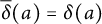 $\overline {\delta }(a)=\delta (a)$
, completing the proof.
By the discussion above, we have the following commutative diagram.

Acknowledgments
We give our appreciation to the referee for the suggestions that have improved the paper.
Funding
This research is supported by NSFC (12171129, 11931009, 12271265, 12261131498, 12326319, W2412041), the Fundamental Research Funds for the Central Universities and Nankai Zhide Foundation, and the Zhejiang Provincial Natural Science Foundation of China (Grant No. Z25A010006).
Competing interest
The authors have no competing interests to disclose.
Data availability statement
No new data were created or analyzed in this study.



