

Organisational voice has the ability to influence important work-related factors, including employees’ affective organisational commitment, work engagement, neglect, and exit (Allen & Meyer, Reference Allen and Meyer1990; Allen & Tuselmann, Reference Allen and Tuselmann2009; Bryson, Charlwood, & Forth, Reference Bryson, Charlwood and Forth2006; Farndale, Van Ruiten, Kelliher, & Hope-Hailey, Reference Farndale, Ruiten, Kelliher and Hope-Hailey2011; Miles, Borman, Spector, & Fox, Reference Miles, Borman, Spector and Fox2002; Park & Rainey, Reference Park and Rainey2007; Vakola & Bouradas, Reference Vakola and Bouradas2005; Withey & Cooper, Reference Withey and Cooper1989). The term ‘voice’ has, however, been used interchangeably to refer to both voice behaviour, which concerns the act of communicating, and voice climate, which refers to the perception and beliefs about attitudes, and practices related to voice behaviour in the workplace. Research suggests that voice climate perceptions are best represented by three components: encouragement, safety, and efficacy (Allen & Tuselmann, Reference Allen and Tuselmann2009; Farndale et al., Reference Farndale, Ruiten, Kelliher and Hope-Hailey2011; Frazier, Reference Frazier2009; Landau, Reference Landau2009; Morrison, Wheeler-Smith, & Kamdar, Reference Morrison, Wheeler-Smith and Kamdar2011), which are conceptually distinct from related constructs such as psychological safety, general group efficacy, and involvement climate (Frazier, Reference Frazier2009; Morrison et al., Reference Morrison, Wheeler-Smith and Kamdar2011). Only one previous study has included encouragement as a component of voice climate (Frazier, Reference Frazier2009) and none have incorporated all three facets. Furthermore, research has yet to explore the extent to which the three components can be differentiated from one another. This study therefore sought to contribute to the voice climate literature by exploring the extent to which voice climate is multidimensional, comprising of the three components: encouragement, safety, and efficacy, and whether the three-component model is useful in determining work-related outcomes.
Voice Climate: A Multi-Dimensional Construct
The encouragement component of voice climate relates to employees’ perception about the extent to which voice behaviour is supported by their superiors at work (Frazier, Reference Frazier2009). For example, in a positive voice climate, the perception that voice behaviour is encouraged may develop if employees are consistently asked their opinions and are given opportunities to provide input in relation to work related issues.
The safety component of voice climate relates to employees’ beliefs about the likelihood that voice behaviour will result in negative consequences such as reprimand (Morrison et al., Reference Morrison, Wheeler-Smith and Kamdar2011). Employees often perceive voice behaviour to be risky, as challenging or confronting superiors can be emotionally difficult and speaking out may incur retaliation (Withey & Cooper, Reference Withey and Cooper1989). As a consequence, employees may weigh up the possible costs and potential benefits of voice behaviour before voicing. The only study other than this one to have included safety expectations and efficacy as components of employees’ voice climate perceptions found that voice climate explained a significant amount of variance in voice behaviour (32%) beyond that explained by other variables such as satisfaction and workgroup identification (Morrison et al., Reference Morrison, Wheeler-Smith and Kamdar2011).
The efficacy component of voice climate relates to how effective employees believe their voice behaviour is likely to be. Employees who consistently have their contributions listened to and acted upon can be said to be working within an efficacy-positive voice climate (Morrison et al., Reference Morrison, Wheeler-Smith and Kamdar2011). Furthermore, employees who were satisfied with the impact of their past voice behaviour had higher levels of affective commitment, viewed their supervisors more favourably, and had lower levels of exit, than employees with negative experiences of the effectiveness of their voice behaviour (Landau, Reference Landau2009).
Employees’ perception about their organisation's voice climate can be complex, as employers often present mixed messages about their position on voice behaviour (Landau, Reference Landau2009); for example, by encouraging voice through employee surveys but then showing a lack of voice efficacy by failing to act on the survey results. In order to develop accurate hypotheses about the links between voice climate and work-related outcomes, it is important that measures reflect all aspects of voice climate.
Voice Climate and Affective Organisational Commitment
Affectively committed employees feel involved and emotionally attached to their organisation, identify with its goals and values, and therefore remain with the organisation because they want to (Allen & Meyer, Reference Allen and Meyer1990). Previous research indicates that when employees feel they are permitted to provide input, that their voice behaviour is likely to be well received, or they are empowered, they are likely to have higher levels of affective commitment (Farndale et al., Reference Farndale, Ruiten, Kelliher and Hope-Hailey2011; Vakola & Bouradas, Reference Vakola and Bouradas2005). These findings align closely with ownership theory, as proposed by O’Driscoll, Pierce, and Coghlan (Reference O’Driscoll, Pierce and Coghlan2006), which argues that involvement and efficacy engender a sense of belonging. Work environments that empower employees and provide them with knowledge of their jobs and organisations, in turn enables employees a greater investment into their work. It is therefore hypothesised that all three subcomponents of voice climate will be positively related to affective organisational commitment.
Voice Climate and Work Engagement
In the current study, work engagement is defined ‘as a positive, fulfilling, work-related state of mind that is characterised by vigour, dedication, and absorption’ (Schaufeli, Salanova, Gonzalez-Roma, & Bakker, Reference Schaufeli, Salanova, Gonzalez-Roma and Bakker2002). There is a lack of research regarding voice climate as a predictor of work engagement; however, voice efficacy has been linked to job involvement (Brown & Leigh, Reference Brown and Leigh1996), which is conceptually similar (Hallberg & Schaufeli, Reference Hallberg and Schaufeli2006). Research has also linked participation in organisational decision-making to work engagement through perceptions of organisational climates as open, trusting and supportive (Wuesterwald, Reference Wuestewald2012). This aligns with models of social exchange in that individuals are empowered via encouragement, safety and efficacy, which is reciprocated via a greater sense of attachment and commitment (Liden, Wayne, & Sparrowe, Reference Liden, Wayne and Sparrowe2000). It is therefore hypothesised that all three components of voice climate will be positively related to work engagement.
Voice Climate and Neglect
Much of the research involving neglect has limited the construct to fairly passive behaviours such as chronic lateness, non-medical absenteeism, the personal use of company resources, shirking, and disengagement from work tasks (Allen & Tuselmann, Reference Allen and Tuselmann2009; Hagedoorn, Van Yperen, Van De Vliert, & Buunk, Reference Hagedoorn, Van Yperen, Van De Vliert and Buunk1999; van Iterson, Naus, & Roe, Reference van Iterson, Naus and Roe2007). Neglect can, however, be differentiated from the withdrawal of goodwill. Employees expressing goodwill toward their organisation may be performing their duties beyond expectations, while withdrawal of this goodwill may result in adequate performance that is not neglectful (Allen & Tuselmann, Reference Allen and Tuselmann2009). The current study therefore defines neglect as the intentional failure by employees to perform to the best of their ability at work (Allen & Tuselmann, Reference Allen and Tuselmann2009; Travis, Gomez, & Mor Barak, Reference Travis, Gomez and Mor Barak2011).
Employees often feel dissatisfied when working in negative voice climates (Vakola & Bouradas, Reference Vakola and Bouradas2005), and neglect has been shown to be a likely response to dissatisfying workplace situations (Farrel, Reference Farrell1983). To reduce employee dissatisfaction, employee voice behaviour may depend on the receptiveness and response within the organisation (Bryson et al., Reference Bryson, Charlwood and Forth2006). This was evidenced in a longitudinal study by Travis et al. (Reference Travis, Gomez and Mor Barak2011), which found that voice behaviour was negatively related to neglect measured 6 months later. Travis and colleagues suggested that employees may reduce neglectful behaviours as organisations process and respond to the messages that are voiced. It is therefore hypothesised that voice climate, and in particular voice efficacy, will be negatively related to neglect.
Voice Climate and Exit
Researchers are fairly consistent in their definition of employee exit as including: resigning, seeking alternative employment, or simply considering leaving the organisation (Allen & Tuselmann, Reference Allen and Tuselmann2009; Hagedoorn et al., Reference Hagedoorn, Van Yperen, Van De Vliert and Buunk1999; Withey & Cooper, Reference Withey and Cooper1989). This is distinct from turnover that encompasses both voluntary and involuntary departure. This conceptualisation of exit allows researchers to gain some insight into how employees are feeling about remaining with the organisation, even when they perceive that quitting is not an option.
No research to date has examined the links between voice climate and exit. However, employees often feel dissatisfied when working in negative voice climates (Vakola & Bouradas, Reference Vakola and Bouradas2005) and a number of studies have found significant positive relationships between employee dissatisfaction and exit (Anshoo, Reference Anshoo2011; Hagedoorn et al., Reference Hagedoorn, Van Yperen, Van De Vliert and Buunk1999; Withey & Cooper, Reference Withey and Cooper1989). In addition, Allen and Tuselmann (Reference Allen and Tuselmann2009) suggest that employees are even more likely to respond to dissatisfaction with exit in situations where they perceive that voice behaviour is either too costly, or unlikely to improve their situation. It is therefore hypothesised that voice climate, and in particular efficacy and safety, will be negatively related to exit.
Work engagement, characterised by vigour, dedication, and absorption; and affective commitment, characterised by feeling involved and emotionally attached to the organisation, are conceptually distinct but interrelated constructs. Employees may feel engaged because of their attachment to the company or committed because of their engagement. Both work engagement and employee commitment have, however, long being established as antecedents of employee neglect (Deniz, Noyan, & Ertosun, Reference Deniz, Noyan and Ertosun2013) and exit (Ram & Prabhakar, Reference Ram and Prabhakar2011); and neglect, a determinant of employees’ decision to exit organisations (Si & Li, Reference Si and Li2012). The path model outlined in Figure 1 proposes that positive voice climate perceptions increase employees’ engagement and commitment, which in turn reduces employee neglect and exit intentions.
Hypothesised path model of the relationships between voice climate, engagement, commitment, neglect and exit.

Method
Participants
The sample (N = 119) included 94 females and 24 males (with one participant not reporting their gender), and ranged in age from 18 to 64 years (M age = 36, SD = 14). Participants included full-time (51%), part-time (16%), casual (26%), and contracted (3%) employees, with 3% unspecified. Approximately 23% of the participants were employed in a manager or supervisor position. Participants were employed in a number of organisations, based primarily in Western Australia. The majority of participants worked in either government departments (62%) or retail (25%) for an average of 5 years (SD = 6.19).
Procedure
Participants were invited to complete an anonymous online questionnaire using the following strategies: an advertisement in an Australian university alumni newsletter, a direct email request to the researchers’ personal contacts, or an online ‘Subject Pool’, through which university students were credited 30 minutes of research participation towards their course requirements. All participants were in employment. Ethics approval was granted by the university's Human Ethics Committee and participant consent provided.
Measures
Voice climate
The study combined two previous voice climate measures, bringing together the three components of voice climate: encouragement, safety, and efficacy (Frazier, Reference Frazier2009; Morrison et al., Reference Morrison, Wheeler-Smith and Kamdar2011) and used a response scale from 1 (strongly disagree) to 7 (strongly agree).
The encouragement component was measured with Frazier's (Reference Frazier2009) six-item voice climate measure and items included: ‘Employees here are encouraged to speak up with new ideas or changes in procedures’ and ‘Employees here are encouraged to keep well informed about issues where our opinions might be useful to the group’. The six-item safety and six-item efficacy components of voice climate were measured with an adapted version of Morrison et al.'s (Reference Morrison, Wheeler-Smith and Kamdar2011) voice climate measure. Examples of safety items included: ‘Employees can get involved in issues that affect the quality of their work-life, without fear of reprimand or reprisal’ and ‘Employees can safely speak up and get others involved in issues that affect the group, without fear of reprimand or reprisal’. Efficacy items included: ‘It is worthwhile for employees to develop and make recommendations concerning issues that affect the group’ and ‘It is worthwhile for employees to communicate their opinions about work issues, even if those opinions are different and others disagree’.
Affective organisational commitment
Allen and Meyer's (Reference Allen and Meyer1990) affective organisational commitment scale was modified to reduce the overall questionnaire length by selecting the five items with the strongest factor loadings, as reported by Allen and Meyer (Reference Allen and Meyer1990). Items included ‘I feel like “part of the family” at my organisation’ and ‘This organisation has a great deal of personal meaning for me’, rated on a scale from 1 (strongly disagree) to 7 (strongly agree).
Work engagement
The nine-item Utrecht Work Engagement Scale (Seppala et al., Reference Seppala, Mauno, Feldt, Hakanen, Kinnunen, Tolvanen and Schaufeli2008) with a response scale from 1 (strongly disagree) to 7 (strongly agree) was used. Items included ‘At my work, I feel that I am bursting with energy’ and ‘I am immersed in my work’.
Neglect
The study used the five neglect items from Hagedoorn et al.'s (Reference Hagedoorn, Van Yperen, Van De Vliert and Buunk1999) ‘five categories of responses to problematic events’. Items included ‘Now and then, do not put enough effort into your work’ and ‘Come in late because you do not feel like working’. The response scale ranged from 1 (strongly disagree) to 7 (strongly agree). Neglect was the only scale with a reliability coefficient below the generally acceptable level of .70 (Bernardi, Reference Bernardi1994). Removal of the item ‘Miss out on meetings because you do not feel like attending them’, which had a total item correlation below .3, resulted in an increase in Cronbach's alpha to .67.
Exit
The six exit items from Hagedoorn et al.'s (Reference Hagedoorn, Van Yperen, Van De Vliert and Buunk1999) ‘five categories of responses to problematic events’ were used. Items included ‘Actively look for a job elsewhere within your field’ and ‘Intend to change employers’, using a response scale from 1 (strongly disagree) to 7 (strongly agree).
Results
Data Analysis
Common method
Self-report items using similar response formats have the potential to inflate the interrelationships between measures. If a substantial amount of common method variance is present, either (a) a single factor will emerge from the factor analysis, or (b) one general factor will account for the majority of the covariance among the variables (e.g., Andersson & Bateman, Reference Andersson and Bateman1997; Aulakh & Gencturk, Reference Aulakh and Gencturk2000; Krishnan, Martin, & Noorderhaven, Reference Krishnan, Martin and Noorderhaven2006; Podsakoff, MacKenzie, Lee, & Podsakoff, Reference Podsakoff, MacKenzie, Lee and Podsakoff2003; Podsakoff & Organ, Reference Podsakoff and Organ1986). Principal components factor analysis with direct oblimin rotation with SPSS v21.0 identified seven factors with Eigen values greater than 1.19, which accounted for 72% percent of the total variance. The first factor did not account for the majority of the variance (36%) and Harman's single factor test, which forces all items to load onto one factor (Podsakoff, MacKenzie, Lee, & Podsakoff, Reference Podsakoff, MacKenzie, Lee and Podsakoff2003), did not account for the majority of variance (36%), thus no general factor arising from common method is apparent.
Principal Component Analysis of Voice Climate
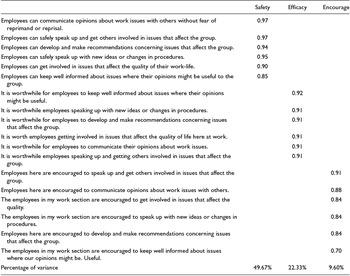
To investigate the underlying structure of the 18-item measure of voice climate, data were subjected to principal component analysis with direct oblimin rotation to allow for the factors to be intercorrelated, which would be expected given that all three factors are hypothesised to be lower order facets of voice climate. Three components with Eigen values exceeding 1 explained 82% of the variance. All items loaded on their expected components and none of the items had cross-loadings above .30.
Each factor is represented by six items, which is above the recommended minimum of four to five items per factor for small samples (Marsh & Hau, Reference Marsh, Hau and Hoyle1999; Marsh, Hau, Balla, & Grayson, Reference Marsh, Hau, Balla and Grayson1998). The sample size allows for a ratio of 6.6 responses per item, which is in the lower bound range of 5 or 10 recommended in the literature (Mueller, Reference Mueller1996; Nunnally, Reference Nunnally1978), and communality is also high, with only one item dropping below .8 (Costello & Osborne, Reference Costello and Osborne2005).
Normality
Analyses of skewness and kurtosis via AMOS 21.0 indicated that all variables were sufficiently normally distributed, with the exception of Voice Climate Self-Efficacy (Kurtosis = 4.075, critical ratio = 9.07). To address this, bootstrap analyses (250) were run and the Bollen-Stine p-value is reported alongside the results of the path analyses. No strong evidence was found, and given the relatively high tolerances of path analysis it would have been unlikely to interfere with the interpretation of results (Osborne & Waters, Reference Osborne and Waters2002). The ratio of 17 cases per predictor is slightly greater than the 15 recommended by Stevens (Reference Stevens2009) and substantively larger than the minimum of 5 suggested by Bentler and Chou (Reference Bentler and Chou1987).
Direct Oblimin Rotated Pattern Matrix of the 18-Item Voice Climate Measure

Note: Factor loadings less than .30 were removed.
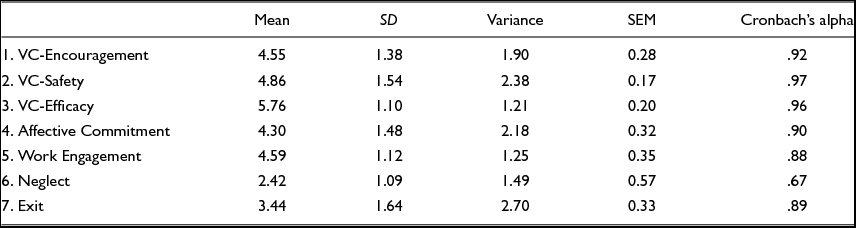
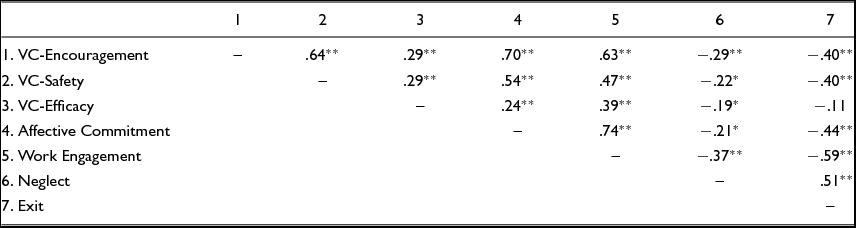
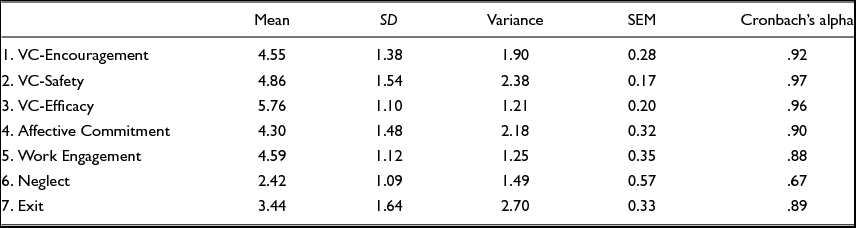
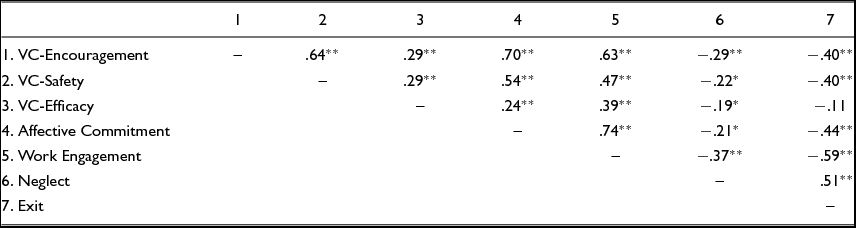
Descriptive statistics, Cronbach's alpha and Pearson's correlation coefficients for all the scales and subscales are presented in Tables 2 and 3.
Descriptive Statistics for All Scales
Note: VC = Voice Climate.
Intercorrelations Between Voice Climate and Organisational Outcomes
Note: ** = p < .01, * = p < .05.
Intercorrelations supported the hypotheses that all three components of voice climate would be positively associated with organisational commitment, work engagement and neglect. Efficacy was not, however, more strongly associated with neglect than encouragement. Encouragement and safety were also negatively associated with exit, but efficacy did not have a statistically significant association.
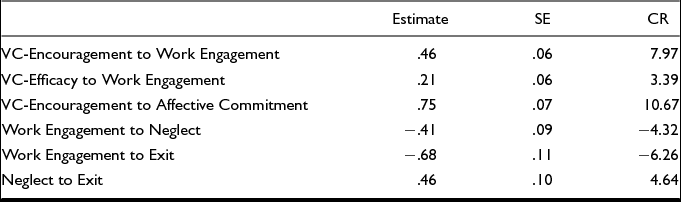
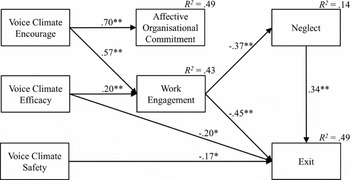
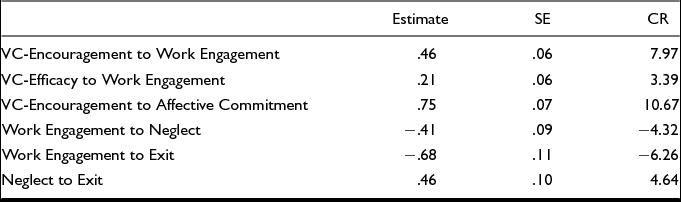
Path analysis using AMOS 21.0 was used to test the model proposed in Figure 1. Non-significant pathways were excluded and the final model with standardised parameter estimates is presented in Figure 2. Indices of fit suggest a good approximation to the data (χ2 = 9.359, p = .228; CFI = .992; IFI = 1.001; NFI = .969, RMSEA = .053). Bootstrap analyses using 250 samples identified a mean chi-squared of 10. 489, SE = .330; Bollen-Stine p = .606. Unstandardised regression weights, standard errors and critical ratios for the regression weights are presented in Table 4; estimates of bias from the bootstrap analysis ranged from .007 to −.01.
Unstandardised Regressions, Standard Errors and Critical Ratio for the Variables in the Final Model
Note: VC = Voice Climate.
Path model of the relationships between voice climate, engagement, commitment, neglect and exit.

The path analysis indicated that the relationships between voice climate encouragement and efficacy, and voice climate encouragement and neglect were fully mediated by work engagement. Furthermore, affective organisation commitment, while being strongly correlated with neglect and exit, did not predict additional variance above and beyond work engagement. The path analysis also suggests that work engagement fully mediates the relationship between voice climate encouragement and exit, and partially mediates the relationship between voice climate efficacy and exit, while voice climate safety is directly associated with exit.
The strongest correlation was 0.74 and the strongest standardised regression coefficient was 0.70, with all paths in the hypothesised direction indicating that multicollinearity was not an issue (Garson, Reference Garson2012).
Discussion
The results of this study supported the conceptualisation of voice climate as multidimensional and the hypothesis that positive voice climate perceptions promote improvements in work-related outcomes. This study adds support to the notion that perceptions of voice climate are complex, and involves an awareness of the extent to which voice behaviour is supported by the organisation, and the respective costs and benefits of voice behaviour (Farndale et al., Reference Farndale, Ruiten, Kelliher and Hope-Hailey2011; Frazier, Reference Frazier2009; Morrison et al., Reference Morrison, Wheeler-Smith and Kamdar2011).
Voice Climate and the Work-Related Outcomes
The current study provides support for the hypotheses that employees working in organisations with positive voice climates are likely to have higher levels of affective commitment and work engagement, and are less likely to neglect their work duties or leave their job. These findings add weight to the idea that organisations can significantly benefit by ensuring that work climates are facilitative of employee voice behaviour (Allen & Tuselmann, Reference Allen and Tuselmann2009; Anshoo, Reference Anshoo2011; Farndale et al., Reference Farndale, Ruiten, Kelliher and Hope-Hailey2011; Wuesterwald, Reference Wuestewald2012).
The finding that affective organisational commitment was most strongly associated with voice climate supports previous research (Farndale et al., Reference Farndale, Ruiten, Kelliher and Hope-Hailey2011; Vakola & Bouradas, Reference Vakola and Bouradas2005). Specifically, this study found that encouragement of voice behaviour was most strongly associated with affective commitment. In other words, voice climates perceived as being supportive of employees speaking out facilitate employees’ emotional attachment to the organisation. The path analyses suggested that this relationship may hold regardless of whether voice is effective in facilitating change; however, the cross-sectional nature of the current study precludes this interpretation.
The strong link between voice climate and affective organisational commitment is noteworthy for employers, as high levels of affective commitment have been associated with increases in job satisfaction, retention, motivation, performance, and quality of work (Park & Rainey, Reference Park and Rainey2007). This study also found that voice climate encouragement and efficacy are predictive of work engagement. In other words, employees’ engagement to their jobs is associated by the extent to which employees feel supported to contribute and whether their contributions will be effective. To a large extent, these findings parallel the work on employee empowerment (Gelfand, Fulmer, & Severance, Reference Gelfand, Fulmer, Severance and Zedeck2011; Stajkovic, Lee, & Nyberg, Reference Stajkovic, Lee and Nyberg2009) and aligns with ownership theory (O’Driscoll et al., Reference O’Driscoll, Pierce and Coghlan2006).
It is also noteworthy in this study that employees who are engaged with their jobs’ roles, tasks, and working environments are less likely to withdraw and consider leaving the organisation. In other words, voice climate arguably has an indirect relationship with important behavioural outcomes operating via work engagement to reduce neglect and exit.
In order to affect organisational outcomes, interventions focusing on improving employees’ voice climate perceptions need to address and manage each of the components. For example, employees may appreciate not being reprimanded for speaking up, but may still feel discouraged from doing so, or perceive that doing so tends not to be effective. These findings suggest that organisational mechanisms such as grievance systems, meetings, and open door policies may be limited in their ability to improve voice climate perceptions alone. Employees are likely to be aware of the extent to which some channels may be unsafe or ineffective and may be particularly influenced by the extent to which they feel encouraged to utilise different mechanisms (Allen & Tuselmann, Reference Allen and Tuselmann2009; Farndale et al., Reference Farndale, Ruiten, Kelliher and Hope-Hailey2011; Landau, Reference Landau2009; Morrison et al., Reference Morrison, Wheeler-Smith and Kamdar2011; Withey & Cooper, Reference Withey and Cooper1989).
While the analyses did not find any strong evidence for common method and multicollinearity, the small sample size necessitates that the results of this study be interpreted with caution. More research is needed before the result can be generalised more broadly, although there is strong theoretical support for the multidimensional conceptualisation of voice climate. Longitudinal analysis has already identified the possibility of lag effects of voice climate on behaviour (Travis et al., Reference Travis, Gomez and Mor Barak2011) and future research is needed to examine the longitudinal and causal pathways using a multidimensional conceptualisation of voice climate (Flanders, Lin, Pirkie, & Caudill, Reference Flanders, Lin, Pirkie and Caudill1992) while considering alternate methods of measurement and the efficacy of interventions. For example, these results suggest that it is more important for employers to encourage voice behaviour and ensure it is actioned, than to focus solely on ensuring employees feel voice behaviour is safe in targeting high levels of employee neglect. Utilisation of this multidimensional conceptualisation of voice climate by researchers may ensure measures are broad enough to provide accurate insights into all aspects of voice climate and thereby increase the accuracy of hypotheses regarding the antecedents and consequences of voice climate perceptions.
Conclusion
This study provides support for a multidimensional conceptualisation of voice climate perceptions and the idea that, individually and as a whole, these components are strongly related to the work-related outcomes, affective organisational commitment, work engagement, neglect, and exit. These findings add weight to the idea that organisations can benefit by ensuring that work climates are facilitative of employee voice behaviour and particularly by encouraging and acting on employees contributions. This research may assist employers in understanding how their organisation's voice climate is linked to work-related outcomes that could have implications for the costs associated with lower productivity experienced via neglect and disengagement, as well as replacement costs associated with rehiring and training (O’Connell & Kung, Reference O’Connell and Kung2007).