INTRODUCTION
Delirium is a neuropsychiatric disorder characterized by disturbances of consciousness, attention, cognition, and perception with an abrupt onset and fluctuating course. Delirium usually has underlying physiological etiologies (Trzepacz et al., Reference Trzepacz, Breitbart and Franklin1999). Delirium is a common event in the course of medical hospitalization depending on the age of the patient and the severity of the illness. In a general hospital setting the prevalence of delirium in medically ill patients is about 30% and increases in the hospitalized elderly to 40%. On admission to hospital, up to 24% of older patients are delirious and up to 56% will go on to develop delirium during the course of hospitalization (Massie et al., Reference Massie, Holland and Glass1983; Lipowski, Reference Lipowski1989; Bucht et al., Reference Bucht, Gustafson and Sandberg1999; Breitbart & Strout, Reference Breitbart and Strout2000; Bond et al., Reference Bond, Neelon and Belyea2006). Delirium and dementia are highly interrelated, yet their interrelationship still has to be further elaborated (Inouye, Reference Inouye2006). Dementia is the leading risk factor for delirium, and two thirds of cases of delirium occur in the setting of dementia (Cole, Reference Cole2004). Dementia may increase the risk of becoming delirious by 40% (McNicoll et al., Reference McNicoll, Pisani and Zhang2003). Furthermore, delirium increases the likelihood of being diagnosed with dementia in patients with no known premorbid dementia (Rahkonen et al., Reference Rahkonen, Makela and Paanila2000). Delirium is associated with poor functional outcomes, increased morbidity and mortality, and prolonged hospitalization (Inouye, Reference Inouye1998). Both delirium and dementia involve global cognitive impairment and may be a diagnostic challenge in certain cases. Generally, delirium is diagnosed when there is an abrupt onset, fluctuating course, and a disturbance in level of consciousness or arousal. Dementia, on the other hand, usually presents with a gradual onset, stable symptomatology, and a clear sensorium. Yet end-stage dementia may resemble a chronic delirious state, and delirium may be superimposed upon dementia (Trzepacz et al., Reference Trzepacz, Breitbart and Franklin1999; Moraga & Rodriguez-Pascual, Reference Moraga and Rodriguez-Pascual2007).
The differences in phenomenology between delirium in the absence of dementia versus delirium in the presence of dementia have not been well studied. Liptzin et al. (Reference Liptzin, Levkoff and Gottlieb1993) compared groups of elderly delirious patients with and without an underlying dementia using the Delirium Symptom Inventory (DSI). No differences were found with respect to disturbances of consciousness, disorientation, speech, perception, psychomotor behavior, and sleep. Trzepacz et al. (Reference Trzepacz, Mulsant and Amanda1998) were able to show a difference in cognitive domains and concluded that delirium dominates dementia symptomatology when they occur together, creating a compounding negative effect of delirium and dementia on cognitive domains. No differences were found in hallucinations, delusions, psychomotor behavior, and sleep. Cole et al. (Reference Cole, McCusker and Dendukuri2002) found an increased level of altered consciousness, more psychomotor agitation, less perceptual disturbances, and sleep–wake cycle alterations in delirium superimposed on dementia compared to delirium in the absence of dementia. McCusker et al. (Reference McCusker, Cole and Dendukuri2003) found an increased number of symptoms of delirium at diagnosis in patients with delirium and dementia compared to the nondemented delirious patients. Patients with dementia and delirium scored higher in disturbance of consciousness, disorientation, memory impairment, disorganized thinking, perceptual disturbance, and psychomotor abnormality. Inattention, disorientation, and impaired memory were the most persistent symptoms in both groups, and symptoms persisted up to 12 months after diagnosis of delirium. Voyer et al. (Reference Voyer, Cole and McCusker2006a) studied delirium superimposed on dementia and found that the prevalence of delirium increased with the severity of premorbid dementia-related cognitive dysfunction. Symptoms of delirium were similar except for the level of disorganized thinking in patients with premorbid mild, moderate, and severe cognitive dysfunction. In a later study Voyer et al. (Reference Voyer, McCusker and Cole2006b) showed that the severity of prior cognitive dysfunction influenced the severity of most of the symptoms of delirium, particularly attentional impairment, disorientation, disorganization of thought, and memory impairment.
Further studies regarding the phenomenology of delirium in dementia versus delirium in the absence of dementia are needed to further clarify the findings in the literature to date. We therefore analyzed a prospectively collected delirium database on psychiatric consultations for delirium at Memorial Sloan-Kettering Cancer Center to examine phenomenological differences present in patients with delirium superimposed on dementia versus delirium in the absence of dementia. We hypothesized that differences in cognitive domains in patients with delirium superimposed upon dementia versus delirium in the absence of dementia would be most prominent, whereas noncognitive domains would remain phenomenologically similar.
METHODS
Subjects and Measures
Subjects in this trial included patients referred for delirium management to the Memorial Sloan-Kettering Cancer Center (MSKCC) Psychiatry Service from July 2000 to November 2000. Clinical data, including serial Memorial Delirium Assessment Scale (MDAS) ratings, etiologies of delirium, medications and dosages utilized, adverse events, and comorbid medications and medical conditions (including dementia, cognitive disorders, and brain metastases) were recorded in the MSKCC Psychiatry Service clinical delirium database. All patients treated for delirium met criteria for diagnosis of delirium according to the Diagnostic and Statistical Manual of Mental Disorders (4th ed.; DSM-IV; American Psychiatric Association, 2000, pp. 124–127). The delirium database was registered with the institutional review board and an IRB waiver was obtained for the analysis of the data. All patients and families gave verbal consent to be evaluated for the purpose of this data collection. In patients with limited capacity to provide consent due to delirium, the patient's primary caregiver provided verbal consent with the patient's assent to treatment.
We conducted an analysis of our delirium database examining the phenomenology of delirium, comparing patients with delirium and dementia (DD) versus patients with delirium in the absence of dementia (ND). Delirium phenomenology and severity was measured with the MDAS, a 10-item, 4-point clinician-rated scale (range 0–30; Breitbart et al., Reference Breitbart, Rosenfeld and Roth1997). Scale items assess disturbance in arousal and level of consciousness as well as several areas of cognitive functioning (memory, attention, orientation, and disturbances in thinking), psychomotor activity, and sleep–wake cycle disturbance (see Tables 1 and 2). Each individual MDAS item is rated as either “absent,” “mild,” “moderate,” or “severe” in degree of severity. As proposed by Meagher et al. (Reference Meagher, O'Hanlon and O'Mahony2000, Reference Meagher, Moran and Raju2008a, Reference Meagher, Moran and Raju2008b), the subtyping of delirium is based on the motoric subtype, MDAS item number 9. Overall delirium severity is categorized, using the MDAS total scores, as follows: mild delirium (MDAS <16), moderate delirium (MDAS 16–22), and severe delirium (MDAS >22). In the DD group a documented history of dementia based on the DSM-IV criteria for dementia was present.
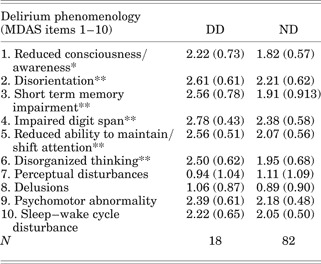
Delirium Phenomenology in DD and ND Groups Based on Mean (SD) MDAS Item Scores

*Wilcoxon: p<.05, **Wilcoxon: p < .01.
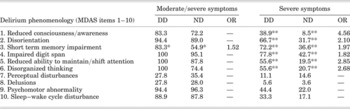
Presence of Moderate and Severe Symptoms in DD and ND Groups Based on MDAS Items in Percent

OR = odds ratio.
*Chi-square: p<.05, **chi-square: p < .01.
Statistical Analysis
The analysis of the data was performed with the SPSS 16 statistical software package for Windows. The data contained interval, ordinal, and categorical variables. Interval variables were analyzed with the t test for independent samples. For ordinal data, we used the Wilcoxon test for the comparison of two independent samples and the Kruskal–Wallis test for three independent samples. Categorical data were computed with Pearson's chi-square and logistic regression analyses performed. Exact tests were used when applicable.
RESULTS
Sample Characteristics
We analyzed 100 patients treated for delirium; 18 patients had delirium superimposed upon dementia (DD) and 82 patients had a diagnosis of delirium without dementia (ND). The average age of the DD patients, 68.67 years (38–89 years, SD 14.1), was significantly higher than the age of the ND patients, 56.12 years (19–82 years, SD 16.48) (t test: p < .01). Cancer diagnoses were diverse, with most patients diagnosed with lung cancer (21%), gastrointestinal cancer (14%), lymphoma (13%), and breast cancer (11%). Contributing etiologic factors for delirium included opioids (63.4%), infection (40.9%), corticosteroids (30.1%), hypoxia (28%), and dehydration and CNS disease (12.9% each). Most patients had moderate severity delirium (71%), 17% had severe delirium, and 11% had mild delirium. Brain metastases were present in 24%. Etiologies for dementia were also diverse, including Alzheimer's dementia, multi-infarct dementia, and dementia due to general medical condition (primary brain cancer, brain metastasis, and brain surgery).
Differences in Delirium Phenomenology
The mean MDAS total scores were significantly higher in the DD group (21.83, 15–30, SD 3.79) than in the ND group (18.57, 14–26, SD 2.75; Wilcoxon: p < .01). Delirium severity was more pronounced in the DD group (with 50% moderate delirium, 44% severe delirium, and 5.6% mild delirium) than in the ND group (with 75.6% moderate delirium, 13.4% mild delirium, and 11% severe delirium).
In both the DD and ND groups, the most severe impairments, based on specific mean MDAS items, were seen, in descending order, in the following domains: impairment in attention (as measured by MDAS item 4: digit span), followed by disorientation, reduced ability to maintain and shift attention, disorganized thinking, psychomotor behavior, and sleep–wake cycle disturbance. Perceptual disturbances and delusions were least severe when present. Significant differences between the DD and ND groups were found in all cognitive domains (MDAS items 2–6) and in the domain of arousal disturbance or disturbance of consciousness (MDAS item 1), with more severe impairments seen in the DD group compared to the ND group. There were no significant differences between DD and ND patients in the prevalence of hallucinations, delusions, psychomotor behavior, and sleep–wake cycle disturbances (see Table 1).
Some interesting findings became apparent when we examined the phenomenology of delirium based on the severity of individual MDAS items, particularly when we examined difference between the DD and the ND groups as to the presence of “moderate” and/or “severe” and “severe” symptoms of delirium (see Table 2): In the DD group, 100% of patients had moderate and/or severe impairment in the following cognitive domains: impaired digit span, ability to maintain and shift attention, and disorganized thinking. Disorientation, psychomotor behavior abnormalities, sleep–wake cycle disturbance, arousal disturbance, and short term memory impairment occurred in 80% of DD patients at the moderate and/or severe level. In the ND group the prevalence of moderate and/or severe symptoms of delirium were lower. Interestingly, in the ND group a noncognitive domain—psychomotor abnormality—was the most often encountered impairment, whereas in the cognitive domains impaired digit span—a task of working memory and attention—was the most often encountered impairment, followed by disorientation and reduced ability to shift and maintain attention. Short-term memory impairment occurred in only half of the patients with ND. Hallucinations and delusions were the least often encountered symptoms at a moderate and/or severe level for both the DD and ND groups. Abnormality in psychomotor behavior was the only MDAS item of moderate and/or severe intensity in which the ND group scored higher than the DD group. Differences between the DD and ND groups in terms of the presence of moderate and/or severe delirium symptoms based on the MDAS item severity was mainly evident in the cognitive domain. The most pronounced difference was found in short-term memory impairment, occurring in 83.3% of DD patients and only 54.9% of ND patients (chi-square <0.05, odds ratio of 1.52). The differences between groups for all other cognitive items were not statistically significant. Noncognitive domains, rated as moderate and/or severe intensity, such as disturbance of arousal, hallucinations, delusions, psychomotor behavior abnormalities, and sleep–wake cycle disturbance were also not statistically different between the DD and ND groups.
When we examined differences between the ND and DD groups on “severe” intensity ratings of individual MDAS items (see Table 2), we found that patients in the DD group had significantly more severe symptoms in the MDAS items reflecting the cognitive domain: impaired digit span and short-term memory. Throughout the cognitive domain severe impairment was about twice as high in the DD group compared to ND group. Severe intensity ratings of level of disturbance of consciousness were significantly higher in the DD group (38.9%) compared to the ND group (8.5%). There was no statistical difference between the DD and ND groups as to the presence of severe intensity ratings on MDAS items for hallucinations or delusions. Thus, severe intensity delirium symptoms related to the cognitive domain and level of disturbance of consciousness were significantly greater in the DD group than in the ND group, whereas most noncognitive domains showed no significant differences between groups.
DISCUSSION
We were able to show, in our sample of 100 patients with delirium, that delirium superimposed upon dementia likely presents with more severe impairments in the cognitive domain and in level of disturbance of consciousness. Severe intensity delirium symptoms are more common in patients with delirium superimposed on dementia compared to patients with delirium in the absence of dementia.
Although Liptzin et al. (Reference Liptzin, Levkoff and Gottlieb1993) were not able to show differences between DD and ND groups in respect to disturbance of level of consciousness, we were able to show significantly greater severity of disturbance of level of consciousness among DD patients compared to ND patients. As in the Liptzin et al. (Reference Liptzin, Levkoff and Gottlieb1993) report, we also found no differences in perceptual disturbance, psychomotor behavior, and sleep–wake cycle between the two groups. As in the Trzepacz et al. (Reference Trzepacz, Mulsant and Amanda1998) report, we were able to show a significant difference in impairment of cognitive domains between DD and ND patients (with no differences in hallucinations, delusions, psychomotor behavior, and sleep); however, we were also able to demonstrate a more pronounced disturbance of level of consciousness in DD patients that was not demonstrated in the Trzepacz study. McCusker et al. (Reference McCusker, Cole and Dendukuri2003) found increased disturbance in level of consciousness, disorientation, memory impairment, and disorganized thinking in DD compared to ND patients, but also observed an increased level of perceptual disturbance and psychomotor abnormality, which we did not find. The presence of more severe symptoms and an increased odds ratio in patients with delirium and dementia in our results support Voyer et al.'s (2006b) findings that prior cognitive dysfunction influences the severity of most of the symptoms of delirium, particularly attentional impairment, disorientation, disorganization of thought, and memory impairment.
Our results confirm a number of previous findings: (1) Disturbance of level of consciousness (or arousal disturbance) is more severe in patients who have delirium superimposed upon dementia compared to those who have delirium in the absence of dementia. (2) The impairment in the cognitive domain is more severe in patients with delirium with dementia. (3) There appear to be no significant differences in the severity of hallucinations, delusions, psychomotor abnormality, or sleep–wake cycle disturbances between those with delirium and dementia compared to those with delirium in the absence of dementia. In addition we were able to show that severe delirium symptomatology, based on MDAS items, was more frequent in delirium superimposed on dementia. In the cognitive domain the odds ratio ranges from 1.97 to 2.85 for DD, with the ability to maintain and shift attention and thought disorder/speech within the cognitive domain being the most affected symptoms. These results were to be expected, as delirium in dementia is characterized by prior cognitive deficits, and as Trzepacz et al. (Reference Trzepacz, Mulsant and Amanda1998) posited, delirium superimposed on dementia may represent a compounding effect of delirium on dementia in the cognitive domains. More surprising is the finding of an odds ratio of 4.56 in the DD group for disturbance in level of consciousness in the severe range of intensity. It appears that the vulnerability of patients with prior cognitive deficits (McNicoll et al., Reference McNicoll, Pisani and Zhang2003) may affect disturbance in the level of consciousness in the DD patient population and that severe disturbance in level of consciousness may be an important identifying symptom in the DD population. Our results confirm the compounding effect of delirium on dementia within the cognitive domain and stress the importance of disturbance of consciousness as an indicator for delirium superimposed on dementia.
A number of limitations to our analysis have to be noted. The number of subjects with delirium superimposed on dementia group was rather low. We did not differentiate between etiologies for dementia due to the limited number of patients with delirium and dementia. We were not able to get a baseline assessment of the level of cognitive dysfunction due to the naturalistic design of the data collection and long-lasting persistence of delirium symptoms in this population. In the earlier studies reviewed and contrasted with ours, delirium phenomenology was assessed using different tools, thus at times representing different symptom clusters. The MDAS is a validated tool based on the DSM-IV criteria and should allow the comparison within similar clusters. Despite these limitations, we feel our study results may provide further insight into the phenomenology of delirium superimposed on dementia.
ACKNOWLEDGMENTS
This article was, in part, presented at the Annual Meeting of the Academy of Psychosomatic Medicine, Miami, FL, November 14–18, 2008. This trial was not sponsored by a pharmaceutical company.
CONFLICTS OF INTEREST
William Breitbart is on the speaker's bureau of and consultant to Cephalon and received grants from the National Cancer Institute (NCI), which did not support this work. Steven Passik is on the speaker's bureau of and consultant to Lilly, Cephalon, King/Ligand, Alpharma, Endo, and Purdue-Pharma and received grants from Lilly, Cephalon, and the NCI, which did not support this work. Soenke Boettger does not have affiliations to pharmaceutical companies.