







1. Introduction and methods
The winds of O-type stars are driven by absorption lines in metals, mainly iron (Vink et al. Reference Vink, de Koter and Lamers2001). Therefore, they are expected to depend strongly on metallicity (Z), and decrease in strength towards low Z. Of particular interest are the wind properties in this low Z domain, as understanding them will reveal the nature of the first stars to have existed in the Universe.
The closest analogues of these stars are located in Local Group dwarf galaxies, where star formation is modest and, thus, the star forming gas is still relatively pristine. Large scale surveys, like ULLYSES and XShootU, have extensively observed OB stars in the optical and UV in the Large and Small Magellanic Clouds, where
 ${\rm Z}_{\rm LMC, SMC} = 0.5,0.2\,{Z}_\odot$
, respectively, and substantial insights into radiation driven winds at low Z have already been revealed. However, to observe stars at even lower Z, we must look beyond the SMC to dwarf galaxies at distances of
 $\sim 1\,$
Mpc.
To this end, we analysed a sample of 11 O-type stars in different Local Group dwarf galaxies: 5 IC 1613 stars, 2 WLM stars, 2 NGC 3109 stars, and 1 star each from Sextans A and Leo P. We used the stellar atmosphere code Fastwind (v10.6; Santolaya-Rey et al. 1997; Puls et al. Reference Puls, Urbaneja and Venero2005; Rivero González et al. Reference Rivero González, Puls, Najarro and Brott2012; Carneiro et al. Reference Carneiro, Puls, Sundqvist and Hoffmann2016; Sundqvist and Puls Reference Sundqvist and Puls2018) with the genetic algorithm Kiwi-GA (Brands et al. Reference Brands, de Koter and Bestenlehner2022) to get stellar and wind parameters of our sample stars from their optical and UV spectra. Our findings are published in full, and are discussed in detail, in Furey et al. (Reference Furey, Telford and de Koter2025); in this proceedings, we briefly summarise our main results.
2. Results and discussion
To examine the Z dependence of radiation driven winds at
 $Z\lt 0.2\,{\rm Z}_\odot$
, we focused on the modified wind momentum (
 $D_{\rm mom} := \dot{M} v_\infty \sqrt{R}$
, with
 $\dot{M}$
the mass loss rate,
 $v_\infty$
the terminal wind velocity, and R the stellar radius). Within the context of CAK theory (after Castor et al. Reference Castor, Abbott and Klein1975), and at a fixed Z,
 $D_{\rm mom} \propto L^{1/ \alpha}$
, where L is the stellar luminosity, and
 $\alpha$
is the ratio of the number of optically thick lines to the total number of lines driving the windFootnote †. Typically,
 $\alpha \sim 2/3$
at
 $Z_\odot$
, and is predicted to decrease with decreasing Z (Puls et al. Reference Puls, Springmann and Lennon2000). We tested the recently derived empirical relation of Backs et al. (Reference Backs, Brands and de Koter2024) extrapolated to
 $Z\lt 0.2\,{\rm Z}_\odot$
. As our sample stars come from different galaxies, we assume an average
 $Z\sim 0.14\,{\rm Z}_\odot$
and fit the following equation to six of our stars:
 \begin{equation} \log D_{\rm mom} = \log D_0 + \frac{1}{\alpha}\log L \,. \end{equation}
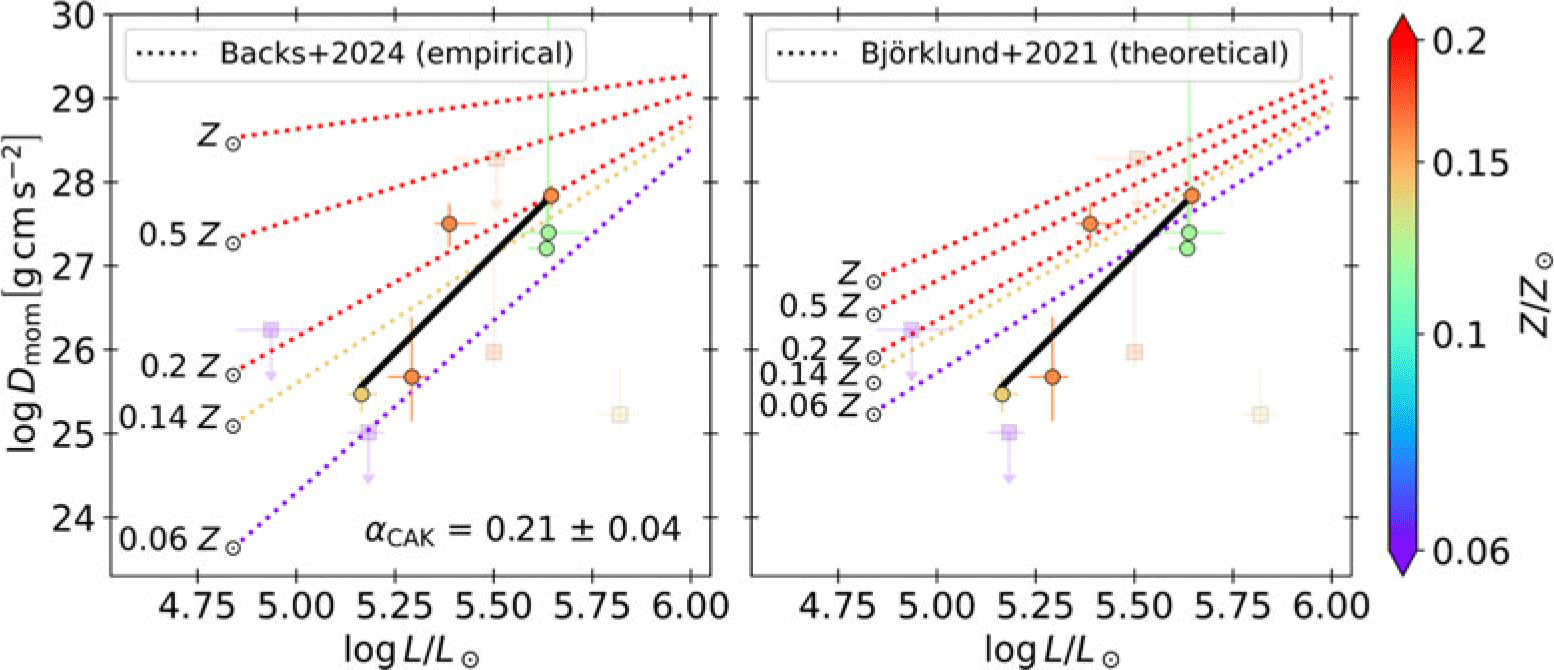
Our fit is shown in Fig. 1. On the left, we see that it is relatively in line with the empirical relation at
 $0.14\,{\rm Z}_\odot$
. On the right, we show how our fit compares to the theoretical relation of Björklund et al. (Reference Björklund, Sundqvist, Puls and Najarro2021): our fit is steeper than extrapolations of this relation to
 $0.14\,{\rm Z}_\odot$
. This finding, namely a steeper Z dependence than what is predicted by theory, has been found by other recent empirical studies in the SMC (Ramachandran et al. Reference Ramachandran, Hamann and Oskinova2019; Rickard et al. Reference Rickard, Hainich and Hamann2022; Backs et al. Reference Backs, Brands and de Koter2024) and low Z (Telford et al. Reference Telford, Chisholm and Sander2024). Our fit also suggests that a simple
 $\dot{M}\propto Z^x$
dependence does not sufficiently capture the nature of radiation driven winds (especially towards low
 $L \sim 10^{5.3}\,{\rm L}_\odot$
); rather, an L dependence on the exponent x should also be considered.
Our fit of Eqn. (1) at
 $Z=0.14\,{\rm Z}_\odot$
to our sample stars (thick black line). In both plots, only the circle points are considered in the fit; faded square points have been excluded. The assumed metallicity of each star is colour-coded, whose mapping is shown by the colour bar. In the left plot, the dotted lines show the empirical
 $D_{\rm mom}(L,Z)$
relation of Backs et al. (Reference Backs, Brands and de Koter2024), while those in the right show the theoretical predictions of Björklund et al. (Reference Björklund, Sundqvist, Puls and Najarro2021) of this quantity, both of which have been extrapolated to
 $Z\lt 0.2\,{\rm Z}_\odot$
. These lines are also colour-coded according to their metallicity.

These findings have two major implications. At relatively low
 $L \sim 10^{5.3}\,{\rm L}_\odot$
(or
 $M_{\rm ZAMS} \sim 20-30\,{\rm M}_\odot$
), there is a strong Z dependence, meaning main sequence mass loss is much less pronounced at low Z for stars in this mass regime. As the mass loss rates are already so low in this regime anyway (
 $\sim 10^{-7}\,{\rm M}_\odot\,{\rm yr}^{-1}$
), this does not necessarily mean that stellar evolution calculations for stars in this mass regime are incorrect, as a factor of 10 decrease of
 $\dot{M}$
would have minimal effect on the mass evolution of the star on the main sequence over a lifetime of
 $\sim 10\,{\rm Myr}$
. Whether this also holds for post main sequence evolution (e.g. during RSG or LBV phases) in this mass regime remains to be investigated.
On the other hand, at high L, where
 $L\gtrsim 10^{6}\,{\rm L}_\odot$
, where masses on the zero age main sequence
 $\gtrsim 90-100\,{\rm M}_\odot$
, mass loss rates depend weakly on Z. This could have profound implications on the evolution of the very first stars in the Universe, which are expected to have been very massive. If this shallow Z dependence indeed holds in these stars, they may have lost mass at rates comparable to the most massive stars at metallicities similar to that of the LMC or even the Milky Way.
This work represents the largest spectroscopic optical+UV analysis, to date, of O-type stars in Local Group dwarf galaxies with
 $Z\lesssim{\rm Z}_{\rm SMC}$
, but the sample is still small. To further investigate the nature of their winds, namely this potentially strong
 $\dot{M}(L,Z)$
scaling, larger samples are still needed. This is now becoming possible with more observations of these galaxies in both the optical (e.g. Lorenzo et al. Reference Lorenzo, Garcia and Najarro2022 in Sextans A) and the UV (e.g. the Treasury of Extremely Metal-Poor O stars, TEMPOS, a HST treasury programme, Programme ID: 17491, PI: Telford).

 Z=0.14Z⊙
 Dmom(L,Z)
 Z<0.2Z⊙


