1. Introduction
Zoophycos is among the most distinct trace fossils. As defined by Häntzschel (Reference Häntzschel and Teichert1975), Zoophycos is a planar spreite marking successive, former positions of the burrow, present either as simple lobes or as ornate spiral structures, enclosed by a marginal burrow which may not always be evident (either not developed or not preserved). While there are now several ichnogeneric names available for trace fossils that this describes (e.g. Spirophyton, Fucoides, Glossophycus) these are generally treated as synonyms (Uchman, Reference Uchman1995; Olivero, Reference Olivero and Miller2007) and the ichnogenus Zoophycos is commonly applied to a morphologically diverse set of trace fossils containing lobate or spiralling spreiten structuring (cf. Bromley & Hanken, Reference Bromley and Hanken2003).
The systematic processing of sediment suggested by the general morphology of Zoophycos has led workers to interpret this burrow as a classic fodinichnion; that is, it is produced, at least in part, by deposit feeding (Seilacher, Reference Seilacher1967, Reference Seilacher2007; Bromley & Hanken, Reference Bromley and Hanken2003). The identity of the Zoophycos producer is unknown but is generally considered to be some sort of infaunal worm-like animal (Seilacher, Reference Seilacher1967, Reference Seilacher2007; Kotake, Reference Kotake1989; Bromley, Reference Bromley1991). Zoophycos has been considered by some to have an age range that extends to the Cambrian (e.g. Crimes, Reference Crimes1992; Löwemark & Shäfer, Reference Löwemark and Schäfer2003, etc.) based on two tentative reports of this burrow from Atdabanian strata of the Campito Formation in eastern California (Alpert, Reference Alpert, Crimes and Harper1977) and the Mickwitzia Sandstone in Sweden (Jensen, Reference Jensen1997). However, these two examples contain morphological features such as enlarged marginal tubes relative to the corresponding spreiten (Jensen, Reference Jensen1997) and pelleted laminae (Alpert, Reference Alpert, Crimes and Harper1977) that are atypical of the ichnogenus (Simpson, Reference Simpson, Crimes and Harper1970; Miller, Reference Miller1991; Seilacher, Reference Seilacher2007) yielding a temporal distribution of Zoophycos that extends only from the Ordovician to Recent (Wetzel & Werner, 1980; Bromley, Reference Bromley1991; Seilacher, Reference Seilacher2007). Here we report archetypal Zoophycos burrows from lowest Cambrian strata (Rusophycos avalonesis Zone) in the Wood Canyon Formation of southeastern California, significantly extending this age range nearly to the base of the Cambrian. Even when considering the other reports of Cambrian Zoophycos (Alpert, Reference Alpert, Crimes and Harper1977; Jensen, Reference Jensen1997), there have been no previous reported examples of this burrow that pre-date skeletal elements of the Cambrian fauna.
Of potentially greater significance than these being the oldest examples of Zoophycos, these specimens provide robust evidence of deposit feeding in close proximity to the Precambrian–Cambrian boundary. The advent of deposit feeding and the potential to effectively mix sediment by mining large volumes of sediment were key steps in the evolution of animals that fundamentally changed the nature of ecosystems and perpetually altered the physical and chemical characteristics of sediment. The ichnogenus Oldhamia is widespread in Cambrian marine settings, particularly in deeper-water environments (Orr, Benton & Briggs, Reference Orr, Benton and Briggs2003); it represents a distinctive Chondrites-like probing style of deposit feeding and may be restricted to or at least developed best in association with microbial mats (Seilacher, Reference Seilacher1999). The ethology of Oldhamia and Chondrites are therefore clearly distinct from that of Zoophycos, not least in that they involve the processing of considerably smaller volumes of sediment. Otherwise, no uncontroversial evidence for deposit feeding has been previously reported from strata older than Ordovician (Butterfield & Jensen, Reference Butterfield and Jensen2001; Butterfield, Reference Butterfield2002). The argument that deposit feeding is less prevalent in Cambrian time than subsequently is supported by the conclusion that Pascischnia are less common in Cambrian deep-marine environments than in younger periods (Orr, Benson & Briggs, Reference Orr, Benton and Briggs2003). Unlike body fossils or even other trace fossils that have been suggested as possible fodinichnia from Early Cambrian time (Crimes, Reference Crimes1992), the features within these Zoophycos provide clear evidence of Cambrian strip-mining deposit feeders.
2. Geologic setting
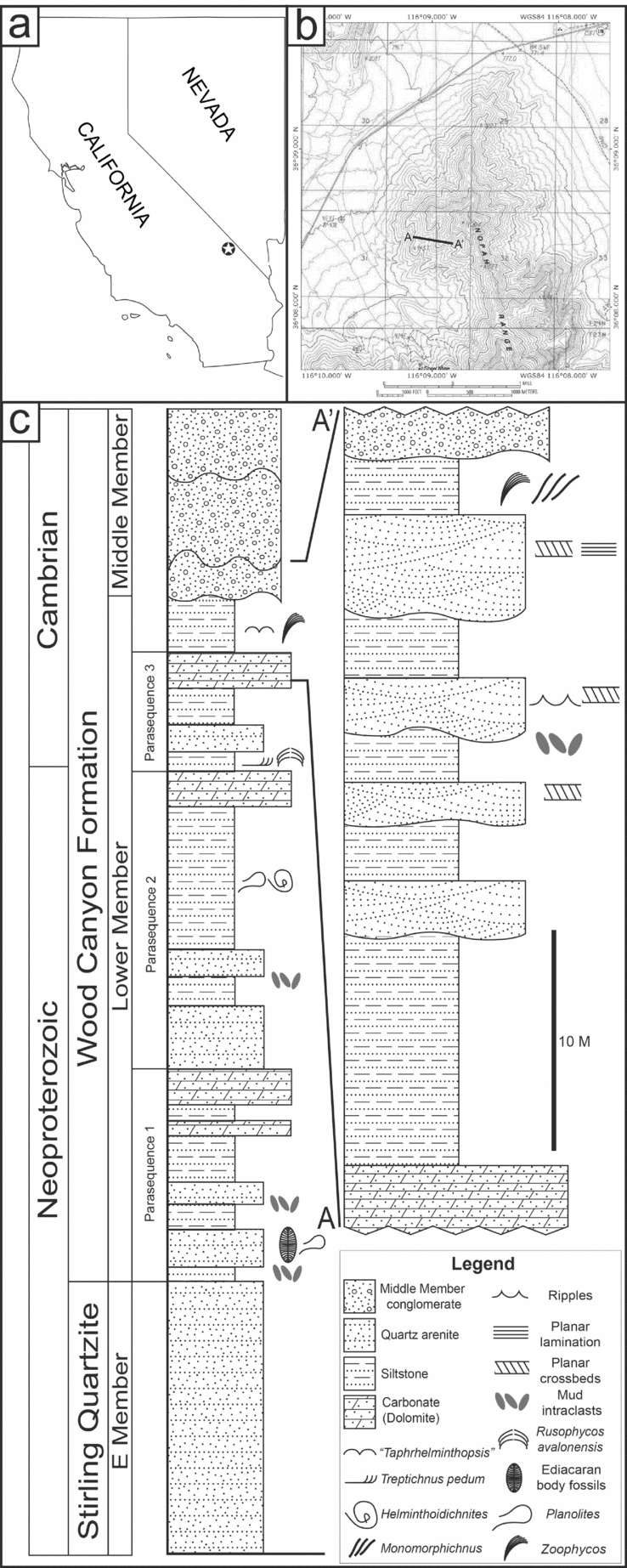
The Wood Canyon Formation is an Ediacaran–Lower Cambrian unit cropping out from southeastern California to southwestern Nevada (Stewart, Reference Stewart1970). Specimens were recovered at Chicago Pass in the northern Nopah Range just west of the California–Nevada state line (Fig. 1). At Chicago Pass, Proterozoic and Lower Cambrian rocks of the Stirling Quartzite and Wood Canyon Formation rest on top of Middle Cambrian rocks of the Bonanza King Formation due to thrusting along the N-dipping Chicago Pass Thrust Fault.
Locality map and stratigraphic context for portions of the Wood Canyon Formation in the Death Valley region. (a, b) Regional context for field locality. A to A′ transect line in (b) shows location of actual stratigraphic section depicted in inset of (c). (c) Generalized stratigraphic section for Precambrian to Lower Cambrian strata of the Stirling Quartzite and Wood Canyon Formation. Inset shows actual stratigraphic section obtained at the Chicago Pass locality. The trace fossils indicated in these sections show only first occurrences.

The Wood Canyon Formation is divided into three members with the Precambrian–Cambrian boundary placed within the Lower Member among a series of siliciclastic to carbonate capped parasequences of varying thicknesses (Horodyski et al. Reference Horodyski, Gehling, Jensen and Runnegar1994; Corsetti & Hagadorn, Reference Corsetti and Hagadorn2000; Jensen, Droser & Heim, Reference Jensen, Droser, Heim and Corsetti2001). Lithofacies within the Lower Member of the Wood Canyon Formation have been interpreted as representing a subtidal environment (Corsetti & Hagadorn, Reference Corsetti and Hagadorn2000) or possibly the distal edge of a braid-delta (Fedo & Cooper, Reference Fedo and Cooper2001). Comprehensive reviews of the stratigraphy and sedimentology of these sections are provided by Stewart (Reference Stewart1970) and P. E. Diehl (unpub. Ph.D. thesis, Pennsylvania State Univ., 1976).
The Precambrian–Cambrian boundary is located just above the second parasequence of the series (Horodyski, Reference Horodyski1991; Jensen, Droser & Heim, Reference Jensen, Droser, Heim and Corsetti2001) based on the earliest observed occurrence of the trace fossil Treptichnus pedum (Horodyski et al. Reference Horodyski, Gehling, Jensen and Runnegar1994), the boundary-defining ichnotaxon at the Global Stratotype Section and Point (GSSP) in Newfoundland (Narbonne et al. Reference Narbonne, Myrow, Landing and Anderson1987). Ediacaran body fossils, including Cloudina and Swartpuntia, stratigraphically underlie this horizon (Hagadorn, Fedo & Waggoner, Reference Hagadorn, Fedo and Waggoner2000). Specimens of Zoophycos occur approximately 20 m above the top of the third parasequence (Fig. 1) within the Early Cambrian Rusophycus avalonensis trace fossil zone (Jensen, Droser & Heim, Reference Jensen, Droser, Heim and Corsetti2001).
3. Description of Zoophycos specimens
Zoophycos specimens are rare in the Wood Canyon Formation and are concentrated in a stratigraphic interval that spans no more than 1 m in thickness. One complete specimen and seven incomplete specimens have been recovered. We utilize the established terminology of Simpson (Reference Simpson, Crimes and Harper1970) to describe the general morphology of these materials. Two morphological features, laminae and lamellae, apply to these Zoophycos and are discussed in further detail below.
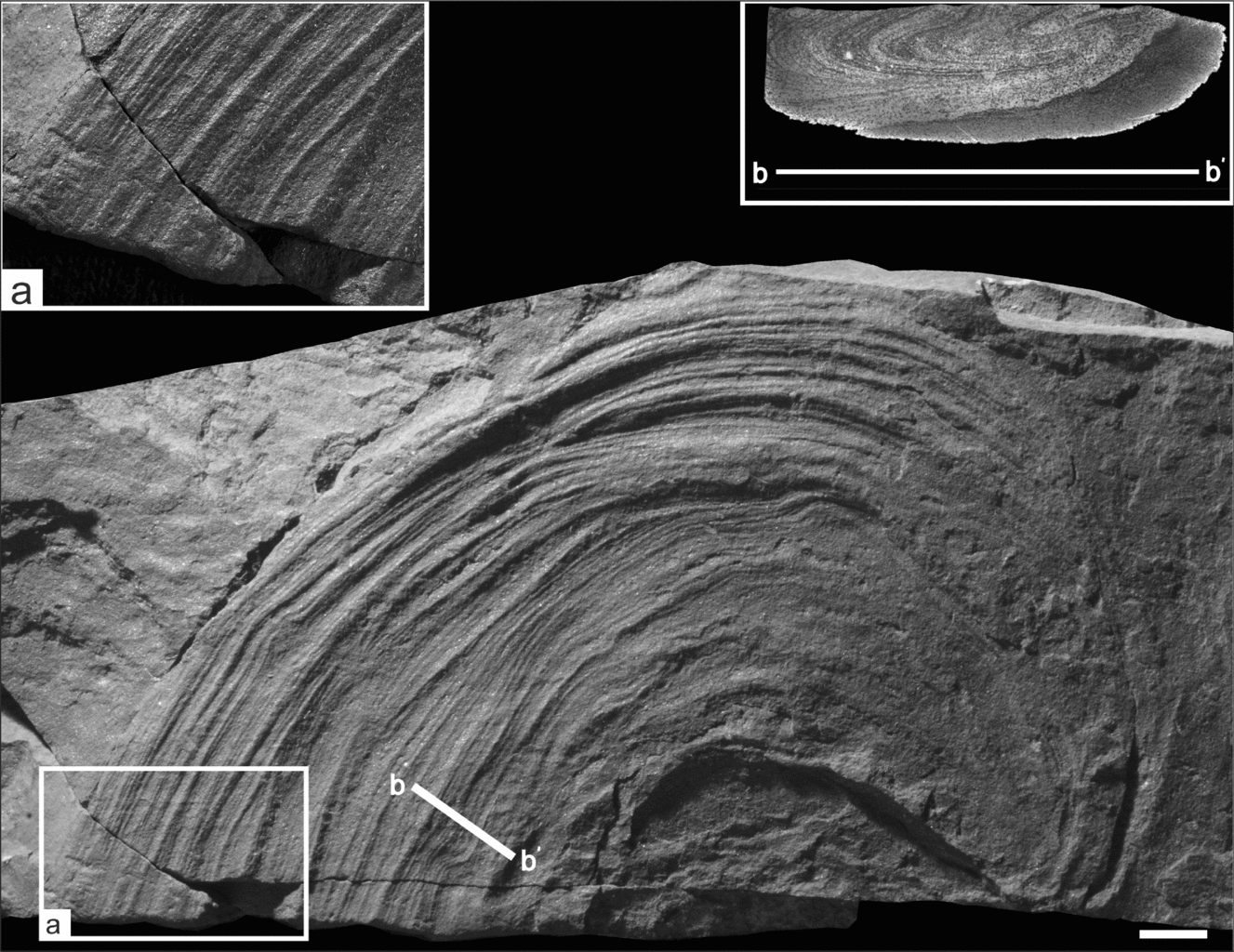
Zoophycos laminae are defined by Simpson (Reference Simpson, Crimes and Harper1970) as the ‘lobes’ within the trace and are described by the general shape of their outline (Stewart, Reference Stewart1970; Bromley & Hanken, Reference Bromley and Hanken2003). The laminae in the Wood Canyon Zoophycos are arcuate (Stewart, Reference Stewart1970, p. 508, fig. 1b; Fig. 2), preserving the ‘cocks-tail’ or ‘cauda galli’ morphology common in other specimens of Zoophycos. Lamellae are produced by sediment sorting by the animal within the burrow and define the internal structure of the laminae (Stewart, Reference Stewart1970, p. 507). In bedding-plane view, lamellae are expressed as subparallel lines originating at the apical portion of the trace. Lamellae are most abundant in the widest portions of the fossil with as many as 81 lamellae present in a single transect drawn perpendicularly to the margins of the trace fossil (see online Supplementary Material at http://journals.cambridge.org/geo). The ridges of the lamellae have an average spacing of approximately 1 mm with a standard deviation of approximately 0.3 mm (see online Supplementary Material at http://journals.cambridge.org/geo). In the narrowest portions of the fossil, fewer lamellae are present and spacing between individual lamella is greater. In cross-section, the collection of lamellae preserve the typical Zoophycos chevron pattern produced by the segregation of fine- and coarse-grained materials by the original organism (inset to Fig. 2). Chevron direction viewed in cross-section suggests migration of the animal from the outer margin (i.e. the longest margin of the arcuate lobe) of the lamina inwards.
Zoophycos specimen (UCR10966/1) from the Lower Member of the Wood Canyon Formation. Main photo is bedding-plane (epirelief) view of the specimen. Inset shows thin-section of the specimen cut along the transect labelled as b to b′. (a) Close-up bedding-plane view of lamellae in the distal portion of the fossil. Scale bar is 1 cm.

4. Discussion
Zoophycos commonly have an apical tube in the narrowest portion of the trace fossil that the organism utilized for vertical migration in the sediment (Miller, Reference Miller1991). This structure is not present in the Wood Canyon Formation specimens suggesting that either this feature was not preserved or that vertical movement was not accomplished by the progenitor of these burrows. Thus, only horizontal movement of the organism can be inferred from these specimens. Zoophycos burrows in late Palaeozoic and younger sedimentary rocks are considered elite burrows; that is, they are deep tier burrows (Bromley, Reference Bromley1996) with high preservation potential. In contrast, the lack of any vertical aspect within these Early Cambrian Zoophycos suggests that they were shallow, near-surface burrows, most commonly constructed well within the interpreted mixed layer of a maximum 1–2 cm in depth at this time (Droser, Jensen & Gehling, Reference Droser, Jensen and Gehling2002). This is also consistent with the rarity of these burrows in the Wood Canyon Formation and the absence of definitive Zoophycos specimens until Ordovician time when the depth and extent of burrowing increased (Droser & Bottjer, Reference Droser and Bottjer1989). Given that Zoophycos are easily identifiable in cross-section, the lack of reported Zoophycos between the Lower Cambrian and the Ordovician is consistent with a sediment surface to shallow burrow origin.
No specimens have been recovered that preserve the marginal tube that reflects the terminal active burrow of the organism prior to the abandonment of burrow activity. Häntzschel (Reference Häntzschel and Teichert1975) emphasized the importance of this feature in Zoophycos; however, the majority of workers no longer consider this a defining feature of the ichnogenus (Ekdale & Lewis, Reference Ekdale and Lewis1991; Miller, Reference Miller1991; Uchman, Reference Uchman1995; Olivero, Reference Olivero and Miller2007). The preservation of a differentiated marginal burrow would require that the burrow remain open long enough to be filled in with sediment. Thus, taphonomy more than ethology may contribute most significantly to the presence or absence of this feature.
While the lamellae within these specimens follow a fairly regular pattern, they are not well organized nor do they contain minor (branching) lamellae as in some other specimens of Zoophycos. Localized cross-cutting of lamellae in bedding-plane view is a common feature among Wood Canyon specimens. Cross-cutting of the lamellae within the Wood Canyon Formation specimens (online Supplementary Material at http://journals.cambridge.org/geo) on a bedding plane suggests multiple passes by the organism through the same area. This interpretation is supported by the uneven lamellae in the narrow portion of the fossil while becoming more parallel and evenly spaced as the trace becomes wider. The narrowest portions of the burrow would have to have been visited multiple times to create the arcuate laminae in these Zoophycos. In these areas, older lamellae would have been ‘cut’ as the organism propagated through to exploit new materials in the more distal regions of the trace.
5. The advent of deposit feeding
The problems associated with constraining feeding strategies from fossilized remains, even in exceptionally preserved materials, suggest that the trace fossil record provides the only robust proxy for interpreting these types of behaviours (Butterfield & Jensen, Reference Butterfield and Jensen2001; Butterfield, Reference Butterfield2002). For example, body fossils of the Chengjiang biota containing sediment-filled guts have been used as the primary evidence of Cambrian deposit feeding (Bergström, Reference Bergström, Briggs and Crowther2001); however, taphonomic evidence and detailed morphological analysis of these taxa has revealed that they could not have been deposit feeders (Butterfield, Reference Butterfield2002). Prior to the discovery of these Zoophycos, no definitive trace fossils that could be attributed to the strip-mining style of deposit feeding had been reported from prior to the Ordovician period (Butterfield, Reference Butterfield2002).
Early Cambrian trace fossils including Treptichnus pedum, Teichichnus and Rhizocorallium have been considered by some to be evidence of deposit feeding (Alpert, Reference Alpert, Crimes and Harper1977; Löwemark & Schäfer, Reference Löwemark and Schäfer2003; Seilacher, Reference Seilacher2007). However, this interpretation is problematic as these burrows are not exclusive to a single behaviour (Seilacher, Reference Seilacher2007). That is, these burrows may have been utilized for a diverse set of infaunal activities that may or may not have included deposit feeding (Seilacher, Reference Seilacher2007). While additional behaviours have been proposed for Zoophycos that may augment interpretations of the trace maker as strictly a deposit feeder (Bromley, Reference Bromley1991), an aspect of deposit feeding is present in all current models. The extent to which deposit feeding is expressed among Zoophycos burrows is interpreted from the overall morphology and internal characteristics of the burrow on a case by case basis.
The general morphology of these specimens is consistent with their construction by a horizontal strip miner as suggested by Seilacher (Reference Seilacher2007). Lamellae are most likely to have been produced by backfilling as an organism excavated new materials and placed those materials in the previously open portion of the burrow. It is unlikely that closely spaced, well-sorted and systematically arranged lamellae would suggest detritus feeding or some other selective feeding strategy as the organized and repetitive nature of these backfilled burrows do not represent a selective means of processing sediment.
6. Summary and conclusions
These Wood Canyon Formation Zoophycos are currently the oldest reported examples of this well-known trace fossil. These burrows provide robust evidence that deposit feeding was utilized as a feeding strategy by Cambrian organisms. Deposit feeding is a prevalent feeding style among disparate freshwater, marine and terrestrial invertebrates and is the most effective means of biologically mixing sediment (Rhoads & Young, Reference Rhoads and Young1970; Lopez & Levinton, Reference Lopez and Levinton1987). Thus, the robust evidence of deposit feeding near the Precambrian–Cambrian boundary that these specimens provide has direct and significant evolutionary implications for the biosphere and the expanding interaction between animals and the lithosphere at this time.
Biologically mediated sediment mixing has been credited for a variety of ecological and environmental changes near the Precambrian–Cambrian boundary including the disappearance of the Ediacara biota (Seilacher & Pflüeger, Reference Seilacher, Pflüeger, Krumbein, Paterson and Stal1994), changes in ocean chemistry (Canfield & Farquhar, Reference Canfield and Farquhar2009) and the eventual radiation of the Cambrian Fauna (Seilacher & Pflüeger, Reference Seilacher, Pflüeger, Krumbein, Paterson and Stal1994). Placed in this temporal context and given the extent to which deposit feeding can generate change in the substrate, it is tempting to cite the advent of deposit feeding as having contributed to the severe ecological and environmental changes that occurred at this time. While these Zoophycos burrows demonstrate that deposit-feeding organisms were present during Early Cambrian time, the lack of any vertical aspect in these burrows precludes any interpretation that this behaviour occurred any deeper than the depth of penetration observed in the lunate lamellae. Evidence suggesting that the Early Cambrian mixed layer was already a few centimetres deep (Droser, Jensen & Gehling, Reference Droser, Jensen and Gehling2002) and the lack of any evidence suggesting that these burrows extended any deeper, limits the impact that this feeding strategy can be concluded to have had.
Acknowledgements
We acknowledge partial funding for field work from National Science Foundation Grant EAR-9219731 (to M.L.D.), the Paleontological Society, SEPM, Southern California Academy of Sciences, American Federation of Mineralogical Societies and the Geological Society of America. C. Sappenfield, E. Clites, D. Garson and M. Ballint assisted with field work. Lastly, we thank S. Jensen for his helpful comments.