




No CrossRef data available.
Binding by Phase: (Non-)Complementarity in German
Published online by Cambridge University Press: 01 June 2004
Abstract
This paper explores areas of reflexive and pronominal noncomplementarity in German Accusativus cum Infinitivo (AcI)-constructions and other configurations that involve embedding of a subclausal (smaller than IP) constituent. The main empirical finding is that there are several non-complementarity-inducing contexts that have not been noticed before. In examples with embedded AcIs or complex DPs, a reflexive may be bound across an intervening subject, and a pronominal may be free even if its antecedent is only a vP-, DP-, or PPboundary away. The proposed account of these facts is based on the claim that vP, DP, and PP are all potentially phase-defining categories (Chomsky 2000). The expected “regular” cases of complementarity are accounted for by postulating as the relevant binding domain for both reflexive and pronominal the minimal phase containing the anaphoric element. Newly discovered cases of non-complementarity that exist at least for some speakers stem from the ability of reflexives, but not pronominals, to covertly raise to the edge of their phase (Safir 2004). Finally, well known cases of non-complementarity in AcIs where the anaphoric element is embedded in a PP can be explained if θ-independent (that is, internally saturated) PPs are adjoined high, to the AcI (vP)-phase-edge. This then achieves a unified account of both the well established binding facts documented in the literature and the surprising long-distance binding of reflexives reported as acceptable for some speakers.My thanks to Judith Aissen, Jorge Hankamer, and especially Jim McCloskey, who have helped me with and greatly contributed to the various drafts of this paper. Thanks also to my JGL reviewers for their helpful feedback. (Any remaining errors are my own.) Finally, I am indebted to all my native speaker consultants.
Information
- Type
- ARTICLES
- Information
- Copyright
- © 2004 Society for Germanic Linguistics
Introduction
Patterns of complementarity are found in many areas of linguistic inquiry. When the environments in which two forms occur never overlap, we say that the forms stand in complementary distribution. The main body of research on syntactic complementarity comes from the study of anaphora, more specifically, the binding behavior of reflexive and nonreflexive pronouns in various phrase-structural contexts (see, for example, Safir 2004). The current paper contributes to this body of research by investigating anaphoric relations in contexts where complementarity seems to break down. Since the empirical evidence comes from German, which does not have logophorically used reflexives, the cases discussed here have the useful theoretical property that they cannot be dismissed as being beyond the scope of a theory of binding. Furthermore, assuming a configurational theory of binding, this paper argues that the distribution of reflexive and nonreflexive pronouns provides crucial evidence regarding clause structure.
In most syntactic environments, the distribution of reflexives and pronominals is complementary. Use of one of the forms obviates the other form. However, certain contexts are known to allow the two forms to overlap. “Accusativus cum Infinitivo” (AcI), a type of reduced infinitive construction occurring in German, is one such context. Although binding in AcI-constructions has been extensively discussed in the literature (see, for example, Reis 1976, Grewendorf 1983, Pustejovsky 1984, Haider 1985, Primus 1989, and Frey 1993), the full extent of non-complementarity in AcIs, and other configurations that involve embedding of a subclausal constituent, has not been given a satisfactory account.
AcI-constructions are found as complements of permissive or causative lassen ‘let, allow, have’ and perception verbs like hören ‘hear’, sehen ‘see’, fühlen ‘feel’, and spüren ‘sense’. An example is given in 1. The indicated coreference relations are based on my judgments as a native speaker “(L.-S.)”.
1When I present other people's examples and add my initials to theirs, I share their judgments. There may, however, be additional binding possibilities for me that are not indicated. In section 3, I explicitly take issue with Haider (1985), Reis (1973, 1976), and Frey's (1993) empirical generalizations.
In order to verify my own native speaker judgments, I conducted an informal study in the form of two questionnaires (see appendix). For each questionnaire a number of native speakers of German (mostly from northern Germany) were presented with sentences containing AcI-constructions and asked to rate coreference relations between anaphoric elements and their antecedents on a scale from 1 (perfectly grammatical) to 5 (absolutely ungrammatical). The results generally support my own intuitions. Whenever I refer to “my judgments” in this paper, I am generalizing over myself and my informants.

While the pronominal behaves as expected in that it can only refer to the higher (matrix) subject Martin or some other male person not mentioned in the sentence, the reflexive can either refer to the lower subject den Mann or engage in seemingly long-distance binding with the matrix subject. Here we have an instance of non-complementarity. The domain in which the reflexive must be bound is larger than the domain in which the pronominal must be free. The nominal in the embedded clause, den Mann, is marked with accusative case. Here it expresses the agent role with respect to the infinitive reden, and I will be calling it the AcIsubject
2My use of “AcI-subject” is to be distinguished from “subject.” The definition of the latter is developed in sections 2 and 3. I am using “AcI-subject” to refer to the topmost accusative-marked nominal in the AcI, regardless of its semantic role.
Since the exact internal structure of AcIs cannot be taken for granted and is developed in later sections, I simply mark the AcI-edge here as “[AcI”.
To introduce the topic and prepare the reader for my review of previous accounts in section 2, I am describing the phrase structure of this AcIconstruction in traditional terms, assuming that verbal heads can have both an external and an internal argument. In section 3, I appeal to a different theory of phrase structure.
Reis (1973, 1976) and Haider (1985) claim that the reflexive pronoun sich can be bound across the intervening AcI-subject only if it is embedded in a certain type of PP. Reis characterizes PPs out of which this apparent long-distance binding of sich is possible as “less obligatory” and gives examples such as those shown in 2 and 3. Haider specifies that these PPs have to be “non-arguments” and backs this up with examples like 4.

After a detailed discussion of Reis's, Haider's, and Frey's (1993) accounts of the anaphoric relations in these sentences in section 2, I argue that, for some speakers, the binding of sich is in fact less restricted. This is illustrated in my examples 5 and 6. Here the reflexive is not embedded in a “less obligatory” or “non-argument” PP. Rather, it appears to be an argument of the AcI-infinitive and thus a coargument of the AcI-subject. Yet it is allowed to be bound by the matrix subject and, crucially, across its own subject.

Since the AcIs in 5 and 6 can each be considered a Complete Functional Complex (CFC),
5A Complete Functional Complex (CFC) is a maximal projection that contains a lexical head and in which all the grammatical functions compatible with that head are assigned (from Chomsky 1986).
As pointed out by Harbert and Srivastav (1988), Gurtu (1985) has a similar claim for Hindi, and Kluender (1986) for German. I thank one of my reviewers for the Harbert and Srivastav reference.

As mentioned above, German reflexives (unlike English anaphors) do not have a logophoric or emphatic use. The apparent long-distance binding ability of the reflexive thus cannot be dismissed as going beyond the scope of a theory of binding. While the English reflexive in 8a is grammatical because, in Reinhart and Reuland's (1993) terms, it does not reflexive-mark the predicate and is thus exempt from Condition A of the Binding Theory, the German equivalent in 8b is ruled out.

The data then force a three-way distinction among relevant cases. 7a is an example of case I: Reflexive and antecedent are separated by a CPboundary. This type of long-distance binding is clearly ungrammatical. There is no variability in judgments. Haider's Schnaps-example given in 4 is a prototype of case II: The reflexive is embedded in a PP, and there is no CP-or IP-boundary intervening between sich and its matrix-clause antecedent. Again, though more subtle than in case I, the judgments are relatively clear: Long-distance binding between the reflexive and the matrix subject is generally allowed. Finally, case III is exemplified by 5, 6, and 7b: The reflexive is in a non-PP AcI-argument position (dative or accusative-marked). Here, the judgments are variable. Many speakers categorically rule out long-distance binding between sich and the matrix subject; others allow it at least marginally. The goal of the analysis I present is to account for all three cases, in particular II and III, and the distinctions among them.
As for pronominal binding, this paper proposes that the pronominal can be bound in the same domain in which the reflexive must be bound (that is, IP), as long as it is separated from its antecedent by an external argument, such as an agentive subject. This claim is supported by the type of binding contrast illustrated in 9 and 10. The examples are adapted from Frey 1993 and are discussed further in sections 2 and 3.

For now, I use these examples to provide a descriptive preview of the account I propose for pronominals in AcI-constructions. In 9, where the AcI-subject den Gefangenen is agentive, the pronominal i h m is grammatical when referring to the matrix subject der König. The reflexive and the pronominal thus overlap. In 10, however, where the AcI-subject, den Stein, is nonagentive, ihm is impossible. As explained in section 3, the existence of a domain that allows the pronominal to be free, and thus grammatical, falls out from the syntactic correlate of agentivity and, more generally, of external argumenthood this paper supports. Section 3 also proposes an extension of the analysis from AcIs to the nominal domain. Finally, in section 4, I reinterpret the results in terms of a phase-based understanding of binding domains. The analysis unifies the binding conditions for AcI and DP constructions and account for the three cases of long-distance reflexive binding ability mentioned above.
Previous Accounts
Reis 1973, 1976 and Haider 1985
Reis and Haider would predict the coreference relation represented by the i-index in examples 5, 6, and 7b (case III) to be ungrammatical because their accounts only allow the reflexive sich to be bound across the intervening AcI-subject when it is embedded in a PP. This is shown in 2–4 above and repeated here in 11–13.

By “its governor” Haider (1985) means the element that is responsible for its case realization. According to Haider's “Realisationsprinzip,” the governor assigns a case index to its argument. If this case index is structural (NOM or ACC), case must be realized externally, and being realized externally means that it is not realized through the verb that assigns the index (p. 232). In an AcI the AcI-subject then gets its case index from the infinitive, but its case is realized through the matrix verb.
Haider states that the converse of the reflexive binding rule in 14 holds for pronominals: A personal pronoun may not be anteceded by an argument of its governor (1985:244). With respect to the pronominal, however, Haider does not add a second clause. If the governor of the pronominal does not have an external argument, the converse of 14 is vacuously satisfied and allows for the pronominal to be bound by any other nominal. In the case of 13, this wrongly predicts that the pronominal can have the AcI-subject as its antecedent. Even if it were plural (sie ‘them’), the pronominal could not be bound by die Leute. Thus, Haider's (1985) system is successful in accounting for the binding ambiguity regarding reflexives, but it fails to sufficiently constrain the binding possibilities of the pronominal.
Furthermore, it is not obvious how Haider would treat sentences like 11 and 12 taken from Reis 1973. The AcI predicates are the idiomatic expressions über jemanden herfallen ‘to attack (lit. to fall over) someone’ and auf jemanden zukommen ‘to approach (lit. to come toward) someone’. Since the PPs clearly complement the verbs, they should be arguments of the AcI-infinitive and have the AcI-subject as their external argument. Although Haider's system, according to which PP-embedded reflexives are governed by P, presumably regardless of whether the PP is an argument or adjunct (see note 7), makes the right prediction for the reflexive here, the only instances he discusses involve adjunct-PPs. Examples with argument-PPs like 11 and 12 certainly seem to be at odds with Haider's claim that binding ambiguity can only result if the reflexive is part of a “non-argument”.
Reis (1973) remains vague regarding the issue of whether the PPs in her examples are arguments or adjuncts. She simply states that the constraint disallowing reflexives to be bound across an intervening deep structure subject “can be escaped by prepositional (and therefore less obligatory?) object NPs, although a good deal of lexical variation is to be observed” (p. 522).8
As discussed by Harbert and Srivastav (1988), the availability of the higher subject as an antecedent for an embedded reflexive is equally disputed in Hindi. While some speakers allow long-distance binding when the reflexive is in an argument, most speakers only allow it when the reflexive is in adjunct position.
Frey 1993
An alternative account, which is endorsed in Haider's later work (1993) and goes beyond the adjunct versus argument status of the constituent containing the anaphoric element, has been proposed by Frey (1993). He gives the following binding conditions for reflexives and pronominals (his 28 and 29, ch. 7).
9In order to understand Frey's (1993) binding conditions as translated in 15, the following definitions must be kept in mind. Since some of these definitions are not entirely clear to me, I am providing both Frey's exact words in German (pp. 119–120, 23–24, 26–27) and literal translations into English.
(i) Ein CFC ist die minimale abschließende Kategorie, in der sämtliche Elemente, die durch einen gegebenen lexikalischen Kopf eine Projektionslizenz erhalten, realisiert sind.
‘A CFC is the minimal domain-closing category in which all the elements that receive a license to project from a given lexical head are realized.’
(ii) Die lokale Domäne für einen Ausdruck A ist der minimale CFC, der sämtliche Lizensierer von A enthält.
‘The local domain for an expression A is the minimal CFC that contains all licensors of A.’
(iii) Domänen abschließende Elemente sind: I und Elemente, welche die [Spec, DP]-Position realisieren.
‘Domain-closing elements are: I and those elements that realize the [Spec, DP]-position.’
(iv) Unter dem Begriff ‘SUBJEKT’ werden jene syntaktischen Repräsentanten einer externen Argumentstelle, welche in eine Bindungsbeziehung mit einer DP eintreten können, und Domänen abschließende Elemente zusammengefasst.
‘The cover term ‘SUBJECT’ stands for domain-closing elements and those syntactic representatives of an external position that can enter into a binding relationship with a DP.’

If all AcI-constructions were CFCs containing a SUBJECT, only reflexives in AcI-subject position would be allowed to have an antecedent outside the AcI. Reflexives that are object-DPs or embedded in a PP would never be expected to be bound by the matrix clause subject. In order to account for sentences that exhibit precisely this—thus far unpredicted—binding possibility in his system, Frey appeals to the distinction between unaccusative and unergative verbs. Assuming that auxiliary choice and passive verb forms are direct indications of argument structure, Frey claims that all verbs selecting sein ‘be’ (as opposed to haben ‘have’) as their perfect auxiliary are unaccusative and thus do not have an external argument.
For unaccusative AcI-verbs, Frey's binding conditions make the following predictions. An AcI with an unaccusative infinitive is a SUBJECTless local domain within which requirement i of Principle A, as stated above, cannot be met. As a consequence of requirement ii, the entire sentence (IP) is the relevant CFC, and the matrix clause subject must bind the reflexive. Once the domain is extended to include the whole sentence, the pronominal cannot be free and is thus predicted to be ungrammatical. In discussing example 16 (his 10b, ch. 7), Frey actually does not go by his binding conditions but refers to Haider's (1987) and Grewendorf's (1988) notion of argument structure unification. According to this notion, the whole argument structure of an unaccusative AcIinfinitive blends with that of the matrix verb. The result is a reduced structure with only one complex predicate.

Note that I do not agree with Frey's judgment here. As discussed in section 2.3, the majority of my consultants find the indicated binding possibility for the pronominal acceptable. Reis (1976), who also uses this example (her 49g), confirms that the pronominal is at least marginally acceptable.
The following sentences (his 10a and 10c, ch. 7) are two more of Frey's unaccusative AcI examples. Again, he claims that the reflexive is allowed to, and in fact, must be bound by the matrix subject because the AcI does not contain a SUBJECT and is not even a domain that can be considered separate from the matrix clause.

In both 17 and 18 the anaphoric element precedes the DP that I have been calling the AcI-subject (that is, the topmost accusative-marked nominal in the AcI). In 16 we have an example of a passive lassenconstruction (equivalent to the causative faire par+infinitive in French), in which the word order of the anaphoric element and the AcI-subject is fixed. In 18, which is the example I adapted in 10, the word order can be changed, so that the AcI-subject precedes the anaphoric element: Hansi lässt den Stein sichi/*ihmi auf den Kopf fallen.
11In order for the accusative object DP Stein ‘rock’ to be allowed to precede the dative reflexive pronoun sich, it must be definite (den Stein ‘the rock’) (see Büring 2001).
When it comes to AcIs with transitive infinitives, Frey contends that the argument structures of the AcI-infinitive and the matrix verb do not blend because both the matrix verb and the infinitive have an external argument. Frey's Principle A predicts that, since the AcI contains a SUBJECT, the reflexive must be bound within its local domain and cannot have the matrix subject as its antecedent. In other words, reflexive binding across the intervening AcI-subject should not be possible. Rather, the pronominal must be used in order to refer to the matrix subject. According to Frey's Principle B, the pronominal is grammatical because it is free in its minimal SUBJECT-containing CFC. Sentences 19–21 (his 11, ch. 7) illustrate that these predictions are consistent with Frey's grammaticality judgments.

As for examples like 4, repeated here as 22, with a transitive AcIinfinitive where the anaphoric element is embedded in what Haider (1985) calls a non-argument PP, Frey's system is similar to Haider's.

If the preposition is lacking an external argument—in Frey's terms, if the external argument of the preposition is identified with the event θ-role of the sentence (p. 127)—there is no SUBJECT in the local domain of the reflexive, and according to part ii of Frey's Principle A, the reflexive must be bound by a SUBJECT in the minimal CFC that contains a domain closing element. The extended binding domain is then the whole sentence. This is illustrated in 23 (Frey's 55a, ch. 7).

The reflexive sich can be bound by either Hans or ihn. As in Haider's system, the ambiguity results from the fact that the reflexive binding condition (Frey's Principle A given in 14) consists of a two-part requirement. Since the minimal CFC, the PP bei sich, does not contain an external argument, it is SUBJECTless and therefore does not fulfill part i. Part ii demands that the binding domain now be extended, crucially not to the next bigger CFC that contains an external argument (the AcIsubject) but to the minimal CFC that contains a domain-closing element, namely I. With the entire sentence as its extended binding domain, the reflexive then has two possible antecedents, the AcI-subject, ihn, and the matrix subject, Hans.
Unlike Haider (1985), Frey does not neglect PP-embedded pronominals. Frey's Principle B differs from his Principle A in that it consists of only one step. For pronominals, there is no local domain defined as a CFC that contains all the licensors of the anaphoric element. The only domain that counts for a pronominal is the minimal CFC that contains a SUBJECT. If the infinitive is transitive or unergative, the CFC is the AcI, with the AcI-subject as the SUBJECT. In this domain, the pronominal can be free and therefore grammatical.
Interestingly, all of Frey's adjunct-PP examples are locatives introduced by prepositions like neben ‘next to’ and bei ‘at (someone's place).’ There is no question about the adjunct status of these PPs since they are clearly optional and unpredictable (in the sense that their content is not selected by the verb).
12This does not hold for the context of verbs like setzen, stellen, and legen (all ‘put’), where locative PPs, like neben ‘next to,’ are subcategorized for.


As also claimed by Haider (1985), the reflexive can only be bound by the matrix subject, across the intervening AcI-subject, if it is embedded in an adjunct-PP. Frey is more explicit than Haider in that he distinguishes between adjunct-PPs and argument-PPs by assuming that the former constitute a CFC with an external argument that is identified with the event θ-role of the sentence,
13The event θ-role, the referential argument of the sentence, is not licensed by the adjunct. (Frey 1993:45). Consequently, this external argument does not count as a SUBJECT, and the binding domain for the reflexive must be extended beyond the PP to include a possible antecedent.
Although Frey's system is an improvement over Haider's, there are still problems. First, although the distinction between adjuncts and arguments is notoriously fuzzy, both Haider and Frey categorically classify the für (‘for’)-PP in 21 as an adjunct. Intuitively, however, this für-PP is much more closely connected to the verb besorgen ‘get/buy’ than the neben (‘next to’)-PP in 24 is to the verb sprechen ‘speak.’ This intuition is confirmed in that besorgen just like English get or buy, is often complemented by a benefactive, that is, the person for whom something is gotten or bought. The benefactive can either be expressed as a für-PP or a Dative DP. (Sie besorgten ihm (DAT) Bier. ‘They got him some beer.’) Since the PP-versions of applicatives (like benefactives and passive by-phrases) are considered systematically optional arguments,14
Reis (1976) calls für-PPs “semi-obligatorische Verbergänzungen” (p. 28).
The second problem concerns Frey's unaccusativity analysis, as explained above. It unexpectedly rules out the pronominal in Reis's (1973) examples given in 11 and 12, repeated here as 26 and 27. More specifically, the problem is that auxiliary choice does not seem to correlate with the binding possibilities in the way that Frey's account suggests.

The infinitives über jemanden herfallen ‘attack someone’ and auf jemanden zukommen ‘come toward/approach someone’ select sein as their perfect auxiliary. According to Frey, they should thus be unaccusative, and consequently cause argument structure unification. The pronominal is predicted to have no chance of being free. The fact that it can be free here suggests that, in Frey's terms, argument structures have not blended and that the nominals die Männer ‘men’ and die Verantwortung ‘responsibility’ have external argument status. This in turn means that the infinitives cannot be unaccusative despite the fact that they select sein. Thus neither Haider nor Frey offers a convincing account for Reis's well established data in 26 and 27. One of the points I make in the following subsection is that pronominal binding facts are a better diagnostic for unaccusativity than auxiliary choice (see also Lee-Schoenfeld to appear).
Reconsidering the Facts
As the preceding discussion reveals, neither of the systems presented in this section is able to account for all of the commonly agreed upon binding facts in examples involving AcI-constructions. Furthermore, not all of the empirical generalizations presented in Reis 1973, 1976; Haider 1985, 1993; and Frey 1993 are compatible with the judgments of the group of native speakers consulted for this paper. In particular, according to Reis, Haider, and Frey, there is no reflexive binding ambiguity when the reflexive is an argument (or, for Reis, a non-prepositional object NP) of the AcI-infinitive; sich has to be bound by the external argument of the AcI. Thus case III, namely coreference of a reflexive in argument (or non-PP) position with a DP beyond the intervening embedded subject, is strictly ruled out. Section 4 of the current paper aims to give an account of binding in AcI-constructions that explains both the facts reported in the literature thus far (case II) and the judgments at issue here (case III). There needs to be an explanation, then, for 5 and 6, repeated here as 28 and 29, where sich is a non-PP argument of the AcI-infinitive and can be bound by either the AcI or the matrix subject.
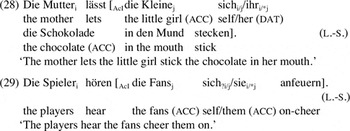
In 28 sich is an indirect, dative-marked object; in 29 it is a direct, accusative-marked object. Although the more local binding possibility is generally preferred for the reflexive (especially in 29), binding across the intervening embedded subject is not impossible. As for the pronominals (ihr and sie), there are three options: They can be bound by the matrix subject, refer to a DP from previous discourse, or be used deictically. Intuitively, it is precisely this ambiguity involving the pronominal that allows the reflexive to provide an alternative way of referring to the matrix subject. For many of the consulted informants, it is most natural to think of the pronominal in 28 as referring to a third person not mentioned in the sentence. At the same time, although they find it possible, they do not feel completely comfortable with the reflexive referring to the matrix subject either. There does not seem to be a perfect way of establishing this binding relation. When it comes to an accusative-marked reflexive as in 29, the long-distance binding possibility is even harder to get. Descriptively speaking, it seems that acceptability of the reflexive decreases the more clear-cut the argument status of the phrase containing it is. Still, if the speaker puts him or herself in the position of the players (see 29), and the context of the described situation is clear, the reflexive cannot be ruled out: It is at least possible and in this way contrasts sharply with 7a in which the reflexive is within a finite CP and binding is utterly impossible. Again, since German reflexives cannot be used logophorically and thus be exempt from the binding conditions, the judgments in 28 and 29 are a significant empirical finding that a binding account must at least attempt to explain (see section 4 for the analysis proposed here).
As shown by the sentence pairs in 30 and 31, what rules out coreference of the reflexive with the matrix subject in Haider's and Reis's data is probably not the given syntactic configuration. The asentences are taken from Haider and Reis and represent their judgments of the binding facts. The b-sentences are slightly altered versions of the respective counterparts in a and show that the binding possibilities change, or are less constrained than they seem to be, depending on lexical choices and possibly perspective. Crucially, in all of the following sentences, the anaphoric element is a dative-marked (non-PP) nominal.

Without making a significant phrase-structural difference, the slightly altered context in the b-examples clearly facilitates the binding possibility between reflexive and matrix subject. The same kind of observation can be made about Frey's (non-PP) examples in 19 and 20. The reflexive can reach beyond the embedded subject if the context is slightly changed.
As for Frey's analysis of pronominal binding, a system in which all sein-selecting verbs are considered unaccusative has no way of accounting for the binding facts in 32. Despite the fact that niederknien is a sein-verb, many of my consultants find that both reflexive and pronominal are perfectly acceptable as referring to the matrix subject.

Unlike the pronominal, the reflexive also has the possibility of being bound by the closer, embedded subject. Given the strong tendency of sich to be bound locally, this is unsurprising. Pragmatically, of course, the coindexation (j) of sich and den Gefangenen is only possible if the nonlinguistic context provides a mirror.
15This corresponds to a Proxy-reading of the reflexive, as discussed in Safir (to appear).
The judgments do not seem to vary when it comes to examples like 17 (the causative passive example) and 18, repeated below as 33 and 34.
16As pointed out by a reviewer, lassen has many different shades of meaning going beyond permissive and causative (see Höhle 1978 who identifies eight types of lassen.) I follow Reis (1976), however, in assuming that there is no evidence of structural distinctions based solely on these different shades of meaning. In section 3 I propose a structural distinction between transitive/unergative and unaccusative AcIs, which reflects at least some of the semantic differences among the many types of lassen.


In these cases, the pronominal is clearly ungrammatical, and the reflexive only has one binding possibility. It is reasonable to argue for a reduced structure with only one complex predicate. In order to attribute this structure to the unaccusativity of the infinitive, however, I have to conclude that niederknien ‘kneel down’ in 32 is not an unaccusative verb, despite the fact that it selects sein. I therefore claim that auxiliary selection is not a reliable diagnostic for unaccusativity. Rather, as suggested by the contrast between 32 and 34, it is the external argumenthood (here, agentivity) of its argument that classifies an intransitive verb as unaccusative or unergative. While den Gefangenen ‘the prisoner’ is agentive and seems to be able to turn the AcI into a domain within which the pronominal can be free, einen Stein ‘a rock’ is nonagentive and does not signify a domain boundary for the pronominal.
Some minimal-pair-like examples that support this contrast in agentivity and its correlation with the binding facts are shown in 35–38.
17The focus is on the acceptability of the pronominal here. As for the reflexive, it can be coindexed with both the matrix and the AcI-subject where pragmatically possible. In 39, for example, sich can be bound by the AcI-subject die Polizisten if it takes on its reciprocal function.
In 35–38 all the b-sentences have agentive AcI-subjects. What is crucial, though, is that these subjects are the external arguments of the respective AcIinfinitives. In Dowty's (1991) terms, they need to be “Proto-Agents,” that is, have external-argument-like properties. As one reviewer remarks, in order to account for the examples in i–iii, it is not enough to say that pronominals are grammatical as long as they are separated from their antecedent by an agentive subject. The AcI-subjects in i–iii are nonagentive but (according to my judgments) still constitute enough of a separation between matrix clause antecedent and pronominal.

In short, an agentive subject is just one type of AcI-subject that licenses binding between an AcI-embedded pronominal and the matrix subject. Other external arguments (experiencer, causer, etc.) are licensors as well.


It is evident that the pronominal generally becomes more acceptable when embedded in a PP. While the dative-marked argument ihm is clearly ungrammatical in 35a and 36a and slightly better in the corresponding b-sentences, the PP-embedded pronouns ihn and sie get better judgments overall, in both the a- and b-sentences of 37 and 38. As I explain in section 4, PP-embeddedness can render a syntactically bound pronominal acceptable, regardless of whether or not the AcI-subject is an external argument.
It would be possible, in principle, to build reference to “agentivity” directly into the binding questions. In this paper, I explore a different path. It has already been established that the crucial property of an agentive AcI-subject is the fact that it is the external argument of the AcI-infinitive. Recent work, in the minimalist program and elsewhere, has explored the syntactic correlate of expression of an external (prototypically agentive) argument. This line of thought opens up the possibility of defining binding domains in phrase-structural terms and thereby capturing the “agentivity effects” just documented indirectly. I argue, beginning in section 3, that this framework yields a relatively straightforward account of the facts. More specifically, I show that it is the presence or absence of the syntactic head introducing the external argument that determines the binding possibilities for the pronominal.
Binding Domains and External Argumenthood
To reiterate the basic intuition driving this reanalysis of the binding facts in German AcI-constructions, I propose that the reflexive binding possibilities need to be less restricted than usually assumed and that the distribution of reflexives and pronominals partially overlaps when the AcI-subject is an external argument. More specifically, for some speakers, the only binding restriction on the reflexive is that it be bound within the minimal IP containing it. As for the pronominal, it can be bound within the same IP as the reflexive, as long as it is contained in a smaller domain within which it can be free. After a discussion of the syntactic correlate of external argumenthood in 3.1, the analysis will be extended to instances of binding in the nominal domain in 3.2.
A Phrase-Structural Analysis of Unaccusativity
Instead of relying on a concept like Frey's (1993) argument structure unification (based on Haider 1987 and Grewendorf 1988), which is difficult to characterize in terms of phrase structure, I appeal to a theory that allows for a clear-cut and purely phrase-structural distinction between unaccusative verbs on the one hand and unergative and transitive verbs on the other. Within this framework, the configurations of these types of verbs are more radically different than in the classic principles and parameters framework. This more radical difference is desirable because it offers a solution to the following puzzle. If, as traditionally assumed, the argument of an unaccusative verb, though base-generated as the verb's internal argument, moves to receive case in external argument position, it ends up in the same position as the argument of an unergative verb and the higher argument of a transitive verb. Thus, syntactically speaking, both types of verbs have an external argument. Why, then, should the binding behavior of their arguments be different?
Within the framework of the phrase structure theory assumed here (see Hale and Keyser 1993, Chomsky 1995, and Kratzer 1996), unergative and transitive verb structures subsume both a lexical VP and its little vP-projection, as shown in 39. The verb originates as the V-head and raises to little v. Each of the verbal heads assigns a θ-role to the argument positioned in its specifier. The verb's internal argument then occupies Spec VP, while the external argument is in Spec vP. Crucial to the analysis to be developed here, external arguments (including agents) can only be introduced by v.

In contrast to this double-layer configuration of unergative and transitive verbs, the characteristic structure of unaccusative verbs is less elaborate. It lacks vP and thus consists of the lexical VP only. No external argument role gets assigned. This is shown in 40.

It follows that only subjects of unergative and transitive, not unaccusative, verbs can receive an agent-type role. I assume that either one of the verbal structures in 39 and 40 can occur as complement of AcI-matrix verbs like lassen ‘let, allow, have’ and sehen ‘see’. Following Wurmbrand (2001), I analyze AcI-introducing verbs as “semifunctional” v-heads that are assigned to a functional category but are lexical in that they establish a thematic relation with the argument in their specifier. The tree structures in 41a and b show both the unergative and the unaccusative type of AcI-configuration embedded under lassen.
19I am abstracting away from the position of the matrix verb, the position of I0, and V-to-I0 movement. According to Vikner (1995), verbal heads and I0 are phrase-final, and the verb moves via I0 to C. The subject moves via Spec IP to Spec CP (see Haider 1993 for a different view).

Case and θ-assignment proceed as follows. In both 41a and b, the matrix subject checks nominative case with I, while the AcI-subject checks accusative case with the matrix v lässt. The matrix valso assigns an external argument role to the matrix subject, which then moves to Spec IP, leaving a trace in Spec vP. In the unergative AcI-structure (a), the AcI-subject gets an agent role from the embedded v, whereas in the unaccusative AcI-structure (b), this does not happen because the structure lacks a vP-projection.
These two types of AcI-structures lead to different binding possibilities. The extra structural layer of unergative and transitive AcIs, resulting from the presence of vP (see 42a), provides a domain in which the pronominal can be free. The assumption that vis needed to assign an external argument role to the AcI-subject explains the intuition that the pronominal is grammatical as long as it is separated from its antecedent by an agent-type subject. The crucial binding domain for the pronominal should thus be vP. The reflexive, on the other hand, can transcend vP boundaries. While it is preferably bound within the embedded vP, some speakers find it grammatical, as long as it has a binder within its minimal IP. The preliminary binding conditions for AcI-constructions are thus given in 42. I assume provisionally that “subject” refers to “DPs in Spec vP.”
20In this paper I focus solely on subject-oriented anaphora. For cases of reflexives with object antecedents, see Grewendorf 1985.

In section 4, I propose a way to eliminate the disjunction (IP or vP) implicit in 42. For now, consider how this formulation will do its work. In 41a the pronominal ihm can refer to the matrix subject der König because it is free in the minimal vP containing it. The AcI-subject den Gefangenen is the intervening external argument. If the AcI-infinitive does not include a vP, as is the case in 41b, the minimal vP containing the pronominal is the matrix vP, which also contains the trace of the matrix subject antecedent. Within this higher vP, the pronominal cannot be free and is thus ruled out. As for the reflexive, sich has two binding possibilities in 41a. Both den Gefangenen and der König are within the minimal IP that contains sich and can thus antecede it. (Again, the prisoner would have to be in front of a mirror.) In 41b only the matrix subject der Bauarbeiter is a possible antecedent. It seems that pragmatically only very few verbs allow for nonagentive subjects to antecede the reflexive. An example is in sich zusammensacken ‘to (internally) collapse’ as in Er sah den Kucheni in sichi zusammensacken ‘He saw the cake collapse’. Generally, we only get non-complementarity of the reflexive and the pronominal if the phrase structure of the AcI corresponds to 41a, that is, the unergative/transitive type.
A consequence of the proposed analysis is that pronominal binding facts may, but auxiliary choice may not be taken as a reliable probe for unaccusativity. The fact that motion verbs, for example, select sein ‘be’ as their perfect auxiliary does not necessarily mean that they are unaccusative. Agentivity and thus the presence of an external argument is only one of the factors influencing auxiliary selection. Although agentivity (or control) are crosslinguistically associated with HAVEselection, there are other factors like change of location, which, combined with agentivity, may lead to BE-selection (see Sorace's [2000] Auxiliary Selection Hierarchy). The point is that unaccusativity dynamically depends on the subtleties of sentence interpretation rather than on auxiliary choice.21
See Lee-Schoenfeld to appear for an indepth discussion of the noncorrelation of agentivity and auxiliary choice.
An Extension to the Nominal Domain
In the previous section, it has been established that sentences with embedded AcI-constructions call for binding conditions having IP as the relevant domain for the reflexive and vP as the relevant domain for the pronominal. Since the former domain is bigger than the latter, we get non-complementarity. Before proposing a way to unify the domains for reflexive and pronominal in section 4, I focus here on determining what impact the findings thus far have on the study of German anaphora in a broader sense. That is, does the current analysis extend to non-AcI contexts? This section explores two such contexts:complex DPs with a possessor in Spec DP and plain DPs.
Consider first the complex DP example in 43.

The binding conditions as stated in 42 do not predict the coindexation of the pronominal ihn with the matrix subject to be possible because there is no vP within which the pronominal is free. Here, ihn is embedded in a PP that is part of a complex DP. There is a remarkable parallel between the binding facts in this complex DP example and those in unergative and transitive AcI-constructions. Compare 43 with 44.

The reflexive sich is ambiguous in that it can be bound either by the subject/possessor in the embedded domain or, within IP, by the matrix subject. The pronominal, on the other hand, can only be bound by the matrix subject or refer to someone not mentioned in the sentence. The fact that the pronominal in 43 is at all grammatical suggests that DP, just like vP, constitutes a domain within which the pronominal is free. The possessor in Spec DP (43) is the equivalent of the agentive subject in Spec vP (44). Both intervene between the pronominal and its matrix clause antecedent. As for the reflexive binding facts, IP is still the only upper boundary needed.
If the possessor in Spec DP is considered a “subject,” the binding condition for the reflexive, as stated in 42a, still holds. The definition of “subject,” however, must be broadened now. It needs to include DPs in both Spec vP and Spec DP. I propose to adopt Safir's (2004) definition, as shown in 45. Furthermore, the pronominal binding condition must now allow for a pronominal to be free within the minimal DP containing it. The revision (adding another disjunction to be eliminated shortly) is given in 46.
22Assuming the ‘bare phrase structure’ definition of complement and specifier, according to which complements are phrases that are incorporated by first merge to a given head and all subsequent merges produce specifiers, Safir's definition of ‘subject’ could be reduced to: DP specifier of (the extended projection of) a θ-assigning head.


Safir's (2004) definition of “syntactic subject” (his 21, ch. 5) includes the specifier of the immediate or extended projection of any lexical category. With respect to the AcI-constructions in 41a and b, the definition may be applied as follows. Both the lassen-vand the V are at least semilexical categories23
According to Wurmbrand, lassen behaves like a lexical predicate with respect to its pragmatic properties (see section 3.2).
It is important to note that the disjunction “vP or DP” in 46 cannot be eliminated by referring instead to a “subject-containing category” (which would be natural). This is because even DPs without a possessor in Spec DP appear to constitute a domain for pronominals. The evidence comes from unaccusative AcI examples like 47.

According to 42, a pronominal should not be grammatical in an unaccusative AcI. The lack of a vP and thus an intervening external argument between the pronominal and its antecedent is predicted to rule out the pronominal. The fact that it is grammatical in 47 can be explained if das Boot neben sich/ihm has the structure [DP [PP ]]. As in the complex DP example in 43, the anaphoric element is then embedded in a PP that is part of a DP. Within the domain of the DP the pronominal is free. If the [DP [PP ]]-analysis is forced, that is, if the possibility of interpreting the DP and the PP as separate arguments of the infinitive is excluded,
24The possibility of interpreting the PP as a separate argument or adjunct of the infinitive and the effect of the corresponding phrase structure on binding are discussed in connection with the proposals made in section 4.

Examples like 47 and 48 suggest that even without a “subject,” a DP behaves like a vP in that it provides enough intervening structure between a pronominal and its antecedent to license the pronominal. In the next section I address what vP and DP have in common and sketch a proposal of how to eliminate both the “vP or DP”-disjunction in the pronominal binding condition and the need for distinct domains for reflexive and pronominal (IP vs. vP/DP).
Taking the Analysis to the Next Phase
At this point it has been established that a German reflexive that is not embedded in a PP is most readily acceptable when bound locally (that is, within the minimal vP containing it), but that, for at least some speakers, it can also transcend vP-boundaries and engage in apparent long-distance binding. Furthermore, both vP and DP have been shown to be relevant binding domains for the pronominal within IP (case I). The goals of this final section are twofold. First, I account for the parallel between the binding facts in unergative/transitive AcI and complex DP-constructions and thus, more generally, between vP and DP as binding domains. Second, this account simultaneously explains the widely attested default case of complementarity between reflexive and pronominal, while still allowing for the (at times marginal) long-distance binding ability of the reflexive, which leads to non-complementarity (cases II and III).
Unifying vP and DP
One way to shed light on the parallel between vP and DP as pronominal binding domains is to appeal to the minimalist notion of “phase” (Chomsky 2000, 2001).
Within the framework of minimalism the derivation of a sentence proceeds in phases. A phase is a subpart of a derivation whose internal content is closed off to grammatical interaction with external elements. The only parts of a phase that can interact with external elements (introduced later in the computational sequence) are those at its edge. The edge of a phase in turn consists of its defining head, the specifiers of that head, and any adjoined material. Among the grammatical operations that cannot penetrate phase boundaries are feature-checking operations; it follows that higher heads can establish such relations with material inside a lower phase only if that material is at the phase-edge. Once a phase is completed, its contents get evaluated at LF (and also at PF, though that is of less concern here). Any unchecked features, or material that is otherwise dependent on phase-external elements, causes the derivation to crash. One of the category-types that define phases is CP. As shown, for example, by the successive-cyclic nature of wh-movement, raising out of a CP entails stopping off in Spec CP (McCloskey 2001). With respect to the current analysis, it is crucial that vP and DP have also been argued to constitute phases. Chomsky (2000) (building on work by Fox [2000] and Nissenbaum [2000]) makes the argument for vP; McCloskey (2000) and Svenonius (2004) for DP. In both cases, extraction seems to proceed via the respective specifier position. If vP and DP indeed have this commonality, the binding condition for the pronominal does not need to be stated as a disjunction (see 45). It can simply require that the pronominal be free in the smallest phase that contains it.
Besides allowing for a unified, more general pronominal binding condition, the proposal that vP and DP (in addition to CP) define phases also has interesting consequences for the reflexive binding condition. Since the internal contents of a phase are not accessible to higher elements, the binding requirements of a phase-internal reflexive cannot be satisfied by a phase-external antecedent. While the “subject” in Spec vP of unergative or transitive AcI-constructions, for example, is an accessible binder for a phase-internal sich, the matrix subject (being external to the embedded vP-phase) is not. The question is then how to explain the possibility (for some speakers) of long-distance binding for sich in AcI-examples like 41a and complex DP-examples like 43. What allows sich to be bound by the matrix subject? The following subsections offer a solution based partly on Safir's (2004) proposal of drawing a parallel between German sich and reflexive clitics in Romance, which are known to be able to raise from inside VP to the inflectional layer.
Reflexive Raising
In The Syntax of Anaphora (2004), Safir develops a theory in which the distribution of anaphors and pronominals is determined by “universal principles applying to select the ‘best available’ form-to-interpretation match” (p. 1, ch. 3). As there can only be one “best available” form, the distribution is complementary. Non-complementarity can only exist if there is a difference in interpretation between the use of the reflexive and the use of the pronominal. Since the data at issue here show a large area of non-complementarity that does not coincide with clear interpretive differences, the empirical generalizations seem incompatible with Safir's theory. In his discussion of German AcI-constructions, however, Safir does point out a characteristic of the reflexive pronoun sich that provides the means for reconciling Safir's theoretical claims and the empirical observations here. His discussion is based on the mainstream view that “sich can be bound in a clause higher than its thematic assignment” (p. 19, ch. 5) when it is embedded in a PP. Safir gives one of Reis's (1976) examples, here shown in 49.

To account for the “larger domain” of the reflexive, Safir compares German sich to the French reflexive clitic se.
25See also Pica 1987. Although I follow Safir in rejecting Pica's account of head movement, it should be noted that Safir's proposal of covert clitic movement for German sich relies on the essence of Pica's analysis, uniting subject-orientation and movement domains.
This explains the grammaticality of the reflexive, but it does not provide an answer for why the pronominal can be considered grammatical as well (see i). Reis (1973) puts a question mark next to the pronominal, and I agree that ihn ‘him’ is at least marginally acceptable.

Safir does not discuss the pronominal in this context at all. It is unclear why, in his terms, the most dependent available form, namely the reflexive sich, does not obviate the pronominal ihn.
Safir's covert clitic movement, that is, the ability of the reflexive to raise covertly, justified by the fact that the Romance reflexive has the ability to do so overtly, constitutes the starting point for the account of reflexive raising I develop in the following subsections. If sich is able to covertly move up and adjoin to the edge of its vP or DP-phase, even if it is not introduced as the object of a preposition, it becomes accessible to the higher elements of the sentence. It can then find the matrix subject as its antecedent, while still being pronounced as part of the embedded domain. Before we get to the details of the account, however, I lay out some basic assumptions concerning movement and the nature of reflexive binding.
Assuming the copy theory of movement, according to which movement consists of the operations copy, merge, and delete, the first two steps of “covert” movement proceed just as they would in overt movement. The only difference lies in the deletion-part of the two types of movement. Instead of deleting (or not pronouncing) all but the highest copy of the moved element, covert movement leaves only the lowest copy to be pronounced (see, for example, Boskovic 2001, Bobaljik 2002, and Reintges, LeSourd, and Chung to appear). On this view, then, covert reflexive raising happens in narrow syntax. Since the goal here is to explain a case of non-complementarity, it is crucial that the pronominal be unable to undergo this covert raising process. But this seems reasonable given that reflexives are generally grammatically active in ways that pronominals are not. Reflexives, for example, must be syntactically bound, while pronominals can refer to an antecedent mentioned in previous discourse or may not have a linguistic antecedent at all. As has been established by Kayne (1975), the binding behavior of French clitics involves a type of agreement relation that is closely related to the system of A-movement. Both clitics and A-moved phases can engage in apparently unbounded interactions by means of establishing successive-cyclic local relations.27
As pointed out by Safir (to appear), French clitic movement extends the range of a potential anaphor even more than A-movement could because the morphosyntax of the Romance causative structure can circumvent the problem of an intervening subject by rendering it dative or through the involvement of a restructuring verb (the latter is the case in German). Still, what clitic and Amovement have in common is that their potentially nonlocal character is only apparent. Both can give rise to nonlocal effects due to stopoff points at phaseedges.
While the third person reflexive pronoun is the invariable sich-form, the first and second person forms vary. They are homophonous (or, on another view, identical) with the corresponding nonreflexive pronouns.
Note that the inability of the reflexive to be bound across an IP or CP-boundary (case I), that is, the fact that cases of non-complementarity do not extend beyond tensed clauses, also falls out from the parallel we are drawing between covert reflexive raising in German and its overt counterpart in Romance. It is a matter of fact that overt reflexive clitics target a position no higher than the inflectional layer (that is, not the edge of a CP-phase). In Reinhart and Reuland's (1993) terms, reflexives form a special kind of predicate, so that (loosely speaking) reflexive pronouns most naturally occur in the verbal domain (including functional vP and inflectional projections, but not CP). Put another way, the movement operations which reflexives undergo are A-movements, solely within the inflectional layer (again, see Kayne 1975).
To reiterate, in the general case of local reflexive binding, where the reflexive is not at the phase-edge, the only possible antecedent is the closest subject. When it comes to long-distance reflexive binding, there are two ways (corresponding to case II and case III) for the reflexive to be a part of the next higher phase. Case II, which exists for all speakers of German, is addressed in subsection 4.4. Case III, which is at issue here and only available to some speakers, involves covert reflexive raising. I now discuss the details of the narrow-syntactic mechanism that leads to case III.
Binding by Phase
Consider again the AcI-binding scenario in 50.

The reflexive binding possibility that is most readily available to all speakers (although pragmatically dispreferred) is marked with the jindex. In this case no binding-related operation takes place in narrow syntax. The feature bundle representing sich probably includes a feature identifying it as a reflexive, but this is not a feature that triggers an Agree or movement relation. It is presumably an interpretable feature that persists throughout narrow syntax and comes to be significant at LF. It is not clear whether this interpretable feature is connected to the LF evaluation process we associate with Condition A, but it seems safe to assume that Condition A (whatever it is exactly) comes into the picture once the narrow syntax has completed the embedded vP (the AcI-)phase (again, see Baltin 2003). The AcI passes the evaluation here because the phase contains a binder (die Fansj) for the reflexive. Since only the material at the edge of the AcI-vP, namely the AcI-subject in Spec vP and the AcI-infinitive, which has raised to v, are part of the next higher phase and thus still accessible to the rest of the derivation, sich, which is trapped within VP, cannot have a matrix-clause antecedent.
The other (more marginal) reflexive binding possibility in 50, namely case III, is marked with the i-index. Here a binding relation is established between the reflexive and the matrix subject (die Spieleri) although sich is the internal argument of the AcI-infinitive (within VP). In order for sich to be accessible to the matrix subject at LF, it must have raised to Spec vP, the edge of the AcI. Since the material at the edge of the embedded vP and contents of the matrix vP undergo the LF evaluation process as part of the same phase, Condition A is satisfied. The crucial question is what triggers the reflexive raising process.
Since reflexive pronouns in many languages have special morphology distinguishing them from their nonreflexive counterparts (in German, this distinction exists for all third person forms), let us follow up on my speculative suggestion above and postulate that all reflexive pronouns (crosslinguistically and crossdialectally) bear an interpretable reflexive feature. This may then be the same feature that Condition A recognizes when it checks whether reflexive and antecedent are in the same phase at LF. For speakers who allow the long-distance binding scenario in 50 and thus have covert reflexive raising in their grammar, there must be an additional reflexive feature that is uninterpretable and can, when paired with the EPP feature,29
The EPP feature demands that the head bearing this feature acquire an extra specifier.
We should keep in mind that German also allows long-distance binding across a DP-phase boundary. This means that the raising mechanism described here must also hold for covert movement of sich to the edge of DP.
More generally, it is then the presence of an uninterpretable feature on vthat, by widening the reflexive range, enables sich to be in the same domain as its distant binder. This scenario is very familiar from apparently unbounded syntactic phenomena like raising and whmovement. In order for the moved element to interact with and reach its ultimate destination, there must be stopoff points at intermediate phaseedges, and the movements from phase-edge to phase-edge must be featurally driven.
This leads us to the next question: If only some speakers have the just described mechanism needed for reflexive raising in their grammar, what is it that makes long-distance reflexive binding possible for all speakers (that is, categorically) when sich is embedded in (certain) PPs (case II)? An answer to this question is offered in subsection 4.4. Before we add PPs to the picture, however, it is time to restate the binding conditions (compare 42 and 46) in minimalist, that is, phase-based, terms. Both pronominal and reflexive now have the phase as their relevant binding domain.
31As becomes clear in sections 4.4 and 4.5, the reflexive must be bound within the minimal phase that contains it and in which its binding requirements can in principle be met (Chomsky 1986).

The conditions stated as such account for the general case of reflexive-pronominal complementarity. The particular case of noncomplementarity seen in 50 is a result of reflexive raising, that is, the ability of the reflexive, but not the pronominal, to covertly raise to the edge of its phase. Crucially, being located at the phase-edge means being part of the next higher phase (see Chomsky 2001). More specifically, given two phase-defining heads H1 and H2 (assuming no other phasedefining head intervenes between them):

Material at the edge of H2 can be bound by elements in the domain of H1 or by the external argument introduced by H1. Put another way, edge material of a phase-defining head belongs in a certain sense to both phases, the higher and lower. Thus, if a reflexive in an embedded vP or DP moves to the edge of its phase, it is contained in the matrix vP. Within this higher phase, it can find the matrix subject in the higher Spec vP as its antecedent.
32German binding is largely subject-oriented, and in the AcI-case, the only potential binder in the matrix clause is in fact the external argument, introduced by the matrix v. In double-object constructions with sich embedded in a complex direct object DP, however, sich has three potential binders: the matrix subject in Spec vP, the possessor in Spec DP of the direct object, and marginally also the indirect object (for example, Martini erzählt [DP(IO)Frankj][DP(DO)Thorstensk Geschichten über sichMi/?j/k]. The restriction that sich be bound by a “subject” is therefore omitted in 51a.
Why PP-Embedded Reflexives are Different
While long-distance binding between sich and the matrix subject in examples like 50 is only a possibility for some speakers (case III), all native speakers of German seem to agree that the PP-embedded sich in examples like 52 can have either the AcI or the matrix subject as its antecedent (case II).

The reflexive is embedded in a clearly optional bei-PP here. Assuming that nonsubcategorized PPs, with a P that assigns its own internal θ-role independently from the verb,
33See Hestvik's (1991) distinction between three types of PPs: i. PPs that assign an independent θ-role to the prepositional object (these PPs are CFCs, regardless of whether they are complements or adjuncts); ii. PPs that assign a θ-role to the prepositional object through the verb (these PPs are not CFCs); and iii. PPs that are not involved in θ-role assignment at all, that is, where the prepositional object gets its θ-role directly from the verb (these PPs are not CFCs).
See Grewendorf 1983.
A recent account of long-distance binding out of PPs that appeals to the “meaningfulness” of P is Gunkel 2003: “The more concrete the meaning of the preposition, the more likely it is that the PP in an AcI-construction can undergo (long) reflexivization” (p. 127).
We then get the following constellation.

Being adjoined to Spec v', sich is part of the edge of the embedded vPphase and thus contained in the next higher, the matrix phase, which also contains both seinen Kollegen and Hans. Hence, both the matrix and the AcI-subject are in positions that allow them to antecede the reflexive. Crucially, no reflexive raising is involved. From the high PP-adjunction site, sich can have access to both subjects without having to move. This then explains why both those speakers who have covert reflexive raising in their grammar and those who do not accept the reflexive binding ambiguity here.
However, while the PP-adjunction story accounts for the binding behavior of the reflexive, it runs the risk of compromising what has thus far been said about the pronominal. If the adjoined PP in 52 is part of the higher phase, how can ihm (with the given coindexation) be free? The only way to prevent the matrix subject Hans and the pronominal ihm from being in the same minimal phase is to claim that, besides CP, vP, and DP, PP can be a phase as well. This does not affect the reflexive binding behavior because, treating PPs as phases in the sense of CFCs, PPs are subjectless and thus cannot possibly fulfill the binding requirements of the reflexive. Following Chomsky (1986), the reflexive binding domain must then be extended to the next higher subjectcontaining domain. This may seem like a step backward in that it rephrases part of Frey's (1993) CFC-based binding conditions in terms of phases, but the merit of replacing CFCs with phases is that the latter are independently needed to account for island phenomena, ordering, and more generally, reduction of “search space” (Chomsky 2000), while the notion of CFC is of use only in the domain of binding. As further discussed in the next subsection, if it is independently plausible to assume that PP-adjuncts are phases, the pronominal binding facts in examples like 52 are accounted for regardless of whether or not the PP is adjoined high and thus part of the matrix vP-phase.
PP-Phases
In order to account for the pronominal in 52 as well as other instances of pronominals that can be bound by the matrix subject when embedded in nothing but a PP, we are now asking the question whether, in addition to vPs and DPs, certain PPs constitute pronominal binding domains as well. If they do, and if the goal is to maintain phase-based binding domains, at least certain PPs must be added to the types of constituents that potentially qualify as phases. As it turns out, Baltin (1982) has argued that extraction from PP proceeds by way of its specifier. Assuming that this is a viable diagnostic for phasehood, PPs may indeed be a reasonable addition to the class of phase-like constituents. Furthermore, letting phases do the work of the binding-specific construct CFC, I follow Hestvik (1991) in assuming that CFC/phasehood is characterized by independent and phrase-internally complete θ-role assignment, that is, phrase self-sufficiency and saturation. More specifically, I assume that all PPs, argument or adjunct, whose prepositional object receives its θ-role from P (without involvement of the verb) are phases. Pronominal binding then serves as a phasehood diagnostic.
The following are both AcI and non-AcI examples suggesting that a pronominal can be free inside a PP that is not contained in a vP or DPphase. Since the use of untergehen ‘sink’ in 53a triggers an unaccusative AcI-structure here, there is no embedded vP-projection. Similarly, there are no embedded vP or DP-boundaries that could explain the acceptability of the pronominals in 53b and c. The PPs alone must be the relevant binding domains for the pronominals here.

As pointed out by a reviewer, the facts here seem to be the opposite in English, at least for those speakers who share the judgments in i.
(i) Shei put the book next to heri/??herselfi.
The current analysis has no explanation for this contrast between German and English. The English facts in binding contexts like these are notoriously unclear, however. Some speakers find pronominal and reflexive equally acceptable here.
While the pronominal in 53c is only marginally acceptable, it is clearly better than the pronominals in the θ-dependent PPs auf and für in 54b and c.
If all three PPs in 53 constitute pronominal binding domains and thus phases, another question worth asking is which subsentential phrases do not qualify as such domains. As for bare VPs (in my system, the immediate and only projection of passive and unaccusative verbs), section 3 has already established that they do not provide enough (or not the right type of) structure for a syntactically bound pronominal to be free. In line with Chomsky 2000, 2001, the data presented here thus suggest that the projection of passive and unaccusative verbs (in Chomsky's system a defective vP) is not a phase.
38This is contra Legate (2003), who argues that all vPs as well as bare VPs constitute phases. Her claim is based on reconstruction, quantifier raising, and parasitic gaps in English.
Again, I am abstracting away from subject and verb movement. What is important here is that the pronominal ihn is VP-internal (and does not have to move beyond VP to check case), while the subject der Mann is introduced into a VP-external position.

Non-phase argument-PPs in unaccusative AcIs are expected to show the same pronominal binding pattern as 54a. Since there is no vP-layer, and since the PP is θ-dependent on the verb, the pronominal cannot be free. As illustrated by the a-examples of 37 and 38, repeated here as 55a and b, the facts tend to support this expectation.
40The fact that a few speakers do not completely rule out the pronominal in 55 may have to do with the possibility of interpreting the PPs as nonsubcategorized and thus as phases. The verbs would just be stürzen and rollen, and the PPs, consisting of the pre- and postpositions auf…nieder and auf…zu, would be optional specifications of direction. As explained in subsection 4.4, the reflexive would still be able to find the matrix subject as its binder because PPs are inherently subjectless (see Hestvik 1991) and therefore allow the reflexive to look beyond a PP-phase.
In contrast to 54, Reis's (1973) example given in 26, repeated here as i, allows for a syntactically bound pronominal because, in my terms, die Männer qualifies as an external argument and therefore turns the AcI into the relevant binding domain for the pronominal. As for 27, repeated here as ii, the AcI consists of an idiomatic expression in which the AcI-subject die Verantwortung seems to be personified (responsibility cannot literally come toward someone) and interpreted as the external argument of zukommen. Just as in i, the AcI is then a vP which allows the pronominal to be free. The question of why speakers who do not have “covert” reflexive raising would get long-distance binding of sich here, will be addressed in connection with “semiobligatory” PPs.


To sum up, subsections 4.4 and 4.5 have dealt with the following case II binding scenarios:

In all three sets of examples, the argument/adjunct status of the PP is clear. The assumption that PP-adjuncts are adjoined to v' (that is, the AcIphase-edge) accounts for the invariable grammaticality of the reflexive, while the claim that θ-independent PPs are phases explains the acceptability of the syntactically bound pronominal. Note that this analysis of PPs allows for a way to incorporate Reis's (1973, 1976), Haider's (1985), and Frey's (1993) intuition concerning the longdistance binding ability of PP-embedded reflexives into the broader framework of the current proposals.
As discussed by Reis (1976), there are other instances of case II that are less clear-cut. She presents a number of examples in which both pronominal and reflexive can be anteceded by the matrix subject although they are embedded in a PP that does not straightforwardly qualify as a phase. (Reis calls these PPs “semi-obligatory.”) One of my examples that falls into this category is 1, repeated here as 56.

Although the embedded vP ensures that the pronominal is accounted for, regardless of whether the PP is a phase or not, the reflexive is only expected to be judged grammatical by all speakers if it is part of a PP that is adjoined to the AcI-phase-edge. Since it is not obvious that potentially subcategorized PPs should be allowed to occupy a VPexternal position, we are faced with a puzzle. So far, I have assumed that only θ-independent PPs can occur outside the subcategorization domain of the verb. The fact that the über-PP in 56 does not license a syntactically bound pronominal in simplex clauses (for example, Eri spricht nur [über *ihni] ‘He only talks about himself’) confirms that this PP cannot be treated like the θ-independent PPs in 52 and 53. For speakers who do not have covert reflexive raising, there must then be another way for sich to reach the phase-edge. One possibility is for the PP to start within VP, fulfill the verb's selectional requirements, and then scramble to the vP-phase-edge. Scrambling would feed binding then. Due to the notoriously fuzzy argument-adjunct distinction, as well as various nonsyntactic factors
42To address just a few of the nonsyntactic factors at play here, Reis's data suggest that, even for speakers who categorically rule out case III, there are exceptional contexts that make long-distance binding across an embedded external argument less of a violation. In transitive AcIs, for example, where it is pragmatically unlikely that the anaphoric element corefers with the AcI-subject, use of the reflexive to refer to the matrix subject is perfectly acceptable despite the intervening external argument; for example, Hansi lässt den Mannj auf sichi/auf ihn∗i eifersüchtig werden. ‘Hans lets the man get jealous of him.’ (Reis 1976: 31). If, on the other hand, ambiguity could arise, the pronominal is judged to be the more acceptable way of referring to the matrix subject; for example, Hansi lässt den Vaterj ruhig stolz auf sich∗i/auf ihni sein. ‘Hans has no problem letting the father be proud of him.’ (Reis 1976: 31). The judgments Reis documents implicate that, although the pronominal should be a possibility in both these contexts, the chance of using sich obviates the pronominal. Other nonsyntactic factors, such as avoidance of two homophonous reflexive pronouns in the same sentence, and involvement of idiomatic expressions that often make the reflexive “sound better” than the pronominal (see also note 40), complicate the facts even further.
Abstracting away from case II-examples involving “semiobligatory” PPs, the system I propose has a way to account for both case II and case III binding possibilities. The crucial mechanism needed to explain case III is reflexive raising, a type of movement that is independently needed for many apparently unbounded phenomena (including raising and whmovement). Assuming that syntactic derivations proceed by phase, overt or covert movement to phase-edges is necessarily an integral part of the system. Since transitive AcIs containing a sequence of two nonprepositional arguments (often both accusative-marked) are extremely marginal, even without the involvement of anaphora, it is not surprising that, depending on exposure, speakers may or may not make covert reflexive raising part of their grammar. As for case II, the proposed analysis accurately captures the invariable judgments involving PPs that are either clearly arguments or clearly adjuncts. Again, no new technology needs to be introduced: The postulation of both high PPadjunction and PP-phases is in line with previously made claims or uncontroversial assumptions.
Conclusion
This paper has consequences for two areas of grammar: binding and the phrase-structure of reduced infinitive constructions (in particular AcIs). The main empirical contribution made to the study of anaphora is the finding that there are several contexts (more than previously recorded) in which the reflexive and the pronominal are not in complementary distribution. In examples with embedded AcIs or complex DPs, the reflexive (whether part of a PP or not) can be bound across an intervening subject, and the pronominal may be grammatical even if its antecedent is only a vP, DP, or PP-boundary away. The noncomplementarity results from the fact that the reflexive is more versatile in finding a binder than the pronominal in being free. This can be formalized configurationally, without reference to argument structure and the binding-specific construct CFC. The minimalist notion of “derivation by phase” offers an explanation for both the versatility of the reflexive and the easily gained “freedom” of the pronominal. As long as the reflexive is at an embedded phase-edge, it is accessible to the contents of both the embedded and the next higher phase. Its binding requirement can thus be satisfied within a widened range. While both reflexives and pronominals can reach the phase-edge via PP-adjunction, only reflexives are endowed with the ability to covertly raise. This, we have assumed, is a reflection of the larger pattern that reflexive pronouns are morphosyntactically active in a way that “ordinary” pronouns are not.
Given that it is reasonable to treat not only vP and DP but also PP as potentially phase-defining categories, and given that Condition A and B apply at LF after the completion of each phase, the proposed analysis is largely successful at covering the facts. Both the majority of the previously recorded and the newly discovered empirical observations are accounted for. Whether there is a systematic way to account for the reflexive binding possibilities in what Reis (1976) calls “semi-obligatory” PPs remains to be seen. Considering the extremely marginal status of transitive AcI-constructions in general, the variability in judgments on binding, probably influenced by various nonsyntactic factors, is not surprising.
APPENDIX
Below are the two questionnaires I used to elicit grammaticality judgments from other native speakers of German. The first survey was completed by eight speakers and the second by ten speakers, mostly from northern Germany. In most cases the sentences were read aloud to the subject. First they heard the sentence with the reflexive, then with the pronominal. After each version of the sentence, they indicated which of the given antecedents they felt the anaphoric element referred to by picking a number from 1 to 5 (1=immediately comes to mind; 2=fine with appropriate context but isn't the first thing that comes to mind; 3=possible but doesn't seem quite right; 4=sounds pretty much wrong; 5=absolutely impossible). The 1–5 evaluation results are shown with respect to the different antecedents, first for the use of the reflexive, then for the use of the pronominal. The speakers are represented by their initials.
Fragebogen zur Bindungstheorie (#1)
Bitte lesen Sie die folgenden Sätze und entscheiden Sie, worauf sich das Reflexivpronomen (sich) bzw. das Personalpronomen (ihn/ihm/sie/ihr…) bezieht. Sie werden oft Mehrdeutigkeiten feststellen. Benutzen Sie die vorgegebene Bewertungsskala (1–5). Tragen Sie also in jedes Kästchen eine Zahl von 1 bis 5 ein. Dieselbe Zahl kann mehr als einmal pro Satz benutzt werden. Bitte nehmen Sie sich Zeit und fügen Sie, falls erforderlich, einen erklärenden Kommentar hinzu.
Bewertungsskala:
- Ja, kommt mir sofort in den Sinn.
- Ja, mit entsprechendem Kontext; kommt mir aber nicht als erstes in den Sinn.
- Ja, vielleicht, aber kommt mir komisch vor.
- Kaum möglich; hört sich falsch an.
- Nein, eindeutig falsch.


Fragebogen: Bindung in AcI-Konstruktionen (#2)
Bitte lesen Sie die folgenden Sätze und entscheiden Sie, worauf sich das Reflexivpronomen (sich) bzw. das Personalpronomen (ihn/ihm/sie/ihr…) bezieht. Sie werden sowohl Mehrdeutigkeiten als auch unmögliche Kombinationen vorfinden. Benutzen Sie die vorgegebene Bewertungsskala und tragen Sie in jedes Kästchen Ihr Urteil, also eine Zahl von 1 bis 5, ein. Dieselbe Zahl kann mehr als einmal pro Satz benutzt werden. Wenn Sie meinen den Kontext genauer erklären zu müssen, fügen Sie bitte einen Kommentar hinzu. Vielen Dank fürs Mitmachen!
Bewertungsskala:
- Ja, kommt mir sofort in den Sinn.
- Ja, mit entsprechendem Kontext; kommt mir aber nicht als erstes in den Sinn.
- Ja, vielleicht, aber kommt mir komisch vor.
- Kaum möglich; hört sich falsch an.
- Nein, eindeutig falsch.


References
Baltin Mark.
1982.
A landing site theory of movement rules.
Linguistic Inquiry
13.
1–
38.Google Scholar
Baltin Mark.
2003.
The interaction of ellipsis and binding: Implications for the sequencing of Principle A.
Natural Language and Linguistic Theory
21.
215–
246.Google Scholar
Bobaljik Jonathan.
2002.
A-chains at the PF-interface: Copies and “covert” movement.
Natural Language and Linguistic Theory
20.
197–
267.Google Scholar
Boskovic Zeljko.
2001.
On the nature of the syntax-phonology interface: Cliticization and related phenomena.
Amsterdam:
Elsevier.
Büring Daniel.
2001.
Let's phrase it! Competition in syntax,
ed. by Gereon Müller and
Wolfgang Sternefeld,
69–
105.
(Studies in generative grammar, 49.)
Berlin and New York:
Mouton de Gruyter.
Burzio Luigi.
1986.
Italian syntax: A government-binding approach.
Dordrecht:
Reidel.
Chomsky Noam.
1986.
Barriers.
Cambridge, MA:
MIT Press.
Chomsky Noam.
1995.
The minimalist program.
Cambridge, MA:
MIT Press.
Chomsky Noam.
2000.
Minimalist inquiries: The framework. Step by step: Essays on minimalist syntax in honor of Howard Lasnik,
ed. by Roger Martin,
Daniel Michaels, and
Juan Uriagereka,
89–
156
Cambridge, MA:
MIT Press.
Chomsky Noam.
2001.
Derivation by phase. Ken Hale, a life in language,
ed. by Michael Kenstowicz,
1–
51.
Cambridge, MA:
MIT Press.
Dowty David.
1991.
Thematic proto-roles and argument selection.
Language
67.
547–
619.Google Scholar
Fox Danny.
2000.
Economy and semantic interpretation.
Cambridge, MA:
MIT Press.
Frey Werner.
1993.
Syntaktische Bedingungen für die semantische Interpretation.(Studia grammatica, 35.)
Berlin:
Akademie Verlag.
Grewendorf Günther.
1983.
Reflexivierung in deutschen AcIKonstruktionen—kein transformations-grammatisches Dilemma mehr.
Groninger Arbeiten zur Germanistischen Linguistik
23.
120–
196.Google Scholar
Grewendorf Günther.
1985.
Anaphern bei Objekt-Koreferenz im Deutschen: ein Problem für die Rektions-Bindungs Theorie. Erklärende Syntax des Deutschen,
ed. by Werner Abraham,
137–
171.
Tübingen:
Gunter Narr.
Grewendorf Günther.
1988.
Aspekte der deutschen Syntax.
Tübingen:
Gunter Narr.
Grimshaw Jane.
2000.
Locality and extended projection. Lexical specification and insertion,
ed. by Peter Coopmans,
Martin Everaert, and
Jane Grimshaw,
115–
133.
Amsterdam and Philadelphia:
John Benjamins.
Gunkel Lutz.
2003.
Reflexivierung in AcI-Konstruktionen. Arbeiten zur Reflexivierung,
ed. by Lutz Gunkel,
Gereon Müller, and
Gisela Zifonun,
115–
133.
(Linguistische Arbeiten, 481.)
Tübingen:
Max Niemeyer.
Gurtu M.
1985.
Anaphoric relations in Hindi and English. Doctoral dissertation,
Central Institute of English and Foreign Languages, Hyderabad.
Haider Hubert.
1985.
Über sein oder nicht sein: Zur Grammatik des Pronomens sich. Erklärende Syntax des Deutschen,
ed. by Werner Abraham,
223–
254.
Tübingen:
Gunter Narr.
Haider Hubert.
1987.
Deutsche Syntax, generativ—Parameter der deutschen Syntax.
Unpublished manuscript,
University of Vienna.
Haider Hubert.
1993.
Deutsche Syntax generativ.
Tübingen:
Gunter Narr.
Hale Kenneth, and
Samuel Keyser.
1994.
On argument structure and the lexical expression of syntactic relations. View from Building 20,
ed. by Kenneth Hale and
Samuel Keyser,
53–
109.
Cambridge, MA:
MIT Press.
Harbert Wayne, and
Veneeta Srivastav.
1988.
A complement/adjunct binding asymmetry in Hindi and other languages.
Cornell Working Papers in Linguistics
8.
79–
105.Google Scholar
Hestvik Arild.
1991.
Subjectless binding domains.
Natural Language and Linguistic Theory
9.
455–
496.Google Scholar
Höhle Tilman.
1978.
Lexikalistische Syntax.
Tübingen:
Max Niemeyer.
Kayne Richard.
1975.
French syntax: The transformational cycle.
Cambridge, MA:
MIT Press.
Kluender R.
1986.
Sätzchen: German small clauses as Ss. North East Linguistic Society Proceedings 16,
ed. by S. Berman,
J.-W. Choe, and
J. McDonough,
274–
292.
Somerville, MA:
Cascadilla Press.
Kratzer Angelika.
1996.
Severing the external argument from its verb. Phrase structure and the lexicon,
ed. by Johan Rooryck and
Laurie Zaring,
109–
137.
Dordrecht:
Kluwer.
Lee-Schoenfeld Vera.
To appear. Agentivity versus auxiliary choice: Evidence from pronominal binding in German AcI-constructions.
Workshop volume on
Crosslinguistic Variation in Auxiliary Selection, University of California, Davis,
May 2003.
Legate Julie.
2003.
Some interface properties of the phase.
Linguistic Inquiry
34.
506–
516.Google Scholar
McCloskey James.
2000.
Quantifier float and wh-movement in an Irish English.
Linguistic Inquiry
31.
57–
84.Google Scholar
McCloskey James.
2001.
Resumption, successive cyclicity, and the locality of operations. Derivation and explanation in the minimalist program,
ed. by Samuel Epstein and
Daniel Seeley,
184–
226.
Cambridge:
Basil Blackwell.
Nissenbaum Jon.
2000.
Investigations of covert phrase movement. Doctoral dissertation,
MIT.
Pica Pierre.
1987.
On the nature of the reflexivization cycle.
Proceedings of the North East Linguistic Society 17,
ed. by J. McDonough and
B. Plunkett,
483–
499.
Somerville, MA:
Cascadilla Press.
Primus Beatrice.
1989.
Parameter der Herrschaft: Reflexivpronomina im Deutschen.
Zeitschrift für Sprachwissenschaft
8.
53–
88.Google Scholar
Pustejovsky James.
1984.
Opacity and the accessibility of subject in German A.c.I.-constructions.
Proceedings of North East Linguistic Society 14,
ed. by C. Jones and
P. Sells,
360–
376.
Somerville, MA:
Cascadilla Press.
Reintges Chris,
Philip LeSourd, and
Sandra Chung.
To appear. Movement, whagreement, and apparent wh-in-situ. Wh-Movement on the move,
ed. by L. Cheng and
N. Cover.
Cambridge, MA:
MIT Press.
Reis Marga.
1973.
Is there a rule of subject-to-object raising in German?
Chicago Linguistics Society Proceedings 9.
519–
529.
Reis Marga.
1976.
Reflexivierung in deutschen A.c.I.-Konstruktionen. Ein transformations-grammatisches Dilemma.
Papiere zur Linguistik 9.
5–
82.
Safir Ken.
2004.
The syntax of anaphora.
New York and Oxford:
Oxford University Press.
Sorace Antonella.
2000.
Gradients in auxiliary selection with intransitive verbs.
Language
76.
859–
890.Google Scholar
Svenonius Peter.
2004.
On the edge. Peripheries,
ed. by D. Adger,
C. de Cat, and
G. Tsoulas,
259–
287.
Dordrecht:
Kluwer.
Vikner Sten.
1995.
Verb movement and expletive subjects in the Germanic languages.
New York and Oxford:
Oxford University Press.
Wurmbrand Susi.
2001.
Infinitives: Restructuring and clause structure.
Berlin and New York:
Mouton de Gruyter.
 You have
Access
- 16
- Cited by