INTRODUCTION
The study considers structure and use in acquisition of complex syntax by Hebrew-speaking toddlers as reflecting developmental phases in the expression of form–function relations, taking into account the impact of interlocutor-supported compared with child-initiated productions. The domain of complex syntax at issue here is variously termed ‘clause-linkage’ (Bickel, Reference Bickel and Bril2010), ‘connectivity’ (Berman Reference Berman, Dittmar and Penner1998, 2009), ‘nexus’ (Foley & Van Valin, Reference Foley and Van Valin1984), or ‘syntactic packaging’ (Berman & Slobin, Reference Aksu-Koç, von Stutterheim, Berman and Slobin1994). In child language research, reference is commonly to “acquisition of complex sentences”, as in Bowerman's (Reference Bowerman, Fletcher and Garman1979) and Limber's (Reference Limber and Moore1973) groundbreaking chapters, and, more recently, in Diessel's (Reference Diessel2004) detailed study of early grammatical development in English, and in Lust, Foley, and Dye's (Reference Lust, Foley, Dye and Bavin2009) generative approach to the topic. The term clause-combining is adopted here (cf. Haiman & Thompson, Reference Haiman and Thompson1988; Clark, Reference Clark2009, pp. 229–253), based on the definition of a clause as a linguistic construction that contains “a unified predication … which expresses a single situation (activity, event, state)” (Berman & Slobin, Reference Aksu-Koç, von Stutterheim, Berman and Slobin1994, p. 660). The clause, rather than a ‘sentence’ is adopted as the basic unit of analysis for several reasons: (i) it combines semantic and syntactic criteria in a readily accessible fashion, as demonstrated (ii) decisions about clause boundaries made by students as well as scholars are reached rapidly and with high levels of agreement; (iii) it avoids attributing to young preschool children a mental representation of a ‘sentence’, as an abstract, theory-dependent notion that is notoriously difficult to define (Chafe, Reference Chafe1994), and which has a particularly dubious status in oral language use (Halliday, Reference Halliday1989, pp. 66–67); and (iv) it has proved a viable measure of linguistic proficiency across numerous languages, including Hebrew, in both oral, preschoolers’ narratives (Berman & Slobin, Reference Aksu-Koç, von Stutterheim, Berman and Slobin1994), and spoken and written texts of schoolchildren and adolescents (Berman & Verhoeven, Reference Berman and Verhoeven2002).
Clause-combining (CC) thus reflects inter-clausal relations, involving the ability to join clauses into longer units of syntactically and thematically connected stretches of discourse. For present purposes, a key requirement for two or more clauses to be defined as participating in the process of CC is that semantically and/or pragmatically they refer to the same topic, typically containing a syntactically independent ‘main clause’, to which related clauses add more information or elaborate on its content (Berman & Nir, Reference Berman, Nir, Guo, Lieven, Ervin-Tripp, Budwig, Özçalişkan and Nakamura2009; Nir, Reference Nir2008). A critical feature of this analysis is the notion of contingent clauses, where ‘contingency’ means that a given clause is dependent on another for grammatical well-formedness and/or for semantic interpretation. For example, in coordinated or subordinated constructions such as those in (1), the underlined clauses are contingent on the Main Clause that precedes or follows them.
- (1)
a. The little boy fell from the swing and started crying.
b. The little boy started crying because he fell from the swing.
c. When he fell from the swing, the little boy started crying.
d. The little boy didn't cry although he hurt himself falling from the swing.
The task of clause-combining presents children with various challenges beyond structural linguistic complexity. These include: cognitive on-line processing capacity in packaging together different pieces of information into a single stretch of speech output; thematic expression of various temporal and logical semantic relations between situations; and the pragmatic ability to add more information to or elaborate on a given predication within a single conversational turn. Nonetheless, this ability has been shown to emerge in children's speech production from as young as around age two years, once simple clause-structure is well established, even if not yet fully mastered (Clark, Reference Clark2009; Diessel, Reference Diessel2004; Dromi & Berman, Reference Dromi and Berman1986).
The present study extends the rather sparse information available on acquisition of complex syntax in Hebrew, deriving from, while going beyond, a recent study of the two authors (Berman & Lustigman, Reference Berman and Nir2014). Prior research on the topic concerns syntactic packaging in the Hebrew ‘frog-story’ narratives produced by children from age three years – the upper age-limit considered here (Berman & Neeman, Reference Berman, Neeman, Berman and Slobin1994), while others deal with later, school-age language development – in experimental elicitations of conditional constructions and ‘merging sentences’ (Ravid & Saban, Reference Ravid, Saban, Stavans and Kupferber2008) or in analyzing narrative-embedded clause-combining strategies from middle childhood across adolescence (Berman & Nir, Reference Berman, Nir, Guo, Lieven, Ervin-Tripp, Budwig, Özçalişkan and Nakamura2009). Particularly relevant to the present study is a cross-sectional study of developing syntax in Hebrew preschoolers from age 1;6 to 5;6, based on investigator–child recordings of twenty children in each of five year-groups (Dromi & Berman, Reference Dromi and Berman1986). Two studies which, like the one documented below, are based on longitudinal data in interactive settings are Arnon's (Reference Arnon and Kidd2011) investigation of relative clause usage in sibling conversational interactions, and Armon-Lotem's (Reference Armon-Lotem, Ravid and Bat-Zeev Shyldkrot2004) description of order of acquisition of different types of subordination in a database similar to the one analyzed below, but without quantitative breakdowns of their occurrence in different CC environments.
In contrast to these two studies, the present analysis investigates complex syntax of Hebrew-speaking toddlers between two and three years of age across the entire range of their CC productions – precursors, coordinated constructions, and different types of subordinate clauses. Like our earlier investigation of emergent CC in Hebrew (Berman & Lustigman, Reference Berman, Lustigman, Arnon, Casillas, Kurumada and Estigarribia2014), analysis takes into account the role of caretaker–child interactions, based on the idea of different types of ‘supportive contexts’ provided by adult interlocutors. Here, children's early CC is examined from the perspective of (i) the developmental path of lexico-syntactic form (connectives) and syntactic function (types of contingent clauses) from initial emergence to categorial variation, and (ii) the interplay between interlocutor-supported and autonomous, child-initiated CC.
Our approach to the topic is developmental, delineating distinct phases in marking of inter-clausal relations in the form of an age-related progression from non-marking to under-specified and on to fully conventional, explicit marking of grammatical categories characterizing CC, in line with other domains of grammatical development, such as verb inflection and prepositional marking (Lustigman, Reference Lustigman2013a, Reference Lustigman2013b). From this perspective, linguistic knowledge – here, for clause-combining complex syntax – does not proceed in a one-step shift from non-production to mastery, but evolves as a gradual process of increasing explicitness and greater variation in deployment of linguistic forms at the service of discourse functions (Berman, Reference Berman and Levin1986, Reference Berman and Berman2004; Karmiloff-Smith, Reference Karmiloff-Smith1983, Reference Karmiloff-Smith and Levin1986).
Relevant developments are analyzed from a functional perspective, similar to that of Diessel (Reference Diessel2004), who defines complex sentences in a usage-based functionalist approach as “grammatical constructions that express a specific relationship between two or more situations in two or more clauses” (p. 41). Underlying our study is a form–function approach in which, with development, children use new forms to serve earlier acquired functions, while concurrently assigning new functions to earlier acquired forms (Berman, Reference Berman and Bavin2009; Karmiloff-Smith, Reference Karmiloff-Smith1979; Slobin Reference Slobin, Ferguson and Slobin1973, 2004). To this end, the developmental route of children's CC is described below in terms of increasing variation from the combined perspectives of the syntactic functions realized by ‘contingent clauses’ (starting with V-V combinations like English have to go, want to eat, and proceeding to different types of coordinate and subordinate clauses), on the one hand, and of the linguistic forms like those meaning ‘and’, ‘that’, or ‘so’ which children use to express these functions, on the other.
THE STUDY
The database and coding categories analyzed were as follows.
Database
The longitudinal sample consists of audio-recordings of weekly sessions with three typically developing children, between age two to three years, in interaction with their native Hebrew-speaking caretakers, college graduates of middle-to-high SES. Transcription followed a CHILDES-adapted broad phonemic representation of current Hebrew pronunciation, with digitalized versions of the original recordings consulted when necessary. Hebrew examples are given in broad phonemic transcription, with children's utterances presented in the target adult forms, rather than replicating their juvenile or partial articulations. Word-stress is marked by an accent aigu if not word-final. Examples are translated freely into English, except where morpheme-by-morpheme glossing is needed to interpret CC constructions.
Coding was conducted by the two authors working in conjunction, with disagreements resolved in consultation with a research team directed by Dr Bracha Nir. Interpretation of child utterances took into account three kinds of evidence: the situational extralinguistic context, preceding adult utterances, and the child's subsequent utterances (Bloom, Reference Bloom1970). The caretakers who did the recording (two mothers and a maternal aunt) had been explicitly instructed to provide what Brown (Reference Brown1973) calls ‘rich semantic context’ in explaining the child's intentions, while transcribers also regularly consulted with the mothers to resolve unclear child output. Table 1 outlines the database for the present analysis, where number of utterances equals number of textlines, as specified by intonation following CHAT conventions (MacWhinney, Reference MacWhinney2000), so including not only clauses but also single, non-clausal phrases, and multi-clause strings.
Number of recordings and total utterances in the age range analyzed for CC of three children, by child

Table 1 shows that the earliest instances of CC were recorded in the period between 2;0 and 2;1 for all three children, confirming findings from other languages that age around two years is a common point in the shift from reliance on isolated clauses to production of clause-combining utterances. Importantly, all caregivers used complex syntax extensively in addressing the children well before then, as shown in (2) below.
(2) Caregivers’ use of CC when addressing the children before the emergence of CC in the children's speech output
a. Lior's mother, at age 1;6·00:
hu dofeq ba-délet, az at doféqet al ha-délet?
‘He knocks on the door, so (do) you knock on the door?’
b. Hagar's mother, at age 1;7·03:
child: ma ze? ‘What's that?’
mother: ze šir al yéled še-yagídu lo, al take, al tarbic, ze lo yafe leharbic
‘It's (a) song about (a) boy that people will-say to-him, don't hit, it's not nice to-hit’
c. Leor's aunt, at age 1;9·00
bo tešev ve-niqra séfer im ába
‘Come (=let's) sit and we'll read (a) book with Daddy’
As detailed in Table A in the ‘Appendix’, the mothers of all three children used complex syntactic constructions liberally in the speech they addressed to the children, with the proportion of CC instances out of their total speech output showing striking similarities across the three mothers, constituting roughly a third of their total utterances.
Categories of analysis
The following types of constructions were identified as clauses (following Dromi & Berman, Reference Dromi and Berman1986, and Berman & Slobin, Reference Aksu-Koç, von Stutterheim, Berman and Slobin1994): (i) all strings containing a single verb, whether or not correctly inflected for subject-agreement in number, gender, and/or person (e.g. ani mecayéret et ze ‘I draw+sg.fm acc-this’ [Hagar, 2;8·10], hem yavóù maxar ‘they will-come+3rd.pl tomorrow’ [Lior, 2;9·07]); (ii) strings containing two verbs, defined as ‘extended predicates’, where the first is a modal or aspectual verb or operator inflected for tense (e.g. roca liròt ‘want to-see’ [Lior, 2;4·21], ani holex lehavi od ‘I go = am-going to-bring more’ [Leor, 2;11·02], ani crixa likfoc al ha-susim ‘I need to-jump on the-horses’ [Lior, 2;8·23]); and (iii) verbless clauses, mainly ‘nominal sentences’ (Berman, Reference Berman1978): present-tense copular constructions that have no overt manifestation of the verb haya ‘be’ in equational propositions (e.g. anaxnu dubim gdolim ‘we (are) bears big = we are big bears’ [Hagar, 2;4·14]), existentials and locatives (e.g. po yeš glida ‘here there-is ice-cream = there is ice-cream here’ [Hagar, 2;9·04]), and possessives (e.g. yeš lax praxim ‘there-is to-you flowers = you have flowers’ [Leor, 2;6·21]).
Data analysis covered all children's productions that contained more than a single predicating element in a given string, excluding rote-learned sequences from storybooks, television programs, songs, and other routines. Categories of analysis derive from prior research on complex syntax in different languages including Hebrew (Berman & Nir, Reference Berman and Nir2014; Nir, Reference Nir2008; Nir & Berman, Reference Nir and Berman2010a), supplemented by innovative criteria for analyzing input-supported compared with self-initiated early CC in adult–child interactive contexts (Berman & Lustigman, Reference Berman, Lustigman, Arnon, Casillas, Kurumada and Estigarribia2014).
As a starting point, non-CC clause-internal V-V combinations were identified, on the assumption that these might form precursors to clause-combining complex syntax. These ‘extended predicates’ – from the Hebrew-language notion of nasu murxav (Azar, Reference Azar1977; Berman, Reference Berman1978; Blau, Reference Blau1966) – are strings of two or more verbs or verbal operators, with the first, tensed item typically modal (e.g. English have to, need to) or aspectual (be going to, start to), in Hebrew invariably followed by an infinitive verb-form. These have been labeled variously as ‘predicate complement constructions’ (Bloom, Tackeff & Lahey, Reference Bloom, Tackeff and Lahey1984), ‘complement taking verbs’ (Diessel, Reference Diessel2004), or ‘complex VPs’ (Givón Reference Givón2009, pp. 129–203). For present purposes, such combinations are not analyzed as a clause-combining category, but as part of a single clause, since they modify a given predication rather than specifying a separate situation or event (Berman & Slobin Reference Berman and Slobin1994, pp. 660–882; Dromi & Berman Reference Berman and Levin1986). This is consistent with the English-based analysis of Vasilyeva, Waterfall, and Huttenlocher (Reference Vasilyeva, Waterfall and Huttenlocher2008), who likewise do not consider such elements as forming a separate clause. Besides, the non-independent status of such constructions is reflected phonologically in English contractions such as wanna, hafta, gonna, and morphologically in Hebrew, where many such predicate-initial elements are part of suppletive verb paradigms or adjectival in form (e.g. carix ‘must, have-to’, yaxol ‘can, be-able-to’, asur ‘not-allowed, don't’).
Inter-clausal categories included all and only clauses that are syntactically and/or thematically contingent on another (typically although not necessarily adjacent) predication where, as noted, ‘contingency’ means that a given clause is dependent on another for grammatical well-formedness and/or for semantic interpretation – as illustrated by the underlined strings in (1) above. Ten categories of contingent clauses were identified, including both conventional and non-canonic, non-adultlike constructions.
Types of contingent clauses
The ten types of contingent clauses listed below include two types of CC relations unmarked by overt lexico-semantic connectives (Nos. #1 and #2), and three defined specifically for early child CC (Nos. #8 to #10). All ten categories are given with their coding labels and illustrated from our database (contingent clauses are underlined).
1. Directives [DRC] – termed ‘serial-verb constructions’ in the English-based study of Vasilyeva et al. (Reference Vasilyeva, Waterfall and Huttenlocher2008), these are V-V strings intermediate between canonic CC and clause-internal constructions. In Hebrew, they consist of an initial motion verb in the Imperative – typically bo ‘come’ corresponding to English let's, and occasionally also lex ‘go’ – followed by an irrealis verb in Future tense, Infinitive, or Imperative. Both verbs in such constructions are inflected in Hebrew – for 2nd person, number (singular/plural), and gender (masculine/feminine) – except when the second verb is in the infinitive: for example, bói tiftexi ‘come-2nd,Fem open’ = ‘Come open (the box)’ [Leor, 2;7·11], bo lesader et ha-báyit ‘Come (= let's) to-tidy the-house’ [Lior, 2;1·27]). In function, these constructions serve as directives urging the interlocutor to perform or to cooperate in a given action (analogously to English let's), while in form they constitute a transitional category between unified, fully fused ‘extended predicates’ and two distinct predications.
2. Juxtaposed Clauses [MCJ] are thematically linked to another clause, but lack overt connective marking specifying the semantic and/or syntactic relation between them, hence constituting asyndetic constructions, common in adult spoken usage as well (Mann & Thompson, Reference Mann and Thompson1986; Nir, Reference Nir2008). Examples from our database: ze misxak, oy, hu nogéa be-ze. ‘It's (a) game, oh, he's touching it’ [Lior, 2;0·29], hu hitxil laléxet, et mi hu ra'a šam? ‘He started to-leave, who (did) he see there?’ [Hagar, 2;6:21].
3. Coordinate Clauses [CO] – clauses introduced by the conjunctions ve- ‘and’ and aval ‘but’ – were specified for form of connective and whether the conjoined clauses had the same or different subjects (e.g. hi bá'a maher maher, ve-hi ráca ‘She came-over very quickly, and she ran’ [Lior, 2;5·0], hem gamru le-exol ve-nixnasu la-báyit ‘They finished to-eat [= eating] and went-into the house’ [Leor, 2;11·02], ani lo ohévet uga aval ima natna li uga ‘I (do) not like cake but Mommy gave me (a) cake’ [Lior, 2;8·07]), respectively. Predicate-initial impersonal constructions – with a subjectless verb in 3rd person plural or with a modal or evaluative operator (Berman, Reference Berman, Malchov and Sierwieska2011) – were coded as a third subtype of non-subject referring coordination (e.g. sogrim lax et ha-eynáyim ve-omrim lax mi soger lax et ha-eynáyim ‘(They) close-Plural your eyes and tell-Plural you who closes your eyes’ [Leor, 2;11·19], ani eten lo maqot ve-asur lo ‘I'll give him (a) beating and-(it's) forbidden to-him (= he's not allowed)’ [Lior, 2;7·25]). Coordinate clauses introduced by ve- ‘and’ combined with an overt marker of sequentiality such as az ‘then’, axárkax ‘afterwards’, were separately coded [SEQ] (e.g. telex habáyta amar Ariq, beséder, ve-az hem halxu habáyta ‘Go home, said Arik, okay, and-then they went home’ [Hagar, 2;4·14]).
4. Complement Clauses – encoding the content of the predicate of the Main Clause (termed in Hebrew grammars mišpatey toxen ‘content clauses’) – are commonly introduced by the general-purpose subordinator še- ‘that’ (e.g. hu roe še-ha-bank sagur ‘He sees that the bank's closed’ [Leor, 2;10·18]), which, unlike in English, cannot be deleted. Other subclasses of complements in the database were: Embedded-questions (e.g. tiri eyx hu ole ‘See-Fem how he climbs’ [Leor, 2;11·28]), Direct Speech clauses (e.g. hu caxaq ve-amar: ma ze po? ‘He laughed and said: What's this here?’ [Hagar, 2;8·07]), and Non-Finite complements in the infinitive (e.g. ani mafria lax kcat lirot televizya? ‘(am) I bothering you (a)-bit to-watch (= from watching) television?’ [Lior, 2;6·25]).
5. Adverbial Clauses [ADV] were classified both by introducing connective and by associated semantic function – temporal, conditional, purpose, reason, etc. For example, nelex la-banq kše-yiftexu et ha-man'ul ‘We'll-go to-the-bank when-(they)will -open the-lock’ [Leor, 2;10·18] = Temporal Adverbial with kše- ‘when’; and gam lánu yeš ki Nican tinoq ‘We also have (one), because Nican's (a) baby’ [Lior, 3;1·01] = Reason Adverbial with ki ‘because’). A special code [ADVše] was assigned in cases where temporal and/or purpose connectives (kše- ‘when’ and kedey še ‘in-order that’) were reduced to generalized še- (e.g. še-hay íti ktana ktana, az heveti le-íma avokádo, gadol gadol ‘That ( = when) I-was very small, (I) gave to-Mommy (an) avocado, a very big one’ [Hagar, 2;8·07], tasimi po še-Nican yiga' ‘Put (it) here that (= so that) Nican will-touch’ [Lior, 2;7·18]) – both common in Hebrew adult usage, hence in child-directed speech as well.
6. Relative Clauses modifying a preceding nominal were divided between those contingent on a predicating clause (e.g. ani lo yexola (la)šévet ba-kise šel šel šeli še-yeš lo picpucot kaélu ‘I can't sit in-my, my chair that's got rice-grains like these’ [Lior, 3;1·01]) or on a non-clausally embedded NP (e.g. ze'ev še-ose hav hav ‘(a) wolf that goes bow-wow’ [Leor, 2;11·09]), and as contingent on a referring or headless NP (e.g. ma še-ani lokáxat ‘What that-I take ( = what I take)’ [Hagar, 2;5·23]).
7. Adverbial Coordination [ADVC] – clauses introduced by az ‘so’ indicating result, distinct from when used with the coordinator ve- ‘and’ to indicate sequential ‘then’ (e.g. ata roce lehikanes iti la-pil, az ata katan ‘You want to-go-in with-me into-the-elephant, so you're small’ [Leor, 2;11·17]).
The last three coding categories (#8 to #10) – where a connective is omitted or ambiguous – were, as noted, defined specifically for early child CC, since they typically do not occur in adult usage.
8. Connective Omission [OMS] – ungrammatical omissions of required connectives, as distinct from adult-like ellipses, gappings, and/or juxtapositions (e.g. ani roce ša'on ose tik-tak ‘I want (a) clock goes tick-tock’ [Leor, 2;1:28]).
9. General Purpose še [GPS] – juvenile usages, where the clause-type cannot be identified because its introductory še- is so opaque that its relation of contingency to the preceding clause is ambiguous, interpretable as either coordinate, relative, and/or temporal, reason, or purpose adverbial. GPS is thus a non-specified type of contingent clause (e.g. ani raq yoréqet še-ha-dúbi baxuc ‘I only spit that the (gummy) bear's out(side)’ [Lior, 2;6·04]; at roa, še- ze šaṭuax šel še-ani ya'amod al ha-ricpa ve-ani etgaleš ‘you see, this (is) flat, of, that-I will-stand on the-floor and-I will-slide’ [Leor, 2;10·10]).
10. Non-conventional [ADVše:REA] – non-conventional reduced še- in place of required reason markers such as ki, biglal še- ‘because’, observed only for Leor, usually in response to a question (e.g. child: uga ktana. ‘(a) little cake’ adult: láma? ‘Why?’ child: še-eyn la uga gdola ‘That-there's-no for-her (a) big cake ( = because she does not have a big cake)’ [Leor, 2;7·24]).
Co-constructed versus autonomous CC
Another dimension of analysis specifies for each contingent clause whether it was autonomously produced by the child or relied on a preceding clause in adult input. An earlier analysis of children's early CC described three types of supportive contexts provided by adult input: Affirmation, Scaffolding, and Interlocutor–Child Co-construction (Berman & Lustigman, Reference Berman, Lustigman, Arnon, Casillas, Kurumada and Estigarribia2014). Only the third of these is taken into account in this analysis, since in co-constructed CC, the child's output clause is syntactically as well as semantically contingent on input from the adult. In other words, in such contexts, the adult's input provides the basis both for topic elaboration and for the syntactic structure of the child's contingent clause – often in the form of a question or other input yielding an adjacency pair of utterances which together serve a clause-combining function, as in (3) and (4). In the following examples, and throughout the paper, connectives – the lexico-grammatical items introducing contingent clauses – are marked in bold.
(3) adult: tiftax. ‘open (it)’
child: avalani lo yaxol, ani lo ose xazak [Leor, 2;8·29]
‘butI can't, I am not doing (it) strong(ly)’
(4) adult: ze me'od lo yafe. az lama ciyart?
‘It's very not pretty. So why (did) you-draw (it)?’
child: kiani roca rak lasim et ze. [Hagar, 2;8:7]
‘Because I want just to-put it (there).’
Data-analysis took into account two main classes of CC: contingent clauses co-constructed in the context of supportive interlocutor input, and autonomous, self-initiated productions, where the child produced both the Main Clause and its associated contingent clause(s). Interlocutor–child co-constructions were counted only in cases where the children's contingent clause was explicitly marked, as in (2) and (3). Other Question–Answer adjacency pairs (such as ‘Why is she crying?’ > ‘She has a tummy-ache’ or ‘What happened then?’ > ‘We went home’) were disregarded. Moreover, since CC is a non-obligatory system of the grammar (unlike, say, clause-internal agreement or case marking), distributions were not defined across the entire speech output examined for each child. Rather, the total for analysis was counted as all and only children's clauses that were associated with another clause syntactically and/or thematically in one or more of the ten types of CC relations defined above.
Predictions
Three broad lines of results were predicted, based on prior findings from research on early complex syntax in Hebrew and other languages and on general trends observed in the literature on phase-based developmental trajectories and form–function relations in language acquisition.
1. precursors: Two of the constructions described in the preceding section were assumed to precede fully-fledged clause-combining complex syntax in Hebrew: (i) Clause-Internal V-V ‘extended predicates’ and (ii) Non-marked Inter-Clausal Constructions – Imperative + Irrealis Verb Directives (Category #1 above) and thematically related Juxtaposed clauses without an overt connective (Category #2).
2. Development in CC production was predicted to proceed along several phases, characterized by increased specification from initial unmarked precursors via early, restricted marking by general purpose connectives to more explicit and varied marking of different types of contingent clauses.
3. These developments will manifest elaboration of form–function relations such that additional connectives (i.e. new forms) may be added initially in co-constructed contexts of CC relying on adult input while, with age, previously acquired forms will serve in autonomous, child-initiated constructions in a wider range of syntactic contexts (i.e. new functions).
RESULTS
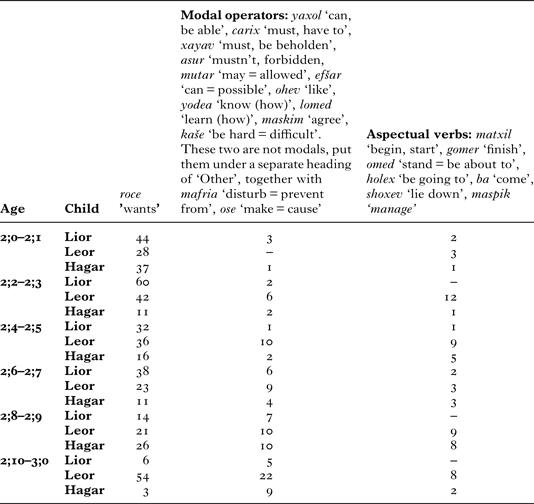
As background, note that V-V clause-internal ‘extended predicate’ constructions, as predicted, preceded the onset of syntactic clause-combining (categories #1 to #10) for the two girls (emerging at age 2;0·01 in Lior's speech output, and at 2;0·02 in Hagar's) and coincided with the first instances of CC for the boy Leor (age 2;0·05) – hence justifying the idea that they constitute ‘precursors’ to clause-combining complex syntax (Givón, Reference Givón2009; Limber, Reference Limber and Moore1973). They were also common throughout subsequent periods of analysis for all three children, with age-related development showing increased variety in the introducing verbs. They all started out with the ubiquitous roce ~ roca ‘want-Pres, Masc ~ Fem’, gradually adding modal operators like carix ‘must, have to’, yaxol ‘can, be able to’, and aspectual verbs like holex ‘be-going-to’, omed ‘stand = be about to’ – consistent with findings for lexico-semantic developments in analogous constructions in English and other languages (Diessel, Reference Diessel2004). Thus, for example, as detailed in Table B in the ‘Appendix’, between ages 2;0 to 2;3, occurrences of roce ~ roca came to 104 for Lior, 70 for Leor, and 48 for Hagar, as against 5 modal operators and 2 aspectual verbs for Lior, 6 and 15 respectively for Leor, and 13 and 2 respectively for Hagar; these proportions shift somewhat between ages 2;4 to 2;7, thus: roce ~ roca 70 for Lior, 44 for Leor, 37 for Hagar, as against 7 modal and 3 aspectual verbs for Lior, 19 and 9 respectively for Leor, 6 and 8 for Hagar; with a similar trend to higher, more varied occurrence of modal operators and aspectual verbs between ages 2;8 and 3;0.
The rest of this section details distributions of contingent clauses in relation to the ten categories of analysis outlined earlier. Table 2 presents the breakdown in raw figures of contingent clauses occurring in total clause-combining instances, that is, all strings with a main clause and at least one associated contingent clause (= CC environments) for the 12-month period analyzed for each child, for both autonomous and co-constructed CC from the onset of the first instances at age two years (see Table 1).
Total CC environments and number of contingent clauses in the period analyzed, by child

Table 2 shows that in the period analyzed for ‘emergent clause combining’, the two girls each produced around 400 and Leor over 600 instances of CC. The larger number of contingent clauses compared with total CC environments for each child reflects the fact that their CC outputs in many cases included strings of more than two clauses (e.g. kše-hayíti ktana, nasánu le-sávta Janet ve-hayíti be-kise šel Nican? ‘When I-was small, (we) drove to grandma Janet and I-was in Nican's chair?’ [Lior, 3;1·01]). The baseline for the findings presented below was thus the total number of contingent clauses produced by each child.
Striking similarities emerged for both the onset and the general developmental trajectory of the CC strings produced by the three children. Starting with emergence of CC at age two years (Table 1), all three displayed the same four developmental phases, defined by deployment of morpho-lexical connectives. The starting point of each developmental phase was specified by the first occurrence of a given type of CC, as follows: Phase I – a short period, starting with the emergence of V-V combinations and sporadic CC with no explicit marking by connectives; Phase II – starting with initial marking restricted to the two general purpose connectives – the basic coordinator ve- ‘and’ and the generic subordinator še- ‘that’; Phase III – marked by initial addition of other connectives, specifically the adversative coordinator aval ‘but’, the monolexemic subordinator ki ‘because’, and az ‘then’ or ‘so’, functioning as a coordinator or as an adverbial marker of purpose respectively; and Phase IV – initiated by emergence of complex adverbial conjunctions in the form of Preposition + še-, marking temporal (e.g. ad še- ‘until’, axarey še- ‘after’, lifney še- ‘before’) and other relations (e.g. biglal še- ‘because’, for reason, kdey še- ‘in order that, so that’, for purpose, kmo še- ‘like, as’, marking comparison). Table 3 shows the distribution of contingent clauses and V-V constructions for each child during each of these four phases.
Age range, total V-V constructions, and total contingent clauses [ctg] in each developmental phase, by child
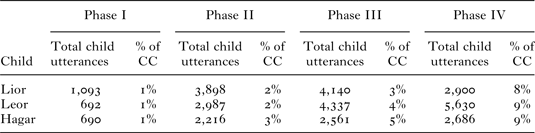
Table 3 reveals a consistent increase in amount of CC in the speech of all three children, with the four phases differing in length as follows for all three children: Phase I lasts a few weeks, Phase II around three months, Phase III around four months, while Phase IV continues for around half a year to the end of the period analyzed. In order to observe the weight of the multi-clausal usages against the total speech output, the proportion of CC instances out of the total number of child utterances is presented in Table 4.
Total number of utterances and percentage of CC instances* out of total utterances in each phase, by child
note: * Number of CC instances (multi-clausal constructions) is not necessarily the same as the number of total contingent clauses (Table 3) and is usually smaller, since a single CC instance may include two or more contingent clauses.
It appears that despite the differences in the size of their total speech output, the three children show a shared trend of increase in the proportion of multi-clausal constructions from each phase to the next.
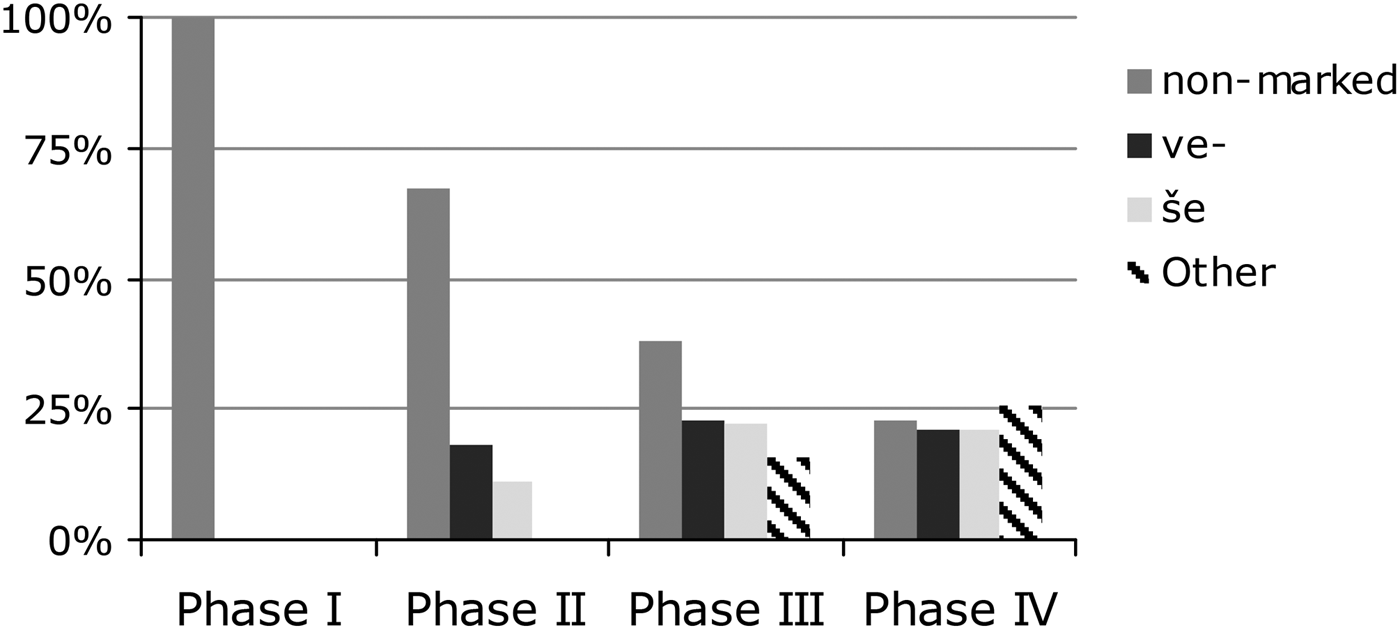
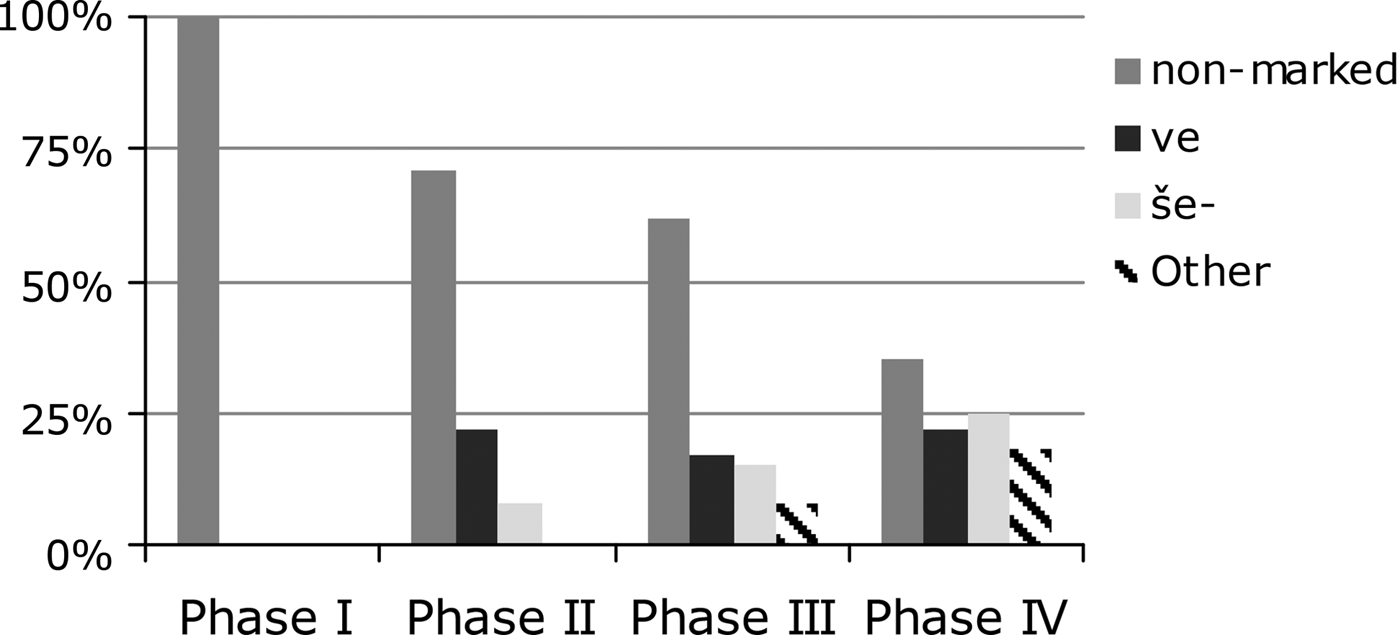
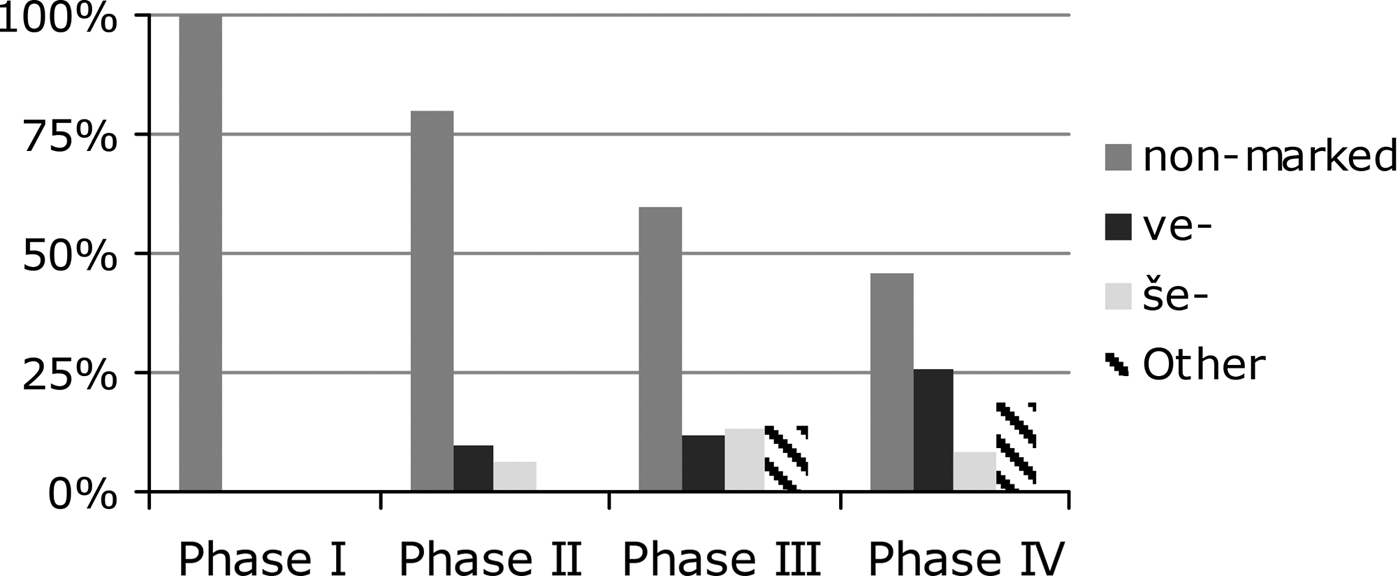
Figures 1a to 1c present the breakdown of four classes of CC markings out of total CC (both autonomous and co-constructed) produced by each child at each developmental phase, as follows. Non-marked: all CC constructions lacking an overt connective, including ungrammatical omissions (Category #7 above), as well as clause-types that do not require overt marking in adult usage (Imperative directives #1, Juxtaposed clauses #2, and Complements #4 not marked by še-: Direct-speech, Infinitival, and Embedded questions). Two main types of overt markers are specified in Figures 1a to 1c: the basic coordinating conjunctionve- ‘and’ (Category #3); the multi-functional subordinatorše-, including (i) conventional uses of še- – introducing Complements (Category #4) and Relative Clauses (#6); (ii) underspecified Adverbial clauses, mainly temporal and purpose, where še- is used instead of explicit kše- ‘when’ or kdey še- ‘so that, in order that’, respectively (#5); and (iii) vague and/or non-canonic ‘general purpose’ uses of še- (#9). The fourth category in Figures 1a to 1c, labeled Other, covers all remaining contingent clauses that were appropriately and explicitly marked by other connectives, including Coordinate clauses with aval ‘but’ and various Adverbial clauses.
Breakdown in percentages of clausal (non)-marking for Lior, by phase.
Breakdown in percentages of clausal (non)-marking for Leor, by phase.
Breakdown in percentages of clausal (non)-marking for Hagar, by phase.
Figures 1a to 1c reveal a shared developmental pattern, such that all three children show a gradual decrease in the proportion of non-marked CC constructions together with an increase in explicitly marked CC, with the latter becoming gradually more varied in Phase III. By Phase IV, non-marking of CC decreases by one quarter to half of the time to 22% (86/395) for Lior, 35% (221/640) for Leor, and 46% (192/417) for Hagar.
This is not to say that, by age 3 years, the children had mastered a full repertoire in marking of CC relations. Connectives that fail to occur in the speech of any of the three children in our sample include: the coordinator o ‘or’ and the adversative contradiction-marker ela ‘but’ (corresponding to German sondern) and formal ax ‘though, yet’, correlatives (e.g. o še- … o še- ‘either/or’, lo še- … lo še- ‘neither … nor’), higher register markers of reason (e.g. me'axar še-or mekevan še- ‘since, as, for’), and of time (e.g. bizman še- ‘while’, kol zman še- ‘as long as’), and also semantically and/or morphologically more complex markers of adverbial relations (e.g. concessive lamrot še- ‘(al)though’, afilu še- ‘even though’, beod še- ‘whereas’, degree kexol še- ‘as much as’, conditional ilu ‘hypothetical if’, bitnay še- ‘on-condition that’).
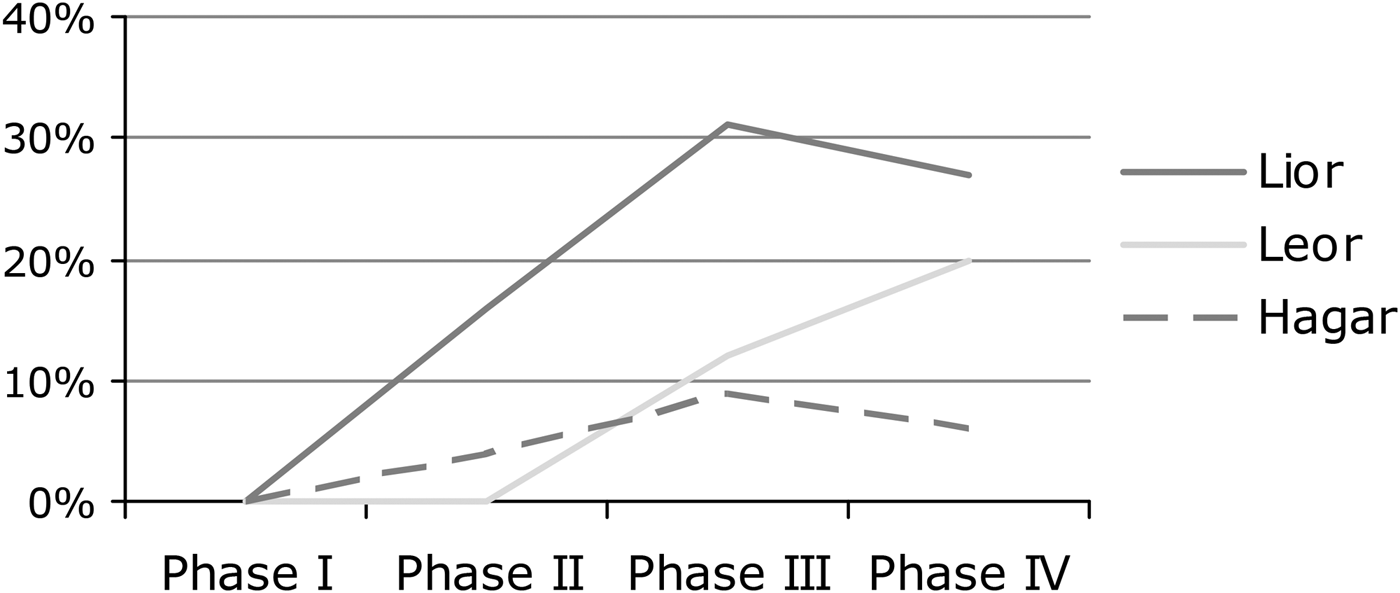
Another facet analyzed for acquisition of CC relations in the period under discussion compares the relative amount of contingent clauses produced by the children in Phases I to IV by context of CC production – co-constructed versus autonomous contingent clauses – as shown in Figure 2.
Proportions of interlocutor-supported co-constructions out of total contingent clauses for all children, by phase.
Figure 2 shows that there were no adult–child CC co-constructions at all in Phase I, while the proportion of contingent clauses produced in such environments rises between Phases II and III for all three children.
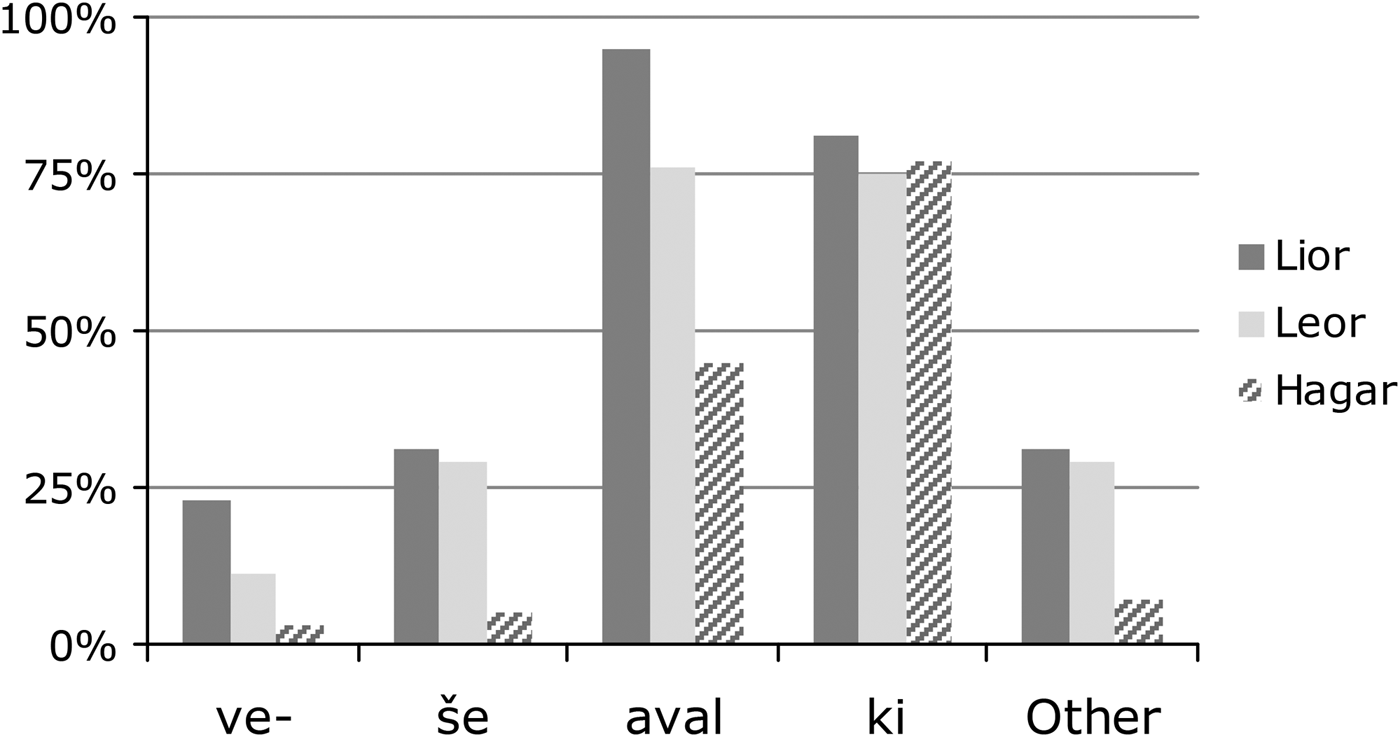
Another finding concerns the breakdown of connectors in relation to context of production of contingent clauses – interlocutor-supported or autonomous. This analysis took into account the four connectives that turned out to have the highest frequency in our database, as follows. Out of total clauses marked by an overt connective, the two most basic conjunctions – ve- ‘and’, še- ‘that’ – together accounted for well over half the forms used by all three children across the period of analysis (as high as 75% for Leor and around 60% for Lior and Hagar), with Leor and Lior using each of these two forms to much the same extent (30% to 40% each), whereas Hagar favored ve- considerably (45% of all her connectives) over še- (only 21%). Two more specific markers of coordination and subordination (adversative aval ’but’ and reason ki ‘because’, respectively) accounted for nearly 20% of all other markings for all three children, with the remaining connectives taking the form of az ‘so, then’ or of a few other more specific markings of sequential and adverbial relations. Figure 3 shows the breakdown of the four most common connectives in co-constructed as against autonomously produced contingent clauses for each child.
Proportions of interlocutor-supported contingent clauses out of total contingent clauses, by connectives, for each child.
Figure 3 reveals a clear, across-the-board difference in the frequency of connectives used in co-constructed contexts versus autonomous productions: the semantically more specific coordinate and subordinate markers aval ‘but’ and ki ‘because’ were significantly more favored in co-constructed contexts, whereas their basic, general purpose counterparts ve- ‘and’ and še- ‘that’ occurred mainly in contingent clauses produced autonomously. A chi-squared test revealed that these differences in proportion of occurrence in interlocutor-supported contexts are significant for each of the three children (Lior: χ2(4, N = 399) = 114·95, p < .001; Leor: χ2(4, N = 490) = 120·61, p < .001; and Hagar: χ2(4, N = 290) = 132·96, p < .001).
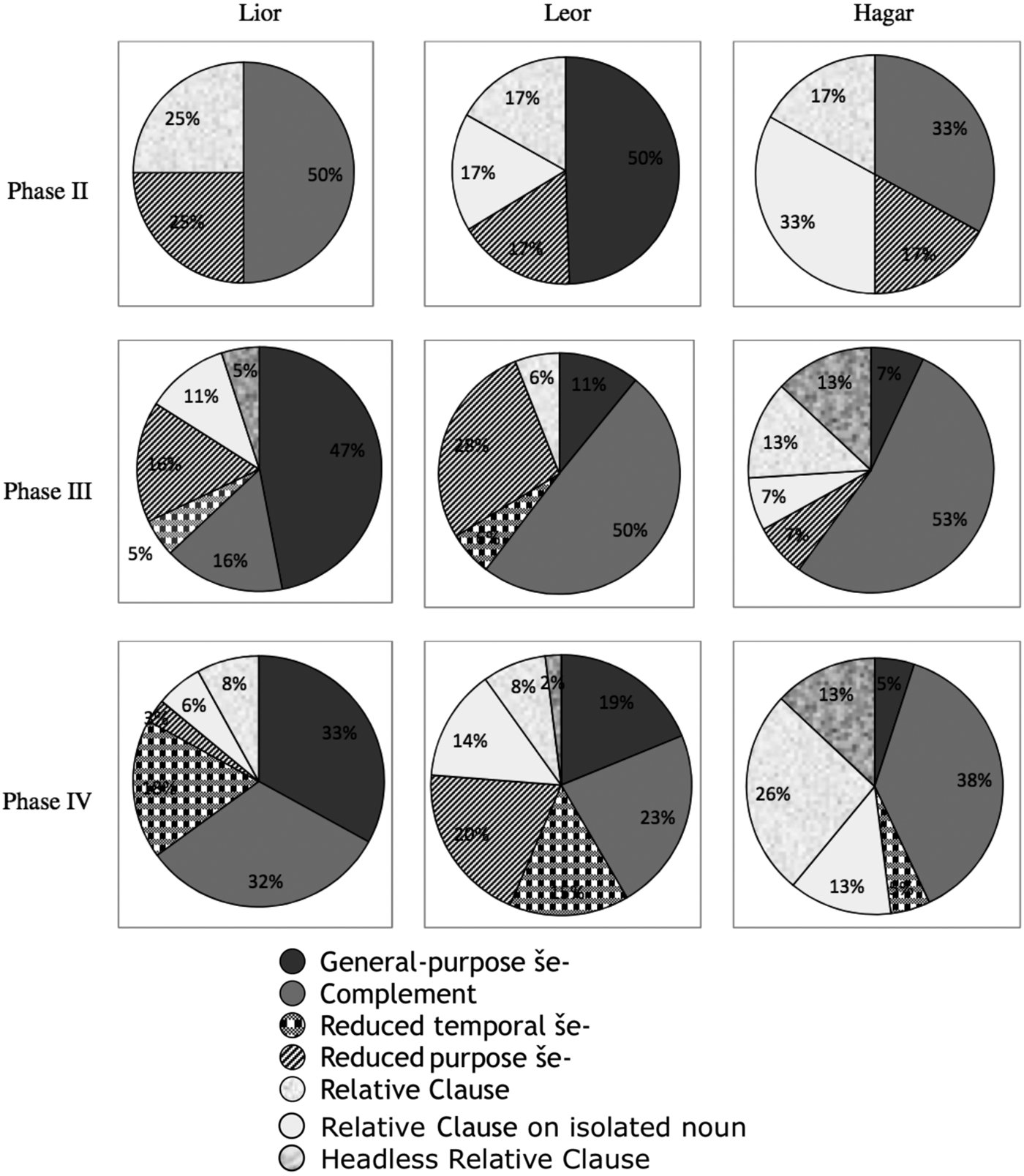
The next finding, depicted graphically in Figure 4, shows the breakdown of uses of the ubiquitous subordinator še- in autonomously produced, child-initiated contingent clauses. This analysis is confined to še-, as a multi-functional marker of different types of syntactic constructions (Complements, Relatives, and Adverbials), in contrast to ve-, whose only clause-combining function in Hebrew as in other languages is to link two or more clauses in a syntactic relation of coordination. Thus, as shown in the key to Figure 4, še- serves to express various types of inter-clausal contingencies, as follows: Complements (CMP), Adverbials – mainly of Time and Purpose (ADV:TMP, ADV:PUR) – and Relatives, modifying clause-internal or isolated noun phrases (RC, RC:NC) or Headless (RC:H), and also childlike vague, ambiguous General Purpose clauses (GPS). The diagrams in Figure 4 present uses of še- from its first occurrence in Phase II (see Figures 1a to 1c).
Breakdown (in percentages) of syntactic functions of še- out of all occurences of še- in autonomously produced contingent clauses in phases II to IV, by child.
The pie diagrams in Figure 4 show the following developmental trajectory: Phase II, with the start of overt marking of CC, reflects initial reliance of all three children on the two general-purpose most pervasive connectives ve- and še- (see Figure 1). From Phase III, along with extension of forms – reflected in the use of additional connectives – mostly aval ‘but’, ki ‘because‘, az ‘ so’, and mainly in interactive contexts (Figures 1 and 3, respectively) – children also use še- for a variety of different functions in the contingent clauses which they produce autonomously. Phase IV shows greater lexico-semantic variety in more explicit marking of different types of Adverbial clauses, with ‘bare’ še- increasingly confined to Complement and Relative clauses.
DISCUSSION
The study aimed at characterizing the development of early clause-combining (CC) complex syntax by Hebrew-speaking toddlers, taking as our starting point the view that CC functions as a means of topic elaboration. To this end, we compared types of non-marking and use of connectives introducing clauses contingent on a main clause to which they are juxtaposed, conjoined, or subordinated. These were broken down into a detailed, partially innovative set of syntactic categories (seven adultlike and three specific to children's usage), defined for our database by all instances of CC environments for each of the three children in the sample. Analysis also took into account how relevant relations between linguistic forms (lexical connectives) and functions (types of CC contingencies) were expressed in interlocutor-supported co-constructions compared with autonomous child-initiated productions of CC.
Results both confirmed and went beyond our predictions. First, the finding that initial CC emerged at two years of age for all three children is consistent with earlier studies showing that this period marks the ‘the onset of complex syntax’ (Bowerman, Reference Bowerman, Fletcher and Garman1979; Clark Reference Clark2009, pp. 229–253; Diessel, Reference Diessel2004 – for English; Dromi & Berman Reference Dromi and Berman1986 – for Hebrew; Sekali, Reference Sekali2012 – for French). Our analysis further demonstrates that, prior to overt marking of clause-combining relations, children relied on various ‘precursors’, primarily in the form of clause-internal V-V extended predicates and non-marking of inter-clausal relations, by such means as directive (‘serial verb’) or juxtaposed constructions. Second, findings revealed a developmental path via four phases shared by the three children from early precursors to initial emergence and subsequent elaboration of CC marking (Figure 1a to 1c). Third, CC development manifested a consistent elaboration of form–function relations, such that, in fact, new forms – the coordinating aval ‘but’ and subordinating ki ‘because’ – were added to the two basic conjunctions ve- ‘and’ and še- ‘that’ in the context of interlocutor-supported co-constructions (Figure 3), while, with age, the earlier acquired multi-functional operator še- ‘that’ served an increasing range of syntactic and semantic functions in autonomously produced contingent clauses (Figure 4). The study thus sheds new light on a form–function approach to language acquisition and development to the effect that, with age, previously acquired functions – here, CC connectivity – are marked by new forms while, concurrently, earlier acquired forms – here, the subordinator še- ‘that’ – come to serve new functions.
Another, unpredicted facet of form–function interrelations in early CC complex syntax is revealed by the transition from Phase II to Phase III for all three children in two apparently unrelated areas. On the one hand, interlocutor-supported productions – totally absent at the initial Phase I – increase markedly for all three children between Phase II and III (Figure 2). Not only is adult–child co-construction by no means confined to initial CC, it in fact increases with age, even for Hagar, who in general was given very little child-directed input, and used mainly autonomous CC constructions from the start. That is, such co-construction does not disappear with age, but appears to be a general feature of interactive conversational usage, one which, in the context of clause-combining processes, provides children with a basis for extending their initial reliance on the pervasive, basic markers ve- ‘and’ and še ‘that’ to the semantically more specific aval ‘but’ and ki ‘because’. On the other hand, concurrently with the increase in co-constructed CC, the transition from Phase II to Phase III also reveals an upsurge in the functional variation of the basic, general-purpose subordinating conjunction še- in autonomously produced, child-initiated CC (Figure 4). This temporal overlap in different facets of developing CC form–function relations reflects both typologically motivated as well as more general properties of child language acquisition, as discussed below.
The four phases observed for all three children delineate a developmental trajectory from non-marked CC constructions (Phase I) to restricted marking by the two most basic, morphologically simplex connectives (Phase II), gradually extended by adding more monomorphemic connectives to their CC repertoire (Phase III), subsequently by complex connectives expressing more varied and specific functions (Phase IV). Development of connective use in early Hebrew CC can thus be seen as reflecting a general progression from non-specification to under-specification and on to fully elaborated marking of grammatical categories previously noted for different facets of acquisition of simple clause structure in Hebrew (Berman, Reference Berman and Levy1993; Lustigman, Reference Lustigman2013a) and other languages (Gathercole, Sebastián & Soto, Reference Gathercole, Sebastián and Soto1999; Pizzuto & Caselli, Reference Pizzuto, Caselli and Levy1994; Veneziano & Sinclair, Reference Veneziano and Sinclair2000). Further, the phase-based path revealed here for CC connective marking reflects progression in both structural and functional specificity, with increasing complexity of form (from simplex to complex connectives) accompanied by increased specificity of function (from pervasive uses of ve- and še- via more specific, monolexemic aval and ki to semantically more explicit markers of adverbial relations).
Realization of these shared patterns in development of grammatical distinctions is, in general, critically dependent on ambient language typology (Slobin, Reference Slobin, Wanner and Gleitman1982, Reference Slobin, Strömqvist and Verhoeven2004). In the case in point, the phases identified here in acquisition of CC relate directly the Hebrew-specific multi-functionality of še-: it provides an effective, readily available jumping-off point for the early and concurrent emergence of subordinating CC together with coordinating ve-, supported throughout by continued reliance on its overuse as a vague, ‘general purpose’ marker of functionally non-specific contingent clauses (Figure 4); as a bare form standing alone, it constitutes an early, and canonically conventional means of introducing Complement and Relative clauses – analogously to English that or French que-; and it is subsequently elaborated in marking Adverbial contingencies by complex Preposition + še- conjunctions like ad še- ‘until’ and kdey še- ‘so that’, reflecting development in lexical forms expressing new semantic notions.
As multi-functional forms, the conjunctions ve- and še- in Hebrew are good candidates for functioning as transitional, bridging categories in initial marking of inter-clausal relations in Phase II (Lustigman, Reference Lustigman2013a). In Hebrew, as in other languages, the pervasive coordinator ve- ‘and’ serves a variety of non-CC functions from very early on, in clause-internal phrasal conjunction and as an utterance-initial discourse marker in interactive and narrative contexts (Berman, Reference Berman, Slobin, Gerhardt, Kyratzis and Guo1996), while še-, as noted above, plays a unique role in developing subordination. And, like their counterparts in other languages, the morphemes ‘and’ and ‘that’ are generally pervasive beyond early child CC. For example, they were among the three lexical items with highest frequency in Hebrew and other languages in large samples of narrative and expository texts produced by schoolchildren, adolescents, and adults – far outranking other connectives like az ‘so, then’, aval ‘but’, ki ‘because’, and kše- ‘when’ (Strömqvist, Johansson, Kriz, Ragnarsdóttir & Ravid, Reference Strömqvist, Johansson, Kriz, Ragnarsdóttir and Ravid2002). This pervasiveness of ve- and še- was directly reflected in the speech output of the three toddlers considered here, since they together accounted for well over half the forms used by all three children across the period of analysis, two of whom used both ve- and še- around the same amount (30% to 40% each out of all their connectives), whereas Hagar favored ve- (45% versus 21% še-). This finding is also in line with those of previous studies showing that coordination and subordination emerge concurrently and not sequentially in children's early CC productions (Limber, Reference Limber and Moore1973).
The subordinator še- was selected as the focus for analysis of syntactic functions of CC in the preceding section for several reasons. First, unlike the case of that and its counterparts in other languages, development in the semantic and discursive functions of and and its equivalents in different languages, including Hebrew, has been detailed in numerous prior studies (e.g. Ardery, Reference Ardery1979; Berman, Reference Berman, Slobin, Gerhardt, Kyratzis and Guo1996; Jisa, Reference Jisa1987; Lust & Y-Chien, Reference Lust and Y-Chien1984; Peterson & McCabe, Reference Peterson and McCabe1987; Tager-Flusberg, de Villiers & Hakuta, Reference Tager-Flusberg, de Villiers, Hakuta and Kuczaj1982). Second, ve- occurs in child language in intra-clausal coordination well before it is used for clause-combining, whereas še- functions only inter-clausally and not for phrasal conjunction. Moreover, ve-, again like its counterparts in other languages, serves only for coordination, whereas še- functions in a range of subordinating clauses – Complement, Relative, and Adverbials. Besides, an attempt to trace development in uses of syntactic subcategories of ve- in the present sample – by comparing occurrence of contingent clauses with different versus same subjects as the antecedent main clauses – failed to reveal clear-cut developments across the three children: Lior used far more different subjects at first, replaced subsequently largely by same-subject coordination; unlike both Leor and Hagar, who started out by preferring to coordinate two clauses with a shared subject. Moreover, same-subject elision in the contingent coordinate clause, reflecting a particularly tight form of cohesion favored in accepted Hebrew style, was rare in the usage of all three children, consolidating mainly at later preschool age (Berman, Reference Berman1990; Berman & Nir, Reference Berman, Nir, Guo, Lieven, Ervin-Tripp, Budwig, Özçalişkan and Nakamura2009; Berman & Slobin, Reference Aksu-Koç, von Stutterheim, Berman and Slobin1994, p. 540).
On the other hand, functions of that and its equivalents, while a key issue in general linguistics (e.g. Dor, Reference Dor2005) and clearly reviewed in an early Hebrew-based study by Ariel (Reference Ariel1978) have as far as we know not previously been analyzed for child language. In Hebrew, the special status of both ve- and še- as closed-class morphemes is expressed orthographically, since they are the only two conjunctions out of the seven morphemes (with the definite marker ha- and four basic prepositions) written as prefixed to the following word, corresponding to separate words in European languages (Ravid, Reference Ravid2012). Moreover, simplex monomorphemic connectives like ve- and še-, and their more specific counterparts aval ‘but’, ki ‘because’, are the exception rather than the rule (along with the conditional conjunctions im ‘if’, which was rare in our sample) in Hebrew. Thus, while ‘bare’ še-, as noted, is a required marker of (non-question) Complements and Relative clauses, Adverbial clauses generally require complex conjunctions formed by lexically fused combinations of preposition + še-. Compare the prepositional phrases with their clausal counterparts in (5):
- (5)
a. hu baxa biglal ha-peca ~ hu baxa biglal še—nifca
‘He cried because-of the-wound ~ he cried because he got-hurt’
b. hu xika ad ha-aruxa ~ hu xikaad še- yoxlu
‘He waited until the-meal ~ he waited until they'd eat’
c. hu higia lifney ha-msiba ~ hu higia lifney še– ha-msiba hitxila
‘He arrived before the party ~ He arrived before the party began’
d. hu caxak lamrot ha-ke'ev ~ hu caxak lamrot še-ka'av
‘He laughed in spite of the-pain ~ he laughed even though (it) hurt’
Written with a space between the preposition and its associated še-, these subordinating conjunctions are analogous to complex prepositions in Hebrew and other languages (Hoffman, 2005; Nir & Berman, Reference Nir and Berman2010b; Saint-Dizier, Reference Saint-Dizier2006). In this, they contrast with the fused conjunction kše- ‘when’, an abbreviated form of the synonymous, high-register form ka-ašer ‘when-that’. The form kše- was rare in our database, replaced across-the-board by bare še-, as is common in current colloquial adult usage, too. In this, children's usage reflects a more general trend in the language, where bare še- has shifted from marking Complement and Relative clauses to the early-acquired high-frequency ‘when’ of Temporal Adverbials (Ariel, Reference Ariel1978; Aksu-Koç & von Stutterheim, Reference Aksu-Koç, von Stutterheim, Berman and Slobin1994). These findings are in line with earlier studies on acquisition of closed-class lexical items that demonstrate elaboration beyond early preschool age in use of prepositions in Hebrew and other languages (Berman, Reference Berman and Bavin2009; Berman & Neeman, Reference Berman, Neeman, Berman and Slobin1994). And it is consistent with another, to be expected, finding of our study noted in the preceding section, that young preschool children in general fail to use high-register closed-class items, not only prepositions, but also conjunctions.
Beyond exclusive reliance on ve- and še- in Phase II (Figures 1a to 1c), the transition to more advanced and varied connective usage is accompanied by an increase in reliance on interlocutor-supported contexts (Figure 2). Interestingly, the commonest non-basic connectives, aval ‘but’ and ki ‘because’, turned out to occur across the board at significantly higher rates in such co-constructed contexts than in autonomously produced contingent clauses, in contrast to ve- and še- (Figure 3). That is, interactive settings appear to trigger expansion of CC form–function relations, since they provide explicit environments for expressing adversative and causative functions not yet cognitively available for autonomous production at this level of development. The form ki – like its English counterpart because ~ cos – is generally dependent on why-questions in early child language, as in the Hebrew example in (3) above, while the interlocutor-based initial use of aval is consistent with early occurrences of English but as well (Diessel, Reference Diessel2004). The fact that in our sample ki initially never occurs in autonomously produced CC strings (throughout Phases III and most of Phase IV) may be attributed to the cognitive load of formulating both cause and effect in a single multi-clausal string. Relatedly, use of aval, although not directly triggered by the structure of the input clause, also poses a more cognitively challenging task in autonomous CC production, since it requires ahead-of-time planning in order to contradict (part of) the proposition asserted in the first clause by means of the second, contingent clause. By providing the topic of the first CC clause, interlocutor-supported contexts enable children at this developmental stage to use these two connectives to give syntactic expression to the semantic functions of reason and adversity that might otherwise emerge later in their autonomous speech output – as found for the narrative productions of three- to four-year-old Hebrew-speaking children (Berman & Neeman, Reference Berman, Neeman, Berman and Slobin1994).
In addition to contributing to the expansion of children's repertoire of connectives, the upsurge in interlocutor-supported CC shows an unexpected temporal overlap with broadening in the syntactic functions of children's autonomous production of še- (Figures 2 and 4). That is, children begin using a more varied array of input-supported connectives at the same time as they begin adding more syntactic functions to their autonomous use of še-. This phenomenon does not appear to be Hebrew-specific. The precedence of reason adverbial clauses in co-construction contexts rather than in self-initiated CC has also been documented for German, Dutch, and English (Evers-Vermul, Reference Evers-Vermul2005; van Veen, Reference van Veen2011; van Veen, Evers-Vermuel, Sanders & van den Bergh, Reference van Veen, Evers-Vermuel, Sanders, van den Bergh, Gruber and Redeker2014), where it is attributed to the conceptual complexity of reason adverbials. Bloom's (Reference Bloom1991) study on the acquisition of English points to similar trends for both causal and adversative CC functions. Although she does not attribute adult–child interaction a central role in the acquisition of early complex sentences, Bloom does note that adult–child co-constructions (what she termed ‘reciprocity in discourse’) are observed mainly in CC instances expressing causality and adversative relations, while other types of contingency are expressed by self-initiated CC instances (‘child–child cohesion’). This concurrent expansion of syntactic functions in two mutually exclusive interactive contexts indicates that, although the two types of settings trigger different types of form–function developments, these progressions occur in parallel, possibly feeding into each other. In other words, the cognitive advancement and flexibility afforded children by expansion in one area of their CC capacities (say, in adversative and causative constructions) is pervasive, affecting other domains of connectivity use as well.
In sum, development in use of linguistic forms for CC as in other domains of the grammar shifts from non-specification without connectives via under-specification by vague or non-explicit uses of one or two favored connectives and on to adult-like specification of form–function relations by varied connective conjunctions. In function, too, marking of CC relations reflects more general developmental trends, from initial vague or restricted functions of a given form to more explicit usages and on to forms expressing such abstract concepts as adversativity, concession, or exception. The multi-faceted analysis undertaken in this study underscores the interplay between these shared patterns in acquisition of form–function relations and the interconnectedness of ambient-language typology with interlocutor-supported versus child-initiated constructions to characterize early clause-combining in Hebrew as in other languages.
Appendix
Distribution of extended predicates (ext) and contingent clauses in the speech of the mother of each child during a single recording session, by contingent clause type (juxtaposed = MCJ; directive = DRC; complement = CMP; coordinate = CO; adverbial = ADV; sentential subject = SBJ; relative clause = RC; adverbial coordination = ADVC; and noun complement = NCMP)

Distribution of V-V introducing verb types (roce/modal/aspectual) used by the three children, by two-month intervals