Introduction
The well-replicated association between ethnic minority position and psychotic disorder is thought to reflect the impact of environmental factors (Van Os et al. Reference Van Os, Kenis and Rutten2010). The specific environmental elements remain unknown, but may involve social stress. Ethnic minorities are more often exposed to socio-economic disadvantage and experience of social exclusion, social defeat and discrimination, factors that have been suggested to mediate the association with psychotic outcomes (Selten & Cantor-Graae, Reference Cantor-Graae and Selten2005; Morgan et al. Reference Morgan, Charalambides, Hutchinson and Murray2010). If stress related to minority position mediates risk for psychosis, similar associations probably apply to other social minority groups, including sexual minorities. Lesbian, gay and bisexual (LGB) individuals more often report mental health problems than heterosexuals, including suicidal ideation, depression, anxiety, substance use and eating disorders (for recent meta-analyses, see King et al. Reference King, Semlyen, Tai, Killaspy, Osborn, Popelyuk and Nazareth2008; Marshal et al. Reference Marshal, Friedman, Stall, King, Miles, Gold, Bukstein and Morse2008). In The Netherlands, where attitudes towards homosexuality comparatively are most positive among European countries (Keuzenkamp, Reference Keuzenkamp2011), homosexual men, compared with their heterosexual counterparts, were three times more likely to present with depression or anxiety disorder (Sandfort et al. Reference Sandfort, De Graaf, Bijl and Schnabel2001), and up to 10 times more likely to have suicidal thoughts and behaviour (De Graaf et al. Reference De Graaf, Sandfort and Ten Have2006). To the authors' knowledge, only two studies have examined the association between sexual orientation and psychosis. General population surveys in the UK and the USA reported that people who were attracted to their own gender, who indicated ever having had a same-sex partner or who self-identified as a sexual minority, had three to four times higher odds of probable psychosis than heterosexual respondents (Bolton & Sareen, Reference Bolton and Sareen2011; Chakraborty et al. Reference Chakraborty, McManus, Brugha, Bebbington and King2011). These studies did not explore what factors may underlie the association.
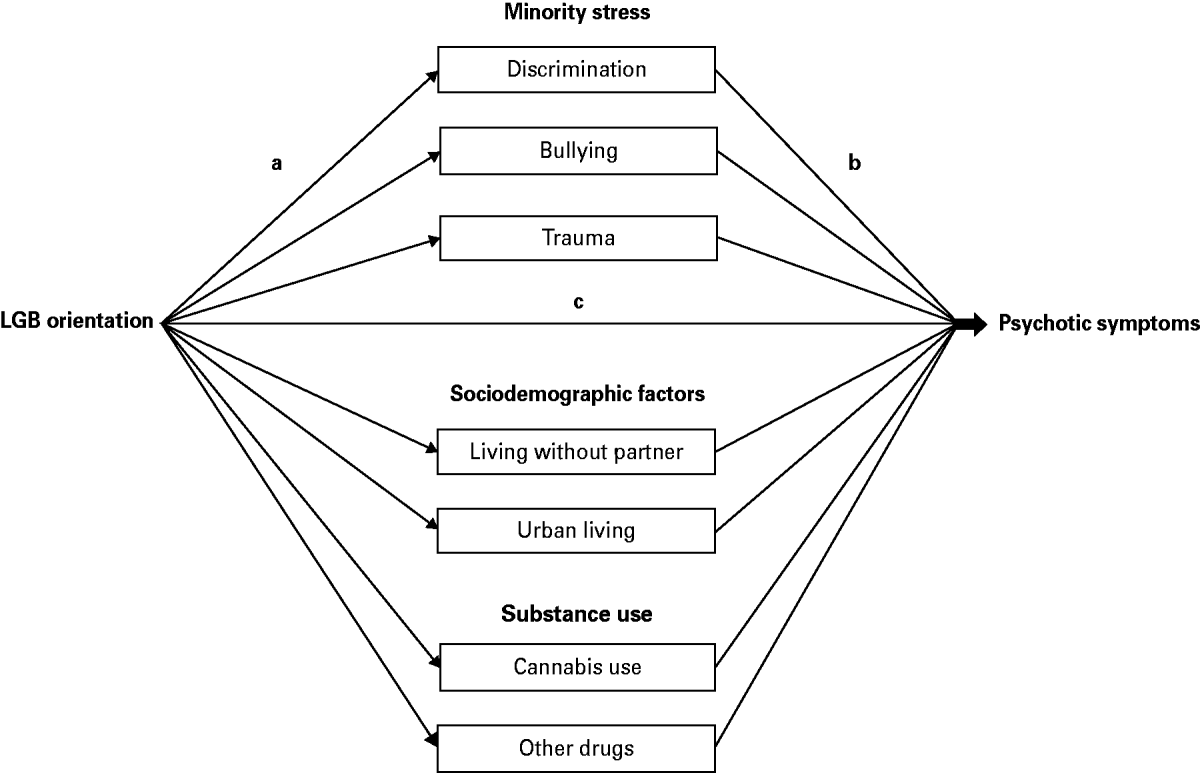
The minority stress model (Meyer, Reference Meyer1995, Reference Meyer2003) offers an explanatory framework for how sexual minority status is associated with mental health problems. It identifies several types of minority stress, including experiences of victimization, such as trauma, bullying, discrimination and rejection. These experiences may mediate the association between sexual minority status and mental health problems. The model further suggests that having a positive minority identity and finding support in the minority community can moderate the effects of stress on mental health. Several studies in LGB populations provide evidence in support of elements of the minority stress model, showing, for example, an association between discrimination and suicidality (De Graaf et al. Reference De Graaf, Sandfort and Ten Have2006), and between childhood maltreatment and depression (Zietsch et al. Reference Zietsch, Verweij, Heath, Madden, Martin, Nelson and Lynskey2012). Also, LGBs more often report childhood trauma than heterosexuals (Sandfort et al. Reference Sandfort, De Graaf and Bijl2003). During childhood and adolescence sexual identity is still under development. Those individuals who will later identify as LGB may in this developmental process display behaviour that causes them to be singled out and bullied by their peers, or misunderstood and maltreated by their parents. There is preliminary evidence for a dose–response relationship between victimization and mental health problems in adolescent and young adult LGBs (D'Augelli, Reference D'Augelli2002). None of the studies in this field, however, has investigated psychosis as an outcome. Minority stressors such as perceived discrimination (Janssen et al. Reference Janssen, Hanssen, Bak, Bijl, De Graaf, Vollebergh, McKenzie and Van Os2003), bullying (Lataster et al. Reference Lataster, van Os, Drukker, Henquet, Feron, Gunther and Myin-Germeys2006) and childhood trauma (Janssen et al. Reference Janssen, Krabbendam, Bak, Hanssen, Vollebergh, Graaf and Van Os2004) have been associated with psychosis in the general population. In the current study, these types of victimization experiences are examined together as a possible minority stress pathway in a model for explaining the association between non-heterosexual orientation and psychosis (see Fig. 1). While minority stress is of primary interest, two other possible pathways to psychosis are considered. Since LGBs are more likely to use drugs than heterosexuals (Marshal et al. Reference Marshal, Friedman, Stall, King, Miles, Gold, Bukstein and Morse2008) and since cannabis use (Moore et al. Reference Moore, Zammit, Lingford-Hughes, Barnes, Jones, Burke and Lewis2007) and other illicit drug use (Miller et al. Reference Miller, Lawrie, Hodges, Clafferty, Cosway and Johnstone2001) have been associated with psychosis risk, a substance abuse pathway is included in the model (Fig. 1). Furthermore, sociodemographic factors such as urban environment and single marital status, both associated with increased risk for psychosis (Kendler et al. Reference Kendler, Gallagher, Abelson and Kessler1996; Van Os et al. Reference Van Os, Hanssen, Bijl and Vollebergh2001), could be important. Homosexuality has long been associated with urban rather than rural environments (Aldrich, Reference Aldrich2004), and the presence of visible LGB communities as well as the possibility of living in relative anonymity make cities a more attractive place to live for LGBs (Annes & Redlin, Reference Annes and Redlin2012). Additionally, LGBs are less likely to live together with a partner than heterosexuals, and same-sex marriages are not permitted in most countries. Therefore these factors may jointly be considered as a sociodemographic pathway to psychosis (Fig. 1).
Possible pathways by which non-heterosexual orientation can lead to psychotic symptoms. Central boxes represent possible mediators of the association between lesbian, gay and bisexual (LGB) orientation and psychotic symptoms, split in three different pathways. Arrows marked with letters (a, b, c) represent the different parameters tested in a mediation analysis. Parameter c' is not represented by an arrow in the figure.

Clinicians distinguish between psychotic symptoms, which are prevalent in the general population and often present without need for care, and psychotic disorder, which requires care. Although psychotic symptoms are often transient and lack clinical relevance, psychotic symptoms are an indicator of more severe psychopathology (van Os et al. Reference Van Os, Verdoux, Maurice-Tison, Gay, Liraud, Salamon and Bourgeois1999; Hanssen et al. Reference Hanssen, Peeters, Krabbendam, Radstake, Verdoux and Van Os2003; Perlis et al. Reference Perlis, Uher, Ostacher, Goldberg, Trivedi, Rush and Fava2011) and meta-analytic work indicates that they do constitute a risk factor for developing psychotic disorder and other severe mental illness (Kaymaz et al. Reference Kaymaz, Drukker, Lieb, Wittchen, Werbeloff, Weiser, Lataster and Van Os2012).
The aim of this study is to examine whether sexual minorities are at increased risk of developing psychotic symptoms and, if this proves to be the case, to explore the contribution of the minority stress, substance use and sociodemographic pathways. It is predicted that, in two large independent general population samples in The Netherlands, past-year homosexual behaviour and self-reported same-sex attraction are both associated with lifetime experience of psychotic symptoms. Furthermore, this association will be mediated by minority stressors such as perceived discrimination, bullying and trauma. It is expected that minority stress mediates more of the association between sexual orientation and psychosis than either the sociodemographic or the substance use pathway.
Methods
Sample
Data were acquired from the baseline measurements of both Netherlands Mental Health Survey and Incidence Studies (NEMESIS), two longitudinal studies focusing on the incidence, prevalence, course and consequences of mental health problems in the general population. Baseline data were collected in 1996 for NEMESIS-1 (hereafter referred to as Study 1) and in 2007-2009 for its successor (NEMESIS-2, hereafter referred to as Study 2). Individuals between 18 and 64 years, who had sufficient mastery of the Dutch language, were contacted on the basis of a stratified random sampling procedure, which was designed to generate a representative sample of the Dutch adult population. The response rate for Study 1 was 69.7% and for Study 2 65.1% of the selected sample, resulting in, respectively, 7075 and 6646 participating subjects. Young people and ethnic minorities were somewhat under-represented (Bijl et al. Reference Bijl, Van Zessen, Ravelli, De Rijk and Langendoen1998; de Graaf et al. Reference De Graaf, Ten Have and Van Dorsselaer2010, Reference De Graaf, Ten Have, Van Gool and Van Dorsselaer2012). For details on the sampling procedure, representativeness, instruments and statistical methods, see the respective baseline publications of Study 1 (Bijl et al. Reference Bijl, Van Zessen, Ravelli, De Rijk and Langendoen1998) and Study 2 (De Graaf et al. Reference De Graaf, Ten Have and Van Dorsselaer2010, Reference De Graaf, Ten Have, Van Gool and Van Dorsselaer2012).
Instruments
Composite International Diagnostic Interview (CIDI)
All subjects were interviewed with the lifetime version of the CIDI (Dutch version, Study 1: version 1.1, Study 2: version 3.0), a comprehensive, standardized diagnostic interview originally developed by the World Health Organization (Robins et al. Reference Robins, Wing, Wittchen, Helzer, Babor, Burke, Farmer, Jablenski, Pickens and Regier1988; World Health Organization, 1990). The CIDI has been found to show good inter-rater reliability (Cottler et al. Reference Cottler, Robins, Grant, Blaine, Towle, Wittchen and Sartorius1991; Wittchen et al. Reference Wittchen, Robins, Cottler, Sartorius, Burke and Regier1991) and test–retest reliability (Wittchen, Reference Wittchen1994). The CIDI is designed to be administered by trained interviewers who are not trained as clinicians.
Sexual orientation
Participants were classified as either heterosexual or LGB using two different criteria. The primary classification was based on sexual behaviour, while the second classification was based on same-sex attraction. Since the CIDI does not include a section on sexuality, data came from an additional questionnaire administered after the CIDI interview.
For classification based on sexual behaviour, participants were asked if they had sexual contact (defined as at least touching the genitals of another person) in the preceding year, and about the gender of their partner(s). Conforming to previous work in this sample (Sandfort et al. Reference Sandfort, De Graaf, Bijl and Schnabel2001), participants who reported sexual contact with at least one same-sex partner in the preceding year were categorized as LGB, regardless of any additional heterosexual contacts. All other sexually active participants were categorized as heterosexual. Since respondents who did not have sex in the preceding year could not be classified, analyses based on behaviour were restricted to the sexually active subpopulation.
Of the initial 7075 participants in Study 1, 30 did not answer questions regarding sexual behaviour. Of the remaining 7045 participants, 85.2% reported sexual activity in the preceding year. Men were slightly more often sexually active than women (87.6% v. 83.1%). Of the 6002 participants reporting sexual activity, five could not be classified as heterosexual or LGB because of missing data. Another 70 participants could not be included in the analyses because of missing data on other predictors. The analyses thus were conducted on the remaining 5927 participants, among whom 2.7% of men were homosexually active (n = 76) and 1.3% of women (n = 39).
Of the initial 6646 participants in Study 2, 279 did not answer questions regarding sexual behaviour. Of the remaining 6367 participants, 83.7% reported sexual activity in the preceding year. Men were marginally more often sexually active than women (85.4% v. 82.4%). Of the 5331 participants reporting sexual activity, three could not be classified as heterosexual or LGB because of missing data. Another 28 participants could not be included in the analyses because of missing data on other predictors. The analyses thus were conducted on the remaining 5300 participants, among whom 2.4% of men were homosexually active (n = 58) and 2.0% of women (n = 56).
In Study 2 only, an additional questionnaire with questions on sexual attraction followed those on sexual behaviour. Respondents were asked to indicate whether they were sexually attracted to women only, predominantly to women, equally to women and men, predominantly to men, or to men only. Respondents who were equally, predominantly or only attracted to their own gender were classified as being LGB, while the remainder were classified as heterosexual. The correlation between homosexual behaviour and same-sex attraction in the sexually active subpopulation was strong (r = 0.81, p < 0.0001).
Psychotic symptoms
The psychosis section (G-section CIDI 1.1) of the CIDI contains questions on four types of hallucinations (visual, auditory, haptic, olfactory) and 13 types of delusions (e.g. being spied upon, can read thoughts, influenced by a strange force). As the psychosis section included in CIDI 3.0 was less comprehensive, it was replaced by a psychosis add-on instrument based on the original G-section. This instrument retained the original 17 psychotic experiences and added three more. In order to maintain a consistent outcome variable over Study 1 and Study 2, the new items were ignored in the current analyses. Each of the 17 items was coded as either: (1) not present; (2) psychotic symptom present but not clinically relevant (no impairment or help-seeking); (3) psychotic symptom resulting from drug use; (4) symptom is the result of somatic disease; (5) true psychotic symptom; or (6) interviewer is uncertain because there appears to be a plausible explanation for the reported symptom. In Study 1, clinical re-interviews were conducted over the telephone by an experienced resident in psychiatry for all individuals who had at least one rating of 5 or 6, using questions from the Structured Clinical Interview for DSM-III-R (SCID), an instrument with proven reliability and validity in diagnosing schizophrenia (Bak et al. Reference Bak, Delespaul, Hanssen, De Graaf, Vollebergh and Van Os2003). In Study 2, all individuals who endorsed at least one lifetime psychotic experience, regardless of cause or severity, were approached for a clinical re-interview (Van Nierop et al. Reference Van Nierop, van Os, Gunther, Myin-Germeys, de Graaf, ten Have, van Dorsselaer, Bak and van Winkel2012). Again, interviews were conducted over the telephone by an experienced clinician, either at the level of psychologist or psychiatrist, now using questions from SCID-I for DSM-IV. The CIDI ratings in both studies were revised on the basis of these clinical interviews. In cases of non-response to the re-interview (Study 1 25.9%; Study 2: 26.0%), the original CIDI rating was used. As the different ratings for the presence of psychotic symptoms were shown to underlie a single psychotic symptom construct (Van Os et al. Reference Van Os, Hanssen, Bijl and Ravelli2000), they were combined into a single rating. Thus, if any of the psychosis items on the interview was rated as present (value > 1), the participant was categorized as having, or having had, psychotic experiences (1), otherwise a rating of ‘no psychotic experience’ (0) applied. To allow for sensitivity analyses on clinical outcomes, respondents were additionally rated as either likely (1) or not likely (0) to meet the criteria for a clinical diagnosis of non-affective psychotic disorder, based on CIDI-generated diagnoses and the re-interview.
Minority stress
Three different dichotomous measures of minority stress were used: discrimination in Study 1, bullying in Study 2, and childhood trauma in both studies. These were hypothesized to represent a minority stress pathway to psychosis, which is depicted in Fig. 1. Discrimination was rated as present when participants answered ‘yes’ when they were asked if they had experienced any discrimination over the past year because of their sexual orientation. Bullying was rated as present when participants answered ‘yes’ when they were asked if they had been bullied regularly before the age of 16 years. Trauma was assessed using a semi-structured interview on whether participants had experienced any kind of emotional, physical, psychological or sexual trauma before the age of 16 years. When respondents reported any kind of trauma they then indicated the frequency of the traumatic experience on a six-point scale. Conforming to previous work in this sample (Janssen et al. Reference Janssen, Krabbendam, Bak, Hanssen, Vollebergh, Graaf and Van Os2004), trauma was rated as present if any type of trauma had occurred regularly, often or very often.
Substance use and sociodemographic measures
A dichotomous variable was created for both lifetime cannabis use, and other drug use, which included amphetamine, cocaine, ecstasy, angel dust, opiates, glue or other drugs of abuse. Urbanicity of current residence was also classified dichotomously: rural (the 20% of the country with the lowest address density), and urban. A proxy variable for single status was created by classifying respondents according to whether they were living without a partner.
Statistical analyses
All analyses were carried out using Stata version 11.0 (StataCorp LP, USA). Logistic regression procedures were applied with past-year same-sex behaviour and same-sex attraction as the independent variables and any psychotic symptom as the dependent variable, yielding unadjusted odds ratios (ORs) for the presence of psychotic symptoms. Subsequently, adjusted models were computed by adding the following a priori selected covariates, guided by previous work: age (in years), gender, educational level (five levels) and foreign birth of at least one parent. Age was considered an important covariate because the psychosis measure used in the current study was defined over the lifetime, not over a specific interval. Higher rates of psychotic symptoms have been observed in men (McGrath et al. Reference McGrath, Saha, Welham, El Saadi, MacCauley and Chant2004), people with lower pre-morbid intelligence quotient (Woodberry et al. Reference Woodberry, Giuliano and Seidman2008) and migrants (Cantor-Graae & Selten, Reference Cantor-Graae and Selten2005). People living in urban environments (Van Os et al. Reference Van Os, Hanssen, Bijl and Vollebergh2001), unmarried people (Kendler et al. Reference Kendler, Gallagher, Abelson and Kessler1996), cannabis users (Moore et al. Reference Moore, Zammit, Lingford-Hughes, Barnes, Jones, Burke and Lewis2007) and other illicit drug users (Miller et al. Reference Miller, Lawrie, Hodges, Clafferty, Cosway and Johnstone2001) are also at increased risk for psychosis. These latter factors can be grouped into two other possible pathways to psychosis and are depicted as a separate sociodemographic and a substance use pathway in Fig. 1. As these pathways were separate from the main mechanism of interest in the current analysis, they were included in the adjusted model as the dichotomous covariates of lifetime cannabis use, other illicit drug use, urban living, and living without a partner. By including covariates that may actually mediate the effect of the variable of interest, a conservative estimate of the relationship between sexual minority status and psychosis was ensured.
Mediation analyses were carried out using the Sobel–Goodman procedure with Stata's sgmediation (Ender, Reference Ender2008), allowing for a comparison between the proposed pathways. Such an analysis follows four steps (Baron & Kenny, Reference Baron and Kenny1986) (Fig. 1). First, the association between homosexual behaviour and psychotic symptoms is tested (Fig. 1, path c). Second, the association between homosexual behaviour and the proposed mediator is tested (Fig. 1, path a). Third, the association between the mediator and psychotic symptoms is tested (Fig. 1, path b) whilst controlling for homosexual behaviour. Fourth, the coefficient of the first step should be larger than the coefficient of the third step. The steps are represented by the arrows labelled with letters in Fig. 1. A case-resampling bootstrapping procedure with 1000 repetitions was employed to obtain bias-corrected 95% confidence intervals (CIs) for the direct and indirect effects. Bootstrapping is recommended for testing indirect effects (Preacher & Hayes, Reference Preacher and Hayes2004). Mediation analyses were conducted in the combined sample of Study 1 and Study 2 for each of the predictors which are part of the minority stress, substance use and sociodemographic pathways separately. Analyses of discrimination and bullying could not be conducted in the combined sample and were done in Study 1 and Study 2, respectively. In the regression analyses, each model included age, gender, educational level and foreign birth of parent. Additionally, each model included the predictors that were not considered to lie on the same pathway. For example, analyses for bullying, discrimination and childhood trauma were adjusted for cannabis and other illicit drug use, and for urban living and living without a partner. When adjusting for the minority stress pathway, only childhood trauma could be included in the model, since bullying and discrimination were not available in the combined sample. The proportion of the total effect of LGB status on psychotic symptoms mediated by each predictor was computed in order to facilitate a comparison of the three pathways.
Ethical approval
The NEMESIS-1 procedures were approved by the ethics committee of The Netherlands Institute of Mental Health and Addiction, Utrecht, The Netherlands. After having been informed about the study aims, respondents provided verbal informed consent in accordance with the prevailing Dutch law of 1996. The NEMESIS-2 study proposal, field procedures and information for respondents were approved by the Medical Ethics Review Committee for Institutions on Mental Health Care (METIGG). Respondents provided written informed consent to participate in the interview, after full written and verbal information about the study was given before and at the start of the baseline assessment.
Results
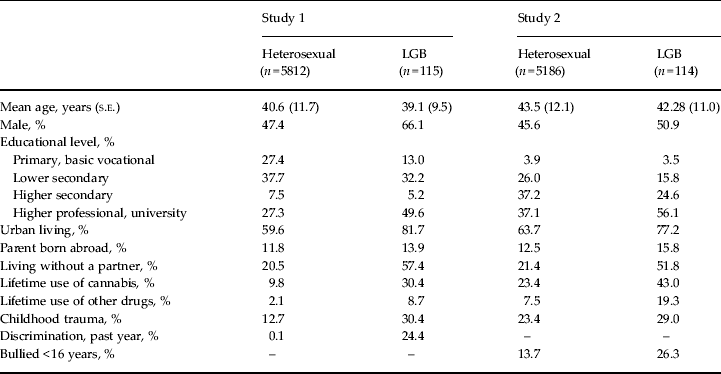
Homosexually active respondents differed from heterosexually active respondents in several ways. They were more likely to be highly educated, to live in an urban environment, to live without a partner and to have used cannabis or other drugs. They were also more likely to report childhood trauma (sample 1 only), to report having been discriminated against in the past year (data only available in sample 1) or to have been bullied frequently during childhood (data only available in sample 2). The demographics for both samples are shown in Table 1.
Sample characteristics by sexual behaviour for Study 1 and Study 2

Study 1, Netherlands Mental Health Survey and Incidence Study 1 (NEMESIS-1); Study 2, NEMESIS-2; LGB, lesbian, gay and bisexual; s.e., standard error.
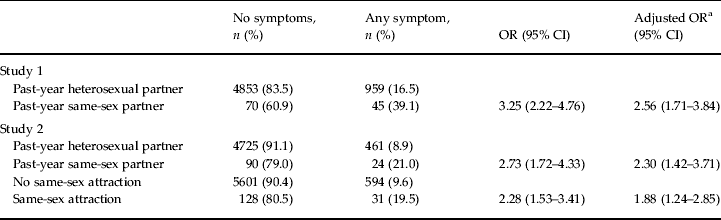
The cumulative incidence of psychotic symptoms was elevated in the LGB population as compared with the heterosexual population in both samples. Respondents who had same-sex partners were more likely to report psychotic symptoms than those who had only heterosexual partners. In Study 1, 39.1% of LGBs reported psychotic experiences as compared with 16.5% of heterosexuals (OR 3.25, 95% CI 2.22–4.76), and, in Study 2, 21.0% of LGBs reported such experiences as compared with 8.9% of heterosexuals (OR 2.73, 95% CI 1.72–4.33) (Table 2). When adjusting for demographic characteristics (age, gender, educational level and foreign birth of parent) and known risk factors for psychosis (lifetime cannabis use, other illicit drug use, urban living, and living without a partner), LGB respondents remained more likely to report psychotic symptoms than heterosexual respondents. In neither Study 1 (OR 2.56, 95% CI 1.71–3.84) nor Study 2 (OR 2.30, 95% CI 1.42–3.71) did the relationship between homosexual behaviour and psychotic symptoms disappear when testing a model chosen to provide a conservative estimate of the OR (Table 2).
Base model and adjusted model for Study 1 and Study 2

Study 1, Netherlands Mental Health Survey and Incidence Study 1 (NEMESIS-1); Study 2, NEMESIS-2; OR, odds ratio; CI, confidence interval.
a Adjusted for: gender, education level, urbanicity, foreign-born parents, living without a partner, cannabis use, other illicit drug use.
Same-sex attraction
The results for the analyses based on sexual attraction in Study 2 followed the same pattern as those for sexual behaviour. LGB participants were more likely to report psychotic symptoms (19.5%) than the heterosexual population (9.6%, OR 2.28, 95% CI 1.53–3.41) and the association remained in the adjusted model (OR 1.88, 95% CI 1.24–2.85) (Table 2).
Mediation analyses
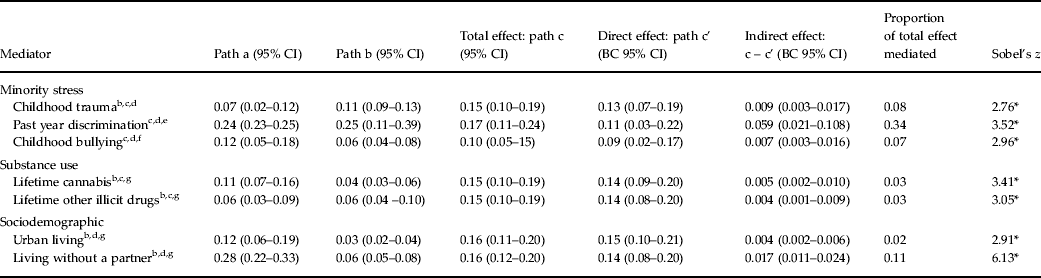
The coefficients for the separate steps in the mediation analysis are summarized in Table 3. All mediators tested were found to satisfy the conditions for mediation and had positive outcomes on the Sobel test.
Mediation analysis results with sexual orientation defined by behaviour a

CI, Confidence interval; BC, bias corrected.
a All analyses adjusted for age, gender, education level, foreign-born parent.
b Across both studies (n = 11227).
c Additionally adjusted for urbanicity and living without a partner.
d Additionally adjusted for lifetime cannabis and other illicit drug use.
e Study 1 only (n = 5927).
f Study 2 only (n = 5300).
g Additionally adjusted for childhood trauma.
* p < 0.01.
All of the predictors in the minority stress pathway mediated a substantial part of the total effect. Past-year discrimination mediated 34% of the total effect of homosexual behaviour on the occurrence of psychotic symptoms in Study 1 (z = 3.52, p < 0.001) and a history of being bullied in childhood mediated 7% (z = 2.99, p = 0.003) of the total effect in Study 2. In the data for both studies combined, childhood trauma mediated about 5% (z = 2.76, p = 0.006) of the effect.
In the substance use pathway, both cannabis use (z = 3.41, p < 0.001) and other illicit drug use (z = 3.05, p = 0.002) mediated 3%. In the sociodemographic pathway, urban living accounted for 2% (z = 2.91, p = 0.004) of the total effect, while living without a partner mediated 11% (z = 6.13, p < 0.001) of the total effect. The contribution of the substance use pathway was relatively small compared with the minority stress pathway, while living without a partner mediated a similar percentage of the total effect as the minority stress predictors.
Sensitivity analyses
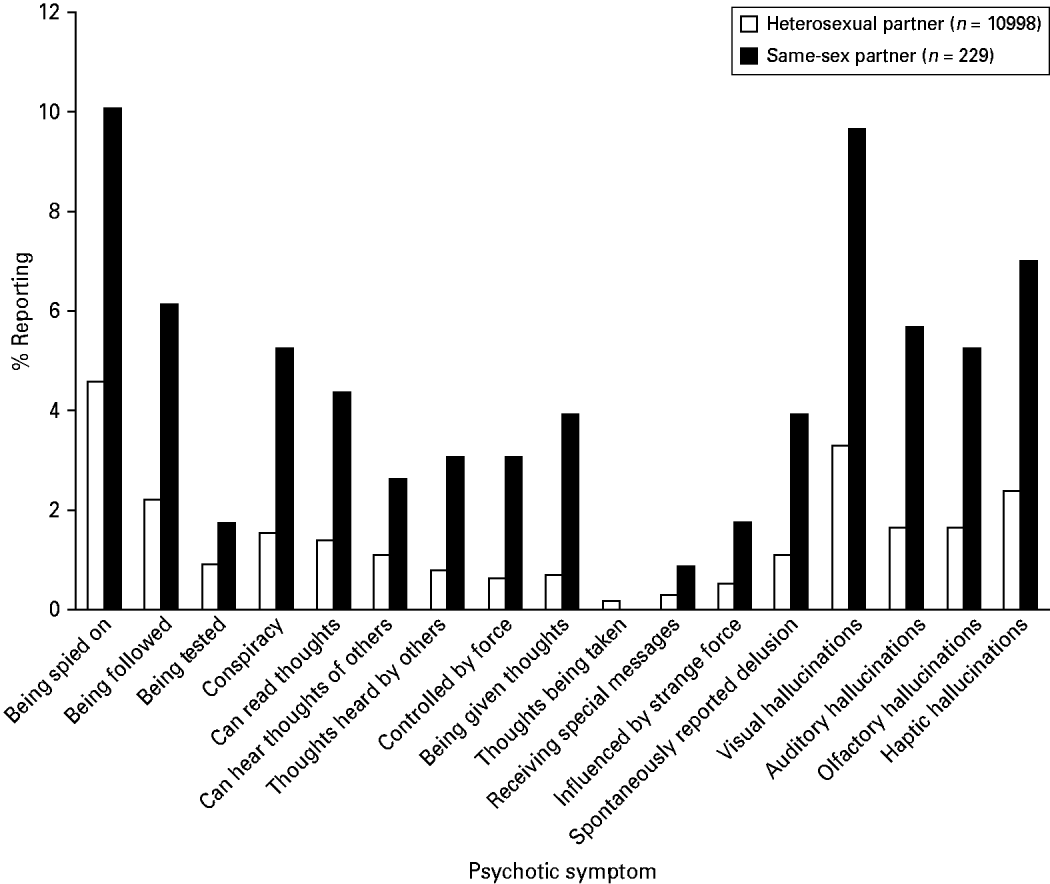
In the sexually active sample across the two studies (n = 10 837) three homosexually active respondents, 1.35% of the total, had a likely lifetime diagnosis of non-affective psychotic disorder. This applied to 37 (0.35%) of the heterosexually active respondents. Fig. 2 shows that all psychotic symptoms, with the exception of ‘thought extraction’, were reported more frequently by LGB respondents.
Psychotic symptom types by sexual behaviour: percentages of heterosexual and same-sex-partnered respondents across the two studies reporting each of the 13 delusions and four hallucinations.

To check the validity of the findings in the sexually active subpopulation as compared with the entire adult population, a planned sensitivity analysis was conducted. Sexual orientation was recoded so that respondents who were not sexually active were all classified as heterosexual. In the combined sample including sexually inactive respondents (n = 13 288) homosexual behaviour remained the strongest predictor in the model (adjusted OR 2.50, 95% CI 1.85–3.37).
Discussion
The main finding of this study is a higher lifetime cumulative incidence of psychotic symptoms in LGB participants compared with heterosexuals. This association was found in two large independent general population samples and remained statistically significant using different definitions of sexual minority status and after adjustment for a wide range of confounding factors. Minority stressors such as bullying, discrimination and trauma partly mediated the association between sexual minority status and psychotic symptoms. This finding is consistent with the notion that the experience of minority stress is an important mechanism by which sexual and other minorities are at increased risk for psychosis.
It is important to note that the present study concerns psychotic symptoms, not psychotic disorder. However, as stated above, psychotic symptoms are an indicator of severity of psychopathology (van Os et al. Reference Van Os, Verdoux, Maurice-Tison, Gay, Liraud, Salamon and Bourgeois1999; Hanssen et al. Reference Hanssen, Peeters, Krabbendam, Radstake, Verdoux and Van Os2003; Perlis et al. Reference Perlis, Uher, Ostacher, Goldberg, Trivedi, Rush and Fava2011) and predict transition to psychotic disorder with substantial burden to society in terms of healthy life years lost and costs for care (Kaymaz et al. Reference Kaymaz, Drukker, Lieb, Wittchen, Werbeloff, Weiser, Lataster and Van Os2012). The main strength of this study is that similar results were found in two independent samples of more than 5000 individuals, using very similar methods, collected with a 12-year interval. Other strengths include the use of the CIDI, a well-validated diagnostic instrument, with clinical re-interview procedures for psychosis, and random sampling from the general population. Many studies on LGB mental health rely on convenience samples for adequate numbers of sexual minority respondents. Often these are help- or support-seeking populations, which probably biases results. Such samples have more morbidity than LGB individuals in the general population and/or may benefit more from the protective effects of LGB community support. The definitions used to classify respondents as LGB were conservative and consistent across samples, in order to minimize misclassification. Classification was based on past-year same-sex behaviour instead of lifetime sexual experience to avoid erroneously classifying people based on experimenting behaviour in childhood or adolescence. A cut-off of at least equal same-sex to other-sex attraction was implemented in order to make it likely that those classified as LGB would also identify themselves as such.
Several limitations should be taken into account. First, the study was cross-sectional and is not conclusive about the direction of the relationship between sexual minority status and psychotic symptoms. There is no evidence, however, that psychotic symptoms influence the development of sexual identity. Second, it is possible that same-sex behaviour and attraction were under-reported. In particular, LGB individuals for whom their social environment is not aware of their sexual orientation may consider such information too sensitive to share with researchers. However, this could only explain the present findings if concealing one's sexual orientation were associated with a lower rate of psychotic symptoms. This is unlikely since there is evidence that the mental health of LGB youth is better if parents know of their sexual preference (D'Augelli, Reference D'Augelli2002) and that cortisol levels and psychiatric symptoms are lower in adult LGBs who have disclosed their sexual identity (Juster et al. Reference Juster, Smith, Ouellet, Sindi and Lupien2013). Third, while measures of sexual behaviour and attraction were collected, these remain only proxy measures for LGB status. Little is known about the stability of same-sex attraction and behaviour in adulthood, but there is substantial variability in early life (Savin-Williams & Ream, Reference Savin-Williams and Ream2007). A direct question about self-declared sexual identity in response to which people indicate if they see themselves as LGB could have been informative. However, such a question also involves a greater risk of under-reporting since such categories may appear more stigmatizing to respondents than questions about behaviour or attraction. A final possible concern is that the time-frames of the mediating and outcome variables do not match. The discrimination question only referred to the past year while a lifetime measure of psychotic experiences was used. However, a recent review suggests that discrimination measures which leave the time-frame unspecified or consider the past year (or a shorter period) are most predictive of health outcomes (Paradies, Reference Paradies2006). Moreover, lifetime discrimination experiences and rate of currently perceived discrimination were found to be correlated (r = 0.44) (Kessler et al. Reference Kessler, Mickelson and Williams1999). The majority (76%) of respondents in the current study who had experienced discrimination during the past year reported on a subsequent question that this had occurred more than once. Thus, the discrimination measure used can be considered, at least to a degree, a proxy measure for earlier (chronic) exposure and was found to be a strong mediator of the relationship between sexual minority status and psychotic symptoms. The measures of bullying and trauma were retrospectively assessed and only refer to events before the age of 16 years, when people typically do not yet (openly) identify themselves as LGB. It can therefore be argued that the minority stress predictors used covered a period in life that was too early, and are not a result of being LGB. However, this argument cannot explain why large differences exist between LGBs and heterosexuals in experience of bullying or trauma before the age of 16 years. Subtle differences in childhood or adolescent behaviour could be the source of these differences. LGBs are more likely than heterosexuals to show behaviour which does not conform to traditional gender roles in childhood (Rieger et al. Reference Rieger, Linsenmeier, Gygax and Bailey2008) and such gender non-conformity in pre-LGB children has been found to be associated with experiences of victimization (Landolt et al. Reference Landolt, Bartholomew, Saffrey, Oram and Perlman2004). Since psychotic symptoms usually first manifest themselves during late adolescence or early adulthood (Verdoux et al. Reference Verdoux, Van Os, Maurice-Tison, Gay, Salamon and Bourgeois1998), it is plausible that early life experiences play an important role in the hypothesized direction for the outcome under investigation.
This study is the first to explore possible mechanisms by which LGB status may be related to psychotic symptoms. There is growing evidence that discrimination or other minority stressors play a key role in LGB mental health problems. For example, LGB individuals who reported multiple kinds of discrimination had four times higher odds for substance use disorder than LGBs who reported no discrimination (McCabe et al. Reference McCabe, Bostwick, Hughes, West and Boyd2010). Similarly, LGBs in The Netherlands who encounter more negative reactions to their sexuality score worse on a mental health indicator (Kuyper & Fokkema, Reference Kuyper and Fokkema2011). The current study shows that minority stressors mediate part of the relationship between sexual orientation and psychotic symptoms. The most important single mediator was discrimination (34%). Full mediation of effects by minority stressors was not expected in this study as this type of stress involves a multitude of processes, which are hard to measure comprehensively. Moreover, the substance abuse and sociodemographic pathways were expected to play a role as well. The proportions mediated by minority stressors were larger than those mediated by illicit drug use and sociodemographic variables, with the exception of living without a partner (11%). It should be noted that the proportions reported cannot be summed within or between pathways since multiple mediator models were not tested in this study.
The findings confirm recent preliminary evidence that higher rates of mental health problems in sexual minorities include psychotic symptoms. One of the two previous studies (Chakraborty et al. Reference Chakraborty, McManus, Brugha, Bebbington and King2011) was conducted with data pertaining to the Adult Psychiatric Morbidity Survey, a UK general population sample. Using less conservative definitions of non-heterosexual orientation, the authors found a wide range of mental disorder outcomes to be elevated in LGBs, including probable psychosis as measured with a combination of screening measures and the SCAN (Schedules for Clinical Assessment in Neuropsychiatry) interview. However, the study did not have enough power to control for important confounders. The other previous study, using the National Epidemiologic Survey on Alcohol and Related Conditions data from the USA, came to similar conclusions while controlling for confounders including psychiatric co-morbidity (Axis I and Axis II), but the psychosis measure used was a self-report of ever receiving a diagnosis of any psychotic disorder or episode (Bolton & Sareen, Reference Bolton and Sareen2011). The current study replicates these results, and adds to the literature by showing that the rate of psychotic symptoms remains increased after adjustment for potential confounders in a study that included data from clinical interviews. Additionally, it demonstrates that discrimination as well as other forms of victimization can be considered as mediators between sexual orientation and mental health. These results underline the importance of social context in the development of psychopathology. Minority stress can be internalized but is by definition initialized through interactions with the social environment. In the USA, an ecological experiment involving institutional discrimination demonstrated that the level of gay-friendliness of an environment affected mental health. Mental disorders became more prevalent among LGB respondents in states that had introduced legislation to ban gay marriage as compared with states that did not pass such laws (Hatzenbuehler et al. Reference Hatzenbuehler, McLaughlin, Keyes and Hasin2010). Also, LGB health is better in states where there is a larger LGB population (Hatzenbuehler et al. Reference Hatzenbuehler, Keyes and McLaughlin2011), a finding which mirrors ethnic density effects for common mental disorders (Das-Munshi et al. Reference Das-Munshi, Becares, Dewey, Stansfeld and Prince2010) and psychosis among ethnic minorities (Veling et al. Reference Veling, Susser, Van Os, Mackenbach, Selten and Hoek2008). The finding that LGB individuals are at greater risk of experiencing psychotic symptoms adds to the growing body of literature linking minority status and psychosis. The current study illustrates that LGB mental health is relatively poor even in a reputedly gay-friendly country and extends to a severe type of pathology associated with reality distortion. Therefore the study underlines the need for more research and adds an additional justification for programmes to improve the position of LGBs in societies around the world. Programmes aimed at creating a more equal, accepting and healthy environment for ethnic minorities or LGBs would reduce their chronic exposure to minority stress, a strong candidate mechanism for explaining the mental health alterations in both groups. Such programmes could prove a cost-efficient way of reducing the burden of psychosis as compared with investments in treatment of affected individuals.
Acknowledgements
Financial support for NEMESIS-1 and NEMESIS-2 was received from the Ministry of Health, Welfare and Sport, with supplement support from The Netherlands Organization for Health Research and Development (ZonMw), the Genetic Risk and Outcome of Psychosis (GROUP) Investigators, and the National Institute for Public Health and Environment (RIVM). The funding organizations or sponsors had no role in the design and conduct of the study; collection, management, analysis and interpretation of the data; or preparation, review or approval of the manuscript.
Declaration of Interest
None.