Introduction
In response to globalization and escalating market turbulence, enterprises must be more prepared than ever to react and to adjust their activities if they are to remain competitive. Some manage by exploring and exploiting innovative opportunities and idea generation (Aguilar, Vengrouskie, & Lloyd, Reference Aguilar, Vengrouskie and Lloyd2019). When employees are infused with an entrepreneurial spirit (Filion & Chirita, Reference Filion and Chirita2016), business activities can be rejuvenated, along with business performance (Gawke, Gorgievski, & Bakker, Reference Gawke, Gorgievski and Bakker2019). Intrapreneurial behavior occurs when employees take entrepreneurial action within an organization that can add value to the organization and that exerts an energizing effect on its adaptive and developmental capacities (Sieger, Zellweger, & Aquino, Reference Sieger, Zellweger and Aquino2013). Employees are the heart and soul of a company's operations. Compared to managers and directors, they have a more hands-on grasp of problems as they arise, and they are better positioned to find high-impact solutions (Sathe, Reference Sathe2003). This holds particularly true for small and medium enterprises (SMEs), where performance depends more heavily on the talents and capabilities of human capital (Torrès, Reference Torrès2015).
However, although SMEs strive to foster intrapreneurial vision in their employees (e.g., coming up with new ideas, anticipating future needs, and improving existing processes), few succeed in integrating the intrapreneurial vision into their routines and procedures. This tends to hinder employees' intrapreneurial intentions (Fini, Grimaldi, Marzocchi, & Sobrero, Reference Fini, Grimaldi, Marzocchi and Sobrero2012). Although some studies indicate that intrapreneurial behavior is associated with organizational performance (Valsania, Moriano, & Molero, Reference Valsania, Moriano and Molero2016) and with the performance (Teneau & Dufour, Reference Teneau and Dufour2015) and well-being of employees (Gawke, Gorgievski, & Bakker, Reference Gawke, Gorgievski and Bakker2018), the research has largely neglected to explore its psychosocial determinants. This raises a significant theoretical and practical issue: the current knowledge is based on the potential effects of intrapreneurial behavior, which fails to account for the motivational conditions that allow it to flourish in the first place. The scientific and managerial interest in enriching the understanding of psychosocial determinants of intrapreneurship is to get a better grasp of how the association between organizational support and employees' intrapreneurial activities varies as a function of their intrapreneurial self-efficacy (ISE). From a managerial standpoint, the contingency perspective proposed in the present study suggests that organizations wishing to nurture intrapreneurship must review the conditions that not only support the entrepreneurial actions of employees, but that help strengthen their self-efficacy.
To address this concern, we draw on the premises of the theory of planned behavior (Ajzen, Reference Ajzen1991), social exchange theory (SET; Blau, Reference Blau1964), and social cognitive theory (Bandura, Reference Bandura1997) to propose that employees' perceptions of the organization's recognition of their efforts (perceived organizational support [POS]; Eisenberger, Huntington, Hutchison, & Sowa, Reference Eisenberger, Huntington, Hutchison and Sowa1986) is liable to contribute to their intrapreneurial intentions and behaviors, but only when they feel confident about their intrapreneurial skills. Thus, employees' feelings of ISE would be an essential condition to explain when organizational support can foster the development of intrapreneurial behavior.
This study offers three main contributions to the research. First, beyond the rationale behind the intrapreneurial decision, we provide evidence that intrapreneurial action can be facilitated or hindered by the conjunction of organizational and motivational factors. This adds to the research (Park, Kim, & Krishna, Reference Park, Kim and Krishna2014; Rigtering & Weitzel, Reference Rigtering and Weitzel2013; Urbano, Alvarez, & Turró, Reference Urbano, Alvarez and Turró2013; Van Wyk & Adonisi, Reference Van Wyk and Adonisi2012; Zur & Walega, Reference Zur and Walega2015) that has focused largely on organizational factors (e.g., top management support, organizational structure, rewards, work discretion, and resources). Second, we specify the role of intrapreneurial intention as an explanatory mechanism for the relationship between organizational support and intrapreneurial behavior. Our results therefore provide new insights into how organizations can build an intrapreneurial spirit that translates into effective behaviors. Third, we explain how some employees readily adopt intrapreneurial behaviors while others remain set in their ways. By spotlighting the intrapreneurial process, we light up new directions for the theory and research on self-efficacy (Bandura, Reference Bandura1997). As far as the moderating role of self-efficacy is concerned, the research has concentrated mainly on how self-efficacy moderates adaptation to stressful situations and sources rather than how it contributes to optimal functioning (professional and organizational development) (Alessandri, Borgogni, Schaufeli, Caprara, & Consiglio, Reference Alessandri, Borgogni, Schaufeli, Caprara and Consiglio2015).
Theoretical foundations and hypotheses
Employee intrapreneurial behavior (EIB)
Two main research streams in the literature address entrepreneurship within existing organizations. The first stems from the work of Sharma and Chrisman (Reference Sharma and Chrisman1999), who use the term corporate entrepreneurship to describe the entrepreneurial viewpoint of existing organizations. Thus ‘Corporate entrepreneurship is the process whereby an individual or group of individuals, in association with an existing organization, create a new organization or instigate renewal or innovation within that organization’ (Sharma & Chrisman, Reference Sharma and Chrisman1999). The second research stream focuses on the term intrapreneurship, a contraction of the term intraorganizational entrepreneurship coined by Pinchot (Reference Pinchot1986) and defined as ‘the bottom-up initiative of individuals that make change happen with the goal of improving their organisations’ (Deprez, Leroy, & Euwema, Reference Deprez, Leroy and Euwema2018: 163). For Filion and Chirita (Reference Filion and Chirita2016), intrapreneurship is a phenomenon that goes beyond corporate entrepreneurship. They argue that whereas corporate entrepreneurship refers to the processes and resources that management puts in place to help employees act as intrapreneurs, intrapreneurship is another concept altogether. It is an entrepreneurial practice enacted by those employees who can evolve within a corporate entrepreneurship context even in the absence of organizational support. For Bouchard and Basso (Reference Bouchard and Basso2011: 220), intrapreneurship is ‘the adoption by employees of entrepreneurial attitudes and behaviours.’ Although most authors agree that employee intrapreneurship would provide firms with a unique competitive advantage, this concept has received much less attention (Blanka, Reference Blanka2019), which may be explained, among others, by the lack of a precise definition (Gawke, Gorgievski, & Bakker, Reference Gawke, Gorgievski and Bakker2017).
Recently, more precise operational definitions have been proposed. For Léger-Jarniou and Arzeni (Reference Léger-Jarniou, Arzeni, Léger-Jarniou and Arzeni2013), intrapreneurship is an entrepreneurial dynamic that occurs in existing enterprises, is embodied in the development of new business models, and is manifest in the attitudes of employees who personify entrepreneurial qualities (proactiveness, flexibility, autonomy, and creativity). Thus, intrapreneurship is considered as an autonomous strategic behavior that emerges when operational-level employees spy on opportunities beyond those proffered by management (Calisto & Sarkar, Reference Calisto and Sarkar2017). Gawke, Gorgievski, and Bakker (Reference Gawke, Gorgievski and Bakker2017) conceptualize intrapreneurship as agentic and anticipatory behavior by individual employees with a view to creating new businesses for the organization and for improving its ability to respond to internal and external advancements.
In addition, the research generally characterizes individual intrapreneurial behaviors in terms of three widely acknowledged dimensions: innovativeness, risk-taking, and proactiveness (e.g., De Jong, Parker, Wennekers, & Wu, Reference De Jong, Parker, Wennekers and Wu2015; Valsania, Moriano, & Molero, Reference Valsania, Moriano and Molero2016; Yariv & Galit, Reference Yariv and Galit2017). Innovativeness encompasses all the individual actions taken to generate, process, and implement new ideas that can benefit the organization at whatever level (Kleysen & Street, Reference Kleysen and Street2001). Risk-taking implies venturing into the unknown and the ability to tolerate potential losses (i.e., loss tolerance). Proactiveness means taking actions that lie outside the normal boundaries: the focus is on innovations in the long-term to anticipate and analyze potential opportunities and threats and to cope with obstacles (Frese & Gielnik, Reference Frese and Gielnik2014). This is consistent with Neessen, Caniëls, Vos, and De Jong (Reference Neessen, Caniëls, Vos and De Jong2019: 551) view that intrapreneurship is ‘a process whereby employee(s) recognize and exploit opportunities by being innovative, proactive and by taking risks, in order for the organization to create new products, processes and services, initiate self-renewal or venture new businesses to enhance the competitiveness and performance of the organization.’ We used this conceptualization to define intrapreneurial behavior (EIB).
POS and EIB in SMEs
It is widely agreed that organizational support is a key factor for intrapreneurship within existing organizations (Gonzalez-Serrano, Gonzalez-García, & Pérez-Campos, Reference Gonzalez-Serrano, Gonzalez-García and Pérez-Campos2018). In terms of Eisenberger et al.'s (Reference Eisenberger, Huntington, Hutchison and Sowa1986) organizational support theory, this support reflects the extent to which the organization values its employees' contributions and cares about their well-being. According to Özdemirci and Behram (Reference Özdemirci and Behram2014), organizational support means that the organization cares for its employees and their overall satisfaction, values their contributions, and appreciates their extra efforts. In addition, the organization recognizes their extraordinary performance, takes pride in their accomplishments, and cares about their complaints (Eisenberger, Rhoades Shanock, & Wen, Reference Eisenberger, Rhoades Shanock and Wen2020). In terms of intrapreneurship, Alpkan, Bulut, Gunday, Ulusoy, and Kilic (Reference Alpkan, Bulut, Gunday, Ulusoy and Kilic2010) propose that organizational support constitutes five factors: ‘(1) management support for generating and developing new business ideas, (2) allocation of free time, (3) convenient organizational structures concerning, in particular, decentralization level or decision-making autonomy, (4) appropriate use of incentives and rewards, and (5) tolerance for trial-and-errors or failures in cases of creative undertakings or risky project implementations.’
In SMEs, intrapreneurs are located at the heart of the emergence of intrapreneurship by combining knowledge and/or resources in new ways (Aguilar, Vengrouskie, & Lloyd, Reference Aguilar, Vengrouskie and Lloyd2019). Moreover, resources are scarce in SMEs, and the performance of intrapreneurs narrowly impacts the organization's performance (Carrier, Reference Carrier1994). Support from the organization is therefore especially useful in this context in which intrapreneurial behavior is perceived as carrying greater risk (Camelo-Ordaz, Fernández-Alles, Ruiz-Navarro, & Sousa-Ginel, Reference Camelo-Ordaz, Fernández-Alles, Ruiz-Navarro and Sousa-Ginel2012). Some researchers recognize that managerial measures encouraging innovations in organizations are effective by looking not only at the organizational level but also at the individual level (Aguilar, Vengrouskie, & Lloyd, Reference Aguilar, Vengrouskie and Lloyd2019). This is particularly easy in SMEs thanks to the hierarchical proximity by facilitating the dissemination of information between the manager and his employees. However, insofar as SME employees need organizational support, or an environment that fosters intrapreneurship plus a manager who encourages intrapreneurial behavior (Valka, Roseira, & Campos, Reference Valka, Roseira and Campos2020), their perception of these factors constitutes a potentially significant lever for intrapreneurial behavior. Yet employees' perceptions of the quality of the support they receive from their organization and its impact on the intrapreneurial process (the pathway from intention to behaviors) have been largely neglected in the research to date (Yariv & Galit, Reference Yariv and Galit2017). According to SET (Blau, Reference Blau1964), individuals enter into a voluntary exchange of benefits, either material or not (e.g., information, advice, and access to resources and other services). This sets up obligations to repay the donor, or reciprocal social interactions in which the donor expects to receive an equivalent or greater return (Ulhøi, Reference Ulhøi2005). SET models assume that POS contributes to employees' affective attachment and their expectations that their efforts to achieve organizational objectives will be rewarded (Colquitt, Baer, Long, & Halvorsen-Ganepola, Reference Colquitt, Baer, Long and Halvorsen-Ganepola2014; Eisenberger et al., Reference Eisenberger, Huntington, Hutchison and Sowa1986; Rockstuhl et al., Reference Rockstuhl, Eisenberger, Shore, Kurtessis, Ford, Buffardi and Mesdaghinia2020). In this respect, Taştan and Güçel (Reference Taştan and Güçel2014) show that the organizational climate (structural support and organization recognition) promotes a sense of belonging through identification with structural support and organizational recognition, which contribute in turn to employees' intrapreneurial behaviors. Badoiu, Segarra-Ciprés, and Escrig-Tena (Reference Badoiu, Segarra-Ciprés and Escrig-Tena2020) suggest that mutual confidence and the quality of the relationship between employees and top managers are the most valued factors for intrapreneurs. This suggests that when organizations build trust, employees' perceptions of organizational support can foster intrapreneurial behaviors.
Studies have investigated the norm of reciprocity as a model of mutual exchange of gratifications (Gouldner, Reference Gouldner1960) within organizations. Settoon, Bennett, and Liden (Reference Settoon, Bennett and Liden1996) provide empirical evidence that employee behaviors that are set forth in formal employment contracts are associated with the quality of the relationship with the immediate supervisor, and that employee organizational commitment depends on individual perceptions of the organization's support. Thus, POS acts on desired work behaviors, including both expected behaviors and those that go beyond what is expected (e.g., intrapreneurial activities). This interdependent exchange relationship, or reciprocity between the organization and its employees (Cropanzano & Mitchell, Reference Cropanzano and Mitchell2005), could be particularly salient for SMEs, where managers and employees work in close proximity (Torrès, Reference Torrès2015).
Most studies on the relationship between POS (or similar constructs) and EBIs have been conducted through the lens of SET. Zhang and Jia (Reference Zhang and Jia2010) found that when organizational support is perceived as positive, SME employees show voluntary proactive and innovative behavior. Moreover, Özdemirci and Behram (Reference Özdemirci and Behram2014) showed, in an industrial setting (76.2% SMEs), that employee innovativeness and proactiveness stemmed from perceptions of high-performance human resources practices (selective staffing, extensive training, internal mobility, employment security, clear job description, result-oriented appraisal, incentive reward, and participation). Nazir, Shafi, Atif, Qun, and Abdullah (Reference Nazir, Shafi, Atif, Qun and Abdullah2019) examined the role of POS in the innovative behavior of employees in the manufacturing and information technology sectors. They found that organizational justice was significantly related to affective commitment and innovative behavior and mediated by POS. Similarly, Nazir, Qun, Hui, and Shafi (Reference Nazir, Qun, Hui and Shafi2018) noted that nurses' POS wielded a positive influence on innovative behavior and that this perception was predicted by an innovative organizational culture and high-quality exchanges with their leader. Zampetakis, Beldekos, and Moustakis (Reference Zampetakis, Beldekos and Moustakis2009) observed that POS in employees of public and para-public organizations in the services sector was positively associated with signals of entrepreneurial behavior emitted by the organization. According to ul Haq, Khalid, and Usman (Reference ul Haq, Khalid and Usman2018), organizational support positively affects intrapreneurial behavior in SME employees in the manufacturing sector through organizational trust. Thus, when employees develop trust and positive perceptions of support, they are encouraged not only to venture beyond their comfort zones and standardized routines (Bendickson & Liguori, Reference Bendickson and Liguori2014), but also to engage in intrapreneurial behavior as well.
Based on SET (Blau, Reference Blau1964) and the available empirical evidence, we propose the following hypothesis:
Hypothesis 1: Employee perception of organizational support (POS) is positively associated with EIB.
The mediating role of intrapreneurial intention
Intrapreneurial behavior makes a vital contribution to the logical planning and decision-making process that ends up generating and implementing new ideas (Razavi & Ab Aziz, Reference Razavi and Ab Aziz2017). Nevertheless, the intention appears to be a determinant factor in this process as well (Neessen et al., Reference Neessen, Caniëls, Vos and De Jong2019). Hence, the development of intrapreneurial intention prior to the intrapreneurial decision would be a worthwhile research avenue, because these states could be influenced by subjective factors arising from particular contexts. Employee intrapreneurial intention (EII) refers to the probability that an employee will start a new project or venture that would add value to an existing organization, particularly to become an intrapreneur (Douglas & Fitzsimmons, Reference Douglas and Fitzsimmons2013; Martiarena, Reference Martiarena2013; Monsen, Patzelt, & Saxton, Reference Monsen, Patzelt and Saxton2010; Nicholson, Shen, & Nicholson, Reference Nicholson, Shen and Nicholson2016; Parker, Reference Parker2011; Razavi & Ab Aziz, Reference Razavi and Ab Aziz2017). To deepen the understanding of the psychological mechanisms that underlie intrapreneurial behavior, we propose that POS relates to intrapreneurial behavior through intrapreneurial intention. This prediction is based on the theory of planned behavior (Ajzen, Reference Ajzen1991), which posits that individuals perform an intended behavior depending on the degree of control they have over the behavior, and when they can consciously decide to exert an effort to perform the behavior.
From a planned behavior theory perspective (Ajzen, Reference Ajzen1991), perceived behavioral control (e.g., information, opportunities, dependence on others, obstacles, and resource availability) would contribute to behavioral enactment through the intention. According to Douglas and Fitzsimmons (Reference Douglas and Fitzsimmons2013), the lower the risk tolerance, the higher the intrapreneurial intention. Yariv and Galit (Reference Yariv and Galit2017) emphasize that when employees operate in an environment that is tolerant to mistakes and failures, they feel secure enough to try out new ideas and initiate new developments. In other words, they will naturally and voluntarily be inclined toward intrapreneurship. In the Iranian R&D sector, Razavi and Ab Aziz (Reference Razavi and Ab Aziz2017) found that networking, innovativeness, proactiveness, and risk-taking were positively related to intrapreneurial intention. Nicholson, Shen, and Nicholson (Reference Nicholson, Shen and Nicholson2016) showed that implementation of a Net-Enabled Business Innovation Cycle increased students' intrapreneurial intentions.
According to Cadiou and Cadiou (Reference Cadiou, Cadiou and Christian2010: 28), intention, as a mental process, is a construction that requires cognitive mapping and the conceptor's interpretation of the world. From a sociocognitive perspective, individuals do not make decisions based on a clear vision of the future but are instead guided by their perceptions and representations of the environment (Fayolle & Degeorge, Reference Fayolle and Degeorge2012). Neessen et al. (Reference Neessen, Caniëls, Vos and De Jong2019) propose that in addition to the relationship with the organization, motivation and intrapreneurial intention are determinant attitudinal dimensions of intrapreneurship. Thus, employees' POS should act on intrapreneurial behaviors through intrapreneurial intentions. However, to our knowledge, the mediating role of intrapreneurial intentions has not yet been the subject of specific studies. Indirect evidence suggests that intrapreneurial intentions vary according to perceptions of certain individuals (e.g., attitudes toward intrapreneurship) and organizational factors (e.g., firm's entrepreneurial orientation) (Douglas & Fitzsimmons, Reference Douglas and Fitzsimmons2013; Gerards, van Wetten, & van Sambeek, Reference Gerards, van Wetten and van Sambeek2020). Other studies have indicated that EII is associated with the number of intrapreneurial activities developed (e.g., Urbano, Alvarez, and Turró, Reference Urbano, Alvarez and Turró2013).
Based on the premises of planned behavior theory (Ajzen, Reference Ajzen1991), we propose the following hypothesis:
Hypothesis 2: EII acts as a mediator in the relationship between POS and EIB.
The moderating role of ISE
Despite the research interest in the determinants of intrapreneurial intention and behavior, little attention has been paid to the conditions that strengthen or weaken this relationship (Blanka, Reference Blanka2019). Beyond the rational process in which the belief in one's ability to act influences individual decisions, individual perceptions of ISE would be a relevant concept to consider to deepen our understanding of the intrapreneurial process. Wood and Bandura (Reference Wood and Bandura1989) define self-efficacy as people's beliefs about their capacity to enlist their motivation and cognitive resources and to take action to exercise control over events in their life. Through its strong impact on thought, affect, motivation, and action, this individual resource plays a central role in how people act (Bandura, Reference Bandura1991).
In the present study, we consider ISE as an individual's belief in the ability to accomplish an intrapreneurial role, task, or set of behaviors. Based on this theory, the research shows that self-efficacy is essential for intrapreneurial intention (Douglas & Fitzsimmons, Reference Douglas and Fitzsimmons2013) and intrapreneurial behavior (Ibrahim, Mahmood, & Bakar, Reference Ibrahim, Mahmood and Bakar2016; Wakkee, Elfring, & Monaghan, Reference Wakkee, Elfring and Monaghan2010). For example, Nicholson, Shen, and Nicholson (Reference Nicholson, Shen and Nicholson2016) found that using a Net-Enabled Business Innovation Cycle project in a technology entrepreneurship course fostered students' ISE, and consequently intrapreneurial intention. In a study of 221 working professionals, Tucker, Croom, and Marino (Reference Tucker, Croom and Marino2017) found that entrepreneurial self-efficacy was associated with intrapreneurial intentions. Similar results were observed by Douglas and Fitzsimmons (Reference Douglas and Fitzsimmons2013) among MBA students.
In addition, the present study assumes that ISE provides the motivational conditions for employees to transpose their intrapreneurial intention into actual behavior. Although strong EII can provide the motivation to create new value within an existing organization, the relationship with EIB may also vary according to ISE, or employees' beliefs that their intention will culminate in expected outcomes. In effect, EII should translate into EIB only insofar as employees are confident in their intrapreneurial ability. This leads to the following hypothesis:
Hypothesis 3: Employee ISE moderates the indirect relationship between POS and EIB through EII, such that the mediating relationship is stronger when ISE is higher.
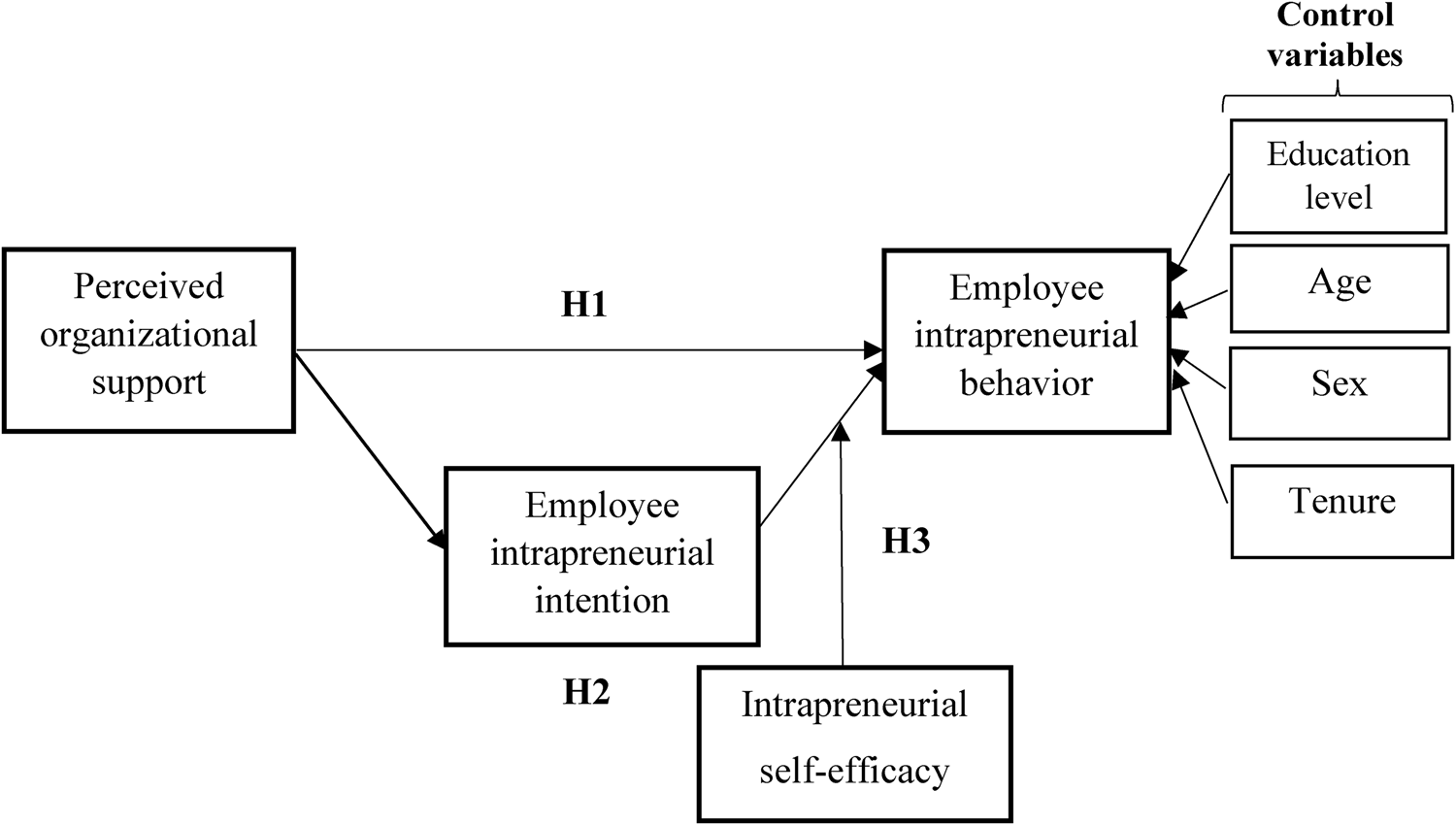
After conducting this literature review, we developed a moderated mediation model (Figure 1). In a nutshell, we propose that ISE positively moderates the strength of the indirect link between POS of employees and their intrapreneurial behavior through intrapreneurial intention, such that the mediation relationship is stronger when there is a higher level of ISE.
Proposed moderated mediation model.

Method
Participants and procedure
Data were gathered from 250 employees of an SME specializing in the damage insurance sector in the province of Québec, Canada. In all, 179 employees (82.1% women) with average age 41.72 years (standard deviation [SD] = 11.13) participated in the study. The majority (53.6%) had a college diploma. Tenure with the company varied from 0 to 39 years (M = 9.75), including 41.3% with <5 years experience. Employees received an email inviting them to complete an online questionnaire. The questionnaire was administered in French. Measures that had not been validated in French (POS, EII, ISE, and EIB) were adapted using a classic translation/retranslation procedure (Brislin, Reference Brislin, Triandis and Berry1980; Vallerand, Reference Vallerand1989) by independent bilingual translators.
Measures
Perceived organizational support (POS)
We assessed POS with nine items adapted from Eisenberger et al.'s (Reference Eisenberger, Huntington, Hutchison and Sowa1986) instrument. Participants indicated their degree of agreement with each item on a scale from 1 (strongly disagree) to 7 (strongly agree). A sample item is, ‘the organization does what is required to help me do my work to the best of my ability’ (α = .93). Studies have supported the psychometric properties (validity and reliability) of this abridged version (e.g., Eisenberger, Fasolo, & Davis-LaMastro, Reference Eisenberger, Fasolo and Davis-LaMastro1990; Gillet, Fouquereau, Huyghebaert, & Colombat, Reference Gillet, Fouquereau, Huyghebaert and Colombat2016).
Employee intrapreneurial intention (EII)
We used a 3-item measure developed by Douglas and Fitzsimmons (Reference Douglas and Fitzsimmons2013) to assess EII. Participants responded to items on a scale from 1 (very unlikely) to 7 (very likely). For purposes of this study, the work situation was adjusted as follows: ‘if your employer asks you to participate in a new project that requires your skills and expertise and which, if successful, would create a new business opportunity within the organization, indicate the likelihood that you would agree to each proposal.’ A sample item is, ‘the likelihood that you would agree to participate in a new department or service of your organization that will introduce a major innovation’ (α = .95). Tucker, Croom, and Marino (Reference Tucker, Croom and Marino2017) obtained a comparable Cronbach's alpha (α = .93) for a similar scale.
Intrapreneurial self-efficacy (ISE)
We used an adapted version of Chen, Greene, and Crick (Reference Chen, Greene and Crick1998) and Bateman and Crant (Reference Bateman and Crant1993) scales to assess ISE with respect to innovativeness (four items; e.g., ‘I can design services that resolve current problems’; α = .76), risk-taking (three items; e.g., ‘I can make decisions in uncertain situations’; α = .68), and proactiveness (four items; e.g., ‘regardless of the likelihood of failure, when I believe in something, I can accomplish it’; α = .75). Participants responded on a scale from 1 (strongly disagree) to 5 (strongly agree). Consistent with other studies (e.g., Chen et al., Reference Chen, Greene and Crick1998), we calculated a total score of ISE by averaging the 11 items (α = .84). Scale reliability was supported by previous studies (e.g., Douglas & Fitzsimmons, Reference Douglas and Fitzsimmons2013; Parker & Sprigg, Reference Parker and Sprigg1999).
Employee intrapreneurial behavior (EIB)
We used an adapted version of Stull and Singh (Reference Stull and Singh2005) and Janssen (Reference Janssen2000) scales to measure EIB. Intrapreneurial behavior comprises three components: innovative behavior (five items; e.g., ‘as part of my job, I develop new procedures, services, or products’; α = .89), risk-taking (two items; e.g., ‘as part of my job, I do things that might not work out’; α = .57), and proactiveness (four items; e.g., ‘as part of my job, I anticipate future problems, needs, or changes’; α = .79). Again, a total score was calculated by averaging the 11 items (α = .90). Participants indicated how often they performed these intrapreneurial actions as part of their job on a scale from 1 (never) to 5 (very often). Internal consistency for this scale was .9, similar to that obtained in other studies (e.g., Moriano, Topa, Valero, & Lévy, Reference Moriano, Topa, Valero and Lévy2009; Rigtering& Weitzel, Reference Rigtering and Weitzel2013).
Control variables
Similar to recent studies that stressed the role of sociodemographic factors on employee intrapreneurship (De Jong et al., Reference De Jong, Parker, Wennekers and Wu2015; Gawke, Gorgievski, & Bakker, Reference Gawke, Gorgievski and Bakker2017, Reference Gawke, Gorgievski and Bakker2018; Moriano, Molero, Topa, & Lévy Mangin, Reference Moriano, Molero, Topa and Lévy Mangin2016; Yariv & Galit, Reference Yariv and Galit2017), we considered the potential confounding effect of the following variables: age, education level, sex, and tenure in the company.
Results
Preliminary analysis
To determine whether the measures provided good data representation and to test for model fit, we used robust maximum likelihood estimation with Mplus 8.3 (Muthén & Muthén, Reference Muthén and Muthén2017). It is now broadly accepted that all a priori models are false and will be shown to be false when tested with a sufficiently large sample size. For this and other reasons, chi-square tests of statistical significance are of little relevance for evaluation of goodness of fit for a single model (e.g., Marsh, Balla, & McDonald, Reference Marsh, Balla and McDonald1988). Hence, in applied Confirmatory Factor Analysis (CFA)/Structural Equation Modeling (SEM) research, there is a predominant focus on indices that are sample size-independent (e.g., Hu & Bentler, Reference Hu and Bentler1999; Marsh, Hau, & Grayson, Reference Marsh, Hau, Grayson, Maydeu-Olivares and McArdle2005; Marsh, Hau, & Wen, Reference Marsh, Hau and Wen2004) such as the comparative fit index (CFI), the Tucker–Lewis index (TLI), and the root mean square error of approximation (RMSEA). Values >.90 for CFI and TLI are considered to be indicative of adequate model fit, although values approaching .95 are preferable. Values <.08 or .06 for the RMSEA support, respectively, acceptable and good model fit.
The measurement model showed adequate fit: χ2 = 3,861.491; df = 561; p ⩽ .01; CFI = .914; TLI = .905; RMSEA = .056 (confidence interval [CI] = .048, .063). Table 1 presents the estimated model parameters and residual variances, revealing well-defined, interrelated yet differentiated constructs. To control for method bias, certain items were worded negatively (e.g. POS5: ‘even if I do the best possible job, the organization would not even notice’). This is a relevant strategy in this regard (Podsakoff, MacKenzie, & Podsakoff, Reference Podsakoff, MacKenzie and Podsakoff2012). Moreover, we used different anchoring points (i.e., strongly agree, very likely, and very often) for the different scales in our questionnaire. To minimize the potential effects of common method variance (CMV), we used Harman's single factor test as suggested by Podsakoff and Organ (Reference Podsakoff and Organ1986). We thus tested a measurement model of all 34 items in the study using a factor analysis to determine whether most of the variance could be explained by a general factor. CMV is supposed to exist where a single factor emerges from the factor analysis or if the general factor accounts for most of the variance among the variables (Podsakoff & Organ, Reference Podsakoff and Organ1986). In this case, the general factor accounts for 26.94% of the total variance explained and no single factor explains the overall variance of the items. We have therefore concluded that there is little common variance bias in our data.
Standardized factor loadings (λ) and residual variances (δ)

POS, perceived organizational support; EII, employee intrapreneurial intention; ISE, intrapreneurial self-efficacy; EIB, employee intrapreneurial behavior; δ, item residual variance; λ, factor loading.
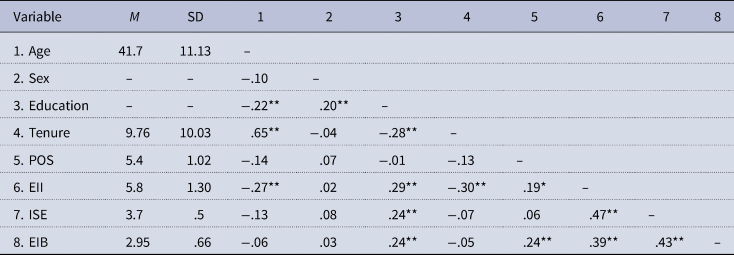
Table 2 presents the descriptive statistics (mean and SD), correlations among the variables of interest (POS, EII, ISE, and EIB), and sociodemographic variables. The correlation analysis provides preliminary support for Hypotheses 1 and 2: POS is positively related to EII (r = .19, p < .05) and EIB (r = .24, p < .01), and EII is positively related to EIB (r = .39, p < .01). In terms of the sociodemographic variables, a positive correlation is observed between education level and EIB (r = .24, p < .01), EII (r = .29, p < .01), and ISE (r = .24, p < .01), while EII is negatively correlated with age (r = −.27, p < .01) and tenure (r = −.30, p < .01).
Means (Ms), SDs, and correlations
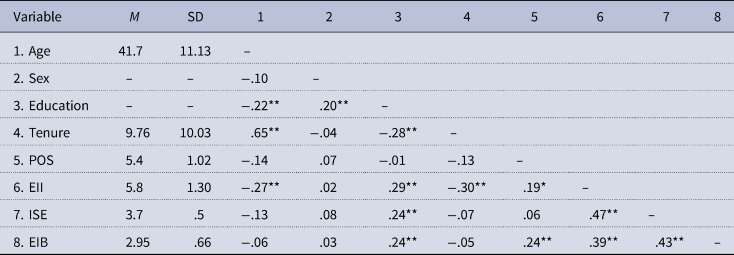
N = 179. *p < .05. **p < .01. Age in years. Sex: F = 1; M = 2. Education level: elementary = 1; high school = 2; college = 3; university = 4. Tenure in years.
Hypothesis tests
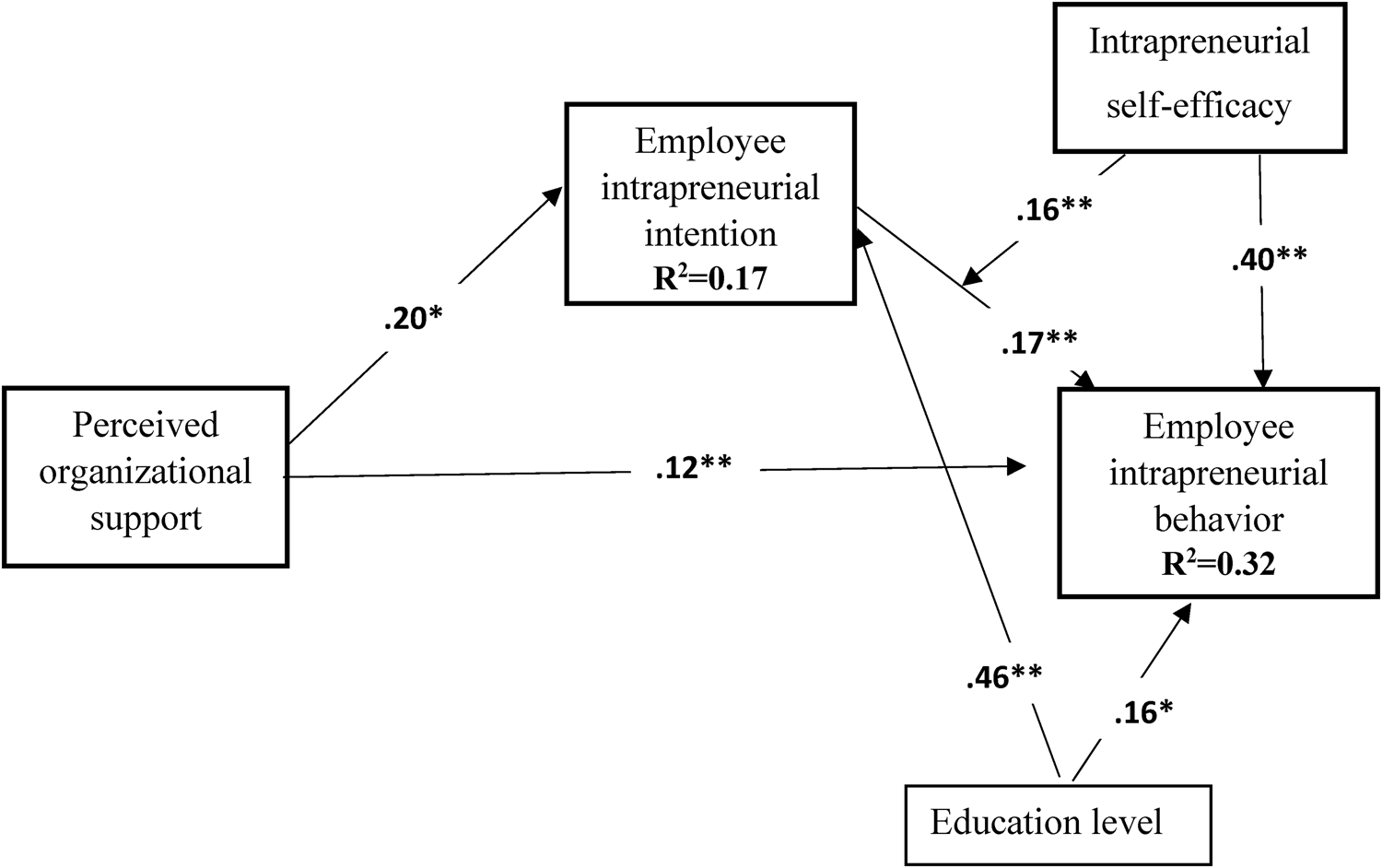
The results of the final moderated mediation model are presented in Figure 2. Multiple regression using Process v3.1 macro for SPSS (Preacher & Hayes, Reference Preacher and Hayes2004) was applied to test the research hypotheses.
Final model. **p < .01, *p < .05.
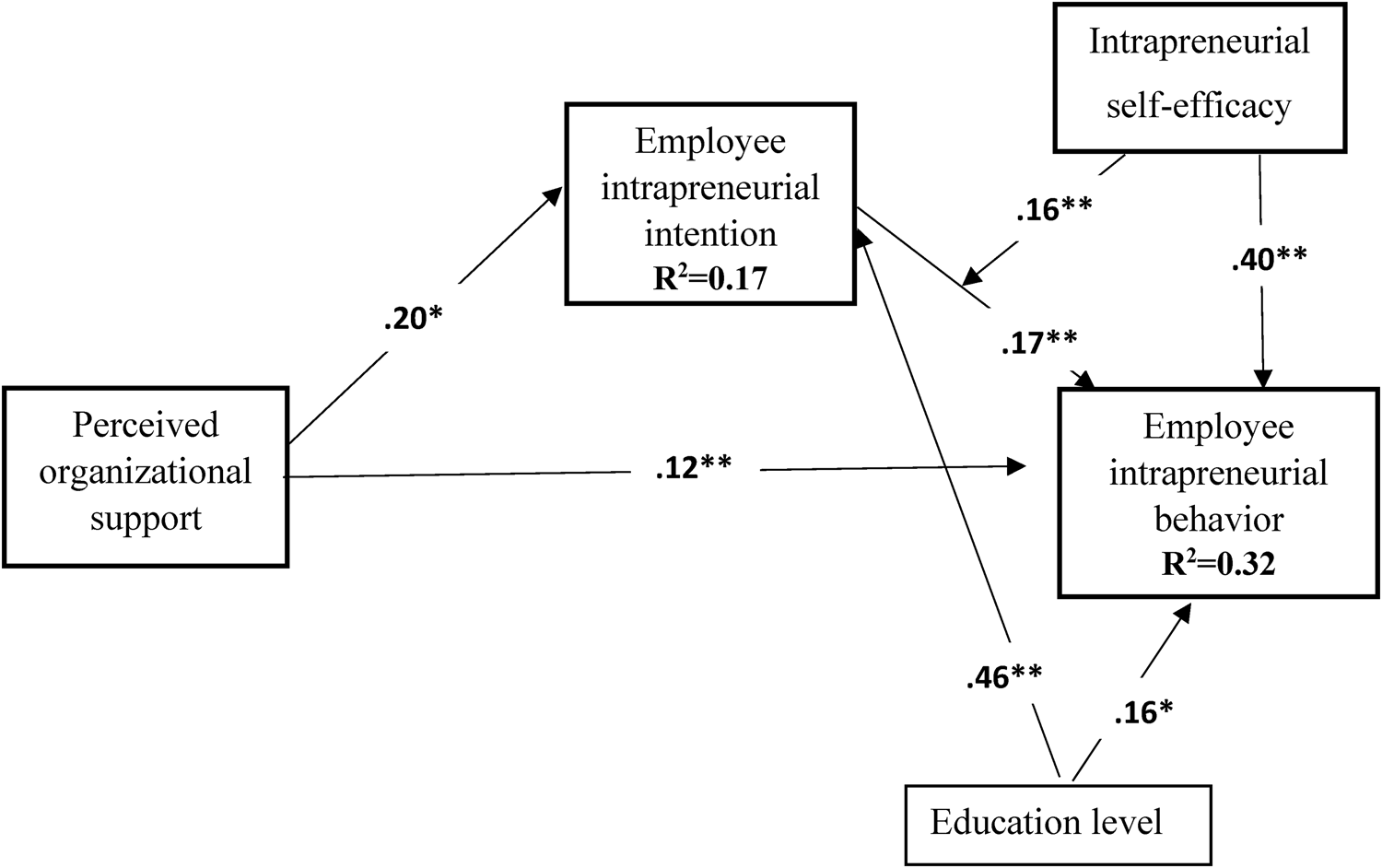
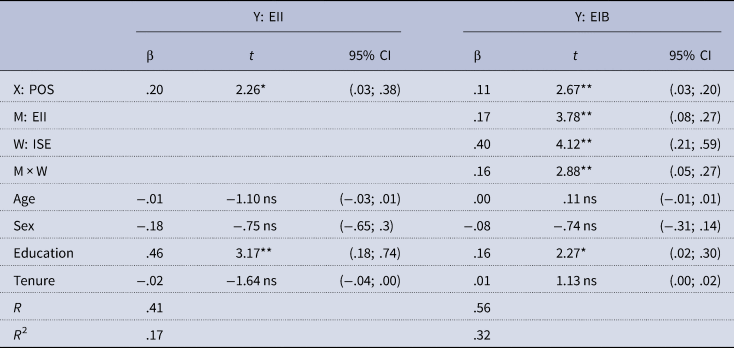
The parameter estimates in the prediction part of the model that includes the interactions are summarized in Table 3. When age, sex, education level, and tenure are controlled, the results support Hypothesis 1, showing a positive relationship between POS and EIB (β = .11, t = 2.67, p < .01). In support of Hypothesis 2, EII has an indirect (mediating) effect on the relationship between POS and EIB.
Results for the proposed moderated mediation model
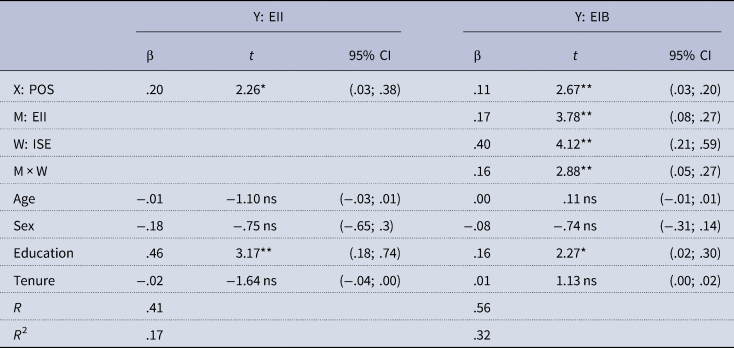
**p < .01; *p < .05.
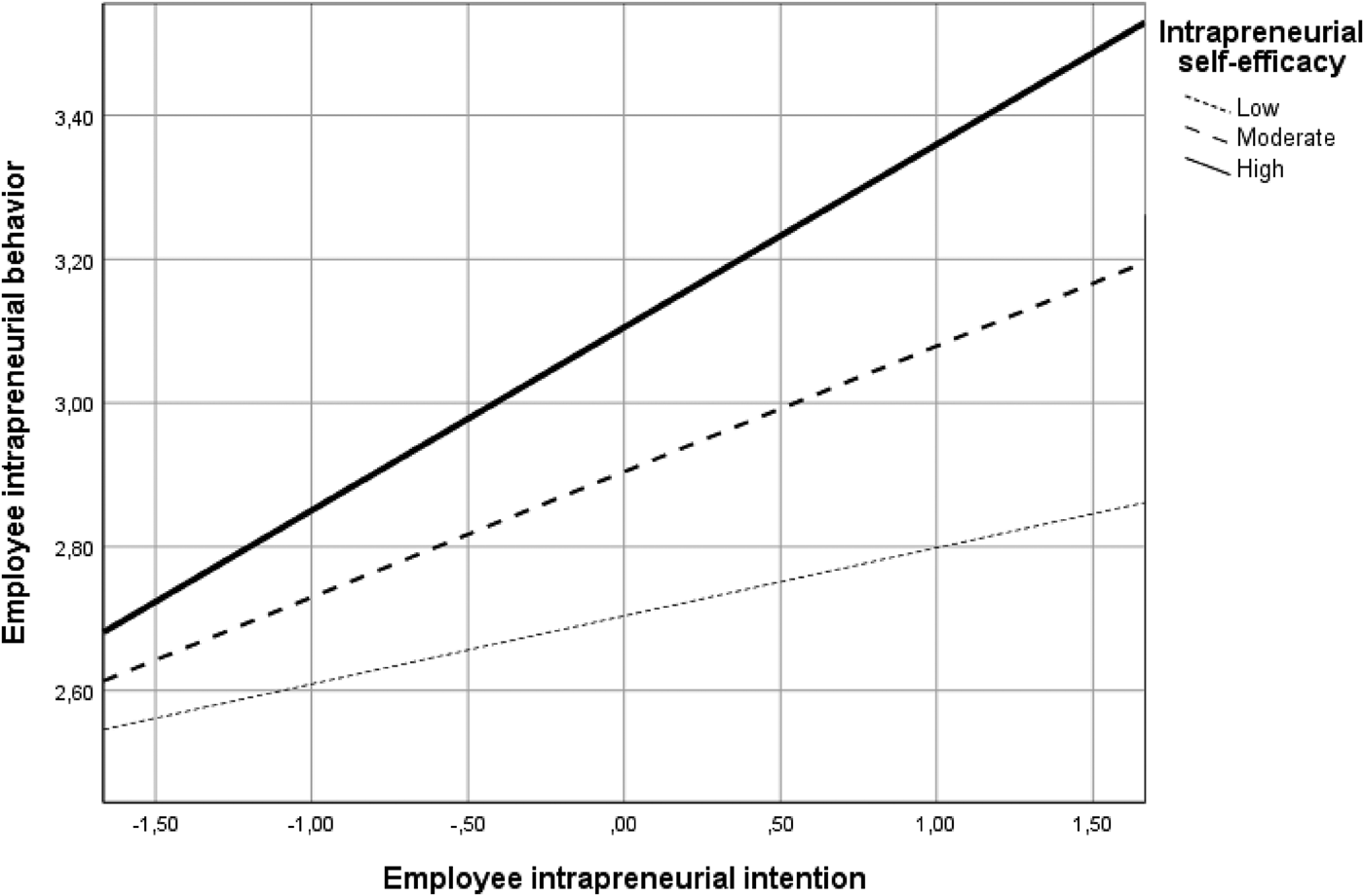
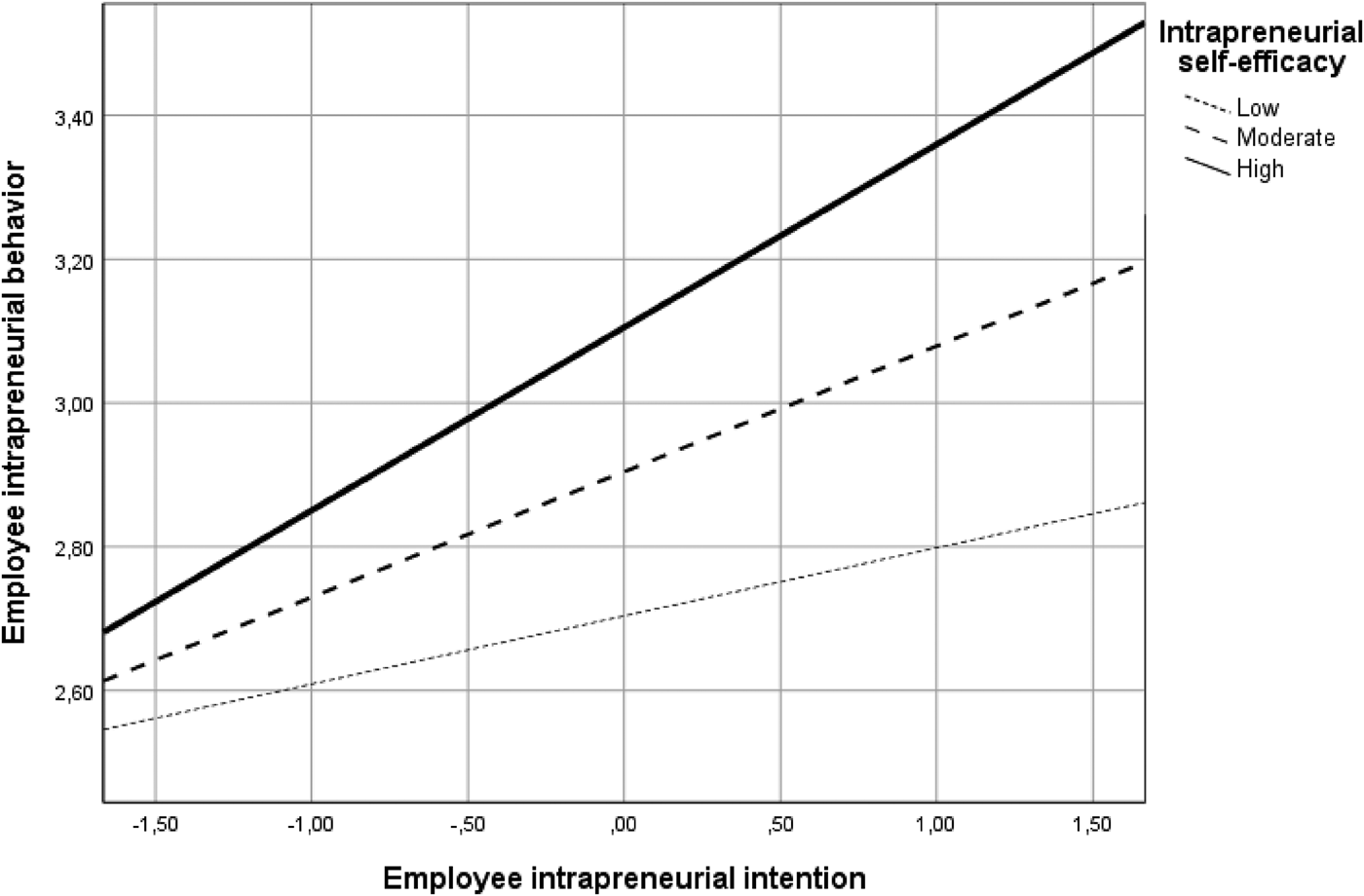
In accordance with Hypothesis 3, the interaction between EII and ISE is significant (β = .16, t = 2.88, p < .01), indicating that the indirect effect of POS on EIB through EII is moderated by ISE. The conditional indirect effect is significant when ISE is moderate (.035; CI = [.001; .082]) or high (.051; CI = [.002; .118]), but nonsignificant when ISE is low (.019; CI = [−.0003; .052]). Moreover, ISE is positively related to EIB (β = .40**, t = 4.12, p < .01) at CI = (.21; .59). For the sociodemographic variables, only education level is positively related to EIB (β = .16*, t Education–EIB = 2.27, p < .05) and EII (β = .46**, t Education–EII = 3.17, p < .01).
Figure 3 illustrates this indirect effect under low, moderate, and high ISE. As can be seen, the effect of intention on intrapreneurial behavior is stronger with an increasing level of ISE.
Indirect conditional effects of intrapreneurial intention at low, moderate, and high ISE.
Complementary analysis
Although we proposed that an indirect effect of POS on EIB through EII would be moderated by ISE, other interactions were also feasible. For example, ISE could exert a moderating effect in the first part of the model (between POS and EII). When we tested this alternate moderated mediation model the results did not support it. Despite a positive and significant impact of ISE on EII (β = 1.08**, t = 6.47, p < .01), the moderating effect between POS and EII was nonsignificant (β = .03; ns). We therefore concluded that our data provided stronger support for the proposed moderated mediation model.
Discussion
Our aim was to deepen the understanding of employee intrapreneurship in SMEs by investigating how EIB is related to the following psychosocial factors: POS, EII, and ISE. The results show that POS predicts EIB through EII, and that this indirect relationship is moderated by ISE. These findings make a useful contribution to the research on the intrapreneurial behavior of SME employees.
Theoretical contributions
In line with the principles of SET (Blau, Reference Blau1964), the results reveal that POS contributes to the intrapreneurial process. SET posits that when an individual provides a benefit (e.g., information, advice, and access to resources and other services) to another, usually on a voluntary basis, an obligation is set up such that the receiver should reciprocate with some kind of benefit (Ulhøi, Reference Ulhøi2005). Our results suggest that this reciprocity can manifest as intrapreneurial behavior when employees perceive that the organization supports them. They would then be more inclined to intrapreneurial activities, which translates into creative, innovative, and proactive behaviors at work. These results add to the research on intrapreneurship and SET (ul Haq, Khalid, & Usman, Reference ul Haq, Khalid and Usman2018; Zampetakis, Beldekos, & Moustakis, Reference Zampetakis, Beldekos and Moustakis2009; Zhang & Jia, Reference Zhang and Jia2010) by demonstrating that not only does POS foster a positive attitude toward extra-role behavior, meaning performance that exceeds prescribed tasks (Alnaimi & Rjoub, Reference Alnaimi and Rjoub2019), but that this behavior can take the form of intrapreneurial action.
The motivation for the present study stems from the fact that the pathway from intrapreneurial intention to intrapreneurial behavior in the presence of POS has been largely overlooked in the literature, despite the importance of Ajzen (Reference Ajzen1991) theory in this field. The results show that POS is positively associated with intrapreneurial behavior through the intrapreneurial intention. Thus, our results support the premises of planned behavior theory (Ajzen, Reference Ajzen1991) in the sense that intention would precede behavior. Moreover, these results highlight that the intrapreneurial process plays out within an organizational context that is shaped by employees' perceptions of the support they receive. Thus, POS, which is considered as a social resource (Marchand & Vandenberghe, Reference Marchand and Vandenberghe2014), inspires intrapreneurial intention, which can then translate into intrapreneurial action. These results expand our comprehension of the theory of planned behavior as applied to the intrapreneurial process, particularly in terms of the psychosocial determinants.
The results also indicate that ISE is positively related to EII. This finding concurs with the results of previous studies that employees' confidence in their ability to identify and exploit new opportunities and ideas within an existing organization contributes to their intrapreneurial behavior (Ibrahim, Mahmood, & Bakar, Reference Ibrahim, Mahmood and Bakar2016). More importantly, our results reveal that ISE is a necessary motivational condition for POS to act on the intrapreneurial process so that intention can translate into behavior. Although social cognitive theory (Bandura, Reference Bandura1997) stipulates that support and encouragement from others at the workplace reinforce self-efficacy and are therefore explanatory factors for employee behaviors, our results qualify this proposal by showing that self-efficacy also acts as a moderator in the intrapreneurial process. Thus, the indirect effect of intention translates into behavior, but only for employees who report considerable (moderate or high) self-efficacy. This contingency perspective implies that when self-efficacy is low, it is unable to strengthen the indirect relationship between POS and intrapreneurial behavior through intrapreneurial intention. In other words, POS would have little influence in the passage from intention to behavior when employees lack confidence in their intrapreneurial skills. These results underscore the relevance of employee self-efficacy for unleashing intrapreneurship behaviors, and they open up new perspectives on how self-efficacy facilitates job adaptation. In addition to helping employees cope with stress (Schaubeoeck & Merritt, Reference Schaubroeck and Merritt1997), self-efficacy can boost their professional development even as they contribute to creating a thriving and profitable business environment.
Limitations
This study includes a few limitations. First, the cross-sectional design does not allow establishing clear causal relationships between the variables or investigating developmental patterns associated with the intrapreneurial process. Some variables, such as intrapreneurial intention and intrapreneurial behavior, might gather strength over time. Therefore, a longitudinal study would enable a more rigorous examination of the temporal dynamics at play (Preacher, Reference Preacher2015). Second, because all data were gathered using the same method, common variance bias may have affected the results by heightening or diminishing the strength of the associations. Nevertheless, the observed moderating effect limits this possibility, as it is improbable that the presence of common variance would strengthen the indirect association between intrapreneurial intention and behavior for only those employees who reported specific levels of ISE. Notwithstanding, future studies should gather data from diverse sources in addition to self-report measures. For example, EIB could also be assessed from the immediate superior's standpoint. Third, the relatively small sample size and the specific sector examined constitute further limitations. With a larger sample size, future studies could consider each specific dimension of ISE and behavior to widen the scope of the findings. Although some alpha values of specific dimensions (ISE and EIB risk-taking) were within the lowest range of acceptability in the present study, it is noteworthy that reliability is negatively impacted by number of items (Streiner, Reference Streiner2003). Whereas this study makes an appreciable contribution to the nonmanufacturing sector, where research on intrapreneurship is scarce, future studies should also aspire to greater generalization of results. Hence, more studies are needed in larger samples and in various sectors and cultures to enhance the validity of the results.
Managerial implications and conclusion
Despite these limitations, this study offers useful clues as to how managers and executives can foster intrapreneurial behavior in their employees. Our results shed light on certain psychological factors that are determinants for intrapreneurial behaviors. From a social exchange perspective, the results suggest that employees who feel considered and valued by the organization are more inclined to adopt an innovative and proactive approach at work, overcome obstacles, and venture beyond their prescribed duties. Social resources play a major role in nurturing this kind of behavior, as they go a long way to make employees feel appreciated (e.g., allocation of free time, tolerance of failure, and recognition of performance). Consequently, employees are inspired to act as intrapreneurs. When employees feel that their opinions and well-being are taken into account, are assigned projects that go beyond their daily tasks, are granted increasing responsibility, and are publicly recognized for their extra initiatives and efforts, they are more likely to perceive their organization as supportive.
Our results show that ISE plays an important role in the pathway from intrapreneurial intention to intrapreneurial action. Therefore, organizations could introduce training programs to build employees' skills in initiative-taking and new project development. This would also develop their feelings of self-efficacy. According to Bandura (Reference Bandura1997), self-efficacy is nurtured by mastery experiences, social learning, verbal persuasion, and emotional states. Organizations could also seek to strengthen employees' intrapreneurial skills by providing diverse programs (e.g., training, mentoring, and twinning) designed to optimize the intrapreneurship process. Mokhber, Khairuzzaman, and Vakilbashi (Reference Mokhber, Khairuzzaman and Vakilbashi2018) believe that transformational leadership is an important leadership practice that can enhance the motivation and ability of employees to be creative and innovative. In sum, organizations can take a proactive stance toward intrapreneurship by offering the support that employees want and need.
Acknowledgements
This first author's work was supported by a postdoctoral scholarship grant from the Groupe de recherche sur la santé et le mieux-être au travail (G-SMAT) and the Laboratoire de recherche interdisciplinaire sur les processus motivationnels (LIRPOM).