Primary ciliary dyskinesia and heterotaxy are both rare but not mutually exclusive disorders, which have been linked through dysfunction of the human cilia. Primary ciliary dyskinesia is a heterogeneous, primarily autosomal recessive disorder of the motile cilia, with an estimated prevalence of 1/16,000. Clinical manifestations include neonatal respiratory distress, chronic sinusitis, recurrent bronchitis or pneumonia, recurrent otitis media, and male infertility, owing to dysfunction of sperm flagella.Reference Knowles, Daniels, Davis, Zariwala and Leigh 1 Primary ciliary dyskinesia patients also have dysfunction of the embryonic nodal cilia with situs inversus and associated laterality defects in 50%.Reference Zariwala, Knowles and Leigh 2 – Reference Torgersen 4 In addition, mutations in ciliary outer dynein arm genes – DNAI1 and DNAH5 – can cause both heterotaxy and primary ciliary dyskinesia, with outer dynein arm defects in both the embryonic nodal cilia and respiratory cilia.Reference Kennedy, Omran and Leigh 5 – Reference Tan, Rosenthal and Zhao 9
“Isolated” heterotaxy is a disorder involving organ laterality defects, situs ambiguus, and often congenital heart disease, and is associated with various genetic inheritance patterns, including autosomal dominant, autosomal recessive, X-linked, and complex inheritance.Reference Casey, Cuneo and Vitali 10 – Reference De Luca, Sarkozy and Consoli 13 The prevalence of heterotaxy is estimated at 1/10,000.Reference Zhu, Belmont and Ware 14 In 2006, a retrospective study showed that heterotaxic anomalies are present in at least 6.3% of an international primary ciliary dyskinesia population, and more recently, a prospective study has increased this prevalence to be at least 12.1%.Reference Kennedy, Omran and Leigh 5 , Reference Shapiro, Davis and Ferkol 6 However, the true prevalence may be even higher, as many primary ciliary dyskinesia patients do not routinely have investigations to define their abdominal laterality defects. Moreover, heterotaxy patients, particularly those with congenital heart disease, often have complicated medical courses including neonatal respiratory distress, cyanosis, and pneumonias. Many of these symptoms may be mistakenly attributed to a cardiac origin, yet they may be due to unrecognised respiratory cilia dysfunction.Reference Brueckner 15 One study showed that children with heterotaxic heart lesions, when compared with children with non-heterotaxic heart lesions of similar severity, require considerably longer courses of postoperative ventilator support and have more postoperative respiratory complications, which may reflect occult respiratory cilia dysfunction.Reference Swisher, Jonas and Tian 16 Thus, the prevalence of primary ciliary dyskinesia in heterotaxy remains ill-defined, and many physicians are not aware of the link between these two ailments.
We present results of a web-based survey, completed by members of a non-profit heterotaxy organisation, investigating the prevalence of clinical symptoms commonly associated with primary ciliary dyskinesia within this population of individuals with heterotaxy.
Materials and methods
Qualtrics software (Qualtrics Labs Inc., Provo, Utah, permission through The Howard W. Odum Institute for Research in Social Science, University of North Carolina, Chapel Hill, North Carolina, United States of America) was used to design a web-based survey. We sent an electronic invitation to all 200 members from the Heterotaxy Hope Organization, formerly the Right Isomerism and Asplenia Syndrome Network, to participate in the survey. People in this non-profit group are self-referred, and their heterotaxy lesions are not verified for membership. Heterotaxy patients themselves or parents of children with heterotaxy were asked to respond. The survey remained active for 4 months, and participants were sent an invitation link to the survey on two occasions via the Heterotaxy Hope Organization online message board.
This survey contained detailed questions on the presence of cardiac, vascular, abdominal, and other laterality defects in each participant. Questions were included on personal or family history of heterotaxy and primary ciliopathies – Bardet–Biedl syndrome, Joubert syndrome, Orofaciodigital syndrome, Retinitis Pigmentosa, hydrocephalus, Meckel–Gruber syndrome, Ellis-van Creveld syndrome, Jeune syndrome, caudal regression syndrome, nephronophthisis, and cystic kidney disease. Questions on the past testing for cystic fibrosis and primary ciliary dyskinesia were also incorporated. Detailed clinical history on the presence of chronic oto-sino-pulmonary symptoms was collected. Finally, information was gathered on the presence of bronchiectasis and results of past respiratory cultures in each participant.
Respondents were considered at increased possibility of having primary ciliary dyskinesia if they had at least two chronic respiratory symptoms, including year-round wet cough on a daily basis, year-round nasal congestion on a daily basis, chronic otitis media, recurrent pneumonia or bronchitis, or chronic sinusitis. With the expected high prevalence of neonatal respiratory distress in this heterotaxy population with congenital heart disease, we did not use neonatal respiratory distress as criteria for increased possibility of primary ciliary dyskinesia. However, in a primary ciliary dyskinesia population without congenital heart disease, neonatal respiratory distress, often accompanied by shifting lobar collapse, is present in more than 80% of primary ciliary dyskinesia births.Reference Knowles, Daniels, Davis, Zariwala and Leigh 1 , Reference Mullowney, Dell, Manson and Shah 17 Special attention was paid to daily wet cough and daily nasal congestion with onsets before 1 year of age, as these criteria are quite prevalent in heterotaxy patients with primary ciliary dyskinesia.Reference Shapiro, Chawla and Baker 18 – Reference Shapiro, Chawla and Baker 20 To ensure adequate time for development of chronic symptoms, we limited analysis to those respondents over 1 year of age. As independent parameters, the presence of bronchiectasis or past respiratory cultures growing pseudomonas, burkholderia, stenotrophomonas, or non-tuberculous mycobacterium species also suggested the possibility of primary ciliary dyskinesia. Those participants with possible primary ciliary dyskinesia were contacted and advised to pursue further testing at the University of North Carolina or locally through a pulmonologist. Those assessed at the University of North Carolina received a comprehensive medical history, a complete physical examination, a nasal nitric oxide measurement,Reference Leigh, O'Callaghan and Knowles 21 , Reference Leigh, Hazucha and Chawla 22 a nasal ciliary biopsy with electron microscopy analysis, and screening for mutations in genes known to harbour primary ciliary dyskinesia causing mutations as part of a National Institutes of Health funded research protocol, after obtaining consent from the parents.
All p-values were calculated by Fisher’s exact or Mann–Whitney tests as applicable, and values <0.05 were considered statistically significant. The institutional review board at the University of North Carolina approved this study.
Results
Of the 200 members in the Heterotaxy Hope Organization, 54 responded to the survey invitation and completed all question fields. Of the responses, 49 (24.5%) were for participants older than 1 year of age (median age 4.8 years, range 1.0–41.6 years, 42% male), and 46 surveys were completed by parents of a child with heterotaxy, whereas three were completed by participants with heterotaxy themselves. Respondents were spread across 26 different states in the United States, and eight were from other countries (Ireland=4, United Kingdom=2, Australia=1, and Canada=1).
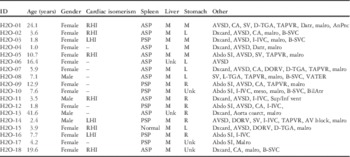
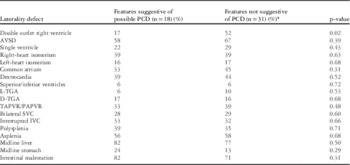
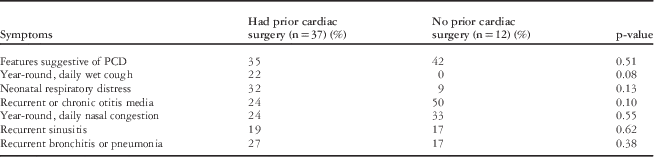
Looking at overall situs status, 18 (37%) respondents reported situs inversus totalis, 19 (39%) had abdominal situs inversus, and 12 (24%) were unsure of their overall situs designation (Table 1). Of the participants, 19 (39%) had right-heart isomerism and eight (16%) had left-heart isomerism. All participants except for one had structural cardiovascular anomalies at birth, and 37 (76%) had previous cardiac surgery. No cardiac, vascular, abdominal, or laterality defects were more prevalent in those with features suggestive of primary ciliary dyskinesia versus those without features of primary ciliary dyskinesia (Table 2). Double outlet right ventricle was more prevalent in those without features of primary ciliary dyskinesia – double outlet right ventricle without features of primary ciliary dyskinesia 52%, double outlet right ventricle with features suggestive of possible primary ciliary dyskinesia 17%, p=0.02. There were no significant differences in prevalence of chronic respiratory symptoms for those with previous cardiac surgery versus those without previous cardiac surgery, although the prevalence of daily wet cough tended to be higher in those with previous cardiac surgery (22% versus 0%, p=0.08) (Table 3).
Laterality, cardiac, vascular, and abdominal defects in those with features suggesting possible PCDFootnote *.

Abdo SI=abdominal situs inversus; AnPnc=annular pancreas; ASP=asplenia; AVSD=atrioventricular septal defect; BilAtr=biliary atresia; B-SVC=bilateral superior vena cava; CA=common atrium; coarct=aortic coarctation; Datr=duodenal atresia; DORV=double outlet right ventricle; D-TGA=dextro transposition of great vessels; Dxcard=dextrocardia; I-IVC=interrupted inferior vena cava; L=left; LHI=left-heart isomerism; L-TGA=levo transposition of great vessels; M=midline; malro=intestinal malrotation; meso=mesocardia; PCD=primary ciliary dyskinesia; PSP=polysplenia; R=right; RHI=right-heart isomerism; SIT=situs inversus totalis; Sup/Inf vent=superior inferior ventricles; SV=single ventricle; TAPVR=total anomalous pulmonary venous return; Unk=unknown
* All data obtained by participant report
Prevalence of laterality, cardiac, vascular, and abdominal defects in all participants.

AVSD=atrioventricular septal defect; D-TGA=dextro transposition of great vessels, Interrupted IVC=interrupted inferior vena cava, L-TGA=levo transposition of great vessels, SVC=superior vena cava; TAPVR/PAPVR=total or partial anomalous pulmonary venous return
* All data obtained by participant report
Prevalence of respiratory symptoms by prior cardiac surgery status.

PCD=primary ciliary dyskinesia
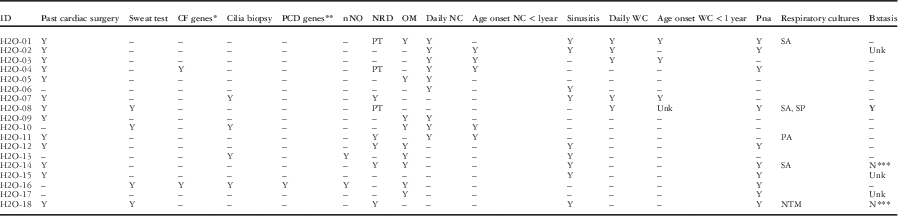
Of the participants, 18 (37%, median age 6.5 years, range 1–46 years) participants had clinical features suggestive of primary ciliary dyskinesia, with at least two chronic oto-sino-pulmonary symptoms, bronchiectasis, or past respiratory cultures associated with primary ciliary dyskinesia, of whom five (10%) had daily wet cough with onset before 1 year of age, and eight (16%) had daily nasal congestion with onset in the first year of life (Table 4), and 10 of those with possible primary ciliary dyskinesia had asplenia, and seven had polysplenia. Overall, 18 (37%) of the total respondents had a past chest computed tomography scan, including 10 (56%) of those with features suggesting possible primary ciliary dyskinesia. One respondent (H2O-08) had bilateral lower lobe bronchiectasis on a past chest computed tomography scan. Initially, two additional respondents had reported bronchiectasis that was discovered at 1 month of age, but this was later clarified as “bronchiolitis” and not bronchiectasis. Of the participants, 11 (22%) had received previous flexible bronchoscopy, and two had respiratory cultures positive for pseudomonas or non-tuberculous mycobacterium, respectively (Table 4); 31 (63%, median age 4.8 years, range 1.2–27 years, p=0.28) participants were lacking clinical features of primary ciliary dyskinesia. Of these, two (4%) had isolated daily nasal congestion and two (4%) had isolated daily wet cough with onsets before 1 year of age.
Clinical symptoms and past investigations in those with features suggesting possible PCD.

Bxtasis=bronchiectasis; NC=nasal congestion; nNO=nasal nitric oxide; NRD=neonatal respiratory distress; NTM=non-tuberculous mycobacterium; OM=otitis media; PA=pseudomonas; Pna=pneumonia or bronchitis; PT=preterm; SA=Staphylococcus aureus; SP=Streptococcus pneumonia; Unk=unknown; WC=wet cough
* Any previous genetic testing for CF mutations, limited or extended mutation panels or full CFTR gene sequencing
** Previous genetic testing for any mutations in known PCD-causing genes
*** Initially reported as bronchiectasis, actually “bronchiolitis”
Overall, six (12%) participants had previous testing for primary ciliary dyskinesia, five had ciliary biopsies performed, two had genetic testing for primary ciliary dyskinesia, and two had nasal nitric oxide measurements to screen for primary ciliary dyskinesia. None were actually diagnosed with primary ciliary dyskinesia before survey participation, and only four of them with features suggestive of possible primary ciliary dyskinesia had past testing for respiratory cilia defects. Of the participants, nine (18%) were tested for cystic fibrosis, and five of them had features suggestive of possible primary ciliary dyskinesia. None were diagnosed with cystic fibrosis.
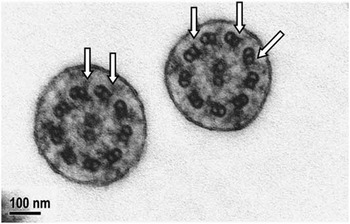
Of the heterotaxy respondents with possible primary ciliary dyskinesia, four completed a full clinical evaluation at the University of North Carolina, and three of them had very low nasal nitric oxide measurements, signifying probable primary ciliary dyskinesia.Reference Leigh, Hazucha and Chawla 22 – Reference Chawla, Shapiro and Hazucha 25 Unfortunately, only one of these respondents had adequate cilia upon nasal biopsy, which showed 38% absent, 46% shortened, and 16% normal outer dynein arms, consistent with a diagnosis of primary ciliary dyskinesia (Fig 1). Whole-exome sequencing for this participant confirmed primary ciliary dyskinesia with compound heterozygote mutations in DNAH5, which is known to harbour primary ciliary dyskinesia-causing mutations.Reference Olbrich, Haffner and Kispert 26 , Reference Hornef, Olbrich and Horvath 27 The proband had one missense variant [c.7096 G>A (p.Arg2366Trp)] in exon 43 and one loss-of-function variant [c. 9637delG (p.Ala3213Leufs*8)] in exon 57. Genetic testing of the proband’s mother revealed that she carried only the missense variant. Details of the investigations for these participants can be found in Table 5.
Ciliary ultrastructure by electron microscopy, demonstrating frequently absent and shortened outer dynein arms (white arrows) in participant H2O-03, consistent with a diagnosis of primary ciliary dyskinesia.

Results of confirmatory PCD testing on participants evaluated in person.

EM=electron microscopy; OPF=oropharyngeal flora; PCD=primary ciliary dyskinesia; SA=Staphylococcus aureus
* nNO=nasal nitric oxide, nNO <100 nl/minute with palate closure is consistent with classic PCD, nNO <60 nl/minute at 4 years old, and <35 nl/minute at 2 years old via tidal breathing is consistent with classic PCDReference Shapiro, Chawla and Baker 20 , Reference Leigh, O'Callaghan and Knowles 21
** All known genes harbouring PCD-causing mutations were not testedReference Knowles, Daniels, Davis, Zariwala and Leigh 1
Review of other elements revealed that no participants or their family members had evidence of other primary ciliopathies. Of the respondents with family members, one respondent had two relatives with cystic fibrosis, but no family members with primary ciliary dyskinesia; and five (10%) had a family member with heterotaxy, of which three had features suggestive of possible primary ciliary dyskinesia. Of those respondents who received full clinical evaluations, one with probable primary ciliary dyskinesia had an identical twin brother with duodenal atresia, imperforate anus, and hypoplasia of the right thumb, but no chronic respiratory symptoms, whereas the participant with confirmed primary ciliary dyskinesia had a healthy male sibling with normal situs.
Discussion
Heterotaxy and primary ciliary dyskinesia are rare disorders linked through dysfunction of the human motile cilia. In this survey of a heterotaxy population, the prevalence of self-reported chronic oto-sino-pulmonary symptoms is substantial (37%). In addition, another four (8%) participants had isolated daily wet cough or daily nasal congestion from an early age, and these two symptoms are quite prevalent in heterotaxy patients with primary ciliary dyskinesia.Reference Shapiro, Chawla and Baker 18 – Reference Shapiro, Chawla and Baker 20 Thus, the prevalence of respiratory cilia dysfunction manifesting as chronic respiratory symptoms in this population may be even higher than reported here.
Aside from clinical symptoms suggestive of primary ciliary dyskinesia, two participants had respiratory cultures with organisms (pseudomonas and non-tuberculous mycobacterium) that are associated with primary ciliary dyskinesia and cystic fibrosis. However, these two respondents were never actually tested for either respiratory disease. Unlike the respiratory culture findings in cystic fibrosis, where 80% of patients grow pseudomonas aeruginosa by 18 years of age, respiratory cultures in children with primary ciliary dyskinesia more commonly yield Streptococcus pneumoniae, Staphylococcus aureus, Moraxella catharralis, and Hemophilus influenza, which are often regarded as community-acquired infections.Reference Noone, Leigh and Sannuti 23 , Reference Treggiari, Rosenfeld and Mayer-Hamblett 28
Only one participant in this heterotaxy population had documented bronchiectasis, suggesting substantial airway disease and chronic damage. Bronchiectasis is an age-related finding in primary ciliary dyskinesia, with 56% of children having bronchiectasis on chest computed tomography scan in past research.Reference Kennedy, Noone and Leigh 29 Whereas 37% of the total respondents had a past chest computed tomography scan, many of these scans were likely performed during infancy to define vascular anatomy in preparation for surgical procedures. Therefore, these scans do not fully evaluate the prevalence of bronchiectasis in this population, and there may be some participants with undiscovered bronchiectasis.
There are no prospective studies on the development of bronchiectasis in children with heterotaxy or congenital heart disease in general – aside from the literature on outcomes after cardiac transplantation – and smaller case reports on bronchiectasis in anomalous pulmonary venous return and pulmonary artery agenesis were published before the connection between primary ciliary dyskinesia and heterotaxy was known.Reference Counil, Ichay and Guillaumont 30 , Reference Bouros, Pare and Panagou 31 Children in these reports may have actually had primary ciliary dyskinesia, as this was not ruled out in either of these publications. Although we only had one participant with verified bronchiectasis, we did see that participants with previous cardiac surgery had a higher prevalence of daily cough versus those who never had cardiac surgery. These observations support the need for a prospective study of chronic respiratory symptoms and bronchiectasis in children with heterotaxy and congenital heart disease in general.
Asplenia or dysfunctional polysplenia with resulting immune deficiency could explain the increase in respiratory symptoms in our respondents. Yet, only 10 (56%) of them with features suggestive of possible primary ciliary dyskinesia had asplenia, and past publication shows the majority of children with heterotaxy and polysplenia actually have functional splenic tissue.Reference Nagel, Williams and Stewart 32 Moreover, no distinct cardiac, abdominal, vascular, or laterality defect was more prevalent in those respondents with features suggesting possible primary ciliary dyskinesia. The prevalence of double outlet right ventricle was higher in those respondents without features of primary ciliary dyskinesia, and the reason for this is unclear. Therefore, any person with heterotaxy, regardless of the actual heterotaxic defect(s) should be investigated for primary ciliary dyskinesia when chronic oto-sino-pulmonary symptoms are present.
Diagnosing primary ciliary dyskinesia can be quite difficult outside of highly specialised centers. Some European and Canadian centres offer clinical primary ciliary dyskinesia screening with nasal nitric oxide measurement; however, this screening test is limited to research settings in the United States of America. Approximately 20–30% of electron microscopy images from ciliary biopsies can be normal in primary ciliary dyskinesia, and current genetic testing can only detect 50–60% of primary ciliary dyskinesia-causing genetic mutations. High-speed videomicroscopy with beat pattern analysis can increase the diagnostic yield, but this service is only offered at a limited number of centres. There is no single “gold standard” primary ciliary dyskinesia diagnostic test, and often several different tests are required to confirm a diagnosis of primary ciliary dyskinesia.Reference Knowles, Daniels, Davis, Zariwala and Leigh 1
The 10% prevalence of heterotaxy recurrence within families responding to this survey is greater than the reported familial heterotaxy prevalence.Reference Øyen, Poulsen, Boyd, Wohlfahrt, Jensen and Melbye 33 However, several reports have demonstrated familial clustering through either autosomal dominant, autosomal recessive, or X-linked inheritance patterns.Reference Casey, Cuneo and Vitali 10 – Reference Zhu, Belmont and Ware 14 Approximately 10% of infants with heterotaxy have a close relative with congenital heart defects,Reference Zhu, Belmont and Ware 14 and perhaps our survey respondents considered any relative with congenital heart disease as having heterotaxy.
This patient-reported survey is limited by lack of clinical confirmation of heterotaxic lesions and lack of diagnostic testing for primary ciliary dyskinesia in the majority of subjects. As the respondents are spread across the globe, complete analysis of all participants with suggestion of possible primary ciliary dyskinesia was not a realistic option for this protocol. We did advise respondents with features suggestive of possible primary ciliary dyskinesia to pursue further testing through a local pulmonologist. Of note, we report verbatim participant responses, and some situs descriptions are contradictory – situs inversus totalis with right-heart isomerism and levocardia in one individual. This underlies the confusion surrounding nomenclature in heterotaxy, which can often be unclear even to trained medical practitioners.Reference Evans 34 Furthermore, to avoid respondent confusion, some terminology in the survey was intentionally oversimplified. For example, the response choices for right- or left-heart isomerism specifically omitted any reference to atrial appendages or spleen status, which are often incorporated into the varying definitions of isomerism sequence. This simplification may have affected the accuracy of the responses. Sampling error may also explain our very high prevalence of respondents with features suggesting possible primary ciliary dyskinesia, as those with chronic oto-sino-pulmonary symptoms were likely more motivated to participate in our survey. Finally, there is doubt about the underlying population’s denominator. We cannot be certain how representative the members of Heterotaxy Hope Organization are of all patients with heterotaxy, as group members have the interest and resources necessary to belong to an advocacy group, although there is no reason to believe that members’ disease would systematically differ from that of patients who were similar except for the lack of group membership.
This study shows that web-based surveys are a powerful tool for investigating rare diseases, especially when participants are geographically isolated and in-person visits are not feasible. In addition, web surveys can provide valuable insight into overlapping diseases that are followed by separate medical and surgical services, just as heterotaxy and primary ciliary dyskinesia fall under the differing auspices of pulmonology, cardiology, and cardiothoracic surgery. Physicians treating heterotaxy patients could use similar online surveys to query this complex cohort of patients and discover evolving oto-sino-pulmonary symptoms, which could lead to further primary ciliary dyskinesia investigation.
In conclusion, the prevalence of primary ciliary dyskinesia-related symptoms in one heterotaxy population is very high, and physicians managing heterotaxy patients should be aware of the association with respiratory cilia dysfunction. Investigation of primary ciliary dyskinesia should be aggressively pursued in heterotaxy patients with bronchiectasis, daily wet cough, daily nasal congestion, or other recurrent oto-sino-pulmonary disease symptoms. Therefore, early referral to a centre with experience in diagnosing primary ciliary dyskinesia is essential for improved outcomes in children with heterotaxy and complex congenital heart disease.
Acknowledgements
The authors are grateful to the families and members of the Heterotaxy Hope Organization for their participation in this survey. They also thank Francesc Lopez-Giraldez, PhD, and Richard P. Lifton, MD, PhD, of Yale University for their assistance with whole-exome sequencing.
Financial Support
Funding for research was provided to A.S., M.Z., M.K., and M.L. by US NIH/ORDR/NHLBI grant 5US54HL096458–06, to MK and MZ by NIH-NHLBI grant 5R01HL071798 and NIH-NCATS grant UL1 TR000083 to UNC-CH. The Genetic Disorders of Mucociliary Clearance Consortium (5U54HL096458) is a part of the NIH Rare Disease Clinical Research Network (RDCRN), supported through collaboration between NIH-ORDR at NCATS, and NIH-NHLBI. The content is solely the responsibility of the authors and does not necessarily represent the official views of the National Institutes of Health.
Conflicts of Interest
None.
Ethical Standards
Informed consent was obtained for all participants, and this study was reviewed and approved by the Institutional Review Board at the University of North Carolina.
Supplementary material
To view supplementary material for this article, please visit http://dx.doi.org/10.1017/S1047951114000912