Large scale distributions of highly migratory marine animals are often difficult to discern due to the concealing nature of their environment, vast expanses of potential habitat, and uncertainty associated with abiotic and biotic preferences of a given species. Historically, distributions of large marine organisms were determined by combining fisheries-dependent data and anecdotal reports (e.g. Bigelow & Schroeder, Reference Bigelow, Schroeder, Tee-Van, Breder, Hildebrand, Parr and Schroeder1948). Recently, understanding of large scale distributions has been refined through the use of fisheries-independent data and advanced tagging technologies (Sims, Reference Sims, Carrier, Musick and Heithaus2010); however, anecdotal accounts still represent an important source of information for identifying areas on the periphery of a species' range or documenting anomalous occurrences.
The basking shark, Cetorhinus maximus (Gunnerus, 1765), is a large elasmobranch, with a reported maximum total length (TL) of 12 m (Sims, Reference Sims2008) that is considered seasonally common in the western North Atlantic Ocean from Newfoundland to North Carolina (Castro, Reference Castro2011). The distribution of basking sharks in the western North Atlantic Ocean has been the subject of much speculation. For example, Bigelow & Schroeder (Reference Bigelow, Schroeder, Tee-Van, Breder, Hildebrand, Parr and Schroeder1948) reported that basking sharks rarely occur south of Cape Cod, Massachusetts during summer months and based on the lack of sightings during colder months hypothesized that the sharks are inactive during the winter and occupy deep waters ‘perhaps lying on or close to the bottom’. Briggs (Reference Briggs1960) hypothesized that while basking sharks are usually encountered in cold waters, they make transequatorial movements since they are found in both the northern and southern hemispheres. This hypothesis was confirmed almost 50 years later by Skomal et al. (Reference Skomal, Zeeman, Chisholm, Summer, Walsh, McMahon and Thorrold2009) who demonstrated that basking sharks in the western North Atlantic Ocean migrate during winter months into tropical waters, including the Bahamas, Caribbean Sea and off the coast of South America. Since basking sharks make long distance winter migrations into mesopelagic waters associated with the tropics, past observations of individuals during winter months off the east coast of Florida (Springer & Gilbert, Reference Springer and Gilbert1976; Choy & Adams, Reference Choy and Adams1995) are no longer surprising. However, the sole report of a basking shark in the Gulf of Mexico during the spring of 1969 (Springer & Gilbert, Reference Springer and Gilbert1976) remains enigmatic. We report on recent observations of four basking sharks off the north-west Florida coast which suggest the occurrence of this species in the Gulf of Mexico might not be as exceptional as once thought.
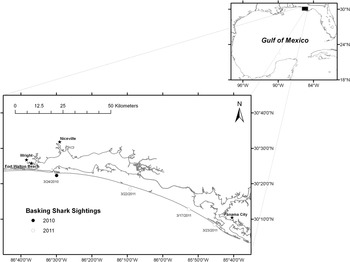
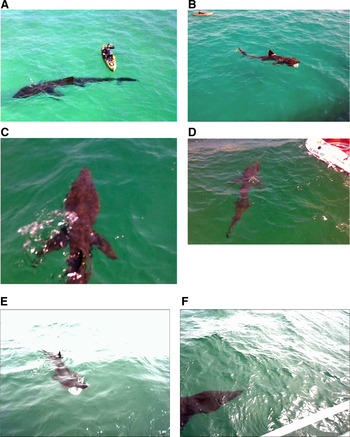
On 17 March 2011, a basking shark was observed and photographed by one of the authors (L. Cavitt) in the coastal waters off Panama City Beach, Florida (30.213°N 85.878°W; Figure 1). The shark's TL was estimated to be 9.0 m based on the dimensions of a kayak (Angler 144 Sit on Top Kayak, 3.7 × 0.8 m) captured in a photograph with the basking shark (Figure 2A, B). The shark, which was observed from 1500 to 1800 hours, swam in tight circles and appeared to be feeding on a relatively dense aggregation of copepods (L. Cavitt, personal observation). The water depth and temperature at the sighting location were 7.6 m and 19°C, respectively.
Map depicting the locations of basking shark, Cetorhinus maximus, sightings reported from the northern Gulf of Mexico during 2010 (●) and 2011 (○).

Photographs: (A, B) showing a 9.0 m basking shark, Cetorhinus maximus, swimming at the surface in shallow waters off Panama City Beach, Florida, 17 March 2011; (C, D) of an estimated 2.4 m basking shark, Cetorhinus maximus, sighted off Panama City, Florida, 23 March 2011; and (E, F) of an estimated 2.1 m basking shark, Cetorhinus maximus, sighted off Destin, Florida, 24 March 2010. Photographic credits: (A) Ryan Huggins; (B) Linda Cavitt; (C, D) Charles Chan; (E, F) William Weldon.

On 22 March 2011, a second basking shark was briefly observed and photographed by Edmond Alexander at 0828 hours. The shark was swimming at the surface 1.6 km south of Destin, Florida (30.310°N 86.153°W; Figure 1), approximately 29 km north-west of the 17 March 2011 sighting. The dorsal fin, which was clearly visible above the water's surface, was estimated to be 0.7 m in height. Based on morphometric relationships presented by Springer & Gilbert (Reference Springer and Gilbert1976) the shark was calculated to be 5.3 m TL. A third basking shark was observed and photographed by Captain Charles Chan on 23 March 2011 between 1400 and 1500 hours in shallow waters off Panama City, Florida (30.140°N 85.756°W; Figure 1), about 14.5 km east of the 17 March 2011 sighting (Figure 2C, D). The shark was estimated to be 2.4 m TL.
As a result of intense local and national media attention given to the 17 March 2011 sighting, Captain William Weldon, a local fisherman, provided video recording of a basking shark he had observed in shallow waters off Destin, Florida on 24 March 2010 (30.372°N 86.499°W; Figure 1). The shark, estimated to be 2.0 m TL (Figure 2E, F), was sighted at 1400 hours and swam at the surface for 0.25 hours. The angler's log reported water depth and temperature as 6.1 m and 19°C, respectively. Interestingly, this shark (2.0 m TL) and the individual observed on 23 March 2010 (2.4 m TL) were only slightly larger than the size at parturition for basking sharks (Sims, Reference Sims2008). Individuals of this size are rarely observed anywhere throughout their known range (Sims, Reference Sims2008).
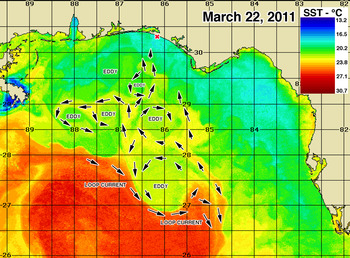
Of the three basking shark sightings that occurred over a 7-day period during March 2011, all three observers reported unusually high water clarity in the area of the encounter. In addition, one of the authors obtained photographs and underwater video footage of copepods that were being preyed upon by the 17 March 2011 basking shark (L. Cavitt, unpublished data). Though the copepods could not be identified to species level, they were identified as a calanoid copepod common to the offshore waters of the Gulf of Mexico (R. Heard, personal communication). Based on the simultaneous presence of oceanic copepods and reports of unusually high water clarity in the area of the sightings, it was hypothesized that a filament of oceanic water associated with a Loop Current eddy had moved inshore. After analyses of satellite infrared imagery, acquired from the NOAA 15, 16, 18, 19 and Metop_A satellites, it was evident that water associated with the Loop Current was in the vicinity of the coastal areas of the north-eastern Gulf of Mexico where the three 2011 sightings took place (Figure 3). During the week of 20 March 2010, the Loop Current was extending into the northern Gulf of Mexico and a series of cyclonic and anti-cyclonic eddy features had pulled filaments of oceanic water northward to within 50 km of the coast. Based on sequential image analysis of infrared and ocean colour satellite data, acquired from the Aqua and Terra satellites, intrusions of mixed oceanic and coastal waters were in a northerly direction into the study area.
A colorized composite satellite image derived from infrared data on 22 March 2011 from NOAA 15, 16, 18, 19 and Metop_A showing the intrusion of the Loop Current (warmest with red colours) into the northern Gulf of Mexico. The black arrows indicate the overall direction of the water flow, and the cyclonic and anti-cyclonic eddy features are labelled. The red ‘X’ indicates the location of the basking shark on that day.

Recent findings regarding seasonal migrations of basking sharks in the western Atlantic Ocean point to the possibility that the Loop Current could play a significant role in the annual migration of the species. Basking sharks in the north-western Atlantic Ocean spend the spring and summer in coastal temperate feeding grounds and then overwinter in mesopelagic tropical waters (Skomal et al., Reference Skomal, Wood and Caloyianis2004, Reference Skomal, Zeeman, Chisholm, Summer, Walsh, McMahon and Thorrold2009). Skomal et al. (Reference Skomal, Zeeman, Chisholm, Summer, Walsh, McMahon and Thorrold2009) speculated that the movements of basking sharks from the temperate waters of the North Atlantic Ocean into the tropical waters of the Caribbean Sea and southern hemisphere were not based on energetic requirements alone and could be linked to their reproductive biology. Skomal et al. (Reference Skomal, Zeeman, Chisholm, Summer, Walsh, McMahon and Thorrold2009) further suggested that the mesopelagic tropical waters could provide more stable conditions for gestation and parturition, as well as serve as critical nursery habitat for this species. The Gulf of Mexico is located between the basking shark's temperate summer feeding and tropical overwintering grounds, and could represent ephemeral habitat for this species during its northward spring migration.
Skomal et al. (Reference Skomal, Zeeman, Chisholm, Summer, Walsh, McMahon and Thorrold2009) used satellite telemetry data to document the use of open ocean waters by basking sharks in the western North Atlantic Ocean during their seasonal migration to the overwintering grounds, which ranged from the Caribbean Sea to the coast of South America. Therefore, basking sharks that overwinter in the Caribbean Sea could enter the Gulf of Mexico through the Strait of Yucatan during the period of northerly migration. Once in the Gulf of Mexico, oceanic currents such as the Loop Current would present a northerly transport corridor for access to northern Gulf of Mexico waters (Figure 3). Basking sharks, including small juveniles could utilize the Loop Current and subsequently the Gulf Stream as a migratory pathway to their temperate feeding grounds in the North Atlantic Ocean.
With no reported sightings of basking sharks in the Gulf of Mexico between 1969 and 2009, the presence of other basking sharks in the region was considered doubtful. However, the four sightings reported here suggest that basking sharks could be seasonal migrants in the Gulf of Mexico and are more abundant than previously thought. That the seasonal timing of these sightings corresponded with the original basking shark sighting off Sarasota, Florida (Springer & Gilbert, Reference Springer and Gilbert1976) suggests that the Gulf of Mexico waters could represent available feeding habitat during early spring while making their northerly migration. Better communication is needed between the public and local scientists so that the distribution of highly migratory organisms, like the basking shark, can be properly documented.
ACKNOWLEDGEMENTS
We would like to thank Edmond Alexander, Charles Chan, William Weldon, Josh Reeves and Ryan Huggins for the information and photographic documentation provided with regard to their basking shark encounters, and Gregory Gawlikowski for helping to derive the satellite imagery. We would also like to thank Glenn Parsons for his review of this manuscript.