Introduction
Fatigue is one of the most common symptoms among cancer patients (Alawneh et al., Reference Alawneh, Anshasi and Khirfan2017; Mehnert et al., Reference Mehnert, Hartung and Friedrich2017), even in cancer survivors (patients with complete remission or no evidence of disease) (Adam et al., Reference Adam, van de Poll-Franse and Mols2019). Around 45% of patients undergoing cancer treatment and 29% of patient survivors reported having moderate to severe fatigue (Wang et al., Reference Wang, Zhao and Fisch2014). Fatigue severity was associated with poor performance status and poor quality of life (Wang et al., Reference Wang, Zhao and Fisch2014; Charalambous and Kouta, Reference Charalambous and Kouta2016).
Cancer-related fatigue (CRF) has been considered as a distressing symptom for many patients before, during, and after cancer treatment (Peoples et al., Reference Peoples, Roscoe and Block2017), resulting in negative impacts on patients, including a reduction in physical, mental, or emotional functions, and poor quality of sleep (Rodrigues et al., Reference Rodrigues, Trufelli and Fonseca2015). These negative impacts considerably affect the quality of life, which lead to the financial burden for family and society (Charalambous and Kouta, Reference Charalambous and Kouta2016). Therefore, effective interventions to reduce fatigue among cancer patients are badly needed.
Nowadays, there has been a growing interest in managing fatigue with complementary health approaches. As a part of these approaches, Mind–Body Interventions (MBIs) have recently gained much interest in managing CRF (Gok Metin et al., Reference Gok Metin, Karadas and Izgu2019; Wang et al., Reference Wang, Li and Wu2019; Zetzl et al., Reference Zetzl, Schuler and Renner2019). MBIs are a variety of interventions designed to facilitate the mind's capacity to affect physical function (Astin et al., Reference Astin, Shapiro and Eisenberg2003). Any technique that changes a patient's mental or emotional status will generate corresponding changes in the body and could, therefore, be called a “mind–body intervention” (Hassed, Reference Hassed2013), and include relaxation techniques, meditation, hypnosis, massage, mindfulness, yoga, acupuncture, acupressure, and moxibustion (the application of heat).
Many studies reported that MBIs were effective for CRF (Gok Metin et al., Reference Gok Metin, Karadas and Izgu2019; Wang et al., Reference Wang, Li and Wu2019; Zetzl et al., Reference Zetzl, Schuler and Renner2019), but contradictory findings yielded at the same time (Kieviet-Stijnen et al., Reference Kieviet-Stijnen, Visser and Garssen2008; Chandwani et al., Reference Chandwani, Thornton and Perkins2010; Moran et al., Reference Moran, Puerto-Parejo and Leal-Hernandez2019). In addition, some systematic reviews, which summarized the results of the available evidence, provided heterogeneous results, which make it difficult to draw conclusions on the potential effectiveness of MBIs in CRF management (Zeng et al., Reference Zeng, Luo and Finnegan-John2014; Duong, et al. Reference Duong, Davis and Robinson2017). Systematic limitations or flaws in the design, conduction, or reporting of a review could bias the results. Therefore, it is necessary that systematic reviews undergo a critical appraisal to provide recommendations for future studies. Thus, the purpose of this study was to evaluate the methodological quality of systematic reviews and meta-analyses of MBIs for the management of CRF. This study contributes to identifying knowledge gaps in the literature that require to be addressed by researchers and to develop a set of recommendations for enhancing the methodological quality of future research in this field.
Methods
Search strategy
The search strategy to identify relevant systematic reviews included key terms of “cancer-related fatigue”, “cancer patients”, “mind–body interventions”, “meditation”, “hypnosis”, “massage”, “mindfulness”, “yoga”, “relaxation techniques”, “guided imagery”, “moxibustion”, “acupuncture”, and “acupressure”. A three-step search strategy was used with the aim of locating published systematic reviews with or without meta-analyses on the MBIs for the management of CRF. Firstly, an initial limited search via EBSCO, Scopus, MEDLINE, EMBASE, The Cochrane Library, PubMed, and CINAHL's databases was conducted followed by an analysis of the text of the title and abstract, and of the index terms utilized to describe the article. Secondary, search using all identified keywords and index terms was conducted across all included databases. Lastly, the reference lists of all included articles were scanned for further studies.
Inclusion criteria
The PICO (Participants, Interventions, Comparison groups, and Outcomes) framework was utilized to develop the basis of the literature search strategy. The systematic reviews and meta-analyses were included in this study if they met the following inclusion criteria: (1) regarding participants, the systematic reviews had to involve primary studies that included adult patients with cancer, regardless of cancer types, and stage; (2) in terms of intervention, the systematic reviews had to include primary studies that used any techniques of MBI, including meditation, hypnosis, acupuncture, acupressure, moxibustion, massage therapy, mindfulness, yoga, relaxation techniques, guided imagery, and combinations of these; (3) for comparison groups, authors included no intervention, usual care (e.g. education, physical therapies), and placebo (or “sham”) interventions which are specifically designed to have no real effect, such as in sham acupuncture, needles do not go as deep and are not used at the same points on the body; (4) in terms of outcomes, the systematic reviews had to include primary studies that measured fatigue using validated outcome measures such as Brief Fatigue Inventory (Mendoza et al., Reference Mendoza, Wang and Cleeland1999); (5) the systematic reviews that had primary studies that measured fatigue intensity immediately after the end of the intervention and/ or a follow-up measure (multiple time points measurement after intervention); and, (6) published as a full-text article in a peer-reviewed journals between January 2008 to December 2019.
Screening and selection of included reviews
Following the Preferred Reporting Items for Systematic Reviews and Meta-Analyses (PRISMA) guideline, firstly, all duplicates were eliminated from the references. The abstracts of identified systematic reviews were reviewed by two authors (A.H. and A.M.) independently for their potential eligibility. Next, full-text articles were subsequently retrieved and scrutinized in detail to evaluate their eligibility. All articles ineligible for inclusion were recorded along with reasons for exclusion. All the included systematic reviews were checked for consistency by authors (A.H. and A.M.). Disagreements were solved by discussion and consensus.
Methodological quality assessment of included reviews
The authors independently evaluated the methodological quality of included reviews using Assessing the Methodological Quality of Systematic Reviews (AMSTAR), which contains 11 items (Shea et al., Reference Shea, Grimshaw and Wells2007). Each AMSTAR item was scored with a yes, no, cannot answer, or not applicable. Final grading of the quality of each systematic review was based on the overall score and reported as either high (score ≥ 8), medium (score 4–7), or low (score ≤ 3).
Data extraction and analyses
Data were extracted on the following: (a) author names, (b) publication years, (c) the number of primary studies included, (d) specific details of the PICO characteristics of systematic reviews, and (e) AMSTAR scores. Results were summarized and evaluated narratively taking into consideration the methodological quality and PICO characteristics of each review.
Results
Search results
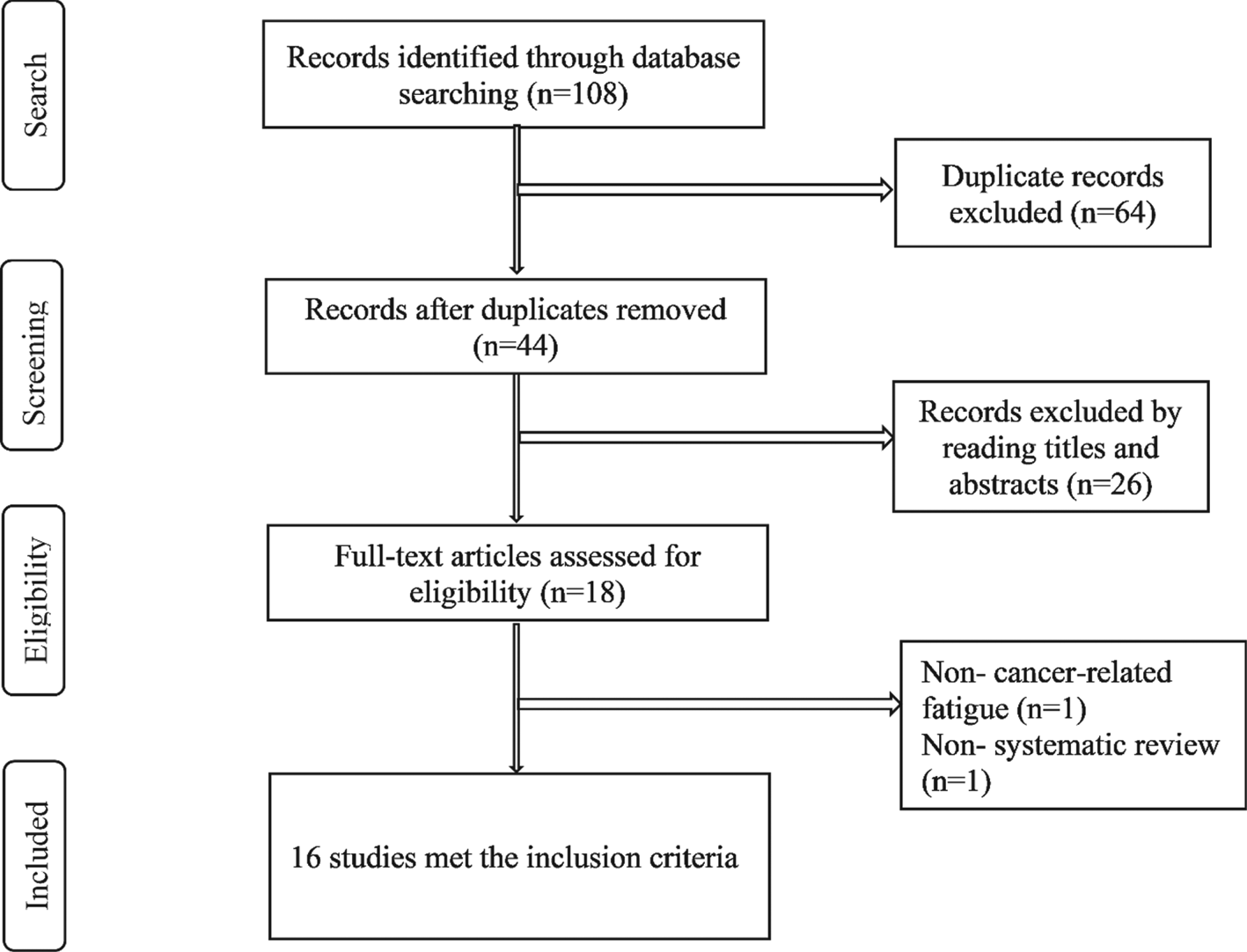
One hundred-eight records were initially identified from searching. Sixty-four duplicates were identified and excluded, ending up with 44 articles. The titles and abstracts of the remaining articles were screened and narrowed down to 18. Full-text articles of these 18 studies were retrieved for further evaluation. Two articles were excluded because one of them was not a systematic review (Kwekkeboom et al., Reference Kwekkeboom, Cherwin and Lee2010), and the other one did not review trials on CRF (Ulrichsen et al., Reference Ulrichsen, Kaufmann and Dørum2016). Finally, a total of 16 studies met inclusion criteria (Santos et al., Reference Santos, Hill and Morgan2010; Zhang et al., Reference Zhang, Yang and Tian2012, Reference Zhang, Lin and Li2018; Finnegan-John et al., Reference Finnegan-John, Molassiotis and Richardson2013; He et al., Reference He, Wang and Li2013; Posadzki et al., Reference Posadzki, Moon and Choi2013; Sadja and Mills, Reference Sadja and Mills2013; Lee et al., Reference Lee, Jerng and Liu2014; Ling et al., Reference Ling, Lui and So2014; Zeng et al., Reference Zeng, Luo and Finnegan-John2014; Lau et al., Reference Lau, Wu and Chung2016; Tao et al., Reference Tao, Jiang and Tao2016; Duong et al., Reference Duong, Davis and Robinson2017; Haller et al., Reference Haller, Winkler and Klose2017; Morgan, Reference Morgan2017; Hilfiker et al., Reference Hilfiker, Meichtry and Eicher2018). Figure 1 describes the flowchart of searching for and screening of eligible studies.
Flowchart of searching and selecting process.

Characteristics of the included reviews
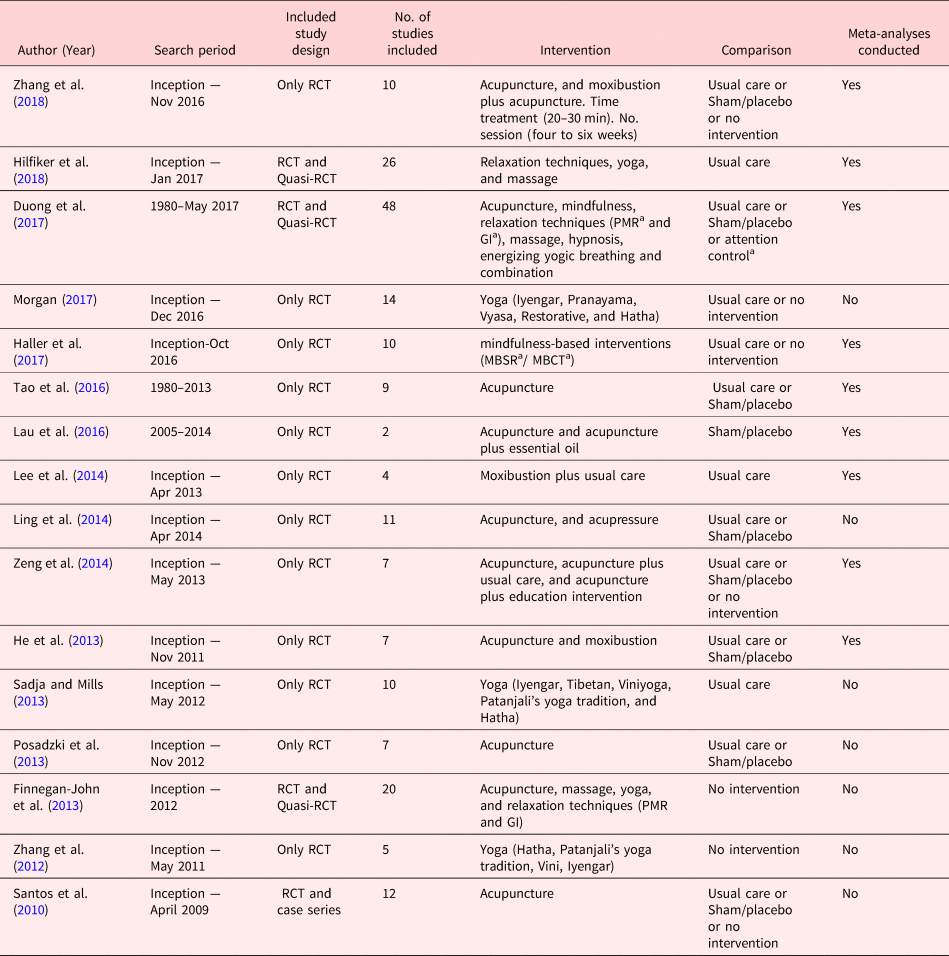
The 16 systematic reviews were published between 2010 and 2018, 10 (62.5%) of them were published after 2013. Out of 16 systematic reviews, 9 conducted meta-analyses (He et al., Reference He, Wang and Li2013; Lee et al., Reference Lee, Jerng and Liu2014; Zeng et al., Reference Zeng, Luo and Finnegan-John2014; Lau et al., Reference Lau, Wu and Chung2016; Tao et al., Reference Tao, Jiang and Tao2016; Duong et al., Reference Duong, Davis and Robinson2017; Haller et al., Reference Haller, Winkler and Klose2017; Hilfiker et al., Reference Hilfiker, Meichtry and Eicher2018; Zhang et al., Reference Zhang, Lin and Li2018). Overall, the 16 systematic reviews reported results from 202 primary studies (median, 10). Twelve systematic reviews included RCTs only (Zhang et al., Reference Zhang, Yang and Tian2012, Reference Zhang, Lin and Li2018; He et al., Reference He, Wang and Li2013; Posadzki et al., Reference Posadzki, Moon and Choi2013; Sadja and Mills, Reference Sadja and Mills2013; Lee et al., Reference Lee, Jerng and Liu2014; Ling et al., Reference Ling, Lui and So2014; Zeng et al., Reference Zeng, Luo and Finnegan-John2014; Lau et al., Reference Lau, Wu and Chung2016; Tao et al., Reference Tao, Jiang and Tao2016; Haller et al., Reference Haller, Winkler and Klose2017; Morgan, Reference Morgan2017). The remaining four systematic reviews included RCTs as well as quasi-RCTs (Santos et al., Reference Santos, Hill and Morgan2010; Finnegan-John et al., Reference Finnegan-John, Molassiotis and Richardson2013; Duong et al., Reference Duong, Davis and Robinson2017; Hilfiker et al., Reference Hilfiker, Meichtry and Eicher2018).
In terms of interventions used, the most common interventions were acupuncture and/or related therapies (acupressure, moxibustion) (n = 9, 56.25%). The other interventions included yoga (n = 3, 18.75%), mindfulness-based intervention (n = 1, 6.25%), and multi-modal MBIs (n = 3, 18.75%). Regard to comparison groups, most studies included usual care and/or placebo interventions and/or no intervention (n = 10, 62.5%). The remaining six studies included only one form of comparison, including usual care (n = 3, 18.75%), no interventions (n = 2, 12.5%), and sham/placebo interventions (n = 1, 6.25%). The characteristics of the 16 systematic reviews are presented in Table 1.
Characteristics of included systematic reviews of mind–body intervention for cancer-related fatigue

Keys: RCT, randomized controlled trial; PMR, progressive muscle relaxation; GI, guided imagery; MBSR, mindfulness-based stress reduction; MBCT, mindfulness-based cognitive therapy.
a Sham/placebo control (maneuver that mimics the intervention so that patients do not know their treatment assignment); attention control (control that mirrors the time and attention received by those in the intervention group); usual care (e.g. education, physical therapies, psychological interventions, or conventional medications).
The methodological quality of included systematic reviews
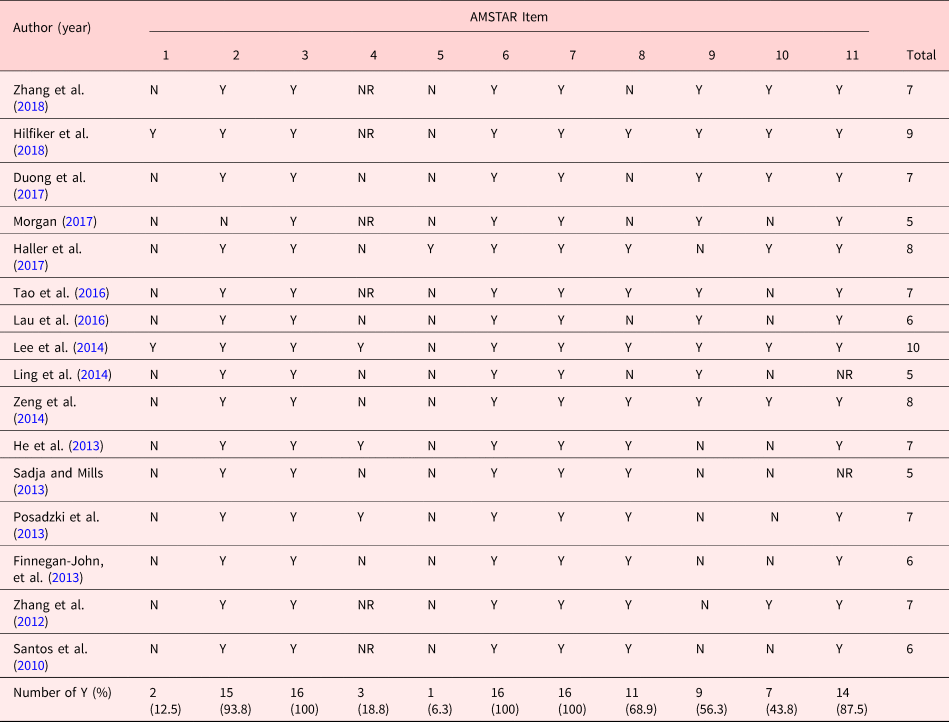
The methodological quality of the 16 included reviews was generally moderate (score 4–7) to high (score ≥ 8) on the 11-point AMSTAR scale. Only 4 systematic reviews were found to be high quality (Lee et al., Reference Lee, Jerng and Liu2014; Zeng et al., Reference Zeng, Luo and Finnegan-John2014; Haller et al., Reference Haller, Winkler and Klose2017, Hilfiker et al., Reference Hilfiker, Meichtry and Eicher2018), whereas 12 systematic reviews were of moderate quality (Santos et al., Reference Santos, Hill and Morgan2010; Zhang et al., Reference Zhang, Yang and Tian2012, Reference Zhang, Lin and Li2018; Finnegan-John et al., Reference Finnegan-John, Molassiotis and Richardson2013; He et al., Reference He, Wang and Li2013; Posadzki et al., Reference Posadzki, Moon and Choi2013; Sadja and Mills, Reference Sadja and Mills2013; Ling et al., Reference Ling, Lui and So2014; Lau et al., Reference Lau, Wu and Chung2016; Tao et al., Reference Tao, Jiang and Tao2016; Duong et al., Reference Duong, Davis and Robinson2017; Morgan, Reference Morgan2017).
All 16 systematic reviews conducted a comprehensive literature search (AMSTAR, Item 3), provided the characteristics of the included studies (AMSTAR, Item 6), and assessed the scientific quality of the included studies (AMSTAR, Item 7). Although all 16 systematic reviews provided references to the included studies, one systematic review (6.3%) provided lists of both included and excluded studies (AMSTAR, Item 5) (Haller et al., Reference Haller, Winkler and Klose2017). Only two systematic reviews (12.5%) provided evidence of a published a priori protocol (AMSTAR, item 1), and three systematic reviews (18.8%) searched the gray or unpublished literature for eligible studies (AMSTAR, item 4). Approximately half of the systematic reviews formulated conclusions, taking into consideration the scientific quality of evidence. The overall agreement on the study qualification between authors was high at 96% and for each item, assessment ranged from 90% to 100%. Results of the critical appraisal for the 16 systematic reviews using the AMSTAR scale are presented in Table 2.
Methodological quality of included systematic reviews

Keys: Y, yes; N, no; NR, not reported. AMSTAR item: 1. Was an “a priori” design provided? 2. Was there duplicate study selection and data extraction? 3. Was a comprehensive literature search performed? 4. Was the status of publication (i.e. gray literature) used as an inclusion criterion? 5. Was a list of studies (included and excluded) provided? 6. Were the characteristics of the included studies provided? 7. Was the scientific quality of the included studies assessed and documented? 8. Was the scientific quality of the included studies used appropriately in formulating conclusions? 9. Were the methods used to combine the findings of studies appropriate? 10. Was the likelihood of publication bias assessed? 11. Was the conflict of interest included?
Note: In terms of the item 4, If review indicates that there was a search for “gray literature” or “unpublished literature,” indicate “yes.” SINGLE database, dissertations, conference proceedings, and trial registries are all considered gray for this purpose. If searching a source that contains both gray and non-gray, must specify that they were searching for gray/unpublished literature.
Discussion
To our knowledge, this is the first review conducted to evaluate the methodological quality of systematic reviews and meta-analyses of MBIs for the management of CRF using the AMSTAR scale. The quality of the 16 systematic reviews included in this study was classified as being moderate (score 4–7) or high (score ≥ 8) on the 11-point AMSTAR scale.
All 16 systematic reviews adequately satisfied the quality in the following domains: conducting a comprehensive literature search (AMSTAR, Item 3), providing the characteristics of the included studies (AMSTAR, Item 6), and assessing the scientific quality of the included studies (AMSTAR, Item 7). However, several aspects should be improved in future research. First, the majority of included systematic reviews failed to provide evidence of a published a priori protocol (AMSTAR, item 1). When The Cochrane Collaboration was set up in 1993, it required authors to register a review proposal form before conducting systematic reviews to avoid publication bias and duplicate research (Higgins and Green, Reference Higgins and Green2008). Non-Cochrane reviews should have their a priori design registered in a formal registry platform such as PROSPERO (International prospective register of systematic reviews) (Booth et al., Reference Booth, Clarke and Dooley2012), as PRISMA has suggested (Moher et al., Reference Moher, Liberati and Tetzlaff2010), or should publish their protocol in appropriate journals.
Second, most of the systematic reviews did not search the gray or unpublished literature for eligible studies (AMSTAR, item 4) (Santos et al., Reference Santos, Hill and Morgan2010; Zhang et al., Reference Zhang, Yang and Tian2012, Reference Zhang, Lin and Li2018; Finnegan-John et al., Reference Finnegan-John, Molassiotis and Richardson2013; Sadja and Mills, Reference Sadja and Mills2013; Ling et al., Reference Ling, Lui and So2014; Zeng et al., Reference Zeng, Luo and Finnegan-John2014; Lau et al., Reference Lau, Wu and Chung2016; Tao et al., Reference Tao, Jiang and Tao2016; Duong et al., Reference Duong, Davis and Robinson2017; Haller et al., Reference Haller, Winkler and Klose2017; Morgan, Reference Morgan2017; Hilfiker et al., Reference Hilfiker, Meichtry and Eicher2018). In most cases, studies containing significant findings were more likely to be published than were those with non-significant findings, and systematic reviews based mainly on the published literature tended to overestimate the effectiveness of interventions (Sterne et al., Reference Sterne, Sutton and Ioannidis2011; Schmucker et al., Reference Schmucker, Blümle and Schell2017). Restricting the study publication type may leave out unpublished literature which may cause publication bias. Thus, all types of publications should be included to avoid confusion.
Third, although all the systematic reviews provided references to the included studies, one systematic review presented lists of both included and excluded studies (AMSTAR, Item 5) (Haller et al., Reference Haller, Winkler and Klose2017). Listing both included and excluded studies should be provided that would ensure comprehension reporting of systematic reviews and allow readers to examine the excluded studies if they had different perspectives (Higgins et al., Reference Higgins, Thomas and Chandler2019). Thus, further research on the MBIs for the management of CRF should focus on methodologically strong systematic reviews by providing lists of both included and excluded studies.
Finally, users of systematic reviews on the MBIs for the management of CRF should be more cautious, and researchers should focus more on improving the quality instead of quantities of systematic reviews.
Conclusion
This study demonstrates the need for high methodological quality systematic reviews on the MBIs for the management of CRF. Thus, further research should focus on methodologically strong systematic reviews by providing a priori design, not limiting the publication type, and providing a list of excluded studies. Additionally, researchers should conduct systematic reviews according to PRISMA guideline.
Conflict of interest
The authors declare no conflicts of interest.