Children born with CHD are at increased risk for respiratory syncytial virus-related hospitalisation and have high rates of associated morbidity and mortality.Reference Hall, Weinberg and Iwane 1 – Reference Aujard and Fauroux 6 Palivizumab (Synagis, MedImmune Inc., Gaithersburg, Maryland, United States of America), a monoclonal respiratory syncytial virus antibody, was approved by the United States Food and Drug Administration in 1998 for immunoprophylaxis against respiratory syncytial virus in “high-risk paediatric patients”. Subsequently, a randomised controlled trial in children with haemodynamically significant heart disease demonstrated that palivizumab reduced respiratory syncytial virus-related hospitalisations in this specific subset of patients. 7 , Reference Feltes, Cabalka and Meissner 8 These findings prompted the American Academy of Pediatrics in 2003 to recommend palivizumab immunoprophylaxis for all children with haemodynamically significant heart disease who were ⩽24 months old.
Following the 2003 American Academy of Pediatrics guidelines, several investigations have questioned the cost-effectiveness of palivizumab.Reference Yount and Mahle 9 – Reference Chang and Chen 12 Moreover, statewide analyses from California and Tennessee have raised concerns about the overall effectiveness of palivizumab beyond the clinical trial setting and in non-infants.Reference Boyce, Mellen, Mitchel, Wright and Griffin 5 , Reference Chang and Chen 12 , 13 After reviewing these more recently published data, in 2014, the American Academy of Pediatrics revised their guidelines, limiting recommendations for palivizumab to children with haemodynamically significant heart disease who are ⩽12 months old. 13 , 14 Although these guidelines were revised with the best available evidence, there has been no nationally representative analysis of respiratory syncytial virus disease burden in children with haemodynamically significant heart disease since Food and Drug Administration approval of palivizumab in 1998.
To better understand the impact of respiratory syncytial virus in children with haemodynamically significant heart disease and to evaluate the effectiveness of palivizumab immunoprophylaxis, we used a large, nationally representative administrative database to (1) evaluate the trends in respiratory syncytial virus hospitalisations in children ⩽24 months with haemodynamically significant heart disease, (2) determine which subsets of children with haemodynamically significant heart disease are most at risk for hospitalisation due to respiratory syncytial virus, and (3) evaluate the outcomes and cost of hospitalisation in children with haemodynamically significant heart disease and respiratory syncytial virus infection.
Materials and methods
Data source
We performed a retrospective cohort study using data from the 1997, 2000, 2003, 2006, 2009, and 2012 Healthcare Cost and Utilization Project Kids’ Inpatient Database. 15 The Kids’ Inpatient Database is a 20% stratified sample of discharges for patients younger than 21 years across the country collected by the Agency for Healthcare Research and Quality. Stratification, cluster, and weighting variables account for complex survey design and allow for calculation of national estimates. The Kids’ Inpatient Database has been released every 3 years since 1997 and is the largest all-payer inpatient database of paediatric hospitalisations. The 2009 data set includes 3.4 million hospitalisations and 7.4 million weighted hospitalisations from 4121 hospitals in 44 states. This study was considered exempt from approval by the Duke University Institutional Review Board.
Definitions
Hospitalisations of children ⩽24 months old with an ICD-9-CM diagnosis code for respiratory syncytial virus bronchiolitis, respiratory syncytial virus pneumonia, or respiratory syncytial virus were included in the cohort. ICD-9-CM codes are listed in the Appendix. The primary diagnosis of respiratory syncytial virus was defined as hospitalisation with a respiratory syncytial virus-associated ICD-9-CM code as the first-listed diagnosis for the discharge, consistent with Kids’ Inpatient Database definitions. Haemodynamically significant heart disease was defined using a compilation of ICD-9-CM codes listed in the Healthcare Cost and Utilization Project clinical classification software code for heart failure – non-hypertensive – which signified haemodynamic burden, as well as ICD-9-CM codes for pulmonary hypertension, common ventricle, common truncus, hypoplastic left heart syndrome, or heart transplant. 16 Hospitalisations with diagnostic codes for all other congenital heart defects, such as ASDs and VSDs, were included only if there was a concomitant diagnostic code for heart failure. These codes were chosen to represent the target population of children with CHD who were likely eligible for palivizumab under the 2003 American Academy of Pediatrics guidelines. 7 The cohort was intentionally restrictive, including only the most severe lesion-specific diagnostic codes or those children with a documented haemodynamic burden – that is, heart failure or pulmonary hypertension – to avoid inclusion of children whose eligibility might be questionable – for example, surgically repaired heart defects or simple defects that were not haemodynamically significant. For the 1997, 2000, 2006, 2009 Kids Inpatient Databases, age was classified as <6 months, 6 to <12 months, and 12–24 months or 1 year old. Patients with age in years listed as zero but missing age by month were considered to be under 1 year old. For the 2012 Kids Inpatient Database, age by month is not available, and thus children <2 years old were included but were not classified by age in months. Cyanotic and acyanotic CHD, single ventricle heart defects, mechanical ventilation, extracorporeal membrane oxygenation, and cardiopulmonary resuscitation were defined by ICD-9-CM codes (Appendix). Mortality was defined as in-hospital death. The pre-palivizumab era included the years 1997 and 2000 before release of the 2003 American Academy of Pediatrics guidelines recommending palivizumab in children with haemodynamically significant heart disease. 7 The post-palivizumab era included the years 2006, 2009, and 2012.
Respiratory syncytial virus incidence
Incidence in children without haemodynamically significant heart disease was calculated as number of respiratory syncytial virus hospitalisations in children ⩽24 months old without haemodynamically significant heart disease divided by the number of children ⩽2 years old as reported by the United States Centers for Disease Control and Prevention. 17 For the primary analysis, incidence in the haemodynamically significant heart disease cohort was calculated using a numerator of respiratory syncytial virus hospitalisations in children ⩽24 months old with haemodynamically significant heart disease with a denominator of annual hospitalisations for children ⩽24 months old with haemodynamically significant heart disease in the Kids’ Inpatient Database. To confirm that changes in respiratory syncytial virus incidence in children with haemodynamically significant heart disease reflected a true change and not a change due to other factors such as an overall change in disease burden of CHD – that is, change in prevalence, frequency of hospitalisation – or other unanticipated factors, sensitivity analyses were conducted using three different denominators: (1) birth hospitalisations with a diagnosis of haemodynamically significant heart disease in the Kids’ Inpatient Database; (2) birth hospitalisations with a Clinical Classifications Software code for any CHD in the Kids’ Inpatient Database; and (3) number of children in the United States of America <2 years old as reported by the United States Centers for Disease Control and Prevention. To evaluate further, trends in the ratio of respiratory syncytial virus-related hospitalisations in children with haemodynamically significant heart disease were compared with those without haemodynamically significant heart disease.
Statistical analysis
The primary outcome was change in incidence of respiratory syncytial virus hospitalisation in children ⩽24 months old with or without haemodynamically significant heart disease. Secondary outcomes included in-hospital morbidity, mortality, and cost of respiratory syncytial virus-related hospitalisations. Standard Healthcare Cost and Utilization Project weighting was used to account for complex survey design and create national trend estimates.Reference Chu, Houchens, Elixhauser and Ross 18 , 19 Summary statistics were used to describe patient characteristics. Univariable comparisons between cohorts were performed using weighted χ2 tests for comparison of dichotomous variables and weighted t-tests for continuous variables. Weighted logistic regression analysis was used to evaluate the association between respiratory syncytial virus hospitalisations and haemodynamically significant heart disease hospitalisations over time and to determine whether there were differences in trends between those with versus those without haemodynamically significant heart disease. The model included a dichotomous variable – haemodynamically significant heart disease status – and a continuous variable – year of hospitalisation. An interaction term between haemodynamically significant heart disease status and year of hospitalisation was used to test for differences in trends over time between those with versus those without haemodynamically significant heart disease. To closely approximate current hospital costs, Healthcare Cost and Utilization Project 2009 hospital cost-to-charge ratios were used to convert hospital charges from the 2009 Kids’ Inpatient Database to actual costs paid. Hospitalisations missing hospital charges were excluded (n=6). All analyses were carried out using SAS 9.3 (SAS Institute Inc., Cary, North Carolina, United States of America). A p-value <0.05 was considered statistically significant.
Results
Patient characteristics
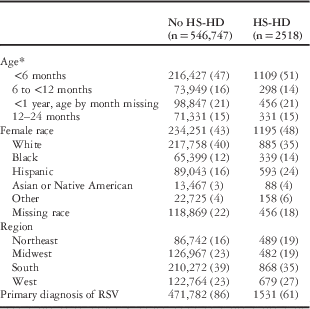
Our cohort included an estimated 549,265 hospitalisations for children ⩽24 months old with a respiratory syncytial virus-related diagnosis, of which 2518 (0.5%) hospitalisations also had haemodynamically significant heart disease-related diagnosis code. For both cohorts, the majority (>85%) of children were <12 months of age at hospitalisation, of whom most were <6 months old (Table 1).
Patient characteristics [n (%)].

HS-HD=haemodynamically significant heart disease; RSV=respiratory syncytial virus
* Age data do not reflect data from the 2012 Kids Inpatient Database as age in months is not reported
The most common cardiovascular diagnoses in the haemodynamically significant heart disease cohort included heart failure (n=1769, 70%) and acyanotic heart disease (n=1397, 56%), followed by cyanotic heart disease (n=768, 31%). Other high-risk cohorts included children with single ventricle heart defects (n=549, 22%), pulmonary hypertension (n=307, 12%), and heart transplant (n=51, 2%). These diagnoses were not mutually exclusive.
Trends in respiratory syncytial virus hospitalisation
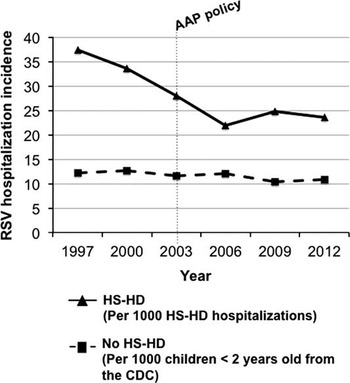
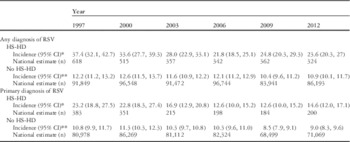
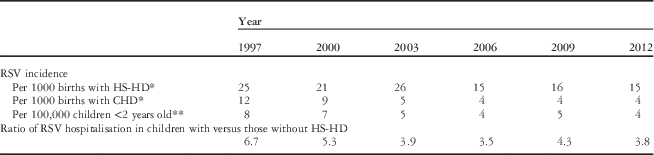
Incidence of respiratory syncytial virus hospitalisations declined significantly between 1997 and 2012 for both cohorts with and without haemodynamically significant heart disease (Fig 1, Table 2). This trend persisted when restricted to hospitalisations in which respiratory syncytial virus was the primary diagnosis (Table 2). In multivariable analysis, predictors of respiratory syncytial virus hospitalisation included earlier year of hospitalisation and presence of haemodynamically significant heart disease (e-Table 1). The interaction term for haemodynamically significant heart disease and year was also significant (p<0.001), indicating a greater relative decline in hospitalisation rate in the haemodynamically significant heart disease cohort. For the haemodynamically significant heart disease cohort, respiratory syncytial virus hospitalisation incidence decreased by 36% when comparing eras before versus those after the 2003 American Academy of Pediatrics guidelines (from 36 [95% CI: 32, 40] to 23 [21, 26] respiratory syncytial virus hospitalisations per 1000 haemodynamically significant heart disease-associated hospitalisations for children ⩽24 months for the pre- versus post-guideline eras, respectively). Similarly, the incidence of primary respiratory syncytial virus hospitalisations in the haemodynamically significant heart disease cohort declined by 43% (23 [20, 26] to 13 [12,15] primary respiratory syncytial virus hospitalisations per 1000 haemodynamically significant heart disease-associated hospitalisations, p<0.001). This compared to an 8% decrease for the cohort without haemodynamically significant heart disease (12 [12, 13] to 11 [11, 12] respiratory syncytial virus hospitalisations per 1000 children <2 years old). Multiple sensitivity analyses were conducted in the haemodynamically significant heart disease cohort using different denominators, and all yielded similar trends (Table 3). The relative frequency of respiratory syncytial virus-related hospitalisations in children with haemodynamically significant heart disease also declined compared to those without haemodynamically significant heart disease (Table 3).
US Trends in respiratory syncytial virus hospitalisation incidence Incidence in the HS-HD cohort calculated per 1000 HS-HD-related hospitalisations for children ⩽24 months in the Kids’ Inpatient Database. Incidence in cohort without HS-HD calculated per 1000 children ⩽2 years old from the CDC. Trends in RSV hospitalisation decline were significant for both the HS-HD and no HS-HD cohort (p<0.001). CDC=Centers for Disease Control and Prevention; HS-HD=haemodynamically significant heart disease; RSV=respiratory syncytial virus.

National trends in RSV hospitalisations for children ⩽24 months old.

CI=confidence interval; HS-HD=haemodynamically significant heart disease; RSV=respiratory syncytial virus
* Incidence per 1000 hospitalisations for children ⩽24 months with HS-HD-related diagnosis
** Incidence per 1000 children <2 years of age from the Centers for Disease Control and prevention
Sensitivity analysis of RSV hospitalisation incidence trends in the HS-HD cohort.

HS-HD=haemodynamically significant heart disease; RSV=respiratory syncytial virus
* Birth denominators derived from the Kids Inpatient Database
** Denominator of children <2 years old from the Centers for Disease Control and Prevention
In the subgroup analysis, rates of decline in the incidence of respiratory syncytial virus in children with haemodynamically significant heart disease did not differ by age; hospitalisations decreased by 34% in children with haemodynamically significant heart disease aged <12 months (30.2 to 19.9 respiratory syncytial virus hospitalisations per 1000 haemodynamically significant heart disease-associated hospitalisations, p<0.001) and by 37% in children 12–24 months old (5.4 to 3.4 respiratory syncytial virus hospitalisations per 1000 haemodynamically significant heart disease-associated hospitalisations, p=0.003).
Clinical outcomes
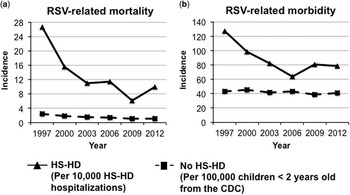
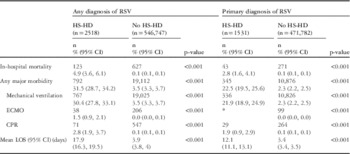
Table 4 summarises clinical outcomes. The haemodynamically significant heart disease cohort had higher in-hospital mortality (4.9 versus 0.1%, p<0.001) and longer mean hospital length of stay (17.9 versus 3.9 days, p<0.001) compared with those without haemodynamically significant heart disease. This relationship persisted when restricting the analysis to primary respiratory syncytial virus hospitalisations, although with lower in-hospital mortality for both cohorts (2.8 versus 0.1%, p<0.001). Respiratory syncytial virus-related mortality did not differ significantly by age in the haemodynamically significant heart disease cohort. The overall incidence of in-hospital mortality in children with haemodynamically significant heart disease decreased significantly from 1997 to 2012 (27 [13, 40] to 10 [4, 17] deaths per 10,000 haemodynamically significant heart disease hospitalisations, p=0.01) (Fig 2). However, the in-hospital respiratory syncytial virus-related mortality rate did not change significantly (4.6% [2.0, 7.1] versus 4.0% [2.4, 5.6] for pre- versus post-palivizumab guideline eras, respectively, p=0.70).
US Trends in respiratory syncytial virus mortality and morbidity incidence ( a ) RSV-related mortality; ( b ) RSV-related morbidity (mechanical ventilation, extracorporeal membrane oxygenation, or cardiopulmonary resuscitation). Incidence in HS-HD cohort calculated per 10,000 HS-HD-related hospitalisations for children ⩽24 months in the Kids’ Inpatient Database. Incidence in cohort without HS-HD calculated per 100,000 children ⩽2 years old from the CDC. Mortality and morbidity incidence trends were significant for the HS-HD cohort (p<0.001). CDC=Centers for Disease Control and Prevention; HS-HD=haemodynamically significant heart disease; RSV=respiratory syncytial virus.

RSV-related mortality and morbidity frequencies in children with and without HS-HD.

CI=confidence interval; CPR=cardiopulmonary resuscitation; ECMO=extracorporeal membrane oxygenation; HS-HD=haemodynamically significant heart disease; LOS=length of stay; RSV=respiratory syncytial virus
* Too few observations to be reported
The haemodynamically significant heart disease cohort also had higher rates of major morbidities, including the need for mechanical ventilation (30.4 versus 3.5%, p<0.001), extracorporeal membrane oxygenation (1.5 versus 0.0%, p<0.001), and cardiopulmonary resuscitation (2.8 versus 0.1%, p<0.001). Subgroup analysis by age demonstrated that children <1 year experienced significantly higher combined morbidity compared with those aged 12–24 months (33.5 versus 19.7%, p<0.001). Overall, the incidence of these combined morbidities declined from 1997 to 2012 (128 [96, 159] to 80 [60, 100] per 10,000 haemodynamically significant heart disease hospitalisations, p=0.001) (Fig 2). However, the proportion of respiratory syncytial virus hospitalisations in the haemodynamically significant heart disease cohort associated with major morbidity was 37% [28,36] for both the pre- and post-palivizmab guideline eras.
Cost
In 2009, the mean (95% CI) cost per respiratory syncytial virus-related hospitalisation for children ⩽24 months with haemodynamically significant heart disease was $58,166 ($46,017, $70,315) or $2298 per hospitalisation day and that for a primary diagnosis of respiratory syncytial virus was $33,779 ($22,166, $45,392) per hospitalisation or $2453 per hospitalisation day.
Discussion
In this nationally representative cohort of children 24 months or younger, there was a significant decline in the overall incidence of respiratory syncytial virus hospitalisation in children ⩽24 months of age from 1997 to 2012. Importantly, there was a greater relative decline in respiratory syncytial virus hospitalisations in children with haemodynamically significant heart disease. Some of this decline occurred before 2003, when guidelines were introduced recommending routine palivizumab immunoprophylaxis, and it is not clear whether the decline in hospitalisation rates is a direct result of palivizumab administration or whether other factors may be contributing. Although there has been a concomitant decline in the incidence of mortality and morbidity associated with respiratory syncytial virus, children with haemodynamically significant heart disease remain at significantly greater risk for adverse outcomes compared with children without haemodynamically significant heart disease.
Impact of palivizumab on respiratory syncytial virus hospitalisations in children with haemodynamically significant heart disease
Our analysis is the first to evaluate national trends in respiratory syncytial virus hospitalisation rates in children with haemodynamically significant heart disease following Food and Drug Administration approval of palivizumab in 1998. Our reported 36% reduction in respiratory syncytial virus-related hospitalisations and 43% reduction in primary respiratory syncytial virus hospitalisations between the pre- and post-American Academy of Pediatrics palivzumab guideline eras closely reflects the 45% relative reduction in respiratory syncytial virus hospitalisations reported in the 2003 palivizumab clinical trial (n=1287) in children with haemodynamically significant heart disease.Reference Feltes, Cabalka and Meissner 8 However, our rates are approximately twice those reported in a similar analysis restricted to California evaluating trends before and after the release of American Academy of Pediatrics guidelines in 2003.Reference Chang and Chen 12 This discrepancy may be related to the known regional variability in respiratory syncytial virus incidence.Reference Stockman, Curns, Anderson and Fischer-Langley 2 , Reference McGuiness, Boron, Saunders, Edelman, Kumar and Rabon-Stith 20 Possibly, respiratory syncytial virus hospitalisations in California may not adequately reflect the incidence across the United States of America. Our study included hospitalisations across the United States of America and accounted for regional variability. The California cohort was also smaller – 366 respiratory syncytial virus-related hospitalisations for children with haemodynamically significant heart disease – and perhaps less representative of paediatric inpatient care as it was obtained from a database of non-federal acute care hospitals. In contrast, the Kids’ Inpatient Database is the largest all-payer paediatric inpatient database in the United States of America and designed to evaluate rare paediatric diseases.
It is notable that we observed declines in respiratory syncytial virus hospitalisations before the 2003 American Academy of Pediatrics guidelines. These trends may indicate that factors other than palivizumab contributed to the declining incidence in respiratory syncytial virus hospitalisations. Possibly the respiratory syncytial virus immunoprophylaxis clinical trials occurring in the late 1990s may have increased awareness around respiratory syncytial virus-related mortality and morbidity and motivated behavioural changes that lowered respiratory syncytial virus transmission.Reference Simoes, Sondheimer and Top 21 – 23 Alternatively, there may have been earlier uptake of palivizumab by physicians treating children with haemodynamically significant heart disease; palivizumab was approved in 1998 for any “high-risk paediatric patient” even though initial trials were restricted to premature infants. In support of this, an analysis of the Palivizumab Outcomes Registry showed a four-fold increase in the number of children with CHD who received palivizumab between 2000 and 2003.Reference Cohen, Zanni, Cohen, Harrington, VanVeldhuisen and Boron 24 Another possible explanation is that the pre-2003 decline was related to palivizumab administered to premature infants with CHD. 23 Palivizumab has been recommended for premature infants since 1998 and prematurity is relatively common in children with CHD; a recent population-based analysis reported that 14% of children with CHD were born prematurely.Reference Laas, Lelong and Thieulin 25
Respiratory syncytial virus risk in haemodynamically significant heart disease populations
In our study, children <1 year of age composed 85% of the respiratory syncytial virus hospitalisations with haemodynamically significant heart disease, with most <6 months old. These findings are similar to those reported from a national retrospective study in which 58% of all respiratory syncytial virus hospitalisations were for infants younger than 6 months and a prospective study showing that 64% of respiratory syncytial virus hospitalisations were for children younger than 6 months and 83% for children younger than 12 months.Reference Stockman, Curns, Anderson and Fischer-Langley 2 , Reference Hall, Weinberg and Blumkin 4 Recent revisions to the American Academy of Pediatrics guidelines have recommended limiting immunoprophylaxis in children with haemodynamically significant heart disease to those aged 12 months or younger; it had been previously recommended for children ⩽24 months. 13 , 14 In our analysis, rates of decline in respiratory syncytial virus incidence were similar across age groups, suggesting similar efficacy of immunoprophylaxis regardless of age. However, the overall substantially higher incidence of respiratory syncytial virus hospitalisation in younger children ensures that the revised American Academy of Pediatrics guidelines will lead to improved cost-effectiveness of immunoprophylaxis.
Respiratory syncytial virus-related morbidity and mortality
Our haemodynamically significant heart disease cohort had markedly higher mortality and major morbidities compared with children without haemodynamically significant heart disease. This might partially reflect the increased risk associated with nosocomial respiratory syncytial virus infection: for example, postoperative infection; however, the high mortality rate for those with a primary diagnosis of respiratory syncytial virus (2.8%) highlights that many of these hospitalisations were not initially caused by a cardiac comorbidity.Reference MacDonald, Hall, Suffin, Alexson, Harris and Manning 3 , Reference Navas, Wang, de Carvalho and Robinson 26 Our overall mortality of 4.9% for any respiratory syncytial virus hospitalisation in children with haemodynamically significant heart disease is higher than that in other studies, which have reported mortality ranging from 1.9 to 3.4%.Reference Chang and Chen 12 , Reference Navas, Wang, de Carvalho and Robinson 26 , Reference Moler, Khan, Meliones, Custer, Palmisano and Shope 27 This may be due to the exclusion of children with less severe CHD. Reassuringly the overall incidence of respiratory syncytial virus-related in-hospital mortality and morbidity declined significantly over time. This likely reflects an overall reduced incidence of respiratory syncytial virus infection rather than a reduction in respiratory syncytial virus-related mortality and morbidity rates in infected patients as we did not observe a significant decrease in the in-hospital rates of mortality, major morbidities, or hospital length of stay when comparing pre- and post-palivizumab guideline eras.
Cost
The cost-effectiveness of palivizumab immunoprophylaxis has been questioned: a seasonal series of palivizumab costs in excess of $10,000.Reference Meissner and Kimberlin 28 In a cost–utility analysis in children with haemodynamically significant heart disease, Yount estimated costs of $114,307 per quality-adjusted life-year saved (in 2004 dollars), a relatively high cost when compared with conventionally accepted bounds. Their analytic model estimated an average cost of $33,740 per respiratory syncytial virus hospitalisation and $1635 per respiratory syncytial virus hospitalisation day.Reference Yount and Mahle 9 These costs are similar to our estimates for primary respiratory syncytial virus hospitalisation ($33,779 per hospitalisation and $2453 per hospital day). However, their primary analysis estimated a respiratory syncytial virus-related mortality of 3% and assumed that prophylaxis did not reduce mortality as no prior analyses have demonstrated a mortality benefit. In sensitivity analyses, they demonstrated more favourable cost–utility in the event of (1) higher baseline mortality and (2) a mortality benefit associated with palivizumab. Our data suggest that both of these conditions could possibly be true; we found respiratory syncytial virus-associated mortality rates to be higher than that in previous reports and, although nonsignificant, there was some decline in overall mortality over time. If these improved mortality rates are in fact directly attributable to immunoprophylaxis, then applying our data to their sensitivity analyses would yield a more acceptable cost (below $50,000 per quality-adjusted life-year saved). When also considering that revised guidelines now recommend prophylaxis in a more restricted and higher-risk cohort, cost utility may be further improved. Of course there are many assumptions in this argument, and one must also consider that the current wholesale-acquisition cost of a 100 mg vial of palivizumab has more than doubled since 20,049.Reference Meissner and Kimberlin 28 Ultimately our data are not sufficient to comprehensively evaluate the cost–utility of palivizumab immunoprophylaxis; however, they may be helpful to stakeholders for future analyses.
Limitations
Our study has several limitations. The Kids’ Inpatient Database is an administrative database reliant on accurate coding by providers. Because the Kids’ Inpatient Database does not include outpatient data, we could not determine whether a child died after discharge, was readmitted, received palivizumab, or was compliant in receiving the entire five-part series. Without data on palivizumab status or compliance, respiratory syncytial virus hospitalisation incidence could not be directly compared between those who did and those who did not receive palivizumab. Furthermore, some institutions do not provide palivizumab to eligible patients during respiratory syncytial virus season while patients are in the hospital. Variation in these institutional practices could not be evaluated. It is possible that respiratory syncytial virus-hospitalisation trends reflected factors other than palivizumab. Additionally, the cases were not matched by region and there could be bias from differences in regional distribution between the cohorts with and those without haemodynamically significant heart disease. Another limitation is our strict definition of haemodynamically significant heart disease, which was used to ensure that the cohort represented children in whom there was little doubt that palivizumab should be prescribed. Using this strict definition may underestimate the number of children with haemodynamically significant heart disease. However, palivizumab is not recommended for infants with surgically corrected haemodynamically significant heart disease without heart failure and a strict definition was necessary to exclude this large subset of children. 7 In addition, our study was limited by an inability to determine whether mortality and morbidity were related to respiratory syncytial virus infections or to a patient’s underlying disease. Analysis of primary respiratory syncytial virus hospitalisations was performed to better represent hospitalisations that occurred due to infection. While mortality and morbidity outcomes in the primary respiratory syncytial virus hospitalisations may not be directly attributed to infection, they are more representative of complications that may not have otherwise occurred if the patient had not been hospitalised for respiratory syncytial virus infection.
Conclusion
Respiratory syncytial virus-related morbidity and mortality remain high in children with haemodynamically significant heart disease, but overall respiratory syncytial virus-related hospitalisations, mortality, and morbidity incidences have all declined significantly from 1997 to 2012. The decline in hospitalisation rates was substantially greater among children with haemodynamically significant heart disease when compared with the broader subset of children 24 months or younger, most of whom were not eligible for palivizumuab. Palivizumab may have played a role in this decline; however, declines that occurred before the 2003 American Academy of Pediatrics respiratory syncytial virus immunoprophyaxis guidelines reflect that other factors may also have contributed. Our data suggest that current guidelines restricting palivizumab to those 12 months or younger accurately reflect that these children are at greatest risk for poor outcomes and therefore might receive the greatest benefit with palivizumab.
Acknowledgements
None.
Financial Support
This work was supported by the National Center for Advancing Translational Sciences of the National Institutes of Health (P.C. grant number 1TL1TR001116, J.L., C.H., K.H. grant number UL1TR001117).
Conflicts of Interest
Dr Hill has a research grant from the Gilead Cardiovascular Scholars Research Program and is a consultant for Kowa Pharmaceuticals. Ms Chu, Dr Hornik, Dr Campbell, and Dr Li do not have any financial disclosures. None of the authors have conflicts of interest relevant to this article to disclose.
Ethical Standards
The authors assert that all procedures contributing to this work comply with the ethical standards of the relevant national guidelines on human experimentation and with the Helsinki Declaration of 1975, as revised in 2008, and has been approved by the Duke University Institutional Review Board.
Supplementary Material
To view supplementary material for this article, please visit http://dx.doi.org/10.1017/S1047951116000470