1 Introduction
Tashlhiyt Berber is known among phonologists and phoneticians for a cross-linguistically rare phenomenon: its words and sentences can be composed of particularly long strings of consonants without intervening lexical vowels (e.g. /t-bdg/ [tbdg] ‘she is wet’, /t-kks-t=stt t-ɾzm-t=stt t-sɾs-t=stt ʁ lqʷbb/ [tkkststt trzmtstt tsrststt ʁ lqʷbb] ‘you took it off, you opened it and you put it in the dome’).Footnote 1 Related to this is the claim that any consonant, including a voiceless stop, can be the peak of a syllable, a striking exception to the major trend in world languages, whereby only vowels, or vowels and sonorants, can be syllabic (see Dell & Elmedlaoui Reference Elmedlaoui1985, Reference Dell and Elmedlaoui1988, Reference Dell and Elmedlaoui2002, Elmedlaoui Reference Elmedlaoui1985, Boukous Reference Boukous1987, Prince & Smolensky Reference Prince and Smolensky1993, Jebbour Reference Jebbour1995, Clements Reference Clements and Roca1997, Ridouane Reference Ridouane2008, Reference Ridouane2014). This analysis excludes schwa from any phonological role with respect to syllable structure.
At the phonetic level, in addition to the surface realisations of the three lexical vowels /i a u/, a schwa is sometimes present in the realisation of an underlying consonantal cluster. For example, /t-bdg/ can be produced with three schwas (i.e. as [təbədəg]). In this study we are concerned with the nature of this vocalic element: is it an epenthetic vowel inserted by the phonological component, or merely a transitional element with no structural relevance? We address this question by providing a production study in which bisyllabic VC.CC(C) words such as /i-bdg/ ‘he is wet’ and /i-ftk=t/ ‘he sprained it’ are elicited in two prosodic conditions: polar questions and emphatic statements. The aims are to determine the frequency with which schwa is inserted in different consonantal contexts, and to explore the nature of the interaction between schwa insertion and prosodic prominence. As background to our argumentation, we first review the theoretical discussion on the status of schwa in Tashlhiyt.
1.1 Tashlhiyt schwa: a review
The nature of schwa in Tashlhiyt has been a long-standing topic of debate, and different positions have been taken by researchers. Some view schwa as a transitional element with no structural relevance, while others consider it to be an epenthetic vowel. More recent positions, drawing on recent work on the intonational system of the language, try to combine the two views.
Both phonological and phonetic evidence have been provided in favour of the point of view that schwa is a mere transition between segments. We call this the ‘no schwa-nucleus’ account. Dell & Elmedlaoui (Reference Dell and Elmedlaoui1985, Reference Dell and Elmedlaoui1988, Reference Dell and Elmedlaoui1996a, Reference Dell and Elmedlaoui2002) present a range of arguments against a phonological treatment of this sort, including the following: native speakers are largely unaware of the presence of this schwa in their speech, it does not affect intuitions about syllabification, it does not contribute to syllable weight in versification of traditional songs and it is ignored by phonological processes such as regressive obstruent devoicing. Its occurrence is argued to be predictable from the phonetic make-up of the consonants within a sequence: it never occurs within a sequence of voiceless sequences or within a homorganic sequence with unreleased consonants. From a phonetic perspective, Ridouane & Fougeron (Reference Ridouane and Fougeron2011) provide production data based on C1C2VC items (e.g. [bdiʁ] ‘I started’), showing that the occurrence of schwa within the consonant clusters was conditioned by the laryngeal and supralaryngeal specifications of adjacent consonants: it did not occur when both C1 and C2 were voiceless, nor within homorganic sequences with unreleased consonants (e.g. between /n/ and /t/ in [nttat] ‘her’). Schwa was frequent elsewhere, though it did not occur systematically. Thus, at least in this position, schwa can be viewed as a transition between consonants, behaving like intrusive vowels observed in other, unrelated, languages (Hall Reference Hall2006, Silverman Reference Silverman2011).
Other authors view schwa as part of the phonological inventory of Tashlhiyt (Coleman Reference Coleman1996, Reference Coleman, Ohala, Hasegawa, Ohala, Granville and Bailey1999, Reference Coleman2001, Angoujard Reference Angoujard1997, Louali & Puech Reference Louali and Puech2000). We call this the ‘schwa-nucleus’ account. Coleman treats schwa as an epenthetic vowel that functions as a syllable nucleus. He interprets consonants which are syllabic in Dell & Elmedlaoui's account (e.g. in /tχ.wa/ ‘it is empty’) as sequences of phonological schwa plus consonant (i.e. [təχ.wa]). Schwa is claimed to occur in any syllable that does not have a lexical vowel. If the acoustic record provides no evidence of the presence of schwa, it is claimed to be phonetically overlapped by adjacent consonants (akin to English vowel reduction in s(u)ppose or t(o)night). The main argument presented by Coleman (Reference Coleman2001) in support of this analysis is based on production data from one speaker (other arguments are discussed in Dell & Elmedlaoui Reference Dell and Elmedlaoui2002: 184–187). Coleman's acoustic data do show that schwas are frequently observed within consonant sequences, and can even surface in final position (e.g. [təmzʜə] ‘she jested’), a context where, arguably, they cannot be considered to be purely low-level phonetic transitions between consonants. According to Coleman, the occurrence of schwa in final position is consistent with the analysis of a stem-final consonant as a syllable onset followed by a schwa nucleus (i.e. [təmz.ʜə]).
In Ridouane (Reference Ridouane2008)’s cross-dialectal study, fibrescopic and photoelectroglottographic data were examined to determine whether words and sentences in Tashlhiyt could be entirely voiceless, without any intervening schwa. The acoustic data contained 24 phonological words consisting entirely of voiceless obstruents (e.g. [fk] ‘give’, [tsskʃftstt] ‘you dried it’). These items were produced by six speakers in two different conditions: in isolation and within a frame sentence having lexical vowels (e.g. [inna tkkststt jat twalt] ‘he said you took it o ff once’). Results showed that 766 out of 864 target items were produced as totally voiceless, with no intervening schwa. Of the remaining 98 utterances, 84 had schwa in word-final position. More than 82% of these 84 cases were words produced in isolation. The presence of schwa in this position was interpreted as being of prosodic origin:
A more plausible interpretation of the presence of these vocoids may be related to prosodic constituents higher than the syllable. Several aspects suggest that phrasal boundaries are involved … suggesting that vocoid insertion is one of the phonetic cues used to mark a phrase boundary, possibly in addition to other phonetic cues, such as final lengthening (Ridouane Reference Ridouane2008: 335).
Recent studies on the intonation system of the language provide further evidence that higher prosodic level should be taken into account in order to explore the nature of schwa in Tashlhiyt in greater depth (Gordon & Nafi Reference Gordon and Nafi2012, Grice et al. Reference Grice, Roettger, Ridouane, Fougeron, Lee and Zee2011, Grice et al. Reference Grice, Ridouane and Roettger2015, Roettger Reference Roettger2016). Focusing on the placement of F0 peaks in polar questions and contrastive statements, Grice et al. (Reference Grice, Ridouane and Roettger2015) show that in utterance-final target words consisting entirely of voiceless obstruents (e.g. /t-kʃf/ ‘it dried’ in the polar question [is inna tkʃf] ‘did he say it dried?’), three intonation patterns may occur: (i) there is a F0 peak before the target word (i.e. on the /a/ of [inna]), (ii) there is no F0 peak at all or (iii) there is a F0 peak on a schwa in the target word, [tkʃəf]. This finding proves on the one hand that schwa can occur within a sequence of voiceless consonants, and on the other that it can bear a prosodically functional load by enabling the alignment of a relevant tonal movement. The same finding was obtained by Gordon & Nafi (Reference Gordon and Nafi2012) on the basis of bisyllabic and trisyllabic words produced in isolation and followed by an adverb. Here too, schwas bearing what the authors termed pitch accent were observed in different contexts, including between voiceless obstruents, as in [tftəχt] ‘you rolled’. Gordon & Nafi (Reference Gordon and Nafi2012) assume that schwas used in such pitch-accented contexts are true epenthetic vowels, which play a prosodic role. Occurrences of schwa are also observed in Roettger (Reference Roettger2016)’s analysis of tonal placement in voiceless words, and are analysed as postlexically triggered epenthetic vowels. These results can be related to what is reported by Dell & Elmedlaoui (Reference Dell and Elmedlaoui2008) and Dell (Reference Dell, Cairns and Raimy2011) on singing, where schwas also act as carriers for pitch in text-to-tune alignment: ‘[Tashlhiyt Berber] schwa is metrically irrelevant … Its only relevance is to text-to-tune alignment below the syllable level’ (Dell Reference Dell, Cairns and Raimy2011: 186).
In the present study we build on these findings, and make a new empirical contribution to the debate over the nature of schwa in Tashlhiyt. We provide a production experiment involving 14 speakers, explicitly designed to test both the segmental and the prosodic factors that are likely to trigger the insertion of schwa. The segmental factors, which have previously been identified in the literature on Tashlhiyt (see e.g. Dell & Elmedlaoui Reference Dell and Elmedlaoui2002), include the voicing and the place of articulation of the consonants in bisyllabic VC.CC(C) items. This part of the study, building on earlier findings on CC sequences in CCVC items presented in Ridouane & Fougeron (Reference Ridouane and Fougeron2011), aims to provide additional evidence that the distribution of transitional schwas is constrained by the phonetic characteristics of the surrounding consonants (i.e. they are not expected to occur between voiceless obstruents and within sequences of consonants sharing the same place of articulation).
The prosodic factors allow us to examine how schwa patterns in two sentence modalities displaying different phonological prominences on target VC.CC(C) items: (i) polar questions, where target items are in medial position of the utterance (e.g. [is ikʃm bɾahim] ‘did Brahim come in?’, and (ii) emphatic statements, where target items are produced in isolation (e.g. [ikʃm] ‘he came in’). In polar questions, the F0 peak is expected to be systematically attracted to the final heavy syllable of the utterance (i.e. [him]), in accordance with previous findings (Gordon & Nafi Reference Gordon and Nafi2012, Grice et al. Reference Grice, Ridouane and Roettger2015, Roettger & Grice Reference Roettger and Grice2015, Roettger Reference Roettger2016, Bruggeman et al. Reference Bruggeman, Roettger and Grice2017). In other words, prominence is not expected to be found on target [ikʃm], and prosodically functional schwas are thus unlikely to occur in this context. In emphatic statements, on the other hand, a strong prosodic prominence, which typically lengthens the word-final vowel, has to be implemented within target items lacking final vowels. Specifically, we seek to determine whether schwa is used to implement emphatic lengthening in such items, and examine how this is related to the phonological factors of sonority and syllable weight.
2 Production experiment
2.1 Speech materials
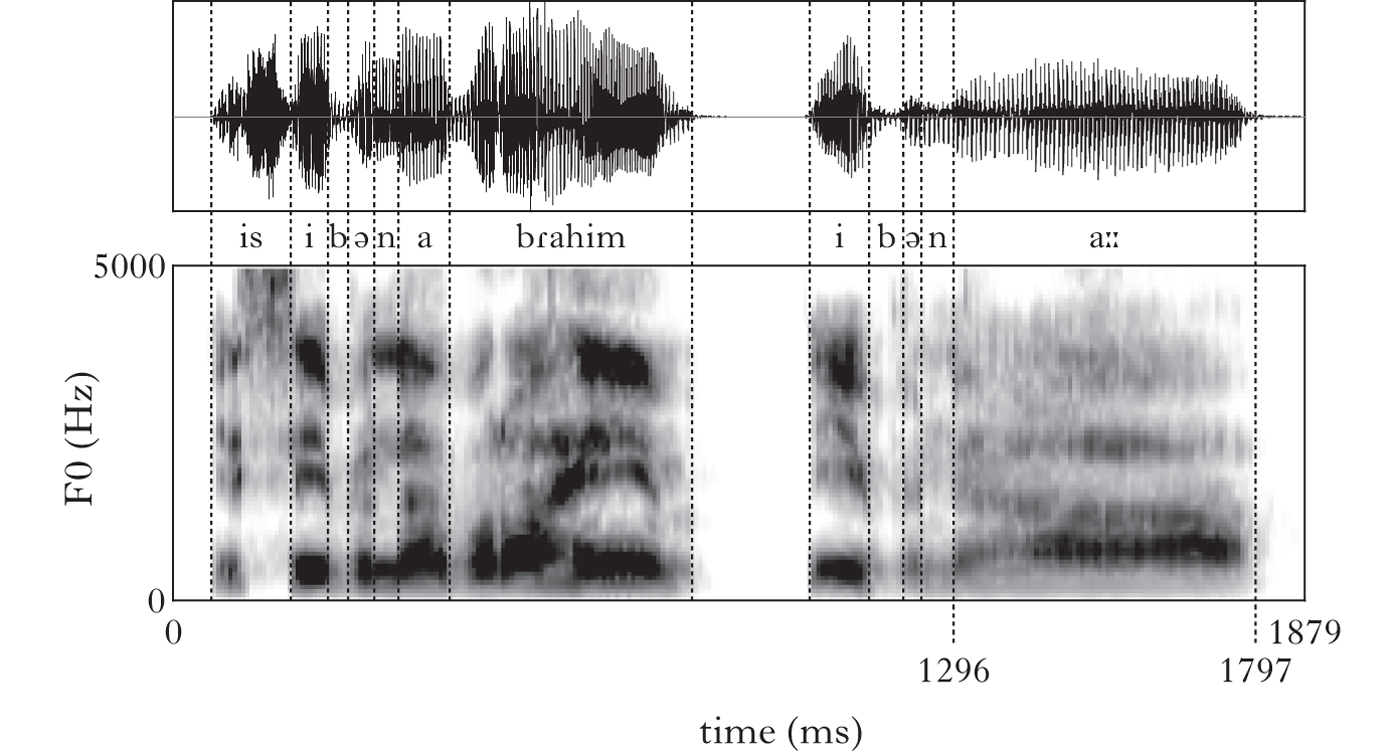
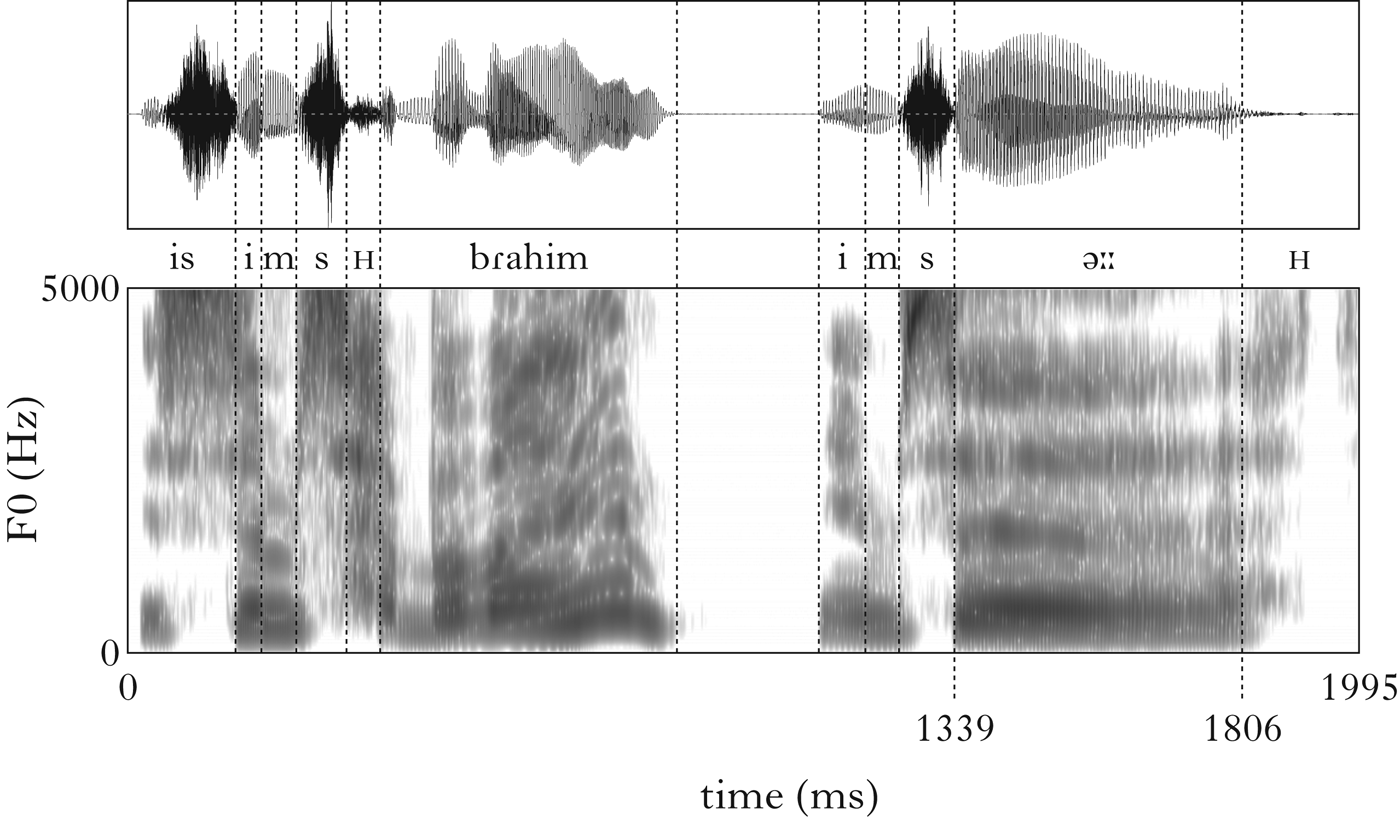
In Tashlhiyt, where vowel duration is not lexically contrastive, an emphatic statement is expressed through a dramatic lengthening of the syllable-final vowel of the verb, often as an answer to a polar question. Using emphatic lengthening conveys a particular attitude, implying that the action conveyed by the verb took place a long time ago and should have already been known. Lengthened vowels in such items can be more than 500 ms long. An example is shown in Fig. 1, with the verb /ibnaːː/ ‘he built’ (where emphatic lengthening is indicated by ‘ːː’ following the lengthened segment). We use emphatic statements as a way of testing how such a strong prosodic prominence is expressed when target items lack final vowels. We specifically seek to determine whether schwa can be used to implement this phenomenon to enable the lengthening of the final syllable, and how the distribution of schwa, if present, is related to the weight and the degree of sonority of the nucleus of the final syllable.
Acoustic waveform and spectrogram of one realisation of (left) the polar question /is ibna bɾahim/ ‘Did Brahim build?’ and (right) the emphatic statement /ibnaːː/ ‘he built’, illustrating the emphatic lengthening of the final vowel /a/.

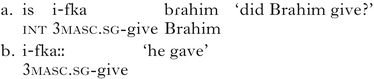
Target items consisted of a phonotactically controlled set of verbal roots conjugated in the 3rd person masculine singular perfective, yielding a set of bisyllabic verbs containing different types of final syllables; e.g. /i-fka/ (3masc.sg-give) ‘he gave’, /i-fsɾ/ (3masc.sg-spread out) ‘he spread out’. The data analysed were obtained using the unmarked morphosyntactic structures found in polar questions (1a) and emphatic statements (1b).
(1)

A similar dialogue was constructed with the addition of the direct object /t/, allowing the final syllable of the target item to be heavy in emphatic statements, as in (2).
(2)

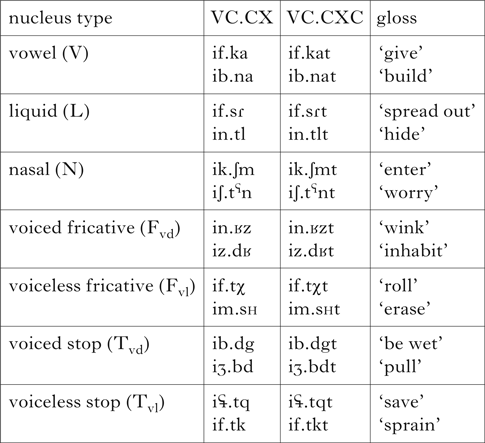
We recorded 14 pairs of verbs of the shape [iC.CX(C)], where X was a nucleus vowel or consonant. Six types of consonant nucleus were used, based on the sonority scale in (3), first proposed for Tashlhiyt consonants by Dell & Elmedlaoui (Reference Dell and Elmedlaoui1985).Footnote 2
(3)

For each nucleus type, two verbs were used, as shown in Table I. Verbs with /l/ and /n/ as nuclei were chosen, so that these consonants occurred within homorganic sequences differing in sonority (e.g. [intlt] ‘he hid him’), as this is a context where transitional schwas are not expected to occur. Similarly, items with voiceless obstruents as nuclei were included within voiceless sequences (e.g. [iftk] ‘he suffered a sprain’), as transitional schwas are also not expected to surface in this position. Transitional schwas may occur in all other contexts (see Ridouane & Fougeron Reference Ridouane and Fougeron2011).
Target items listed according to the nucleus condition. Members of each pair differ in syllable weight: CX vs. CXC.

2.2 Speakers
Fourteen native speakers of Tashlhiyt, all of whom were university students or graduates, participated in the production experiment. Five (4 males: S1, S2, S9, S10; 1 female: S12) were recorded in a soundproof booth at the Laboratoire de Phonétique et Phonologie (CNRS/Sorbonne Nouvelle, Paris), and nine (6 males: S3, S4, S5, S8, S11, S14; 3 females: S6, S7, S13) in a quiet room at the Ibno Zohr University in Agadir. The ages of the subjects ranged from 21 to 46 (mean = 30). All of the participants reported being able to speak Moroccan Arabic, Standard Arabic and French, as is common for university students. Some of the participants also spoke English.
Speakers were instructed in Tashlhiyt to produce dialogues such as (1) and (2) above. The speakers produced each dialogue three times for each condition, during six separate sessions. Before recording began, participants were asked to read a word-list containing all the verbs in Table I, to ensure that they were familiar with all the items. They were then seated in front of a computer screen, and produced polar questions along the lines of (1a) and (2a). The target items were presented in Latin script, commonly used by university students. After each polar question the emphatic statement, which was not presented orthographically, was then produced by the subjects. Each target word was produced in the polar question and emphatic statement forms, resulting in a total dataset of 2352 tokens (the 7 nucleus conditions corresponding to the rows in Table I × 2 words per condition × 2 syllable weights (light vs. heavy) × 2 sentence modalities (polar question and emphatic statement) × 3 repetitions × 14 speakers).
2.3 Analyses
The acoustic data were segmented and annotated using Praat (Boersma & Weenink Reference Boersma and Weenink2013). The target items were labelled in both the polar questions and the emphatic statements. The location of the F0 peaks in polar questions was judged by ear, and subsequently confirmed by visual inspection of the F0 contour and spectrogram generated by Praat.
For the segmentation of schwa, it is important to distinguish between transitional schwa and schwa used to express emphatic statements (i.e. lengthened schwa). Determining whether a lengthened schwa [əːː] is present within target items in emphatic statements is very easy to establish, as this corresponds to a visible vocalic interval between two consonants, displaying clear formant structure, and having a very long duration (mean duration 390 ms; see Fig. 9 below).
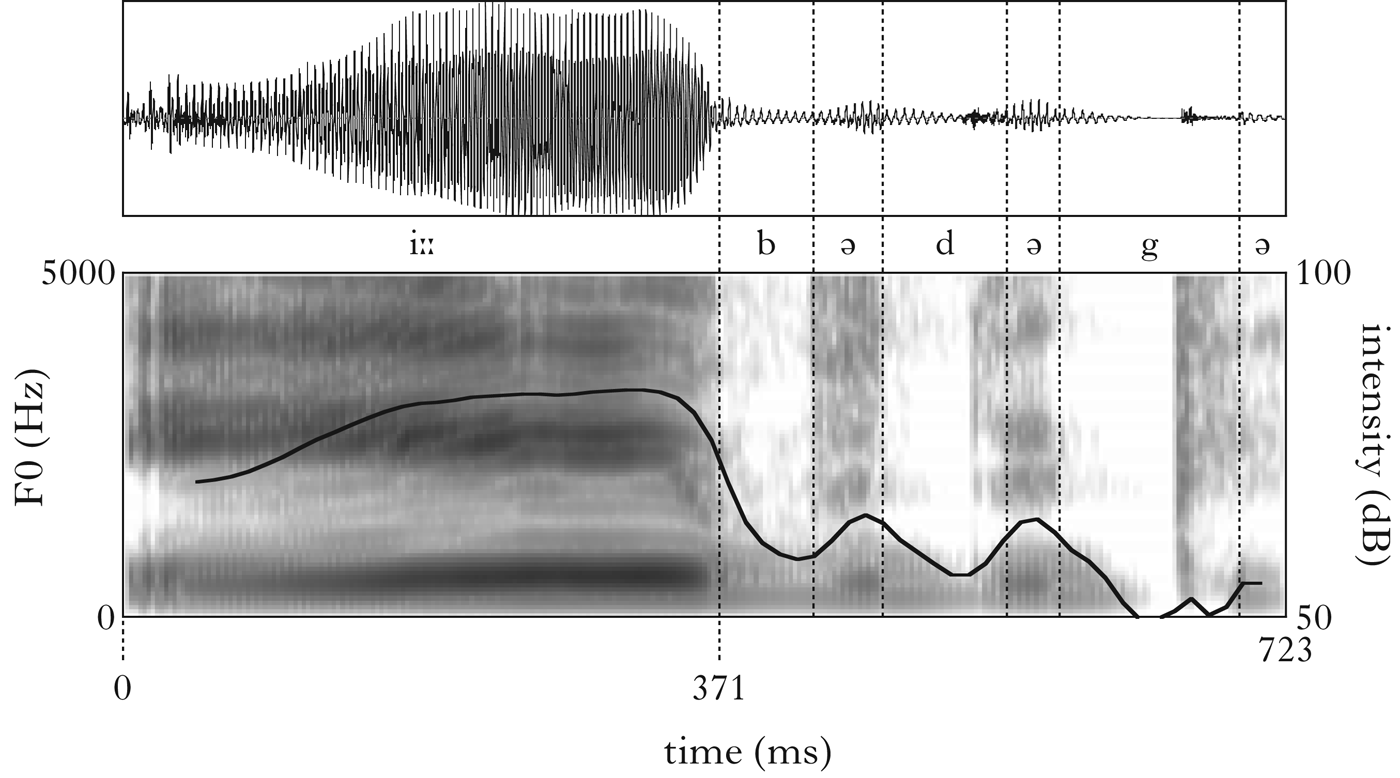
Determining whether a transitional schwa is present within a consonant sequence was not always straightforward. The labelling of the data was thus carried out in two steps. A first annotator did a first pass on the data to label all cases where there were non-ambiguous schwas, and mark the ambiguous cases. These latter cases were then re-examined by the first annotator and one other, and all cases were classified as absent or present on the basis of a combination of cues. The annotators labelled as schwa any interval between two consonants presenting some periodic vibrations accompanied by a local increase in the signal energy at the consonant release, and/or an interval after the consonant release with formant structure or some energy in the F2/F3 region characteristic of vowels. Additionally, the onsets and offsets of all segments in the target items were annotated. In the example presented in Fig. 2, the presence of schwas was determined by the clear increase/decrease of signal amplitude and rather long intervals with formant structure within the consonantal sequences (i.e. between /b/ and /d/, and between /d/ and /g/). These criteria for schwa identification are consistent with previous research (e.g. Ridouane & Fougeron Reference Ridouane and Fougeron2011).
Acoustic waveform and spectrogram of one realisation of /i−bdg/ ‘he is wet’, produced with clear schwas following /b/, /d/ and /g/, as shown by the increase of energy in the signal and intervals with formant structure in the spectrogram.

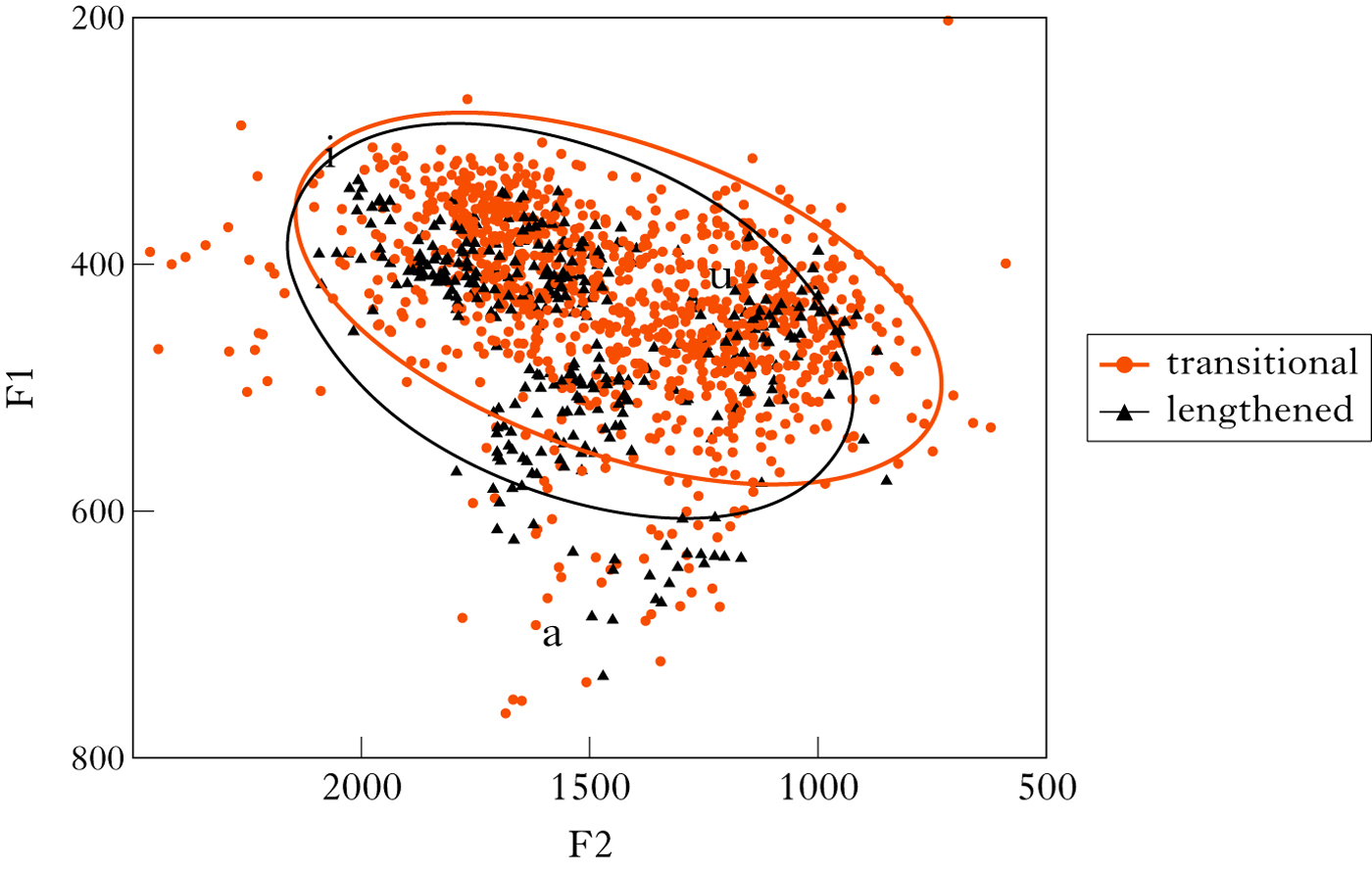
Figure 3 provides a comparison of the formant values of lengthened and transitional schwas with those of the lexical vowels /a i u/. Both lengthened and transitional schwas are central elements whose precise qualities vary as a function of surrounding consonants and lexical vowels (see also Coleman Reference Coleman, Ohala, Hasegawa, Ohala, Granville and Bailey1999 and Yang Reference Yang2018). We will transcribe both schwas as [ə]; their precise quality is not crucial to the analysis of their distribution.
Average formant values for transitional schwa and lengthened schwa, compared to those of the lexical vowels /a i u/. Formant values for lexical vowels are adapted from Ridouane (2014).
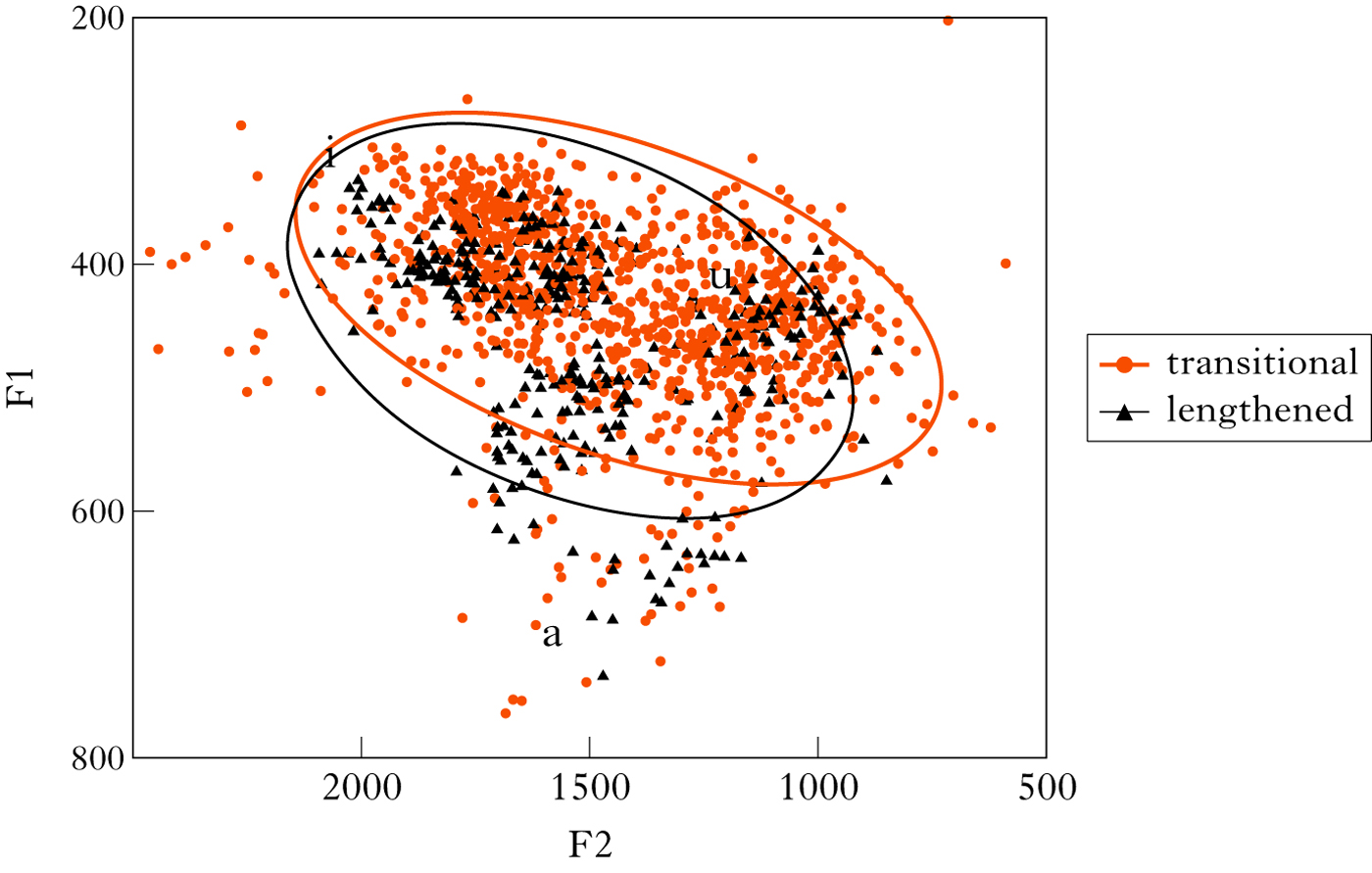
Three types of data were extracted from our production study: (i) the frequency of occurrence of schwas within the consonant sequences of target items in polar questions and emphatic statements, (ii) the frequency with which the second syllable was lengthened in emphatic statements and (iii) the type of segments lengthened.Footnote 3 Significance tests (repeated measure ANOVAs) and post hoc tests using standard and paired sample t-tests were conducted on the data.
3 Results
We first show the distribution of schwa in target items in polar questions, before presenting the results on emphatic statements in more detail.
3.1 Schwa in polar questions
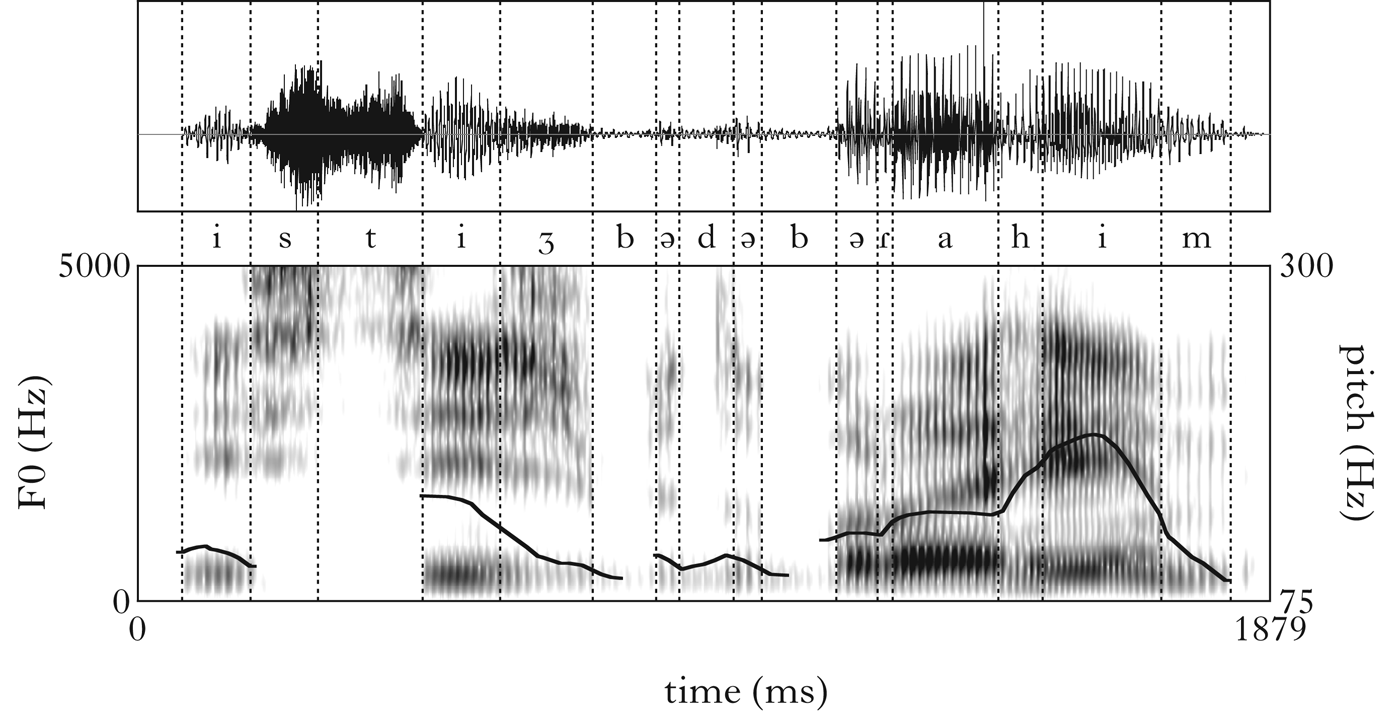
As expected from previous findings (Gordon & Nafi Reference Gordon and Nafi2012, Grice et al. Reference Grice, Ridouane and Roettger2015, Roettger Reference Roettger2016), the F0 peak in polar questions is systematically attracted to the vowel nucleus of the final heavy syllable of the intonational phrase (i.e. the syllable [him] of the utterance-final word [bɾahim]). A consequence of this is that there is no communicatively relevant pitch movement on the final syllable of the target items. An illustrative example of this pattern is shown in Fig. 4.
Acoustic waveform and spectrogram of one realisation of the polar question /istiʒbd bɾahim/ ‘Did Brahim pull him?’, showing the peak F0 on final /i/ and the absence of relevant pitch movement on the final syllable of the target item /iʒbd/.

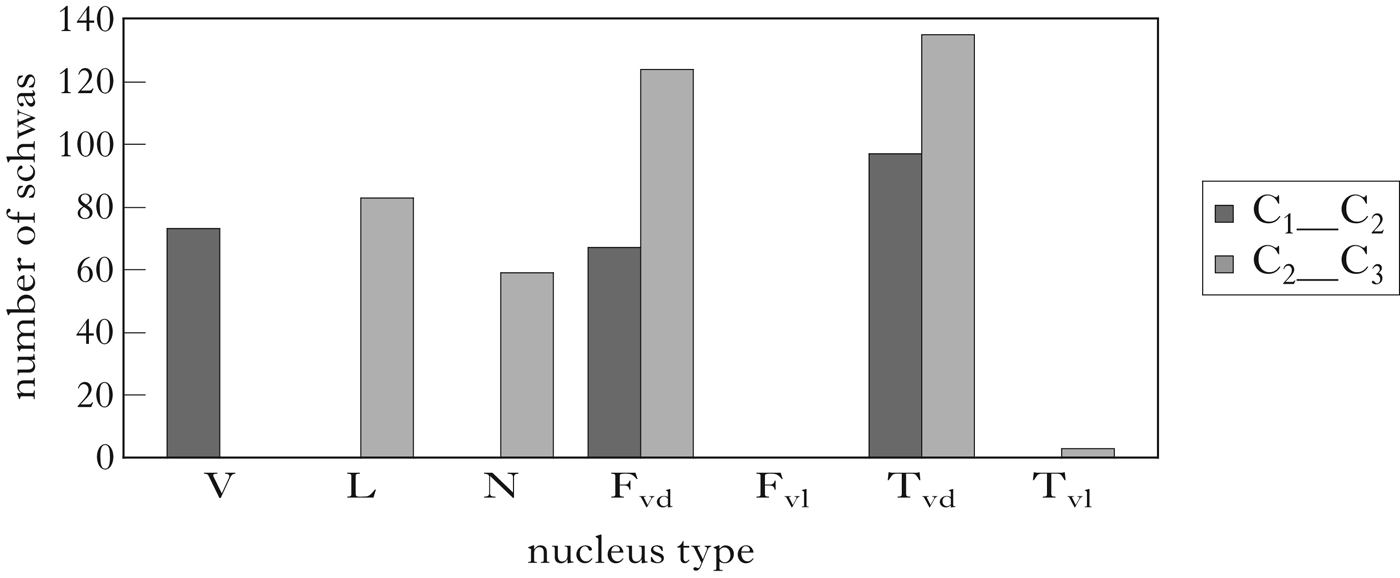
The target items contain 2184 sequences of two consonant phonemes (dyads), the contexts where schwas are likely to occur: 1176 C1C2 sequences and 1008 C2C3 sequences (the consonant sequences at the boundary between the target items and the word Brahim are not considered here). Figure 5 shows the distribution of schwa in C1C2 sequences and in C2C3 sequences (the detailed distribution of schwa for each consonant sequence and each target verb is shown in Appendix A).
Number of occurrences of schwa between C1 and C2 and between C2 and C3 in polar questions, by nucleus type.

Schwa occurred in 626 of the 2184 CC sequences (29%). For ease of exposition, we compare the observed distribution of these schwas to their expected occurrences according to the ‘no schwa-nucleus’ account. Recall that, on this account, schwa is a transitional element which is not expected to surface between two voiceless consonants or between two consonants sharing the same place of articulation. The distribution of transitional schwa in our target items supports the predictions of this model: transitional schwa never occurred between two homorganic consonants (e.g. between /t/ and /l/ in [intl] ‘he hid’) and only three instances of schwa were observed in 756 voiceless consonants dyads (0.4%), twice within the sequence /tq/ in [iʢtq] by S4 and once within the sequence /tk/ in [iftk] by S6 (note that [iʢtq] was realised by S4 as [iʢdq], with a voiced [d], which is an alternative realisation, in free variation). As also predicted by the ‘no schwa-nucleus’ account, confirming the results from Ridouane & Fougeron (Reference Ridouane and Fougeron2011), schwas were frequently encountered in contexts where at least one consonant was voiced: 672 instances of voiced–voiced consonant sequences, of which 482 (72%) displayed schwa, and 252 instances of voiced–voiceless consonant sequences, of which 59 (23%) displayed schwa. The fact that schwas are less frequent in voiced–voiceless consonant sequences is probably due to the tendency for voiced consonants to devoice when followed by a voiceless obstruent. Schwas are quasi-systematically observed within /Cɾ/ sequences: out of 84 instances of /ɾC/ or /Cɾ/ sequences, 83 (99%) displayed schwa. The systematic occurrence of this vocoid in /Cɾ/ and /ɾC/ sequences has already been noted in Tashlhiyt (Coleman Reference Coleman2001), as well as in various other unrelated languages, including Spanish (Bradley & Schmeiser Reference Bradley, Schmeiser, Kempchinsky and Piñeros2003), Catalan (Recasens & Espinosa Reference Recasens and Espinosa2006), Hungarian (Vago & Gòsy Reference Vago, Gósy, Trouvain and Barry2007), Greek (Baltazani & Nicolaidis Reference Baltazani, Nicolaidis, Gavriilidou, Efthymiou, Thomadaki and Kambakis-Vougiouklis2012) and Polish (Savu Reference Savu2014). This vocoid can arguably be considered to be intrinsic to the realisation of tap /ɾ/ when it is adjacent to a consonant.
To sum up, when schwa does not bear a prosodically functional load, its occurrence within a sequence is highly predictable from the laryngeal and supralaryngeal characteristics of the consonants contained in that sequence. This provides additional evidence in favour of the ‘no schwa-nucleus’ account, which views schwa as a mere transitional vocoid.
3.2 Schwa in emphatic statements
We now present our findings on emphatic statements, where target items must be prosodically prominent. Recall that we want to determine whether schwa is used to implement emphatic lengthening in such items, and to examine how this is related to the phonological factors of sonority and syllable weight. We present our results from two perspectives: the position of the syllable where emphatic lengthening occurs (i.e. initial or final syllable) and the type of segment lengthened within that syllable. We then present our findings concerning the patterning of schwa.
3.2.1 Which syllable is lengthened?
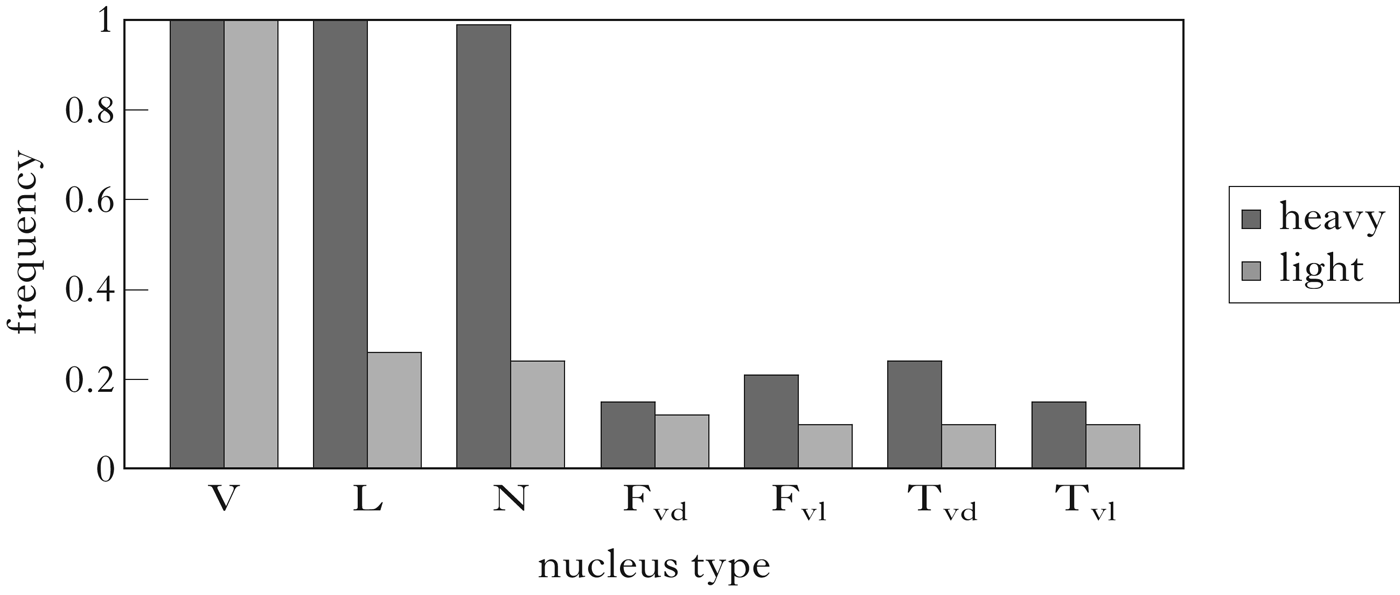
Emphatic lengthening within bisyllabic words is determined by several factors. In addition to the systematic lengthening of the final syllable when its nucleus is a lexical vowel (e.g. [if.ka] ‘he gave’), the following three patterns emerge from our data: (i) lengthening systematically occurs on the final syllable when it is heavy and its nucleus is a sonorant consonant (e.g. [if.sɾt] ‘he spread out’), (ii) lengthening occurs in 25% of utterances on the final syllable when it is light and its nucleus is a sonorant consonant (e.g. [ik.ʃm] ‘he entered’) and (iii) lengthening occurs in 15% of utterances on the final syllable when its nucleus is an obstruent (e.g. [im.sʜt] ‘he erased it’). This is shown in Fig. 6.
Frequency of final syllable lengthening in emphatic statements, by nucleus type and syllable weight.

We ran a repeated measures ANOVA to test whether nucleus type (L, N, Fvd, Fvl, Tvd, Tvl) and syllable weight (light, heavy) had an effect on speaker preference for lengthening the final syllable. Syllable weight was the between-subjects factor, with 14 speakers. Nucleus type had a significant effect (F(5,130) = 51.49, p < 0.001), as did syllable weight (F(1,130) = 21.94, p = 0.001). The interaction of nucleus type and syllable weight was significant (F(5,130) = 24.87, p < 0.001), syllable weight being significant when the nucleus was a sonorant consonant (t(55) = 10.025, p < 0.001), and when the nucleus was an obstruent consonant (t(55) = 2.396, p = 0.020). In addition, our results show that syllables with obstruent nuclei did not display a significantly different behaviour for voicing (t(110) = 0.251, p = 0.802) and manner of articulation (t(110) = 0.5, p =0.960). That is, syllables with voiced and voiceless obstruents attract lengthening in the same way, as did syllables with fricatives and stops. Similarly, no significant differences were observed between syllables with liquids and syllables with nasals (t(54) = 0.143, p = 0.887). The combined effect of sonority and syllable weight on lengthening of the final syllable leads to the following hierarchical ranking, reflecting the likelihood of final syllable lengthening: CV(C) = CC[+son] C > CC[+son] ≥ CC[―son]C ≥ CC[―son].
3.2.2 Which segment is lengthened?
We now consider the strategies speakers used to express emphatic lengthening, by identifying the lengthened segment. In all cases where there was a lexical vowel in the final syllable, speakers systematically chose to lengthen it (i.e. all 168 tokens). This was illustrated in Fig. 1 above, where the lengthened final /a/ in the form [ibnaːː] has a duration of 467 ms.
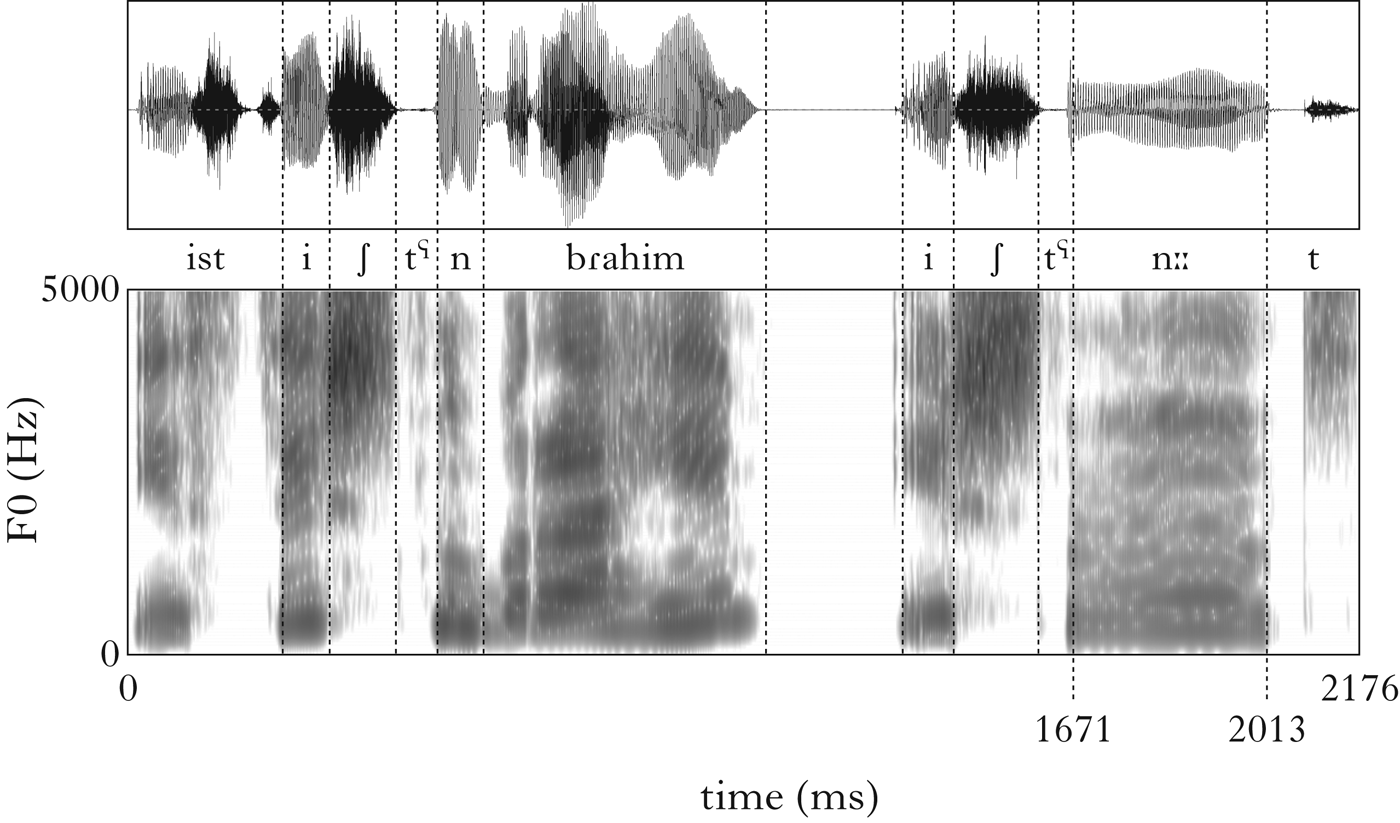
For target items lacking lexical vowels in the final syllable, our data show that speakers also use three different strategies. In the majority of the cases, lengthening is realised on the full vowel of the first syllable (i.e. on [i]). This occurred in 701 of the 1008 utterances (70%). An example was shown in Fig. 2 for the form [iːːbədəg], where the lengthened /i/ has a duration of 371 ms. The second strategy is to lengthen a consonant in the final syllable. This occurred in 46 utterances (5%), and is shown in Fig. 7 for the form [iʃtˁnːːt] ‘he worried him’, where lengthened /n/ has a duration of 342 ms. This strategy is used when the nucleus is a non-rhotic coronal sonorant within a sequence of homorganic consonants (i.e. in [in.tl(t)] and [iʃ.tˁn(t)]).
Acoustic waveform and spectrogram of one realisation of (left) /ist iʃtˤn bɾahim/ ‘Did Brahim worry him?’ and (right) /iʃtˤnt/ ‘he worried him’, illustrating the lengthening of nucleus /n/.

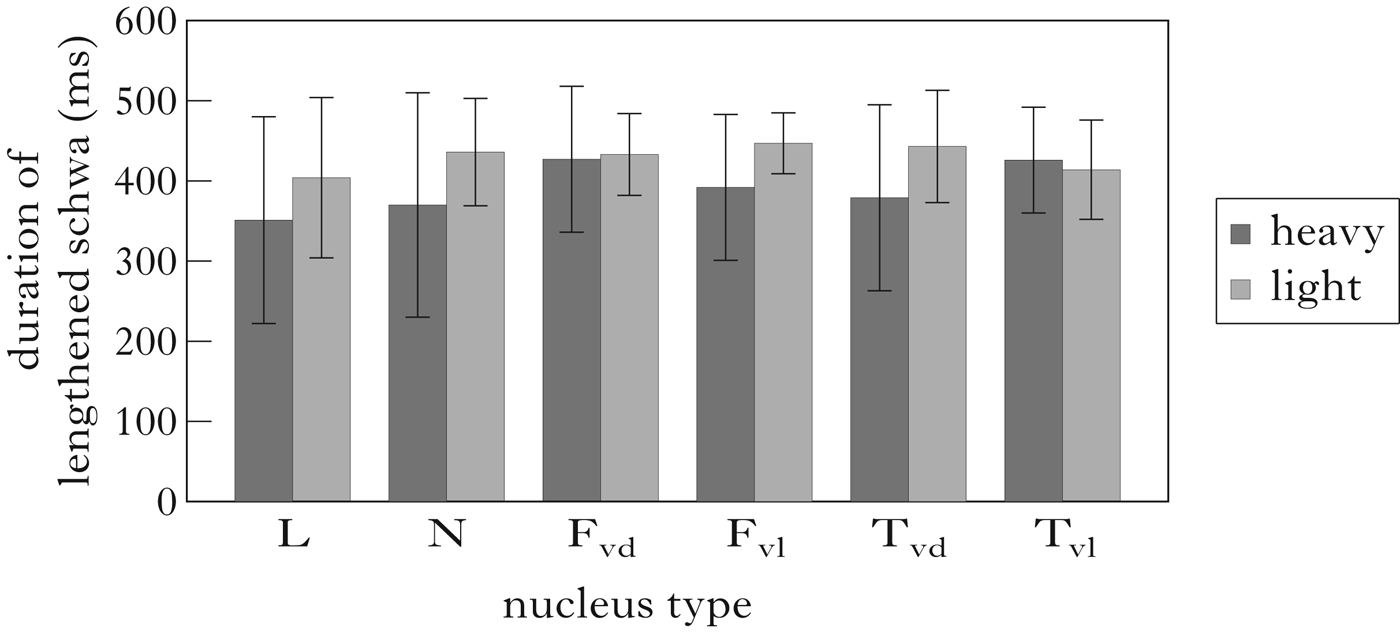
The third strategy used by speakers is to lengthen a schwa inserted within the consonantal string of the final syllable. Lengthened schwas occurred in 261 utterances (26%). This is illustrated in Fig. 8 for the form [imsəːːʜ] ‘he erased’, where the lengthened schwa has a duration of 501 ms. The shortest lengthened schwa has a duration of 121 ms and the longest 675 ms (mean = 390 ms).
Acoustic waveform and spectrogram of one realisation of (left) /is imsʜ bɾahim/ ‘Did Brahim erase?’ and (right) /imsʜ/ ‘he erased’, illustrating the lengthening of schwa

Figure 9 presents a summary of the durations of lengthened schwas by nucleus type and syllable weight. As can be seen, with the exception of Tvl, the mean duration of lengthened schwas in heavy syllables is shorter than in light syllables. This is presumably due to the presence of a coda consonant in the heavy syllables.
Mean duration of lengthened schwas in final syllables in emphatic statements, by nucleus type and syllable weight (standard errors are given as positive and negative error bars).

3.2.3 Distribution of lengthened schwa
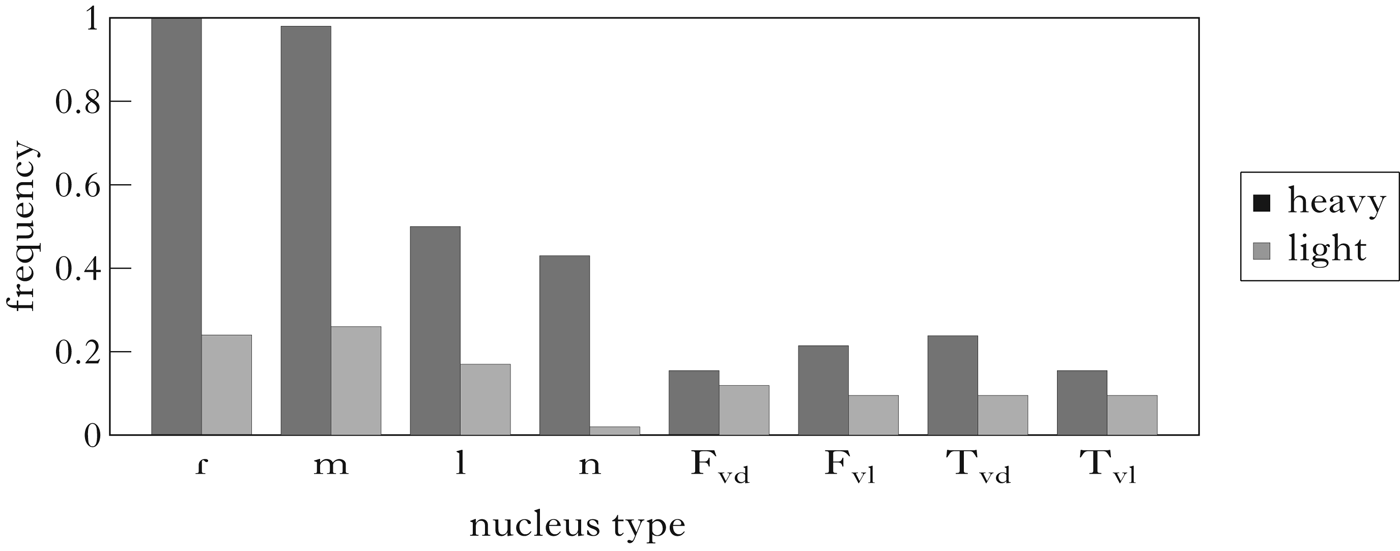
Figure 10 shows the distribution of lengthened schwas according to the degree of sonority of the nucleus and the weight of the syllable (we show the patterns of individual sonorant consonants in order to highlight the differences between /l/ and /n/ on the one hand and /ɾ/ and /m/ on the other). A number of patterns are evident in this figure. First, lengthened schwas can occur in all contexts, including within voiceless sequences and sequences of consonants sharing the same place of articulation (compare transitional schwas in polar questions, shown in Fig. 5). Second, obstruent nuclei vary less than sonorant nuclei in terms of the extent to which the frequency of schwa lengthening is affected by syllable weight. Third, the use of schwa lengthening is systematic in heavy syllables with /ɾ/ and /m/ as nuclei, but highly variable in the other contexts. Tests of independence shows that this variability is speaker-dependent: χ(39) = 202.38, p < 0.001 for light syllables and χ(39) =69.14, p = 0.002 for heavy syllables. While all speakers used lengthened schwa in final heavy syllables with sonorant nuclei at least once, six speakers (S4, S6, S7, S8, S10, S11) did not have lengthened schwa when the nucleus was an obstruent (see Appendix B for more details).
Frequency of lengthened schwas in final syllables in emphatic statements by nucleus type and syllable weight.

In the following subsections we present the distribution of lengthened schwas according to nucleus type in greater detail. We also show the occurrences of transitional schwas, to highlight how the distribution of the two types of schwas differs.
3.2.3.1 Distribution of schwas among items with sonorant consonant nuclei
Our data contain 336 tokens displaying the four sonorant consonants /ɾ l m n/ in nucleus position. Within these tokens, 151 were produced with lengthened schwas (45%). In the form [if.sɾ], lengthened schwa was used to convey an emphatic statement in 24% of the repetitions (i.e. [ifsəːːɾ]). Interestingly, in the remaining 76% of the utterances, where the vowel of the initial syllable was lengthened, a transitional schwa was systematically present in the final syllable (i.e. [iːːfsəɾ]). This shows that the lengthening of the lexical vowel of the initial syllable and the presence of a transitional schwa in the final syllable are not mutually exclusive. It also shows that the presence of a transitional schwa in the polar question context does not necessarily imply the presence of a lengthened schwa in the emphatic context. In [if.sɾt], where the final heavy syllable is always lengthened, the 14 speakers used schwa to express an emphatic statement (i.e. [ifsəːːɾt]). As for the rhotic sonorant nucleus, when lengthening occurs in the final syllable of the forms [ik.ʃm] and [ik.ʃmt], it was systematically expressed using schwa (11/42 in the light syllable context and 41/42 in the heavy syllable context).
The pattern observed in the forms containing /l n/ as nuclei (i.e. [in.tl(t)] and [iʃ.tˁn(t)]) differs in two ways. First, schwas in these forms only occur when used as a means for expressing emphatic statements. In other words, when lengthening is on the lexical vowel of the first syllable, transitional schwa never surfaces within the homorganic sequences. Second, unlike /ɾ/ and /m/, emphatic statements can be expressed through lengthening /l/ or /n/ (10/84 in light syllables and 36/84 in heavy syllables). What is common to all syllables with sonorant consonants is that lengthened schwas are always adjacent to the nucleus. However, unlike what has been observed for singing by Dell (Reference Dell, Cairns and Raimy2011), schwa does not systematically follow the sonorant nucleus: it more frequently precedes it, as only 13 tokens (out of 151) displayed a lengthened schwa following the nucleus.
3.2.3.2 Distribution of schwas among items with fricative nuclei
For the great majority of tokens with fricative nuclei, speakers expressed emphatic lengthening using the lexical vowel of the first syllable (85% of the tokens). Emphatic statements can also be expressed using lengthened schwa, although less frequently (15% of the tokens). The items with fricative nuclei pattern in the same way, regardless of whether the fricative is voiced or voiceless: (i) the frequency of occurrence of lengthened schwas in these items is virtually the same (23/168 for voiced fricatives and 26/168 for voiceless fricatives), and (ii) lengthened schwas systematically occur between the onset and the nucleus (e.g. [izdəːːʁ], [iftəːːχ]). There is one important difference, however. When lengthening is on the initial syllable, transitional schwas never surface within the final syllables with voiceless fricative nuclei. In contrast, transitional schwas are extremely frequent in the final syllables with voiced fricative nuclei, occurring either following C1 (73/168) or C2 (107/168). This is similar to the results obtained for the polar question context. Again, this shows that that there is no correlation between a lexical item having a transitional schwa in the polar question context and having a lengthened schwa in the emphatic context.
3.2.3.3 Distribution of schwas among items with stop nuclei
The pattern observed for voiced stop nuclei is similar to that observed for voiced fricative nuclei. Transitional schwas are very common, occurring after C1 (108/168), C2 (105/168) or even C3 (13/168), yet emphatic statements are most frequently expressed using the lexical vowel of the first syllable (only 15% of tokens were produced with lengthened schwas). There is a clear preference for the lengthened schwa to precede the nucleus. The only exception was speaker S5's three realisations of [iʒbdəːːt] ‘he pulled it’, with lengthened schwa following nucleus /d/.
Items having voiceless stop nuclei also display the same behaviour as items having voiceless fricative nuclei. Either the final syllable is chosen to host the emphatic statement and schwa is used to implement it or lengthening is on the initial syllable lexical vowel and transitional schwa never occurs on the final voiceless syllable. The latter option is by far the most frequent (88% of the utterances). All lengthened schwas in items having voiceless stop nuclei occur between onsets and nuclei.
4 General discussion
This study has provided an investigation into the nature of schwa in Tashlhiyt. We presented new empirical data describing the distribution and behaviour of this vocoid within phonotactically different types of word-final consonant syllables in two different prosodic modalities: polar questions and emphatic statements. Data from polar questions illustrated the case where target items were realised with no prosodic prominence or pitch peak, allowing for the analysis of the segmental effect on the distribution of schwa, with no influence from suprasegmental factors. Data from emphatic statements illustrated the case where a strong prosodic prominence, which typically lengthens the word-final vowel, had to be implemented within items lacking final vowels. We attempted to determine whether schwa could be used to implement emphatic lengthening in such items, and to examine how this was related to the phonological factors of sonority and syllable weight.
Results from polar questions showed that when target items were realised with no prosodic prominence the presence or absence of schwa within these items could be predicted from the laryngeal and supralaryngeal properties of the consonants within the sequence: schwa almost never occurred within a sequence of voiceless consonants, and never within a homorganic sequence with unreleased consonants. The occurrence of schwa elsewhere was variable, and was more or less favoured depending on manner of articulation of the consonants and the position of the voiced consonant within the sequence. These results are in accordance with previous production data presented by Ridouane & Fougeron (Reference Ridouane and Fougeron2011) on word-initial clusters in CCV(C) items. They provide strong additional support that at least some instances of schwa should be analysed as transitional vocoids that are the result of the way in which consonant sequences are produced.
Results from emphatic statements showed that when target items had to be realised with a strong prosodic prominence (i.e. extra lengthening) speakers used three different options: (i) they lengthened the lexical vowel of the initial syllable (e.g. [iːːftk]), (ii) they lengthened a sonorant consonant within the final syllable (e.g. [intlːːt]) or (iii) they lengthened a schwa adjacent to the consonant nucleus (e.g. [izdəːːʁ]). The first option was the most frequent (69% of the data). Native speakers could lengthen the lexical vowel of the first syllable except in one condition: when the final syllable was heavy and closed with a sonorant nucleus. The second option was the least frequent (5%). It was possible when the final syllable had a sonorant non-rhotic coronal consonant /l/ or /n/ that was homorganic with the preceding consonant. The third option was found in 26% of the data, and was possible for all items, regardless of the phonetic make-up of the final syllables. This result is important, since it provides strong evidence that some instances of schwa in Tashlhiyt cannot be attributed to low-level phonetic factors.
Before we consider further the results from emphatic statements and the functional behaviour of schwa, it is important to compare our results on transitional vocoids to the ‘schwa-nucleus’ approach advocated by Coleman (Reference Coleman2001) and others (e.g. Angoujard Reference Angoujard1997, Louali & Puech Reference Louali and Puech2000). Recall that in this approach all syllables have a vowel as a nucleus, and all occurrences of schwa are epenthetic (except when adjacent to /ɾ/). On this analysis, the bisyllabic forms used in our data are expected to have the representation [VC.CəC(C)]. Comparing the schwas in the production experiment with those posited by the ‘schwa-nucleus’ approach reveals some important disparities. Consider the form /inʁz/ ‘he winks’, which is sometimes produced as [inəʁəz], with two schwas. Under the ‘schwa-nucleus’ approach this form has the representation [in.ʁəz], with a schwa between onset /ʁ/ and nucleus /z/. This schwa, however, does not have a systematic reflex in the pronunciation, since it is present in only 31 out of 84 tokens. One might argue that schwa in this position is overlapped by the adjacent consonants. The problem, however, arises with the other schwa (between coda /n/ and onset /ʁ/), which according to ‘schwa-nucleus’ account should not occur in this position, since it is not an environment where it can be inserted by syllabification (the sequence /nʁ/ is heterosyllabic). However, schwa almost always occurs in this position (it occurs in 72 out of 84 realisations). There is no principled way of explaining why schwa is often overlapped between /ʁ/ and /z/, even though it is inserted by phonology, but almost never between /n/ and /ʁ/, where its presence has no phonological motivation.
Another problem with the schwa-nucleus account concerns the numerous cases where a schwa is acoustically present in the final syllable, but in which an emphatic statement is signalled using the lexical vowel of the initial syllable. To take one example, consider the form /i-bdg/ ‘it is wet’. This word was systematically produced with at least one schwa by the 14 speakers (e.g. [ibədəg]). However, only 9% of the tokens were produced with lengthened schwas; native speakers overwhelmingly preferred to lengthen the first syllable lexical vowel /i/ (i.e. [iːːbədəg]; cf. Fig. 2 above). The presence of schwa does not necessarily cause lengthening to occur on that schwa. As a reviewer points out, it is common for languages to avoid putting prosodic prominence on schwa or reduced vowels: English, for example, does not stress schwa, although it is phonologically present. Similarly, in Lebanese Arabic, a closed penult is not stressed when it contains an epenthetic vowel (Hall Reference Hall2011). The case of schwa in Tashlhiyt is different, however. Whereas epenthetic vowels in English are never stressed, Tashlhiyt schwa is sometimes used to implement emphatic lengthening, and sometimes not. Again, there is no principled way of deciding why this is the case. This fact has a straightforward explanation under the account advocated here: non-lengthened schwas occurring in [iːːbədəg] are transitional elements caused by the dynamics of speech production. The fact that they are ignored by prosody should come as no surprise, since they have no structural relevance, and are absent from the representations that are inputs to the Tashlhiyt linguistic system.
It is also the case that schwa can have a phonological function, expressing an emphatic statement (or acting as a carrier for pitch). The question thus arises as to how two apparently contradictory aspects can be reconciled: the view that schwa is a mere transitional element and the fact that it can sometimes have a linguistic function. The present paper does this by arguing for the existence of two types of schwas in Tashlhiyt: a transitional vocoid (T-vocoid) and a prosodically triggered vocoid (P-vocoid). The insertion of a P-vocoid in Tashlhiyt is an accommodation strategy driven by prosodic prominence: when a suprasegmental feature has to be implemented with a combination of duration, fundamental frequency contour and glottal source waveform, speakers compensate for the absence of these cues in consonant-only syllables by inserting a vocoid.
The insertion of P-vocoids in the data examined in this study depends on whether an emphatic statement is attracted to the final syllable. The frequency of occurrence of lengthening in the final syllable depends to a great extent on the combined effects of final syllable weight and the sonority profile of its consonant nucleus, suggesting an interaction between phonotactics and prosodic prominence. We argue that it is the overall prominence of the rhyme (in the sense of Gordon Reference Gordon2002) that acts as an attractor. That is, the greater the prominence of the rhyme, the more likely it is to attract emphatic lengthening. On this view, closed syllables with sonorant nuclei are prominent enough to be systematically targeted by final lengthening, where lengthening is realised either by schwa insertion or by the lengthening of a sonorant consonant (in /tl/ and /tn/ sequences). Patterning for the other types of final syllables is probabilistic, and the location of lengthening can be defined with a certain likelihood, but cannot be predicted deterministically: open syllables with sonorant nuclei, being less prominent, attract lengthening in 25% of cases, but they are more prominent than open syllables with obstruent nuclei, which attract lengthening in only 10% of cases. Closed syllables with obstruent nuclei are intermediate, and attract lengthening in 19% of cases. The observed pattern for light syllables with sonorant nuclei and for light and heavy syllables with obstruent nuclei exhibits a high degree of variability. This variability is observed both across speakers and within speakers. The within-speaker variation is observed even across repetitions of the same word. For example, speaker S1 uses both [iːːzdəʁ] and [izdəːːʁ] to express emphatic statements (see Appendix B). This high degree of variability, which makes a formal phonological rule difficult to establish, but could be captured within a probabilistic model, clearly reflects the speaker-specific ways of resolving a conflict between the necessity to express an emphatic statement within the final syllable (i.e. its privileged position) and the lack of the appropriate phonetic material to realise it within that syllable.
The P-vocoid is thus driven by prosody: it is inserted to express an emphatic statement, or to carry pitch in text-to-tune alignment (Dell Reference Dell, Cairns and Raimy2011) and in intonational tone alignment (Gordon & Nafi Reference Gordon and Nafi2012, Grice et al. Reference Grice, Ridouane and Roettger2015, Roettger Reference Roettger2016), when appropriate phonetic material (typically a vowel) is lacking. Because its distribution is governed by prosodic considerations, it can occur in a much wider range of contexts than the T-vocoid, including within voiceless consonants or within consonants sharing the same place of articulation. The distribution of P-vocoids in our data seems to be consistent with the distribution of epenthesis predicted by the syllabification-driven account of Coleman (Reference Coleman2001), as it almost always occurs between the onset and the nucleus of the final syllable (e.g. [if.təːːk]). Does this imply that P-vocoids can play a role within the syllable structure? As we shall argue below, the preference for P-vocoids to occur between the onset and the nucleus does not necessarily imply that they can occupy the syllable-nucleus position.
As opposed to P-vocoids, the occurrence of T-vocoids is not restricted by syllable structure, but their distribution is tightly constrained by the phonetic characteristics of the surrounding consonants: they do not surface within a homorganic sequence with unreleased consonants, nor within voiceless sequences. T-vocoids are very common within other types of consonant sequences, and seem to occur systematically in sequences where one of the consonants is /ɾ/. It appears reasonable to consider both T-vocoids and P-vocoids as natural consequences of the lexical and morphological structure of Tashlhiyt, a language that brings various types of consonants together, forming long strings of consonants. These consonants are required to have releases into an open vocal tract. (The only exception is when homorganicity across a consonantal sequence does not favour the release; see Dell & Elmedlaoui Reference Dell and Elmedlaoui1996b for a detailed presentation of the contexts where release is mandatory or optional.) This configuration may be motivated on perceptual grounds (Silverman Reference Silverman1995, Byrd Reference Byrd1996, Wright Reference Wright1996, Chitoran et al. Reference Chitoran, Goldstein, Byrd, Gussenhoven and Warner2002). In stop–stop sequences, for example, information on the place of articulation of the first consonant is primarily cued by the spectral information at its release. The release into a more open gesture, with a particular duration and energy envelope, would allow these cues to be more distributed in time on the burst, the noise transient and in the transitions toward the schwa. A substantial overlap of consonants, on the other hand, will not only reduce information about their identity, but will potentially result in perceptual confusion with other consonant sequences or with geminates. In a form like [ibdg], for example, the initial consonant cannot be substantially overlapped without risking confusion with [iddg] ‘he is bright’.
Various authors have proposed formal analyses of how transitional vocalic elements surface. From the Articulatory Phonology perspective, it is generally argued that they derive acoustically from a reduced gestural overlap between the flanking consonants (Browman & Goldstein Reference Browman and Goldstein1992, Gafos Reference Gafos2002). Ridouane & Fougeron (Reference Ridouane and Fougeron2011) report acoustic and articulatory data on phonetic contexts that favour the emergence of these elements in Tashlhiyt. They show that the vocal tract must be sufficiently open during the transition from one consonant configuration to the next. Consider, for example, the sequence [dg], illustrated in Fig. 11. The release of the coronal /d/ takes place well before the target constriction of /g/ is achieved, resulting in an open transition between the two consonants. This open transition translates acoustically into a vocoid if the vocal folds are vibrating during the transition from the release of /d/ to the closure of the following /g/. It translates into a voiceless interval with frication and/or aspiration noise if none of the consonants are voiced, as for example between /t/ and /k/ in [iftk] (see Ridouane et al. Reference Ridouane, Fuchs, Hoole, Harrington and Tabain2006). On this view, the T-vocoid and the voiceless release both result from this specific timing coordination between supralaryngeal and laryngeal gestures.
Schematic representation illustrating the type of gestural coordination which results in a transitional schwa: the lag between the stop release of /d/ and the constriction target of /g/.

Similarly, the preference for locating P-vocoids between the onset and the nucleus of the final syllable, although not followed consistently, may result from the requirement for onset consonants to have releases associated with them; conversely, where there are consonant releases in the signal, this can be taken as an onset–nucleus boundary. It is this boundary, then, that is used in syllables lacking lexical vowels, in order to make the intended prosodic information perceptually salient. The fact that the P-vocoid does not systematically occur in homorganic sequences such as [tlt] or [tnt], although they form heavy syllables, is evidence that its occurrence is at some point also dependent on the articulatory properties of the surrounding consonants. In such sequences, a single prolonged alveolar closure is produced from the onset of /t/ to the release of /l/ or /n/; the tongue thus never moves away from the alveolar ridge, a gesture necessary for any vocalic element to surface.
5 Conclusion
This study has provided production data based on polar questions and emphatic statements, in order to examine the nature of schwa in Tashlhiyt. The aim was to determine the frequency with which schwa is inserted in different consonantal contexts, and to explore the nature of the interaction between schwa insertion and prosodic prominence. Results from polar questions showed that when consonant sequences are realised with no prosodic prominence, the presence or absence of schwa within these sequences can be predicted from the laryngeal and supralaryngeal specifications of the consonants within the sequence. We referred to this schwa as a T-vocoid, a low-level phonetic phenomenon which is a by-product of gestural underlap, which occurs when consonantal gestures are not entirely overlapping. Results from emphatic statements showed that speakers inserted a schwa when consonant-only sequences were realised with a strong prosodic prominence (i.e. extra lengthening). The distributional characteristics of this prosodically triggered schwa (P-vocoid), were shown to differ from those characterising the T-vocoid, and depend to some extent on the combined effects of syllable weight and the sonority profile of the consonant nucleus.