and
 were explored.
Gilles de Bins (c .1400–60), called Binchois, was listed in fifteenth-century literature alongside Guillaume Du Fay and John Dunstaple as one of the most important composers of his time. His modern reputation rests largely on the incredible popularity of his secular songs, which were cited in poetry and theatre, intabulated for instrumental performance, dismantled to provide tenor lines for dancing and borrowed as the basis for dozens of Masses and motets. Yet despite their popularity, nearly half of Binchois's known secular compositions are preserved in only one source: the manuscript Oxford, Bodleian Library, Canon. Misc. 213 (henceforth Canonici).
Canonici's importance in scholarship can hardly be overestimated; it has been an invaluable resource to scholars since its rediscovery in 1895.Footnote 1 The manuscript is also an important source for the study of late fourteenth- and early fifteenth-century notation. It is the earliest continental source written predominantly in void notation and it was notated in its entirety by a single copyist, who was competent in the mensural practices of the time.Footnote 2 The copyist included several pieces in full-black notation: older pieces in Italian notation as well as early fifteenth-century blended notational styles. The remainder of the manuscript, all in void notation and ranging from the simple to the highly proportional and mensurally complex, was most likely transcribed from exemplars in full-black notation.Footnote 3 Given the copyist's proficiency in such a wide variety of styles, it stands to reason that instances of atypical or unique notation warrant a closer investigation.
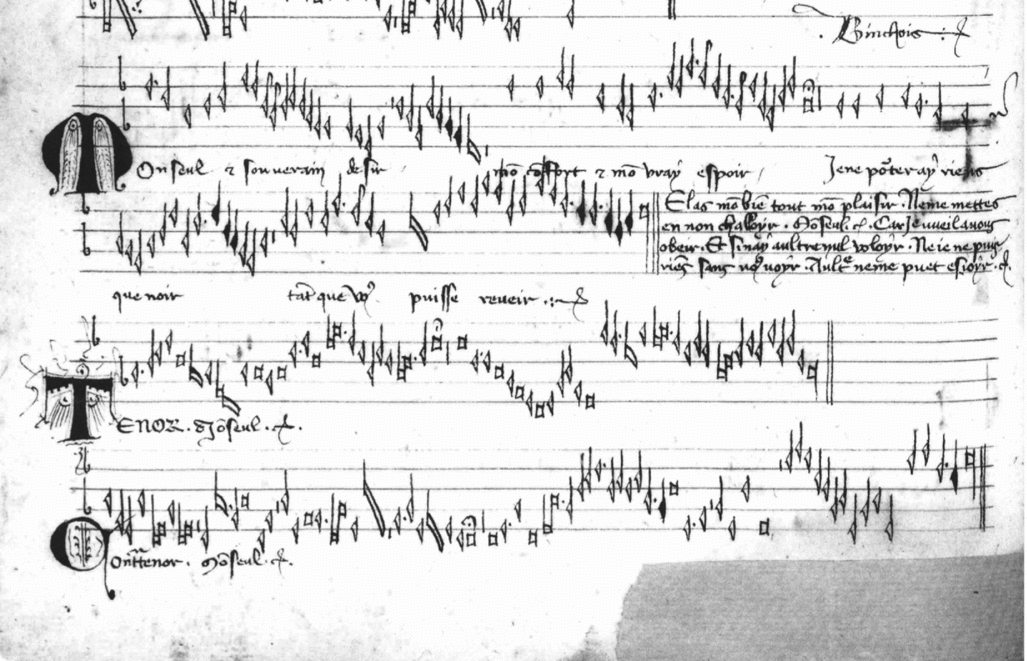
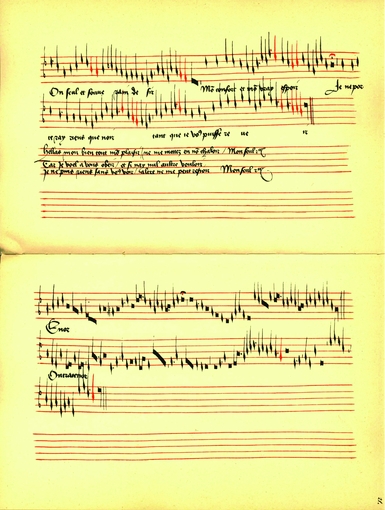
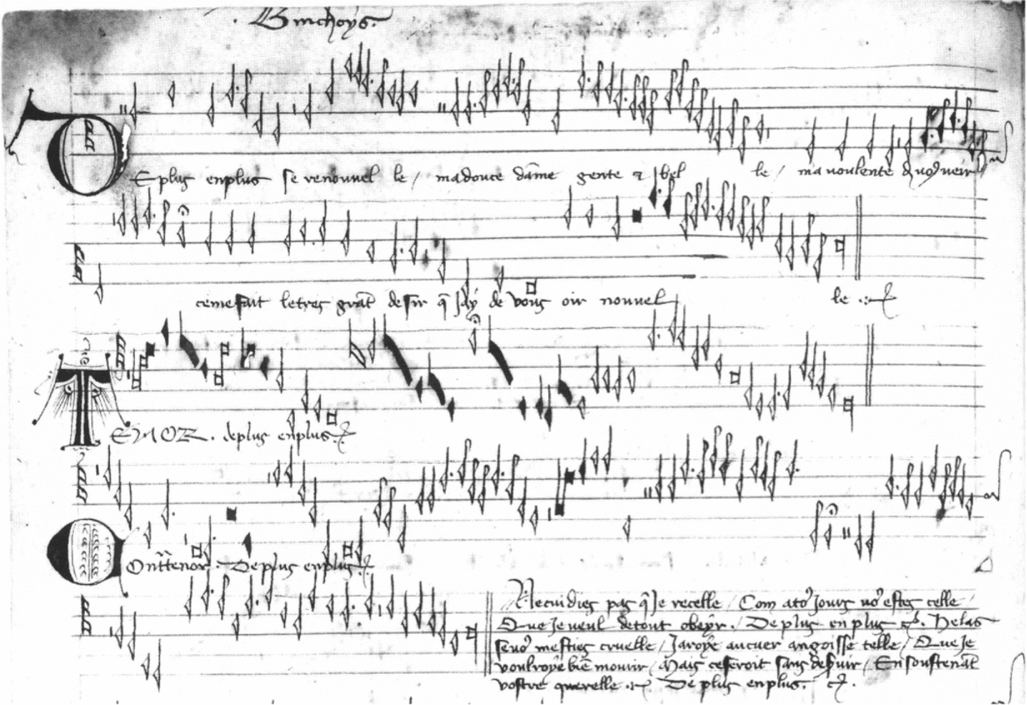
Binchois's rondeau Mon seul et souverain desir (fol. 71v; see Fig. 1) contains examples of such unusual notation. It is one of the earliest of a small body of fifteenth-century compositions that was transmitted without clefs; as such, the rondeau has been a focal point in literature treating this unusual notational phenomenon.Footnote 4 While acknowledging the copy in Canonici, all these studies have relied on the rondeau's concordance in the manuscript Escorial, Palacio Real, Monasterio de San Lorenzo, V.III.24 (also known as Esc A, henceforth Escorial, fols. 20v–21r; see Fig. 2).Footnote 5 Given the predominance of the Escorial copy in these studies and their focus on pitch organisation, none mention the unique mensural feature found only in the Canonici version: Mon seul et souverain desir is the only one of the 326 pieces in Canonici in which the copyist used two different shapes for the semiminim in the same voice.Footnote 6
Binchois, Mon seul et souverain desir (Canonici, fol. 71v). Image from Oxford, Bodleian Library, MS. Canon. Misc. 213, Late Medieval and Early Renaissance Music in Facsimile 1 (Chicago, 1995), courtesy of the University of Chicago Press and the Bodleian Library, University of Oxford.

Binchois, Mon seul et souverain desir (Escorial, fols. 20v–21r). Image from Codex Escorial chansonnier, ed. Wolfgang Rehm, facsimile 2 (Kassel, 1958). Used by permission of European American Music Distributors Company, US and Canadian agent for Bärenreiter-Verlag, publisher and copyright owner.

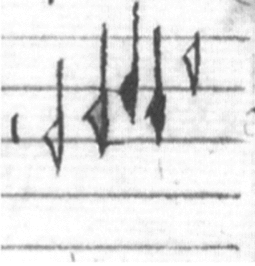
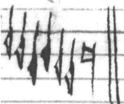
The cantus voice of the Canonici copy features both a void flagged figure (
 ) and a full-black figure (
 ) for the semiminim, as evident in Figure 1 and in the detailed view below. By the time the Canonici copyist notated Mon seul et souverain desir, both shapes designated the value of half a minim, although the full-black figure could also signify a variety of other rhythmic durations. While unusually used together in this rondeau, the two note shapes are readily identifiable here as semiminims, and as such create the same sounding duration.
Yet despite their rhythmic synonymy, the two figures were not entirely interchangeable. Several scholars, most notably Heinrich Besseler and Charles Hamm, have posited that in the years surrounding 1430 minor prolation grew in popularity over major prolation, which dwindled.Footnote 7 In his work on Du Fay, Hamm also noticed a correllation between the type of prolation and the shape of the semiminim: the void flagged figure was typically used in major prolation, the full-black figure in minor.Footnote 8 Later studies of Canonici and other contemporary manuscripts generally support these observations; by the time the gathering that contains Mon seul et souverain desir was written, the Canonici copyist had not only begun to favour pieces in minor prolation but also to adopt the notational practice of aligning semiminim shape with type of prolation.Footnote 9
This practice provides a potential explanation for the unusual notation in this rondeau. More specifically, I suggest that the copyist might have used the two different semiminim shapes as signifiers of the prolations in which they were frequently used, in order to indicate temporary shifts to
 from the prevailing
 . In so doing, the copyist might have left to us a witness of a type of performance practice in which the fluid rhythmic possibilities inherent in the early fifteenth-century mensural system were emphasised.
* * *
The lack of clefs in Mon seul et souverain desir was first discussed in 1964 by Carl Dahlhaus, who criticised Wolfgang Rehm's incorrect transcription from Escorial.Footnote 10 In this source, none of the three voices have clefs; instead, each has two flats written on the second and fourth lines of its respective staff. Rehm, having assigned the top voice a c1 clef, believed the flats in the lower two voices to be scribal error and corrected them to B flat and E flat. Dahlhaus, however, felt that the original flats were correct and would have signified to the fifteenth-century performer the two main hexachords in use for each voice part, necessitating the addition of an extra flat in the key signature of a modern transcription. In 2008, Stefano Mengozzi revisited the rondeau, suggesting that while Dahlhaus's thought-provoking interpretation offered the correct pitch reading, his hexachordal justification was incorrect. Instead, for Mengozzi the flats represented semitone relationships, allowing singers to think in terms of intervals rather than hexachords.Footnote 11
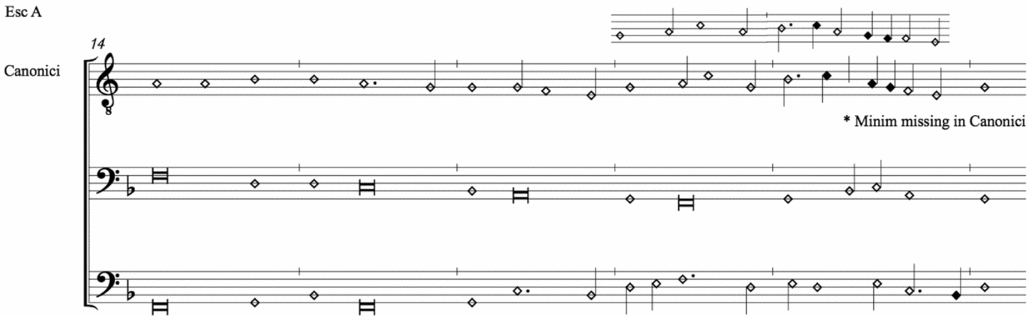
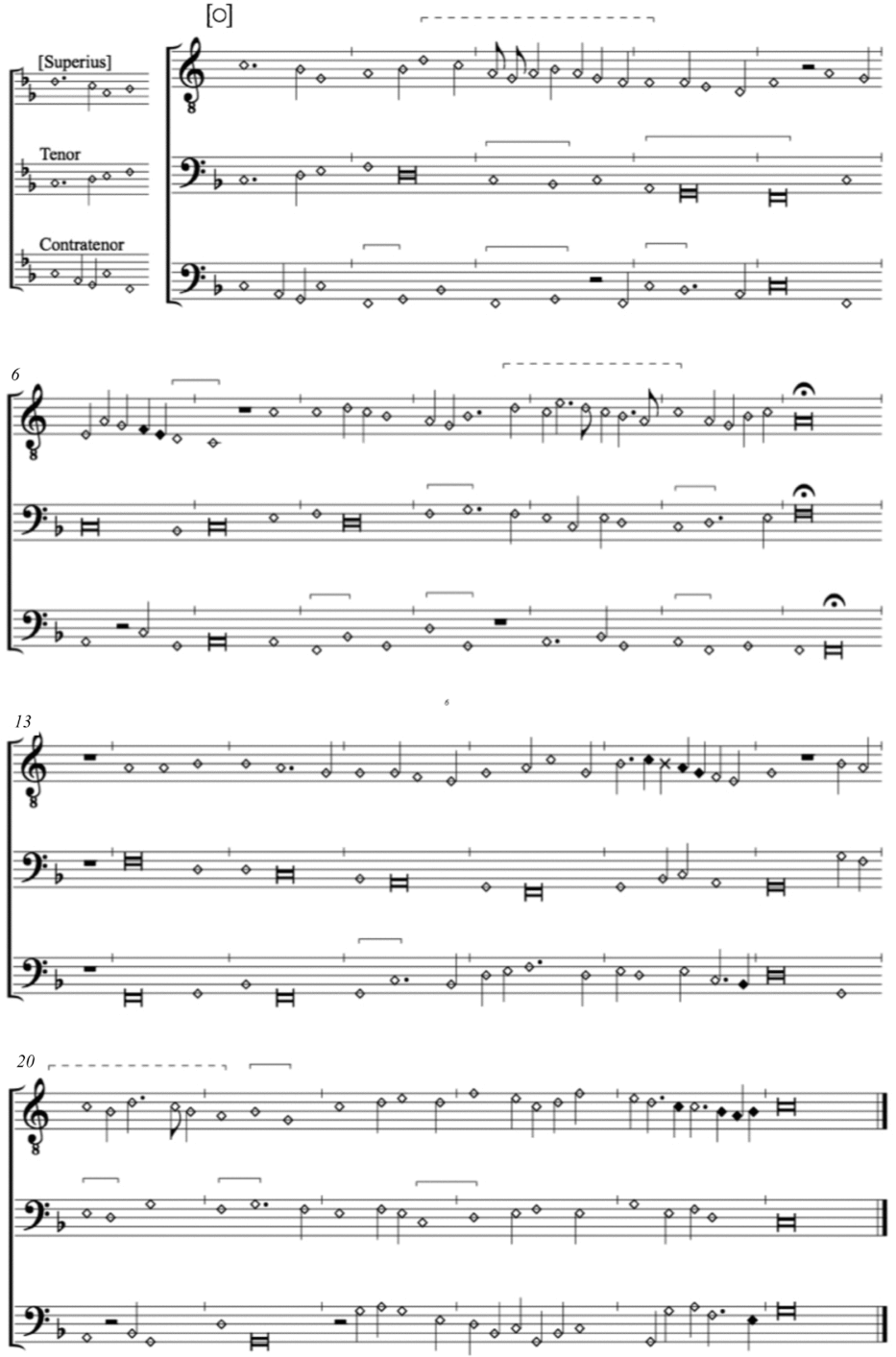
Both Dahlhaus and Mengozzi focus on the copy in Escorial, although Mengozzi mentions the Canonici copy in a footnote. Since the latter is also clefless and uses the same accidentals in each voice, its inclusion would not have affected either of their respective arguments; moreover, the two copies of the rondeau are almost identical with regard to melodic and rhythmic aspects. As Dennis Slavin observes, the cantus line in the Canonici copy is missing a minim (see bar 18 in Fig. 9, marked with an x). At this point in the Escorial copy, the pitch of the minim supplied is incorrect, creating a dissonance with the middle voice, as shown in Figure 3.Footnote 12 According to Slavin, this corrected minim, as well as other pitches that vary from the Canonici copy, point to Escorial's version as the later of the two. While he references the earlier literature on clefs, he does not mention any other notational characteristics of the rondeau in either source.
Scribal error in the Canonici and Escorial copies of Mon seul et souverain desir.

The semiminims in Mon seul et souverain desir have been noted in studies of Canonici's notation, but without explanation. Drawing on the work of Besseler and Hamm, Robert Davis Reynolds explored the notation and chronology of the compositions in Canonici; while he points out several unique examples of semiminims in the manuscript, for this rondeau he observes only that it lacks both mensuration signs and colouration, and that the Escorial concordance uses full-red shapes throughout.Footnote 13 Similarly, Graeme Boone states that Mon seul et souverain desir is the only piece in Canonici to use both semiminim shapes concurrently.Footnote 14 In the 1995 facsimile, editor David Fallows remarks that both of the semiminim shapes in this rondeau were originally notated just as they are, but suggests no reason why the copyist might have done so.Footnote 15
For Fallows, the types of semiminim used throughout Canonici were an important detail in his inventory, as he noticed that the copyist moved increasingly towards using full-black semiminims in the later gatherings. Additionally, he observed that a number of compositions had been edited, such that void flagged semiminims or groups of full-black minims in colouration were turned into full-black semiminims, and suggested that this was perhaps due to the subsequent acquisition of a different exemplar (see Figs. 6 and 7 below).Footnote 16
A small number of pieces copied in later gatherings, however, retained the flagged shape. Of the compositions that Fallows pinpoints as examples, three provide a clue as to the reason for this decision. In void notation, colouration is written with full-black note shapes. The full-black minim figure can therefore create no fewer than three different rhythmic durations, as shown in Figure 4. In colouration passages such as those involving semibreves and minims, typically found in major prolation, the black minim is rhythmically equivalent to the void minim; in smaller colouration groups, three black minims can replace two void minims as a triplet (Fig. 5); and the figure also represents the semiminim, worth half a minim (Fig. 6). The three pieces in question used the full-black figure in colouration, and so likely retained the void flagged figure for the semiminim in order to clarify the intended rhythms for the reader/performer.
Possible rhythmic durations for the full-black minim figure.

Detail of Canonici, fol. 71r, showing full-black semiminims created from an original full-black minim triplet.

Detail of Canonici, fol. 79v, showing full-black semiminims created from void flagged semiminims.

The observations about the relationship of prolation and semiminim shape, and the overall trend towards minor prolation, are borne out in both manuscripts containing Mon seul et souverain desir.Footnote 17 The Escorial manuscript, written by two different scribes entirely in full-black notation with red colouration, is generally dated to between the 1430s and the mid-1440s.Footnote 18 It contains sixty-two songs, forty-nine of which use semiminims. Of these, thirteen are in imperfect tempus with major prolation, all but one of which use the full-black flagged shape. The remaining thirty-six pieces are in perfect tempus with minor prolation. Only one of these pieces uses the flagged black shape; the other thirty-five all use the full-red minim shape.Footnote 19 Escorial thus demonstrates both the growing popularity of minor prolation and the overwhelming tendency, practised by both of the manuscript's copyists, to align each semiminim shape with a particular prolation.
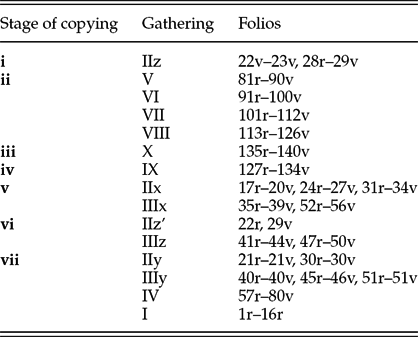
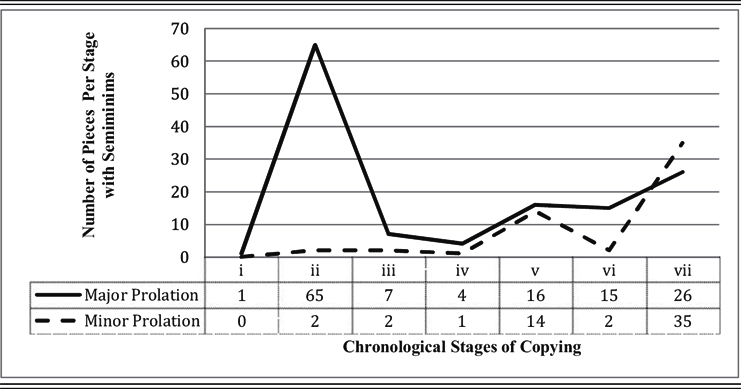
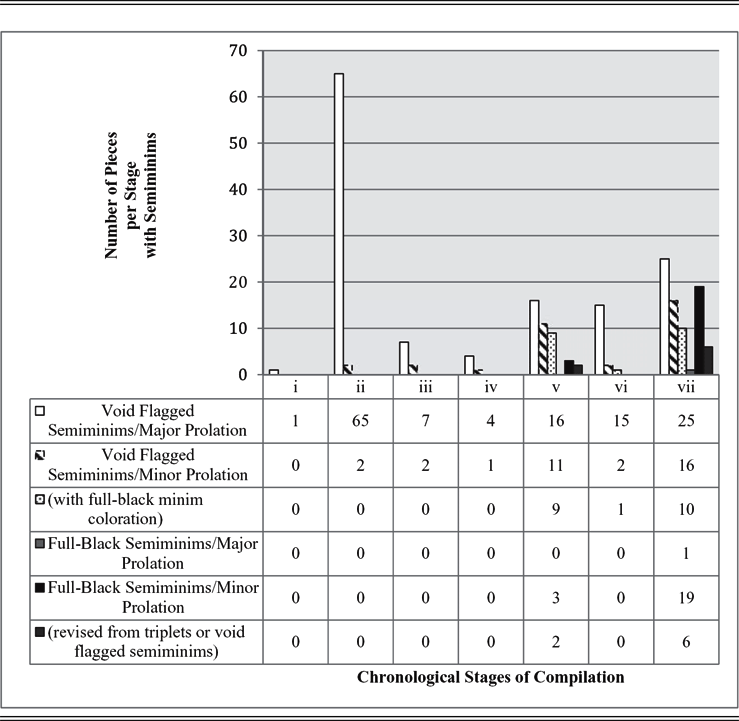
Canonici is believed to have been copied slightly earlier, approximately between 1426 and 1436; Table 1 lays out its structure and chronology.Footnote 20 In the earliest of the ten gatherings (those copied in stages i–iii), major prolation predominates, and the copyist uses the void flagged semiminim shape exclusively. But, as shown in Table 2, the copyist preferred minor prolation in the later stages of compilation, the last of which includes Mon seul et souverain desir in gathering IV.Footnote 21 With the growth in popularity of minor prolation, the full-black grapheme for the semiminim became more commonplace. Table 3 shows not only the gradual rise of both minor prolation and its associated full-black figure over the course of Canonici's copying, but also the retention of the void flagged shape in minor prolation when the full-black figure was used for other rhythmic durations.
Chronological structure of Canonici.

Popularity of prolation types in Canonici.

Relationships between semiminim shape and type of prolation in Canonici.

With regard to these notational changes, as well as to the Canonici copyist's familiarity with other notational styles and developments, the manuscript has been viewed as belonging to a period of transition. For Graeme Boone, the earliest gathering demonstrates the copyist's ‘relative inexperience with white notation’ and with written French, both of which become more confidently utilised over the remainder of the manuscript.Footnote 22 Likewise, David Fallows highlights the significance of the void notation, marking Canonici as a contender for the earliest extant continental source copied in this manner. He adds that the copyist seemed to have little difficulty in transcribing these works, regardless of complexity, from the presumed full-black notation of their exemplars, though again elements such as the semiminims do change over the course of the manuscript's compilation.Footnote 23
The presence of the two shapes in Mon seul et souverain desir has therefore been viewed as a peculiarity that both supports and stands apart from these observations. On the one hand, their use here reinforces our understanding of them as equally legitimate graphic options for the semiminim. Their unique coexistence in this rondeau could therefore be read as a prototype or a snapshot of the burgeoning preference for the use of the full-black figure for the semiminim, an interpretation that strengthens the perception of this manuscript and its notation as transitional. On the other hand, the same coexistence marks this copy as an anomaly with few, if any, parallels in contemporaneous sources. These two graphemes were not fully interchangeable; they were both used in minor prolation, although the void flagged shape decreased over time, but the full black shape was never used in major prolation.Footnote 24
The shapes for the semiminim were thus increasingly relegated to specific mensural contexts, and this pattern was largely broken only when necessity demanded further clarification of rhythmic durations. In this respect, the semiminims in Mon seul et souverain desir momentarily destabilise our understanding of the growing trend to link semiminim shape with type of prolation, for both are found in the same mensuration.
Before any potential significance in this notation can be assessed, though, the possibility of scribal error must be eliminated. The copyist appears not to have been a professional scribe but a well-educated enthusiast, perhaps of high social status, who compiled the manuscript for personal use.Footnote 25 Despite the copyist's apparent breadth of knowledge, the manuscript has its share of mistakes. Several pieces show instances where this person left out a note or rest, transcribed the rhythmic duration or pitch of a note value incorrectly, or included too many notes. As shown above in Figure 3, Dennis Slavin points to just such errors in Mon seul et souverain desir, in which the copyist skipped a minim in the cantus voice.Footnote 26 Yet with regard to rhythm, the semiminim passages are correct and are in all but one instance concordant with the copy in Escorial.Footnote 27
Occasional errors aside, the copyist was attentive to detail and generally accurate, demonstrating fluency in transcribing the notational styles of the late fourteenth and early fifteenth centuries. The copyist also made efforts to update numerous pieces by correcting composer attributions, clarifying text underlay and in some cases revising the notation itself. David Fallows observes that these revisions point not just to the copyist's own use of the manuscript but also to a reliance on numerous exemplars, which might have been made available at various stages in the copying process.Footnote 28
The notation in Mon seul et souverain desir could thus reflect the copyist's use of multiple exemplars containing different semiminim shapes. Yet this idea is unconvincing. If the copyist had begun notating the rondeau using one shape, and then at some point switched to the other shape for the rest of the piece, then the reference to multiple exemplars would be a plausible explanation. But this is not the case; the copyist alternates between the two shapes no fewer than six times, as Figure 1 above shows. It seems highly improbable that a person so steeped in the style of notation used in this rondeau would have needed to consult multiple exemplars with such frequency; additionally, the lower voices show no signs of incongruity or inconsistency. It is equally unlikely that the copyist would not have noticed transcribing two different shapes for the semiminim in such close succession.
If the copyist worked from but a single exemplar, it might have contained some flaw or oddity that caused this notational gesture. The manuscript reveals little difficulty in transcribing pieces from full-black into void notation; an exemplar being written in full-black notation is not enough to suggest any trouble understanding semiminims, especially when no piece copied previously in Canonici shows signs of such confusion. If the exemplar had already been notated in void notation, the possibility for a misunderstanding of this nature ostensibly diminishes even further. As in the discussion of multiple exemplars, it seems unreasonable to suggest that this person would simply not have noticed using two different shapes for the semiminim. There is, of course, the possibility that the copyist's exemplar(s) already contained both semiminim shapes; perhaps this notation even originated with Binchois himself. If so, then the copyist notated Mon seul et souverain desir exactly as it was transmitted. But the copyist's facility with complex notational styles, especially if or when transcribing pieces from full-black notation into void, speaks to an ability to interpret and translate a wide variety of notational gestures. Rather than signalling rote copying, a verbatim transcription of unusual notation might suggest that the copyist already knew, or would have been able to quickly ascertain, the secondary meaning of the semiminim shapes and deliberately chose to notate them as such in Canonici.
Moreover, the revisions noted by David Fallows indirectly cast doubt on the interpretation of the semiminims in Mon seul et souverain desir as errors. In the later gatherings in Canonici, eight pieces have revisions to their semiminims.Footnote 29 Five of these show that ink was scraped out of the first or last notes of a full-black minim triplet, resulting in a rhythmic change to a void minim and two full-black semiminims. The other three show that the note head of a void flagged semiminim was filled in and the flag erased, creating a pair of full-black semiminims instead; in this case, the change is purely visual and has no rhythmic ramifications. Mon seul et souverain desir is copied on fol. 71v, directly next to two of the pieces containing revised semiminims and preceding three more by a scant few pages, yet it shows no signs of revision.
Certainly the lack of revision in this piece is circumstantial and does not prove that Mon seul et souverain desir was notated in this copyist’s, or any other user’s, idea of best practice. However, given that the copyist had expertise in the notation used in this rondeau, skill in other more complicated notational styles and interest in revising the manuscript, we should consider the possibility that these two semiminim figures were written deliberately.
Perhaps this unusual notation was intended to symbolise something in the text. The first portion of the text from Canonici is as follows:

The text underlay is unclear at times, as can be seen above in Figure 1. The void flagged shapes align more or less with the words ‘souverain’, ‘espoir’ and ‘que vous’, the full-black shapes with the words ‘desir’, ‘noir’ and ‘reveir’. The use of the full-black semiminims in the melisma carried by the word ‘noir’ is at first glance intriguing. Yet since this rondeau is in minor prolation, the full-black figure is the expected grapheme. Any symbolic relationship between text and notation would thus presumably be found in the unusual use of the void flagged shape, but none of the words for which those shapes are used suggest such an interpretation. Furthermore, if the copyist were working from an exemplar in full-black notation, all semiminims would presumably have been red and would have been translated into full-black figures regardless of text. It could be that in noticing the connection between the ‘new’ full-black semiminim and the word ‘noir’, the copyist decided to playfully alternate the graphemes; however, the form of the rondeau does not emphasise the word ‘noir’ but rather the repeated phrase ‘Mon seul et souverain desir / Mon confort en mon vray espoir’, which minimises the likelihood that the word ‘noir’ was a motivating factor in any symbolic use of semiminim shape.
If indeed the notation of the semiminims was deliberate, a better explanation for the copyist's actions is found in the relationship between semiminim shape and prolation, which was already exploited by the time Mon seul et souverain desir was copied. Again, since the rondeau is in
, the full-black semiminim is the expected grapheme; the contratenor voice uses that shape exclusively, further marking it as the predominant figure. The void flagged semiminims, then, could be read as signifiers of a temporary shift to major prolation (
) each time they appear.
While indicating this kind of mensural vacillation via semiminim graphemes would have been unorthodox, the logic behind such a decision does make sense within the principles of early fifteenth-century notation. Shifting between mensurations in and of itself was commonplace, usually indicated with signs or by colouration, which temporarily substituted another mensuration or rhythmic hierarchy.Footnote 30
As a very pointed example, Figure 7 shows De plus en plus, another Binchois rondeau as notated in Canonici. At the end of the first system of the cantus voice, there is a brief passage in colouration. The rondeau is in
; the colouration here reduces the perfect void semibreve by one-third, resulting in three coloured semibreves – or, rather, their equivalent in minims and semiminims (Fig. 8). In other words, it momentarily superimposes a breve's worth of
. The rhythmic duration of the minim and semiminim are unaffected by this change; the passage could just as easily have remained in the original void notation. What the colouration signifies is a change in the duration of the semibreve, implying a subtle shift in stress or weight on the semibreve level from
to
.
The copyist could have chosen to insert a mensuration sign here, but again, the passage would have been written exactly the same in void notation, regardless of whether it were in
or
. The sign might then have been unnecessarily confusing, not only for just one breve's worth of material but also in a situation where another commonly used notational device such as colouration was available. Furthermore, the use of a mensuration sign might have resulted in confusion about the successive relationships between the two signs. It stands to reason that in vertical or simultaneous instances of two different mensurations, the proper relationship between the two would be readily determinable, and all the more so between
and
when breve or minim equivalence applies. For the reader/performer of the cantus part, though, the insertion of
into
might have suggested semibreve equivalence, resulting in a breve half again as long as one in
, and vice versa. For this and other reasons, the exact relationship between movements or sections of works with different mensuration signs, such as several of the Mass movements found copied in Canonici, remains a debated topic. The use of colouration in this passage provides the manuscript's users with the correct rhythmic reading without confusion over mensural relationships between voice parts or within the cantus voice itself.
This example highlights one of the flaws of the early fifteenth-century mensural system, however. While applying colouration in this fashion can easily allow a performer to switch from
into
while maintaining breve and minim equivalence, the reverse is not possible without a canon or some other clarification; colouration in a piece in
would operate at the level of the breve, interjecting not
but
. A mensuration sign would need to be used, but once again, a reader might interpret
through semibreve equivalence, resulting in a breve two-thirds the length of one found in
.
Because of the potential for both breve and minim equivalence in
and
, there is an inherent tension and possibility for play between these two mensurations, one that is revealed in the Canonici copyist's decision to use rhythmically unnecessary colouration in De plus en plus. But both colouration and mensuration signs affect only those notes that are coloured or that occur between signs; had the copyist wished to exploit the tension possible between
and
in a more fluid manner, both of these devices might have been too abrupt. In the case of Mon seul et souverain desir, the primary mensuration of
hinders the use of colouration to enact the desired mensural shift, and a new mensuration sign would have posed potential problems in realisation (Fig. 9). The use of semiminims, therefore, might have been intended not only as a signifier of mensural change but also as a flexible, less bounded indicator of a momentarily different groove.
Binchois, De plus en plus (Canonici, fol. 67v). Image from Oxford, Bodleian Library, MS. Canon. Misc. 213, Late Medieval and Early Renaissance Music in Facsimile 1 (Chicago, 1995), courtesy of the University of Chicago Press and the Bodleian Library, University of Oxford.

Readings of the coloration passage in De plus en plus in
and O, showing the reorganisation occurring at the semibreve level.

Transcription of Mon seul et souverain desir from Canonici. Solid brackets indicate ligatures; dotted brackets show moments of potential mensural fluidity signified by the void flagged semiminims. The transcription's pitch follows Mengozzi's suggestion that the flats represent semitone relationships, such that those in the cantus voice mark off C and G. In the interest of clarity, I have left out the text and made no corrections in pitch or rhythm to the Canonici reading.

Graeme Boone discusses the concept of temporal organisation in mensural music, observing that, for the most part, early fifteenth-century music is rhythmically organised in a way that corresponds to a mensuration, whether or not one is specifically signed. He also notes the frequency of mensural shifts, describing them not necessarily as changes in pulse, which is neutral and non-hierarchical, but more appropriately as changes in ictus, which is hierarchical and organisational. Ictus, for Boone, is ‘that variable emphasis in music which allows for the favoring of certain events over others, creating strong and weak functions and, through them, rhythmic hierarchies’.Footnote
31
In a shift between
and
in which breves and minims are equal, such as the colouration group in De plus en plus or the potential fluidity occurring in Mon seul et souverain desir, the ictus thus emphasises the hierarchical regroupings of minims per semibreve: three groups of two minims in
become two groups of three in
, and vice versa, as shown above in Figure 8 and suggested in Figure 9.
This notion of ictus or stress does not necessarily imply our modern understanding of accent or beat, as Boone is quick to state, although it could in fact do so. Similarly, Timothy McGee uses the word stress ‘to imply only that subtle kind of emphasis which marks off a melodic line into sub-units and causes the phrase to flow forward’.Footnote
32
A shift of stress, in other words, reorganises mensural groupings in a way that transfers emphasis onto a different duration or mensural level, which might result in a different accentual pattern. McGee uses as an example a ballade from Canonici: Du Fay's Ce jour le doibt, which, like Mon seul et souverain desir, is in
.Footnote
33
In the ballade, the ‘perceived groupings and stresses dictated by melodic-rhythmic flow’ fall into irregular groupings of two, three, four and even seven semibreves; the stresses in the cantus line tend to align with longer note values or moments of textual importance, occasionally combining in ways that imply a mensuration other than the principal
.Footnote
34
Ross Duffin clarifies this idea, stating that the original notation will often make these groupings obvious, perhaps through colouration; he uses as an example the close relationship between
and
, in which the pattern of a semibreve, two minims and a semibreve could be read in ways that support or enforce either mensuration.Footnote
35
In some fashion, then, the shift of ictus in Mon seul et souverain desir would already have been built into an early fifteenth-century musician's understanding of written and unwritten musical gesture, as well as into the notation and mensural organisation of
and
. A performer or copyist would have been able to engage with the already present interplay between
and
in a rondeau such as this without having it specifically drawn to their attention. In fact, the lower voices of both De plus en plus and Mon seul et souverain desir can also be read in multiple fashions. In bar 10 of Mon seul et souverain desir, both the tenor and the contratenor voices contain rhythmic patterns that can easily be subdivided into three groups of two minims each, supporting the prevailing
, or two groups of three minims each, supporting the cantus voice's potential shift into
. In the measure containing the colouration group in De plus en plus, the lowest voice falls nicely into a rhythmic gesture typical of
: two minim rests, followed by two minims, a dotted minim and a void flagged semiminim, which in performance would subvert the colouration pattern in the top voice. But this arrangement is also easily subdivided into three groups of two minims, and if emphasised in such a way would support the top voice even further.
Notational practices of the early fifteenth century often assumed that musical readers could realise numerous types of unnotated performance practice. Two clear examples of such exist in Mon seul et souverain desir: the aforementioned lack of clefs and the lack of written inflections, or musica ficta. Musicians using either Canonici or Escorial would have needed to be able to determine the proper starting pitch in all three voices and to work their way by intervals through the piece, adding ficta where necessary. Yet this presumed ability does not preclude clefs or accidentals from being notated elsewhere; clefs are obviously the norm, this rondeau being one of the very few early fifteenth-century pieces that does not use them, and notated accidentals are not uncommon in this manuscript. Also, simply because shifts of ictus were not typically notated via semiminims does not mean that they were not ever notated; the aforementioned uses of mensuration signs and colouration would suggest otherwise.
In a 2003 article, Donald Greig discusses three main difficulties of performing repertory written in the ‘ars subtilior’ style: comprehending the rhythmic durations of note values, realising these rhythms in one's own part, and creating a sense of ensemble wherein all parts are combined effectively. As regards his second category, he states that in modern notation, ‘the performer confronts the code, not the intended “feel” of the musical phrasing’, which can create a laboured and unmusical, if precise, result.Footnote 36 Borrowing this idea of musical code, albeit in a somewhat incongruous fashion, I suggest that perhaps the Canonici copyist created or copied a code that attempted to impart such a sense of ‘feel’ to the manuscript's users.
The alignment of different shapes for the semiminim with specific prolations was known to the manuscript's copyist. As there was no rhythmic or textual significance to the two shapes in Mon seul et souverain desir, the use of the void flagged shape to denote major prolation is a plausible explanation for this unusual notation, and it is one that also has theoretical justification. The fourteenth-century Italian theorist Johannes Vetulus discusses the need for multiple shapes in different combinations of mensuration; although in this case he referred not to the semiminim but to the minim, one of his chosen graphemes was the full-black flagged shape used for the semiminim.Footnote 37 Two later treatises, the anonymous Tractatus de musica mensurabili and De musica mensurata, are more specific; both refer to two small note values, the ‘semifusiel’ and ‘semifusiel semi’, as equivalent to the semiminim in rhythm but different in shape so that they might be distinguished in different prolations.Footnote 38 Although the latter treatises are likely of central European origin, they draw on theoretical and notational concepts typical of Jean de Muris's followers as well as more traditionally Italin sources. The potential use of semiminim shapes to signify a shift in stress or even mensuration is thus grounded in both theoretical tradition and practical use, and could also be another example of ludic notation in the same vein as some of the earlier ‘ars subtilior’-style elements also found in Canonici, a puzzle to be solved by the reader.Footnote 39
Knowing that the copyist was likely also the user of the manuscript invites several interpretations for the existence of this notation. One possibility is that the copyist, while transcribing the piece, realised the sound of the cantus in a particular way (silently or perhaps singing aloud) and wanted to record this interpretation for later use. Another intriguing possibility is that the copyist heard the piece performed by others in a way that brought out the nuanced relationship between
and
and therefore used the semiminims creatively to document that performance.Footnote
40
One of the curious aspects of the transmission of Binchois's works is that so many came to be preserved in Italian sources such as Canonici when Binchois himself never left Burgundy.Footnote
41
The popularity of his works in Italy speaks to the possibility of a performance tradition with which the Canonici copyist was familiar (or perhaps even took part in) and which thus might have influenced these transcriptions.
This reading of Mon seul et souverain desir supports the current view of the relationship between Canonici and Escorial. Dennis Slavin argues convincingly that Binchois's compositions copied by the second scribe in Escorial were done so after, but not from, Canonici; Thomas Brothers's investigation of accidentals in Binchois songs strengthens this view.Footnote 42 While the copyist in Escorial does supply the minim missing in Canonici, this reading is dissonant and therefore incorrect, which Slavin believes points to the Canonici reading as the earlier. The two copies seem unlikely either to be directly related to one another or to share a common exemplar.
This interpretation also has ramifications for our understanding of Canonici. Most significantly, it supports a view of the copyist as the editor of the manuscript. Many of the revisions are clearly in this person's handwriting: composer attributions, text underlay, and at least some of the edited notation. But it is not possible to determine who edited the semiminims in the aforementioned eight pieces, since the revisions are created by erasures that could have been done by any hand.Footnote
43
All eight pieces are in
(one also in
 ) and in each case the revision replaces a full-black triplet or void flagged semiminims with the full-black semiminim shape, updating the notation to more recent trends. While the final versions are consistent with the Canonici copyist's practices, this is not enough to prove that this person was responsible for them.
A more convincing tie to the Canonici copyist is found in one of the eight edited pieces. On fol. 54r, the copyist notated the rondeau De couer joyeux je veuil chanter by Benoit. The copyist seems to have been unsure of its composer: at first this person wrote ‘[Re]zon’, but then erased it and wrote ‘Benoit’ at some later point, and to the left of this attribution is a much smaller ‘benoit’ that has also been erased. Fallows states that this piece, copied into the third gathering, is the earliest in the manuscript to contain full-black semiminims.Footnote 44 However, that implies that this piece was the first, chronologically, to use them, which is not the case; as Fallows notes, these full-black semiminims were later adaptations. What is unusual about this piece is that it is the only one of the eight edited pieces not found in gathering IV, making it one of the earliest pieces to have been later revised.Footnote 45 It appears that the copyist came across at least one later exemplar for Benoit's rondeau and consequently updated the composer attribution; it is plausible that the copyist would also have revised the semiminims at the same time, either because the new exemplar used the increasingly popular full-black semiminim or because the copyist recognised that the older piece was notated in an older style and updated it accordingly.
The other six revised pieces are all found in the fourth gathering, written at the time by which the copyist had begun to align semiminim shapes with prolations. If it is true that the copyist was the editor of the semiminims in the Benoit rondeau, then several possibilities must be considered. First, the copyist likely also edited at least the two pieces that contain the exact same revision: filling in the note head of a void flagged semiminim and erasing its flag. Presumably, the pieces that originally contained the void flagged semiminims were amongst the earliest to be copied, but over the course of notating this gathering, the copyist began to use the full-black semiminim shape in minor prolation. At that point, this person might have gone back and revised those pieces in this gathering that were now incorrect or outdated. Or, as with the Benoit ballade, the copyist obtained new exemplars, which motivated a consistency in notation throughout the rest of the gathering. It is not far-fetched to then imagine that this person might also have gone back through the manuscript and edited the other pieces, in which a coloured triplet became a void minim and two full-black semiminims, and likely for the same reasons. Since this gathering also contains Mon seul et souverain desir, the copyist certainly had the opportunity to correct or update the notation in this piece. The fact that this person did not might mean that this notation was already meaningful in a way that required no further revision, although once again it must be stated that the absence of evidence is not evidence of absence, since the manuscript clearly contains numerous compositions containing unaltered void flagged semiminims.
The peculiar notation of semiminims in Mon seul et souverain desir has escaped critical exploration thus far because the two note shapes are rhythmically equivalent; their respective durations are easily understood, and so they must have had the same ‘meaning’. But as Tim Carter states, ‘before we can deliver the notes, we need to know what they signify, and even the same “notes” do not signify the same things in all times and places’.Footnote
46
Semiminim shapes were aligned with specific prolations on the page, and the Canonici copyist was familiar with that phenomenon. This copyist was aware of the tension and interplay between
and
, elsewhere using colouration or mensuration signs to shift between them. This person was also a knowledgeable and fairly accurate copyist who cared enough about the manuscript to revise it after the fact. Whether the unusual notation in Mon seul et souverain desir reflects the copyist's own aural interpretation of the rondeau, describes a performance that this person heard, is evidence of the verbatim copying of another person's invention, is simply a moment of whimsy or is even an error after all, is not possible to determine. But the scenario I have proposed here speaks to the possibility of the notation as deliberate and, moreover, meaningful in a way that went beyond rhythm: the two semiminim shapes brought their own mensural connotations to the page. Read in this light, the Canonici copyist might have allowed us a glimpse into an early fifteenth-century understanding of mensural organisation, and if so, then this manuscript stands witness to the creative use of notational signs that captured performance practices in writing.
Appendix: text and translation
Based on the reading in Escorial, which is clearer; Canonici and Le Jardin de plaisance et fleur de rethoricque offer variants in spelling and word order.