


Introduction
Eating disorders (ED) and obesity have increasingly been considered two poles on the same continuum of problems related to eating and weight (Grilo, Reference Grilo2006). Individuals with either of these two conditions present anomalous functioning patterns, including body dissatisfaction, unhealthy behaviours to lose weight, or the inability to maintain the lost weight (Krug et al., Reference Krug, Villarejo, Jiménez-Murcia, Perpiñá, Vilarrasa and Granero2013). The ED category includes anorexia nervosa (AN), bulimia nervosa (BN) and binge eating disorder (BED) (DSM-5, 2013). Individuals with ED commonly show a diagnostic cross-over between ED diagnostic categories, especially from AN-bingeing/purging type to BN (Eddy et al., Reference Eddy, Dorer, Franko, Tahilani, Thompson-Brenner and Herzog2008; Fairburn and Harrison, Reference Fairburn and Harrison2003). This points to a differentiation between a binge-purge dimension and a restrictive dimension, not only in their clinical characteristics, but also in the therapeutic strategies.
Obesity is not a mental disorder, but rather a chronic disease. ED and obesity can occur simultaneously or increase in severity over time (Neumark-Sztainer et al., Reference Neumark-Sztainer, Wall, Eisenberg, Story and Hannan2006). Both disorders share multiple biological and environmental risk factors (Haines et al., Reference Haines, Kleinman, Rifas-Shiman, Field and Austin2010), and they are associated with maladaptive eating styles that may be relevant in their development and maintenance (Krug et al., Reference Krug, Villarejo, Jiménez-Murcia, Perpiñá, Vilarrasa and Granero2013).
Patients with weight and eating-related problems seem to have difficulties in executive functions, a set of mental processes needed for reasoning, solving problems, and planning (Diamond, Reference Diamond2014). They make wrong decisions when they have to choose whether or not to eat, which food to eat, and how much to eat. Previous research has found that patients with ED or obesity perform worse than healthy controls on tasks assessing decision-making (Wu et al., Reference Wu, Brockmeyer, Hartmann, Skunde, Herzog and Friederich2016). Performance on these tasks is characterized by making decisions based on the short-term consequences (for example, relief of anxiety), despite long-term negative consequences, and by not learning from previous decisions to modify current behavior (Aloi et al., Reference Aloi, Rania, Caroleo, Bruni, Palmieri, Cauteuccio, De Fazio and Segura2015; Brogan et al., Reference Brogan, Hevey and Pignatti2010; Perpiñá et al., Reference Perpiñá, Segura and Sánchez2016). Patients with ED and obesity also show impaired set-shifting abilities (Fagundo et al., Reference Fagundo, de la Torre, Jiménez, Agüera, Granero and Tárrega2012; Perpiñá et al., Reference Perpiñá, Segura and Sánchez2016; Wu et al., Reference Wu, Brockmeyer, Hartmann, Skunde, Herzog and Friederich2014), with difficulties in modifying their behaviour and cognition in order to adapt to a changing environment. Difficulties in set-shifting can be observed in a tendency to solve problems rigidly and perform inflexible routines, in perseverative behaviours fixated on specific rules (Tchanturia et al., Reference Tchanturia, Lounes and Holttum2014), and in the perseveration of restrictive and/or bingeing or purgative behaviours, despite the problems involved and the risks to their physical and psychosocial health. The cognitive profile of individuals with obesity is similar to that of patients with BN, with set-shifting impairments being related to perseveration in the use of methods that are ineffective in losing weight (Mobbs et al., Reference Mobbs, Iglesias, Golay and Van der Linden2011). Another finding related to the executive functions in ED is a deficit in central coherence, specifically, weak central coherence (the tendency to focus excessively on details, with difficulties in integrating elements appropriately in their context) (Lopez et al., Reference Lopez, Tchanturia, Stahl and Treasure2008). This profile is more evident in patients with AN-restricting type, who show superior detail-focused processing (Darcy et al., Reference Darcy, Fitzpatrick, Manasse, Datta, Klabunde, Colborn, Aspen, Stiles-Shields, Labuschagne, Le Grange and Lock2015; Weider et al., Reference Weider, Indredavik, Lydersen and Hestad2016). This finding is also present in weight-recovered patients with AN (Roberts et al., Reference Roberts, Tchanturia and Treasure2013). Conversely, patients with binge/purge symptomatology (BN and BED) show impairments in global integration (Aloi et al., Reference Aloi, Rania, Caroleo, Bruni, Palmieri, Cauteuccio, De Fazio and Segura2015; Darcy et al., Reference Darcy, Fitzpatrick, Manasse, Datta, Klabunde, Colborn, Aspen, Stiles-Shields, Labuschagne, Le Grange and Lock2015; Lang et al., Reference Lang, Stahl, Espie, Treasure and Tchanturia2014; Weider et al., Reference Weider, Indredavik, Lydersen and Hestad2016). Although central coherence has been addressed less frequently in obesity, studies suggest that patients with obesity and BED show preferences for global processing (Aloi et al., Reference Aloi, Rania, Caroleo, Bruni, Palmieri, Cauteuccio, De Fazio and Segura2015).
Although some studies have focused on the neuropsychological impairments in patients with ED or obesity separately, as far as we know only three studies have compared the performance of patients with ED, patients with obesity and healthy controls on executive function tasks (Brogan et al., Reference Brogan, Hevey and Pignatti2010; Fagundo et al., Reference Fagundo, de la Torre, Jiménez, Agüera, Granero and Tárrega2012; Perpiñá et al., Reference Perpiñá, Segura and Sánchez2016). None of the three studies assessed central coherence, cognitive flexibility and decision-making together in patients across the entire weight and eating spectrum, from AN-restricting type to obesity, and controlling the intelligence quotient (IQ) and age, variables that could be related to executive functioning (Arffa et al., Reference Arffa, Lovell, Podell and Goldberg1998).
The aim of the present study was to analyse the neuropsychological performance in weight- and eating-related problems and study the contribution of different types of executive functions in eating pathologies, by differentiating restrictive vs bingeing/purging symptoms for the comparison with a healthy control group.
Method
Participants
A total of 298 female participants took part in this study. The clinical sample included 230 participants recruited at three hospitals of the National Health System (Hospital Clínico Universitario de Valencia, Hospital Universitario de la Ribera, and Hospital San Juan de Alicante) and health centers from the Valencian Community (Spain). Of these, 79 had obesity and 151 had a current diagnosis of ED according to the DSM-5 (American Psychiatric Association, 2013). Within the ED group, 41 patients had AN-restricting type, 25 had AN-binge eating/purging type, 33 had BN and 52 had an ED not otherwise specified (36 EDNOS-AN type and 16 EDNOS-BN type). These patients received treatment in mental health units or in hospitalization units. Participants with ED were receiving both pharmacological and cognitive behavioural therapy, whereas participants with obesity were receiving both pharmacological and dietary therapies. Both pharmacological and non-pharmacological therapies were prescribed by experienced professionals at each of the participating hospital services.
Based on previous studies investigating the difference in the neuropsychological profile of restrictive vs binge-purge symptomatology (Aloi et al., Reference Aloi, Rania, Caroleo, Bruni, Palmieri, Cauteuccio, De Fazio and Segura2015; Van Autreve et al., Reference Van Autreve, De Baene, Baeken, Heeringen and Vervaet2013; Wu et al., Reference Wu, Brockmeyer, Hartmann, Skunde, Herzog and Friederich2014), participants with ED were divided into two groups. The ‘restricting group’ (RG) included 77 patients (AN-restricting type or EDNOS-AN type), whereas the ‘bingeing/purging group’ (BPG) included 74 patients (AN-binge eating/purging type, BN or EDNOS-BN type). The healthy comparison group (HCG) included 68 participants with normal weight [body mass index (BMI) 20–25] and no mental disorder recruited from the general population. The mean duration of illness was 6.90 years (SD = 7.27) in the RG and 6.60 years (SD = 6.27) in the BPG. Participants in the OB group had obesity for most of their lives (mean = 40.84, SD = 16.27).
The general exclusion criteria were IQ scores ≤85, the presence of drug or alcohol abuse/dependence, a severe mental disorder (e.g. schizophrenia), a history of head injury, neurological disease, neuropsychiatric disorders, and hearing or visual impairment. Exclusion criterion for the eating disorders participants was having a BMI above 30, so that BED comorbidity with obesity was ruled out. Patients with obesity with a current or lifetime diagnosis of an ED were excluded. Healthy individuals who were overweight (BMI 25–30) were excluded.
Measures
Cognitive flexibility and control of impulsive responses were assessed with a computerized version of the Wisconsin Card Sorting Test (WSCT) (Berg and Grant, Reference Berg and Grant1948). Four stimulus cards with different symbols (which differ in colour, number or shape) are presented on the computer screen. Participants are instructed to match a response card (which is also presented on the computer screen) with one of the four stimulus cards according to a criterion (which can be colour, number or shape). The computer does not reveal the classification criterion; however, it gives feedback after each trial, specifically telling the participant whether the match is right or wrong. When the participant makes 10 consecutive correct pairings, the computer changes the criterion for matching the cards. The test ends when all 128 response cards have been presented. Different scores can be calculated. In this study, the three most widely used indexes were calculated: ‘total categories completed’, ‘perseverative errors’ and ‘the total number of errors’.
Decision-making ability was assessed by a computerized version of the Iowa Gambling Task (IGT) (Bechara et al., Reference Bechara, Damasio, Damasio and Anderson1994). This instrument was designed to assess risk preferences by simulating real-life decision-making using uncertainty, rewards and punishment. We used the computerized version. The goal of the task is to win as much money as possible by choosing cards from four decks. In the computerized version, the computer presents the four decks to the participants. Two of them (A and B) are disadvantageous or high-risk decks, which provide high immediate gain, but larger future losses. The other two decks (C and D) are advantageous or low-risk decks, which provide less immediate gain, but smaller future losses. The participants disregard this information, initially basing their choices on intuition, and throughout the test they form their own rule of choice to try to win the maximum amount of money. To accomplish the task, participants have to detect, from a long-term perspective, which decks are the most advantageous. In all, the task consists of 100 choices divided into five blocks of 20 choices each, and it provides a global score and a score for each block, making it possible to observe whether the participant learns throughout the task.
Central coherence was assessed by the Group Embedded Figures Test (GEFT) (Witkin et al., Reference Witkin, Ohman, Raskin and Karp1997). This task assesses the tendency to focus on details or pay attention to the whole, and so it is a measure of cognitive style and analytical ability. The task is composed of 25 items distributed in three sections, each with a time limit for its performance. The first section is used to practise for 2 minutes without contributing to the final score. The second and third sections consist of nine items each. Each section has a time limit of 5 minutes. The figures embedded inside the complex figures are of increasing difficulty throughout the test. The participant’s task on each trial is to locate a simple figure hidden within a complex figure. Following the instructions provided in the manual, the simple and complex figures were not presented simultaneously. The scoring is the sum of the correct guesses (maximum 18) from sections 2 and 3.
Pre-morbid intelligence was assessed with the Kaufman Brief Intelligence Test (K-BIT) (Kaufman and Kaufman, Reference Kaufman and Kaufman1990). This test is used as a general intelligence measure of brief application. It provides a verbal IQ, a non-verbal IQ and a total IQ with a mean of 100 (SD = 15).
Procedure
Clinical participants were consecutively referred to their respective health service units (psychiatry services in patients with eating disorders and primary care centres and endocrinology services in patients with obesity). Participants in the healthy group were recruited from the general population, including under- and postgraduate courses at the University of Valencia, and by word of mouth. All participants included in this study were individually screened with a semi-structured interview by the authors, who are PhD level clinical psychologists with several years of experience conducting diagnostic assessments in clinical settings. Current and lifetime ED diagnoses were assessed by an experienced clinician using the SCID-I (First et al., Reference First, Williams, Karg and Spitzer2015). Next, participants completed the neuropsychological assessment in individual sessions carried out by experimenter, weight and height data were collected, and they filled out the self-report questionnaires. All participants were volunteers and gave written signed informed consent, in accordance with the Helsinki Declaration of 1975, as revised in 1983. The study received the approval of the ethics committees of the University of Valencia (H1409824786250) and each hospital of the National Health System involved in the project. There was no compensation (e.g. economic or course credit) for participating in the study.
Statistical analysis
Analyses were carried out with SPSS.21. Differences between groups in continuous demographic and cognitive data were analysed with analysis of variance (ANOVA) and Tukey post-hoc analyses. Partial eta-squared (η2p) was used to assess the size of each individual effect. Analysis of covariance (ANCOVA), adjusted for the covariates of age and IQ, compared the means on the neuropsychological variables. As clinical and obesity groups could be differentiated by BMI, it was not included as a covariate to avoid collinearity. Performance across blocks on the IGT was analysed with repeated measures ANOVA, and the Greenhouse–Geisser test was used to correct the degrees of freedom, due to violations in sphericity. Differences in the WCST scores were analysed with a MANOVA due to the inter-correlations between measures within the task. In order to control for Type I error for multiple tests, the alpha level was set at .01, a p-value for 75 comparisons, according to Benjamini and Yekutieli’s false discovery rate (Narum, Reference Narum2006).
Results
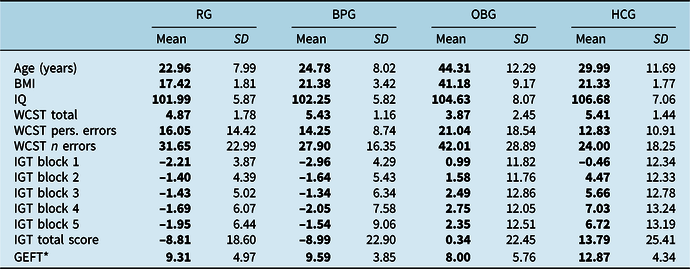
Demographic characteristics of the participants are presented in Table 1. There were statistically significant differences among the groups on age [F (3,294) = 70.35, p < .001, η2p = .42], BMI [F (3,294) = 334.67, p < .001, η2p = .77] and IQ [F (3,294) = 7.61, p < .001, η2p = .07]. Obesity was the oldest group and had the highest BMI, as expected. The HCG scored better on the IQ measures, although all the groups presented a normal IQ.
Demographic information and neuropsychological measures

RG, restricting group; BPG, bingeing/purging group; OBG, obesity group; HCG, healthy comparison group; WCST, Wisconsin Card Sorting Test; total, total categories completed; pers. errors, perseverative errors; n errors, number of errors; IGT, Iowa Gambling Task; GEFT, Group Embedded Figures Test.
* In GEFT, the sample size is reduced to 45 (RG); 29 (BPG); 77 (OBG); 53 (HCG).
Regarding the cognitive flexibility (WSCT), the MANOVA showed significant differences among the groups on all the variables measured [Pillais’ trace V = .138, F (9,870) = 3.863, p < .001, η2p = .046]. Separate ANOVAs showed significant differences between groups on ‘total categories completed’ [F (3,290) = 12.40, p < .001, η2p = .114], ‘number of total errors’ [F (3,290) = 8.84, p < .001, η2p = .084] and ‘number of perseverative errors’ [F (3,290) = 4.98, p = .002, η2p = .049]. Post hoc analysis showed that the obesity group performed worse than patients with eating disorder and the HCG on the three study variables. After controlling the effect of age and IQ, only differences in ‘total categories completed’ remained significant (see Table 1).
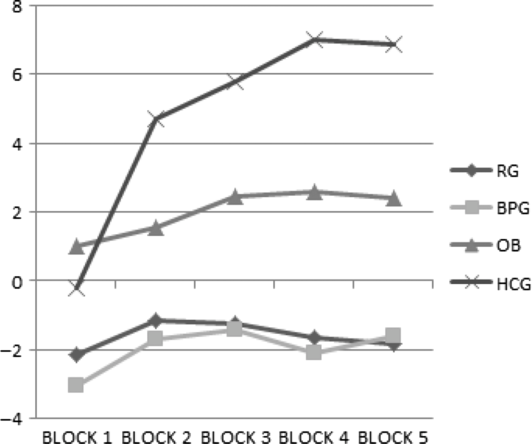
Regarding the decision-making ability (IGT), the ANOVA showed significant differences between groups [F (3,294) = 16.26, p < .001, η2p = .142], with all the clinical groups performing worse than the HCG group. These differences remained significant after controlling for age and IQ [F (3,292) = 11.82, p < .001, η2p = .108]. When the performance across blocks was analysed, the repeated measures ANOVA showed a significant main effect of Block [F (3.32, 975.91) = 15.56, p < .001, η2p = .050], a significant main effect of Group [F (3,294) = 9.54, p < .001, η2p = .089], and a significant interaction [F (9.96, 975.91) = 5.25, p < .001, η2p = .051], indicating that only HCG showed learning during the task. Differences between groups [F (3,292) = 5.29, p = .001, η2p = .052] and the Block × Groups interaction [F (9.97,970.02) = 4.5, p < .001, η2p = .044] remained significant after controlling for age and IQ (see Fig. 1).
Mean net scores on the IGT across each block of 20 trials. Block 1 (trials 1 to 20), Block 2 (trials 21 to 40), Block 3 (trials 41 to 60), Block 4 (trials 61 to 80) and Block 5 (trials 81 to 100). RG, restricting group; BPG, bingeing/purging group; OB, obesity group; HCG, healthy comparison group.

Finally, when central coherence was analysed (GEFT), the ANOVA showed significant differences between groups (F (3,200) = 10.13, p < .001, η2p = .132), with both the ED and obesity groups performing significantly worse than the HCG (Table 1). These differences remained significant after controlling the effects of age and IQ (F (3,198) = 6.21, p < .002, η2p = .086).
Discussion
This study analysed executive functions in eating and weight-related problems ranging from AN-restricting type to obesity. Results indicated that females with ED or obesity showed a different neuropsychological profile compared with healthy controls. Patients with obesity performed worse than patients with ED and healthy controls on the task assessing set-shifting, making more errors, both perseverative and non-perseverative, and completing fewer categories. When the effects of age and intelligence were controlled for, differences on measures of perseveration disappeared, but differences in completed categories remained. These results confirm the difficulties of individuals with obesity found in previous studies (Fagundo et al., Reference Fagundo, de la Torre, Jiménez, Agüera, Granero and Tárrega2012; Perpiñá et al., Reference Perpiñá, Segura and Sánchez2016; Verdejo-García et al., Reference Verdejo-Garcia, Perez-Exposito, Schmidt-Rio-Valle, Fernandez-Serrano, Cruz, Perez-Garcia, Lopez-Belmonte, Martin-Matillas, Martin-Lagos, Marcos and Campo2010). A recent meta-analysis of the spectrum of ED, overweight and obesity (Wu et al., Reference Wu, Brockmeyer, Hartmann, Skunde, Herzog and Friederich2014) provides strong support that inefficient set-shifting is a salient neuropsychological phenomenon across ED subtypes and obesity. Unexpectedly, patients with ED did not perform poorly compared with healthy controls, as found in other studies (Aloi et al., Reference Aloi, Rania, Caroleo, Bruni, Palmieri, Cauteuccio, De Fazio and Segura2015; Westwood et al., Reference Westwood, Stahl, Mandy and Tchanturia2016). In a large dataset study (542 participants), patients with AN and BN showed poor performance in the majority of the WCST domains, compared with healthy controls and patients recovered from AN (Tchanturia et al., Reference Tchanturia, Davies, Roberts, Harrison, Nakazato, Schmidt, Treasure and Morris2012). However, our results are in line with studies that failed to find set-shifting deficits in ED (Galderisi et al., Reference Galderisi, Bucci, Mucci, Bellodi, Cassano, Santonastaso, Erzegovesi, Favaro, Mauri, Monteleone and Maj2011), and others that found evidence for inefficient set-shifting in AN-restricting type but not in AN-bingeing/purging type and BN (Wu et al., Reference Wu, Brockmeyer, Hartmann, Skunde, Herzog and Friederich2014). Set-shifting deficits in both ED and obesity may not only contribute to maladaptive responses to environmental changes in general, but also to eating behaviour in particular (Wu et al., Reference Wu, Brockmeyer, Hartmann, Skunde, Herzog and Friederich2014).
When decision-making was analysed, significant differences were found between ED and HCG, and between OB and HCG, on total net scores (i.e. clinical groups performed worse than participants in the HCG) even after controlling IQ and age. The analysis of the participants’ performance curves revealed that clinical participants (OB, RG and BPG) failed to learn what choices they had to make in order to obtain benefits at the end of the task. These results are in agreement with those concluding that patients with ED show decision-making processes based on immediate gains despite negative long-term consequences (Chan et al., Reference Chan, Ahn, Bates, Busemeyer, Guillaume and Redgrave2014; Mallorquí-Bagué et al., Reference Mallorquí-Bagué, Fagundo, Jimenez-Murcia, de la Torre, Baños and Botella2016), and provide evidence that all the disorders on the weight-related problems continuum show a tendency towards decision-making based on immediate rewards (Aloi et al., Reference Aloi, Rania, Caroleo, Bruni, Palmieri, Cauteuccio, De Fazio and Segura2015; Davis et al., Reference Davis, Patte, Curtis and Reid2010; Mallorquí-Bagué et al., Reference Mallorquí-Bagué, Fagundo, Jimenez-Murcia, de la Torre, Baños and Botella2016; Matsumoto et al., Reference Matsumoto, Hirano, Numata, Matzuzawa, Murano and Yokote2015; Perpiñá et al., Reference Perpiñá, Segura and Sánchez2016).
Regarding central coherence, our results indicated that both the restricting type of ED and patients with obesity showed a preference for global processing and difficulties in paying attention to detail. The central coherence function has hardly been studied in patients with obesity without binge-eating disorder. Our results confirm their difficulties in attending to details (Aloi et al., Reference Aloi, Rania, Caroleo, Bruni, Palmieri, Cauteuccio, De Fazio and Segura2015). However, the results for patients with restrictive symptomatology are somewhat surprising, given that previous studies have shown poor global processing in patients with AN and their unaffected relatives (Lang et al., Reference Lang, Roberts, Harrison, Lopez, Goddard and Khondoker2016). A possible explanation for the absence of higher scores in the ED groups might be related to the administration of the task. In the GEFT administration procedures, the simple and complex figures are not presented simultaneously. This procedure forces examinees to maintain the target figures in the visual working memory, which has been found to be impaired in AN (Kemps et al., Reference Kemps, Tiggemann, Wade, Ben-Tovim and Breyer2006), along with impairments in visual memory (Oltra-Cucarella et al., Reference Oltra-Cucarella, Espert, Rojo, Jacas, Guillén and Moreno2014). It has been reported that scores other than raw scores might more accurately capture impairments in central coherence (Lang et al., Reference Lang, Roberts, Harrison, Lopez, Goddard and Khondoker2016; Lang and Tchanturia, Reference Lang and Tchanturia2014) that could not be analysed in our work due to differences in administration procedures.
These data have important clinical implications. The findings suggest that treatments for obesity and ED would benefit from addressing the more evident clinical ‘content’ (eating, body weight and shape), in addition to the difficulties in ‘form’ related to cognitive functions such as inflexibility, disadvantageous decisions, or an inefficient balance between details and the gestalt (Lang et al., Reference Lang, Stahl, Espie, Treasure and Tchanturia2014; Wu et al., Reference Wu, Brockmeyer, Hartmann, Skunde, Herzog and Friederich2014; Wu et al., Reference Wu, Brockmeyer, Hartmann, Skunde, Herzog and Friederich2016). Allom et al. (Reference Allom, Mullan, Smith, Hay and Raman2018) analysed 80 participants with obesity and found that executive functions improved after 4 to 6 weeks of cognitive remediation therapy, whereas unhealthy eating habits and sedentary behaviour habits were reduced even 3 months after the intervention, compared with the control group. Additionally, improvements in cognitive flexibility after cognitive remediation therapy has been associated with significant weight loss in people with obesity (Raman et al., Reference Raman, Hay, Tchanturia and Smith2018). All these data, including those reported in the present study, suggest that cognitive functions, and more specifically executive functions, need to be included in therapeutic interventions focused on providing strategies to reduce rigid thinking styles and increase the number of alternate ways of coping with problems. These strategies are likely to help people with obesity to lose weight through improvements in cognitive flexibility and a reduction in unhealthy habits (Allom et al., Reference Allom, Mullan, Smith, Hay and Raman2018).
Some limitations must be highlighted. Data on educational level were not collected and could not be analysed. However, a strength is that we controlled for IQ and age in the statistical analyses. All the participants were women, which precludes generalization to males. Although the majority of individuals affected by ED are female, it would be interesting to study gender differences in obesity, where similar proportions of men and women can be found. One of the strengths of this work was the large sample size (n = 298), covering a wide range of eating disorders from anorexia nervosa to obesity. Results support models based on a trans-diagnostic view, taking into account the differences between restrictive and bingeing/purging symptomatology, and validating the full spectrum of EDs, including individuals who migrate from one ED diagnostic category to another, and also in obesity (Aloi et al., Reference Aloi, Rania, Caroleo, Bruni, Palmieri, Cauteuccio, De Fazio and Segura2015). Eating and weight-related problems emerge on a continuum with similar deficits, which points to the use of similar treatment protocols for ED and obesity.
Acknowledgements
None.
Financial support
This study is supported by the Spanish Ministerio de Ciencia y Tecnología (grant PSI2009/10957); Ministerio de Economía y Competitividad (PSI2014-51920-R) and by the Conselleria d’Educació, Cultura i Esport, Generalitat Valenciana (PROMETEO/2013/066). Centro de Investigación Biomédica en Red Fisiopatología de la Obesidad y Nutrición is an initiative of ISCIII.
Conflicts of interest
The authors declare that they have no conflicts of interest.
Ethical statements
The work has been performed according to ethical standards of the national ethics committee. Written informed consent was obtained from all of the participants before participation in the study.



Comments
No Comments have been published for this article.