Different orthographic systems vary greatly with respect to the relationship between the written forms and their pronunciations. At one extreme are the transparent systems, such as those of Finnish, Italian, and Spanish, that are very consistent because each letter is almost always pronounced the same way, regardless of the word in which it appears. At the other extreme are the deep systems, such as those of English, in which a single letter is pronounced very differently, depending on the word to which it belongs. This variability in orthographic systems has important effects on reading strategies: whereas readers of transparent systems can read each letter without having to attend to the whole word, readers of deep systems often find themselves obligated to consider the word as a whole to arrive at the correct pronunciation. Some cross-linguistic studies have confirmed these differences in strategies among readers of different languages. For example, Paulesu et al. (Reference Paulesu, McCrory, Fazio, Menoncello, Brunswick and Cappa2000) found a greater effect of lexicality in English readers than in Italian readers.
In addition to reading words globally, readers of deep orthographies are supported by the intermediate units between graphemes and words, that is, by groups of graphemes with similar pronunciations that cannot be deduced from the individual graphemes. (For instance, in English the grapheme “o” has different pronunciations when it stands alone, as in sorry or soft, and when it is combined with other vowels, as in sound or moon.) In contrast, in transparent languages these intermediate units seem unnecessary (Frith, Wimmer, & Landerl, Reference Frith, Wimmer and Landerl1998; Goswami, Gombert, & de Barrera, Reference Goswami, Gombert and Barrera1998; Ziegler, Perry, Jacobs, & Bruan, Reference Ziegler, Perry, Jacobs and Braun2001).
Spanish orthography is highly transparent, according to the two criteria proposed by Seymour, Aro, and Erskine (Reference Seymour, Aro and Erskine2003): high spelling–sound predictability and a very simple syllabic structure. In Spanish, mappings between graphemes and phonemes are consistent across all words. There is no variation in the pronunciation of the majority of the graphemes, except for three consonants (c, g, and r), which are read in different rule-governed ways depending on the context. The graphemes “c” and “g” have different pronunciations depending on the following vowel; for example, before “a,” “o,” or “u,” they are given a hard sound (e.g., “copa” ➔ /kopa/; “gato” ➔ /gato/), but if they appear before “e” or “i,” they have a soft sound (e.g., “gente” ➔ /xente/; “cine” ➔ /θine/). The letter “r” is read differently depending on its position in a word. If this appears at the beginning of a word or after the letters “n,” “l,” or “s,” it is given a hard rolling sound /r/, which does not occur in English (e.g., “ropa” ➔ /ropa/), but when it appears in the middle or at the end of a word it is given a sound equivalent to that used for the English “r” (e.g,, “barón” ➔ /baɾon/). In addition, there are five double-letter graphemes: “ll,” pronounced /λ/; “rr,” with the hard rolling sound /r/ in the middle of a word (e.g., “perro”); “ch,” with the sound /t∫/; “gu,” to give the “g” a hard sound before “e” or “i” (e.g., “guerra”); and “qu,” for the sound /k/ before “e” or “i.” These double-letter graphemes appear only at the beginning of the syllable.
With regard to syllabic structure, in Spanish it is very simple: the most common type of syllable is consonant–vowel (CV), most syllables are composed of only two or three letters, and there are few consonant clusters, all of which occur only at the beginning of the syllable.
However, despite the simplicity of the Spanish orthography, and even though Spanish speakers can read using only grapheme–phoneme correspondence, there is considerable evidence that they also use units larger than the grapheme. Experimental data obtained with adults clearly indicate that readers of transparent languages also read many words globally for speed and efficiency. The proof of this lies in the effects of (a) the lexical variables found in numerous studies, given that, as in English, effects of lexicality have also been found in other transparent languages, because readers read words more quickly and accurately than pseudowords; (b) frequency, because high-frequency words are read better than low-frequency words; and (c) age of acquisition, given that words learned at an early age are read better than those learned at a later age (Alija & Cuetos, 2005; Cuetos & Barbón, Reference Cuetos and Barbón2006). This notwithstanding, what seems certain is that readers of transparent languages rely less on the lexical route, as is indicated by the smaller effect of the lexical–semantic variables. In Dutch, another language with a quite transparent orthography, Brysbaert, Lange, and van Wijnendaele (Reference Brysbaert, Lange and van Wijnendaele2000) tested the variables of frequency, imageability, and age of acquisition. They confirmed that imageability did not produce significant effects, and the effects of the other two factors were smaller than those described in English. In Italian, Bates, Burani, D'Amico, and Barca (Reference Bates, Burani, D'Amico and Barca2001) found effects of length and frequency, but not of imageability or age of acquisition.
Moreover, effects of the lexical variables have been found not only in adult readers but also in children. In Spanish, effects of the lexical variables have been found starting in the earliest grades (Davies, Seijas, & Cuetos, Reference Davies, Cuetos and Glez-Seijas2007). In Turkish, another transparent language that children read with a high level of accuracy at the end of the first grade (Öney & Durgunogly, Reference Öney and Durgunoglu1997), as children gain experience they have been found to depend less on phonological mediation to accomplish word recognition (Öney, Peter, & Katz, Reference Öney, Peter and Katz1997).
In contrast, because of inconsistency in the orthography–phonology mappings of English, some authors (Ziegler & Goswami, Reference Ziegler and Goswami2005) maintain that English-speaking children must develop intermediate representations between the grapheme and the word (i.e., rhymes, syllables, morphemes) to be able to deal with the irregularities of the system. In a comparative study (among English, French, and Spanish), Goswami et al. (Reference Goswami, Gombert and Barrera1998) found that letter-by-letter reading was most effective in Spanish, whereas English- and French-speaking children had to learn other phonologic–orthographic relations to read pseudowords that rhyme with real words. Likewise, German-speaking children, unlike English-speaking children, have similar results reading pseudowords that are orthographically similar to real words than reading control pseudowords (Goswami, Ziegler, Dalton, & Schneider, Reference Goswami, Ziegler, Dalton and Schneider2003). In addition, the most frequent errors of children learning to read German were pseudowords, in contrast with the errors of English-speaking children, which were real words (Wimmer & Goswami, Reference Wimmer and Goswami1994; Wimmer & Hummer, Reference Wimmer and Hummer1990).
However, in other studies it has been found that children who speak transparent languages also develop representations for those intermediate units. In Italian, a transparent language, children have been shown to be influenced by the morphological properties of words from a very early age, because they read pseudowords formed by real morphemes better than control pseudowords (Burani, Marcolini, & Stella, Reference Burani, Marcolini and Stella2002). In principle, it can be assumed that Spanish-speaking children also develop those intermediate units, given that this would facilitate reading of long words, which are so plentiful in Spanish. The question is at what age these intermediate units are developed in this population.
Some authors maintain that units larger than the grapheme are acquired at a later stage, after the child has already acquired the grapheme–phoneme rules (Ehri, Reference Ehri, Oakhill and Bear1999; Frith, Reference Frith, Patterson, Marshall and Coltheart1985). However, other authors affirm that children can acquire representations for some words and/or groups of graphemes before fully learning all of the graphemes. As the self-teaching hypothesis has shown (Share, Reference Share1995), when the child correctly reads a word over and over again, she ends up forming a representation of that word in her orthographic lexicon, whether or not she has acquired all the grapheme–phoneme rules. Likewise, the reading of constantly repeated groups of letters involves forming representations of those groups of graphemes. Share (Reference Share1995) maintains that the phonological recoding of print serves as a means of self-teaching, through which the learner can acquire the orthographic representations necessary for visual word recognition. The child must begin by learning the grapheme–phoneme relationships, but this learning helps her to form the orthographic representations of words. Over time, the increased frequency of experience in phonological coding, together with an expanding set of words that the learner has encountered and coded, support the child's capacity to grasp useful regularities about spelling patterns and spelling–sound mappings, which entail collections of letters.
In short, it seems quite clear that readers of transparent languages perform lexical reading of familiar words and also globally read frequent letter groupings, given that they form representations of words by reading them again and again. What we still do not know is at what point Spanish children start to use units larger than graphemes, and with what type of stimuli they use them. Is it only when they have been in school for several years and have consolidated grapheme–phoneme learning? Or do they start from the earliest stages of learning to read? The search for these answers motivated us to conduct the present study. We attempted to confirm the effects of the principal psycholinguistic variables (i.e., lexicality, frequency, length, and frequency of groups of graphemes) on the reading accuracy and speed of children 5 to 10 years of age, which is from the time they begin to systematically learn to read until they become more or less competent readers. The effect of these variables at different stages of evolution will inform us of reading development in Spanish. We will thus be able to draw conclusions about the characteristics of learning to read that are dependent on the transparency of the orthographic system.
Our hypothesis is that, given the orthographic transparency of Spanish, reading will develop over a continuum of steps ranging from the phonological recoding of graphemes to the use of global word recognition strategies, passing through intermediate units such as groups of graphemes. This assumes greater use of the sublexical route in the early grades and a progressive switch to the use of the lexical route as readers become more skilled, although this strategy will apply only to the most familiar words. Furthermore, given that in transparent orthographic systems the differences between learners and skilled readers are more noticeable in terms of speed than in terms of accuracy (because accuracy is achieved immediately), speed will be a more sensitive marker of evolutional changes than accuracy. To be specific, we expect strong effects of word length in the early stages of learning to read, and greater effects of frequency and lexicality as grade level rises. Furthermore, given the existence of orthographic groups (e.g., -mente, -able), we assume that Spanish readers will also develop orthographic representations at this level, so they will read stimuli containing graphemes that often appear together more quickly and with fewer errors, whether said stimuli are words or pseudowords.
METHODOLOGY
Participants
The participants in this study were 406 upper middle-class children (236 boys, 170 girls) at five grade levels from two primary schools in Oviedo. The grade levels of the children are the Spanish equivalents of kindergarten (one group we evaluated 4.5 months after the beginning of the academic year [Kindergarten 1] and another group that we evaluated at the end of the year [Kindergarten 2]), plus the first, second, third, and fourth grades of primary school. Two groups of kindergarten children were enrolled because rapid changes occur in that year, when children begin to learn to read (which has already been observed in other transparent language studies; Aro & Wimmer, Reference Aro and Wimmer2003). Therefore, it seems necessary to evaluate the children at these two times to capture the evolution manifested in that first year of reading.
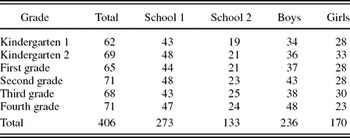
All study participants were Spanish speakers and presented no obvious learning disabilities or deficiencies. All of them, including the kindergartners, knew all of the graphemes, because in Spain in general, and in the selected schools in particular, kindergarten children (age 5) begin the school year knowing all of the vowels and some consonants, and by the middle of the year they know all the graphemes. In one of the schools, reading was taught phonetically, and in the other a combination of phonetic and syllabic methods was used. The children were selected as follows: In the first of the primary schools, two of the three classes at each grade level were randomly chosen, and in the other school half of the children were selected at random from each of the two classes per grade level. They had parental consent to participate in the study. Table 1 presents the distribution by grade level, school, and gender.
Distribution of participants by grade, school, and sex

Stimuli
A total of 96 stimuli were used (48 words, 48 pseudowords) that were selected as a function of lexicality (words vs. pseudowords), lexical frequency (high vs. low; for words, frequency is defined according to Martinez & Garcia, Reference Martínez and García2004; for pseudowords, it refers to the presence or absence of a frequent orthographic ending, such as -mente), and length (short vs. long). Furthermore, syllabic frequency (Alameda & Cuetos, Reference Alameda and Cuetos1995) and total bigram frequency (Davis & Perea, Reference Davis and Perea2005) were available for each stimulus. The characteristics of all the stimuli used can be found in Appendix A.
With these 96 stimuli, eight lists were prepared, each containing 12 stimuli in one of the following categories:
• high-frequency short words (frequency = 91/million; length = four to five letters)
• high-frequency long words (frequency = 90/million; length = seven to nine letters)
• low-frequency short words (frequency = 20/million; length = four to five letters)
• low-frequency long words (frequency = 20/million; length = seven to nine letters)
• short pseudowords (length = four to five letters)
• long pseudowords (length = seven to nine letters)
• short pseudowords with frequent endings (length = four to five letters)
• long pseudowords with frequent endings (length = seven to nine letters)
Procedure
The task consisted of reading each of the eight lists aloud. Each list consisted of 12 items of a single type (high-frequency short words, short pseudowords, etc.) and they were presented independently. The order of the stimuli within each list was the same for all participants, but the order of presentation of the lists was balanced across subjects. The number of hits and reading times were collected for each list. We chose to follow this procedure, which has been used in many other studies (e.g., Peterson, Reference Petersen2002; Tressoldi, Stella, & Faggella, Reference Tressoldi, Stella and Faggella2001; Wimmer, Reference Wimmer1993), wherein average reading time per word is determined by dividing total reading time by the number of words per list. We consider this procedure to be more appropriate for measuring children's everyday reading fluency than the procedure of presenting the stimuli one at a time on a computer monitor. Furthermore, when working with young children, it is more important to collect the total time spent on each word than just the voice onset time, which is what is typically measured when data are collected via computer.
Each list of words was presented in two columns on a sheet of paper, and the child was asked to read them as quickly and as accurately as possible. Number of hits, errors committed, and total time spent reading all the lists of words were recorded on the individual recording sheets. Prior to the task, the task was explained to the child (“You are going to read a series of words. Try to be fast but without making mistakes. We're going to do a test. When I say, ‘Now!,’ begin.”) and a five-item trial was conducted. Each child was evaluated individually in a classroom of the school during the morning hours.
Design
This was a 2 (School) × 2 (Sex) × 6 (Grade) × 2 (Lexicality) × 2 (Frequency) × 2 (Length) factorial design in which the first three variables were between groups and the last three were within subjects. Number of hits (accuracy) and reading time (speed) were considered dependent variables.
RESULTS
For the data analysis, analyses of variance were run through the SPSS statistical package. Analyses were run first on number of hits (i.e., reading accuracy) and then on speed, first with all the stimuli together and then separately for words and for pseudowords, because the concept of frequency is different for these two types of stimuli (number of times an item appears in written texts in the case of words, and familiarity of the groups of letters that form an item in the case of pseudowords).
Reading accuracy
In the combined analysis of reading accuracy, we found no significant differences for sex, F (1, 404) = 0.71, p > .1, or school, F (1, 404) = 2.77, p = .097. There are significant differences for grade, F (5, 400) = 77.96, p < .001, given that the results improve as grade increases.
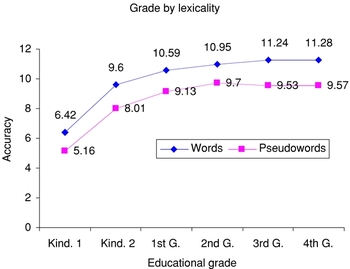
Because there are no significant differences between schools or between genders, all the children were grouped together, separated only by grade, to evaluate the effects of the linguistic variables. In these analyses, all the variables manipulated were significant: lexicality, F (1, 400) = 778.00, p < .001, in that the children obtained better results with words than with pseudowords; frequency, F (1, 400) = 271.97, p < .001, in that the number of hits is greater for high-frequency stimuli (frequent words and pseudowords with frequent endings) than for low-frequency stimuli; and length, F (1, 400) = 162.78, p < .001, because the scores are higher for short than for long stimuli. Furthermore, the Grade × Lexicality interaction was significant, F (5, 400) = 2.52, p = .029, because the differences between words and pseudowords increase with grade, as can be seen in Figure 1.
The Grade × Lexicality interaction in accuracy. [A color version of this figure can be viewed online at journals.cambridge.org/aps]

The following interactions were also significant: Frequency × Length, F (1, 400) = 38.30, p < .001, because of the greater weight of frequency in the short stimuli; Frequency × Lexicality, F (1, 400) = 9.17, p = .003, because the effect of frequency is greater in words than in pseudowords; and Lexicality × Length, F (1, 400) = 162.48, p < .001, because the effect of length is greater in pseudowords than in words.
Reading accuracy in words. When the analyses were conducted for words only, grade again appeared as a determining factor of reading accuracy, F (5, 400) = 83.91, p < .001, because performance improved as grade level progressed, although the differences between grades became shorter. A considerable jump is seen between Kindergarten 1 and Kindergarten 2, the differences between the other grades studied being smaller. Effects of frequency, F (1, 400) = 240.15, p < .001, were also found here, but effects of length were not, although a strong Length × Frequency interaction appeared, F (1, 400) = 103.34, p < .001. This interaction arises because the effect of frequency is stronger in short words than in long words.
Reading accuracy in pseudowords. In the separate analysis of pseudowords, again the variables of grade, F (5, 400) = 59.89, p < .001, frequency, F (1, 400) = 62.50, p < .001, and length, F (1, 400) = 257.25, p < .001, were highly significant. The Grade × Length interaction was also significant, F (5, 400) = 2.97, p = .012, because the effects of length were more pronounced in the lower grades, and the Grade × Frequency interaction was close to significant, F (5, 400) = 2.11, p = .064.
Reading speed
In the analyses of reading speed, we also found no effect of gender or school but we did find an effect of grade, F (6, 424) = 142.43, p < .001, as expected. As the children's grade level rises, they read more and more rapidly. The jump from kindergarten to first grade is especially sizable.
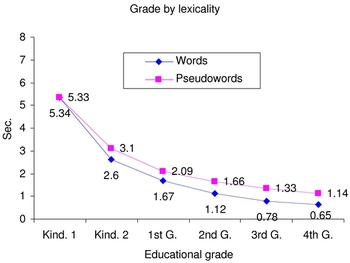
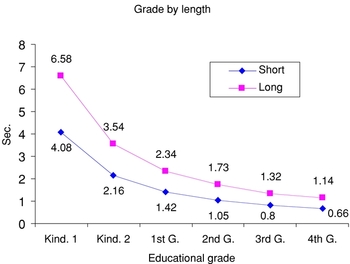
All three of the within-subjects variables were highly significant because the children were faster at reading words than pseudowords, faster at reading high-frequency than low-frequency stimuli, and faster at reading short than long stimuli: lexicality, F1 (1, 382) = 301,49, p < .001, frequency, F (1, 382) = 94.36, p < .001, and length, F (1, 382) = 851.42, p < .001. The Grade × Lexicality, F (5, 382) = 16.14, p < .001, Grade × Frequency, F (5, 382) = 4.26, p < .001, and Grade × Length, F (5, 382) = 64.86, p < .001, interactions were also statistically significant, because as grade level rises the effects of lexicality and frequency increase, whereas that of length is greater in the earlier grade levels. Figure 2 shows that the differences between words and pseudowords increase with grade level, and Figure 3 shows that the effects of length diminish. The Grade × Lexicality × Length, F (5, 382) = 4.02, p < .001, and Grade × Lexicality × Frequency × Length, F (5, 382) = 6.83, p < .001, interactions were also statistically significant. These interactions reveal that the effect of the lexical variables is modulated by grade level.
The Grade × Lexicality interaction in reading speed. [A color version of this figure can be viewed online at journals.cambridge.org/aps]

The Grade × Length interaction in reading speed. [A color version of this figure can be viewed online at journals.cambridge.org/aps]

Reading speed in words
When the analyses are done separately for words, grade, F (5, 400) = 148.18, p < .001, frequency, F (1, 400) = 83.09, p < .001, and length, F (1, 400) = 51.40, p < .001, are again shown to be highly significant, as are the interactions between grade and frequency, F (5, 400) = 4.63, p < .001, and between grade and length, F (5, 400) = 71.58, p < .001. These interactions are because the effects of frequency are greater in the higher grades, whereas those of length are more noticeable in the lower grades.
Reading speed in pseudowords. Finally, in the analyses conducted for pseudowords, an effect of grade level was obtained, F (5, 400) = 143.58, p < .001, as well as effects of frequency, F (1, 400) = 47.99, p < .001, and length, F (1, 400) = 1,354.36, p < .001. The Grade × Length interaction, F (5, 400) = 78.70, p < .001, was also significant, because the effect of length diminishes as grade level increases.
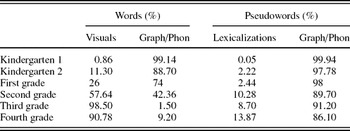
With respect to the types of errors children commit when misreading a stimulus, we followed Valle's (Reference Valle1989) classification of separating them into visual errors (e.g., “tronco” [trunk] instead of “trono” [throne]) and graphemic/phonemic errors (e.g., “braco” instead of “barco” [boat]) in the case of words, and into lexicalizations (e.g., “suave” [soft] instead of “suafe”) and graphemic/phonemic errors (e.g., “candinero” instead of “candillero”) in the case of pseudowords. (We also considered regressions as errors, although we did not include them in this classification.) The percentages of errors can be seen in Table 2.
Types of errors in each grade

DISCUSSION
The objective of this work was to study the learning of reading in Spanish, a transparent language. For this purpose, the principal lexical and sublexical variables were tested to uncover their effects on reading accuracy and reading speed in the first 5 years of learning, from the time when children begin to develop this ability until they become competent readers (at least at the level of decoding).
Our results indicated that, as could be expected, reading accuracy depends on practice, because the number of errors progressively diminished as grade level increased, as had already been found in works conducted in other languages (Martín, Pratt, claydon, Morton, & Binns, Reference Martin, Pratt, Claydon, Morton and Binns2003). Nevertheless, in Spanish, high levels of reading accuracy are reached rapidly, because by kindergarten (5 years old), the first year of experience with the orthographic system, a 73% correct response rate was achieved. These findings coincide with the data described in several studies of reading acquisition in Spanish and other languages with varying degrees of orthographic transparency (Aro & Wimmer, Reference Aro and Wimmer2003; Defior, Cary, & Martos, Reference Defior, Cary and Martos2002; Genard, Alegria, Leybaert, Mousty, & Defior, Reference Genard, Alegría, Leybaert, Mousty and Defior2005; Hoxhallari, van Daal, & Ellis, Reference Hoxhallari, van Daal and Ellis2004; Landerl, Reference Landerl2000; Oney & Durgunoglu, Reference Öney and Durgunoglu1997; Orsolini, Fannari, Tosi, De Nigris, & Corrieri, Reference Orsolini, Fanari, Tosi, De Nigris and Carrieri2006; Seymour et al., Reference Seymour, Aro and Erskine2003).
The effects of the different manipulated variables also provide information about the reading strategies that children develop as they learn. Thus, the superiority of words over pseudowords suggests that Spanish-speaking children can read some words lexically in the early stages, even though in Spanish any word can be read by applying the grapheme–phoneme rules. The lexicality effect found by others (Job, Peressotti, & Cusinato, Reference Job, Peressotti and Cusinato1998; Orsolini et al., Reference Orsolini, Fanari, Tosi, De Nigris and Carrieri2006; Seymour et al., Reference Seymour, Aro and Erskine2003; Zoccolotti, De Luca, Di Flippo, Judica, & Martelli, in press) is consistent with the presence of orthographic representations for common words and contrary to the stage theories (e.g., Ehri, Reference Ehri, Oakhill and Bear1999; Frith, Reference Frith, Patterson, Marshall and Coltheart1985), which postulate that until a child has clearly acquired the grapheme–phoneme conversion mechanisms, she does not advance to the orthographic stage.
Note that the lexicality effect changes with educational level, whether what is measured is reading accuracy or reading speed. In the case of reading accuracy, the data indicate that the greatest difference between words and pseudowords occurred in the higher grades (third and fourth grades of elementary school), which leads one to think that these children relied on a larger number of orthographic representations of words. With regard to reading speed, in the Kindergarten 1 group speed was practically the same for words and for pseudowords, which would support the hypothesis of sublexical reading at this level, in which each grapheme is converted to its corresponding phoneme independently of the word of which it forms a part. The differences that arose later between words and pseudowords would indicate that the children had acquired cognitive lexical representations of these words, which they were activating in parallel with the sublexical process. This gives us reason to maintain that in the early stages of learning to read, greater use would be made of the sublexical route, although the lexical route would gradually gain predominance over the sublexical route, which is slower and more error prone.
The change in the types of errors children make as they advance from grade to grade confirms this progressive switch from sublexical to lexical reading. Table 2 shows that a considerable increase in visual errors in words and lexicalizations in pseudowords can be seen as grade level advances, along with a considerable drop in graphemic and phonological errors. More than 99% of the errors committed by the Kindergarten 1 group of children were graphemic or phonological in nature, whereas their lexicalizations and visual errors did not reach 1%. In contrast, in Grade 4 almost 91% of the word errors were visual and only 9.2% were graphemic or phonological.
The superiority in reading accuracy and speed for words over pseudowords starting in the early grades could be explained by taking into account the orthographic transparency of Spanish and appealing, in turn, to the self-teaching hypothesis (Share, Reference Share1995), an evolutionary explanation based on items rather than on the stages advocated by some authors (Ehri, Reference Ehri, Oakhill and Bear1999; Frith, Reference Frith, Patterson, Marshall and Coltheart1985). In keeping with this theory, and taking into account the characteristics of the Spanish language, words can be successfully decoded from a very early age, which makes it possible to get information about their orthographic form, enabling at least the most frequent words to enter the orthographic lexicon. Therefore, the existence and use of orthographic representations probably begins to develop from very early on, alongside sublexical reading for unknown words and pseudowords.
The data obtained for frequency also support this explanation, because greater accuracy and speed were observed in the reading of high-frequency than low-frequency words, especially as grade level increased (although it was already observed in the early grades). The data further indicate that the first representations that develop are those of frequent, short words, which progressively increase in number over the years (Martín et al., Reference Martin, Pratt, Claydon, Morton and Binns2003; Share, Reference Share1995, Reference Share1999). Similar data were found in Italian (Zoccolotti et al., in press), although the children in that study were older than ours: the mean age of their first grade level was 6.8 years, whereas that of our youngest group was 5.8 years.
However, sublexical reading is also carried out along with lexical reading, as is shown by the important effects of length on both reading accuracy and reading speed, which have been described in other languages as well (Spinelli et al., Reference Spinelli, De Luca, Di Filippo, Manzini, Martelli and Zoccolotti2005; Zoccolotti et al., Reference Zoccolotti, De Luca, Di Pace, Judica, Orlandi and Spinelli1999, Reference Zoccolotti, De Luca, Di Pace, Gasperini, Judica and Spinelli2005). In the case of pseudowords, of which there can be no orthographic representation, there was an important evolution in reading accuracy in the first years (kindergarten and first grade), whereas later (second, third, and fourth grades), once the alphabet code has been acquired and established, the numbers of stimuli read correctly were very similar. These data tell us that children in the first year of reading experience master the important alphabet code of Spanish. Nevertheless, the reading accuracy of pseudowords via grapheme–phoneme conversion never attains levels as high as that for words. This could be because said rules are not applied absolutely automatically, or because it takes time for this way of reading to become totally efficacious, because the probability of committing errors in long stimuli is greater.
This marked evolution by grade level could be explained by a greater reliance on the sublexical route in the first years and a greater tendency to rely on word representations in later years; thus, the reader tends to seek orthographic representations even when reading pseudowords, leading to more lexical errors for pseudowords. Furthermore, the use of sublexical strategies, especially in our Kindergarten 1 group, is supported by the effect of length on reading time, given the important differences between short and long words, which diminish as grade level increases. Again, we might think that the sublexical phase is very brief and that a lexical procedure begins to develop rapidly, confirming previous findings with regard to the Grade × Frequency interaction (Burani et al., Reference Burani, Marcolini and Stella2002; Wimmer & Goswami, Reference Wimmer and Goswami1994; Zoccolotti et al., in press). However, that interaction between length and grade can also be explained, at least in part, by the automatization of the skills children acquire in converting graphemes to phonemes as they advance from grade to grade. The fact that the same interaction is found for reading accuracy and speed with pseudowords suggests that frequency had less of an effect on the older children for reasons other than lexical participation. The automatization that older children are acquiring from the grapheme–phoneme rules also has an influence.
Another interesting result refers to the development of intermediate units between graphemes and words, because we have found that pseudowords formed by familiar groups of letters are read more quickly and accurately than those formed by unfamiliar groups of letters. The children were sensitive to orthographic units larger than the grapheme, which means they are capable of representing units larger than graphemes and smaller than words, as seems to occur in other, more opaque languages (Ziegler, Perry, & Coltheart, Reference Ziegler, Perry and Coltheart2003). The development of these representations does not seem to change over time, because the Grade × Frequency interaction was not significant (although it was nearly significant); in fact, a more detailed analysis indicated that the effect of frequency appeared in first grade, when children could begin to have representations of groups of graphemes. This would be consistent with the possibility of developing a phonological decoding mechanism based on orthographic units larger than the grapheme in Spanish, just as in other languages (Burani et al., Reference Burani, Marcolini and Stella2002; Goswami et al., Reference Goswami, Gombert and Barrera1998; Treiman, Reference Treiman, Gough, Ehri and Treiman1992; Treiman, Weatherston, & Berch, Reference Treiman, Weatherston and Berch1994; Wise, Olson, & Treiman, Reference Wise, Olson and Treiman1990).
Although studies on the use of decoding of large units (e.g., rhymes, morphemes) have already been conducted in other transparent languages, the results are not consistent. Whereas German-speaking children 7–9 years of age manifested a preference for phonological decoding through small units (Goswami, Ziegler, Balton, & Schneider, Reference Goswami, Ziegler, Dalton and Schneider2001), Italian-speaking children 8–10 years of age read pseudowords with word roots and suffixes more quickly and more accurately than pseudowords without such roots or suffixes (Burani et al., Reference Burani, Marcolini and Stella2002). These data, like those of the present study, would indicate that the development of orthographic representations larger than graphemes is also possible in transparent languages, and may constitute an intermediate step between the grapheme and the overall word.
The present developmental study definitely informs us that reading acquisition in Spanish begins with the support of a sublexical process, at least in those subjects who learn through a nonglobal method. The lexical route begins to develop rapidly, but the sublexical route is not abandoned. We are speaking, therefore, of a developmental progression that does not have specific stages characterized by a single process, but rather one in which both processes coexist, are functional, and are used depending on the characteristics of the stimulus to be read. It can also be thought, in accordance with our results, that it is possible to create representations larger than the grapheme, which will facilitate the reading of unknown words but relies on representations of graphemes that often appear together.
In short, the co-occurring effects of the lexical (frequency) and sublexical (length) variables in every grade, including the lowest, suggest that reading develops by items rather than by stages; that is, the most familiar items can be read lexically even by the youngest children, whereas less familiar items are read sublexically even by older children. The difference between first-grade and fourth-grade readers is not that the first group is in one stage of evolution and the second in another, more advanced stage; the difference lies in the number of items each group reads lexically as opposed to sublexically.
APPENDIX A
Characteristics of stimuli used in the study

Note: C, consonant; V, vowel.
ACKNOWLEDGMENTS
This investigation was funded by Grant MEC-06-SEJ2006–6712 from the Spanish Government.