Introduction
As one of the most frequent anxiety disorders, the hallmark of GAD is excessive and difficult to control worry that occurs across a number of different content areas, such as interpersonal/family, work, finances, and minor events (Roemer et al., Reference Roemer, Molina and Borkovec1997). Not surprisingly, the number of different life changes and stressors associated with aging, such as retirement, financial changes, and health concerns, result in many elderly adults being particularly vulnerable to the development of GAD. In one epidemiological study, among 2,136 elderly adults between the ages of 65 and 96 years, 79% of the sample reported worrying excessively during the previous month, with 6.3% meeting the diagnostic criteria for GAD (Golden et al., Reference Golden2011). Similarly, in the National Comorbidity Replication Survey (NCS-R), GAD was one of the most prevalent psychiatric disorders in 2,575 elderly adults; the 12-month prevalence rate of GAD was 2.0% among the “young old, ages 55–64 years,” 3.2% among the “mid-old, ages 65–74 years,” 1.7% among the “old-old, ages 75–84 years,” and 0.9% among the “oldest-old, ages greater than 85 years” (Byers et al., Reference Byers, Yaffe, Covinsky, Friedman and Bruce2010).
A number of instruments have been used to assess anxiety symptoms and disorders within the elderly. While clinical trials typically rely on the clinician-based instrument, the HAMA (Hamilton, Reference Hamilton1959), as a “gold standard” to assess the efficacy of treatment, the length and complexity of this instrument limits its practicality within other types of clinical settings, which often rely on patient-reported measures. In a recent review of measures for the assessment of anxiety in the elderly, the authors found that anxiety questionnaires developed with a broader patient age population are often applied to the elderly without additional psychometric validation (Thiessen and Hunsley, Reference Thiessen and Hunsley2012). Given that elderly patients may have cognitive and physical conditions that can impact how they respond to a questionnaire, assuming that an instrument's validity applies to the elderly may be questionable without specific examination.
The need to develop a patient-reported instrument to assess anxiety in elderly patients that would incorporate the sensitivity of clinician-rated scales, such as the HAMA, while considering the needs of elderly patients led to the development of the Geriatric Anxiety Inventory (GAI, Pachana et al., Reference Pachana, Byrne, Siddle, Koloski, Harley and Arnold2007). The instrument was developed to be sensitive to considerations pertinent to the elderly patient population, such as brevity, ease of use, and symptom profile. Specifically, the questionnaire simplifies assessment so that patients indicate “agree or disagree” rather than rating severity or frequency of the symptom; there are no reverse scoring items; and the content of the questions focuses primarily on psychological symptoms of anxiety as opposed to somatic symptoms that may occur as from medical or medicine-related confounds.
Since its introduction, the GAI has been translated into other languages (e.g. Marquez-Gonzalez, 2012), and has been used to screen for anxiety in elderly patients with medical conditions (e.g. Parkinson's disease, Matheson et al., Reference Matheson2012), and in long-term care (Gerolimatos et al., Reference Gerolimatos, Gregg and Edelstein2013). The initial psychometric validation demonstrated reliability and sensitivity for the assessment of anxiety among elderly patients using a psychogeriatric service. Despite its promising characteristics, the properties of the GAI have not been studied for its sensitivity to change in a controlled treatment setting. Therefore, the GAI was included as an exploratory objective in a placebo-controlled clinical trial that studied the efficacy of duloxetine (a serotonergic noradrenergic reuptake inhibitor) compared with placebo in older adults (≥65 years of age) who were diagnosed with GAD. Results from this trial showed that duloxetine was an efficacious treatment, and details of the trial have been published elsewhere (Alaka et al., Reference Alaka2014). Using the GAI data from this clinical trial, additional psychometric validation for the instrument was undertaken and reported here.
Methods and materials
The study was conducted in 47 sites across 9 countries that included Argentina, Austria, Canada, Germany, Mexico, Poland, Spain, the United Kingdom, and the United States. Institutional Review Boards at each site approved the protocol, which was developed in accordance with the ethical guidelines of Good Clinical Practice and the Declaration of Helsinki. All patients provided written consent after the study was explained, and their questions were answered before any study procedures were initiated. The trial was publically registered at clintrials.gov (identifier: NCT01118780).
Participants
Male and female outpatients were included if they were at least 65 years of age and met criteria for GAD as defined by the Diagnostic and Statistical Manual of Mental Disorders, Fourth Edition-Text Revised (DSM-IV TR) (American Psychiatric Association, 2000) and assessed by the Mini International Neuropsychiatric Interview (Sheehan et al., Reference Sheehan1998). Each patient was required to have GAD with at least moderate illness severity as defined by the following: a Clinical Global Impressions of Severity of Illness (CGI-S) (Guy, Reference Guy1976) score ≥4; Covi Anxiety Scale (Lipman et al., Reference Lipman, Covi and Downing1981) score ≥ 9; no item score >3 on the Raskin Depression Scale (RDS) (Raskin et al., Reference Raskin, Schulterbrandt, Reatig and McKeon1969); CAS total score > RDS total score; and a Hospital Anxiety and Depression Scale (HADS) (Zigmond and Snaith, Reference Zigmond and Snaith1983) anxiety subscale score ≥10. A patient was also required to have a Mini-Mental State Examination (MMSE) (Folstein et al., Reference Folstein, Folstein and McHugh1975) score of ≥24.
The main exclusion criteria were as follows: a primary Axis I psychiatric diagnosis other than GAD; benzodiazepine use in the prior 14 days before randomization; serious risk for harm to self or others; history of alcohol or any psychoactive substance abuse or dependence (as defined in the DSM-IV TR) within the past 6 months; positive urine screen for any substances of abuse; or the presence of a medical condition that could be potentially worsened by duloxetine.
Study design
The study was a multi-center, randomized, double-blind, placebo-controlled, flexible-dose, parallel group trial that consisted of three study periods: screening/washout period (up to 30 days), 10-week therapy period; and an optional 2-week taper-off drug period. Study visits were conducted at weeks 2, 4, 7, and 10. Patients were randomly assigned to receive treatment with duloxetine or placebo once daily (QD) in a 1:1 ratio. For the duloxetine group, treatment was initiated with 30 mg QD for at least two weeks. After these two weeks, the dose could be increased by 30-mg increments up to a maximum dose of 120 mg. Dose adjustments were based on the investigator's judgment and the degree of clinical improvement. All patients were required to maintain a minimum dose of 30 mg to remain in the treatment phase of the study.
Measurements
Geriatric anxiety inventory
The GAI is a 20-item self-report measure that uses an agree/disagree response format, with the number of agree responses added into a total score. The content of the majority of items is focused primarily on psychological anxiety, such as “I worry a lot of the time,” “I can't help worrying about trivial things,” “I think of myself as a worrier,” “I miss out on things because I worry too much,” although there are a few items that contained somatic references, such as, “I get an upset stomach due to my worrying,” “I often feel shaky inside,” and “I often feel that I have butterflies in my stomach” (see Pachana et al., Reference Pachana, Byrne, Siddle, Koloski, Harley and Arnold2007 for full item descriptions).
Validation measures
The primary outcome measure for the study was the clinician-rated HAMA, which was administered using the Structured Interview Guide for the Hamilton Anxiety Rating Scale (Shear et al., Reference Shear2001). The HAMA total score is the sum of the ratings for each of the 14 items, with item 1 being “anxiety mood” and item 2 being “tension” as the core symptoms of GAD. The HAMA has also been examined based on factor structure, with a HAMA psychic factor consisting of the total of items 1–6 and 14 and a somatic factor consisting of the total of items 7–13. Patients also completed the HADS, which is a 14-item questionnaire that consists of an anxiety subscale (HADS-A) and a depression subscale (HADS-D). Each subscale is the sum of seven questions and the score ranges from 0 to 21, with higher scores indicating greater severity. Overall improvement during the study was assessed by the clinician using the Clinical Global Impression of Improvement (CGI-I) and by the patient with the Patient Global Impression of Improvement (PGI). Both scales are scored from 1 to 7 with 1 = “very much better,” 4 = “no change,” and 7 = “very much worse” (Guy, 1976).
Statistical methods
Psychometric evaluation for the GAI was to assess reliability, convergent and divergent validity, known group validation, and sensitivity to treatment. To assess reliability, an internal consistency estimate was calculated from the GAI individual items using Cronbach's α. Convergent validation was assessed by Pearson correlation coefficients between the GAI total score and the HAMA total score, HAMA anxious mood rating (item 1), HAMA tension rating (item 2), HAMA psychic score, and HAMA somatic score. Divergent validation was assessed by the correlation between the GAI and the HADS-D scores at baseline and at endpoint.
The HAMA was also used as an external criterion measure. Patients were assessed as meeting criteria for remission at endpoint if their HAMA total score was ≤ 7 (Matza et al., Reference Matza, Morlock, Sexton, Malley and Feltner2010). Patients were assessed for their status as a “case” based on the GAI total score, with a GAI total score <10 indicating “noncaseness” and GAI total score ≥ 10 indicating “caseness.” The percentage of patients meeting HAMA remission criteria was compared based on their GAI caseness status to determine whether the GAI category could discriminate between patients who were assessed as being in remission.
The GAI sensitivity to change was measured by assessing the mean change in GAI total score from baseline to 10 weeks for patients who had received duloxetine compared with patients who had received placebo. The analysis model was based on a mixed-effects repeated-measures (MMRM) model with terms for treatment, pooled investigative site, visit, treatment-by-visit interaction, baseline GAI total score, and the baseline GAI total score-by-visit interaction. Treatment differences were also analyzed using an ANCOVA model based on the last observation carried forward (LOCF) method with terms for treatment, pooled investigative site, age, and baseline GAI total score. Pearson correlation coefficients were also computed between change in GAI total score across treatments and the CGI-I and PGI-I ratings.
Results
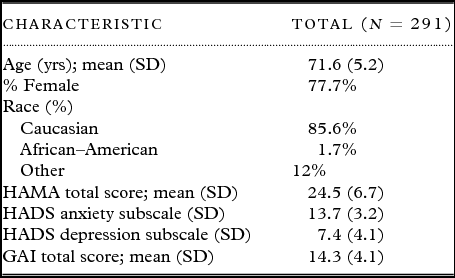
The majority of patients were female (77.7%) and the mean age of the patient population was 71.6 years. Of the 291 patients who were enrolled in the study, 220 completed the study. There were no differences between treatment groups in demographics or baseline illness characteristics (Table 1, data not shown by treatment). Using the baseline GAI item responses, the internal reliability of the GAI was calculated as 0.81 based on Cronbach's α.
Patient demographics and baseline illness characteristics

Abbreviations: SD, standard deviation; HAMA, Hamilton Anxiety Rating Scale; HADS, Hospital Anxiety and Depression Scale; GAI, Geriatric Anxiety Inventory.
Convergent/divergent validation
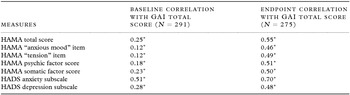
Baseline and endpoint scores were used to establish the convergent validation of instruments (Table 2). The GAI total score was correlated with the HAMA total score, factor scores, and individual items as well as the anxiety and depression subscales of the HADS. At both time points, the GAI total score was most highly correlated with the HADS-A subscale scores. Overall, the correlations were higher at endpoint compared with baseline. Between the HADS-A and the HADS-D subscales, the GAI demonstrated a stronger association with the HADS-A subscale. The correlations between the GAI total and the clinician-rated HAMA total scores were lower compared with the GAI and the HADS subscales.
Correlations of the GAI total score with Hamilton anxiety rating scale and hospital anxiety and depression subscales at baseline and at endpoint

Abbreviations: HAMA, Hamilton Anxiety Ratings Scale; HADS, Hospital Anxiety and Depression Scale.
*p ≤ 0.05.
Known groups' validation
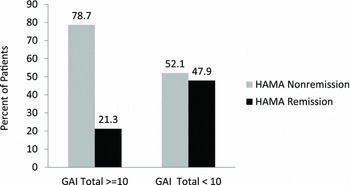
Endpoint scores were examined to determine whether patients met criteria for remission of their GAD based on the HAMA total score. The original discrimination work conducted by Pachana et al. (Reference Pachana, Byrne, Siddle, Koloski, Harley and Arnold2007) suggested that a GAI total score of ˃ 10 represents “caseness” or clinical significance whereas scores < 10 are indicative of nonclinical cases. The status of remission defined by HAMA total score was then examined by the status of cases by the GAI total score (Figure 1). As can be seen, whereas, scores ≥ 10 on the GAI were sensitive to cases of nonremission as indicated by the HAMA endpoint score, the results for GAI scores < 10 were more equivocal. More than half of the patients with lower GAI score were categorized as nonremitted by their endpoint HAMA total score.
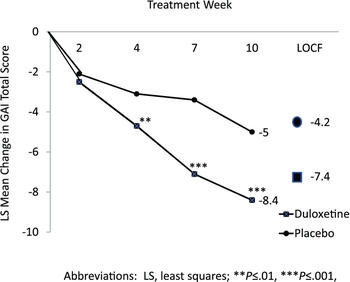
Least squares mean change in GAI total score from baseline by visit and by last observation carried forward method (LOCF) for patients treated with either duloxetine or placebo.

Sensitivity to change
Patients who were treated with duloxetine experienced significantly greater improvement as measured by the GAI total score starting at week 4 and continuing throughout the study (p ranges from ≤ 0.01 to 0.001) (Figure 2). In both the MMRM and LOCF analyses, the mean difference in improvement for patients who received duloxetine was approximately 3 points greater compared with patients who received placebo. As noted, the correlations between the GAI, HAMA and associated measures, and the HADS were also higher at endpoint, indicating that changes in the GAI were strongly correlated with changes on other disease measures. Similarly, the change in GAI total score also correlated similarly with global assessment of improvement as measured by the clinician, (CGI-I, r = 0.46, p ≤ 0.05) and by the patient (PGI-I, r = 0.47, p ≤ 0.05).
Percent of patients whose HAMA total scores at endpoint met criteria for remission or nonremission by GAI total score “caseness” category at endpoint. Remission for HAMA total score was defined as endpoint score ≤ 7.

Discussion
The results from the current study support the use of the GAI as a measure of severity of anxiety symptoms within an older adult population with GAD. At baseline, given the inclusion criteria, patients were required to have an illness of at least moderate severity, and the mean scores on the HAMA and HADS-A were consistent with this range of severity (Zigmond and Snaith, Reference Zigmond and Snaith1983; Matza et al., Reference Matza, Morlock, Sexton, Malley and Feltner2010). Based on these values, then, a mean GAI score of approximately 14 could be interpreted as also reflecting at least moderate illness severity. From a content validity perspective, the GAI has been shown to have four main factors: central nervous system hyperarousal, excessive worry, difficulty making decisions, and gastrointestinal symptoms (Diefenbach et al., Reference Diefenbach, Bragdon and Blank2014), and good internal consistency, which was also reflected by the strong reliability coefficient within the present trial.
Overall, the GAI demonstrated good convergent validation as shown by its correlations with the total scores as measured by the HADS-A, and to a lesser extent, the HAMA. At baseline, the GAI was more highly correlated with the HADS-A subscale compared with the HAMA, which support that these two instruments were tapping into the same construct and reflect the patient's view of the severity of the anxiety illness. In comparison, the lower correlations with the HAMA total score reflect perhaps different sensitivity of the instrument due to methodology as well as the content. In the HAMA, the rating is based on clinical judgment in which the frequency and severity of symptoms provide a foundation for the scores. In addition, both the HADS-A subscale and the GAI have item content that focus predominantly on psychological symptoms (difficulty concentrating, worrying) as opposed to the mixture of psychic and somatic symptoms in the HAMA scale. At endpoint, the correlations between the GAI and the other anxiety measures were stronger, which may in part be due to less restriction of range in the total scores. At baseline, patients had to have at least moderate severity whereas endpoint scores could range from remitted to severe anxiety. The correlation at endpoint between the GAI and the HADS-A subscale was particularly strong (r = 0.70), supporting the convergence between these measures.
In evaluating the pattern for divergent pattern of correlations among the measures of anxiety and depression, the relationship between GAD and major depressive disorder (MDD) must be considered as these conditions are frequently comorbid, especially among the elderly (Byers et al., Reference Byers, Yaffe, Covinsky, Friedman and Bruce2010). The overlap in these independent but associated constructs can make it difficult to determine the ability of an instrument to distinguish between these illnesses. One strength, however, of the present clinical study is that patients with a diagnosis of MDD were excluded from participation, which is reflected by a mean HADS-D subscale total score that is below the threshold for depression using this measure. Thus, within this more uniform sample, the GAI was able to demonstrate greater divergence between the anxiety and depression construct as measured by its stronger correlation with the HADS-A subscale compared with its correlation with the HADS-D subscale. As with the HADS-A subscale, the correlations between the GAI and the HADS-D subscale increased at endpoint reflecting potentially a wider range of depression scores at endpoint despite the initial exclusion criteria.
Since its introduction, the GAI has been primarily studied as a screening instrument within older adults for the purpose of identifying individuals who may need a more thorough evaluation and treatment for an anxiety diagnosis. In the initial validation sample, the suggested cut-off to distinguish between clinical cases and noncases was a GAI total score of 10. More recent work with a sample of older adults receiving home health services supported a score of 9 as the optimal cut-off for sensitivity and specificity in distinguishing between clinical cases (Diefenbach et al., Reference Diefenbach, Tolin, Munier and Gilliam2009). On the other hand, in a sample of patients with chronic obstructive pulmonary disease, the optimal threshold was 2 or 3, reflecting the overall lower base rate for clinical anxiety within this study (Cheung et al., Reference Cheung, Patrick, Sullivan, Cooray and Chang2012).
In the present study, the cut-off was validated against the external criterion of remission following treatment as defined by the HAMA clinician rating total score at endpoint. Within this psychiatric population, patients who were identified as “cases” by the GAI were likely cases as identified by the clinician measure of the HAMA; however, approximately half of the “noncases” by the GAI were still symptomatic using the HAMA total score at endpoint. However, as indicated above, one criticism of using the HAMA with older adults is its emphasis on somatic symptoms that may actually be due to other comorbid medical conditions or medications. The HAMA “nonremitted” status could reflect symptoms associated with these confounds. As a screening instrument, the cut-off scores of potential “caseness” will therefore vary according to the targeted patient population, but the sensitivity to change in the GAI scores within the psychiatric population suggests that the instrument may also serve as a useful tool for monitoring the outcome of treatment.
In summary, the GAI represents a brief, patient-reported outcome measure that has been designed to assess anxiety symptom severity using a format and structure to enhance its ease of use with the older adult population. As a screening instrument, a number of studies have provided evidence of its utility within populations of particular relevance for the older adult population, such as cognitive impairment (Diefenbach et al., Reference Diefenbach, Bragdon and Blank2013). The present study builds upon this foundation by providing the psychometric characteristics in a well-defined population of older adults with GAD and by demonstrating its usefulness as a measure of change with an established treatment.
Conflict of interest declaration
Drs. Ball and Escobar are employees and shareholders of Eli Lilly and Company. Dr. Lipsius is an employee of Inventive Health, Inc. Research was funded by Eli Lilly and Company.
Description of authors’ roles
Dr. Ball was involved in the conception and design, acquisition of data, analysis and interpretation of data, drafting of the manuscript, and final approval. Ms. Lipsius contributed by planning in the analysis and interpretation of data, drafting of the manuscript, and final approval. Dr. Escobar contributed in interpretation of data, critical revisions of the manuscript for intellectual content, and final approval.
Acknowledgments
The authors would like to thank the principal investigators, their staff, and the patients for their participation in this trial.