Advances in the field of genetics have led to the identification of numerous genes involved in long QT syndrome, catecholaminergic polymorphic ventricular tachycardia, hypertrophic cardiomyopathy, and arrhythmogenic right ventricular cardiomyopathy. Genetic testing can provide confirmation of a diagnosis and genetic screening for at-risk family members. Penetrance of disease is variable both between and within families and is condition and gene dependent. The advances in cardiac genetic testing have resulted in the identification of various populations including individuals who are genotype positive/phenotype positive – symptomatic mutation carriers – and individuals who are genotype positive/phenotype negative – asymptomatic mutation carriers.
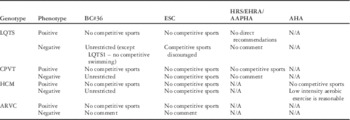
Intense physical activity has been implicated as a trigger for life-threatening cardiac arrhythmias in patients with long QT syndrome, catecholaminergic polymorphic ventricular tachycardia, hypertrophic cardiomyopathy, and arrhythmogenic right ventricular cardiomyopathy. As a result, guidelines have been published regarding exercise restrictions for both phenotype-positive and phenotype-negative mutation carriers (Table 1).Reference Vaseghi, Ackerman and Mandapati 1 – Reference Maron, Ackerman, Nishimura, Pyeritz, Towbin and Udelson 5 β-blocker therapy can provide some protection from sudden cardiac arrest for individuals with these conditions.Reference Postma, Denjoy and Kamblock 6 – Reference Iyer and Chin 9 Management recommendations are challenging as clinicians must weigh the benefits against the implications of decreased physical activity and possible side-effects of medications.
Guidelines regarding participation in competitive sports for individuals with LQTS, CPVT, HCM, and ARVC.

AHA=American Heart Association; ARVC=arrhythmogenic right ventricular cardiomyopathy; BC#36=36th Bethesda Conference; CPVT=catecholaminergic polymorphic ventricular tachycardia; ESC=European Society of Cardiology; HCM=hypertrophic cardiomyopathy; HRS/EHRA/APHRS=Heart Rhythm Society, European Heart Rhythm Association, and Asia Pacific Heart Rhythm Society; LQST=long QT syndrome
The objective of this study was to assess the practices of the same group of paediatric electrophysiologists regarding exercise recommendations and prescription of β-blockers for genotype-positive/phenotype-positive and genotype-positive/phenotype-negative individuals with long QT syndrome, catecholaminergic polymorphic ventricular tachycardia, hypertrophic cardiomyopathy, and arrhythmogenic right ventricular cardiomyopathy. A second objective was to assess factors that influence recommendations including physician physical activity level.
Material and methods
The present study involved a cross-sectional assessment of the practices of an international group of paediatric electrophysiologists regarding management of genotype-positive/phenotype-positive and genotype-positive/phenotype-negative individuals with long QT syndrome, catecholaminergic polymorphic ventricular tachycardia, hypertrophic cardiomyopathy, and arrhythmogenic right ventricular cardiomyopathy. Long QT syndrome was subdivided into the three most common types: type 1, type 2, and type 3. An online survey was developed using SurveyMonkey Inc. (Palo Alto, California, United States of America) and was composed of 20 multiple-choice and matrix of choice questions. The survey included questions regarding demographic information, exercise recommendations, and β-blocker therapy. The survey could be completed in 5–10 minutes. With executive approval, the survey was circulated to members of the Pediatric and Congenital Electrophysiology Society (~150 cardiologists) in April, 2014. The study was approved by the Research Ethics Board at the University of Alberta.
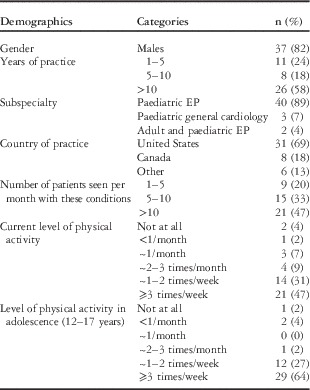
Collected demographic data are detailed in Table 2. Assessment of the level of physician physical activity was recorded using Godin et al’sReference Godin, Jobin and Bouillon 10 “simple self-report question”. Respondents were asked to describe “how often they participated in active sport or vigorous physical activity long enough to get sweaty, during leisure time within the past four months” and during their adolescence – that is, 12–17 years of age.
Physicians’ demographics and exercise habits (n (%)).

EP=electrophysiologists
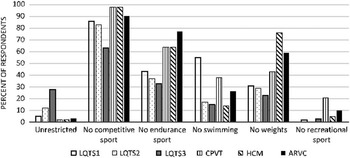
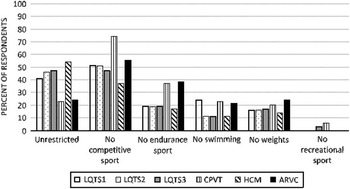
Exercise recommendations were reported for different activities, for phenotype-positive and phenotype-negative mutation carriers, and are detailed in Figures 1 and 2. The activity categories were modelled after a survey developed by Roston et alReference Roston, De Souza, Sandor, Sanatani and Potts 11 with permission from the authors. Respondents were asked to indicate the guidelines on which they based their exercise recommendations and who should be responsible for disqualifying an athlete from sports – the cardiologist, the athlete, or the sporting organisation. The frequency of body mass index assessment and dietary counselling was also evaluated. Finally, respondents were asked to describe the use of β-blocker therapy, in their practice, for phenotype-positive and phenotype-negative mutation carriers.
Exercise recommendations for individuals who are genotype positive/phenotype positive (n (%)). ARVC=arrhythmogenic right ventricular cardiomyopathy; CPVT=catecholaminergic polymorphic ventricular tachycardia; HCM=hypertrophic cardiomyopathy; LQST1=long QT syndrome type 1; LQST2=long QT syndrome type 2; LQST3=long QT syndrome type 3.

Exercise recommendations for individuals who are genotype positive/phenotype negative (n (%)). ARVC=arrhythmogenic right ventricular cardiomyopathy; CPVT=catecholaminergic polymorphic ventricular tachycardia; HCM=hypertrophic cardiomyopathy; LQST1=long QT syndrome type 1; LQST2=long QT syndrome type 2; LQST3=long QT syndrome type 3.

Statistical analysis
Categorical data are presented as counts with percentages. Physician activity level was categorised as “more active” – exercising three or more times per week – and “less active” – exercising less than three times per week. Stata Statistical Software: Release 13 (StataCorp LP, College Station, TX, United States of America) was used to calculate Fisher’s exact odds ratios to assess the relationships between management recommendations and respondents’ levels of physical activity, guidelines referenced, years of practice, and country of practice. Odds ratios were adjusted using the Mantel–Haenszel test. Cell counts were too small to assess the impact of gender or subspeciality in relation to management recommendations.
Results
In total, 53 individuals initiated the survey and 45 completed all the sections, resulting in an estimated response rate of 30%. Only data from respondents who completed the survey are included in the analysis. Demographic data are described in Table 2.
Physical activity recommendations
Restriction from competitive sports was the most consistent recommendation for phenotype-positive mutation carriers for all conditions (Fig 1). Approximately half of the respondents restricted phenotype-negative mutation carriers from this level of sports (Fig 2). Recreational sports are less commonly restricted for any of the conditions, regardless of clinical symptoms.
Just over a quarter of the respondents (28%) did not restrict physical activity for phenotype-positive long QT syndrome type 3 mutation carriers. This compares with 5 and 12% for long QT syndrome type 1 and long QT syndrome type 2 mutation carriers, respectively. Moreover, 53% (n=24) of respondents followed the 36th Bethesda Conference guidelines, 4% (n=2) followed the European Society of Cardiology guidelines, and 18% (n=8) indicated that they referred both. Additional resources referred include the American Heart Association, Australian guidelines, literature reviews, and personal experiences. Respondents who referred to the European Society of Cardiology guidelines alone or in addition to the 36th Bethesda Conference guidelines were more likely to recommend exercise restrictions for phenotype-negative mutation carriers compared with respondents who indicated that they only referred to the 36th Bethesda Conference guidelines. This association reached statistical significance for hypertrophic cardiomyopathy. Respondents who referred to the European Society of Cardiology guidelines had 15.2 times the odds of prescribing exercise restrictions for phenotype-negative hypertrophic cardiomyopathy mutation carriers compared with respondents who did not refer to these guidelines (95% CI (1.3, 734.4), p=0.01). After adjusting for physician activity level, the odds ratio increased to 22.8 (95% CI (1.5, 336.8), p=0.01). The same association was not seen for phenotype-positive patients as the majority of respondents recommended some level of restriction for all conditions.
When asked who should be responsible for disqualifying an athlete from sports, 54% of the respondents reported that it should be the cardiologist, 5% reported that it should be the sporting organisation, and 41% reported that it should be the athlete or his or her parent. Approximately a quarter (n=11) of the respondents added a comment suggesting that sport participation should be a shared decision between the athlete, their parents, and the cardiologist.
Body mass index was rarely or never assessed by 22% of the respondents, and 42% of them rarely or never discussed the option of dietary counselling.
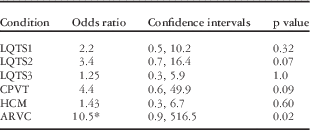
A trend was identified regarding respondents’ current level of physical activity and exercise recommendations for phenotype-negative mutation carriers (Table 3). The trend reached significance for arrhythmogenic right ventricular cardiomyopathy. Less active respondents, who exercised less than three times a week, had 10.5 times the odds of restricting exercise for phenotype-negative arrhythmogenic right ventricular cardiomyopathy mutation carriers compared with more active respondent, who exercised three or more times a week, (p=0.02). A similar, but not statistically significant, trend was seen for catecholaminergic polymorphic ventricular tachycardia and long QT syndrome type 2. Physical activity recommendations did not differ based on years of practice or country of practice.
Odds for prescribing exercise restrictions based on physician level of physical activity (exercise three or more times per week versus less than three times per week) for genotype-positive/phenotype-negative patients.

ARVC=arrhythmogenic right ventricular cardiomyopathy; CPVT=catecholaminergic polymorphic ventricular tachycardia; HCM=hypertrophic cardiomyopathy; LQST1=long QT syndrome type 1; LQST2=long QT syndrome type 2; LQST3=long QT syndrome type 3
* Statistically significant (p<0.05)
β-blocker therapy recommendations
The majority of respondents discussed the option of β-blocker therapy with some or all the patients who were phenotype positive and phenotype negative (Tables 4 and 5). Fewer respondents discussed β-blockers as an option for phenotype-negative arrhythmogenic right ventricular cardiomyopathy and hypertrophic cardiomyopathy mutation carriers, 47 and 64%, respectively. No significant associations were identified between discussion of β-blocker therapy and the demographic information collected.
β-blocker therapy for individuals who are genotype positive/phenotype positive (n (%)).

ARVC=arrhythmogenic right ventricular cardiomyopathy; CPVT=catecholaminergic polymorphic ventricular tachycardia; HCM=hypertrophic cardiomyopathy; LQST1=long QT syndrome type 1; LQST2=long QT syndrome type 2; LQST3=long QT syndrome type 3
β-blocker therapy for individuals who are genotype positive/phenotype negative (n (%)).

ARVC=arrhythmogenic right ventricular cardiomyopathy; CPVT=catecholaminergic polymorphic ventricular tachycardia; HCM=hypertrophic cardiomyopathy; LQST1=long QT syndrome type 1; LQST2=long QT syndrome type 2; LQST3=long QT syndrome type 3
Discussion
Physical activity recommendations
This survey evaluated the practices of paediatric electrophysiologists with regard to the management of individuals with long QT syndrome, catecholaminergic polymorphic ventricular tachycardia, hypertrophic cardiomyopathy, and arrhythmogenic right ventricular cardiomyopathy. The majority of respondents in this study restricted phenotype-positive individuals with long QT syndrome, catecholaminergic polymorphic ventricular tachycardia, hypertrophic cardiomyopathy, and arrhythmogenic right ventricular cardiomyopathy from competitive sports, which is consistent with published North American and European guidelines. Conflicting guidelines regarding participation in competitive sports for phenotype-negative individuals are reflected by varying recommendations across all conditions. The survey showed that respondents referred to the European Society of Cardiology guidelines were more likely to restrict phenotype-negative individuals from competitive sports. This is not surprising, considering that the European Society of Cardiology guidelines, in contrast with the 36th Bethesda Conference guidelines, recommend exercise restrictions for this patient population. Recommendations varied regarding other physical activities for phenotype-positive and phenotype-negative individuals.
Although limited, a few studies have been published regarding physical activity and condition-specific cardiac risks. Data suggest that intense exercise is a trigger for cardiac events for long QT syndrome type 1, whereas emotion is the primary trigger for long QT syndrome type 2, and sleep or rest for long QT syndrome type 3.Reference Schwartz, Priori and Spazzolini 12 This study found that respondents recommended fewer restrictions for phenotype-positive individuals with long QT syndrome type 3 compared with long QT syndrome type 1; however, only a slight difference was seen in exercise recommendations between phenotype-negative long QT syndrome type 1, long QT syndrome type 2, and long QT syndrome type 3 mutation carriers (Figs 1 and 2). A greater number of respondents restricted swimming for individuals with long QT syndrome type 1 compared with long QT syndrome type 2 and long QT syndrome type 3 (phenotype-positive – 55 versus 17 and 15% and phenotype-negative – 24 versus 11 and 11%, respectively).
Recent evidence has also identified an association between intense physical activity and ventricular arrhythmias and the development of heart failure in arrhythmogenic right ventricular cardiomyopathy mutation carriers.Reference James, Bhonsale and Tichnell 13 , Reference Saberniak, Hasselberg and Borgquist 14 Although the majority of respondents in this study recommended some physical activity restrictions for phenotype-positive arrhythmogenic right ventricular cardiomyopathy mutation carriers, almost a quarter recommend no restrictions for phenotype-negative carriers.
Weight assessment and dietary counselling
A significant proportion of respondents recommended physical activity restrictions for at least some of their patients. Decreased physical activity makes this population susceptible to weight gain and other risks associated with a sedentary lifestyle. Nevertheless, 22% of the respondents rarely or never assessed body mass index, and 42% rarely or never discussed the option of dietary counselling. A comprehensive approach could help reduce the risk of obesity and related morbidity for this population
Disqualification from sports
Approximately half of the respondents in this survey felt that disqualification from sports was the responsibility of the cardiologist; however, additional comments emphasised the importance of a shared decision-making model. Several lawsuits have been filed against physicians over the years relating to sport restrictions as well as lack of restrictions.Reference Vaseghi, Ackerman and Mandapati 1 , 15 In the absence of clear guidelines, a shared decision-making approach supports personalised patient care and may decrease medical legal vulnerability.Reference Bisognano and Schummers 16
Physician activity level
Previous research has identified an association between physicians’ activity level and the amount of counselling provided to patients regarding the importance of exercise, with more active physicians providing more counselling.Reference Howe, Leidel, Krishnan, Weber, Rubenfire and Jackson 17 , Reference Abramson, Stein, Schaufele, Frates and Rogan 18 This suggests that patient care may be influenced by the physician’s lifestyle. Our study found evidence to suggest that respondents who exercise less often were more likely to restrict physical activity for phenotype-negative mutation carriers compared with their more active colleagues. A more consistent management approach was seen for phenotype-positive patients, suggesting that when established guidelines exist, physician-specific factors may be less likely to influence patient care.
β-blocker therapy recommendations
β-blocker therapy has been shown to reduce the risk of sudden cardiac death for phenotype-positive and phenotype-negative individuals with long QT syndrome and catecholaminergic polymorphic ventricular tachycardia.Reference Priori, Wilde and Horie 2 This is reflected in our study with the majority of respondents discussing this treatment as an option for some or all patients with these diagnoses. Individuals with obstructive hypertrophic cardiomyopathy have also been shown to benefit from treatment. In contrast, β-blocker therapy does not have an established benefit for phenotype-negative individuals with hypertrophic cardiomyopathy. 4 Nevertheless, 64% of the respondents in our study reported discussing this as an option for some or all of their phenotype-negative hypertrophic cardiomyopathy patients. There are also limited data to support the benefit of β-blocker therapy for phenotype-positive or phenotype-negative individuals with arrhythmogenic right ventricular cardiomyopathy, whereas 71 and 47% of respondents discussed this treatment with some or all patients, respectively.Reference Smith 19 It is evident that clinical experience and practice patterns can significantly defer from published guidelines.
Limitations
The greatest limitation of the study is the low response rate, which is unfortunately common with such surveys.Reference VanGeest, Johnson and Welch 20 It is unclear what proportion of Pediatric and Congenital Electrophysiology Society members are active and are involved in managing patients with these conditions, which may partially explain the low response rate. As respondents are self-selected, it is difficult to know whether the practices reported accurately reflect the practices of most paediatric electrophysiologists.
The study is also limited by the survey format in that all concepts could not be completely defined. Specifically, a detailed definition of criteria for genotype-positive/phenotype-positive and genotype-positive/phenotype-negative carriers was not provided in the survey. Genotype positive/phenotype positive was intended to describe individuals with evidence of structural and/or electrical abnormality associated with the disease, whereas genotype positive/phenotype negative was intended to describe asymptomatic individuals with no evidence of structural and/or electrical abnormality associated with the disease.
This was a cross-sectional study and it described the management practices at the time of the survey, which may have changed over time. Finally, physician activity level was self-reported and due to the small sample size, we were unable to obtain statistically significant associations between physician activity level and management recommendations for each condition.
Conclusion
In paediatric long QT syndrome, catecholaminergic polymorphic ventricular tachycardia, hypertrophic cardiomyopathy, and arrhythmogenic right ventricular cardiomyopathy, congruence and discrepancy among different exercise restriction guidelines were reflected in the clinical practice patterns. Recommendation for phenotype-negative individuals was additionally influenced by physicians’ personal exercise habits, adding to the complex dimensions of clinical decision making. β-blocker therapy recommendation was relatively common, including for the majority of phenotype-negative patients. The varied approaches reported from this study regarding exercise recommendations and β-blocker therapy illustrate the need for more research in this area. The value of β-blocker therapy and exercise restriction in certain scenarios must be weighed against potential detrimental consequences of the morbidity associated with treatment side-effects and a sedentary lifestyle. Regular assessment of body mass index and dietary counselling may help reduce some of these potential harms.
Acknowledgement
None.
Financial Support
This research received no specific grant from any funding agency, commercial, or not-for-profit sectors.
Conflicts of Interest
None.
Ethical Standards
This study was approved by the University of Alberta Research Ethics Board and was conducted within all guidelines of the approval.