Introduction
Mass disasters natural and technological are becoming increasingly frequent. As an example, in 2023, the Emergency Events Database (EM-DAT 1) recorded a total of 399 disasters related to natural hazards. These events resulted in 86,473 fatalities and overall affected 93.1 million people.Reference Delforge, Wathelet and Below 2 These exceptional situations often require urgent deployment of Emergency Medical Teams (EMT) to provide care for casualties directly related to the disasters, but also daily medical and surgical care to the unwounded population that continue to need emergency care while local hospitals are often unusable or overwhelmed.Reference Delforge, Wathelet and Below 2 -Reference Manoochehry, Hoseinzadeh and Taha 5
Deployment of such a facility takes time and is challenging.Reference Naor and Bernardes 6 -Reference Owens, Forgione and Briggs 8 It always must face various geopolitical, logistical, and medical issues that need to be solved gradually and as quickly as possible to provide care for the population in distress. The objective of this field report is to describe the duration of the main phases of the implementation of the ESCRIM EMT-2 during recent missions carried out since its 2022 classification to identify the main obstacles to the production of early care and therefore the levers most likely to be modified to better plan humanitarian action at national and international level.
Materials and Methods
ESCRIM (Elément de Sécurité Civile Rapide d’Intervention Médicale) World Health Organization (WHO) classified EMT type 2
Air-transportable, this field hospital takes part in national or international emergency relief missions following various disasters.Reference Gauss, Ageron and Devaud 11 , Reference Amat Camacho, Hughes and Burkle 12 Self-sufficient (except for fuel and non-potable water) at the site of its deployment, it carries out medical, surgical, and obstetric activities in a 1,000 m2 tent structure, for a period of about 3 weeks. This structure can provide 24/7 care for acute trauma and non-trauma presentations, referrals, and for ongoing investigation or care and community-based primary care in an outpatient fixed facility and in addition general and obstetric surgery for trauma and other major conditions as well as inpatient acute care.Reference El-Khani, Ashrafian and Rasheed 13 Adherence to aseptic conditions, strict onsite sterilization protocols and the use of certified anesthesic/surgical equipment ensured the delivery of optimal surgical care 24/7.Reference Brolin, Hawajri and Von Schreeb 7
Methods
A retrospective review of the ESCRIM mission reports, theater logbooks since its EMT-2 classification was performed, with additional interviews of the deployed staff. Countries and catastrophes were described according to internet sources. In the following work, the implementation of ESCRIM EMT-2, from the time of catastrophe to first patient admission, is described. Time of first surgery, as an indisputable marker of the medical-surgical facility’s full operational capacity, is also reported. For this work, EMT-2 implementation has been divided into 4 steps:
-
1. Alert: from the time of catastrophe, alert of the ESCRIM team leader to official mobilization (authorities’ approval);
-
2. Mobilization: from official mobilization to departure from France;
-
3. Deployment: from departure from France to arrival on site and start of set-up;
-
4. Set-up: from start of set-up to first patient admission.
Results
ESCRIM EMT-2 French Civil Protection field hospital has been deployed since its WHO classification in April 2022. Briefly, over the last 2 years, this EMT-2 has been deployed successfully on 3 natural disasters, one geophysical and two meteorological, under various latitudes and climates, from continental winter through tropical summer and on various continents (Africa, Asia). Details are displayed in Supplemental Table 1.
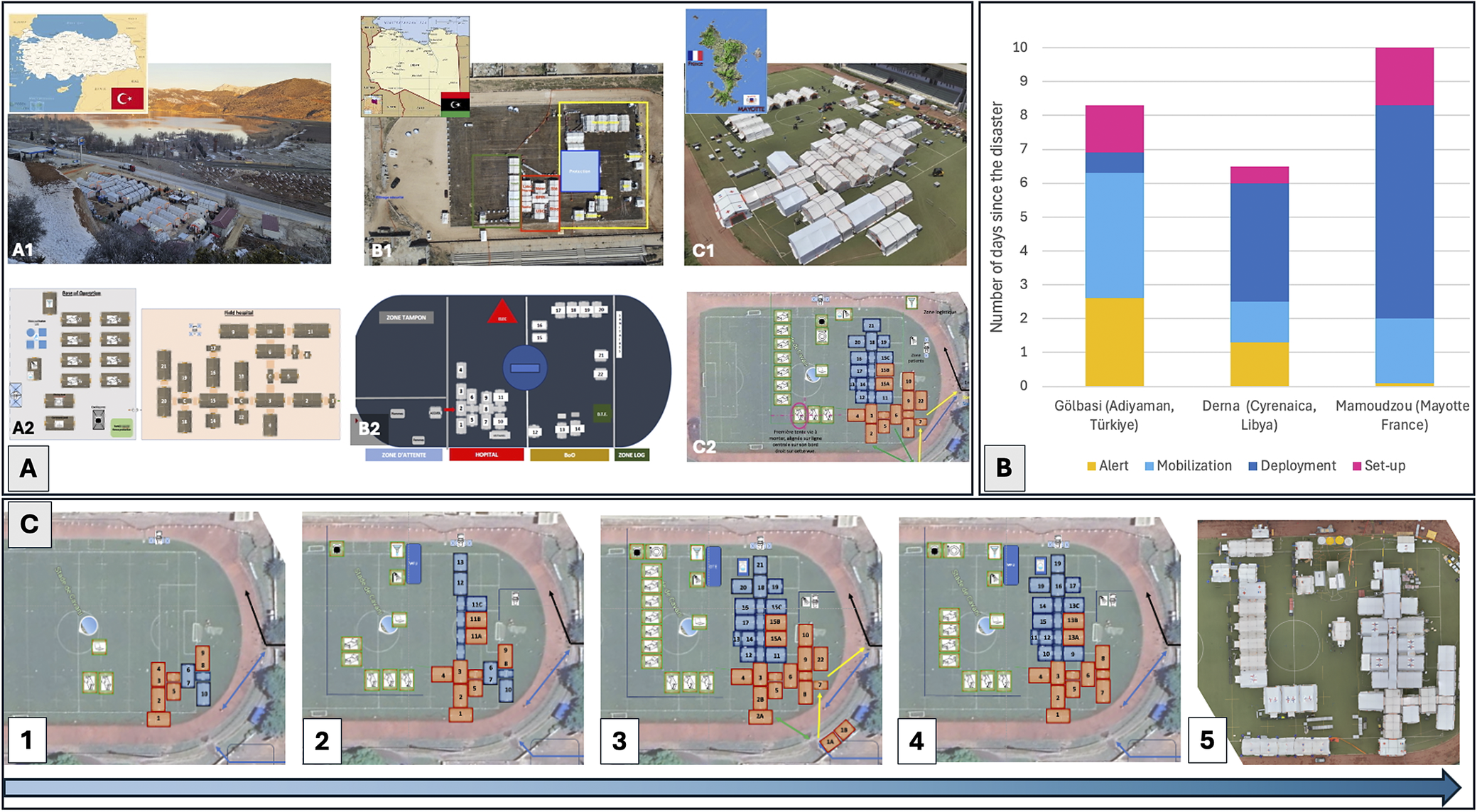
Supplemental Table 2 details the deployed staff, from 57 to 89 persons, necessary to set up the field hospital and the various configurations deployed. Figure 1 show aerial view and ground plan of the ESCRIM EMT-2. The 1.000 m2 tent can be deployed on half a soccer field, i.e., 3.500 m2, on various types of ground.
A: Pictures and ground plans of the ESCRIM (Elément de Sécurité Civile Rapide d’Intervention Médicale) Emergency Medical Team (EMT) type 2 French Civil Protection field at Gölbasi, Derna, and Mamoudzou.
A1: View at Gölbasi (Adiyaman, Türkiye)
A2: Ground plan of Gölbasi installations (Adiyaman, Türkiye)
B1: View at Derna (Cyrenaica, Libya)
B2: Ground plan of Derna installations (Cyrenaica, Libya)
C1: View at Mamoudzou (Mayotte, France)
C2: Ground plan of Mamoudzou installations (Mayotte, France)
B: Timelines of the implementation of ESCRIM (Elément de Sécurité Civile Rapide d’Intervention Médicale) Emergency Medical Team (EMT) type 2 French Civil Protection field hospital during its 3 missions since WHO classification in 2022.
C: Example of a sequential deployment of ESCRIM (Elément de Sécurité Civile Rapide d’Intervention Médicale) Emergency Medical Team (EMT) type 2 French Civil Protection field hospital that could have been done in Mayotte. From left to right, we see (1) the Cavani stadium in Mamoudzou with the ground plan of the first medical-surgical module (the emergency room in red, the ward red tent in a row with the operating theater in blue, itself preceded by the pre- and post-operative room also in blue) then the ground plan after the successive arrivals of the 2nd (2), 3rd (3), and 4th (4) rotations of cargo planes; photo 5 shows the EMT-2 at full capacity (ground plan 5) as deployed in Mayotte.

Timelines of the implementation of the EMT-2 are summarized in Figure 1B and Supplemental Table 3. Overall, between 7 and 10 days after the event were necessary to be able to perform the first surgery. Analysis of timelines shows a generally rapid alert phase, from the time of catastrophe to official mobilization; however, this first step lasted up to 62 hours in one case due to the need to wait for authorization from the authorities of the affected country.
The set-up phase is generally rapid. It took only 11 hours in Derna to set up the field hospital but 34 hours in Türkiye, due to difficult environmental conditions (temperature below 0°C) and the need to stabilize the muddy pitch. The assembly of the EMT-2 in Mayotte on a synthetic sports field without difficulty also took longer (41 h) due to the need for four rotations of the A400M tactical aircraft to project freight, the airport runway being damaged and not allowing heavier cargo aircraft to land. Of note, the sheltering of the field hospital from the violent wind and rain during the passage of storm Dikeledi in Mayotte, one month after cyclone Chido, was very fast: dismantling took 6 hours and reassembly 12 hours.
On the opposite, from official mobilization to arrival on site (mobilization and deployment phases), at least several days and up to a week were necessary. The mobilization phase mainly reflects the difficulty of finding suitable airborne vectors to transport cargo. This was particularly true in Türkiye, where the EMT-2 was deployed in addition to two French heavy urban search and rescue (HUSAR) teams. Surprisingly, the deployment phase is also often very long. In fact, this phase is essentially a reflection of local constraints, particularly in terms of security (Libya, but also, to a certain extent, Mayotte). Indeed, care can only really be provided once security issues have been addressed. But security remains an issue as long as the populations concerned do not have access to basic needs, particularly water, food, and, to a lesser extent, telecommunications. Aeronautical constraints also explained the delay in deploying to Mayotte, as the airport had been partly destroyed (notably its control tower), the runway shortened, making it impossible to land civilian airliners or large cargo planes, and necessitating the use of Airbus Atlas A400M-type military tactical aircraft guided by the air force on the ground. To this airport funnel had to be added the funnel created by the barge system to get from Petite Terre (airport) to Grande Terre (final deployment site), where initially only one barge was operating, then 2 after several days, out of the four normally in service.
Discussion
Since its WHO-classification in 2022, ESCRIM, the French EMT-2 field hospital, has been deployed in 3 occasions, making it one of the most active programs in Europe in recent years (Supplemental Tables 1, 2 and Figure 1A). Analysis of recent operations (Supplemental Table 3 and Figure 1B) shows a relatively rapid alert phase (2-62 hours), sometimes slowed down pending authorization from the affected country. It also shows the ability to fulfill its medical and surgical mission in various situations, under different climates, and within rather a short time once on site (11-41 hours). Nonetheless, ESCRIM mobilization and deployment seem to be taking a long time (4-8 days), mainly due to logistical constraints, but also to safety issues, thereby impeding the hospital’s early efficacy. This results in the provision of initial surgical care occurring within seven to ten days following the onset of the disaster.
The morbidity and mortality of disaster victims are linked to the delay in medical and surgical treatment. 9 -Reference Gauss, Ageron and Devaud 11 The chaotic post-disaster environment of the first few hours and days calls for the fastest possible organization, activating exceptional regional, national, or even supranational health resources. As we have shown, transport constraints are often major. In its complete configuration, ESCRIM, with its 60 tons of material and a volume of 300 to 400 cubic meters, requires a large-volume cargo aircraft and it is estimated that a minimum of 5 to 6 semi-trailers are necessary for the transportation of resources from the airport to the deployment site once on the ground. For the mission in Türkiye, an Airbus A330-200 F was used, with additional fret carry with the team members in another Airbus A330. For ESCRIM’s latest deployment in Mamoudzou (Mayotte, France), an Antonov-124 was initially used from mainland France to the island of La Reunion. As previously mentioned, it was not possible to land large cargo planes at Mayotte. Four round trips of military cargo aircraft Airbus Atlas A400M from the island of La Reunion to Mayotte were then required. Therefore, in the event of a disaster, we must not overlook situations where large cargo aircraft cannot be used. It will sometimes be necessary to rotate smaller tactical cargo aircraft. As a result, one of the most important lessons learned from ESCRIM EMT-2’s recent missions is the need to anticipate this sequential deployment, the need to prioritize cargo in the different planes so that the team landing with the first aircraft can start taking care of victims with a minimum of autonomy while awaiting the rest of the cargo.
In this sequential deployment of the EMT-2 (Figure 1C), the first module should fit in a tactical cargo plane with a limited weight and volume, probably around 25 tons and 80 cubic meters. This first module must be autonomous to function while waiting for the rest of the cargo. We can probably propose a minimum autonomy of 5 days in food and water. It seems difficult to go below this minimum autonomy for reasons of safety of the first projected team. This minimum autonomy, in a volume and weight constrained by the size of the plane, contributes to limiting the size of the projected medical-surgical team since each additional staff member adds a volume and weight linked to food and water. A small team probably means it will be impossible to operate 24/7, but rather exclusively during the day for the first few days while waiting for the rest of the team to organize 24-hour shifts. Ideally, this first module should be both medical and surgical so that it can begin to perform surgery on the most critical victims of the disaster. There is potentially an issue regarding the secondary transfer of operated patients. However, in a disaster situation, especially in the first few days, it is to be expected that transfers will not be possible due to a lack of downstream medical facilities and/or their being already overwhelmed. The first module must therefore be able to hospitalize surgical patients in intensive care units and/or a more conventional ward for a few hours to a few days. It will probably not be possible to have sterilization in this first module, which includes both heavy equipment and depends, for its water supply, on the water treatment unit, which is relatively heavy in an EMT-2. It is therefore conceivable that this first module will operate with a limited supply of surgical kits, allowing a limited number of casualties to be operated on. Contrary to what we have seen in the most recent ESCRIM missions, it is highly likely that this first module will be unable to cope with the flow of victims of the disaster. It will therefore be necessary to carry out effective triage at the front so that only the most urgent patients who can benefit from a surgical solution adapted to this context are allowed to enter the structure. Patients who are less seriously ill or injured, or who can wait a few days, will be seen in the EMT-2 once it is completed and fully operational. The ground plan of the first module must not interfere with the sequential implementation of the rest of the EMT-2 to arrive at the final ground plan (Figure 1C). It would be counterproductive to have to move tents multiple times or to cause interruptions in care to iteratively reorganize the field hospital. These initial elements reveal the logistical difficulty of such a project, but also the need for specific training.Reference Amat Camacho, Hughes and Burkle 12 , Reference El-Khani, Ashrafian and Rasheed 13
Given the multiple constraints slowing the international deployment of an EMT-2, it is unlikely that the first module of the sequential deployment will be operational within 48 to 72 hours, even if this remains an objective. It is conceivable that, after this time, the most seriously injured victims will either have died or already been treated. Although this is probably true to some extent, it must also be recognized that critical patients sometimes require repeated surgery. Moreover, the disaster, which is often limited in time, also often claims new victims during the clean-up and reconstruction phase. Finally, the local teams who worked tirelessly in the early days also need to be relieved so that they can take care of their loved ones and their property, but also to rest so that the safety of the care can continue to be guaranteed. The early operational deployment of a medical-surgical module in the field has therefore multiple benefits that are more or less easily quantifiable. This modification in doctrine must, of course, remain compatible with the WHO EMT standards and must not ultimately result in the deployment of a downgraded structure.
Conclusion
An analysis of recent missions of ESCRIM, the French EMT-2 medical-surgical field hospital, demonstrates its capacity to fulfill its mission of care under various circumstances. While the alert and set-up phases are relatively rapid, the mobilization and deployment phases can be perceived as too long, ranging from four to eight days. Many factors can explain this, including security issues in the broad sense, but above all aeronautical logistical constraints. Based on this feedback from ESCRIM missions, it could be proposed to deploy and set up the EMT-2 sequentially. This sequential deployment would allow medical and surgical care of victims to begin earlier, as soon as the first plane arrives, but with reduced autonomy, limited patient flow capacity, and an adapted technical platform until the rest of the cargo arrives in order to gradually increase the capacity and care offered to meet the standards of a fully operational EMT-2. We believe it could help to better plan humanitarian action at national or international levels and decision-making for disaster preparedness, especially for EMT-2s in the process of classification or re-classification.
Supplementary material
The supplementary material for this article can be found at http://doi.org/10.1017/dmp.2026.10368.
Acknowledgments
We’d like to dedicate this article to our elders who created this marvelous field hospital, and to all those who keep it alive today, whether on mission or at rear base. We would also like to dedicate this article to all the victims cared for by ESCRIM, and to the translators without whom our care work would be very difficult.
Author contribution
Louis Brac: Writing—Review and editing, formal analysis, data curation, methodology, final approval; Sébastien Mirek: Writing—Review and editing, formal analysis, data curation, final approval; Sébastien Buland: Writing—Review and editing, data curation, methodology, final approval; Gilles Hamelin: Writing—Review and editing, data curation, methodology, final approval; Deborah Tosetto: Writing—Review and editing, data curation, investigation, final approval; Paul Thiefaine: Writing—Review and editing, data curation, investigation, final approval; Charlotte Engster: Writing—Review and editing, data curation, investigation, final approval; Damien Chiodo: Writing—Review and editing, data curation, investigation, final approval; Laurent Bernhard: Writing—Review and editing, data curation, investigation, final approval; Benjamin Conte: Writing—Review and editing, data curation, investigation, final approval; Marie Peucelle: Writing—Review and editing, data curation, investigation, final approval; Jaques Pages: Writing—Review and editing, data curation, investigation, final approval; Didier Pourret: Writing—Review and editing, data curation, methodology, final approval; Guillaume Burlaton: Writing—Review and editing, data curation, methodology, final approval; Anthony Couret: Writing—Review and editing, data curation, methodology, final approval; Olivier Yavari-Sartakhti: Writing—Review and editing, formal analysis, methodology, final approval; Isabelle Arnaud: Writing—Review and editing, formal analysis, methodology, final approval; Romain Kedzierewicz: Conceptualization, writing—original draft, formal analysis, methodology, final approval; Philippe Agopian: Writing—review and editing, formal analysis, methodology, final approval; Sébastien Gaujoux: Conceptualization, writing—original draft, formal analysis, methodology, final approval.
Competing interests
None of the authors has any financial or any other kind of personal conflicts of interest in relation to this study.