INTRODUCTORY COMMENTS
Professor Tony Smith was the Arthur Goodhart Visiting Professor in Legal Science in the Faculty of Law, Cambridge University, for the academic year 2015–16, and I had the pleasure of interviewing him on two occasions. Transcripts of the resulting audio records are available on the website of the Eminent Scholars ArchiveFootnote 1 .
Professor Smith has had a long and illustrious career that has encompassed academic and legal work in his native New Zealand, and several institutions in England, and is still ongoing. Throughout, his abiding focus has been on criminality in various forms, and its relationship, in a notional sense, to criminal, public and constitutional law, as well as various jurisprudential aspects of the judicial process. These interests were generated very early in his legal journey, but evolved significantly over the intervening forty years or more. This he attributes in no small measure to changes in society's norms, but also, and partly related to, technological advances. He has had a particular interest in the evolution of policing methods, as applied to large crowds and demonstrations. I shall try to outline these developments as they played out over Professor Smith's various academic and legal appointments. For the record, he lists his research interests on his Victoria University faculty website, as criminal law, public law, and media law (contempt & privacy), and on his Cambridge Faculty website during the tenure of the Goodhart chair as Criminal law and justice: judicial development and codification. Constitutional law: overlap with criminal law. Civil liberties: freedom of speech.
His publications record is an eclectic mix of comprehensive treatises on specific statutory instruments, as well as more general tracts on the theory of criminal law and its ramifications. To express his ideas, Professor Smith has, to date, published sixty-one journal articles, seven books, five chapters in books, and six major oral/conference presentationsFootnote 2 .
The other major strand in his career has been his willingness to occupy various important administrative posts, to which I would suggest, his quiet, reasoned, and unassuming demeanour is well suited.
To date, Professor Tony Smith has held permanent appointments at six academic institutions: University of Canterbury (1970–72), Fellow of Gonville & Caius College (1973–81), University of Durham (1981–85), University of Reading (1986–90), Life Fellow of Gonville & Caius (1990), University of Cambridge (1990–2006), and Victoria University, Wellington (2007–2016).
EARLY LIFE AND UNDERGRADUATE DAYS (1947–72)
Anthony Terry Hanmer Smith was born on January 12th 1947 in Christchurch, New Zealand, two years after the end of World War 2. Although he obviously has no memories of the war itself, its legacy affected his family for several years. This was as a result of his father's having been a member of the New Zealand air force during the Pacific war, as a navigator involved in the operations in Guadalcanal in the Solomon Islands campaign. Mr Smith stayed on in the air force after the war, with the result that the family (Tony had three siblings) moved frequently. They even had a year in England when Tony was a very young child. As a result, Tony received a disrupted primary school education “all over New Zealand”, and even in secondary school, moved between Wellington and Blenheim, before finally his father resigned from the air force and settled in Christchurch, where Tony joined St Bede's Catholic college. Despite this uncertain start, Tony found inspiration through one of his teachers and developed a deep interest in English, and in particular the poetry of the (then) living New Zealand author James K BaxterFootnote 3 . This early mentor was Father John Weir, who was in correspondence with Baxter, and later produced a “wonderful piece of work, a quite amazing piece of scholarship” on his friend's writingsFootnote 4 . Professor Smith told me that he has recently regained contact with his old teacher, who despite the fact that he is now in his eighties, is currently working on a biography of Lewis Carroll.
Tony was also interested in chemistry and mathematics at St Bedes, but poor teaching blunted his enthusiasm for science, and he eventually entered Canterbury, the local university, in 1965 to read political science, history and English. He also studied legal systems, for which a good mark was required to enter the LLB course in his second year. Again Tony was fortunate to encounter some inspirational teachers in his first year, all in political/historical subjects. Three that he emphasised during our conversations were Austin MitchellFootnote 5 , James FlynnFootnote 6 and J G A PocockFootnote 7 . Mitchell become nationally known in New Zealand, and lectured in politics at Canterbury from 1963 to 1967, and in 1963 he had been a founding member of the Political Science Department. Tony gained much inspiration from his lectures. Mitchell later wrote a popular book about New Zealand life, The Half Gallon Quarter Acre Pavlova Paradise Footnote 8 (1972) when he moved back to the UK. Here, he became a charismatic Labour MP, and TV personality. Of the others, Professor Smith said Flynn was “quite a major figure here too…an American refugee from the Vietnam War, but with a very considerable mind, [while] J G A Pocock, who's an honorary fellow of St John's, went off to become a professor at [Johns Hopkins]: a quite outstanding group of scholars.”Footnote 9 With such influences, it is hardly surprising that Tony Smith's own legal scholarship touched so frequently upon issues that conjoined criminal law with political and social matters.
His own ambitions to study law were grounded in his early love of reading about lawyers, which extended as far back as the age of twelve, and he singled out the English barrister Patrick HastingsFootnote 10 . Nevertheless, after graduating in 1968, he left Canterbury with his LLB, and joined the Treasury in Wellington. But the work was “extremely dull”, and he decided after a year to return to academia.
For the next three years (1970–72) Tony was Assistant Lecturer at Canterbury University, where he simultaneously undertook a part-time, two year LLM. By this stage, he had realised that his scholastic fortunes lay on a grander stage. He had been teaching both criminal and constitutional law, and as part of his Masters course had studied jurisprudence, including the criminal jurisprudence of the famous, recently retired Oxford scholar, H L A HartFootnote 11 . A seminal episode in Tony's career occurred when the great man, on retirement, made an extended visit to New Zealand, including Christchurch. Here, Tony showed him around the universityFootnote 12 , and they talked about liability for negligence, during which the work of Glanville WilliamsFootnote 13 at Cambridge came up. The seed having been sowed, it germinated with Tony's gravitating to Cambridge in 1972. He had also been accepted at Oxford, but found Hart's views “too philosophically orientated”, while an offer to work with (then) John Smith was declined as he preferred Cambridge over Nottingham as a place to study.
The draw of Glanville Williams as a determining factor was critical, because, as we shall see anon, Williams became probably the most influential of his mentors, bequeathing Tony a scholarly legacy, that benefitted him throughout his career. Armed with a Commonwealth Scholarship he headed for the UK in 1972, and when he also gained a Tapp Scholarship, he settled on Gonville & Caius College, Cambridge.
AN ODYSSEY THROUGH ENGLISH ACADEMIA (1972–2006)
Gonville & Caius College, Cambridge
For the next ten years (1972–81), Tony Smith was progressively a student, Lecturer, Fellow and Tutor at Gonville & Caius. Initially, he found the “sheer intensity” of Cambridge difficult to adjust to, while conditions for study were not “very congenial” in the cramped quarters of the Old Schools building, in which the Squire Law Library was housed during this period. Nevertheless, the relatively large contingent of New Zealanders at Caius made his aclimatisation easier: Robin CookeFootnote 14 , Leonard SealyFootnote 15 , Jim FarmerFootnote 16 , Jim EvansFootnote 17 , and the Australian Paul FinnFootnote 18 were all his contemporaries. Later, Tony lectured and gave supervisions to law students in criminal and constitutional law, as well as gaining valuable experience in administrative and pastoral duties, that would stand him in good stead in his later posts. (Amusingly, he commented that as Tutor, one of his students was Alistair CampbellFootnote 19 , amongst other people, who “went on to great notoriety”).
During his time at Caius, Tony was influenced by several prominent legal scholars, including Sir William WadeFootnote 20 , Sir John SmithFootnote 21 , Andrew AshworthFootnote 22 , and Sir David WilliamsFootnote 23 . Of the latter, he said “his lectures I thought were the best lectures I ever saw…..because he was an historian, he had the ability to put public law into a political, social, and economic context….in a way I've never seen anybody else really being able to do”Footnote 24 . He described David Williams as “very supportive, a very nice man,” and it is clear that such an approach to legal theory would have struck a chord with Tony, whom as we shall see later, was concerned with the relationship between criminal law and social issues.
However, it was Glanville Williams who made the greatest impression on Tony's career. As he recounted, “I came to this country to work with Glanville Williams”Footnote 25 , and Professor Williams had suggested to Tony that he undertake a PhD under his supervision on the subject the law of contempt of court, and this he duly started. However, “after about six months or so I discovered that another quite senior academic in England was writing a book on it, and there was the possibility of reform of the law in the air. It was a man called Gordon Borrie, who became Lord Borrie, and he did in fact publish a book with a chap called Nigel Lowe”Footnote 26 . Tony cast around for another topic, but Glanville Williams, naturally dismissive of PhDs, suggested that they write a book together, instead.
This involvement with Glanville Williams's publishing activities ultimately resulted in three major texts for Tony over the following 25 years. The background lay in Williams's contract with Sweet and Maxwell in the fifties to write a four volume account of English criminal law: general principles, offences against the person, offences against the state (public order), and offences against property. Glanville Williams had already completed the general part (1953/4, 2nd Edit 1961), so Tony began work with his mentor on accumulating material for property offences, and public order. However, as Glanville Williams became progressively preoccupied with compiling a criminal code for the Law Commission, it became obvious that he would not have time to complete the remaining three volumes. As Professor Smith recalled, “….he was very explicit about it. He said, “That [the code] has to be my highest priority,” and he had a feeling, I think, that his time was getting short, and he really wanted to get this measure off the ground and actually onto the statute book - it didn't happen. So eventually he said “Why don't you finish it yourself?”Footnote 27
Consequently, Tony took over the public order and property projects, and worked on these as long-term enterprises, seeing them to fruition as published books with Sweet & Maxwell in 1987 and 1994, respectively. With such long gestation periods (~15 and ~22 years respectively) there were times when they “[kept] being put away, and then got out again...” In fact, in the Preface to the Property Offences volume, Professor Smith's relief at finally bringing it to print is shown in a heartfelt quote he made from the philosopher HayekFootnote 28 on the futility of forever emending one's research conclusions beyond a “tolerably finished product.”
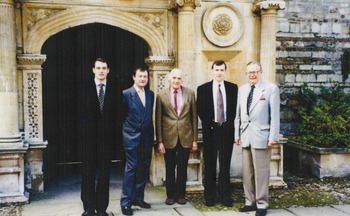
New Zealand Fellows of Caius in front of the Caius Gate of Honour. From left Professor Craig Rotheram (now of Nottingham), Professor Tony Smith, Professor Len Sealy, Professor Andrew Simester and Lord Cooke of Thorndon. Ca. 1990.

A further project effectively bequeathed to Tony by Glanville Williams was his ongoing, very successful involvement with Arlidge & Eady “On Contempt”. Glanville Williams had originally persuaded one of his former students, Anthony Arlidge, to write a book on contempt of court. Little came of this until the Contempt of Court Act was about to become law, when Arlidge recruited his friend, David Eady (later Judge Sir David, another former pupil of Williams), to join him. Their book came out in 1982. They were both busy practitioners and had rather rushed the work, and as Professor Smith recounted to me, “it was rather panned by one of the reviewers,”Footnote 29 mainly for the want of academic input. He was brought in to plug this gap, and in 1998 the second edition appeared, to much acclaimFootnote 30 . This is still an ongoing project.
These three major works on aspects of criminal law, whose production has been spread over nearly forty years, encapsulate much of Professor Smith's thinking on the evolution of English criminal law, and I shall examine this in more detail below. Here I reiterate that Professor Smith, during our conversations, acknowledged the debt he owes to his association with Glanville Williams for this legacy. A further point worth mentioning, and which has played no small part in his career, was Glanville Williams's early appreciation of the potential role that personal computers would play in legal studies. This greatly aided Tony in his research, and in his innovative administrative activities.
Durham
By the time Tony Smith moved as a Reader to the University of Durham in 1981 (he applied originally at the behest of John Smith, who was on the appointments committee), Glanville was using a word processor. To keep up with Williams's output, and to swap files with him, Tony also acquired the necessary technology. Within a short time he had won a large government grant (£150,000) to develop a computer centre at Durham, which at the time was one of only two such facilities in the country (the other was at Warwick). This allowed Tony to gain administrative experience in a small provincial department, while employing innovative and technologically cutting-edge techniques.
He taught criminal and public law with a “a very good colleague” with whom he is still in touch - G R “Bob” SullivanFootnote 31 , who later went on to write the text Simester & Sullivan on Criminal Law. He simultaneously continued amassing material for his own two texts, while publishing ten publications on a variety of criminal law topics in various journals.
Tony liked Durham and its wonderful Cathedral very much, but the then Dean, Frank Dowrick, had deliberately restricted the size of the Law department to ensure that a personal atmosphere prevailed. While this did have some advantages, Tony realised that it severely restricted the possibilities for faculty expansion and individual promotion.
Reading
After five years at Durham, Tony was awarded the chair of Law at Reading University, where again his application was backed by Professor John Smith. He transferred his computing interests to his new department and “managed to persuade the university ….that we all ought to have computers….[we began]…. using them for administrative purposes…..sorting out timetables and all that kind of thing. So …..while I was there, [we managed] to get the whole faculty computerised. That was fairly early [in such developments].”Footnote 32 [By comparison, Michael Prichard was undertaking similar innovative computerisation at Gonville & Caius, and in the Law Faculty at Cambridge around the same time.Footnote 33 ]
It was at Reading that one of Tony's particular interests in criminal law was developed, when he co-operated with a sociologist, Peter “Tank” WaddingtonFootnote 34 who had a close association with the Metropolitan Police, through Sir Peter ImbertFootnote 35 . These friendships allowed Tony to delve into the sociology of policing, and the strategies and mechanics of policing large, potentially violent, public demonstrations, as well as the deployment of police with firearms. He also gained an understanding of how the application of the recent Public Order Act (1986) and its emphasis on preserving public order squared with enabling freedom of expression and the right to assembly. Insights gained were incorporated in his book Offences Against Public Order, Including the Public Order Act 1986 Footnote 36 , which appeared early in his tenure at Reading, and is one reason why it was so well-received by reviewers. In addition, during the five years that he was at Reading, Tony published seven articles in journals. Six of these were on aspects of criminal law, as well as a sortie into the realm of legal ethics with a valedictory offering on “new birth technologies” given at a conference of the New Zealand Law Society in 1988: a further manifestation of his interest in the law and societal matters.
Cambridge
Professor Smith took a further leaf out of Glanville Williams's book when he returned to Gonville & Caius as a lecturer in 1990 - Williams having left the Quain Chair of Jurisprudence, London University in 1955 and returned to Cambridge as a Fellow to Jesus College (1955–97).Footnote 37 Tony further emulated his old mentor by being appointed Professor of Criminal and Public Laws in 1996, a position he retained until 2006. His sixteen years back at Cambridge were a busy and rewarding period, both administratively and academically.
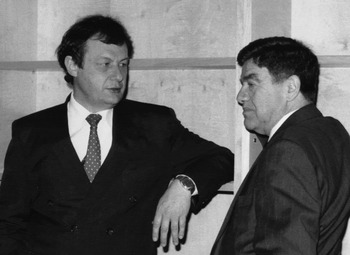
Professor Tony Smith with Professor Peter Stein 1995.

He became Faculty Chairman for three years in 1999, and continued to innovate. The Faculty and the Squire Law Library had finally moved from central Cambridge and the Old Schools to the new West Road site in 1995, shortly after Professor Smith arrived back in Cambridge. His Chairmanship coincided with the immediate post-move period, and part of the work was dealing with the legacy of teething troubles inherent in such a major translocation.
When asked which of his innovations from his time as Chairman he considers the most enduring, he proffered the relationship that the Faculty established with FreshfieldsFootnote 38 . He had discovered that while students from the wealthier colleges had access to good computing facilities, those from poorer colleges did not, and using some of the funds provided by Freshfields, he attempted to rectify this across the latter. As he put it “a mirror of what I was doing in Reading.” Similarly, he arranged for a Freshfield Faculty IT teaching and development post to be established, which, in this case, harked “back to my interest in Durham.”
Professor Smith also helped establish, with the help of Professor Jack BeatsonFootnote 39 , the Herbert SmithFootnote 40 -funded Freehills Visiting Scheme, and also an endowment for the D G T Williams annual lecture. These were the highlights that he mentioned in our conversations, but there were several other, less eye-catching achievements, and one can only reflect on the important impact his Chairmanship had on the Faculty, and the lack of fanfare with which they have become accepted.
Professor Smith's teaching focussed on criminal, and public law, civil liberties and media law, all areas where his research strengths lay. Three of his major texts appeared during his second coming at Cambridge: Property Offences Footnote 41 (1994), Harm & Culpability Footnote 42 (1996), and On Contempt Footnote 43 (1998), while he published a further nineteen papers in journals and proceedings. Two of the books were a response to specific pieces of parliamentary legislation, while Harm & Culpability was the outcome of a series of seminars he helped organise and edit with Andrew Simester, a further Caius emigree from New Zealand, in 1994. This was a book on criminal law theory, academia's reflection on, as Tony explained “wider questions about criminal responsibility that moved away from case law. [Considerations that weren't] ….part of the English tradition….”Footnote 44
Professor Smith's valedictory presentation from his Cambridge chair demonstrated the breadth of his legal interests, his commitment to teaching to undergraduates, and his continuing close ties with his late mentor (Glanville Williams died only in 1997). Williams had brought out the last edition of his famous introductory text Learning the Law Footnote 45 in 1982, and when Tony was asked to update it for its 12th Edition, he had two decades of legal developments to contend with. His first task was to purge the gender gap of twenty years. Over this time the “number of women studying law had gone up and up and up….and the whole book was couched [in an] aggressively masculine [tone] and it felt strange to the modern ear…”Footnote 46 A second, and very substantial, problem was to accommodate the use of computers into the teaching of law, where “databases and so forth were going to change legal education quite significantly”. As we have seen, Professor Smith had been a pioneer in the introduction of computers into law schools in this country, but “it still worries me how much of all that to put in.” And finally, there was a huge amount of European legislation to incorporate.
Although Learning the Law is a slim volume, its upgrade, whilst maintaining its tradition, was a major undertaking. The fact that a 16th Edition has recently been published (2016) is a testament to the success Tony had in 2002 in keeping faith with the legacy bestowed by Glanville Williams.
Victoria, Wellington, New Zealand
Professor Tony Smith returned to his native New Zealand in 2007, primarily for family reasons, and took up the post of Pro-Vice Chancellor and Dean of Law. Initially, he viewed the post as a challenge “Victoria was known to be a difficult faculty so it was quite an interesting challenge and I thought, well, I've done this job now in two or three places and it's something that I've had quite a bit of experience at and it would be an interesting challenge. And so it proved.”Footnote 47
He was able to call upon his considerable experience in academic administration. He was ”...in charge of the Law Faculty and the School of Government. That meant I was part of the senior management of the university and we met one morning a week, but it meant being responsible for promotions, for the budgeting for the university, for the strategic direction of the university……It was very hard work. One of the big challenges for us was the research assessment exercise and we concentrated on that in a quite significant way. I think in 2012, the results came out and we were scored as the most research active university in the country, and the Faculty was the top faculty in the country.”
Although unable to find sufficient time to teach during his eight years in the post, he did manage to continue with his research, and produced sixteen papers on various criminal law issues. Having helped turn both the university and Faculty around, Professor Smith conceded that he had not the slightest regret in returning to New Zealand. At the end of his tenure as Dean, he was awarded the chair of Professor of Law in the Faculty at Victoria, and took up the Goodhart Visiting Professor post at Cambridge for 2015–16.
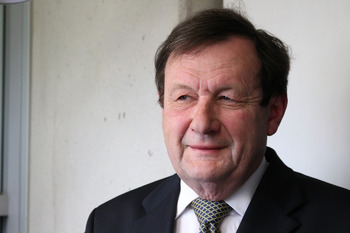
Professor Tony Smith taken before his interview for the Eminent Scholars Archive on 19 January 2016.

When I asked him during our first conversation in January 2016 what research he intended pursuing during his Goodhart tenure, he said that he would like to find out more about the enigmatic Arthur Goodhart, in whose honour the chair was established in 1971. At our second meeting in July, he revealed that he had discovered that there is a large archive of material on Goodhart in the Bodleian Library, and that he was intending to spend time later in the summer examining it. As far as teaching had gone, he was pleased to have jointly established, with Professor Feldman, a new LLM course in legislation looking “at legislation as a phenomenon,” which “to the best of my knowledge there's not a course on that in the country.” Tony Smith continues to innovate.
CRIMINAL LAW AND ITS CONSTITUTIONALITY
Since his undergraduate days, Tony Smith has harboured an abiding interest in the criminal law and notions of criminality. Thus, for over forty years, he has chased down and analysed recurring themes, while adjusting his perceptions as social norms changed and new technology threw up novel challenges. His earliest publication was in 1969 and was written while bored with his work at the Treasury in Wellington. It consisted of reasoned discussion on the subject of provocation as a criminal defenceFootnote 48 , where Tony already had strong enough opinions to disagree with various judgments. It was a topic he followed up in his LLM dissertation a few years later at Canterbury, but he never published on the topic further when at Caius. A paper by Andrew Ashworth on provocation in 1976Footnote 49 showed Tony that he had a lot to learn, and he dropped his own planned article. This cameo illustrated both his ability to learn, and his generous spirit of co-operation which has enabled him successfully to work with a variety of colleagues “[Ashworth was] a wonderful editor [of Criminal Law Review], very good at reading your stuff very carefully and critically, suggesting how you might rephrase or think about a point again. Very happy, particularly with a younger scholar, to help people produce a good piece of work…..I thought I'm not going to publish mine in the light of that, it was a quite astonishing piece of work…. he knew a vast amount about provocation. He became a very good friend, still is.”Footnote 50
Spanning the next thirty-seven years, I have noted thirty-two separate topics in the titles of Professor Smith's journal publications, as he turned his mind to a myriad of criminal law issues. It has been a lifetime's campaign, which has produced a long catalogue of books and learned articles. Various themes are discernible, but at the beginning of our second conversation, I asked him if he could summarise his comprehensive philosophy to things criminal, and how his approach to the broad subject of criminal law has evolvedFootnote 51 .
“I was always interested in the criminal law context - the relationship between the individual and the state. … Of course, in criminal law, the individual is at most risk, most in peril of being imprisoned or [of] the death penalty….What has evolved in my thinking is that I tried to make more explicit the relationship between criminal law and the criminal justice process, and the constitutional context in which it finds itself. So increasingly I have seen criminal law as being a branch of public law. Now, that was certainly not the perception when I started teaching in 1970. We had criminal law here and we had public law and constitutional law over here, and there was no crossover between the two.”
He then drew an important distinction within common law jurisdictions, which identified a critical strand in his thinking, and summarised how it has coloured approach to, particularly, the operation of the criminal justice system. “[T]he Americans did have a crossover between the two, because aspects of their criminal justice process were actually in their constitution - for example, proof against self-incrimination….the United Kingdom and New Zealand, don't have an articulated constitution of that kind, but you see the crossover between constitutional public law and criminal law. So, when I was here in a previous incarnation [Cambridge, from 1996–2006] my title was the Professor of Criminal and Public Laws. So that's …been an evolving focus of it.” Footnote 52
Herein can be seen evidence of Professor Smith's overriding themes - the relationship of criminal law and its application to the constitution in common law jurisdictions, and his wariness of the power of judges to make what sometimes amounted to constitutional changes in the UK through their ability to develop freely the criminal law. Many of his journal publications, while dealing with specific aspects of criminal law and criminality, have as a subplot the ability of the judiciary to alter, sometimes only incrementally, features that impinged on what could be considered constitutional matters: “judicial law making” he called it. He has become very cautious of “not having the judges making it up as they go along.”
He explained that these notions were also, to a certain extent, incorporated in his major books on Public Order and Property Offences, but particularly so “in the Contempt book, because contempt is a common law wrong, not in statutory form.”
This highlights a major factor which has steered Professor Smith's research over the years, viz his inclination towards the adoption of a criminal code for the UK, as found in “most common law countries, including New Zealand and much of Australia and the United States….”Footnote 53 It was, of course, a theme rigorously pursued by Glanville Williams, and which became, as Tony put it of his mentor, “one of his great missions.”Footnote 54 . It would also be reasonable to assume that Tony had been influenced in his thinking on the practicalities of such a scheme by Glanville Williams. As mentioned earlier, Williams eventually completed a draft criminal code for the Law Commission, and Professor Smith recalled during our conversation how in June (2016) he had been in touch with Sir Richard BuxtonFootnote 55 who once had a copy of the Williams code - but had unfortunately mislaid it. This was also a theme championed by another of Tony's colleagues at Cambridge, John Spencer, while Tony set out some of his own ideas on the subject in his 2004 paper “Criminal Law: the future”Footnote 56
So far, however, there has been no resolution on an English criminal code, and the judiciary remain free to “make it up as they go along”, to paraphrase Professor Smith. He explained to me - “So the judges do continue to develop it. For example, quite recently, by saying that jurors, who contrary to their instructions go online to look at the cases they are about to try, are interfering with the administration of justice and committing a criminal offence. I find that problematic because it's not laid down in advance that that is something they are not supposed to do, other than in very general terms.”Footnote 57 In this example, the consequences of the judicial pronouncement were, for Professor Smith, not desirable.
“Not long after the judges did that, Parliament enacted legislation, confirming that's what they thought was an appropriate way of dealing with the problems that we have had. But I didn't like the fact that it's the judges who made the decision in the first place.”
Nevertheless, in lieu of a code, “they are custodians of the justice process, I suppose, and when they see what they believe to be people interfering with it, and it's perfectly true to say that the notion of contempt involves interfering with the administration of justice and that crystallises out into a specific criminal offence. I suppose there is no great harm done, but I think constitutionally it's not the best way of dealing with it.”Footnote 58
Despite the lack of a criminal code in English law, Professor Smith emphasises in his 2004 paper (p. 973–4) that in the application of the criminal law there are in fact a large number of “very detailed, if disparate, codes and Practice Directives”. For example, regulating the searching, detention, treatment and questioning of suspects. The crucial factor, however, is that “these matters of major constitutional importance” are controlled by non-statutory instruments, that being brought into operation by statutory instruments, and are a constitutional oddityFootnote 59 . Similar criticism is directed toward the Code for Crown Prosecutors, aspects of which Professor Smith claims has a “constitutional origin if anything even more murky.”Footnote 60 The ultimate origin of these diktats appears to be the Crown Court Rules Committee, whose activities can be conducted informally through the post, and yet which make “sometimes, constitutionally significant change.” The suppressed indignity at this situation and the lack of apparent progress in resolving it, comes through in Professor Smith's writings.
These notions feed into another of Tony Smith's great interests in criminality: policing and the dangers of political judgments in the application of the law. His 1987 Public Order book sets out the law immediately after the 1986 Public Order Act, and it was interesting to hear his opinions (in 2016) on how this important area has progressed. This was particularly in view of the recent propensity for public, politically-motivated, protest, and the potentially conflicting requirements of maintaining public order (per the 1986 Act) and rights to freedom of expression and freedom to demonstrate as embodied in the 1998 Human Rights Act. He was quite clear that whereas the 1986 Act directed the police to “maintain the peace”, which had certain ramifications regarding freedom of speech in its potential for “inciting” listeners, after the 1998 Act, the police ” [were] aware that if they do force people to desist from speaking, that does confer what is known as a “heckler's veto” on the other protestors. So I think the police will do as much as they can to allow the conflicting views to be aired….I think there is a much greater awareness of the issues that are at stake when the policing of demonstrations.”Footnote 61
Professor Smith admits however that the police do not always get it right, and in two of his recent papers he explored the areas of uncertainty. A theme that he emphasised several times during our conversations was that the police are often “frightened or terribly worried that people are going to get killed in these demonstrations [that can be] advertised by Twitter and so forth, [where it can be] suggested that people should converge on Oxford Circus [for example] from four different directions.”Footnote 62
A species of criminal law which Professor Smith lists on his Victoria University website is “media law (contempt and privacy)”, and during our discussions on his Contempt text, I took the opportunity to ask about this area, which, with some notorious “injunctions” swirling around in the popular press over the last few years, has become a topical issue. It is also intimately tied up with the vexed question of jurors and journalists texting and tweeting, and communing with the Internet. In other words, the issue of criminal law coping with technological innovations that can outpace the ability of the judiciary and legislation to come to terms with it.
I asked Professor Smith if there had been any resolution to a major problem he had highlighted in the 4th edition (2011 p. v): “the whole system of jury trial depends on there being trust between the judge and jury, including an understanding that the jurors will not disobey instructions on law or procedure”, specifically on “securing a fair trial rights in an electronics age…..and insulating jurors from prejudicial information not admitted at trial.”Footnote 63 One solution, which he mentioned in the 2015 Second Supplement Footnote 64 to the fourth edition, had been that judges could consider taking down particular websites during a trial.
He explained that in the time since he had expressed those fears, and faced with the impossible task of stemming the tidal wave of information of the Internet, the courts have taken the line of least resistance and decided to rely on the good sense and maturity of the population. Now judges “explain to the jury why it was unfair to a defendant to take into account material that was not going to be actually discussed in the course of the case itself. That's the point about not being admissible. You are not to take any notice of it. Your oath is to listen to the evidence that is put before you. It is simply unfair to the defendant to take into account material that may or may not be accurate, never been tested. You can't try him on the basis of that and you can only try on the basis of the evidence.” He said he was “reasonably confident that they will do that.”
A similar approach has been taken in the European Court of Human Rights, where in relations to UK courts, ” if the jury are directed properly not to take into account material that is not before them, unless you have got evidence to show that they have not done that….you have to proceed on the basis that they haven't.”Footnote 65 Apparently the idea of taking down websites was dropped “because it looks too much like censorship by the courts…”Footnote 66
Media law has been exercising politicians, the legal profession and various sections of the media industry over recent times, and Professor Smith has taken an interest in it because it combines many strands of criminality and constitutionality on which he has specialised. In particular there have been well-publicised examples of breaches of privacy, and electronic media hacking. This culminated in the Leveson inquiryFootnote 67 , whose final report (2012) was published too late for the 2011 edition of Contempt, although many of the constitutional and legal issues it investigated were also covered in the book. Professor Smith subsequently wrote a lengthy article exploring some of these matters (quoting some of his key words): corruption, data protection offences, defences, hacking, journalists, public interestFootnote 68 . He was especially concerned that many of the matters were of “high constitutional significance” (p. 454), inter alia involving freedom of expression as enshrined in the Human Rights Act (e.g. re. ECHR Article 10). He expressed curiosity as to why the new Director of Public Prosecution Guidelines set out in the inquiry report claimed that such a freedom has “never been defined in law”, pointing out that Lord Bingham did just that in R. V Shayler. He goes on to discuss the pros and cons for the making the case for a general defence of “public interest”, which would cover the multitude of such media-related cases, of which the journalistic skulduggery unearthed during the Leveson inquiry, is probably only one manifestation. Clearly, Leveson did not see things this way (perhaps because of the tight focus of the issue of investigative journalism before him), which is why he plumped only for “Guidelines” for the prosecuting authorities. Professor Smith hopes that these will be only an interim solution, but one senses that he has little hope that Parliament will be in a hurry to tackle the issue that he sees as likely to continually pose privacy/media-related problems of “high constitutional significance.” It is an area where he thinks legislative developments are “very necessary” (p. 464).
Finally in our conversations, and bearing in mind that our second conversation took place only a month after the historic 23rd June Referendum on UK's EU membership, I could not resist asking Professor Smith how the Brexit result would affect his chosen legal specialities.
Several times the question of Brexit was raised in connection with outstanding problems in criminal law, but in the majority, issues that had a European dimension were linked to human rights issues where the European Court of Human Rights in Strasbourg was the supreme jurisdiction to which the English courts are subject. Specifically, this was on issues of freedom of expression and right to assembly, where the 1998 Human Rights Act are linked to the European Convention via Articles 5, 10, and 11, as well as contempt issues in relation to fair trial (Article 6) and so on. He emphasised that Brexit should make no difference to the way our courts deal with these matters, since the Convention is not an EU construct.
On one issue, however, he did identify some important administrative hurdles. “There will be changes to the criminal justice system, because a lot of the relations with EU and criminal matters are a matter of quite highly developed inter-jurisdiction collaborations. In fact, I chaired a seminar in London about six weeks ago before the vote, and it was attended by a lot of the civil servants from the Home Office and the various agencies that do a lot of the nuts and bolts criminal detection and so forth. They were horrified with the prospect. They said there were just not anything like enough of us to be able to cope if we leave….. having to put in place different arrangements for what to do about extraditing and all that sort of thing.” But he stressed “It's not quite as bad as the problem with trade negotiations…”Footnote 69 Professor Smith's remarks showed what huge ramifications within the civil service and legal profession there are to the UK's extrication from the EU.
The major, immediate casualty for Tony Smith of Brexit, however, was his ongoing revision of Learning the Law for its 16th edition. This had got as far as the proof stage, but he then had the dilemma as to what to do about the European chapter. This had been written in two parts, and whereas the section on Human Rights and the UK's relationship with the European Court of Human Rights in Strasbourg was likely to be relatively unscathed, the section relating to EU law and the European Court of Justice in Luxembourg hung in limbo.
In the event, while admitting that Brexit “will throw into reverse over four decades of legal and constitutional development”Footnote 70 , Professor Smith decided to take a pragmatic approach and leave what he had already written seeing that even after Article 50 is invoked, the process of unpicking the legal and political integration “is likely to be protracted, lasting several years”Footnote 71 . The implication being that with such a popular book, the changes in text necessitated by Brexit, can be saved for the next edition!
Professor Smith is the only scholar I have interviewed for the Eminent Scholars Archive over the last twelve years, to have specialised in criminal law, and a better ambassador for his subject it is difficult to envisage. I can only record that it was a great pleasure to have been able to converse with and record for posterity, such a modest, convivial scholar, who wears his impressive academic and administrative achievements so lightly.
Career highlights of Professor Smith