Implications
The gut can undergo long-lasting developmental changes throughout one’s life. Weaning is the most severe, early life stress for piglets and is associated with increased susceptibility to intestinal dysfunction. It is important to better understand how nutritional interventions at early postnatal life stages affect intestinal structure, physiology and function in weaned piglets. The novel finding was that feeding alanyl-glutamine (Ala-Gln), a highly soluble and stable glutamine dipeptide, improves growth performance in weaned piglets, which associated with better intestinal morphological and capability of digestion and absorption. Current results may provide new insights into developing Ala-Gln as a functional feed supplement in pig industry.
Introduction
The gut, which plays a pivotal role in the digestion–absorption of nutrients and regulation of the mucosal response to exogenous antigens, undergoes long-lasting developmental changes throughout one’s life (Boyer et al., Reference Boyer, D’Costa, Edwards, Milloway, Susick, Borst, Thakur, Campbell, Crenshaw and Polo2015; Minerwilliams and Moughan, Reference Minerwilliams and Moughan2016). The environmental factors at early postnatal life stages which in addition to genetic factor, including nutritional stimulus, pathogen infection and stress, have been shown to induce significant changes in intestinal structure, physiology and disease susceptibility in mammalians (Pluske et al., Reference Pluske, Hampson and Williams1997; O’Brien et al., Reference O’Brien, Nelson, Huang and Warner2001; Boudry et al., Reference Boudry, Péron, Le, Lallès and Sève2004). Weaning is the most severe, early life stress for piglets and is associated with increased susceptibility to intestinal dysfunction, including increased intestinal permeability (Smith et al., Reference Smith, Clark, Overman, Tozel, Huang, Rivier, Blikslager and Moeser2010), hypersecretion (Moeser et al., Reference Moeser, Klok, Ryan, Wooten, Little, Cook and Blikslager2007), oxidative injury (Yin et al., Reference Yin, Wu, Xiao, Ren, Duan, Yang, Li and Yin2014), inflammation and barrier disruption (Boudry et al., Reference Boudry, Péron, Le, Lallès and Sève2004; Pié et al., Reference Pié, Lallès, Blazy, Laffitte, Sève and Oswald2004). as well as remarkable changes in morphology (Nabuurs et al., Reference Nabuurs, Hoogendoorn, Ej and van Osta1993). Thus, developing a novel feeding strategy for protecting the integrity of intestinal structure and maintaining the function of intestinal mucosa barrier at postweaning period is particularly important to alleviate stress-associated growth depression and syndrome in weaned piglets.
Glutamine (Gln), a critical gut-trophic nutrient, is a major respiratory fuel for enterocytes and has been shown to protect against intestinal epithelial cell damage in weaned pigs (Wu et al., Reference Wu, Meier and Knabe1996; Yi et al., Reference Yi, Carroll, Allee, Gaines, Kendall, Usry, Toride and Izuru2005). However, a limitation of using Gln as a dietary supplement is that it is unstable in solution or during prolonged storage where it can hydrolyze to the toxic byproducts (Khan and Elia, Reference Khan and Elia1991; Carneiro-Filho et al., Reference Carneiro-Filho, Bushen, Brito, Lima and Guerrant2003). This led to the development of more stable synthetic forms. As a Gln dipeptide, Ala-Gln is highly soluble in water, favorable thermal stability and well tolerated, and commonly used in clinical practice (Jian et al., Reference Jian, Cao, Zhu, Zhao, Yu, Ma, Wang, Zhu, Shu and Liu1999) and experimental settings (Moore et al., Reference Moore, Guedes, Costa, Vallance, Maier, Betz, Aihara, Mahe, Lima and Oriá2015; Zhang et al., Reference Zhang, Lin, Yu, Li, Zhang, Zhou, Yang, Gao and Zhou2016). Furthermore, Ala-Gln performs better in terms of blood l-glutamine availability than the free form of Gln, and is more beneficial for the organism as a whole (Minguetti-Câmara et al., Reference Minguetti-Câmara, Marques, Schiavon, Vilela, Bruschi and Bazotte2014; Rosa et al., Reference Rosa, Azevedo, Bazotte, Peralta, Buttow, Pedrosa, Godoi and Natali2015). It is suggested that supplementation with Ala-Gln can positively act ameliorating intestinal injury and malabsorption in undernourished children (Lima et al., Reference Lima, Soares, Mota, Monteiro, Guerrant and Lima2007) and murine models (Ueno et al., Reference Ueno, Oriá, Maier, Guedes, de Azevedo, Wu, Willson, Hogan, Lima and Guerrant2011). Proposed the mechanisms of improving gut integrity and epithelial cell homeostasis of Ala-Gln include increased epithelial proliferation and the expression of tight junction proteins (Ueno et al., Reference Ueno, Oriá, Maier, Guedes, de Azevedo, Wu, Willson, Hogan, Lima and Guerrant2011; Santos et al., Reference Santos, Braganeto, Oliveira, Freire, Barros, Santiago, Rebelo, Mermelstein, Warren and Guerrant2013; Moore et al., Reference Moore, Guedes, Costa, Vallance, Maier, Betz, Aihara, Mahe, Lima and Oriá2015) and decreased intestinal inflammation, mucosa hyperplasia and enterocytes apoptosis (Rodrigues et al., Reference Rodrigues, Oliveira, Li, Zaja-Milatovic, Costa, Braga Neto, Kolling, Lima, Guerrant and Warren2013). Nevertheless, to our knowledge, the effects of Ala-Gln supplementation on growth performance aspects of intestinal development and digestion–absorption function in weaned piglets are poorly understood.
This study aimed to investigate the effects of dietary Ala-Gln supplementation on growth performance, intestinal morphology and digestion–absorption function in weaned piglets. Furthermore, our findings may provide new insights into developing Ala-Gln as a functional feed supplement in pig industry.
Material and methods
Experimental design, animal and diets
All procedures involving animals were approved by the Animal Care and Use Committee of Jiangxi Agricultural University. A total of 100 purebred Yorkshire weaned male piglets (21±2 days of age, 6.64±0.20 kg) were selected from a commercial pig unit and randomly assigned to one of four dietary treatments (five replicate pens per treatment and five pigs per pen). The four dietary treatments consisted of the basal diet treatment (control group) and the basal diet supplemented with 0.15%, 0.30% or 0.45% Ala-Gln (Sigma-Aldrich, 99% purity, Saint Louis, MO, USA). The basal diet was formulated to meet the National Research Council (2012)-recommended nutrient requirements for pigs weighing 5 to 10 kg, and ingredient and nutrient composition were presented in Supplementary Table S1. The experimental diet was formulated using Ala-Gln to substitute for the same amount of corn in the basal diet. All pigs were housed in temperature-controlled room with free access to food and water. The initial temperature was maintained at 28°C for the 1st week, and then gradually decreased by 2°C per week for the end of the experiment. The experimental period lasted 21 days. The fasted pigs were weighed individually in the morning of days 8, 15 and 22, and feed consumption per pen was measured daily. Average daily feed intake (ADFI), average daily gain (ADG) and feed : gain (F/G) were calculated.
Diarrhea index
The diarrhea of all pigs was observed throughout the experimental period, and fecal consistency was scored as follows: 0, normal; 1, pasty; 2, semiliquid; and 3, liquid. Pigs with daily fecal consistency scores of ⩾2 were defined as diarrhea (Liu et al., Reference Liu, Mao, Yu, He, Zheng, Yu, Luo and Chen2014). The diarrhea rate is expressed as the ratio of the number of piglets with diarrhea to the total number of piglets in each treatment group, and the cumulative rate of diarrhea was calculated.
Blood sampling and analysis
On days 8, 15 and 22 of the trial after overnight fasting, one pig with weight close to the average level per pen was selected for bleeding via precaval vein. Blood samples were allowed to coagulate for 30 min and centrifuged (3000×g, 4°C and 15 min) to obtain serum. Serum diamine oxidase (DAO) activity was determined using spectrophotometry as previously described (Hou et al., Reference Hou, Wang, Zhang, Yang, Ding, Zhu, Liu, Qiu, Yin and Wu2012). Serum cytosolic phospholipase A2 (cPLA2) level was measured using a commercial RIA kit (Beijing Sinouk Institute of Biological Technology, Beijing, China) according to the manufacturer’s instructions.
Tissue sample collection
At the end of the experiment, one piglet with the average BW in each pen was selected and slaughtered by intravenous injection of with pentobarbital sodium according to protocols approved by the Jiangxi Agricultural University Animal Care Advisory Committee. The small intestines were isolated quickly and sampled. Approximately 2 cm segments of duodenum (10 cm from the stomach), the middle jejunum and ileum (15 cm from the cecum) were isolated, washed and fixed in 4% paraformaldehyde for histological analysis. The jejunal specimen obtained from the same site was fixed in 2.5% glutaraldehyde in 0.1 M phosphate buffer for ultrastructural examination. The small intestinal mucosa samples were collected by scraping the intestinal segments with a microscope slide, frozen in liquid nitrogen and stored at −80°C for enzyme activity and gene expression analysis.
Intestinal morphology analysis
The fixed intestinal segments were embedded in paraffin. Then, 5-μm thick tissue sections were deparaffinized, rehydrated and stained with hematoxylin and eosin. At least four images per section and five sections from each individual piglet were acquired. The villus height and crypt depth of the intestinal mucosa (duodenum, jejunum and ileum) were measured on the images using an Olympus CK 40 microscope (Olympus Optical Company, Tokyo, Japan) and the average was used for the calculations. Then villi–crypt ratio (VCR) was calculated.
Transmission electron microscopy
The glutaraldehyde fixed jejunal samples were washed, dehydrated and embedded in Epon-812 (Shell Chemical Co., New York, USA). At least four ultrathin sections for each jejunal sample were stained with 2% uranyl acetate, poststained with 0.2% lead citrate and examined with a Hitachi H-600 transmission electron microscope (Hitachi, Tokyo, Japan).
Measurement of enzymes activities
The activities of disaccharidase (sucrase, lactase and maltase), Na+, K+-ATPase and lysozyme in jejunal mucosa were measured using assay kits purchased from Nanjing Jiancheng Bioengineering Institute (Nanjing, China) according to the manufacturer’s instructions, and expressed as on a per-milligram protein basis. The protein concentration was determined by Pierce BCA Protein Assay kit (Thermo Scientific, Waltham, MA, USA).
Quantitative real-time PCR
Total RNA was extracted from the small intestinal mucosa by using TRIzol reagent (Sigma, Saint Louis, MO, USA) according to the manufacturer’s instructions. Ribonucleic acid concentration was determined by nucleic-acid/protein analyzer (Beckman Coulter DU800; Beckman Coulter Inc., Fullerton, CA, USA). The integrity of RNA was confirmed by 1% agarose gel electrophoresis. Complementary DNA (cDNA) was synthesized with the iScriptTM cDNA Synthesis Kit (Bio-Rad, Hercules, CA, USA). Real-time quantitative PCR was conducted on the ABI Prism 7300 sequence detector (Applied Biosystems, Foster City, CA, USA) as described previously with β-actin used as a reference gene (Ipharraguerre et al., Reference Ipharraguerre, Tedó, Menoyo, De, Holst, Nofrarías, Mereu and Burrin2013). The relative messenger RNA (mRNA) expression of analyzed genes was calculated using the method of 2−ΔΔCt (Livak and Schmittgen, Reference Livak and Schmittgen2001). The primer sequences are listed in Supplementary Table S2.
Statistical analysis
The pen was used as the experimental unit for growth performance and diarrhea rate, while the selected pig in each pen was considered as the experimental unit for all other variables. We verified that the model residuals were normally distributed using the Shapiro–Wilk test and required no transformation before analysis. Data were analyzed using SAS (SAS Institute Inc., Cary, NC, USA) following a randomized block design. The preplanned contrast (0 v. others) was assessed using the GLM procedure in SAS. The linear and quadratic responses to dietary Ala-Gln concentrations were determined using the REG procedure of SAS. A value of P < 0.05 was considered to be statistically significant, whereas P values between 0.05 and 0.1 were considered as trends. All data were presented as means with their standard errors.
Results
Growth performance
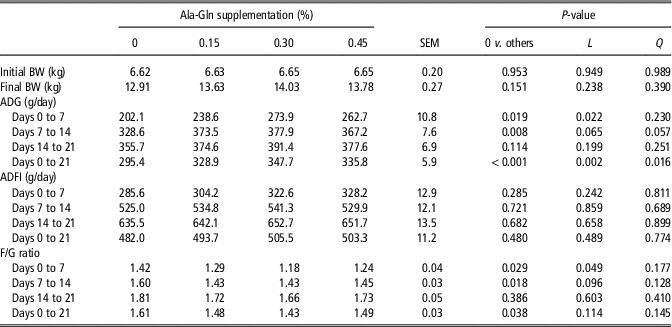
For the whole experimental period, dietary supplementation of Ala-Gln led to a decrease in F/G ratio (P = 0.038) and an increase in ADG (P < 0.001) compared with the control group. Increasing the level of Ala-Gln from 0% to 0.45% increased the ADG (linear and quadratic; P = 0.002 and P = 0.016, respectively). However, there was no significant effect on ADFI with increasing levels of Ala-Gln (P > 0.05) (Table 1).
Effects of dietary alanyl-glutamine (Ala-Gln) supplementation on the growth performance of weaned pigs

ADG = average daily gain; ADFI = average daily feed intake; F/G = feed : gain; L = linear; Q = quadratic.
n = 5 for each group.
As shown in Table 2, piglets fed the Ala-Gln diets had lower (P < 0.05) diarrhea rates than those fed the control diet during the overall period. Meanwhile, a linear decrease in diarrhea rate was observed as Ala-Gln supplementation increased as each week, respectively, as well as the whole experimental period (P < 0.05).
Effect of dietary alanyl-glutamine (Ala-Gln) supplementation on the diarrhea rate (%) of weaned pigs

L = linear; Q = quadratic.
n = 5 for each group.
Intestinal morphology
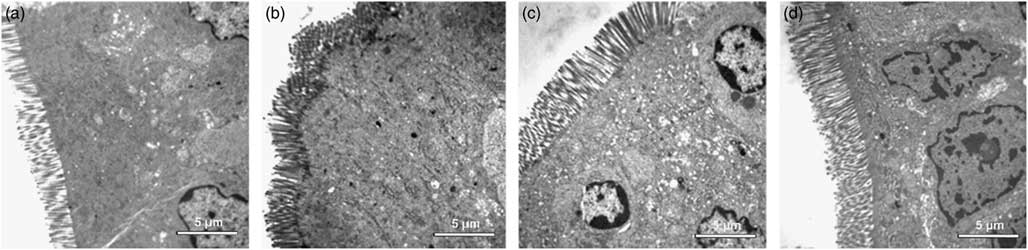
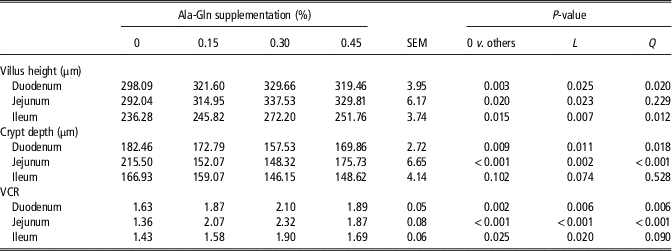
The data of intestinal morphology were shown in Table 3. In the duodenum, dietary supplementation of Ala-Gln significantly increased villous height (P = 0.003) and the VCR index (P = 0.002) and decreased crypt depth (P = 0.009) compared with the control group. Increasing the level of Aln-Gln from 0% to 0.45% increased villous height (linear and quadratic; P = 0.025 and P = 0.020, respectively) and the VCR index (linear and quadratic; P = 0.006 and P = 0.006, respectively), and decreased crypt depth (linear and quadratic; P = 0.011 and P = 0.018, respectively). A similar histomorphalogic changes was noticed in Jejunum. In addition, compared with the control group, examination of the ultrastructural morphology showed a markedly increase in microvillus height and density in jejunum of piglets fed the Ala-Gln diets (Figure 1). In the ileum, piglets fed the Ala-Gln diets had higher villus height (P = 0.015) and VCR index (P = 0.025) than those fed the control diet. Furthermore, the villus height showed linear and quadratic dose responses to the levels of Ala-Gln supplementation (P = 0.007 and P = 0.012, respectively). A linear increase in the VCR index was also observed as Ala-Gln supplementation increased (P = 0.025).
Effects of dietary alanyl-glutamine (Ala-Gln) supplementation on the jejunal ultrastructure of weaned pigs. (a) the basal diet; (b) basal diet and supplementation with 0.15% Ala-Gln; (c) basal diet and supplementation with 0.30% Ala-Gln; (d) basal diet and supplementation with 0.45% Ala-Gln.

Effects of dietary alanyl-glutamine (Ala-Gln) supplementation on intestinal morphology of weaned pigs

VCR = villus height : crypt depth ratio; L = linear; Q = quadratic.
n = 5 for each group.
The activities of disaccharidase and lysozyme in jejunal mucosa
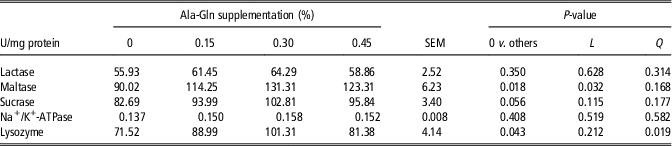
As shown in Table 4. Piglets fed the Ala-Gln diets had markedly increased the activities of maltase (P = 0.018) and lysozyme (P = 0.043), and a tendency to increase sucrase activity (P = 0.056) compared with those fed the control diet. Furthermore, there was a significant linear increase in maltase activity (P = 0.032) and quadratic increase in lysozyme activity (P = 0.019) with the increasing levels of Ala-Gln.
Effects of dietary alanyl-glutamine (Ala-Gln) supplementation on the activities of disaccharidase and lysozyme in jejunal mucosa of weaned pigs

L = linear; Q = quadratic.
n = 5 for each group.
Serum concentration and messenger RNA expression in small intestinal mucosa of cytosolic phospholipase A2
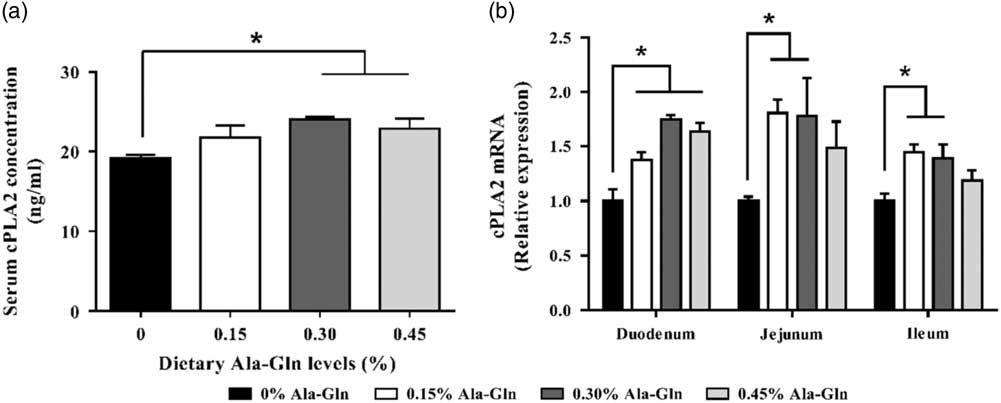
Dietary supplementation with 0.30% or 0.45% Ala-Gln increased serum cPLA2 concentration compared with the control group (P < 0.05, Figure 2a). Expression level of mucosal cPLA2 mRNA in the duodenum, jejunum and ileum of pigs fed 0.15% or 0.30% Ala-Gln diet were higher (P < 0.05) compared with those fed the control diet (Figure 2b).
Effects of dietary alanyl-glutamine (Ala-Gln) supplementation on serum concentration (a) and messenger RNA (mRNA) expression in small intestinal mucosa (b) of cytosolic phospholipase A2 (cPLA2) in weaned pigs. Data are expressed as means ±SEM, n = 5. *P < 0.05.

Serum diamine oxidase activity
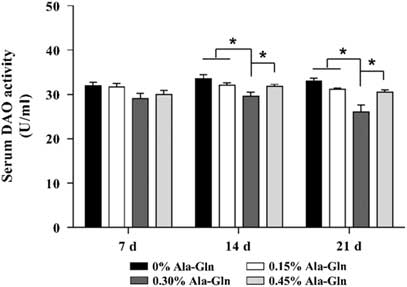
As shown in Figure 3, dietary supplementation with 0.30% Ala-Gln significantly decreased serum DAO activity compared with other groups at days 14 and 21 (P < 0.05).
Effects of dietary alanyl-glutamine (Ala-Gln) supplementation on serum diamine oxidase (DAO) activity of weaned pigs. Data are expressed as means ±SEM, n = 5. *P < 0.05.

Gene expression of nutrient transporters in small intestinal mucosa
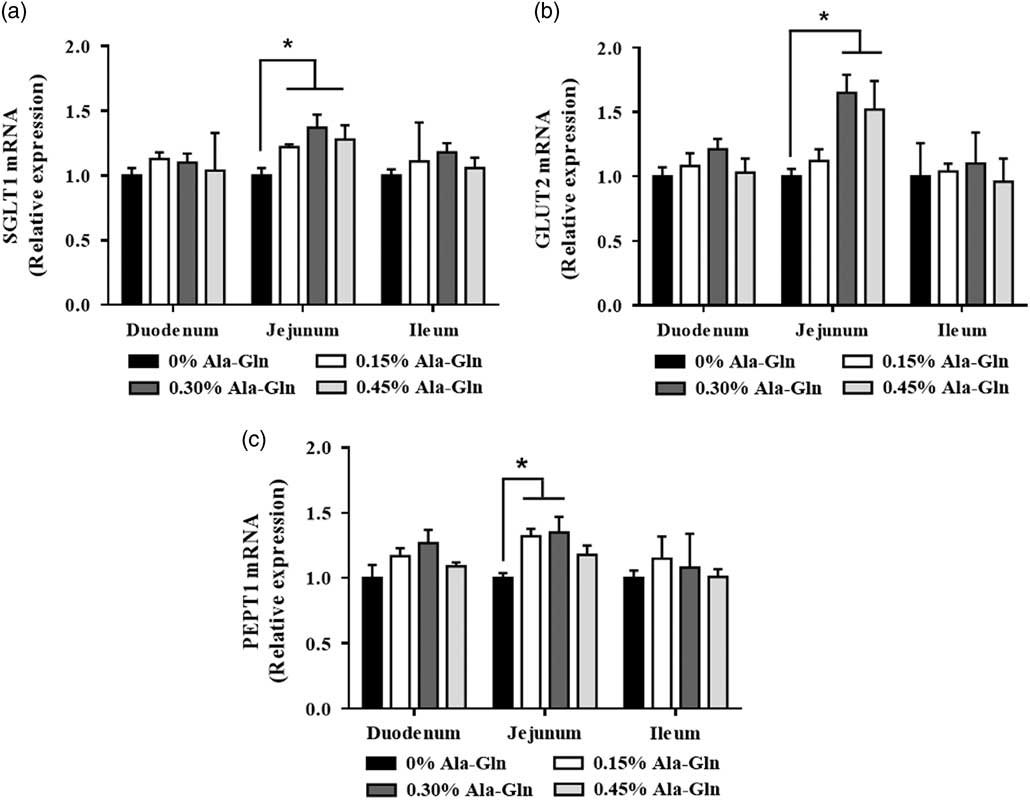
As shown in Figure 4, dietary supplementation of Ala-Gln increased the mRNA expression levels of Na+-dependent glucose transporter 1 (SGLT1) and peptide transporter 1 (PEPT1) in the jejunum compared with control group (P < 0.05). Expression level of glucose transporter 2 (GLUT2) mRNA in the jejunum of piglets fed 0.30% or 0.45% Ala-Gln diet was higher than those fed the control diet (P < 0.05).
Effects of dietary alanyl-glutamine (Ala-Gln) supplementation on mucosal messenger RNA (mRNA) expression of nutrient transporters in the duodenum, jejunum and ileum of weaned pigs. (a to c) mRNA expression of Na+-dependent glucose transporter 1 (SGLT1) (a), glucose transporter 2 (GLUT2) (b) and peptide transporter 1 (PEPT1) (c). Data are expressed as means ±SEM, n = 5. *P < 0.05.

Discussion
It has been well established that early life environmental factors, such as diets and stress, have a remarkable impact on long-term intestinal health and disease susceptibility (Pié et al., Reference Pié, Lallès, Blazy, Laffitte, Sève and Oswald2004; Yi et al., Reference Yi, Carroll, Allee, Gaines, Kendall, Usry, Toride and Izuru2005). Alanyl-glutamine, a stable Gln dipeptide, shown to performed better in terms of blood Gln availability than the free form (Minguetti-Câmara et al., Reference Minguetti-Câmara, Marques, Schiavon, Vilela, Bruschi and Bazotte2014). Several studies have shown that Ala-Gln could promote intestinal integrity and epithelial cell homeostasis in vitro and in animal models (Ueno et al., Reference Ueno, Oriá, Maier, Guedes, de Azevedo, Wu, Willson, Hogan, Lima and Guerrant2011; Zhou et al., Reference Zhou, Zhang, Deng, Liu and Lu2012; Rodrigues et al., Reference Rodrigues, Oliveira, Li, Zaja-Milatovic, Costa, Braga Neto, Kolling, Lima, Guerrant and Warren2013). The present study was conducted to evaluate whether dietary Ala-Gln supplementation could improve growth performance, intestinal development and digestion–absorption function using pig as animal model. Here, we observed that Ala-Gln supplementation was beneficial to growth performance with less occurrence of diarrhea in piglets, which are similar to previous report demonstrating that intravenous administration of Ala-Gln had a positive effect on gain performance and the occurrence of diarrhea in early weaned calves (Zhou et al., Reference Zhou, Zhang, Deng, Liu and Lu2012). In order to clarify the mechanism of growth-promoting effect by supplementing Ala-Gln, the intestinal responses of weaned piglets to Ala-Gln diet were further investigated.
The high value of the VCR ratio has been considered as a useful indicator of a high digestion and absorption capacity of the small intestine (Montagne et al., Reference Montagne, Pluske and Hampson2003). In this study, feeding Ala-Gln diets increased the ratio of VCR in duodenum, jejunum and ileum of weaned piglets, which are an important factor to promote the postnatal growth. Furthermore, our results showed that alteration of intestinal morphology, to some degree, displayed the dose response to the levels of Ala-Gln supplementation. Consistent with the positive influence of Ala-Gln on intestinal morphology, an increased maltase activity in the jejunum was observed in Ala-Gln-supplemented piglets. In addition, it has been demonstrated that lysozyme exerted beneficial effect on nutrient digestibility, intestinal morphology and barrier, as well as gut microflora in weaned piglets (Oliver and Wells, Reference Oliver and Wells2013; Ma et al., Reference Ma, Zhang, Pan and Piao2017). Correspondingly, dietary Ala-Gln supplementation markedly increased the lysozyme activity in jejunum of weaned piglets. Similar with previous reports in juvenile red drum, Sciaenops ocellatus, which found that addition of Gln increased serum lysozyme activity (Cheng, Reference Cheng2011).
To determine whether Ala-Gln could regulate intestinal absorption function in piglets, we examined the gene expression of nutrient transporters in the small intestine of piglets. The expression of SGLT1 and GLUT2 play an important role in the absorption and uptake of glucose in small intestine. The SGLT1 mediates intestinal glucose absorption and utilization and was crucial to the glucose-induced incretion hormone secretion (Röder et al., Reference Röder, Geillinger, Zietek, Thorens, Koepsell and Daniel2014). Glucose transporter 2 transported glucose and fructose from enterocytes into the systemic system (Zhang et al., Reference Zhang, Lin, Yu, Li, Zhang, Zhou, Yang, Gao and Zhou2016). It has been demonstrated that early weaning stress significantly decreased the expression of SGLT1 mRNA in jejunum of pigs (Zhang et al., Reference Zhang, Wang, Shi, Wei, Chen and Zhao2006). In contrast, we found that dietary Ala-Gln supplementation upregulated the expression of SGLT1 and GLUT2 in jejunum of weaned piglets. In addition, studies have shown that the transfer and absorption of oligopeptides were closely correlated with the PEPT1 gene expression (Buyse et al., Reference Buyse, Berlioz, Guilmeau, Tsocas, Voisin, Peranzi, Merlin, Laburthe, Lewin and Roze2001). In this research, the jejunum PEPT1 mRNA level was significantly increased in Ala-Gln group. Together, these results provide evidence that feeding Ala-Gln diets could increase the capacity of nutrients digestion and absorption, thus resulting in the better feed conversion ration relative to piglets fed control diet.
In addition, cPLA2 is the rate-limiting enzyme for the generation of prostaglandins, which are bioactive lipids that have been proved to be important in maintaining gastrointestinal homeostasis (Dey et al., Reference Dey, Lejeune and Chadee2006; Panel et al., Reference Panel, Boëlle and Ayala2006). Our results showed that dietary Ala-Gln supplementation increased serum cPLA2 concentration and the expression of cPLA2 mRNA in duodenum and jejunum of weaned piglets. As previously reported, serum DAO activity may be a useful biomarker for evaluating intestinal mucosal injury and disease (Kamei et al., Reference Kamei, Hachisuka, Nakao and Takagi2005). The clinic study showed that enteral supplementation Gln caused a significant decrease in plasma DAO activity and abated the degree of intestine injury in severe burned patients (Xi et al., Reference Xi, Hong, You, Pei and Wang2004). In this study, there was decreasing serum DAO activity in Ala-Gln-supplemented piglets relative to control piglets. Besides, serum DAO decreased with the lower supplementation of Ala-Gln but increased with the higher supplementation, which implied that the alterations of serum DAO activity did not presented the dose response to the levels of Ala-Gln supplementation. Taken together, these data indicate that Ala-Gln had an effect on maintaining intestinal integrity and improving the mucosal barrier function in weaned piglets, which may explain the reason why Ala-Gln had beneficial effect on the growth performance.
In conclusion, we have demonstrated that feeding Ala-Gln has beneficial effects in alleviating growth depression in weaned piglets, mainly associated with better intestinal morphological function and capability of digestion and absorption.
Acknowledgment
This study was supported by the National Natural Science Foundation of China (31360554) and the Scientific Research Fund of Jiangxi Province Education Department (GJJ12216). The authors are grateful to Prof. Min Du for reviewing and editing the manuscript.
Declaration of interest
The authors declare no conflicts of interest.
Ethics statement
All animal experimental and care procedures followed Experimental Animal Care and Use Guidelines of China and were approved by the Animal Care and Use Committee of Jiangxi Agricultural University.
Software and data repository resources
The authors declare that the data of this study are not deposited in any official repository.
Supplementary material
To view supplementary material for this article, please visit https://doi.org/10.1017/S1751731119000223