Fetal echocardiography has evolved considerably over the last two decades, mostly as a result of advances in imaging technology.Reference Rychik, Ayres and Cuneo 1 Detecting cardiac defects in utero is important not only for understanding the determinants of postnatal disease but also for appropriate counselling of families and planning of postnatal management.
The three-vessel view is a simple and common screening method. It is a transverse, orthogonal view of the upper mediastinum that demonstrates the main pulmonary artery, the ascending aorta, and the superior caval vein arranged in a straight line from left to right.Reference Yoo, Lee and Kim 2 Wong et al revealed that pulmonary artery-to-aorta ratio derived from the measurements in the three-vessel view plane can be used as an initial tool for outflow-tract anomalies such as tetralogy of Fallot.Reference Wong, Ward, Lee-Tannock, Le and Chan 3
Tetralogy of Fallot, which is one of the most common types of cyanotic CHD, occurs in ~1 in 3600 live births and accounts for 3.5% of infants with CHD.Reference Markowitz, Fahey, Hellenbrand, Kopf and Rothstein 4 The clinical presentation is dominantly dependent on the right ventricular outflow obstruction and main pulmonary artery size. If the obstruction is severe and the main pulmonary artery is too small at birth, ductus arteriosus-dependent pulmonary circulation exists. Prostaglandin E1 is intravenously administered immediately after birth to maintain ductal patency, and systemic-to-pulmonary shunt should be required to increase blood supplies for the pulmonary artery during the neonatal period. Previous studies have demonstrated that the main pulmonary artery size, pulmonary artery-to-aorta ratio, pulmonary artery growth pattern, and a reversed flow across the ductus arteriosus in fetal echocardiography may predict the severity of postnatal pulmonary outflow obstruction in fetuses with tetralogy of Fallot;Reference Hornberger, Sanders and Sahn 5 , Reference Bhawna, Stepanie, Kristal, Julie, Howard and Ismee 6 however, they were not able to perfectly identify all fetuses with ductal-dependent circulation.Reference Bhawna, Stepanie, Kristal, Julie, Howard and Ismee 6
We focussed on the cross-sectional ratio of the main pulmonary artery to the bilateral pulmonary arteries in this study, which was known as “the main pulmonary artery cross-section ratio”. We hypothesised that low main pulmonary artery cross-section ratio means that shortage of blood flow through the main pulmonary artery to branch pulmonary arteries by the theory that blood flow influences cardiovascular growth.Reference Rudolph, Heymann and Spitznas 7 Therefore, the growth of the branch pulmonary arteries is dependent on the reversed flow from the ductus arteriosus, and the fetus has ductus arteriosus-dependent pulmonary circulation. Our study aimed to reveal the differences in fetal echocardiography of tetralogy of Fallot between fetuses with postnatal ductus arteriosus-dependent and postnatal ductus arteriosus-independent pulmonary circulation.
Materials and methods
This study was approved by the ethics committee at our institute. We retrospectively collected the medical records of 13 consecutive fetuses with tetralogy of Fallot, whose maternal management was performed at our institution between April, 2011 and December, 2014. Gestational age was based on the last menstrual period.
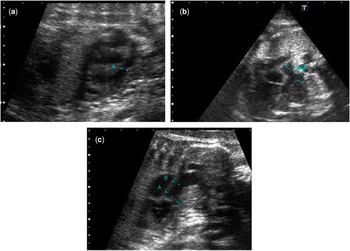
Fetal echocardiography was performed using an ALOCA SSD5500 ultrasound system with 3.5- and 5-MHz transducers. Fetal heart examination was performed in accordance with the guidelines from the American Society of Echocardiography.Reference Rychik, Ayres and Cuneo 1 Tetralogy of Fallot was diagnosed when anterior deviation of the conus septum, a conoventricular septal defect, and an overriding aorta were observed. The following measurements were made by one investigator: the diameter of the main pulmonary artery midway between the valve and bifurcation; proximal left and right pulmonary artery diameters in the short-axis view of the right ventricular outflow tract and the great arteries; and diameter of the ascending aorta in the long-axis view (Fig 1). Furthermore, we reviewed the blood flow direction through the ductus arteriosus.
Frame images of fetal echocardiography. ( a ) Diameter of the pulmonary valve; ( b ) diameters of the bilateral pulmonary arteries, and ( c ) diameters of the aortic valve and the ascending aorta.

We calculated the following variables by using the above measurements: the Z scores were calculated on the basis of previous reports;Reference Schneider, McCrindle, Carvalho, Hornberger, McCarthy and Daubeney 8 , Reference Pasquini, Mellander and Seale 9 the pulmonary artery-to-aorta ratio is the pulmonary artery diameter divided by the ascending aorta diameter; the main pulmonary artery cross-section ratio is the main pulmonary artery diameter squared divided by the sum of the diameter squared of the left and right pulmonary arteries. (The main pulmonary artery cross-section ratio=(main pulmonary artery diameter)2/{(right pulmonary artery diameter)2+(left pulmonary artery diameter)2}.)
We reviewed the postnatal clinical outcomes including timing of surgery, prostaglandin infusion at birth, and subtypes of tetralogy of Fallot. Prostaglandin infusion was discontinued occasionally in neonates once adequate pulmonary blood flow was documented. Administration of prostaglandin, therefore, to sustain adequate oxygen saturations up until the time of surgery and systemic-to-pulmonary shunt operation performed under one month of age were selected as markers of ductus arteriosus dependence. Infants were divided into two groups: ductus-dependent and ductus-independent groups. Fetuses without antegrade pulmonary blood flow on the first fetal echocardiogram were excluded from the analysis, as were those who had a diagnosis of tetralogy of Fallot with absent pulmonary valve syndrome or pulmonary valve atresia with major aortopulmonary collaterals. Infants who were of multiple pregnancies or born prematurely were also excluded.
Statistical analyses were performed using JMP statistical package (version 11.2.1; SAS Institute Inc., Cary, North Carolina, United States of America). Each calculated variable was assessed by using Wilcoxon’s rank sum tests to determine the differences between ductus-dependent and ductus-independent groups. Statistical significance was determined if p<0.01. Data are presented as means±standard deviation.
Results
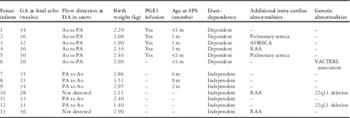
Table 1 describes the postnatal diagnosis and neonatal ductus dependence. The mean gestational age during fetal echocardiography at our hospital was 32.0±4.2 weeks. All fetuses were initially diagnosed and had been followed-up at another hospital. The mean birth weight was 2.47±0.55 kg at delivery. Of the 13 neonates in the study group, two and three had pulmonary atresia and right aortic arch, respectively; two patients had 22q11 deletion. In all, six neonates with pulmonary atresia (n=2) or severe pulmonary stenosis (n=4) had a ductus arteriosus-dependent pulmonary circulation. Of these six, five underwent prostaglandin E1 infusion immediately after birth, and all six underwent systemic-to-pulmonary shunt at ⩽1 month of age. Of the seven neonates with ductus arteriosus-independent pulmonary circulation, three underwent systemic-to-pulmonary shunt at >1 month of age because right ventricular outflow tract obstruction had progressed.
Characteristics of fetuses with tetralogy of Fallot.

Ao=aorta; AORSCA=aberrant origin of the right subclavian artery; DA=ductus arteriosus; echo=echocardiography; GA=gestational ages; PA=pulmonary artery; PGE1=prostaglandin E1; RAA=right aortic arch; SPS=systemic-to-pulmonary shunt
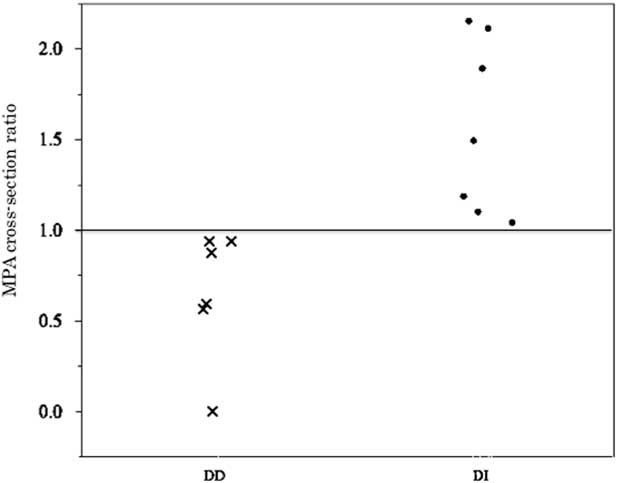
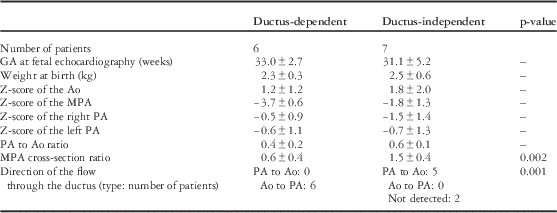
Table 2 shows the echocardiographic findings in fetuses with tetralogy of Fallot in each group. The gestational age at fetal echocardiography was not significantly different between both groups. No significant differences were found in the Z-scores of the aorta and the bilateral pulmonary arteries between groups. The Z-score of the pulmonary artery in the ductus arteriosus-dependent group was lesser, although not statistically significant, compared with the ductus arteriosus-independent group. Pulmonary artery-to-aorta ratios among each group showed no significant differences. In contrast, the main pulmonary artery cross-section ratio in the ductus arteriosus-dependent group was significantly lesser than that in the ductus arteriosus-independent group (0.65±0.44 versus 1.56±0.48, p=0.002). Figure 2 shows the individual main pulmonary artery cross-section ratios for each group. Each group was completely separable when the cut-off value ranged between 0.93 and 1.04. The direction of blood flow through the ductus was impossible to be observed in two fetuses. A total of six fetuses with reverse direction – from the aorta to the pulmonary artery – showed ductus arteriosus-dependent pulmonary circulation after birth, and five fetuses with normal direction – from the pulmonary to the aorta – were in the ductus arteriosus-independent group (p=0.001).
Plot of the degree of duct dependence at birth versus MPA cross-section ratio. Patients were completely separated into ductus arteriosus-dependent and ductus arteriosus-independent groups between 0.93 and 1.04 of the MPA cross-section ratio. DD=ductus arteriosus-dependent; DI=ductus arteriosus-independent; MPA=main pulmonary artery.

Echocardiographic findings in tetralogy of Fallot with each group.

Ao=aorta; GA=gestational ages; MPA=main pulmonary artery; PA=pulmonary artery
Mean±standard deviation
Discussion
In this study, we described the echocardiographic characteristics of fetuses with tetralogy of Fallot and postnatal ductus arteriosus-dependent pulmonary circulation. We revealed that the branch pulmonary arteries of fetuses with tetralogy of Fallot tend to be of normal or near-normal size at mid-gestation. Our findings were supported by the published report that branch pulmonary artery dimensions determined using fetal echocardiography likely reflect lung mass.Reference Sokol, Bohn and Lacro 10 In contrast, the main pulmonary artery size is significantly smaller in mid-trimester fetuses with tetralogy of Fallot, reflecting the severity of outflow tract obstruction;Reference Shinebourne, Babu-Narayan and Carvalho 11 therefore, based on the study by Hornberger et al,Reference Hornberger, Sanders and Sahn 5 we expected that the pulmonary artery-to-aorta ratio would be one of the most important predictors of ductus arteriosus-dependent pulmonary circulation after birth. The pulmonary artery-to-aorta ratio is likely to be smaller in the ductus arteriosus-dependent group, but we could not find statistically significant differences in the pulmonary artery-to-aorta ratio between each group. This may be due to our small number of patients. We wonder whether with a large number of patients the pulmonary artery-to-aorta ratio would be likely to show a statistically significant difference between the two groups.
To the best of our knowledge, this is the first study evaluating the relationship of cross-sections between the main pulmonary artery and the bilateral pulmonary arteries. We named it main pulmonary artery cross-section ratio. We showed that fetuses with tetralogy of Fallot could be clearly separated into those with ductus-dependent and ductus-independent pulmonary circulation in the boundary that the main pulmonary artery cross-section ratio was ~1.0. All fetuses with tetralogy of Fallot and with <1.0 main pulmonary artery cross-section ratio required neonatal treatment with prostaglandin E1 infusion or systemic-to-pulmonary shunt. Besides, they showed ductus arteriosus-dependent pulmonary circulation in the fetal period, because the flow direction through the ductus arteriosus was from the aorta to the pulmonary artery in all fetuses. In contrast, those with a value ≥1.0 main pulmonary artery cross-section ratio had ductus arteriosus-independent pulmonary circulation during the fetal period and required no treatment to increase the pulmonary blood supply during the neonatal period. These findings may imply that the flow direction in the ductus arteriosus might be able to identify all fetuses with ductal-dependent circulation. Arya et al demonstrated that the direction of blood flow in the fetal ductus arteriosus is associated with neonatal ductal dependence but is not perfect to predict it.Reference Bhawna, Stepanie, Kristal, Julie, Howard and Ismee 6 In our cohort, in two of the 13 fetuses, flow direction could not be observed. As the main and branch pulmonary artery diameters are relatively easy to measure, and the main pulmonary artery cross-section ratio may be able to be more clearly predict the neonatal haemodynamics, the cross-section ratio should be considered by physicians as a way to measure the risk associated with tetralogy of Fallot after birth.
Our hypothesis of the relationship of the main pulmonary artery cross-section ratio and the dependency of pulmonary circulation on the ductus arteriosus can be supported by the theory that blood flow influences cardiovascular growth.Reference Rudolph, Heymann and Spitznas 7 , Reference Hove 12 – Reference Di Stephano, Koopmans and Langille 14 The growth of the main pulmonary artery is dependent on antegrade flow across the pulmonary valve, but the branch pulmonary arteries can grow normally with flow from the ductus arteriosus, such that in tetralogy of Fallot with severe pulmonary stenosis the main pulmonary artery grows proportionally less than the branch pulmonary arteries, which is reflected in our main pulmonary artery cross-sectional ratio.
The limitations of our study include the relatively small size of our sample, making detailed statistical analysis inappropriate; moreover, the timing of prenatal echocardiograms was not standardised. Ideally, a prospective serial echocardiographic study of a larger number of fetuses with tetralogy of Fallot would be useful to substantiate the findings of our retrospective study.
In conclusion, the main pulmonary artery cross-section ratio, obtained using fetal echocardiography, may be related to ductus arteriosus-dependent pulmonary circulation, such as pulmonary atresia or severe pulmonary stenosis. Our study also suggests that compared with other fetal echocardiography findings, the main pulmonary artery cross-section ratio may be a more useful variable for predicting postnatal outcomes in fetuses with tetralogy of Fallot.
Acknowledgement
The authors thank Hiromi Ikado for her helpful assessment of the echocardiography and Editage (www.editage.jp) for English language editing.
Financial Support
This research received no specific grant from any funding agency or from commercial or not-for-profit sectors.
Conflicts of Interest
None.
Ethical Standards
The authors assert that all procedures related to this study complied with the 1975 Helsinki Declaration and 2008 revision, and have been approved by the ethics committee at our institute. Informed consent was obtained from each participant.