Implications
It is well known that oxidative stress decreases antioxidative stress capability and health of piglets, but little is known about the nutrient metabolism and requirement of piglets under oxidative stress. This study was conducted to investigate the effects of oxidative stress on tryptophan metabolism in weaned pigs. Results of the study may help to determine the tryptophan requirement of piglets under oxidative stress, enrich the nutritional principles of tryptophan in piglets and provide information to alleviate the damage by oxidative stress and use tryptophan additives properly.
Introduction
Reactive oxygen species (ROS), including the superoxide anion (O2−), hydrogen peroxide (H2O2) and hydroxyl radical (·HO), are highly unstable species with unpaired electrons and are capable of initiating oxidation. Under normal physiological conditions, a homeostatic balance exists between the formation of ROS and their removal by endogenous defensive molecules, such as superoxide dismutase (SOD), catalase (CAT) and glutathione peroxidase (GPx; Lightfoot et al., Reference Lightfoot, Skibola, Smith, Forrest, Adamson, Morgan, Bracci, Roman, Smith and Holly2006). SOD converts superoxide anions to H2O2, which is subsequently transformed to water by GPx and CAT (Beckman and Ames, Reference Beckman and Ames1998). Oxidative stress, induced by tissue damage and oxidation of proteins, lipids and nucleic acids, occurs when such balance has been disrupted by excessive production of ROS or insufficient production of antioxidative molecules (Gutteridge, Reference Gutteridge1995; Schallreuter et al., Reference Schallreuter, Gibbons, Zothner, Abou Elloof and Wood2007). The detrimental effects of oxidative stress on feed intake, growth and muscle gain (Yuan et al., Reference Yuan, Chen, Zhang and Yu2007) may lead to a considerable economic loss for livestock producers, but the metabolism of nutrients under oxidative stress remain largely unknown.
Diquat is a bipyridyl herbicide converting molecular oxygen into superoxide anion radical that subsequently forms hydrogen peroxide by redox-cycling metabolism (Osburn et al., Reference Osburn, Wakabayashi, Misra, Nilles, Biswal, Trush and Kensler2006). Diquat does not bind covalently with biological molecules, but it stimulates cellular production of ROS by undergoing cyclic reduction–oxidation processes. It has been widely used as an effective chemical agent for the induction of oxidative stress (Slaughter et al., Reference Slaughter, Thakkar and O'Brien2002; Osburn et al., Reference Osburn, Wakabayashi, Misra, Nilles, Biswal, Trush and Kensler2006). Fu et al. (Reference Fu, Cheng, Porres, Ross and Lei1999) used oxidative stress induced by an intraperitoneal injection of 24 mg/kg BW to determine the protection of cellular glutathione peroxidase-1. Our previous study also proved that the diquat-administered (12 mg/kg BW) piglets could be the model of oxidative stress, and the activities of antioxidant enzymes were declined for all the diquat-challenged pigs (Yuan et al., Reference Yuan, Chen, Zhang and Yu2007).
Tryptophan is an essential amino acid and is generally considered as the second-limiting amino acid in most corn-based diets of pigs. Recent studies have shown that tryptophan regulates specific gene expressions (Anthony et al., Reference Anthony, Reiter, Anthony, Kimball and Jefferson2001), relieves stress (Guzik et al., Reference Guzik, Matthews, Kerr, Bidner and Southern2006; Koopmans et al., Reference Koopmans, Guzik, van der Meulen, Dekker, Kogut, Kerr and Southern2006) and improves animal growth performance (Guzik et al., Reference Guzik, Matthews, Kerr, Bidner and Southern2006). The tryptophan concentration in blood can be reduced in many pathological conditions. The previous studies have shown that the chronic lung inflammation induced by injection of complete Freund's adjuvant in pigs (Melchior et al., Reference Melchior, Le Floc'h and Seve2003) and chronic paranoid schizophrenics (Freedman et al., Reference Freedman, Belendiuk, Belendiuk and Crayton1981) significantly decrease plasma tryptophan concentrations. However, little is known about the effect of oxidative stress on tryptophan metabolism in pigs. Thus, in this study, we investigated growth performance and tryptophan metabolism in weaned pigs during diquat-induced oxidative stress. These studies may provide information necessary to propose a new nutritional strategy to oxidative stress resistance.
Material and methods
Animals care and diets
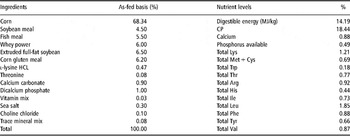
This experiment was conducted according to protocols approved by the Animal Care and Use Committee of Sichuan Agricultural University. These pigs were housed in individual cages in an environmentally controlled building with alternate lighting. The temperature and relative humidity were maintained at 26 ± 1°C and 65% to 75%, respectively. The ingredients and nutrient levels of the diets are summarized in Table 1.
Composition and nutrient levels of experimental diets

aProvided the following per kg of diet: vitamin A, 2800 IU; vitamin D3, 320 IU; vitamin E, 20 IU; vitamin K3, 1 mg; vitamin B1, 1.5 mg; vitamin B2, 5 mg; vitamin B6, 2 mg; vitamin B12, 0.03 mg; nicotonic, 20 mg; pantothenic, 15 mg; folic acid, 0.5 mg; biotin, 0.1 mg.
bProvided the following per kg of diet: 100 mg Fe (FeSO4·7H2O); 6 mg Cu (CuSO4·5H2O); 100 mg Zn (ZnSO4·7H2O); 4 mg Mn (MnSO4·H2O); 0.3 mg Se (Na2SeO3·5H2O); 0.14 mg I (KI).
Nutrient levels met the requirements of 10 to 20 kg BW of pigs according to National Research Council (NRC, 1998). The amino acid content of diets was analyzed. All pigs had free access to water.
Experimental design
A total of 24 pigs (Landrace × Yorkshire) weaned at 28 ± 1 days were used in this study. After 7 days of acclimatization, the pigs (35 ± 1 days) that weighed 10.63 ± 1.00 kg were randomly allotted into one of the three treatment groups (n = 8). At the beginning of experiment, pigs in group 1 (diquat-challenged pigs) received an intraperitoneal injection of diquat (dibromide monohydrate, Chem Service, West Chester, PA, USA) at a dose of 10 mg/kg of BW. Diquat was dissolved in physiological sterile saline solution.
Pigs in group 2 and group 3 were injected with the same volume of sterile saline and constituted the control group (group 2) and the pair-fed group (group 3). Pigs that were pair-fed were fed the average daily food intake of the diquat-challenged group. Pigs were individually weighed at the beginning and on the 7th day of the experiment, and feed intake was measured everyday. Average daily gain (ADG), average daily feed intake (ADFI) and the ratio of gain to feed intake (G/F) were calculated.
Sample collection
At the termination of the experiment, blood was collected via the anterior vena cava into 10 ml vacuum tubes and centrifuged (4000 × g, 5 min) to separate serum. Sera were stored at −20°C immediately for further analysis. On the 7th day, pigs were fasted for 12 h and were anesthetized with intravenous injection of phenobarbital (0.25 mg/kg BW). Subsequently, pigs were killed, and the samples of the liver, jejunum mucosa and hypothalamus were removed and perfused with ice-cold normal saline. All fresh samples were immediately frozen in liquid nitrogen and stored at −80°C until analyzed.
Assay of malondialdehyde (MDA) concentrations and activities of antioxidant enzymes
The MDA concentrations and activities of SOD, GPx and CAT in serum were measured using assay kits (Nanjing Jiancheng Bioengineering Research Institute, Nanjing, China) with Catalog no. A003-2, A001-1, A005-1 and A007, respectively.
Large neutral amino acids (LNAA), tryptophan and kynurenine (Kyn) concentrations
Serum was prepared for amino acid analysis by addition of 10% (w/v) sulpho-salicylic acid, the samples were left in an ice bath for 5 min and then centrifuged in a refrigerated centrifuger for 20 min at 20 000 × g. The supernatant was filtered and assayed for LNAA on an automatic amino acid analyzer (Hitachi L-8800 Auto-Analyzer, Tokyo, Japan). Serum tryptophan concentration was measured using HPLC method. A volume of 200 μl serum was added to 200 μl of 4.5% perchloric acid. After 10 min at room temperature, the mixture was centrifuged at 4000 × g for 30 min and the clear supernatant was removed for analysis. Mobile phase was prepared with 20 ml of acetonitrile diluted in 1 l of distilled water. Concentrated perchloric acid (70%, 0.62 ml) was added to produce a pH of 2.0, followed by the addition of 10 μl of octylamine. The sample (20 μl) was then injected to the column. The temperature of the column was 31°C; the flow rate was increased from 0.1 to 3.0 ml/min over 3 min and maintained at 3.0 ml/min for an additional 9 min, and then decreased to 0.1 ml/min over 3 min. The absorbance was at 280 nm. The retention time for tryptophan was 8.3 min. For Kyn detection, 270 μl of serum was mixed with 30 μl of perchloric acid. This was placed on ice for 15 min and centrifuged at 4000 × g for 30 min. The supernatant was removed for analysis. HPLC was carried out at a flow rate of 1.0 ml/min, with a mobile phase prepared by mixing 5 ml of acetonitrile with 235 ml of 0.1 mol/l acetic acid and 0.1 mol/l ammonium acetate, pH 4.65. The injection volume was 20 μl. The absorbance was at 365 nm. The retention time for Kyn was 5.5 min.
Assay of 5-hydroxytryptamine (5-HT)
5-HT was estimated following the procedure as previously described (Kumar, Reference Kumar2004). Briefly, samples of the hypothalamus were weighed and homogenized in cold acid butanol (10%, w/v). The homogenate was centrifuged at 2500 rpm for 10 min, and the clear supernatant was collected for estimation of 5-HT level. 5-HT was quantified using a spectroflurometer (Hitachi 650-10 M, Tokyo, Japan) at 350/470 nm.
Assay of γ-glutamyl transpeptidase (γ-GT)
The activity of γ-GT in jejunum mucosa was measured using a kit manufactured by Nanjing Jiancheng Bioengineering Research Institute, Catalog no. C017, China.
RNA isolation and reverse transcription (RT)
Total RNA was isolated from both liver and jejunum mucosa using TRIzol reagent (TaKaRa, Shiga, Japan), according to the protocol supplied by the manufacturer. The concentrations of total RNA were determined using Beckman DU800 Spectrophotometer (Beckman Coulter, Fullerton, CA, USA). RNA integrity was detected by electrophoresis in 1.5% agarose gel stained with Goldview (Saibaisheng, Beijing, China).
Two micrograms of total RNA was reverse transcribed using the PrimerScript RT Reagent Kit (TaKaRa, Shiga, Japan). The RT products (cDNA) were stored at −20°C for quantification of liver tryptophan 2,3-dioxygenase (TDO) mRNA and jejunum mucosa Na+-neutral amino acid transporter B0 mRNA by real time quantitative PCR.
DNA manipulation, transformation and screening
The template cDNA containing TDO gene was amplified by PCR using the following specific primers: forward primer 5′-TGAATTCTGGAGACGATGACAGCC-3′ and reverse primer 5′-CGTCGACTCCATTTGGTCATCAGTG-3′. These primers were based on human TDO gene sequence (GenBank accession no. NM005651). PCR reaction was carried out in 25 μl reaction mixtures with 12.5 μl PCR premix (Boracker KT201-02, Shanghai, China), 0.5 μl of primer pairs, 2 μl of cDNA and 9.5 μl of double-distilled H2O. Cycling conditions used were: 35 cycles of 94°C for 30 s, 58°C for 30 s and 72°C for 1 min. The PCR products were analyzed by agarose gel electrophoresis, ligated to pMD18-T Simple Vector (TaKaRa, Shiga, Japan) and transformed into Escherichia coli BL21. The transformants were screened on Luria–Bertani agar supplemented with 60 μg/ml of ampicillin and incubated at 37°C for 16 to 24 h. Single colony was isolated and incubated in 100 ml of Luria–Bertani medium and cultured overnight at 37°C on a shaker at 150 r.p.m. The culture was used for sequencing by Invitrogen Co., Ltd (Shanghai, China).
Real-time quantitative PCR
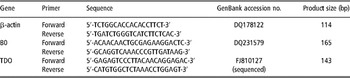
Real-time quantitative PCR was carried out using Real-Time PCR Detection System (PTC-0200, Chromo4 Real-Time Detector, Bio-Rad, Hercules, CA, USA), using the SYBR PrimeScript™ RT-PCR Kit (Perfect Real Time; TaKaRa, Shiga, Japan). The final volume of the reaction mixture was 25 μl. Sequences of primers used for real-time quantitative PCR analysis are listed in Table 2.
List of genes, primer sequences, GenBank accession numbers and product sizes for real-time quantitative PCR analysis

TDO = tryptophan 2,3-dioxygenase.
B0, Na+-neutral amino acid transporter B0.
β-actin was used as the housekeeping gene. PCR cycling conditions were: 40 cycles of 95°C for 10 s, 58°C for 30 s and 72°C for 30 s. To confirm specific amplification, each primer pair used yielded a single peak in the melting curve and a single band with the analyzed product size in agarose gel. Expression of the target gene was calculated using the Pfaffl method (Pfaffl, Reference Pfaffl2001). Data were collected and calculated using Opticon Monitor 3.1 (Bio-Rad, USA).
Statistical analysis
Data were analyzed with an ANOVA procedure of SPSS 13.0 (SPSS Inc., Chicago, IL, USA) followed by least significant difference for multi-comparisons to determine the statistical differences between treatments. All data were presented as mean values with their standard errors. Differences with P < 0.05 were considered to be significant.
Results
Oxidative stress measurements
Table 3 shows the effect of oxidative stress on antioxidant enzyme activities and MDA concentrations in serum of weaned pigs.
Influence of oxidative stress induced by diquat on antioxidant enzymes and MDA in serum of weaned pigs

MDA = malondialdehyde; CAT = catalase; SOD = superoxide dismutase; GPx = glutathione peroxidase.
Data are expressed as means ± s.e., n = 8.
**P < 0.01 v. diquat-challenged; ***P < 0.001 v. diquat-challenged.
There were 13% and 15% reduction of CAT activities in diquat-challenged pigs compared with those of control and pair-fed pigs (P = 0.081 and P = 0.055, respectively). Compared with the control pigs, the activities of SOD and GPx in the serum of diquat-challenged pigs were decreased by 25% (P < 0.001) and 37% (P = 0.004), respectively. Compared with pair-fed pigs, diquat-challenged pigs had 24% lower SOD activity (P < 0.001) and 34% lower GPx activity (P = 0.05). MDA concentration in serum was increased acutely by the oxidative stress induced by diquat (P < 0.001).
Growth performance
As shown in Table 4, compared with the control pigs, diquat challenge decreased ADG, ADFI and G/F by 54% (P < 0.001), 33% (P < 0.01) and 31% (P = 0.012), respectively. ADG and G/F of diquat-challenged pigs were lower than those of pair-fed pigs (P = 0.568 and P = 0.056, respectively).
Influence of oxidative stress induced by diquat on growth performance of weaned pigs

ADG = average daily gain; ADFI = average daily feed intake; G/F = ratio of gain to feed intake.
Data are expressed as means ± s.e., n = 8.
*P < 0.05 v. diquat-challenged; ***P < 0.001 v. diquat-challenged.
Concentrations of tryptophan, Kyn, LNAA and tryptophan/LNAA in serum
Compared with diquat-challenged pigs, control pigs had higher serum tryptophan concentrations (P = 0.004) and increased ratio of tryptophan/LNAA (P = 0.005). Similar trends of tryptophan and tryptophan/LNAA also occurred in pair-fed pigs. Diquat challenge significantly increased Kyn concentrations in serum compared with control (P = 0.043) and pair-fed (P = 0.008) pigs (Table 5).
Influence of oxidative stress induced by diquat on tryptophan, LNAA and Kyn in serum of weaned pigs

LNAA = large neutral amino acids; Kyn = kynurenine.
Data are expressed as means ± s.e., n = 8.
*P < 0.05 v. diquat-challenged; **P < 0.01 v. diquat-challenged.
Concentration of 5-HT in the hypothalamus
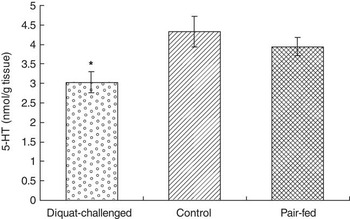
Compared with control pigs, diquat challenge decreased concentrations of 5-HT in the hypothalamus (P = 0.024). However, there was no significant difference of 5-HT concentration (P = 0.108) between diquat-challenged and pair-fed pigs (Figure 1).
Influence of oxidative stress induced by diquat on 5-HT in the hypothalamus. 5-HT, 5-hydroxytryptamine, serotonin; diquat-challenged, pigs challenged with diquat (10 mg/kg BW) and given ad libitum access to feed; control, pigs given ad libitum access to feed and injected with sterile saline; pair-fed, pigs that received the same amount of feed as the diquat-challenged pigs and injected with sterile saline. Values are means, with standard deviation represented by vertical bars. *P < 0.05: diquat-challenged v. control.

Gene sequencing and mRNA level of TDO
The 544-bp porcine partial mRNA sequence of the TDO gene (GenBank accession no. FJ810127) was obtained according to the conserved region in the human gene sequence.
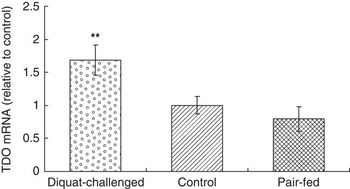
The partial porcine mRNA sequence of the TDO gene had 89% and 81% homology with the known human and mouse sequences, respectively. As shown in Figure 2, real-time quantitative PCR analyses by using β-actin as the housekeeping control revealed that diquat-induced oxidative stress stimulated TDO-relative mRNA abundance in the liver. Compared with the control and pair-fed pigs, the TDO mRNA level in diquat-challenged pigs increased 69% (P = 0.007) and 112% (P = 0.001), respectively.
Influence of oxidative stress induced by diquat on TDO mRNA in liver. TDO, tryptophan 2,3-dioxygenase; diquat-challenged, pigs challenged with diquat (10 mg/kg BW) and given ad libitum access to feed; control, pigs given ad libitum access to feed and injected with sterile saline; pair-fed, pigs received the same amount of feed as the diquat-challenged pigs and injected with sterile saline. Values are means, with standard deviation represented by vertical bars. **P < 0.01: diquat-challenged v. control and diquat-challenged v. pair-fed.

Na+-neutral amino acid transporter B0 mRNA level and γ-GT activity in small intestinal mucosa
The Na+-neutral amino acid transporter B0 functions for the uptake of luminal neutral amino acids across the gut apical membrane.
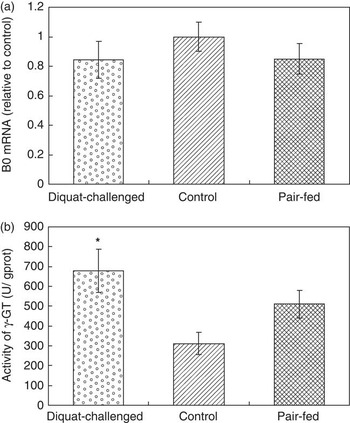
Real-time quantitative PCR analyses using β-actin as the house-keeping control showed that the Na+-neutral amino acid transporter B0 mRNA-relative abundance of diquat-challenged pigs was not significantly different from those of the control and pair-fed pigs (P = 0.274 and P = 0.795, respectively; Figure 3a). Activity of γ-GT in jejunum mucosa of diquat-challenged pigs was dramatically increased as compared with that of control pigs (P = 0.011; Figure 3b). However, γ-GT activity was not significantly different between pair-fed and diquat-challenged pigs (P = 0.181).
Influence of oxidative stress induced by diquat on B0 mRNA expression (a) and γ-GT activity (b) in jejunum mucosa B0, Na+-neutral amino acid transporter B0; γ-GT, γ-glutamyl transpeptidase; diquat-challenged, pigs challenged with diquat (10 mg/kg BW) and given ad libitum access to feed; control, pigs given ad libitum access to feed and injected with sterile saline; pair-fed, pigs received the same amount of feed as the diquat-challenged pigs and injected with sterile saline. Values are means, with standard deviation represented by vertical bars. *P < 0.05: diquat-challenged v. control.

Discussion
The ROS may be neutralized by several antioxidants in the biological system. SOD, CAT and GPx are the main antioxidant enzymes of the biological system (Wozniak et al., Reference Wozniak, Drewa, Wozniak and Schachtschabel2004; Slavic et al., Reference Slavic, Appiah, Nikolic-Kokic, Radojicic, Jones, Spasic, Milovanovic and Blagojevic2006; Lestaevel et al., Reference Lestaevel, Romero, Dhieux, Ben Soussan, Berradi, Dublineau, Voisin and Gourmelon2009). CAT can convert hydrogen peroxide to molecular oxygen and water. Because of the higher K m for H2O2, CAT may be activated by a lower concentration of H2O2 (Makino et al., Reference Makino, Mochizuki, Bannai and Sugita1994). Therefore, CAT plays an important role in resisting oxidative stress (Mates and Sanchez-Jimenez, Reference Mates and Sanchez-Jimenez1999). In this study, the activity of CAT decreased after diquat administration, which is in accordance with a previous study that diquat injection can decrease the expression of CAT in rat liver (Gallagher et al., Reference Gallagher, Buetler, Stapleton, Wang, Stahl and Eaton1995). SOD has been considered as the first shield against ROS (Romeu et al., Reference Romeu, Mulero, Giralt, Folch, Nogues, Torres, Fortuno, Sureda, Cabre, Paternain and Mallol2002). In addition, GPx converts glutathione from its reduced form to its oxidative form, whereas this enzyme converts hydrogen peroxide into hydrogen oxide. During oxidative stress, a significant downregulation of SOD and GPx activities in the serum were observed in this study. Similar results on SOD and GPx activities of liver have been previously demonstrated in rats (Gallagher et al., Reference Gallagher, Buetler, Stapleton, Wang, Stahl and Eaton1995) and pigs (Yuan et al., Reference Yuan, Chen, Zhang and Yu2007). These findings confirm that oxidative stress, induced by diquat challenge, depresses endogenous resistance to ROS. As mentioned above, it can be concluded that the model of oxidative stress was successfully achieved by intraperitoneal injection of 10 mg diquat/kg BW. Our results indicated that oxidative stress induced by diquat decreased feed intake, body growth rate and efficiency of feed utilization, which was consistent with previous studies (Yuan et al., Reference Yuan, Chen, Zhang and Yu2007). In addition, diquat-challenged pigs had lower ADG and G/F compared with pair-fed pigs. These suggested that oxidative stress resulted in poor feed utilization and redistributed nutrients for resisting oxidative damage. Furthermore, in this study, to avoid confounding the effects of decreased feed intake on growth performance and tryptophan metabolism, healthy control animals will be pair-fed the feed intake of animals treated with diquat.
Our results also showed that tryptophan concentration in serum was acutely decreased by oxidative stress. Free tryptophan in serum enters the brain by competing with the LNAA for LNAA transporters (Fernstrom, Reference Fernstrom2005). In this study, the tryptophan/LNAA concentration in serum and 5-HT concentration in the hypothalamus were decreased by oxidative stress. Therefore, an increased metabolism of tryptophan during oxidative stress could reduce its availability for growth and other physiological functions. Recent studies showed that brain 5-HT synthesis depends on the brain tryptophan concentration (Diksic and Young, Reference Diksic and Young2001), and raising or lowering brain tryptophan concentrations rapidly changes the rate of serotonin synthesis (Fernstrom, Reference Fernstrom2005). However, both the decreases of serum tryptophan concentration and tryptophan/LNAA could alter appetite in pigs. Consequently, an overly low concentration of serotonin in the hypothalamus, as a result of tryptophan/LNAA imbalance, could be involved in the reduction of voluntary feed intake (Henry et al., Reference Henry, Seve, Colleaux, Ganier, Saligaut and Jego1992), which is a reasonable explanation for decreased feed intake of stressed pigs in this study (Table 4).
Hepatic TDO, one of the rate-limiting enzymes in tryptophan metabolism, plays an important role in regulating the physiological flux of tryptophan into relevant metabolic pathways, the activity of which determines the relative tryptophan flux into the serotonergic and Kyn pathways (Dairam et al., Reference Dairam, Antunes, Saravanan and Daya2006). In this study, the 544-bp porcine partial mRNA sequence of the TDO gene (GenBank accession no. FJ810127) was obtained according to the conserved region in the human gene sequence. Further analysis for TDO mRNA level indicated that oxidative stress increased liver TDO mRNA levels in weaned pigs. In addition, an increase in the Kyn/tryptophan associated with oxidative stress was derived from the decrease of tryptophan concentrations and the increase of Kyn concentrations in the serum. These suggested the increasing tryptophan degradation through the Kyn pathway and the increasing activity of the TDO enzyme in the liver. The upregulation of TDO mRNA plays an important role in adaptation to oxidative stress, paralleled with alterations of tryptophan metabolism.
To estimate the effects of oxidative stress on enteric tryptophan transportation in weaned pigs, real-time quantitative PCR technique was used to quantify the mRNA levels of specific transporter. There is no significant difference in the Na+-neutral amino acid transporter B0-relative mRNA abundance among the three groups. Epithelial resorption of amino acids across the apical membrane in the intestine is thought to depend on different transporters (Palacin et al., Reference Palacin, Estevez, Bertran and Zorzano1998). It has been observed that the Na+-neutral amino acid transporter B0 functions for the uptake of luminal neutral amino acids across the gut apical membrane in formula-fed neonatal pigs (Yang et al., Reference Yang, Wang, Yin, Yang, Pluske and Fan2006). In this study, oxidative stress caused a significant increase of γ-GT activity. The γ-glutamyl cycle accounts for the glutathione metabolism (Zhang et al., Reference Zhang, Forman and Choi2005), and it has been shown to influence the function of amino acids transport in various tissues (Hawkins et al., Reference Hawkins, O'Kane, Simpson and Vina2006). In fact, the γ-glutamyl cycle is not generally considered as a mechanism for amino acid transport, but rather a generator of extracellular signals, such as γ-glutamyl amino acids. The γ-glutamyl amino acids are converted intracellularly to 5-oxoproline, which activates uptake of amino acids (Vina et al., Reference Vina, Palacin, Puertes, Hernandez and Vina1989). Therefore, high activity of γ-GT in the intestine mucosa could improve tryptophan transportation from the luminal membrane of intestinal endothelial cells to the serum.
Conclusion
In this study, oxidative stress induced by diquat depressed growth performance, increased TDO mRNA abundance in liver and Kyn concentrations in serum, as well as increased γ-GT activity in intestinal mucosa. Furthermore, oxidative stress decreased tryptophan/LNAA and 5-HT concentrations in the hypothalamus. These results suggested that oxidative stress would increase the amounts of tryptophan for metabolism. The underlying mechanism of tryptophan metabolism and whether tryptophan administration will be beneficial to pigs under oxidative stress need further research.
Acknowledgments
This research was supported by grants from the earmarked fund for Modern Agro-industry Technology Research System of China (CARS-36) and the Program for Changjiang Scholars and Innovative Research Team in University (No. IRTO555-5), China Ministry of Education.