There is renewed interest in Gene × Environment interactions (G × E) in the recent developmental psychopathology literature. Several developmental psychopathologists have raised the possibility that candidate gene influences on disorders may not be additive and independent of relevant environmental influences, and that the effects of environmental risk factors for disorders may only be operative for a subset of individuals who are potentially identifiable by their genotypes for various candidate gene polymorphisms (e.g., Moffitt, Caspi, & Rutter, Reference Moffitt, Caspi and Rutter2005, Reference Moffitt, Caspi and Rutter2006; Rutter, Moffitt, & Caspi, Reference Rutter, Moffitt and Caspi2006). Conceptually and theoretically, G × E is appealing given that it represents the important concept of mutifinality in the developmental psychopathology literature, in which a particular cause or developmental process can result in a multiplicity of outcomes depending on other causes or developmental contexts (Cicchetti & Rogosch, Reference Cicchetti and Rogosch1996, Reference Cicchetti, Rogosch, Kendall, Butcher and Holmbeck1999). Multifinality can thus be construed as an example of moderation, in which the relation between a cause (e.g., a particular candidate gene polymorphism) and some developmental outcome varies depending on other factors (e.g., a particular environmental risk factor), which can be modeled using appropriate G × E analyses.
The resurgent popularity of G × E research is due empirically to several high-profile studies that demonstrated that the effects of a polymorphism in the monoamine oxidase A (MAOA) gene on adult antisocial behavior varied as a function of childhood physical maltreatment (Caspi et al., Reference Caspi, McClay, Moffitt, Mill, Martin and Craig2002) and the effects of the frequently studied serotonin transporter (5-HTT) gene promoter polymorphism on adult depression differed as a function of recent previous exposure to stressful life events (Caspi et al., Reference Caspi, Sugden, Moffitt, Taylor, Craig and Harrington2003). These studies led to several replication attempts by other researchers for both the MAOA (e.g., Foley et al., Reference Foley, Eaves, Wormley, Silberg, Maes and Kuhn2004; Haberstick et al., Reference Young, Smolen, Hewitt, Haberstick, Stallings and Corley2006; Nilsson, Reference Nilsson, Sjöberg, Damberg, Leppert, Öhrvik and Alm2005; Young et al., 2005; summarized and meta-analyzed by Kim-Cohen et al., Reference Kim-Cohen, Caspi, Taylor, Williams, Newcombe and Craig2006; Taylor & Kim-Cohen, Reference Taylor and Kim-Cohen2007), and 5-HTT findings (e.g., Eley et al., Reference Eley, Sugden, Corsico, Gregory, Sham and McGuffin2004; Gillespie, Whitfield, Williams, Heath, & Martin, Reference Gillespie, Whitfield, Williams, Heath and Martin2005; Kendler, Kuhn, Vittum, Prescott, & Riley, Reference Kendler, Kuhn, Vittum, Prescott and Riley2005), with both successful replications and failures to replicate reported. These studies also led to G × E being examined for other disorders, including the interaction between the catechol-O-methyltransferase (COMT) gene and adolescent marijuana use for adult psychosis (e.g., Caspi et al. Reference Caspi, Moffitt, Cannon, McClay, Murray and Harrington2005). Pertinent to the current study, several previous groups have reported G × E for attention-deficit/hyperactivity disorder (ADHD) or related disorders. Several studies have found evidence suggesting G × E between polymorphisms in the dopamine transporter (DAT1) gene and maternal prenatal smoking or drinking for childhood ADHD (Brookes et al., 2005; Kahn, Khoury, Nichols, & Lanphear, Reference Kahn, Khoury, Nichols and Lanphear2003), whereas another study found evidence suggesting G × E between COMT and low birth weight for conduct disorder (CD) in a sample of children with ADHD (Thapar et al., Reference Thapar, Langley, Fowler, Rice, Turic and Whittinger2005).
Following from these studies, several researchers have attempted to formulate guidelines for the conduct of G × E research. These include reviewing the quantitative genetic literature for a disorder for evidence of G × E (as opposed to additive and independent genetic and environmental influences), and reviewing the pertinent human and animal literatures to identify relevant candidate genes and environmental pathogens (e.g., Moffitt et al., Reference Moffitt, Caspi and Rutter2005, Reference Moffitt, Caspi and Rutter2006). Although such guidelines should prove useful in increasing the quality and rigor of G × E research, several major issues in G × E studies have gone unexamined or remain unresolved. These include the problems of the environmental context of the putative environmental pathogens and the etiology of the putative environmental measures and of their relations with the disorder of interest.
The first of these problems is that any selected putative environmental risk factor is likely to be correlated with any number of such variables, representing a nexus of environmental context in which any particular environmental variable's influence on the target disorder or trait is very difficult to isolate. This raises the questions of whether the related environmental variables are substitutable for one another (which may represent a form of equifinality, in which several distinct causes or developmental processes can eventuate in the same outcome), are required in combination, or are discriminable in their effects on the target disorder or trait. In extant G × E studies, one is left not knowing whether the putative, measured environmental variable is the “true” environmental risk factor involved, or is merely a proxy for or correlate of it (Shanahan & Hofer, Reference Shanahan and Hofer2005). This problem may be considered one of environmental context background confounds.
The second of these problems is that the “environmental” variables in G × E studies themselves often are heritable, raising the question of whether their influence on the disorder or trait of interest (either as main effects or in interaction with a candidate gene) are indeed environmental or instead represent some process of genetic influence. This problem may be considered one of genetic background confounds. For example, studies have shown heritability for corporal punishment and physical maltreatment of children (Jaffee, Caspi, Moffitt, & Taylor, Reference Jaffee, Caspi, Moffitt and Taylor2004), personal or controllable stressful life events (Kendler, Karkowski, & Prescott, Reference Kendler, Karkowski and Prescott1999; Plomin, Lichtenstein, Pedersen, McClearn, & Nesselroade, Reference Plomin, Lichtenstein, Pedersen, McClearn and Nesselroade1990), cannabis use, abuse, and dependence (Kendler & Prescott, Reference Kendler and Prescott1998), maternal smoking during pregnancy (Magnus, Berg, Bjerkedal, & Nance, Reference Magnus, Berg, Bjerkedal and Nance1985), and alcohol consumption and problematic use (Heath & Martin, Reference Heath and Martin1994).
In the present study, the putative environmental variables examined reflect mother's marital stability and include mother's marital status, number of marriages or cohabiting relationships, and age at first marriage. Relevant to this, previous studies have demonstrated moderate heritability for marital status (Jockin, McGue, & Lykken, Reference Jockin, McGue and Lykken1996; Johnson, McGue, Krueger, & Bouchard, Reference Johnson, McGue, Krueger and Bouchard2004; McGue & Lykken, Reference McGue and Lykken1992) and modest heritability for marital instability (D'Onofrio et al., Reference D'Onofrio, Turkheimer, Emery, Slutske, Heath and Madden2005). Despite its heritability, marital instability was found to have environmental effects on children's externalizing problems (D'Onofrio et al., Reference D'Onofrio, Turkheimer, Emery, Slutske, Heath and Madden2005). Mother's marital stability indices represent plausible, putatively environmental risk factors for childhood ADHD and related disorders, given the higher levels of externalizing behavior problems in children raised in divorced or remarried families (Amato, Reference Amato2001; Dunn et al., Reference Dunn, Deater-Deckard, Pickering, O'Connor, Goodman and Golding1998; Kelly & Emery, Reference Kelly and Emery2003). Studies also have documented differences between blended and nonblended families in a variety of putative environmental risk factors, including family income, mother's education, mother's age, and mother's marital status and number of marriages (Dunn et al., Reference Dunn, Deater-Deckard, Pickering, O'Connor, Goodman and Golding1998; Kelly & Emery, Reference Kelly and Emery2003; Ram & Hou, Reference Ram and Hou2003; Stroschein, Reference Stroschein2005). These findings also echo the importance of considering the environmental context of each individual index of mother's marital stability as a putative environmental risk factor.
In this study, we attempt to redress some of the aforementioned limitations of the extant G × E literature. First, rather than focusing on the interaction between a candidate gene and a single putative environmental risk factor, we examine G × E for each of a set of correlated environmental measures that constitute a nexus of putative environmental risk factors (cf. Shanahan & Hofer, Reference Shanahan and Hofer2005). Second, in addition to testing for the association between these environmental measures and only the child's genotype at the candidate gene polymorphism of interest, we also test for such associations with the mother's genotype for the candidate gene polymorphism, given that this is more likely to represent a direct influence on the putative environmental risk factors and a more comprehensive approach to controlling for gene–environment correlation. Third, in addition to testing for the G × E that are the focus of this study, we reexamine each of these interactions after controlling for several sets of covariates that may reflect the above-mentioned alternative causal pathways due to background genetic influences and background environmental context influences. These unresolved issues in the extant G × E literature are examined herein by testing for interactions between the TaqI polymorphism in the dopamine receptor D2 gene (DRD2) and several variables representing mother's marital stability, including her marital status, her number of marriages or cohabiting relationships, and her age at first marriage.
Methods
Participants
Data collection in this study was conducted at two research sites: Tucson, Arizona, and Atlanta, Georgia. The sample includes 256 families in which there was a child who had been assessed and/or treated at a specialty clinic affiliated with Emory University School of Medicine or by a psychiatrist in private practice in Tucson, Arizona, for ADHD, related behavioral disorders (e.g., oppositional defiant disorder [ODD] and CD), and/or learning problems. Of the 256 clinic families, 249 contain an ADHD proband with 36 siblings who also meet ADHD criteria, plus an additional 118 siblings who are unaffected. In addition, the sample includes 55 control families sampled from the Tucson general population in which there are 11 children who meet ADHD criteria with 2 unaffected siblings, as well as 62 additional unaffected children. Combining these two sets of families yields a total sample of 478 children in 311 families, with DRD2 genotypes available for 219 of the children. Available and cooperating parents in all of the families also participated in the study. The study protocol was approved by the institutional review boards of both the University of Arizona and Emory University, and appropriate informed consent was obtained for all participants.
At the Tucson site, boys who had ADHD and/or a related disorder were identified through psychiatrists in private practice. Whenever possible, a brother of the clinic referred child also was sampled. At the Atlanta site, clinic referred male and female children (i.e., probands) were sampled through the Center for Learning and Attention Deficit Disorders at the Emory University School of Medicine. At this site, brothers and sisters of the probands also were sampled whenever possible. We designated as probands clinic- or private psychiatrist-referred children who originally brought a family to the attention of our study. Probands most often were referred for a disruptive behavior disorder (i.e., ADHD and ODD or CD). Children from clinic and nonreferred control families were assessed using identical test batteries, which comprised a rating scale of common DSM-IV childhood disorders completed by their parents (see descriptions below). The average age of the probands was 9.3 years (SD = 2.75 years, range = 4–18 years) and 74% of the probands were male. About two-thirds (68%) of the probands were of full Caucasian ethnicity, with 12% being of full African American ethnicity, 4% of full Hispanic ethnicity, and the remaining 16% of mixed ethnicity. The proband, sibling, and nonreferred control samples were very similar in age, gender, and ethnicity.
DNA collection, extraction, and genotyping
Buccal DNA samples were collected via mouthwash and buccal brush procedures in families' homes for both the clinic-referred and nonreferred control samples and sent to the Laboratory of Molecular and Systematic Evolution at the University of Arizona for storage, extraction, and genotyping. A low/high salt procedure was used for DNA extraction and genotyping of the DRD2 TaqI polymorphism was conducted according to a standard PCR protocol (outlined in detail in Noble, Blum, Ritchie, Montgomery, & Sheridan, Reference Noble, Blum, Ritchie, Montgomery and Sheridan1991; see also Rowe et al., Reference Rowe, Van den Oord, Stever, Giedinghagen, Gard and Cleveland1999). Similar to previous researchers (e.g., Barr & Kidd, Reference Barr and Kidd1993; Comings et al., Reference Comings, Comings, Muhleman, Deitz, Shahbahrami and Tast1991), we examined a TaqI polymorphism in DRD2 that yields a long and short allele (A1 and A2, respectively). DRD2 genotypes were visualized on agarose gels using DNA stained with ethidium bromide. DRD2 genotypes were available for 219 children and 263 mothers in the sample.
Allele and genotype frequencies for the DRD2 TaqI polymorphism were next examined in the full sample of children, as well as separately in cases and controls. Allele frequencies were similar in cases and controls (cases: 1 allele: .16, 2 allele: .84; controls: 1 allele: .19, 2 allele: .81), as were genotype frequencies (cases: 1/1 genotype: .02, 1/2 genotype: .28, 2/2 genotype: .70; controls: 1/1 genotype: .02, 1/2 genotype: .33, 2/2 genotype: .65). This polymorphism was in Hardy–Weinberg equilibrium in the full sample (χ 2 = .35, p = .696), as well as separately in cases (χ 2 = .36, p = .757) and controls (χ 2 = .08, p = 1.000). The 2 allele was considered the high-risk allele for childhood ADHD and the maternal marital stability traits in our analyses, given that it was associated with ADHD in previous analyses in a subset of our sample (Rowe et al., Reference Rowe, Van den Oord, Stever, Giedinghagen, Gard and Cleveland1999; Waldman, Robinson, & Rowe, Reference Waldman, Robinson and Rowe1999). Children's DRD2 genotype was dichotomized (i.e., the 1/1 and 1/2 genotypes versus the 2/2 genotype) in the analyses of G × E that included covariates (see description in Data analytic methods section) to increase the stability of the analytic results, given the small number of individuals with the 1/1 genotype who also had data for some of the covariate categories (e.g., mothers who reported more than one marriage or cohabiting relationship). Sensitivity analyses (not shown) suggested very similar results for G × E whether DRD2 genotype was dichotomized or left in its original trichotomous form.
Diagnostic measures
The Emory Diagnostic Rating Scale (EDRS)
All children from clinic-referred and nonreferred control families were rated by their parents on the EDRS, which was developed by the principal investigator and colleagues to assess symptoms of the major DSM-IV (American Psychiatric Association, 1994) childhood psychiatric disorders. These include symptoms of the disruptive behavior disorders (i.e., CD, ODD, and the inattention and hyperactivity–impulsivity symptom dimensions of ADHD) as well as symptoms of internalizing disorders (major depression/dysthymia and anxiety disorders such as generalized anxiety disorder, social phobia, simple phobia, separation anxiety disorder, panic disorder and agoraphobia, OCD, tics and Tourette syndrome, and posttraumatic stress disorder). Each symptom of these disorders was translated into a rating scale item on which children were rated by their parents on a 0–4 scale, where 0 = being not at all characteristic and 4 = being very much characteristic of their child. The 0–4 scores for each symptom are summed for each of the items comprising the ADHD and other symptom dimensions, yielding symptom scale scores for each child. Questionnaire-based DSM-IV diagnoses of ADHD and other disorders were derived by imposing DSM-IV cutoffs on the continuous symptom dimensions. For example, children were assigned an ADHD diagnosis if they surpassed the standard diagnostic thresholds (e.g., six or more of the nine inattentive and/or hyperactive–impulsive ADHD symptoms). Scores of 2 or greater were used to indicate the presence of a symptom in making diagnoses, given previous findings (Waldman et al., Reference Waldman, Rowe, Abramowitz, Kozel, Mohr and Sherman1998) that this level of symptom severity yielded appropriate prevalence values, as well as significant association and linkage between ADHD and the DAT1 gene. We used the questionnaire-based ADHD diagnoses in the analyses conducted herein.
Marital stability measures
Marital stability was assessed using three questions as part of a separate demographic and family information questionnaire. The first question asked mothers to indicate their current marital status, specifically whether they were currently married, separated, divorced, widowed, or single/never had been married. For analyses, the “currently married” category was contrasted to all the other categories combined. In this sample, 81% of participating families were in the currently married category. A second question asked mothers to report on the number of marriages or cohabiting relationships they had had. Given the relatively small number of women who reported having zero or more than two marriages or cohabiting relationships, this variable was recoded into having one versus zero or more than one marriage or cohabiting relationships for the analyses of G × E, but it was kept in its original form for all other analyses conducted. In our sample, 72% of mothers reported having had only one marriage or cohabiting relationship. Finally, a third item asked mothers to report on their age when they were first married (M = 23 years old, SD = 4 years, range = 16–40 years old). Both linear and quadratic terms for this variable were explored in the analyses of G × E, but only analyses for the linear term are presented below given that the quadratic term provided no additional prediction of ADHD diagnostic status, either as a main effect or in interaction with DRD2 genotype. Responses to these three questions provided the data for the putative environmental moderator variables in the analyses of G × E presented below.
Data analytic methods
Generalized linear mixed models (Cohen, Cohen, West, & Aiken, Reference Cohen, Cohen, West and Aiken2003) were used for the majority of the analyses conducted, given that most of the criterion variables examined were either dichotomous (i.e., ADHD diagnostic status, mother's marital status) or count variables (number of mother's marriages or cohabiting relationships). The only exception was mother's age at first marriage, which was examined as a criterion variable using general linear mixed model analyses, given that it is continuously distributed. Mixed models employing generalized estimating equations (Self & Liang, Reference Self and Liang1987) were required for these analyses, given that they included multiple siblings sampled from each participating family. In analyses of the relations among the three maternal marital stability indices or between these and child's ADHD diagnosis, as well as in analyses involving main or interactive effects of DRD2 genotypes, categorical predictors (i.e., children's and mother's DRD2 genotype, mother's marital status) were treated as factors, whereas continuous or ordinal predictors (e.g., mother's age at first marriage or number of marriages or cohabiting relationships) were treated as continuous covariates. In all analyses of association involving main or interactive effects of DRD2 genotypes, three variables representing the percentage of European American, African American, and Hispanic ethnicity were entered first as predictors to control for any possible population stratification effects that might bias analyses and yield spurious associations that are not due to the causal effects of the genetic marker of interest. Several studies have found that self- or parent-reported ethnic background is a very accurate proxy for ethnicity determined by genetic ancestry informative markers (e.g., Risch, Burchard, Ziv, & Tang, Reference Risch, Burchard, Ziv and Tang2002; Tang et al., Reference Tang, Quertermous, Rodriguez, Kardia, Zhu and Brown2005).
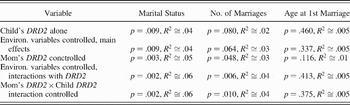
In the analyses of DRD2 genotype associations with ADHD diagnosis or mother's marital stability indices, DRD2 genotype was entered next as a predictor. The order of entry of predictors in the analyses of G × E was the same as depicted in Table 1 (results discussed later). Specifically, following the ethnic background variables, the main effects of child's DRD2 genotype and of one of the mother's marital stability variables was entered, followed by the product term that represented the G × E for these variables. Then, this interaction was reexamined in a series of analyses that included progressive sets of covariates to control for the alternative causal pathways (described in the introductory section) that could represent rival hypotheses for the observed G × E. First the main effects of the other two marital stability variables (i.e., those that are not included in the target G × E with children's DRD2 genotype) were controlled, followed by the main effect of mother's DRD2 genotype. Next, the interactions of child's DRD2 genotype with the other two marital stability variables were controlled, followed by the interaction of mother's DRD2 genotype with child's DRD2 genotype. Controlling for the main and interactive effects of the other two marital stability variables accounts (at least in part) for the alternative causal pathway represented by background environmental context confounds, whereas controlling for the main and interactive effects of mother's DRD2 genotype accounts (at least in part) for the alternative causal pathway represented by background genetic confounds.
Interactions between DRD2 and putative environmental variables on ADHD

Note: Numbers ranged from 183 to 196. Ethnicity was controlled in all tests. DRD2, dopamine receptor D2 gene; ADHD, attention-deficit/hyperactivity disorder.
Results
Correlations among mother's marital stability measures and effects of these on child ADHD
As shown in Table 2, there were moderate associations among the three marital stability measures. Specifically, mothers were twice as likely to be divorced or separated with each additional time they were married or had a cohabiting relationship, and 12% more likely to be divorced or separated with each year younger that they were first married. In addition, mothers who first married younger rather than older had a greater number of marriages or cohabiting relationships (R 2 = .08). We next examined the main effects of each mothers' marital stability index on childhood ADHD. Children were almost 2.5 times more likely to be diagnosed with ADHD if their mothers were divorced, separated, or never married, and almost twice as likely to be so diagnosed for each additional mothers' marriage or cohabiting relationship (R 2 = .04 for both variables). In contrast, children's ADHD diagnostic status was not related to mothers' age at first marriage, despite its association with each of the other marital stability indices.
Relations among putative environmental variables

Note: Numbers ranged from 418 to 434 for correlations among marital stability measures and from 195 to 434 for correlations between marital stability measures and attention-deficit/hyperactivity disorder (ADHD); OR, odds ratio.
** p ≤ .01. ***p ≤ .001.
Main effects of DRD2 genotypes on children's ADHD and mother's marital stability measures
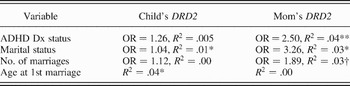
DRD2 genotype main effects on the etiology of childhood ADHD and on each of the mothers' marital stability indices were tested next, and the results are shown in Table 3. When considered by itself, children's DRD2 genotype did not significantly predict ADHD in this sample (odds ratio [OR] = 1.26, R 2 = .005), although the results were generally in the predicted direction (percentage of children with an ADHD diagnosis by child's DRD2 genotype: 1/1 = 60%, 1/2 = 59%, 2/2 = 64%). In contrast, children's ADHD diagnostic status was significantly predicted by mother's DRD2 genotype (OR = 2.50, R 2 = .04), such that the probability of diagnosis increased with the number of 2 alleles (percentage of children with an ADHD diagnosis by mother's DRD2 genotype: 1/1 = 33%, 1/2 = 45%, 2/2 = 59%).
Main effects of DRD2 on ADHD and putative environmental variables

Note: Numbers ranged from 188 to 196 (213 for ADHD Dx) for children's DRD2 genotypes and from 237 to 242 (260 for ADHD Dx) for mother's DRD2 genotypes. Ethnicity was controlled in all tests. DRD2, dopamine receptor D2 gene; ADHD, attention-deficit/hyperactivity disorder; OR, odds ratio.
† p ≤ .10. *p ≤ .05. **p ≤ .01.
Mother's marital status was associated with both child's and mother's DRD2 genotype (OR = 1.04, R 2 = .01 and OR = 3.26, R 2 = .03, respectively). This relation also was in the predicted direction, such that mothers were more likely to be divorced, separated, or never married with increasing numbers of 2 alleles (percentage mothers divorced, separated, or never married by child's DRD2 genotype: 1/1 = 0%, 1/2 = 23%, 2/2 = 20%; by mother's DRD2 genotype: 1/1 = 10%, 1/2 = 15%, 2/2 = 22%). In addition, there was a statistical trend for mother's number of marriages or cohabiting relationships to be associated with mother's DRD2 genotype (p = .071, OR = 1.89, R 2 = .03). This relation also was generally in the predicted direction, such that mothers were more likely to have had zero or more than two marriages or cohabiting relationships with increasing numbers of 2 alleles (percentage of mothers with zero or more than two marriages or cohabiting relationships by mother's DRD2 genotype: 1/1 = 22%, 1/2 = 18%, 2/2 = 30%). Mother's age at first marriage also was associated with children's DRD2 genotype (R 2 = .04), such that children with one or two copies of the 2 allele had mothers who were married at an earlier age than those with two copies of the 1 allele.
Interactions of DRD2 genotype and mother's marital stability indices on children's ADHD
The interactions between child's DRD2 genotype and mothers' marital status, number of marriages or cohabiting relationships, and age at first marriage in predicting children's ADHD diagnosis were next tested (results shown in Table 1). A significant interaction was found between child's DRD2 genotype and mothers' marital status (p = .009, R 2 = .04), such that an ADHD diagnosis was more likely for children homozygous for the 2 allele, but only if their mothers were divorced, separated, or never married (% ADHD diagnosis by child's DRD2 genotype for mothers divorced, separated, or never married: 1/1 or 1/2 = 50%, 2/2 = 89%; % ADHD diagnosis by child's DRD2 genotype for mothers currently married: 1/1 or 1/2 = 57%, 2/2 = 57%). Because of few children with the 1/1 genotype with mothers who were divorced, separated, or never married, we had to dichotomize the DRD2 genotypes, although results were similar for the original genotypes. This interaction was next reexamined after controlling for a series of covariates included in the generalized linear mixed model in an attempt to rule out the abovementioned alternative causal pathways that also could explain the observed interaction. As shown in Table 1, controlling for both the main and interactive effects (with child's DRD2 genotype) of the other marital stability indices and mother's DRD2 genotype resulted in stronger evidence for the mother's marital status by child's DRD2 genotype interaction, rather than weakening or eliminating it.
A statistical trend was found for the interaction between child's DRD2 genotype and mothers' number of marriages or cohabiting relationships (p = .080, R 2 = .02). As for marital status, an ADHD diagnosis was more likely for children homozygous for the 2 allele, but only in the low-risk condition in which mothers had only one marriage or cohabiting relationship, whereas the DRD2 genotype–ADHD diagnosis association went in the opposite direction for mothers who had 0 or >1 marriage or cohabiting relationship (% ADHD diagnosis by child's DRD2 genotype for mothers married only once: 1/1 or 1/2 = 47%, 2/2 = 63%; % ADHD diagnosis by child's DRD2 genotype for mothers who were never married or married more than once: 1/1 or 1/2 = 73%, 2/2 = 61%). Similar to the G × E analyses of marital status above, because of few children with the 1/1 genotype with mothers who had a zero or more than one marriage or cohabiting relationship, we had to dichotomize the DRD2 genotypes, although results were similar for the original genotypes. The form of this interaction is interesting given the main effect of this marital stability variable, in which (as expected) mothers who were never married or married more than once had children with higher rates of ADHD diagnoses than mothers who were married only once. Similar to the analyses for marital status, this interaction was next reexamined after controlling for the series of covariates representing both the main and interactive effects of the other marital stability indices and mother's DRD2 genotype. These generalized linear mixed model analyses also resulted in increasing evidence for the mother's number of marriages or cohabiting relationships by child's DRD2 genotype interaction, rather than weakening or eliminating it, such that after all covariates were controlled this interaction was significant and explained twice as much of the variance in ADHD diagnostic status (p = .010, R 2 = .04). In contrast to the above results, tests of the interaction between mother's age at first marriage and child's DRD2 genotype were nonsignificant and explained little of the variance in ADHD diagnostic status whether tested by itself or after the series of covariates was controlled.
Discussion
As expected, there were moderate associations among the three indices of mother's marital stability, suggesting that these three measures to some extent represent alternative manifestations of an environmental nexus, such that finding a main effect of or a G × E with any one of these measures might also (or instead) implicate the other two. To the extent that this is the case, it is difficult or impossible to attribute the effects uniquely to any one of the constituent environmental variables. It is of interest that despite the moderate associations among these three variables, only the first two (i.e., mother's marital status and her number of marriages or cohabiting relationships) showed evidence for both main effects and interactions with child's DRD2 genotype in predicting ADHD diagnostic status. Although mother's age at first marriage was moderately associated with each of the other two marital stability indices, it showed neither a main effect nor an interaction with child's DRD2 genotype in predicting ADHD diagnostic status. Thus, although moderate relations among measures that constitute some putative environmental nexus suggest difficulties in attributing unique effects to any of these, the present results are a reminder that moderately associated variables are not necessarily substitutable for one another and must be each evaluated as risk factors in turn.
We also found evidence for associations between several of the marital stability indices and DRD2 genotype. Specifically, child's DRD2 genotype was associated with both mother's marital status and her age at first marriage, whereas mother's DRD2 genotype was associated with her marital status and number of marriages or cohabiting relationships (the latter a statistical trend). These associations raise several points that are important to consider in G × E research. First, they highlight the fact that each of the putative environmental risk factors itself has a complex etiology that includes genetic influences. As such, the associations of the putative environmental risk factors with the target candidate gene need to be controlled before testing for the G × E, which can be accomplished most readily within a research design and using general or generalized linear modeling analyses that permit testing of the interaction term only after the genetic and environmental main effect terms (and their covariation) have been partialed out. This is in contrast to some of the designs for examining G × E that have been touted in the literature (e.g., testing for the main effects of candidate genes on a disorder or trait in samples composed solely of individuals exposed to some environmental pathogen; Moffitt et al., Reference Moffitt, Caspi and Rutter2006). An additional related point is that although the candidate gene's association with the putative environmental risk factor is plausible and has been demonstrated in this study, only some of the published G × E studies have controlled for such gene–environment correlations before testing for the interaction. Second, the present findings highlight the importance of controlling for the putative environmental risk factor's association with the mother's genotype for the candidate gene and not only with the child's genotype, as is typically done in published G × E studies. Also reinforcing this point is the finding that child's ADHD diagnosis was associated with the mother's but not the child's genotype for the candidate gene examined.
As discussed in the introductory section, the relations among the putative environmental risk factors and the associations between these and the candidate gene of interest raise the possibility of alternative causal pathways underlying an observed G × E finding from a typical G × E study. This led to a reevaluation of the G × E tested for in this study after controlling for several terms in the generalized linear models that would capture, at least in part, these alternative causal pathways. To control for environmental background confounds, we reexamined each mother's marital stability variable by child's DRD2 genotype interaction after partialing out the main effects of, and the interactions of child's DRD2 genotype with, the other marital stability variables. Rather than weakening the interactions of mother's marital status and number of marriages or cohabiting relationships with child's DRD2 genotype in predicting child's ADHD diagnosis, partialing out the interactions of each of the other two marital stability variables with child's DRD2 genotype actually strengthened the evidence in support of the target interaction (i.e., the p values decreased and the R 2s increased). Similarly, to control for genetic background confounds (at least in part), we reexamined each mother's marital stability variable by child's DRD2 genotype interaction after partialing out the main effects of, and the interactions of child's DRD2 genotype with, mother's DRD2 genotype. Again, controlling for the genetic background confound in this way strengthened the evidence supporting the target interaction. The effects of these covariates on the target G × E was appreciable, as the R 2 for the interaction of mother's marital status and child's DRD2 genotype in predicting child's ADHD diagnosis increased by 50%, whereas the R 2 for the interaction of mother's number of marriages or cohabiting relationships with child's DRD2 genotype in predicting child's ADHD diagnosis actually doubled.
Limitations and Future Directions
Similar to all studies, this study has a number of limitations and suggested future directions. First, we analyzed ADHD diagnoses exclusively as the target disorder, rather than also examining the same G × E for relevant symptom dimensions. Analyses of the inattentive and hyperactive–impulsive ADHD symptom dimensions may afford greater statistical power and permit the examination of similarities and differences in G × E across the two distinct but correlated symptom domains. Nonetheless, these symptom dimensions are not normally distributed, and one must be mindful of spurious G × E arising because of scaling artifacts (e.g., Eaves, Reference Eaves2006). We intend to test such interactions for these symptom dimensions, as well as for symptoms of the overlapping conditions ODD and CD, in follow-up studies.
As with all between-family analyses of association, the possibility of population stratification biases inducing associations that are not due to the causal effects of the gene remain a concern. In this study, all genetic association analyses were conducted controlling for ethnic background (i.e., percentage of European American, African American, and Hispanic) in an effort to control for the operation of any potential population stratification biases. This approach receives support from findings that individuals' self-reported ethnicity maps very closely onto their ethnic classification via sets of ancestry informative DNA markers (Risch et al., 2003; Tang et al., Reference Tang, Quertermous, Rodriguez, Kardia, Zhu and Brown2005), and suggests that controlling for parental and grandparental ethnic background should provide adequate controls for potential population stratification biases. In our future G × E studies, we also intend to utilize our parental genotype data to conduct family-based tests of association and G × E (Lange & Laird, Reference Lange and Laird2002; Spielman, McGinniss, & Ewens, Reference Spielman, McGinnis and Ewens1993), as such tests are completely robust to any population stratification biases.
In this study, the consistency of G × E was examined across multiple putative environmental risk factors, which revealed important differences in G × E despite the fact that such measures were moderately correlated with one another and might be (mistakenly) viewed simply as substitutable indices of mother's marital stability. In future G × E studies, we will extend this approach to examining the generalizability of our findings by testing for G × E across multiple related genes in addition to multiple correlated environmental indices. It is an open question, for example, whether similar or distinct patterns of G × E would be found for multiple genes within the dopaminergic neurotransmitter system. We intend to examine such generalizability by testing for interactions of the maternal marital stability variables and the DAT1 gene, the COMT gene, and the DRD4 gene in predicting ADHD.
An attempt was made in this study to control for background genetic and environmental context confounds by partialing out sets of covariates composed of the correlated maternal marital stability variables and mother's DRD2 genotype. Although such statistical controls represent one approach to ruling out such alternative causal pathways that may explain G × E findings, they have the disadvantages of being potentially quite unwieldy, as the higher order interactions with the covariate terms can be highly correlated with one another, and the multiple interactions can result in sparse data in critical cells in the analysis. In addition, it is worth noting that there are other relevant aspects of the environment (e.g., family socioeconomic status, father's marital stability indices) that could qualify as useful environmental background covariates. Likewise, mother's genotype for the candidate gene may represent only a small part of the genetic background covariate, as it is only one of the possible genetic constituents that comprise the heritable component of the putative environmental risk factors represented in the G × E. To further complicate matters, heritability of the putative environmental risk factor does not preclude that variable having an environmental influence on the target disorder, as demonstrated by studies that found environmental effects of marital instability, corporal punishment, and physical maltreatment on children's externalizing problems (D'Onofrio et al., Reference D'Onofrio, Turkheimer, Emery, Slutske, Heath and Madden2005; Jaffee et al., Reference Jaffee, Caspi, Moffitt and Taylor2004). In our future G × E research, we intend to explore the use of genetically informative study designs (e.g., adoption studies) rather than (or in addition to) statistical analyses (i.e., partialing out covariates) to address and attempt to rule out alternative causal models consistent with the observed G × E.