Introduction
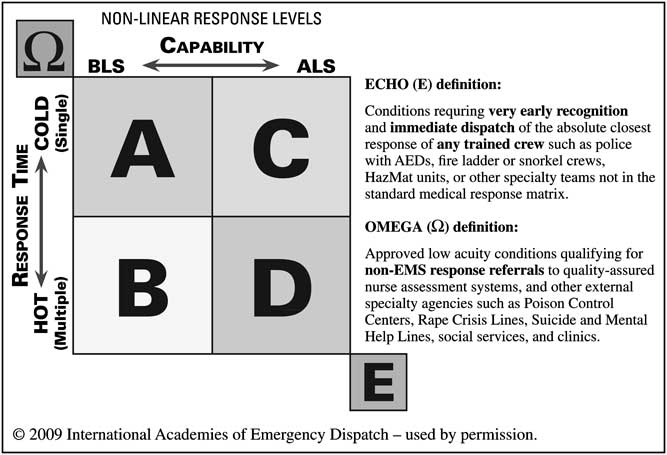
Emergency call centers (responding to 911, 999, and 000 calls) using the International Academies of Emergency Dispatch's (IAED) Medical Priority Dispatch System (MPDS) (version 11.3, 2006 release, Priority Dispatch Corp., Salt Lake City, Utah USA) have reported that Breathing Problems is the most frequently used chief complaint protocol. The Breathing Problems Chief Complaint (CC) Protocol (Table 1) comprises approximately 12% to 16% of all cases.Reference Clawson, Olola, Heward, Patterson and Scott 1 The Breathing Problems CC encompasses a wide variety of potential underlying clinical causes including cardiac (e.g., coronary heart disease or heart failure) or respiratory conditions (e.g., asthma or chronic obstructive pulmonary disease), many of which can be serious and/or life threatening, even resulting in cardiac arrest. Patients usually show physiological deterioration prior to a cardiac arrest.Reference Sax and Charlson 2 - Reference Bellomo, Goldsmith, Uchino, Buckmaster, Hart, Opdam, Silvester, Doolan and Gutteridge 7 Further, “severe breathing problems” is a significant predictor of cardiac arrest,Reference Sax and Charlson 2 with one study demonstrating that an increased respiratory rate was four times more likely in patients who experienced a cardiac arrest, compared with those who did not.Reference Hodgetts, Kenward, Vlachonikolis, Payne and Castle 8 The MPDS has been proven effective at identifying critically ill patients in its ECHO-level dispatch codes.Reference Clawson, Olola, Heward, Patterson and Scott 1 ECHO level denotes those patients who are assessed by the Emergency Medical Dispatcher (EMD) as not breathing or have ineffective breathing and who therefore require immediate intervention by the closest trained responder and an ALS-level response (Figure 1). The MPDS DELTA-level, much like the higher-priority ECHO level, is designed for acute or unstable patients who have been identified by the EMD as requiring an emergency, ALS response, with the addition of a rapid first responder in certain localities.
The Medical Priority Dispatch System (MPDS) Breathing Problems Determinants, Levels, and Descriptors

© 2009 International Academies of Emergency Dispatch – used by permission.
aRecommends to the agency what type of response (in terms of the number of responders, level of expertise, and response time) should be sent to the scene of emergency (see Figure 1).
b Indicates the severity level of the case. The smaller the number, the higher the severity level.
Medical Priority Dispatch System (MPDS) Response Determinant Methodology, Showing the Local Responses that are Assigned to Each MPDS Determinant Code. Abbreviations: ALS, Advanced Life Support; BLS, Basic Life Support

However, data have shown that the DELTA-level determinant codes in the Breathing Problems CC, while highly sensitive for identifying unstable patients, contain patients across a wide spectrum of acuity,Reference Clawson, Olola, Heward, Patterson and Scott 1 including those who ultimately are not transported after paramedic evaluation, suggesting some potential for improvement in system specificity. Given that DELTA-level determinant codes are expected to contain many more high-acuity patients than the lower priority MPDS level codes (notably the single CHARLIE-level code abnormal breathing– 6-C-1 in the Breathing Problems Protocol), it is likely that at least one of the Key Questions (KQs) for Protocol 6 is less useful in making a DELTA level determination. “Does s/he have difficulty speaking between breaths?” is a KQ of particular interest because many DELTA-level (difficulty speaking between breaths – 6-D-2) cases are assigned based on this single question. This code was the most frequently assigned single code in the entire MPDS (IAED, unpublished data). The reliability of this KQ is based on the understanding of its meaning by the caller and/or patient, the caller's ability to visualize and evaluate the patient's breathing and speaking, and the EMD's interpretation of the answer feedback in deciding if the patient actually has this condition.
This study examines the ability of the 15 KQ combinations in the MPDS Breathing Problems Protocol to predict patient acuity, using the incidence of cardiac arrest quotient (CAQ)—a percentage of cardiac arrests found in each code—as the outcome measure. 9 , Reference Clawson, Olola, Heward and Patterson 10 The investigators hypothesized that combinations of caller answers to MPDS Breathing Problems Protocol KQs are correlated with different but specific patient acuities, and may improve the specificity of the Breathing Problems CC codes in predicting acute-status patients.
The primary objective of this study was to determine if different combinations of answers provided by the caller, in response to MPDS protocol KQs, relate to patient acuity.
Methods
Study Design and Setting
This retrospective study involved two dispatch centers in the UK, both of which are IAED – Accredited Centers of Excellence. However, only one dispatch center, covering five regions, participated in the study. The study was approved by the University of Lincoln Research Ethics Committee, UK; the International Academies of Emergency Dispatch's International Review Board, USA; and considered to be an evaluation by the National Health Service (NHS) Research Ethics Committee, UK.
Data Collection and Processing
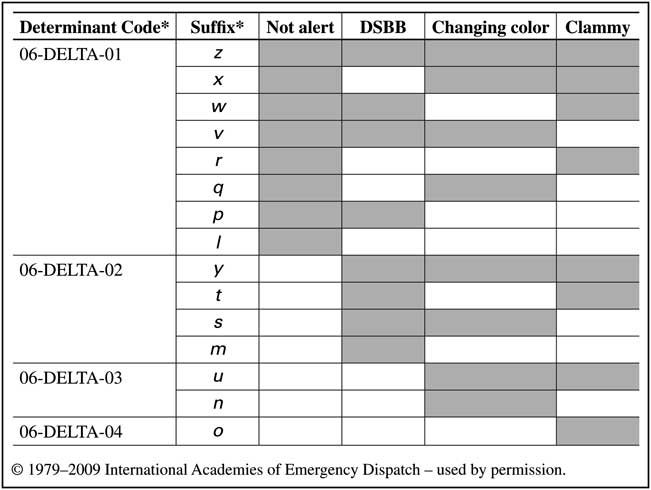
Emergency medical dispatch data were collected for 11 months (from September 2009 through July 2010) using MPDS (MPDS version 12.0, 2008 release, Priority Dispatch Corp., Salt Lake City, Utah USA). All calls recorded under the MPDS Protocol's Breathing Problems CC were included in the analysis. Each MPDS dispatch code contained an additional research suffix that was assigned based on the combination of KQ answers given by the caller (Figure 2). All data were de-identified by expunging the addresses and phone numbers from the dataset of each case. The suffix data were extracted from the automated version of the MPDS system (ProQA version 3.4.2.34, Priority Dispatch Corp., Salt Lake City, Utah USA) using its export function and were combined with data that indicated whether the patient suffered a cardiac arrest at any point during the incident, whether found on-arrival, occurred at-scene, or during transport to hospital. The cardiac arrest data were collected from the computer aided dispatch (CAD) system and/or patient report forms (PRF).
The Medical Priority Dispatch System (MPDS) Protocol Breathing Problems Chief Complaint (Protocol 6) Suffixes and Key Question Answer Combinations (shaded cells).
*A Key Question answer combination (shaded cells) was assigned a determinant code and corresponding suffix to form a final MPDS dispatch code, e.g., the combination of not alert, DSBB, changing color and clammy was represented by MPDS DELTA-level 1 suffix “z” (06-D-01z). Abbreviation: DSBB, Difficulty Speaking Between Breaths

Measures
The primary endpoint of this study was the correlation between the combinations of KQ answers and patient acuity. Patient acuity was defined as the incidence of CAQ in each MPDS determinant code. The secondary endpoint was the correlation between the combinations of KQ answers and asthmatic medical condition.
Data Analysis
STATA for Windows software (STATA Statistical Software Release 9, StataCorp, College Station, Texas USA) was used for data analysis. Frequencies and proportions were used to present descriptive statistics of the KQ answers, grouping by MPDS determinant codes, and patient gender and age. Odds ratio and 95% confidence intervals were used to assess associations between combinations of KQ answer combinations and outcomes (i.e., cardiac arrest and asthma). Differences between study groups were assessed at the .05 level of significance.
Results
A total of 42,000 emergency medical cases were recorded during the 11-month study period, out of which 189 (0.5%) and 41 (0.1%) cases had no gender and MPDS code information recorded, respectively. Approximately 52% of the patients were female, and the median age of all patients was 61 years.
Overall, based on the original MPDS Protocol (before generating KQ combinations), the DELTA-level determinants codes had the highest proportion of cases (74.0%), especially patients with the difficulty speaking between breaths (DSBB) condition (Table 2). There were no significant gender and age differences, although patients with abnormal breathing and clammy conditions tended to be the youngest, and those with changing color and ineffective breathing conditions were the oldest. Patients who had the ineffective breathing condition and those with the not alert condition had the highest number of cardiac arrests outcomes. Patients with the abnormal breathing condition alone recorded the lowest number of cardiac arrest outcome. Among cardiac arrest cases, female patients and those who had the not alert condition were the oldest. Patients who experienced the DSBB and changing color conditions were the most and least asthmatic, respectively. Among the asthmatic patients, those who had the ineffective breathing condition were the oldest. Additionally, the changing color patients were the youngest among the cardiac arrest cases.
Patient Demographics Based on MPDS Protocol Determinant Codes Before Generating Key Question Combinations

Abbreviations: C-1, CHARLIE determinant level-1; D-1, DELTA determinant level-1; D-2, DELTA determinant level-2 (Difficulty speaking between breaths—DSBB); D-3, DELTA determinant level-3; D-4:, DELTA determinant level-4; E-1, ECHO determinant level-1.
Note: 189 records did not have gender information and 41 records did not have Medical Priority Dispatch System (MPDS) determinant code information.
aThe 25th percentile (first quartile) -75th percentile (third quartile) for patient age.
Based on the KQ combinations, the abnormal breathing condition patients recorded a significantly lower percentage of cardiac arrest outcomes (0.1%) than the other patients, except for those with DSBB; changing color; clammy; DSBB plus changing color; and changing color plus clammy conditions (Table 3). Cardiac arrest patients were significantly less likely to be asthmatic than non-cardiac arrest patients (85.1% and 91.1%, respectively; P = .004). The percentage of asthma outcome did not differ significantly between patients with the abnormal breathing condition and those with other conditions.
Correlation Between Key Question (KQ) Combinations and Cardiac Arrest Outcome

Abbreviation: DSBB, difficulty speaking between breaths.
a7,071 records had no suffix.
bOdds ratio (95% confidence interval).
cReference measure.
dUndeterminable value due to small sample size.
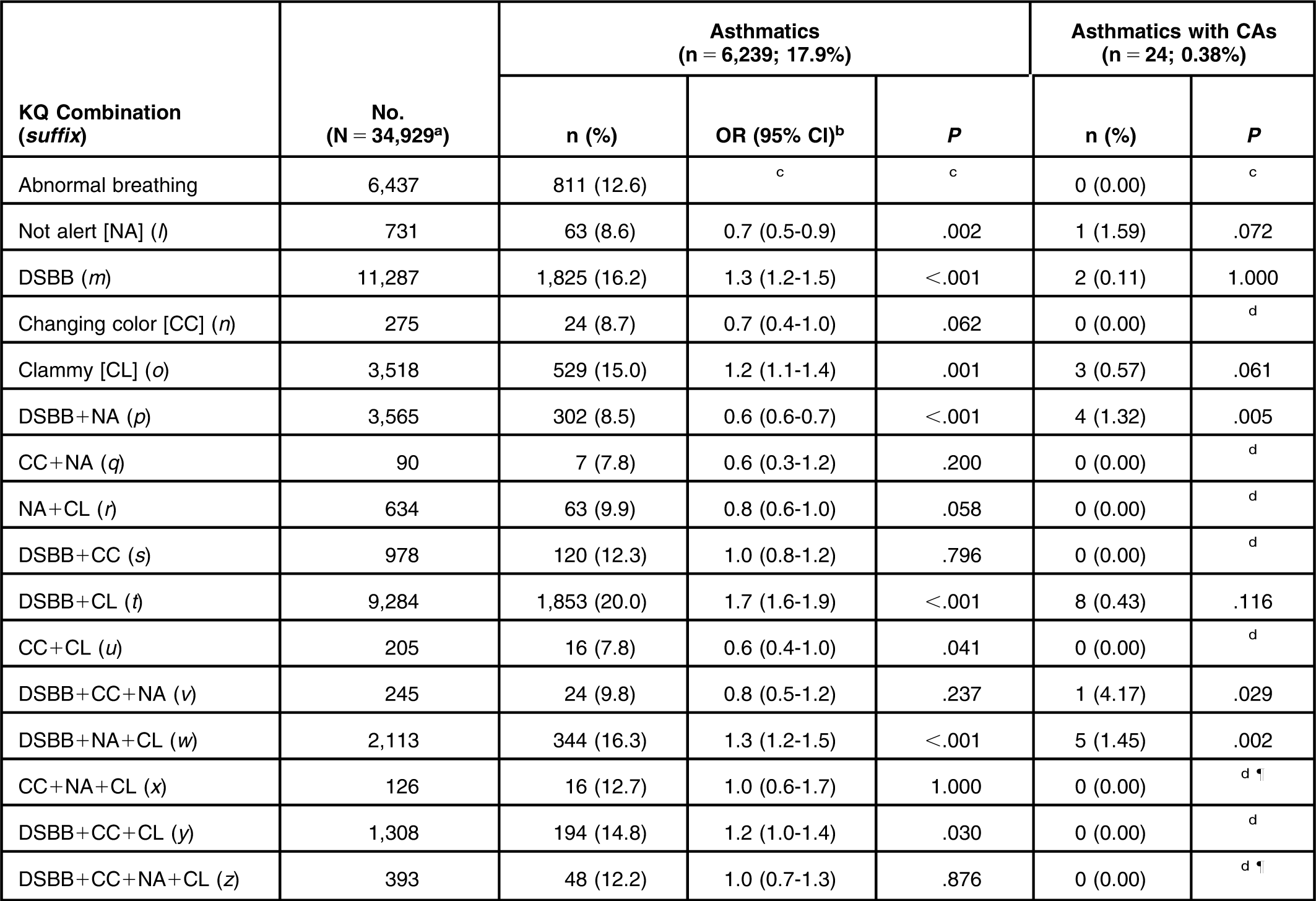
DSBB, clammy; DSBB plus clammy; and DSBB plus clammy plus not alert cases were better predictors of associated asthma than abnormal breathing alone (Table 4). However, not alert; DSBB plus not alert; and changing color plus clammy conditions were significantly less likely to be asthmatics than patients with abnormal breathing alone. The asthmatics were significantly less likely to develop cardiac arrest condition than the non-asthmatics (8.9% and 14.9%, respectively; P = .004). Nevertheless, the percentage of CA outcomes in asthmatic patients was significantly higher in DSBB plus not alert; DSBB plus not alert plus changing color; and DSBB plus not alert plus clammy cases, compared to asthmatic abnormal breathing cases.
Correlation Between Key Question (KQ) Combinations and Asthma Outcome

Abbreviations: DSBB, difficulty speaking between breaths; CA, cardiac arrest.
a7,071 records had no suffix.
bOdds ratio (95% confidence interval).
cReference measure.
dUndeterminable value due to small sample size.
Discussion
Past studies have demonstrated that the percentage of cardiac arrest cases discovered by responders is a good indicator of the MPDS determinant codes’ ability to predict high or low patient acuity. 9 , Reference Clawson, Olola, Heward and Patterson 10 Using the CAQ, it is possible to examine the relative predictive value of reported symptoms—both individually and in combination with each other—independent from their assigned MPDS determinant codes. This data is useful because it may reveal that a symptom, or combination of symptoms, is a better or worse predictor of patient acuity than certain existing DELTA-level MPDS determinant codes, providing evidence for system improvement and more precise research in other protocols.
The existing MPDS determinant codes are assigned by the ProQA software using a hierarchy of single signs or symptoms. In other words, only one sign/symptom is attached to each DELTA-level determinant code regardless of the number of actual signs/symptoms that exist for a given patient, with the symptom highest in the hierarchy becoming the basis for the assigned DELTA-level MPDS code (Table 1). The analysis compared the CAQ of existing DELTA-level symptoms to the CAQ of the two CHARLIE-level codes (those patients who are absent of all DELTA-level symptoms with only the single finding of abnormal breathing, with or without a history of asthma).
The results of this study suggest that using both single and multiple combinations of symptoms as indicators in the MPDS coding for Breathing Problems provides an improved method of predicting patient acuity. With the exception of the single sign of not alert, other single DELTA-level signs or symptoms do not indicate a significantly higher CAQ than the existing CHARLIE-level codes (CHARLIE-1 (abnormal breathing) and CHARLIE-1A (abnormal breathing plus asthma). Notably, the MPDS single symptom of DSBB did not show a significantly higher patient acuity than the abnormal breathing condition. From a response standpoint, this is an important finding, and should be evaluated by the IAED for possible protocol modification.
One unusual finding was that asthma patients, in general, had significantly fewer cardiac arrests than non-asthma patients. There are several plausible explanations for this. First, asthma patients usually tend to know what is wrong with them immediately, and may be more likely to call for an ambulance comparatively earlier after the onset of symptoms. Second, asthma patients are normally capable of self-treating with a prescribed inhaler before the arrival of trained personnel. And finally, when self-treatment is not done, or is ineffective, paramedics have specific treatment regimens and medications that are relatively effective at alleviating asthma symptoms. However, non-asthmatics in certain situations can also be effectively treated by paramedic-based clinical intervention, and a timely response is essential in maintaining a lower CAQ. Conversely, the best indicator of high patient acuity (higher CAQ) is the presence of all DELTA-level symptoms in combination (DSBB plus changing color plus not alert plus clammy).
Limitations
Although the study involved four regions, covered by one Ambulance Service Trust comprising two dispatch centers, the data might not be absolutely representative of all Trusts in the whole of the UK. Therefore, the generalization of the study's findings to other dispatch settings should be done with caution. Additionally, the study was retrospective, using routinely collected data from the dispatch system and clinical records. Therefore, the authors were not able to verify diagnostic categories in clinical records, for example with hospital admission or discharge diagnoses. Another limitation of the study was the small sample size and some missing data, especially within each determinant code. This limitation may have influenced the outcomes of this study. Therefore, further research involving larger sample sizes are required to validate these findings.
Conclusions
The study findings demonstrated that MPDS Key Question answer combinations do relate to patient acuity. Cardiac arrest patients are significantly less likely to be asthmatic than those without CA, and vice versa. Using a prioritization scheme that accounts for the presence or absence of both single and multiple signs/symptoms for the Breathing Problems CC would be a more accurate method of assigning DELTA-level cases in the MPDS. One possible modification of the array of CHARLIE-level and DELTA-level codes would be to move the single signs of DSBB, changing color, and clammy into the CHARLIE-level, leaving the single sign of not alert in the DELTA–level tier; then keeping all combinations of two, three, and all four signs/symptoms in the DELTA-level. Alternatively, a more conservative approach would be to place cases with a single DELTA-level symptom with an asthma (A) suffix in the CHARLIE-level, excluding only those with not alert plus an asthma (A) suffix, which would remain in the DELTA tier. The non-asthma, single-DELTA condition cases would also remain in the DELTA-level code group.
Abbreviations
- CAQ:
-
cardiac arrest quotient
- CC:
-
chief complaint
- EMD:
-
Emergency Medical Dispatch
- KQ:
-
Key Question
- MPDS:
-
Medical Priority Dispatch System
Acknowledgments
The authors thank Pamela Stewart and Holly Clark for logistics management.