Introduction
The COVID-19 pandemic has provoked concern as not just a physical health emergency but also a grave threat to mental health, with specific concerns regarding the potential for increased rates of self-harm and suicide (Gunnell et al. Reference Gunnell, Appleby, Arensman, Hawton, John, Kapur and Pirkis2020; Niederkrotenthaler et al. Reference Niederkrotenthaler, Gunnell, Arensman, Pirkis, Appleby, Hawton, John, Kapur, Khan, O’Connor and Platt2020). While it is not evident that suicide deaths have increased in the early months of 2020 (Pirkis et al. Reference Pirkis, John, Shin, DelPozo-Banos, Arya and Analuisa-Aguilar2021), factors relating to COVID-19 may have influenced the number of self-harm presentations in the early months of the pandemic (Hawton et al. Reference Hawton, Lascelles, Brand, Casey, Bale, Ness, Kelly and Waters2021b; Smalley et al. Reference Smalley, Malone, Meldon, Borden, Simon, Muir and Fertel2021). Differences in patient characteristics of suicide-related hospital presentations, compared with previous years, have been noted and attention has been given to the youth population with no history of mental health conditions presenting during COVID19 restrictions (Ridout et al. Reference Ridout, Alavi, Ridout, Koshy, Awsare, Harris, Vinson, Weisner, Sterling and Iturralde2021).
In Ireland, one hospital recorded a drop in self-harm presentations in March–April 2020 but a rise in April–May 2020, with an increase in substance misuse presentations when compared with previous years (2020: 30.5% v. 2017–2019: 21.8%; McIntyre et al. Reference McIntyre, Tong, McMahon and Doherty2020). Overall studies investigating self-harm hospital presentations during the COVID-19 era, have reported an initial decrease in the early months of the pandemic (March–May 2020) (Hawton et al. Reference Hawton, Casey, Bale, Brand, Ness, Waters, Kelly and Geulayov2021a; Smalley et al. Reference Smalley, Malone, Meldon, Borden, Simon, Muir and Fertel2021), with a slight increase over a longer period (up to October 2020) (Henry et al. Reference Henry, Parthiban and Farroha2021; Holland et al. Reference Holland, Jones, Vivolo-Kantor, Idaikkadar, Zwald and Hoots2021; Joyce et al. Reference Joyce, Richardson, McCombie, Hamilton and Ardagh2021) and a ‘rebound effect’ after an initial lull in presentations (McDowell et al. Reference McDowell, Fry, Nisavic, Grossman, Masaki, Sorg, Bird, Smith and Beach2021; Balestrieri et al. Reference Balestrieri, Rucci, Amendola, Bonizzoni, Cerveri and Colli2021).
Given that chronic or excessive alcohol consumption could increase the risk of COVID-19 related adverse health outcomes (Columb et al. Reference Columb, Hussain and O’Gara2020), public health restrictions have focussed on the potential risk of viral transmission where alcohol is consumed (Reynolds et al. Reference Reynolds, Purdy, Rodriguez and McAvoy2021). Changes in drinking patterns during COVID-19 restrictions have been noted across Europe, with Belgium and Ireland reporting an increase in alcohol consumption the first couple of months of the pandemic (30 and 22% respectively; Vanderbruggen et al. Reference Vanderbruggen, Matthys, Van Laere, Zeeuws, Santermans, Van den Ameele and Crunelle2020; Reynolds et al. Reference Reynolds, Purdy, Rodriguez and McAvoy2021). Within the Irish context, the closure of bars during lockdown has changed drinking habits, where a 93% increase in take-home grocery alcohol sales was reported in April–June 2020 (Kantar 2020). Although alcohol misuse has been reported as a COVID-related factor in some self-harm presentations in the initial stages of the pandemic (Smalley et al. Reference Smalley, Malone, Meldon, Borden, Simon, Muir and Fertel2021; McAndrew et al. Reference McAndrew, O’Leary, Cotter, Cannon, MacHale, Murphy and Barry2021; Hawton et al. Reference Hawton, Lascelles, Brand, Casey, Bale, Ness, Kelly and Waters2021b), there is a lack of evidence on the role of alcohol consumption in hospital-presenting self-harm cases during the pandemic.
Most COVID-19-related studies to date have presented changes of self-harm hospital presentations compared with previous years, as one possible indicator of the COVID-19 pandemic’s impact on mental health. There is, however, a dearth of studies examining differences in presentations of self-harm and suicide-related ideation before and during the COVID-19 pandemic in an Irish context. In particular, studies examining the demographic characteristics of those presenting with self-harm and/or suicide-related ideation and investigating substance misuse as a contributory factor are lacking. The current study aimed to examine changes in self-harm and suicide-related ideation presentations in 2020, compared with 2018 and 2019, to nine Irish Emergency Departments (EDs) that are participating in a national dedicated ED service for those with suicidal behaviours and related ideation.
Methods
Data source
Anonymised ED presentations were retrieved from the database of the National Clinical Programme for Self-Harm and Suicide-related Ideation (NCPSHI). The rationale for establishing the NCPSHI in Ireland is laid out in its Model of Care (HSE 2016), which notes that people who self-harm have up to 40-fold greater risk of suicide than the general population. The Programme aims to provide a timely, standardised biopsychosocial assessment of all those who present to EDs with suicidal behaviours or thoughts by a qualified Clinical Nurse Specialist (CNS) or psychiatry Non-Consultant Hospital Doctor (NCHD). The Programme is currently implemented in 24 out of 26 adult EDs in the Republic of Ireland and also in three paediatric hospitals. Each month the CNS collect and submit anonymised self-harm and suicide-related ideation presentation data in pre-specified electronic templates, which data are further imported in the programme’s database. A complete dataset was available for nine of the 24 participating EDs. Of note, while referrals are made in EDs, the patient may be assessed within the ED or in an acute hospital setting (medical, surgical or intensive care unit ward).
Measurements
In terms of self-harm related information, the programme collects three mutually exclusive outcomes that were used in current study: self-harm act, which is the direct physical outcome of deliberate self-harm regardless of suicidal intent (including cutting, drug-related acts, attempted hanging, attempted drowning, shooting, jumping from a height and other); suicidal ideation, when someone is thinking about suicide, irrespective of a suicide plan and intent; and self-harm ideation, when someone is thinking about self-harm without any co-occurring thoughts of suicide.
The NCPSHI clinicians further assess whether the person presenting with either ideation or a non-drug related self-harm had used any substance (alcohol only, drugs only and both alcohol and drug) that contributed to their presentation. These substance-related data are routinely recorded as contributory factors in the NCPSHI dataset and were also examined in the current analysis.
Based on the sociodemographic information captured in the programme, age, gender and ethnicity data were further analysed. Considering that the NCPSHI holds anonymised information for each presentation, the age of each presented individual is imported in the template in age-bands to avoid potential identification. In the current analysis, 10-year age bands are used. In terms of gender, the template includes male, female and non-binary. As the number of non-binary presentations was small during the study period (n = 7), the non-binary gender was excluded from all analyses. The NCPSHI ethnic groups follow the Central Statistics Office categorisation (CSO 2016) and includes the below ethnic groupings: White Irish; White, any other; White Irish Traveller; Asian or Asian Irish – Chinese; Black or Black Irish – any other background; Black or Black Irish – African; Other, mixed background; Unknown/Not Specified.
Statistical analysis
The time period chosen was January to August 2020 and compared with the same months in 2018 and 2019 for nine NCPSHI services. Descriptive statistics, adjusted residuals and effect sizes (ES; Cramér’s V) for the level of association in chi squares are presented. A binomial regression model was performed in order to investigate whether the outcomes of self-harm and suicide-related ideation where substances played a contributing role were predicted by the different time points. Demographics characteristics, such as gender, age and ethnicity were also added in the binomial model, as literature suggests that they differentiate the risk of suicidal outcomes (Al-Sharifi et al. Reference Al-Sharifi, Krynicki and Upthegrove2015; O’Connor and Nock Reference O’Connor and Nock2014). Odds ratios (OR) and 95% CIs are presented. The level of significance was set at p < 0.05 and analysis was performed with the Statistical Package for Social Sciences version 26 (SPSS Inc. Chicago, IL, USA).
Results
Based on available data from nine hospitals participating in the NCPSHI for the period January to August of three consecutive years (2018–2020), 12,075 presentations were recorded. 6% of all presentations (n = 744) were not assessed either because they left ED before assessment, transferred for a mental health assessment offsite or died. Half of presentations were from males (50%) and majority were White Irish (94%), followed by Irish Traveller patients (3%; Supplementary Table 1).
In Jan–Aug 2020 there was a decrease in alcohol use alone as a contributory factor in the presentations (52% v. 55% in 2019 and 60% in 2018) but an increase in the combined use of alcohol and drugs as contributory factors (30% v. 28% in 2019 and 25% in 2018). As presented in Fig. 1, presentations due to suicide-related thoughts showed an increase from May 2020, which differed from previous years (χ2 = 59.086, df = 14, p < 0.001). No similar increase was found for self-harm presentations (Fig. 2).
Presentations of suicide-related ideation from nine Irish ED services by month and year.

Presentations of self-harm from nine Irish ED services by month and year.

In terms of the demographic characteristics, no significant differences were found between the three timepoints investigated for gender, ethnicity and age-groups based on suicide-related ideation presentations (Supplementary Table 2). When investigating the methods of self-harm by year, a significant increase was noted only for the methods involving substances in 2020, mainly drug and alcohol overdose and overdose poisoning (Table 1). These latter self-harm methods seemed to be increased for both males and females (Supplementary Figures 2 & 3).
Self-harm methods with comorbid substance use in nine NCPSHI services for years 2018–2020

a A.R.= Adjusted residuals; b Cramer’s V interpretation: ES ≤ 0.2 = weak, 0.2 < ES ≤ 0.6 = moderate, ES > 0.6 = strong
1 Drug and alcohol overdose = use of tablets and alcohol with the intention of causing harm.
2Drug overdose = use of prescribed and non-prescribed drugs bought over the counter or on the street with the intention of causing harm.
3Overdose poisoning = using substance that is not a drug or medication, e.g. household bleach with the intention of causing harm.
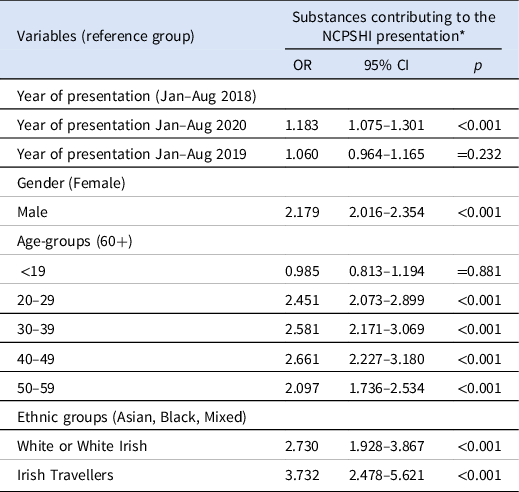
A binomial logistic regression was performed with the binary dependent variable of ‘substances recorded as contributory factors in the presentation’ (Y/N) and timepoint, gender, age-group and ethnicity as predictors. The Jan–Aug 2020 timepoint significantly predicted the role of substances as a contributory role in the NCPSHI presentations (OR = 1.183; 95% CI, 1.075–1.301, p < 0.001; Table 2). Being male and older than 20 years of age significantly increased the risk of having substances contributing to any type of presentation. The ethnic group of Irish Traveller had the highest OR among all independent predictors explored (OR = 3.732; 95% CI, 2.478–5.621, p < 0.001).
Binomial logistic regression for the relationship of demographic characteristics and year of presentation with substances used as contributory factors in self-harm and suicide-related ideation

* Self-harm with drugs or/and alcohol have been excluded from this variable.
Discussion
Our study identified an increase in the presentations of those with thoughts of self-harm or suicide after May 2020, when compared to previous years, but no similar increase on those presenting with self-harm. Similar to other studies, we did not observe any changes in the demographics of those presenting during the pandemic (Dragovic et al. Reference Dragovic, Pascu, Hall, Ingram and Waters2020; Hawton et al. Reference Hawton, Lascelles, Brand, Casey, Bale, Ness, Kelly and Waters2021b; Lee et al. Reference Lee, Kim, Lee, Woo, Jeong and Kim2021; Shields et al. Reference Shields, Bernard, Mirza, Reeves, Wells and Heagerty2021). The contributory role of alcohol and drugs (as a sole use or in combination) in self-harm or ideation presentations seem to be associated with the Jan–Aug 2020 timepoint. As previous studies confirm, being male, older than 20 years of age and White or Irish Traveller further predicted the use of substances in the ED presentations explored (Ceniti et al. Reference Ceniti, Heinecke and McInerney2020; Tanner and Doherty Reference Tanner and Doherty2021).
The increase of suicide-related ideation in 2020, may represent a rebound effect as the impact of stressors such as social disconnect and unemployment may have begun to be felt. Although a U.S study of 20 EDs proposed that ‘stay at home’ orders appeared to result in reduced ED presentations for suicidal ideation (Smalley et al. Reference Smalley, Malone, Meldon, Borden, Simon, Muir and Fertel2021), our findings are in consistent with other studies highlighting a significant increase in suicidal thinking during the pandemic. More specifically, Killgore et al. Reference Killgore, Cloonan, Taylor, Allbright and Dailey(2020) found that suicidal ideation increased in the first three months of the pandemic for those leaving in U.S communities under lockdown restrictions in place. Lu et al. Reference Lu, Xie, Feng, Liu, Ouyang, Hou, Wang, Kong, Zhu, Dao, Zhou, Cao, Long, Xu, Liu and Yin(2021) further noted a higher prevalence in suicidal ideation among those infected with COVID-19, compared with non-infected (16.0% v. 10.7%). A U.S. study pinpointed that adults – but not adolescents- feeling socially isolated were at greater risk of suicidal thinking during the pandemic (Fortgang et al. Reference Fortgang, Wang, Millner, Reid-Russell, Beukenhorst and Kleiman2021). A recent systematic review of suicidal ideation, self-harm and suicides during the pandemic, that estimated a pooled prevalence of 12.1% (CI 9.3–15.2) for suicidal ideation, suggested that social support, quarantine, loneliness, and mental health difficulties were among the risk factors (Farooq et al. Reference Farooq, Tunmore, Ali and Ayub2021). The risk factors associated with increased suicidality in this latter review may be likely related with the increase of suicide-related presentations in our study.
The increase noted for overdose poisoning with non-drug-related substances (e.g. household bleach) may be due to restrictions limiting shopping to essential retailers only. Regarding self-harm methods using substances, our findings indicated that drugs and alcohol (combined) and overdose poisoning were increased in 2020 ED presentations. As strict geographical restrictions on movement were in place for much of the period March to August 2020, access to illicit drugs may have been reduced in this regard, causing a reduction on presentations with intentional drug (only) overdose. It is therefore possible that the increase in combined drug and alcohol overdose involved prescription drugs rather than illicit substances. McAndrew et al. Reference McAndrew, O’Leary, Cotter, Cannon, MacHale, Murphy and Barry(2021) noted a significant reduction in those with alcohol disorder seeking psychiatric evaluation in the initial lockdown period, possibly due to increased alcohol consumption at home. The increase in self-harm presentations with comorbid substance use, however, has been reported elsewhere. McIntyre et al. Reference McIntyre, Tong, McMahon and Doherty(2020) noted an increase in self-harm presentations to one Irish ED in the initial months of the pandemic in those with a primary psychiatric diagnosis of substance misuse disorder. Similarly, while overall psychiatric presentations decreased in the weeks following the COVID-19 outbreak, the proportion of presentations with comorbid substance use disorder increased in one American (McDowell et al. Reference McDowell, Fry, Nisavic, Grossman, Masaki, Sorg, Bird, Smith and Beach2021) and nine Italian EDs (Balestrieri et al. Reference Balestrieri, Rucci, Amendola, Bonizzoni, Cerveri and Colli2021). Seifert et al. Reference Seifert, Meissner, Birkenstock, Bleich, Toto, Ihlefeld and Zindler(2021) further noted that those with substance misuse disorders were more likely to present with suicidal ideation and to be acutely intoxicated with alcohol on presentation to the ED in 2020 versus 2019. The implication is that while persons with affective, psychotic or other psychiatric disorders may have stayed away from Emergency Departments when restrictions were first imposed, those with substance misuse disorders seeking psychiatric evaluation were not so deterred.
Limitations
This study examines self-harm presentations reviewed in acute hospital settings only. We know that the majority of those with suicidality do not seek professional support and thus the data set analysed examines one subset of those with suicidal ideation and behaviours. One of the main limitations of this study is that the data are based on presentations and not individuals, therefore a person could be seen more than once in each ED. No information on previous self-harm or suicide-related ideation is captured in the NCPSHI and we could not investigate whether COVID19 was related with the ED presentations or whether the people presented had a self-harm related history in pre-pandemic periods. When the study was conducted, only 9 out of the 24 participating NCPSHI hospitals had a complete dataset for the specific months and years investigated and our results can not be generalised to all the NCPSHI participating services. Furthermore it should be noted that the HSE National Clinical Programme for Self-harm and Suicide-related Ideation (NCPSHI) database, from which this study is derived, is not a national surveillance system as it only covers EDs operating 24/7. Currently the Republic of Ireland has one of the oldest surveillance systems, the National Self-harm Registry Ireland (NSHRI), that records the occurrence of hospital-presented self-harm (but not suicide-related ideation) in a national level (33 hospitals, including EDs without 24/7 coverage).
Conclusion
Drugs and alcohol (combined) and overdose poisoning were increased in 2020 ED presentations for suicide-related ideation and self-harm compared with previous years. An increase in the suicide-related ideation and substance-related self-harm presentations may indicate longer term effects of the pandemic and its relevant restrictions. Future studies might explore whether there is an increase in suicide deaths in patients presenting with self-harm and suicide-related ideation during the pandemic periods.
Supplementary material
To view supplementary material for this article, please visit https://doi.org/10.1017/ipm.2022.36
Financial support
This research received no specific grant from any funding agency, commercial or not-for-profit sectors.
Conflicts of interest
None
Ethical standards
The authors assert that all procedures contributing to this work comply with the ethical standards of the relevant national and institutional committee on human experimentation with the Helsinki Declaration of 1975, as revised in 2008. The authors assert that ethical approval for publication of this review was granted by the Saolta Group Clinical Research and Ethics Committee, Galway University Hospitals on 23rd June 2020.