Introduction
Hayachine-usuyukiso (Leontopodium hayachinense (Takeda) Hara et Kitam.) is a perennial herbaceous alpine plant whose habitat is limited to Mt Hayachine (1917 m above sea level) located in the north-east of Japan. This plant is a member of the chrysanthemum family and is sometimes referred to as Asian edelweiss. In recent years, its population has decreased rapidly as a result of destruction of the environment and theft. Thus, this endemic chrysanthemum is listed as an endangered plant by the Department of Conservation, Iwate Prefecture, and as a threatened plant by the Ministry of the Environment, Japan.
Currently, methods for ex situ long-term preservation such as managed conservation in the field, in vitro culture collections and cryopreservation (Touchell, Reference Touchell1995; Malik and Chaudhury, Reference Malik and Chaudhury2006) are available. In the present study, we developed an in vitro propagation system and a cryopreservation protocol of shoot tips for Hayachine-usuyukiso.
Experimental
Material
Plantlets of Hayachine-usuyukiso were obtained from the local market with permission from the Iwate Prefecture. The shoots of the plantlets were surface sterilized in 70% ethanol for 1 min and 0.3% benzalkonium chloride solution for 10 min. They were then rinsed three times in sterilized distilled water. After surface sterilization, the shoot tips (1 mm) were excised from the shoots and were transferred to a solid Murashige–Skoog (MS) medium containing a half-strength concentration of inorganic salts (hereafter referred to as 1/2 MS medium; Murashige and Skoog, Reference Murashige and Skoog1962). This was supplemented with 0.2 mg/l benzyladenine, 2.5% (w/v) sucrose and 0.8% (w/v) agar (Wako Pure Chemical Industries Ltd, Osaka, Japan). The shoot tips were then cultured. After 50 d culture, shoots were transferred onto a new 1/2 MS medium. The stock plants were subcultured every 3 weeks onto a solid 1/2 MS medium. The cultures were then incubated at 25°C with a 16 h photoperiod under white fluorescent light (52 μmol/m2/s).
The vitrification protocol
Three-week-old in vitro grown plants were cold hardened at 5°C for 20 d with an 8 h photoperiod under white fluorescent light (26 μmol/m2/s). Subsequently, the shoot tips with two to three pairs of leaf primordia (2 mm long and 1 mm in diameter) were excised from the cold-hardened shoots and pre-cultured at 5°C for 1 d on a 1/2 MS medium containing 0.3 M sucrose.
Cold-hardened and pre-cultured shoot tips were placed in 2.0 ml plastic cryotubes (Wheaton Science Products, Millville, NJ) and were osmoprotected with 1.0 ml loading solution (LS; Nishizawa et al., 1992) containing 2.0 M glycerol and 0.4 M sucrose in liquid MS basal medium for 20 min at 25°C. After the LS was removed, the shoot tips were dehydrated in 1.0 ml plant vitrification solution 2 (PVS2; Sakai et al., 1990) at 25°C for different periods of time. The PVS2 consisted of 0.4 M sucrose, 30% (w/v) glycerol, 15% (w/v) ethylene glycol and 15% (w/v) dimethylsulphoxide in liquid MS basal medium (pH 5.8). The PVS2 was replaced with 1.0 ml fresh PVS2 once during treatment. At specified times, the cryotubes containing the shoot tips and 0.5 ml fresh PVS2 were plunged into liquid nitrogen (LN; − 196°C) and stored for 1 d or longer before warming.
For regrowth, the cryotubes were rapidly warmed in a 37°C water bath for 1–2 min. After warming, the PVS2 was replaced with a 1.0 M sucrose solution in MS basal medium. After incubation for 30 min at room temperature, the shoot tips were transferred onto a solidified 1/2 MS medium supplemented with 1 g/l polyvinyl pyrrolidone, 0.2 mg/l benzyladenine, 2.5% (w/v) sucrose and 0.8% (w/v) agar (Niino et al., Reference Niino, Tanaka, Ichikawa, Takano, Ivette, Shirata and Uemura2003). Survival was evaluated after 4 weeks of culture at 25°C with a 16 h photoperiod at 52 μmol/m2/s by counting the number of shoot tips that developed normal shoots. Typically, ten shoot tips were tested in each experiment, and three replicates were carried out for each treatment. Results are shown as averages of the replicates ± SE. Statistical analyses (Tukey–Kramer HSD test, P < 0.05) were performed using the software JMP4.0 (SAS Institution Inc., Cary, NC).
Vertical sections of Hayachine-usuyukiso were removed, attached to the aluminium stubs with double-sided sticky carbon tabs and examined immediately by means of back-scattered electron imaging using a scanning electron microscope (SEM; VE-7800, Keyence Corporation, Osaka, Japan) at an accelerating voltage of 1.3 kV.
Results and discussion
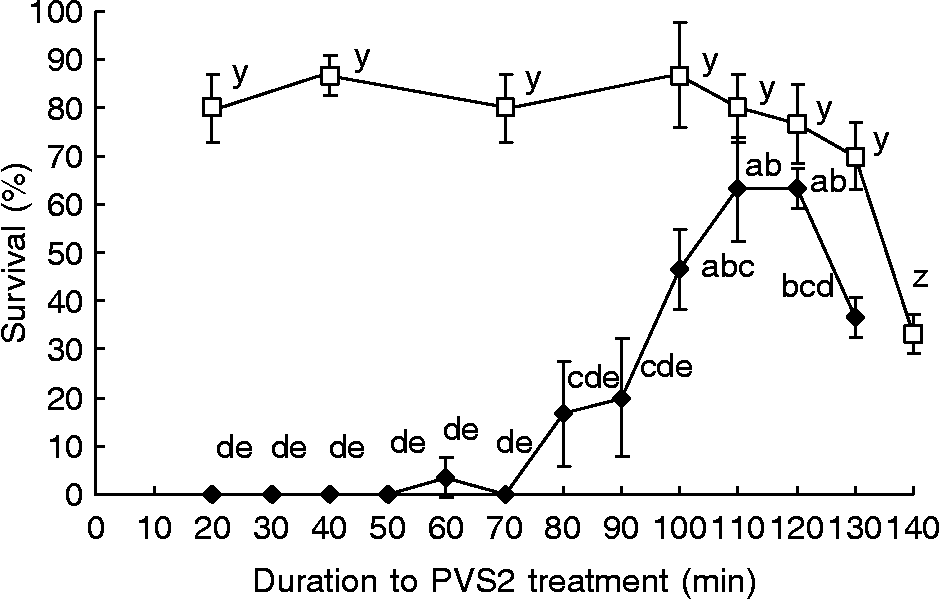
The vitrification procedure consisted of several successive steps that included cold hardening, pre-culture, osmoprotection with LS, dehydration and penetration with PVS2 and immersion into LN. The duration of exposure to PVS2 is a key factor in obtaining high survival rates of vitrified shoot tips. To determine the optimal duration of exposure to PVS2 at 25°C, the shoot tips were treated with PVS2 for different periods of time before being plunged into LN. The survival rate of the vitrified shoot tips that were plunged into LN increased gradually with the duration of exposure to PVS2 reaching a maximum (63.3%) after 120 min. However, the longer treatments (130 min) led to a decrease in the survival rates (Fig. 1).
Effect of duration of PVS2 treatment at 25°C on the survival of Leontopodium hayachinense (Takeda) Hara et Kitam. shoot tips cryopreserved with the vitrification protocol. □, Treated control (without cooling in liquid nitrogen, TC); ♦, cryopreserved (LN). Data are the means ± SE (n = 3). Different letters indicate significant differences (P < 0.05) using the Tukey–Kramer test within either the control or the cryopreserved experiment. Cold hardening, 20 d at 5°C; pre-culture, 0.3 M sucrose for 1 d at 5°C; LS treatment, 20 min at 25°C.

The surviving shoot tips resumed growth 2 d after rewarming and developed shoots without intermediary callus formation. There were no growth differences between the vitrified and the control shoot tips. Nor were morphological abnormalities observed in the plants that developed from the vitrified shoot tips (Fig. 2).
Plant regeneration from vitrified shoot tips of Leontopodium hayachinense (Takeda) Hara et Kitam. on the post-thaw medium for 5 months (upper) and scanning electron micrograph showing the structure of shoot tips (vertical section) (Lower). Upper: LN, cryopreserved; TC, treated control (without cooling in LN). Bar = 10 mm. Lower: LP, leaf primordium; M, meristem; arrow, hairs of leaves. Bar = 125 μm.

In the vitrification procedure, the duration of exposure to PVS2 is generally species specific. The optimal exposure duration of most of the herbaceous plants is 20–30 min at 25°C. However, with Hayachine-usuyukiso, the optimal exposure time was 110–120 min. Direct exposure to a highly concentrated vitrification solution for as long as 2 h usually causes damage because of hyperosmotic stress or chemical toxicity. Tanaka et al. (Reference Tanaka, Niino, Isuzugawa, Hikage and Uemura2004) reported that rapid and severe dehydration of Gentiana shoot tips by PVS2 resulted in a rapid decrease in the survival rate. Even with encapsulation–vitrification, the optimal exposure time at 25°C was 120 min because the shoot tips were embedded in alginate gel. Exposure time to PVS2 (dehydration and penetration times) might vary with the size, stage and morphological state of the shoot tips. In this experiment, we used the shoot tips that were 2 mm long and 1 mm in diameter with two to three pairs of leaf primordia. This shoot tip size is generally used for most of the herbaceous plants. Observations by SEM indicated that there were many hairs from young leaves and leaf primordia covering the shoot tips (Fig. 2). Such hairs might make it difficult to dehydrate the shoot tips with PVS2 because air bubbles around them could impede the dehydration of intracellular water from the upper side of the shoot tips. They might even prevent direct contact with PVS2 during treatment on this side. We examined the effect of removing air bubbles from the shoot tips with a vacuum pump. Results indicated that some vitrified shoot tips might survive even after 30 min exposure to PVS2 with such a degassing treatment (data not shown). However, no vitrified shoot tips could survive following 30 min exposure without a degassing treatment. This result showed that in Hayachine-usuyukiso, the existence of hairs around the shoot tips might strongly affect the optimal exposure duration to PVS2 and/or the dehydration of shoot tips by PVS2. To obtain higher survival rates, a degassing treatment might be an option in preparing the homogeneous material to be cryopreserved in a vitrification-based technique. The present study clearly demonstrates that a cryopreservation by the vitrification protocol could be successfully employed to preserve an endangered and rare germplasm.
Acknowledgements
This work has been supported by the grant-in-aid for Scientific Research (KAKENHI; No. 18710203) from the Ministry of Education, Culture, Sports, Science and Technology (MEXT) from 2006 to 2009. We are grateful for their support.